Record Number
3443
PROSEA Handbook Number
5(1): Timber trees; Major commercial timbers
Taxon
Dialium indum L.
This article should be read together with the article on the genus: Dialium in the Handbook volume indicated above in this database.
This article should be read together with the article on the genus: Dialium in the Handbook volume indicated above in this database.
Protologue
Mant. pl. (Syst. Nat. ed. 12, Vol. 2): 24 (1767).
Synonyms
Dialium laurinum Baker (1878), Dialium patens Baker (1878), Dialium angustifolium Ridley (1929), Dialium marginatum de Wit (1953), Dialium turbinatum de Wit (1953).
Vernacular Names
Indonesia: keranji (general). Malaysia: keranji kertas basar, keranji tebal besar, keranji paya (general). Thailand: yi, kayi khao (peninsular).
Distribution
Peninsular Thailand, Peninsular Malaysia, Sumatra, Java and Borneo.
Uses
The timber is used as keranji. The fruits are edible. The bark can be used for tanning.
Observations
A medium-sized to fairly large tree up to 40 m tall, bole columnar, branchless for up to 12 m and up to 100 cm in diameter; leaflets 5-9, 6-11 cm 2.5-5 cm, glabrous; sepals 5, petals 0, stamens 2; fruit globose to ovoid, 1.5-3 cm 1-2 cm. Dialium indum occurs in swamp and peat-swamp forests, on well-drained flat country and in hills up to 1150 m altitude. The density of the wood is 795-1060(-1250) kg/m3 at 15% moisture content. See also the table on wood properties.
Image
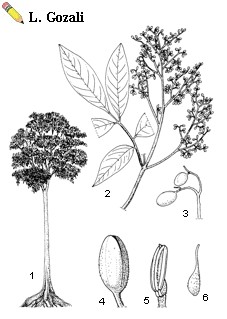 | Dialium indum L. - 1, tree habit; 2, flowering twig; 3, fruits; 4, flower bud; 5, flower with sepals removed; 6, ovary |
Selected Sources
[100]Burgess, P.F., 1966. Timbers of Sabah. Sabah Forest Records No 6. Forest Department, Sabah, Sandakan. xviii + 501 pp.
[102]Burkill, I.H., 1966. A dictionary of the economic products of the Malay Peninsula. 2nd edition. Ministry of Agriculture and Co-operatives, Kuala Lumpur. Vol. 1 (A–H) pp. 1–1240. Vol. 2 (I–Z) pp. 1241–2444.
[146]Cockburn, P.F., 1976–1980. Trees of Sabah. 2 volumes. Sabah Forest Records No 10. Forest Department Sabah, Kuching.
[153]Corner, E.J.H., 1988. Wayside trees of Malaya. 3rd edition. 2 volumes. The Malayan Nature Society, Kuala Lumpur. 774 pp.
[188]de Wit, H.C.D., 1953. Florae Malesianae precursores III. Dialium L. (Caesalpiniaceae). Blumea 7: 320–321.
[190]Desch, H.E., 1954. Manual of Malayan timbers. Malayan Forest Records No 15. 2 volumes. Malaya Publishing House Ltd., Singapore. 762 pp.
[235]Flore du Cambodge du Laos et du Viêtnam (various editors), 1960–. Muséum National d'Histoire Naturelle, Paris.
[359]Keating, W.G. & Bolza, E., 1982. Characteristics, properties and uses of timbers. Vol. 1. South-East Asia, Northern Australia and the Pacific. Inkata Press Proprietary Ltd., Melbourne, Sydney & London. 362 pp.
[401]Larsen, K., 1989. Dialium patens Bak. (Leguminosae-Caesalpinioideae) new to Thailand. Thai Forest Bulletin 18: 82–83.
[587]Rojo, J.P., 1982. Studies in the genus Dialium (Cassieae-Caesalpinioideae). Unpublished thesis. University of Oxford, Oxford. 282 pp.
[626]Smitinand, T. & Larsen, K. (Editors), 1970–. Flora of Thailand. The Forest Herbarium, Royal Forest Department, Bangkok.
[779]Whitmore, T.C. & Ng, F.S.P. (Editors), 1972–1989. Tree flora of Malaya. A manual for foresters. 4 Volumes. 2nd ed. Malayan Forest Records No 26. Longman Malaysia SDN Berhad, Kuala Lumpur.
[796]Wong, W.C., 1980. Density and pH values of exotic and indigeneous tree species grown in Peninsular Malaysia. Malaysian Forester 43: 219–231.
Author(s)
J.P. Rojo
Correct Citation of this Article
Rojo, J.P., 1993. Dialium indum L.. In: Soerianegara, I. and Lemmens, R.H.M.J. (Editors): Plant Resources of South-East Asia No 5(1): Timber trees; Major commercial timbers. PROSEA Foundation, Bogor, Indonesia. Database record: prota4u.org/prosea

All texts are licensed under a Creative Commons Attribution-Noncommercial-Share Alike 3.0 Netherlands License
This license does not include the illustrations (Maps,drawings,pictures); these remain all under copyright.