Record Number
36
PROSEA Handbook Number
6: Rattans
Taxon
Calamus manan Miquel
Protologue
J. Bot. N‚erl. 1: 23 (1861).
Family
PALMAE
Chromosome Numbers
2n = unknown
Synonyms
Calamus giganteus Becc. (1893).
Vernacular Names
Rotan manau (general throughout the region and trade). Malaysia: rotan manau telur (Peninsular).
Origin and Geographic Distribution
Calamus manan is widespread, usually confined to the steep slopes of hill dipterocarp forest, occurring in Peninsular Malaysia, Sumatra and southern Borneo.
Uses
Calamus manan is the most sought after large-diameter cane. It is the premier large furniture cane of unsurpassed quality.
Production and International Trade
Because of its premier quality, Calamus manan is collected for trading wherever it is found. No production and trade figures are available. Due to overexploitation, this species is facing depletion, and several large-diameter species that produce canes of similar appearance and lower quality are now used as substitutes.
Properties
Calamus manan is variable in size and colouration. It has a durable cane of great strength and flexibility and is used mainly as the framework of furniture.
Description
Solitary, massive, high climbing, dioecious rattan with stems eventually reaching over 100 m. Stem without leaf-sheaths to 80 mm in diameter, with sheaths to 110 mm in diameter; internodes to 40 cm long. Leaf to 8 m long including sheath; leaf-sheath dull grey-green, densely armed with black hairy edged triangular spines arranged in lateral groups or scattered; between spines thin white wax abundant; petiole short, to 12 cm long by 5 cm wide in mature plants, much longer in juveniles, armed densely as is the rachis with short triangular spines both on the upper surface and beneath, with scattered grey indumentum between; rachis to 15 cm long, bearing scattered reflexed spines on the lower surface, distally the rachis prolonged into a whip (cirrus) to 3 m long, bearing grapnel-like groups of reflexed spines; leaflets irregular in juvenile leaves, regular in mature leaves, to 45 on each side of the rachis, lanceolate, the largest to 60 cm x 6 cm, pale grey-green, bristly near the tip; knee conspicuously armed as leaf-sheath; ocrea ill-defined. Inflorescences massive, with the male much more finely branched than the female, to 2.5 m long with up to 9 partial inflorescences on each side, up to 70 cm long; all bracts rather densely armed with triangular spines to 3 mm high and red-brown indumentum. Ripe fruit rounded to ovoid, to 28 mm x 20 mm, shortly beaked, and covered with 15 vertical rows of yellowish scales with blackish-brown margins. Seed ovoid, to 18 mm x 12 mm, with finely pitted surface; endosperm densely and deeply ruminate. Seedling-leaf with 2 divergent cucullate leaflets with a waxy blue-grey bloom on a pale dull green surface.
Image
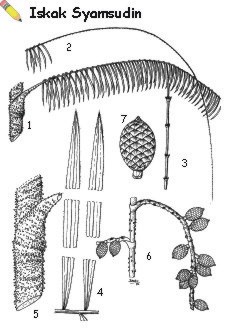 | Calamus manan Miquel - 1, basal part of leaf and sheated stem; 2, top part of leaf with cirrus; 3, part of cirrus; 4, two leaflets; 5, leaf-sheath; 6, part of infructescence; 7, fruit |
Growth and Development
Seeds germinate in 3 to 15 weeks; about 24 months after field planting, the cirri develop, after which the aerial stems may grow at rates between 1-3 m or more per year. Flowering may begin in the fifth year after planting and is annual thereafter.
Other Botanical Information
The closely related Calamus tumidus Furtado differs from Calamus manan in its smaller size, different leaf-sheath armature and the very large bulbous swollen knee.
Ecology
Calamus manan is usually confined to hill dipterocarp forest and is rarely found in lowland dipterocarp forest (mainly near steep slopes). It has an altitudinal range between 50-1000 m and is most abundant between 600-1000 m altitude. Seedlings are abundant in hill forest.
Propagation and planting
Seed stored will not tolerate temperatures below 10 °C for periods exceeding 2 months and seed moisture content needs to be about 50%; whole fresh fruits can be stored up to 2 weeks in well ventilated conditions at 22-28 °C without appreciable loss of viability. In contrast, seeds separated from the sarcotesta desiccate rapidly and lose viability in a few days. is best effected from seeds. The fruit wall and the fleshy seed-coat must be removed before sowing and the clean seeds kept moist, as any drying out will cause the embryo to die. Seeds are usually sown in seed-beds in the shade and potted in polybags when the first leaf has emerged. Once potted, seedlings should be kept in the shade and provided with plenty of moisture without waterlogging. Seedlings are usually ready for planting 9-12 months after transplanting into bags and require tree support. Seedlings require about 50% relative light intensity for establishment and growth. Rubber smallholders may plant them in between rubber planting rows. Silvicultural trials have been established in Peninsular Malaysia. On a commercial scale, it has been planted in secondary forest. The planting distance should be 6 m x 3 m.
Husbandry
Post-planting maintenance is relatively simple. Just before or after planting, the existing canopy needs to be manipulated to allow for 50% light/shade conditions for vigorous growth of the rattan seedlings. Circle-weeding of seedlings is done 3-4 times a year for up to 3 years. Planting lines need to be kept clean, to a distance of 1 m on either side, for easy access and maintenance. Fertilizer application at 6-monthly intervals in the first 3 years enhances growth.
Diseases and Pests
A few have been recorded. In the field, collar rot disease of planted seedlings is so far the only serious disease. In the nursery, leaf diseases (shot holes, brown rings and brown spots) are evident on the leaves of young growing stock. The severity varies from mild to severe and control is by spraying appropriate fungicide at 10-day intervals. Calamus leaves are reported to be attacked by Artona catoxanta (moth), Botryonopa sanguinea, Protocerius colossus and Rhabdocnemis leprosa (all beetles). Fruits have been observed to be attacked by beetles before they are ripe. Stunted growth may result from beetle larvae damaging the swollen basal part of the stem.
Harvesting
Harvesting of the stems varies slightly from place to place. Essentially, it involves dragging the rattan from the canopy, removing dead leaf-sheaths and debris and discarding the uppermost 2-3 m, which are immature and too soft for use. The leaf-sheaths and debris are usually removed by coiling and pulling the rattan stem around a conveniently placed small tree trunk, resulting in a clean stem. The cane is then cut into 3 m lengths suitable for bundling and transport out of the forest to the processor. A period of 15 years is estimated for plantation-grown Calamus manan to reach harvestable state.
Handling After Harvest
Harvested rattan is sorted into species that need treatment and those that do not. Species such as Calamus manan are usually treated to protect them against attack from staining fungi and powder-post beetle. The canes are boiled in a mixture of diesel and coconut oil, or of diesel and kerosene, or of diesel and palm oil, for varying lengths of time. After boiling the canes are rubbed with sawdust, rag-waste or gunny-sacking and then tied loosely in a bundle at one end and stood upright with the untied end on the ground in wigwam-like fashion for drying in the sun for a period of one to two (rarely three) weeks. They may also be fumigated over burning sulphur, which not only prevents attack by diseases and pests but also improves the colour of the rattan skin.
Genetic Resources
Attempts are now being made in Sabah to establish collections to represent the considerable variation found in this species in the wild. Calamus manan is represented in several botanical gardens, arboreta and silvicultural plots.
Breeding
Initial steps have been taken to collect seeds from different areas in Peninsular Malaysia. Seedlings produced have been planted in four different locations in the country. A comparative study of seedlings raised through tissue culture and those from seeds has been initiated.
Prospects
The future of this rattan species in the wild is uncertain owing to severe overexploitation. The steps taken by government agencies in Peninsular Malaysia, Sabah and Sarawak to plant Calamus manan on a plantation scale are very encouraging. This will ensure a constant supply in years to come. The feasibility of growing Calamus manan in rubber plantations is being tested and the results so far seem promising.
Literature
Aminuddin Mohamad, 1989. Effect of canopy manipulation on the growth performance of Calamus manan, a Malaysian rattan. In: Rao, A.N. & Vongkaluang, I. (Editors): Recent research on rattans. Proceedings of the International Rattan Seminar, Chiangmai, 12-14 November 1987. Faculty of Forestry, Kasetsart University, Thailand and International Development Research Centre, Canada. pp. 94-97.
Aminuddin Mohamad & Nur Supardi, M.N., 1986. Intercropping of rotan manau (Calamus manan) with rubber (Hevea brasiliensis). Pertanika 9(2): 161-165.
Dransfield, J., 1979. A manual of the rattans of the Malay Peninsula. Malayan Forest Records No 29. Forest Department, Kuala Lumpur. pp. 143-145.
Manokaran, N., 1977. Survival and growth of the economically important species (Calamus manan) in Ulu Langat, Selangor. Malaysian Forester 40(4): 192-196.
Mori, T., Zollpatah, A.R. & Tan, C.H., 1980. Germination and storage of rotan manau (Calamus manan) seeds. Malaysian Forester 43(1): 44-55.
Norani, A., Tho, Y.P. & Hong, L.T., 1985. Pests and diseases of rattans and rattan products in Peninsular Malaysia. In: Wong, K.M. & Manokaran, N. (Editors): Proceedings of the rattan seminar, Kuala Lumpur, 2-4 October 1984. Rattan Information Centre, Forest Research Institute of Malaysia, Kepong. pp. 131-135.
Silitonga, T., 1989. The effect of several cooking oil compositions on manau (C. manan) canes. In: Rao, A.N. & Vongkaluang, I. (Editors): Recent research on rattans. Proceedings of the International Rattan Seminar, Chiangmai, 12-14 November 1987. Faculty of Forestry, Kasetsart University, Thailand and International Development Research Centre, Canada. pp. 178-181.
Aminuddin Mohamad & Nur Supardi, M.N., 1986. Intercropping of rotan manau (Calamus manan) with rubber (Hevea brasiliensis). Pertanika 9(2): 161-165.
Dransfield, J., 1979. A manual of the rattans of the Malay Peninsula. Malayan Forest Records No 29. Forest Department, Kuala Lumpur. pp. 143-145.
Manokaran, N., 1977. Survival and growth of the economically important species (Calamus manan) in Ulu Langat, Selangor. Malaysian Forester 40(4): 192-196.
Mori, T., Zollpatah, A.R. & Tan, C.H., 1980. Germination and storage of rotan manau (Calamus manan) seeds. Malaysian Forester 43(1): 44-55.
Norani, A., Tho, Y.P. & Hong, L.T., 1985. Pests and diseases of rattans and rattan products in Peninsular Malaysia. In: Wong, K.M. & Manokaran, N. (Editors): Proceedings of the rattan seminar, Kuala Lumpur, 2-4 October 1984. Rattan Information Centre, Forest Research Institute of Malaysia, Kepong. pp. 131-135.
Silitonga, T., 1989. The effect of several cooking oil compositions on manau (C. manan) canes. In: Rao, A.N. & Vongkaluang, I. (Editors): Recent research on rattans. Proceedings of the International Rattan Seminar, Chiangmai, 12-14 November 1987. Faculty of Forestry, Kasetsart University, Thailand and International Development Research Centre, Canada. pp. 178-181.
Author(s)
Aminuddin bin Mohamad
Correct Citation of this Article
Aminuddin bin Mohamad, 1993. Calamus manan Miquel. In: Dransfield, J. and Manokaran, N. (Editors): Plant Resources of South-East Asia No 6: Rattans. PROSEA Foundation, Bogor, Indonesia. Database record: prota4u.org/prosea

All texts are licensed under a Creative Commons Attribution-Noncommercial-Share Alike 3.0 Netherlands License
This license does not include the illustrations (Maps,drawings,pictures); these remain all under copyright.