Record Number
371
PROSEA Handbook Number
12(1): Medicinal and poisonous plants 1
Taxon
Phytolacca acinosa Roxb.
This article should be read together with the article on the genus: Phytolacca in the Handbook volume indicated above in this database.
This article should be read together with the article on the genus: Phytolacca in the Handbook volume indicated above in this database.
Protologue
Hort. bengal.: 35 (1814).
Synonyms
Phytolacca esculenta van Houtte (1848).
Vernacular Names
Indian poke (En). Vietnam: th[uw][ow]ng l[uj]c nh[or].
Distribution
Pakistan, India, Nepal, Bhutan, China, Taiwan, Korea and Japan; introduced in Vietnam, occasionally cultivated elsewhere, e.g. in the Philippines.
Uses
The roots are used in traditional medicine in Vietnam, both internally and externally; they are commonly used in Chinese medicine. In Japan, the entire plant is used as a diuretic, while in India, it is used to alleviate body pain. Young leaves are cooked and eaten as a vegetable. Phytolacca acinosa is sometimes cultivated as an ornamental.
Observations
A perennial herb up to 2(-3) m tall, often with purplish stems; leaves elliptical to ovate, up to 35 cm x 16 cm; flowers in racemes generally shorter than leaves, bisexual, stamens 7-15 (often 10), sometimes in 2 whorls, carpels 6-9 (often 8), free in fruit. The roots of Phytolacca acinosa taste bitter-sour and pungent.
Image
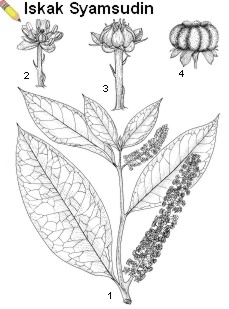 | Phytolacca acinosa Roxb. — 1, flowering and fruiting stem; 2, flower; 3, young fruit; 4, mature fruit |
Selected Sources
[190] Brown, W.H., 1951-1957. Useful plants of the Philippines. Reprint of the 1941-1943 edition. 3 volumes. Technical Bulletin 10. Department of Agriculture and Natural Resources. Bureau of Printing, Manila, the Philippines. Vol. 1 (1951) 590 pp., Vol. 2 (1954) 513 pp., Vol. 3 (1957) 507 pp.
[287] Council of Scientific and Industrial Research, 1948-1976. The wealth of India: a dictionary of Indian raw materials & industrial products. 11 volumes. Publications and Information Directorate, New Delhi, India.
[452] Funayama, S. & Hikino, H., 1979. Hypotensive principles of Phytolacca roots. Journal of Natural Products 42(6): 672-674.
[816] Larsen, K., 1989. Caryophyllales. In: Lescot, M. (Editor): Flore du Cambodge, du Laos et du Viêtnam [Flora of Cambodia, Laos and Vietnam]. Vol. 24. Muséum National d'Histoire Naturelle, Paris, France. 144 pp.
[900] Mansfeld, R., 1986. Verzeichnis landwirtschaflicher und gaertnerischer Kulturpflanzen (ohne Zierpflanzen) [Register of agricultural and horticultural plants (withouth ornamentals)]. 2nd Edition, revised by J. Schultze-Motel. 4 volumes. Springer Verlag, Berlin, Germany. 1998 pp.
[1035] Nguyen Van Duong, 1993. Medicinal plants of Vietnam, Cambodia and Laos. Mekong Printing, Santa Ana, California, United States. 528 pp.
[1057] Nowicke, J.W., 1969. Palynotaxonomic study of the Phytolaccaceae. Annals of the Missouri Botanical Garden 55(3): 294-364.
[1356] Siemonsma, J.S. & Kasem Piluek (Editors), 1993. Plant Resources of South-East Asia No 8. Vegetables. Pudoc Scientific Publishers, Wageningen, the Netherlands. 412 pp.
[1545] Wang, H.B., Zheng, Q.Y., Qian, D.H., Fang, J. & Ju, D.W., 1993. Effects of Phytolacca acinosa polysaccharides I on immune function in mice. Acta Pharmacologica Sinica 14(3): 243-246.
[1627] Yeung, H.W., Feng, Z., Li, W.W., Cheung W.K. & Ng, T.B., 1987. Abortifacient activity in leaves, roots and seeds of Phytolacca acinosa. Journal of Ethnopharmacology 21(1): 31-36.
[1631] Yi, Y.H. & Dai, F.B., 1991. A new triterpenoid and its glycoside from Phytolacca esculenta. Planta Medica 57(2): 162-164.
[1632] Yi, Y.H. & Wang, C.L., 1989. A new active saponin from Phytolacca esculenta. Planta Medica 55(6): 551-552.
[1660] Zhu, X. & Hu, Z., 1989. Preparation of the antiviral protein from pokeweed seeds and assay of its toxicity. Acta Botanica Yunnanica 11(4): 440-448.
[287] Council of Scientific and Industrial Research, 1948-1976. The wealth of India: a dictionary of Indian raw materials & industrial products. 11 volumes. Publications and Information Directorate, New Delhi, India.
[452] Funayama, S. & Hikino, H., 1979. Hypotensive principles of Phytolacca roots. Journal of Natural Products 42(6): 672-674.
[816] Larsen, K., 1989. Caryophyllales. In: Lescot, M. (Editor): Flore du Cambodge, du Laos et du Viêtnam [Flora of Cambodia, Laos and Vietnam]. Vol. 24. Muséum National d'Histoire Naturelle, Paris, France. 144 pp.
[900] Mansfeld, R., 1986. Verzeichnis landwirtschaflicher und gaertnerischer Kulturpflanzen (ohne Zierpflanzen) [Register of agricultural and horticultural plants (withouth ornamentals)]. 2nd Edition, revised by J. Schultze-Motel. 4 volumes. Springer Verlag, Berlin, Germany. 1998 pp.
[1035] Nguyen Van Duong, 1993. Medicinal plants of Vietnam, Cambodia and Laos. Mekong Printing, Santa Ana, California, United States. 528 pp.
[1057] Nowicke, J.W., 1969. Palynotaxonomic study of the Phytolaccaceae. Annals of the Missouri Botanical Garden 55(3): 294-364.
[1356] Siemonsma, J.S. & Kasem Piluek (Editors), 1993. Plant Resources of South-East Asia No 8. Vegetables. Pudoc Scientific Publishers, Wageningen, the Netherlands. 412 pp.
[1545] Wang, H.B., Zheng, Q.Y., Qian, D.H., Fang, J. & Ju, D.W., 1993. Effects of Phytolacca acinosa polysaccharides I on immune function in mice. Acta Pharmacologica Sinica 14(3): 243-246.
[1627] Yeung, H.W., Feng, Z., Li, W.W., Cheung W.K. & Ng, T.B., 1987. Abortifacient activity in leaves, roots and seeds of Phytolacca acinosa. Journal of Ethnopharmacology 21(1): 31-36.
[1631] Yi, Y.H. & Dai, F.B., 1991. A new triterpenoid and its glycoside from Phytolacca esculenta. Planta Medica 57(2): 162-164.
[1632] Yi, Y.H. & Wang, C.L., 1989. A new active saponin from Phytolacca esculenta. Planta Medica 55(6): 551-552.
[1660] Zhu, X. & Hu, Z., 1989. Preparation of the antiviral protein from pokeweed seeds and assay of its toxicity. Acta Botanica Yunnanica 11(4): 440-448.
Author(s)
Razali Yusuf
Correct Citation of this Article
Yusuf, R., 1999. Phytolacca acinosa Roxb.. In: de Padua, L.S., Bunyapraphatsara, N. and Lemmens, R.H.M.J. (Editors): Plant Resources of South-East Asia No 12(1): Medicinal and poisonous plants 1. PROSEA Foundation, Bogor, Indonesia. Database record: prota4u.org/prosea

All texts are licensed under a Creative Commons Attribution-Noncommercial-Share Alike 3.0 Netherlands License
This license does not include the illustrations (Maps,drawings,pictures); these remain all under copyright.