Record Number
4039
PROSEA Handbook Number
5(2): Timber trees; Minor commercial timbers
Taxon
Canarium vulgare Leenh.
This article should be read together with the article on the genus: Canarium in the Handbook volume indicated above in this database.
This article should be read together with the article on the genus: Canarium in the Handbook volume indicated above in this database.
Protologue
Bull. Bish. Mus. 216: 31, fig. 13 (1955).
Synonyms
Canarium commune L. (1767) p.p.
Vernacular Names
Java almond (En). Amande de Java (Fr). Indonesia: kanari (general), ki tuwak (Java), jal (Ambon). Malaysia: pokok kenari, rata kukana (Peninsular).
Distribution
The Kangean and Bawean Islands, the Lesser Sunda Islands, Sulawesi, the Moluccas and New Guinea. Possibly naturalized elsewhere in the Malesian region. Planted throughout the tropics for its fruits.
Uses
The wood is used as kedondong, also for making canoes and as firewood. Paddles have been manufactured from the buttresses. The resin is suitable for varnish and caulking boats, and is used medicinally as a balsam. The seeds are highly valued as a snack, and are sometimes used as a substitute for almonds. The oil from the seeds has been used as a substitute for coconut oil. Trees are planted for shade in nutmeg plantations, and along roadsides.
Observations
A large tree up to 45 m tall, bole often gnarled in cultivated specimens, branchless for up to 20 m, up to 70 cm in diameter, buttresses up to 3 m high, bark surface pale greyish, inner bark exuding clear or whitish resin; stipules caducous, inserted at the leaf axil, oblong; leaves with (5—)9—11 leaflets, leaflets gradually to distinctly long-acuminate at apex, margin entire, glabrous, with 12—15 pairs of secondary veins which are slightly prominent below; inflorescence terminal, broadly paniculate; male flowers 5 mm long, female ones 6—7(—12) mm long, stamens 6; fruit ovoid, circular to slightly trigonous in cross-section, 35—50 mm 15—30 mm, glabrous. Canarium vulgare occurs locally gregariously in primary forest on limestone, up to 1200 m altitude. The density of the wood is 480—680 kg/m3 at 15% moisture content.
Image
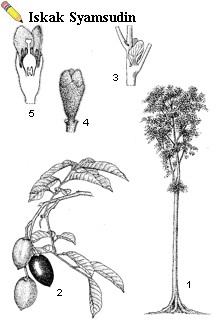 | Canarium vulgare Leenh. – 1, tree habit; 2, fruiting twig; 3, stipules; 4, flower; 5, sectioned female flower. |
Selected Sources
[63]Bosbouwproefstation, 1948. Tabellarisch overzicht van de beste kiem-, bewaar- en verzendingswijze van zaad van een aantal boomsoorten en groenbemesters [Tabular summary of the best ways to germinate, store and send seed of some tree and green manure species]. Voorlopig rapport No 38. Bosbouwproefstation, Buitenzorg. 15 pp.
[78]Burkill, I.H., 1966. A dictionary of the economic products of the Malay Peninsula. 2nd edition. Ministry of Agriculture and Co-operatives, Kuala Lumpur. Vol. 1 (A–H) pp. 1–1240. Vol. 2 (I–Z) pp. 1241–2444.
[162]Flora Malesiana (various editors), 1950–. Kluwer Academic Publishers, Dordrecht, Boston, London.
[218]Hardjowasono, M.S., 1942. Gewicht en volume van verschillende vrucht- en zaadsoorten [Weight and volume of fruits and seeds]. Korte mededelingen No 20. Bosbouwproefstation, Buitenzorg. 172 pp.
[234]Heyne, K., 1927. De nuttige planten van Nederlands-Indid [The useful plants of the Dutch East Indies]. 2nd edition, 3 volumes. Departement van Landbouw, Nijverheid en Handel in Nederlandsch-Indid, 's-Gravenhage. 1953 pp.
[330]Kraemer, J.H., 1951. Trees of the western Pacific region. Tri-State Offset Company, Cincinnatti. 436 pp.
[342]Lam, H.J., 1932. The Burseraceae of the Malay Archipelago and Peninsula, with annotations concerning extra-Malayan species, especially of Dacryodes, Santiria and Canarium. Contributions a l'Ttude de la flore des Indes NTerlandaises XXII. Bulletin du Jardin Botanique de Buitenzorg, STrie III, 12: 281–561.
[366]Leenhouts, P.W., 1959. Revision of the Burseraceae of the Malaysian area in a wider sense Xa. Canarium Stickm. Blumea 9: 275–647.
Author(s)
K.M. Kochummen
Correct Citation of this Article
Kochummen, K.M., 1995. Canarium vulgare Leenh.. In: Lemmens, R.H.M.J., Soerianegara, I. and Wong, W.C. (Editors): Plant Resources of South-East Asia No 5(2): Timber trees; Minor commercial timbers. PROSEA Foundation, Bogor, Indonesia. Database record: prota4u.org/prosea

All texts are licensed under a Creative Commons Attribution-Noncommercial-Share Alike 3.0 Netherlands License
This license does not include the illustrations (Maps,drawings,pictures); these remain all under copyright.