Record Number
4065
PROSEA Handbook Number
5(2): Timber trees; Minor commercial timbers
Taxon
Chukrasia A.H.L. Juss.
Protologue
Mirb. & Cass. apud Guill., Bull. Sci. Nat. Géol. 23: 239 (1830).
Family
MELIACEAE
Chromosome Numbers
x = unknown; Chukrasia tabularis: n = 13, 2n = 26
Trade Groups
Trade groups Surian batu: medium-heavy hardwood, a single species, Chukrasia tabularis A.H.L. Juss. in Mirb. & Cass. apud Guill., Bull. Sci. Nat. Géol. 23: 239 (1830), synonyms: Chickrassia tabularis (A.H.L. Juss.) A.H.L. Juss. (1832), Chukrasia velutina (Wallich) Roemer (1846).
Vernacular Names
Surian batu: chickrassy, chittagong wood, Burma almondwood (En). Malaysia: cherana puteh, repoh, suntang puteh. Burma (Myanmar): yinma, tawyinma, kinthatputgyi. Cambodia: voryong. Laos: nhom, nhom hin, nhom khao. Thailand: siat-ka (south-eastern), yom-hin (general), fakdap (Chanthaburi). Vietnam: l[as]t hoa.
Origin and Geographic Distribution
Chukrasia consists of one or possibly two species and is distributed from Pakistan eastward through India, Sri Lanka, Bangladesh, Indo-China, southern China and Thailand towards Peninsular Malaysia, northern and eastern Sumatra, and Borneo. Major stands of Chukrasia tabularis are found in India (e.g. western Ghats, Assam), Bangladesh, western Thailand and northern Peninsular Malaysia. Chukrasia tabularis has been planted in many countries outside South-East Asia, e.g. in Nigeria, Cameroon, South Africa, Hawaii, Puerto Rico and Costa Rica.
Uses
The timber is highly prized for high grade cabinet work, decorative panelling, interior joinery such as doors, windows and light flooring, and for carving, toys and turnery. Besides, it is used for railway sleepers, ship and boat building, furniture, musical instruments (including pianos), packing cases, sporting goods, lorry bodies, mallet heads, anvil blocks, brush wares, drawing equipment, rifle butts, veneer and pulp. In India the timber is also used for light to medium-heavy construction work, e.g. for posts, beams, scantlings and planks.
An extract of the bark has powerful astringent properties and has been used as a febrifuge. The bark also produces a gum, but this is apparently not used. The flowers yield a red or yellow dye.
An extract of the bark has powerful astringent properties and has been used as a febrifuge. The bark also produces a gum, but this is apparently not used. The flowers yield a red or yellow dye.
Production and International Trade
Surian batu is traded in small amounts and often together with timbers from other Meliaceae genera such as Spanish cedar (Cedrela) and surian (Toona). The total export of this combined group from Sabah in 1992 was only 92 m3 with a value of US$ 33 000. In Peninsular Malaysia surian batu may be marketed under mixed hardwood with a variety of other timbers.
Surian batu has at least some economic value in Vietnam, Bangladesh and Sri Lanka, but no production and trade figures are available. In Thailand a production of 3160 m3 was reported in 1966, increasing to 9800 m3 in 1989, whereas a production of less than 350 m3/year is reported for India.
Surian batu has at least some economic value in Vietnam, Bangladesh and Sri Lanka, but no production and trade figures are available. In Thailand a production of 3160 m3 was reported in 1966, increasing to 9800 m3 in 1989, whereas a production of less than 350 m3/year is reported for India.
Properties
Surian batu is a moderately heavy and moderately hard wood. The heartwood is pale reddish-brown, yellowish-red to red, darkening to dark yellowish-brown, reddish-brown to medium dark brown on exposure, sharply differentiated from the yellowish-white, pale yellowish-brown, pinkish-brown or greyish-brown sapwood; dark streaks may be rather prominent. The density is 625—880 kg/m3 at 15% moisture content. The grain is interlocked and sometimes wavy, producing a roe figure, texture moderately fine but uneven. Freshly cut wood has a fragrant odour, but dried wood has no characteristic odour or taste. Planed surfaces have a high lustrous satiny sheen.
At 15% moisture content, the modulus of rupture is 82—101 N/mm2, modulus of elasticity 10 800—14 300 N/mm2, compression parallel to grain 47—64 N/mm2, compression perpendicular to grain 11—12 N/mm2, shear 15—18 N/mm2, cleavage c. 60 N/mm radial and 71 N/mm tangential and Janka side hardness 8990—9230 N. See also the table on wood properties.
The rates of shrinkage are rather low: from green to 15% moisture content c. 1.3% radial and 1.7% tangential, from green to oven dry 3.9% radial and 6.0% tangential. Usually the wood dries fairly rapidly without degrade, but a slight tendency to check and warp and some liability to collapse have been reported. Fine hair surface checks may develop when drying thick boards. In Malaysia kiln schedule E is recommended.
Tests in Malaysia showed that the wood is difficult to very difficult to saw and cross cut, slightly difficult to turn, very difficult to bore, but easy to plane. It produces a moderately smooth finish, but some picking up of grain may occur on quarter-sawn material during planing and moulding. However, tests in other areas showed that the wood can be easily sawn and machined. Surian batu has good nailing and screw-holding properties, it can be stained effectively and polished excellently. The steam bending properties are rated as good. It can be readily peeled and sliced into veneers and the veneers can be glued satisfactorily to produce decorative plywood.
In Malaysia surian batu is considered as moderately durable under exposed conditions, but elsewhere it is sometimes classified as non-durable. The resistance to termite attack varies from good to poor. The wood is moderately resistant to extremely resistant to preservative treatment.
Young leaves and bark have a high tannin content, and the bark yields a reddish gum.
At 15% moisture content, the modulus of rupture is 82—101 N/mm2, modulus of elasticity 10 800—14 300 N/mm2, compression parallel to grain 47—64 N/mm2, compression perpendicular to grain 11—12 N/mm2, shear 15—18 N/mm2, cleavage c. 60 N/mm radial and 71 N/mm tangential and Janka side hardness 8990—9230 N. See also the table on wood properties.
The rates of shrinkage are rather low: from green to 15% moisture content c. 1.3% radial and 1.7% tangential, from green to oven dry 3.9% radial and 6.0% tangential. Usually the wood dries fairly rapidly without degrade, but a slight tendency to check and warp and some liability to collapse have been reported. Fine hair surface checks may develop when drying thick boards. In Malaysia kiln schedule E is recommended.
Tests in Malaysia showed that the wood is difficult to very difficult to saw and cross cut, slightly difficult to turn, very difficult to bore, but easy to plane. It produces a moderately smooth finish, but some picking up of grain may occur on quarter-sawn material during planing and moulding. However, tests in other areas showed that the wood can be easily sawn and machined. Surian batu has good nailing and screw-holding properties, it can be stained effectively and polished excellently. The steam bending properties are rated as good. It can be readily peeled and sliced into veneers and the veneers can be glued satisfactorily to produce decorative plywood.
In Malaysia surian batu is considered as moderately durable under exposed conditions, but elsewhere it is sometimes classified as non-durable. The resistance to termite attack varies from good to poor. The wood is moderately resistant to extremely resistant to preservative treatment.
Young leaves and bark have a high tannin content, and the bark yields a reddish gum.
Description
Deciduous, monoecious, medium-sized, sometimes fairly large trees up to 30(—40) m tall; bole branchless for up to 18(—32) m, with a diameter of up to 110(—175) cm, without buttresses; bark surface rusty brown or deep brown, deeply fissured or cracked, with lenticels, inner bark reddish. Leaves paripinnate, with alternate, entire, asymmetrical and acuminate leaflets (imparipinnate and lobed or incised when juvenile), glabrous or with simple hairs. Flowers unisexual, in axillary (sometimes appearingly terminal) thyrses, 4- or 5-merous, up to 16 mm long; calyx lobed; petals free, contorted, reflexed in open flowers, white; staminal tube cylindrical, narrowing towards the apex, entire or weakly lobed, with the anthers attached to the margin; disk small; ovary flask-shaped, 3—5-locular, each locule with many ovules, style slender. Fruit an erect, woody, ovoid or ellipsoid capsule opening by 3—5 valves from the apex; valves separating into a woody outer and inner layer, apex of those of the inner layer deeply bifid; locules appearing as 1 locule due to the breaking down of the septae; columella with sharp ridges. Seeds 60—100 per locule, flat, with terminal wings, arranged in layers, alternately "head-to-toe""; embryo with thin cotyledons. Seedling with epigeal germination; cotyledons leafy; first 2 leaves opposite, subsequent ones arranged spirally; terminal leaflet present in seedling leaves but abortive in mature plants.
Image
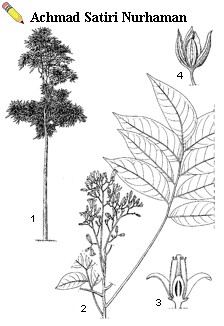 | Chukrasia tabularis A.H.L. Juss. – 1, tree habit; 2, flowering twig; 3, sectioned flower; 4, dehisced fruit. |
Wood Anatomy
— Macroscopic characters:
Heartwood medium dark brown, occasionally with pink tinge, sapwood pale or greyish-brown, usually lustrous. Grain weakly to strongly interlocked. Texture moderately fine. Growth rings distinct or indistinct; vessels small, barely visible to the naked eye, often occluded by black deposits, tyloses indistinct; parenchyma in very fine marginal tangential bands; rays almost invisible to the naked eye; ripple marks absent; axial intercellular canals smaller than vessels, in tangential bands.
— Microscopic characters:
Growth rings present, defined by pore size and marginal parenchyma bands. Vessels diffuse, 13—16/mm2, solitary (15—30%) or in multiples of 2—5, uniformly distributed, generally oval, average tangential and radial diameter c. 90 µm and 95—105 µm respectively, maximum tangential and radial diameter 145—160 µm and 205—255 µm respectively, walls 3—8 µm thick; perforation plates simple; intervessel pits alternate, dense, with a pit border diameter of 3—4 µm; vessel-ray pits alternate to opposite, half-bordered, dense, with a pit border diameter of 3 µm; brown deposits present; tyloses absent. Fibres 0.8—1.5 mm long, non-septate, tangential diameter c. 25 µm, thin-walled (c. 2.5 µm), with sparse minutely bordered pits mainly in the radial walls. Axial parenchyma paratracheal, vasicentric; apotracheal parenchyma diffuse and marginal, strand length 7—11 cells or more. Rays mostly (more than 70%) multiseriate, 2—4 cells wide, up to 0.5 mm high, heterocellular with 1—2 rows of square to upright marginal cells, uniseriate rays few, short, mostly less than 0.2 mm high. Horizontal intercellular canals absent; axial gum canals of the traumatic type occasionally in tangential series, 40—130 µm in tangential diameter. Silica bodies absent.
Heartwood medium dark brown, occasionally with pink tinge, sapwood pale or greyish-brown, usually lustrous. Grain weakly to strongly interlocked. Texture moderately fine. Growth rings distinct or indistinct; vessels small, barely visible to the naked eye, often occluded by black deposits, tyloses indistinct; parenchyma in very fine marginal tangential bands; rays almost invisible to the naked eye; ripple marks absent; axial intercellular canals smaller than vessels, in tangential bands.
— Microscopic characters:
Growth rings present, defined by pore size and marginal parenchyma bands. Vessels diffuse, 13—16/mm2, solitary (15—30%) or in multiples of 2—5, uniformly distributed, generally oval, average tangential and radial diameter c. 90 µm and 95—105 µm respectively, maximum tangential and radial diameter 145—160 µm and 205—255 µm respectively, walls 3—8 µm thick; perforation plates simple; intervessel pits alternate, dense, with a pit border diameter of 3—4 µm; vessel-ray pits alternate to opposite, half-bordered, dense, with a pit border diameter of 3 µm; brown deposits present; tyloses absent. Fibres 0.8—1.5 mm long, non-septate, tangential diameter c. 25 µm, thin-walled (c. 2.5 µm), with sparse minutely bordered pits mainly in the radial walls. Axial parenchyma paratracheal, vasicentric; apotracheal parenchyma diffuse and marginal, strand length 7—11 cells or more. Rays mostly (more than 70%) multiseriate, 2—4 cells wide, up to 0.5 mm high, heterocellular with 1—2 rows of square to upright marginal cells, uniseriate rays few, short, mostly less than 0.2 mm high. Horizontal intercellular canals absent; axial gum canals of the traumatic type occasionally in tangential series, 40—130 µm in tangential diameter. Silica bodies absent.
Growth and Development
In India, growth of seedlings proved moderately fast in the first 2 years. After 2 years the plants had reached a height of 1.2—2.1 m, after 3 years 2.8—3.4 m with a diameter of 4—5 cm and after 6 years 5.5 m tall and a diameter of 15 cm, indicating a mean annual diameter increment of 2.5 cm. Another source from India records a height of 6.6 m and a diameter of 5.2 cm for 5-year-old plants. A planting trial in western Java, using seeds from Sumatra, showed a mean height of 13 m and a mean diameter of 18 cm 10 years after planting. In the arboretum of the Forest Research Institute Malaysia the largest tree, aged 33 years, had attained a height of 33 m, a clear bole of 16 m and a diameter of 58 cm; trees may reach a diameter of 66 cm after 40 years. The tree also grows well in plantations on exposed sites: over 1 cm diameter increment annually.
Chukrasia tabularis flowers and fruits annually, seeds are ripe in January—March. The winged fruits are disseminated by wind.
Chukrasia tabularis flowers and fruits annually, seeds are ripe in January—March. The winged fruits are disseminated by wind.
Other Botanical Information
Chukrasia is a very distinctive genus among the genera of the tribe Swietenieae of the subfamily Swietenioideae. It is characterized by the large flowers, the more or less entire staminal tube, and the arrangement and number of the seeds.
Some authors regard Chukrasia velutina from Thailand as a species distinct from Chukrasia tabularis (being a smaller tree and more hairy, and having harder wood), whereas others treat it as a mere form of the latter.
Some authors regard Chukrasia velutina from Thailand as a species distinct from Chukrasia tabularis (being a smaller tree and more hairy, and having harder wood), whereas others treat it as a mere form of the latter.
Ecology
Surian batu is usually found scattered in lowland evergreen dipterocarp rain forest, moist semi-evergreen forest or deciduous forest at 300—800 m altitude. In Peninsular Malaysia it occasionally occurs as a colonist of bare land, including road cuttings. In Sarawak it is notably found on limestone. Surian batu usually avoids heavy and wet soils. In its natural habitat the annual rainfall is 1800—3800 mm and even more; the average maximum temperature is 36—40.5°C and the average minimum temperature is 2.5—15.5°C.
Propagation and planting
There are about 100 000 seeds per kg. Seeds retain their viability for a relatively short period, about 3 months. They can be separated by threshing sun-dried woody capsules. Seeds require no pretreatment and are sown with overhead shade in light porous soil. Best results have been obtained by raising seedlings in well-drained boxes and pots before transplanting. Germination is fair to easy: in tests in Malaysia 35% of the seeds sown germinated in 1—2.5 weeks, in India 80—90% in 1—4 weeks. Watering of seedlings should be sparse. Seedlings are pricked out and transplanted when about one month old and 6—8 cm high. Chukrasia tabularis should not be planted on sites with heavy soil or excessive moisture. In Hawaii the presence of an impenetrable soil layer at 30—60 cm seemed to cause failure of a trial plantation of this species.
Silviculture and Management
Natural regeneration of Chukrasia tabularis in the evergreen forests of India is adequate, but it is sparse in the semi-evergreen forests. It is regarded as a pioneer species, and common in former shifting cultivation areas. Young trees coppice well.
Diseases and Pests
Like most species of the subfamily Swietenioideae, Chukrasia tabularis is attacked by the shoot borer Hypsipyla robusta. It is also attacked by Hypsipyla spp. in plantations in Africa and Central and South America.
Genetic Resources
In India a germplasm bank and a seed orchard have been established after selection of superior trees.
Prospects
Surian batu timber is of high quality for various uses. It is thus a plantation species with good potential. In Peninsular Malaysia it is rated as having high plantation potential on exposed sites with frequent water stress. Research should focus on silviculture and propagation.
Literature
Chudnoff, M., 1980. Tropical timbers of the world. Forest Products Laboratory, United States Department of Agriculture, Forest Service. pp. 591-592.
Dahms, K.-G., 1982. Asiatische, ozeanische und australische Exporthölzer [Asiatic, Pacific and Australian export timbers]. DRW-Verlag, Stuttgart. pp. 88-90.
Desch, H.E., 1954. Manual of Malayan timbers. Malayan Forest Records No 15. Vol. 2. Malaya Publishing House, Singapore. pp. 341-343.
Keating, W.G. & Bolza, E., 1982. Characteristics, properties and uses of timbers. Vol. 1: South-east Asia, Northern Australia and the Pacific. Division of Chemical Technology, Commonwealth Scientific and Industrial Research Organization. Inkata Press, Melbourne, Sydney and London. p. 87.
Lee, Y.H., Engku Abdul Rahman & Chu, Y.P., 1979. The strength properties of some Malaysian timbers. Malaysian Forest Service Trade Leaflet No 34. Revised edition. Malaysian Timber Industry Board, Kuala Lumpur. 107 pp.
Mabberley, D.J. & Pannell, C.M., 1989. Meliaceae. In: Ng, F.S.P. (Editor): Tree flora of Malaya. A manual for foresters. Vol. 4. Forest Research Institute Malaysia. Longman Malaysia SDN. Berhad, Petaling Jaya. pp. 254-256.
Rai, S.N., 1985. Notes on nursery and regeneration technique of some species occurring in southern tropical wet evergreen and semi-evergreen forests of Karnataka (India), part II. Indian Forester 111(8): 645-657.
Research Institute of Wood Industry, 1988. Identification, properties and uses of some Southeast Asian woods. Chinese Academy of Forestry & International Tropical Timber Organization. p. 123.
Styles, B.T. & Khosla, P.K., 1976. Cytology and reproductive biology of Meliaceae. In: Burley, J. & Styles, B.T. (Editors): Tropical trees. Variation, breeding and conservation. Linnean Society Symposium Series No 2. Academic Press, London. pp. 61-67.
Troup, R.S., 1921. The silviculture of Indian trees. Vol. 1: Dilleniaceae to Leguminosae (Papilionaceae). Clarendon Press, Oxford. pp. 191-194.
Dahms, K.-G., 1982. Asiatische, ozeanische und australische Exporthölzer [Asiatic, Pacific and Australian export timbers]. DRW-Verlag, Stuttgart. pp. 88-90.
Desch, H.E., 1954. Manual of Malayan timbers. Malayan Forest Records No 15. Vol. 2. Malaya Publishing House, Singapore. pp. 341-343.
Keating, W.G. & Bolza, E., 1982. Characteristics, properties and uses of timbers. Vol. 1: South-east Asia, Northern Australia and the Pacific. Division of Chemical Technology, Commonwealth Scientific and Industrial Research Organization. Inkata Press, Melbourne, Sydney and London. p. 87.
Lee, Y.H., Engku Abdul Rahman & Chu, Y.P., 1979. The strength properties of some Malaysian timbers. Malaysian Forest Service Trade Leaflet No 34. Revised edition. Malaysian Timber Industry Board, Kuala Lumpur. 107 pp.
Mabberley, D.J. & Pannell, C.M., 1989. Meliaceae. In: Ng, F.S.P. (Editor): Tree flora of Malaya. A manual for foresters. Vol. 4. Forest Research Institute Malaysia. Longman Malaysia SDN. Berhad, Petaling Jaya. pp. 254-256.
Rai, S.N., 1985. Notes on nursery and regeneration technique of some species occurring in southern tropical wet evergreen and semi-evergreen forests of Karnataka (India), part II. Indian Forester 111(8): 645-657.
Research Institute of Wood Industry, 1988. Identification, properties and uses of some Southeast Asian woods. Chinese Academy of Forestry & International Tropical Timber Organization. p. 123.
Styles, B.T. & Khosla, P.K., 1976. Cytology and reproductive biology of Meliaceae. In: Burley, J. & Styles, B.T. (Editors): Tropical trees. Variation, breeding and conservation. Linnean Society Symposium Series No 2. Academic Press, London. pp. 61-67.
Troup, R.S., 1921. The silviculture of Indian trees. Vol. 1: Dilleniaceae to Leguminosae (Papilionaceae). Clarendon Press, Oxford. pp. 191-194.
Other Selected Sources
[22]Anonymous, 1974. Country report Thailand. Testing methods for basic properties of wood and the classification of timbers in Thailand. In: ASEAN Technical meeting on forestry, Kuala Lumpur, 1–4 July 1974. ASEAN/74/PCFA/KL/Tech. MF1/Rpt.1, ASEAN Secretariat, Wisma Putra, Kuala Lumpur.
[24]Appanah, S. & Weinland, G., 1993. Planting quality timber trees in Peninsular Malaysia – a review. Malayan Forest Record No 38. Forest Research Institute Malaysia, Kepong. 221 pp.
[53]Beniwal, B.S. & Singh, N.B., 1990. Genetic improvement of forest trees in Arunachal Pradesh, India. Indian Forester 116(1): 3–10.
[78]Burkill, I.H., 1966. A dictionary of the economic products of the Malay Peninsula. 2nd edition. Ministry of Agriculture and Co-operatives, Kuala Lumpur. Vol. 1 (A–H) pp. 1–1240. Vol. 2 (I–Z) pp. 1241–2444.
[157]Farmer, R.H., 1956. A handbook of hardwoods. Her Majesty's Stationary Office, London. 269 pp.
[185]Gamble, J.S., 1922. A manual of Indian timbers. 2nd edition. Sampsom Low, Marston & Company, London. 868 pp.
[250]Indian Standard Institution, 1963. Indian standard classification of commercial timber and their zonal distribution. (Revised) IS: 399-1963. Indian Standard Institution, New Delhi.
[339]Lahiri, A.K., 1987. A note on prospects of Tectona grandis and Xylia dolabriformis mixture in North Bengal. Indian Journal of Forestry 10(3): 232–233.
[365]Lee, Y.H. & Lopez, D.T., 1980. The machining properties of some Malaysian timbers. Malaysian Forest Service Trade Leaflet No 35 (revised edition). Malaysian Timber Industry Board, Kuala Lumpur. 31 pp.
[371]Letourneux, C., 1957. Tree planting practices in tropical Asia. FAO Forestry Development Paper No 11. FAO, Rome. 172 pp.
[391]Mabberley, D.J., 1982. William Roxburgh's 'Botanical description of a new species of Swietenia (mahogany)' and other overlooked binomials in 36 vascular plant families. Taxon 31: 65–73.
[463]Ng, F.S.P., 1991. Manual of forest fruits, seeds and seedlings. Vol. 1. Malayan Forest Record No 34. Forest Research Institute Malaysia, Kepong. 400 pp.
[465]Ng, F.S.P. & Mat Asri Ngah Sanah, 1991. Germination and seedling records. Research Pamphlet No 108. Forest Research Institute Malaysia, Kepong. 191 pp.
[466]Ng, F.S.P. & Tang, H.T., 1974. Comparative growth rates of Malaysian trees. Malaysian Forester 37(1): 2–23.
[487]Pearson, R.S. & Brown, H.P., 1932. Commercial timbers of India. Their distribution, supplies, anatomical structure, physical and mechanical properties and uses. 2 Volumes. Government of India, Central Publication Branch, Calcutta. x + 1150 pp.
[492]Pennington, T.D. & Styles, B.T., 1975. A generic monograph of the Meliaceae. Blumea 22: 419–540.
[574]Smitinand, T., 1980. Thai plant names. Royal Forest Department, Bangkok. 379 pp.
[676]Vidal, J., 1962. Noms vernaculaires de plantes en usage au Laos [Vernacular names of plants used in Laos]. Ecole frantaise d'extreme-Orient, Paris. 197 pp.
[678]Von dem Bussche, G.H., 1982. The establishment of hardwood plantations for the production of furniture and joinery timber in the Transvaal. Part I: planning and process. South African Forestry Journal 121: 11–16
[697]Whitesell, C.G. & Walters, G.A., 1976. Species adaptability trials for man-made forests in Hawaii. USDA Forest Service Research Paper PSW- 118. Pacific Southwest Forest and Range Experiment Station, Berkeley. 30 pp.
[746]Zentsch, W. & Kaul, M.L.H., 1968. Viability and germination behavior of Indian forest tree seeds. Beiträge zur Tropischen und Subtropischen Landwirtschaft und Tropenveterinärmedizin 6(3): 213–219.
[24]Appanah, S. & Weinland, G., 1993. Planting quality timber trees in Peninsular Malaysia – a review. Malayan Forest Record No 38. Forest Research Institute Malaysia, Kepong. 221 pp.
[53]Beniwal, B.S. & Singh, N.B., 1990. Genetic improvement of forest trees in Arunachal Pradesh, India. Indian Forester 116(1): 3–10.
[78]Burkill, I.H., 1966. A dictionary of the economic products of the Malay Peninsula. 2nd edition. Ministry of Agriculture and Co-operatives, Kuala Lumpur. Vol. 1 (A–H) pp. 1–1240. Vol. 2 (I–Z) pp. 1241–2444.
[157]Farmer, R.H., 1956. A handbook of hardwoods. Her Majesty's Stationary Office, London. 269 pp.
[185]Gamble, J.S., 1922. A manual of Indian timbers. 2nd edition. Sampsom Low, Marston & Company, London. 868 pp.
[250]Indian Standard Institution, 1963. Indian standard classification of commercial timber and their zonal distribution. (Revised) IS: 399-1963. Indian Standard Institution, New Delhi.
[339]Lahiri, A.K., 1987. A note on prospects of Tectona grandis and Xylia dolabriformis mixture in North Bengal. Indian Journal of Forestry 10(3): 232–233.
[365]Lee, Y.H. & Lopez, D.T., 1980. The machining properties of some Malaysian timbers. Malaysian Forest Service Trade Leaflet No 35 (revised edition). Malaysian Timber Industry Board, Kuala Lumpur. 31 pp.
[371]Letourneux, C., 1957. Tree planting practices in tropical Asia. FAO Forestry Development Paper No 11. FAO, Rome. 172 pp.
[391]Mabberley, D.J., 1982. William Roxburgh's 'Botanical description of a new species of Swietenia (mahogany)' and other overlooked binomials in 36 vascular plant families. Taxon 31: 65–73.
[463]Ng, F.S.P., 1991. Manual of forest fruits, seeds and seedlings. Vol. 1. Malayan Forest Record No 34. Forest Research Institute Malaysia, Kepong. 400 pp.
[465]Ng, F.S.P. & Mat Asri Ngah Sanah, 1991. Germination and seedling records. Research Pamphlet No 108. Forest Research Institute Malaysia, Kepong. 191 pp.
[466]Ng, F.S.P. & Tang, H.T., 1974. Comparative growth rates of Malaysian trees. Malaysian Forester 37(1): 2–23.
[487]Pearson, R.S. & Brown, H.P., 1932. Commercial timbers of India. Their distribution, supplies, anatomical structure, physical and mechanical properties and uses. 2 Volumes. Government of India, Central Publication Branch, Calcutta. x + 1150 pp.
[492]Pennington, T.D. & Styles, B.T., 1975. A generic monograph of the Meliaceae. Blumea 22: 419–540.
[574]Smitinand, T., 1980. Thai plant names. Royal Forest Department, Bangkok. 379 pp.
[676]Vidal, J., 1962. Noms vernaculaires de plantes en usage au Laos [Vernacular names of plants used in Laos]. Ecole frantaise d'extreme-Orient, Paris. 197 pp.
[678]Von dem Bussche, G.H., 1982. The establishment of hardwood plantations for the production of furniture and joinery timber in the Transvaal. Part I: planning and process. South African Forestry Journal 121: 11–16
[697]Whitesell, C.G. & Walters, G.A., 1976. Species adaptability trials for man-made forests in Hawaii. USDA Forest Service Research Paper PSW- 118. Pacific Southwest Forest and Range Experiment Station, Berkeley. 30 pp.
[746]Zentsch, W. & Kaul, M.L.H., 1968. Viability and germination behavior of Indian forest tree seeds. Beiträge zur Tropischen und Subtropischen Landwirtschaft und Tropenveterinärmedizin 6(3): 213–219.
Author(s)
K.S. Ho (general part, properties), S. Noshiro (wood anatomy)
Correct Citation of this Article
Ho, K.S. & Noshiro, S., 1995. Chukrasia A.H.L. Juss.. In: Lemmens, R.H.M.J., Soerianegara, I. and Wong, W.C. (Editors): Plant Resources of South-East Asia No 5(2): Timber trees; Minor commercial timbers. PROSEA Foundation, Bogor, Indonesia. Database record: prota4u.org/prosea

All texts are licensed under a Creative Commons Attribution-Noncommercial-Share Alike 3.0 Netherlands License
This license does not include the illustrations (Maps,drawings,pictures); these remain all under copyright.