Record Number
4119
PROSEA Handbook Number
5(2): Timber trees; Minor commercial timbers
Taxon
Dacrycarpus imbricatus (Blume) de Laubenf.
This article should be read together with the article on the genus: Dacrycarpus in the Handbook volume indicated above in this database.
This article should be read together with the article on the genus: Dacrycarpus in the Handbook volume indicated above in this database.
Protologue
Journ. Arn. Arb. 50: 320 (1969).
Synonyms
Podocarpus imbricatus Blume (1827), Podocarpus cupressina R.Br. ex Mirbel (1925), Podocarpus javanicus auct. non (Burm.f.) Merr.
Vernacular Names
Indonesia: jamuju (general), kayu embun (Sumatra, Sulawesi), cemba-cemba (Sulawesi). Philippines: igem. Burma (Myanmar): sha-mo-pin. Malaysia: podo chucher atap (Peninsular). Laos: hing2 'khièo, pêk dêng, lông leng. Thailand: phaya-makhampom dong (eastern), phayamai, sarun (south-eastern). Vietnam: thong nang.
Distribution
From southern China, Indo-China, Burma (Myanmar) and Thailand throughout the Malesian archipelago towards Vanuatu and Fiji.
Uses
Dacrycarpus imbricatus is the most important source of podocarp timber; the wood is used especially in the Philippines, e.g. for utensils, masts, tea chests and carving. In Thailand, it is used for furniture and cabinet work.
Observations
A large, majestic tree up to 50 m tall, bole up to 200 cm in diameter; adult leaves imbricate or spreading, straight, scale-like, keeled on 1 to 4 sides, 1.0—1.8 mm 0.4—1.0 mm, involucral leaves spreading and exposing the receptacle already when this is immature, 2.5—5.0 mm long; receptacle red when ripe; seed about 6 mm long. Dacrycarpus imbricatus is divided into 4 varieties: var. imbricatus, var. patulus de Laubenf. (synonyms: Podocarpus kawaii Hayata, Dacrycarpus kawaii (Hayata) Gaussen), var. robustus de Laubenf. (synonyms Podocarpus papuanus Ridley, Dacrycarpus papuanus (Ridley) Gaussen) and var. curvulus (Miq.) de Laubenf. (synonyms: Podocarpus cupressina R.Br ex Mirbel var. curvula Miq., Podocarpus imbricatus Blume var. curvula (Miq.) Wasscher). They are distinguished on the basis of the leaves being slender or robust and imbricate or spreading. Dacrycarpus imbricatus occurs scattered but is locally common and sometimes co-dominant or dominant as a canopy or emergent tree in primary forest at (0—)700—2500(—3400) m altitude. The density of the wood is 380—770 kg/m3 at 15% moisture content. See also the table on wood properties.
Image
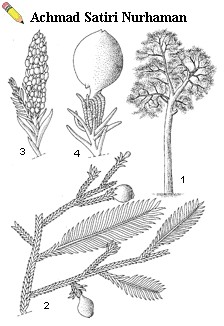 | Dacrycarpus imbricatus (Blume) de Laubenf. – 1, tree habit; 2, twig with seed cones; 3, pollen cone; 4, seed cone. |
Selected Sources
[21]Anonymous, 1937. Groei in een gemengde gebergtecultuur [Growth in a mixed mountain plantation]. Tectona 30: 329–330.
[41]Bakhoven, A.C., 1930. Vul-, drijf- en dekkingshout in wildhoutbergculturen, dan wel, de in bergwildhoutculturen in te brengen houtsoorten voor blijvend onderbestand en ondergroei [Auxiliary, nursing and soil-covering tree species in the montane non-teak plantations and tree species to mix in the montane non-teak plantations to form a permanent understorey tree layer and undergrowth]. Tectona 23: 558–569.
[46]Barly & Permadi, P., 1988. Pengawetan lima jenis kayu menurut metode rendaman panas-dingin [Preservation of five timber species using the hot and cold water process]. Jurnal Penelitian Hasil Hutan 5: 265–268.
[55]Bloemen, J., 1950. Het naaldhout in de Maleise Archipel [The coniferous species of the Malayan Archipelago]. Agricultural University Wageningen. 45 pp.
[61]Bolza, E. & Kloot, N.H., 1972. The mechanical properties of 56 Fijian timbers. Technological Paper No 62. Division of Forest Products, CSIRO, Melbourne. 51 pp.
[67]Brown, W.H., 1917. The rate of growth of Podocarpus imbricatus at the top of Mt. Banahao, Luzon, Philippine Islands. Philippine Journal of Science, Section C. Botany 12(6): 317–329.
[73]Burger, D., 1972. Seedlings of some tropical trees and shrubs mainly of South East Asia. Pudoc, Wageningen. 399 pp.
[77]Burgess, P.F., 1966. Timbers of Sabah. Sabah Forest Records No 6. Forest Department, Sabah, Sandakan. xviii + 501 pp.
[78]Burkill, I.H., 1966. A dictionary of the economic products of the Malay Peninsula. 2nd edition. Ministry of Agriculture and Co-operatives, Kuala Lumpur. Vol. 1 (A–H) pp. 1–1240. Vol. 2 (I–Z) pp. 1241–2444.
[117]Dallimore, W. & Jackson, A.B., 1966. A handbook of Coniferae and Ginkgoaceae. 4th edition. Revised by S.G. Harisson. Edward Arnold Ltd., London. xix + 729 pp.
[127]de Laubenfels, D.J., 1969. A revision of the Malesian and Pacific rainforest conifers, I. Podocarpaceae, in part. Journal of the Arnold Arboretum 50(2): 274–314.
[129]de Laubenfels, D.J., 1978. The taxonomy of Philippine Coniferae and Taxaceae. Kalikasan 7: 117–152.
[135]den Berger, L.G., 1926. Houtsoorten der cultuurgebieden van Java en Sumatra's oostkust [Tree species of the cultivated areas of Java and the east coast of Sumatra]. Mededeelingen No 13. Proefstation voor het Boschwezen, Buitenzorg. 186 pp.
[145]Eddowes, P.J., 1977. Commercial timbers of Papua New Guinea, their properties and uses. Forest Products Research Centre, Department of Primary Industry, Port Moresby. xiv + 195 pp.
[160]Fernandez, L.A., 1978. Germination media for igem (Podocarpus imbricatus). Sylvatrop 3(4): 251–252.
[161]Fidel, M.M., 1986. Development of starch-based adhesives from minor forest products for wood-based panels.
[162]Flora Malesiana (various editors), 1950–. Kluwer Academic Publishers, Dordrecht, Boston, London.
[189]Gaussen, H., 1974. Les Gymnospermes actuelles et fossiles. Chapitre 20: Les Coniferales 12. Les PodocarpacTes autres que Podocarpus ss. [Present and fossile gymnosperms. Chapter 20: The Coniferales 12. The Podocarpaceae excluding Podocarpus ss.]. Traveaux du Laboratoire Forestier de Toulouse. Tome 2, Etudes dendrologiques. Vol. 1, part. II-3. pp. 1–174.
[213]Hair, J.B. & Beuzenberg, E.J., 1958. Chromosomal evolution in the Podocarpaceae. Nature 181: 1584–1586.
[226]Hellinga, G., 1949. Resultaten van de proeftuinen voor boomgewassen sedert 1937. Coniferen [Results from trial plots for trees since 1937. Conifers]. Rapport No 23. Bosbouwproefstation, Buitenzorg. 12 pp.
[234]Heyne, K., 1927. De nuttige planten van Nederlands-Indid [The useful plants of the Dutch East Indies]. 2nd edition, 3 volumes. Departement van Landbouw, Nijverheid en Handel in Nederlandsch-Indid, 's-Gravenhage. 1953 pp.
[268]Johns, R.J., 1983. Common forest trees of Papua New Guinea. Part one: the gymnosperms. Revised edition. Forestry Department, University of Technology, Lae. 42 pp.
[282]Kapisa, N. & Kosasih, A.S., 1989. Percobaan penanaman Rhodoleia teysmanii Miq., Podocarpus imbricatus Bl., Exbucklandia populnea R.W. Brown di Aek Nauli [A planting trial of Rhodoleia teysmanii Miq., Podocarpus imbricatus Bl., Exbucklandria populnea R.W. Brown in Aek Nauli]. Buletin Penelitian Kehutanan Pematang Siantar 5(2): 191–121.
[289]Keating, W.G. & Bolza, 1982. Characteristics, properties and uses of timbers. Vol. 1. South-East Asia, northern Australia and the Pacific. Inkata Press Proprietary Ltd., Melbourne, Sydney & London. 362 pp.
[332]Kramer, F., 1926. Onderzoek naar de natuurlijke verjonging en den uitkap in Preanger gebergtebosch [Research on natural regeneration and selective cutting in the Priangan mountain forest]. Thesis. Agricultural University Wageningen. 182 pp.
[401]Martawijaya, A. & Barly, 1982. Resistance of Indonesian timbers to impregnation with CCA preservative. Pengumuman No 5. Lembaga Penelitian Hasil Hutan, Bogor. 19 pp.
[404]Martawijaya, A. et al., 1992. Indonesian wood atlas. Vol. 2. Forest Products Research and Development Centre, Bogor. 168 pp.
[444]Momose, Y., 1978. Vegetative propagation of Malaysian trees. Malaysian Forester 41(3): 219–223.
[459]Ng, F.S.P., 1980. Germination ecology of Malaysian woody plants. Malaysian Forester 43(4): 406–437.
[465]Ng, F.S.P. & Mat Asri Ngah Sanah, 1991. Germination and seedling records. Research Pamphlet No 108. Forest Research Institute Malaysia, Kepong. 191 pp.
[474]Oey Djoen Seng, 1951. Perbandingan berat dari jenis-jenis kaju Indonesia dan pengartian beratnja kaju untuk keperluan praktek [Specific gravity of Indonesian woods and its significance for practical use]. Laporan No 46. Balai Penjelidikan Kehutanan, Bogor. 183 pp.
[548]Sastrosuparto, R.R., 1957. Beschouwingen over de djamuju en de mogelijkheden tot cultuur uitbreiding [Considerations on jamuju and the possibilities of extending its cultivation]. Unpublished. 30 pp. In: Effendi, M. et al. (Editors), 1982. I
[571]Siregar, M., 1987. Berbagai perlakuan untuk memecahkan dormansi biji cemara pandak (Podocarpus javanicus (Burm.f.) Merr.) [Some treatments to break the dormancy of seed of cemara pandak (Podocarpus javanicus (Burm.f.) Merr.)]. Berita Biologi 3: 359–360.
[572]Sjape'ie, I., 1954. Gewicht en volume van verschillende vrucht- en zaadsoorten [Weight and volume of fruits and seeds]. Korte mededeling 20A. Bosbouwproefstation, Bogor. 10 pp.
[575]Smitinand, T. & Larsen, K. (Editors), 1970–. Flora of Thailand. The Forest Herbarium, Royal Forest Department, Bangkok.
[587]Soerianegara, I., 1972. Survey orientasi hutan djamudju (Podocarpus imbricatus) di lereng Gn. Tjeremai, Djawa Barat [Preliminary survey of jamuju (Podocarpus imbricatus) forest on the slopes of Mount Ceremai, West Java]. Laporan No 109. Lem
[589]Soewarsono, P.H., 1965. Identifikasi kaju-kaju konifer Indonesia jang penting-penting [Identification of important Indonesian conifer woods]. Rimba Indonesia 10: 175–193.
[636]Tesoro, F.O., 1984. Coconut: a potential material for plywood and blockboard. Philippine Lumberman 30(1): 6–9, 20–21.
[652]Uittenbogaard, H.P., 1951. Indrukken over culturen van Acacia decurrens [Some remarks on plantations of Acacia decurrens]. Tectona 41: 287– 288.
[676]Vidal, J., 1962. Noms vernaculaires de plantes en usage au Laos [Vernacular names of plants used in Laos]. Ecole frantaise d'extreme-Orient, Paris. 197 pp.
[685]Wasscher, J., 1941. The genus Podocarpus in the Netherlands Indies. Blumea 4: 359–542.
[705]Whitmore, T.C. & Ng, F.S.P. (Editors), 1972–1989. Tree flora of Malaya. A manual for foresters. 2nd edition. 4 volumes. Malayan Forest Records No 26. Longman Malaysia SDN. Berhad, Kuala Lumpur & Petaling Jaya.
[716]Wolff von Wülfing, H.E., 1932. Stamtafels voor djamoedjoe (Podocarpus imbricata, Podocarpaceae) [Volume tables for jamuju (Podocarpus imbricata, Podocarpaceae)]. Tectona 25: 177–231.
[41]Bakhoven, A.C., 1930. Vul-, drijf- en dekkingshout in wildhoutbergculturen, dan wel, de in bergwildhoutculturen in te brengen houtsoorten voor blijvend onderbestand en ondergroei [Auxiliary, nursing and soil-covering tree species in the montane non-teak plantations and tree species to mix in the montane non-teak plantations to form a permanent understorey tree layer and undergrowth]. Tectona 23: 558–569.
[46]Barly & Permadi, P., 1988. Pengawetan lima jenis kayu menurut metode rendaman panas-dingin [Preservation of five timber species using the hot and cold water process]. Jurnal Penelitian Hasil Hutan 5: 265–268.
[55]Bloemen, J., 1950. Het naaldhout in de Maleise Archipel [The coniferous species of the Malayan Archipelago]. Agricultural University Wageningen. 45 pp.
[61]Bolza, E. & Kloot, N.H., 1972. The mechanical properties of 56 Fijian timbers. Technological Paper No 62. Division of Forest Products, CSIRO, Melbourne. 51 pp.
[67]Brown, W.H., 1917. The rate of growth of Podocarpus imbricatus at the top of Mt. Banahao, Luzon, Philippine Islands. Philippine Journal of Science, Section C. Botany 12(6): 317–329.
[73]Burger, D., 1972. Seedlings of some tropical trees and shrubs mainly of South East Asia. Pudoc, Wageningen. 399 pp.
[77]Burgess, P.F., 1966. Timbers of Sabah. Sabah Forest Records No 6. Forest Department, Sabah, Sandakan. xviii + 501 pp.
[78]Burkill, I.H., 1966. A dictionary of the economic products of the Malay Peninsula. 2nd edition. Ministry of Agriculture and Co-operatives, Kuala Lumpur. Vol. 1 (A–H) pp. 1–1240. Vol. 2 (I–Z) pp. 1241–2444.
[117]Dallimore, W. & Jackson, A.B., 1966. A handbook of Coniferae and Ginkgoaceae. 4th edition. Revised by S.G. Harisson. Edward Arnold Ltd., London. xix + 729 pp.
[127]de Laubenfels, D.J., 1969. A revision of the Malesian and Pacific rainforest conifers, I. Podocarpaceae, in part. Journal of the Arnold Arboretum 50(2): 274–314.
[129]de Laubenfels, D.J., 1978. The taxonomy of Philippine Coniferae and Taxaceae. Kalikasan 7: 117–152.
[135]den Berger, L.G., 1926. Houtsoorten der cultuurgebieden van Java en Sumatra's oostkust [Tree species of the cultivated areas of Java and the east coast of Sumatra]. Mededeelingen No 13. Proefstation voor het Boschwezen, Buitenzorg. 186 pp.
[145]Eddowes, P.J., 1977. Commercial timbers of Papua New Guinea, their properties and uses. Forest Products Research Centre, Department of Primary Industry, Port Moresby. xiv + 195 pp.
[160]Fernandez, L.A., 1978. Germination media for igem (Podocarpus imbricatus). Sylvatrop 3(4): 251–252.
[161]Fidel, M.M., 1986. Development of starch-based adhesives from minor forest products for wood-based panels.
[162]Flora Malesiana (various editors), 1950–. Kluwer Academic Publishers, Dordrecht, Boston, London.
[189]Gaussen, H., 1974. Les Gymnospermes actuelles et fossiles. Chapitre 20: Les Coniferales 12. Les PodocarpacTes autres que Podocarpus ss. [Present and fossile gymnosperms. Chapter 20: The Coniferales 12. The Podocarpaceae excluding Podocarpus ss.]. Traveaux du Laboratoire Forestier de Toulouse. Tome 2, Etudes dendrologiques. Vol. 1, part. II-3. pp. 1–174.
[213]Hair, J.B. & Beuzenberg, E.J., 1958. Chromosomal evolution in the Podocarpaceae. Nature 181: 1584–1586.
[226]Hellinga, G., 1949. Resultaten van de proeftuinen voor boomgewassen sedert 1937. Coniferen [Results from trial plots for trees since 1937. Conifers]. Rapport No 23. Bosbouwproefstation, Buitenzorg. 12 pp.
[234]Heyne, K., 1927. De nuttige planten van Nederlands-Indid [The useful plants of the Dutch East Indies]. 2nd edition, 3 volumes. Departement van Landbouw, Nijverheid en Handel in Nederlandsch-Indid, 's-Gravenhage. 1953 pp.
[268]Johns, R.J., 1983. Common forest trees of Papua New Guinea. Part one: the gymnosperms. Revised edition. Forestry Department, University of Technology, Lae. 42 pp.
[282]Kapisa, N. & Kosasih, A.S., 1989. Percobaan penanaman Rhodoleia teysmanii Miq., Podocarpus imbricatus Bl., Exbucklandia populnea R.W. Brown di Aek Nauli [A planting trial of Rhodoleia teysmanii Miq., Podocarpus imbricatus Bl., Exbucklandria populnea R.W. Brown in Aek Nauli]. Buletin Penelitian Kehutanan Pematang Siantar 5(2): 191–121.
[289]Keating, W.G. & Bolza, 1982. Characteristics, properties and uses of timbers. Vol. 1. South-East Asia, northern Australia and the Pacific. Inkata Press Proprietary Ltd., Melbourne, Sydney & London. 362 pp.
[332]Kramer, F., 1926. Onderzoek naar de natuurlijke verjonging en den uitkap in Preanger gebergtebosch [Research on natural regeneration and selective cutting in the Priangan mountain forest]. Thesis. Agricultural University Wageningen. 182 pp.
[401]Martawijaya, A. & Barly, 1982. Resistance of Indonesian timbers to impregnation with CCA preservative. Pengumuman No 5. Lembaga Penelitian Hasil Hutan, Bogor. 19 pp.
[404]Martawijaya, A. et al., 1992. Indonesian wood atlas. Vol. 2. Forest Products Research and Development Centre, Bogor. 168 pp.
[444]Momose, Y., 1978. Vegetative propagation of Malaysian trees. Malaysian Forester 41(3): 219–223.
[459]Ng, F.S.P., 1980. Germination ecology of Malaysian woody plants. Malaysian Forester 43(4): 406–437.
[465]Ng, F.S.P. & Mat Asri Ngah Sanah, 1991. Germination and seedling records. Research Pamphlet No 108. Forest Research Institute Malaysia, Kepong. 191 pp.
[474]Oey Djoen Seng, 1951. Perbandingan berat dari jenis-jenis kaju Indonesia dan pengartian beratnja kaju untuk keperluan praktek [Specific gravity of Indonesian woods and its significance for practical use]. Laporan No 46. Balai Penjelidikan Kehutanan, Bogor. 183 pp.
[548]Sastrosuparto, R.R., 1957. Beschouwingen over de djamuju en de mogelijkheden tot cultuur uitbreiding [Considerations on jamuju and the possibilities of extending its cultivation]. Unpublished. 30 pp. In: Effendi, M. et al. (Editors), 1982. I
[571]Siregar, M., 1987. Berbagai perlakuan untuk memecahkan dormansi biji cemara pandak (Podocarpus javanicus (Burm.f.) Merr.) [Some treatments to break the dormancy of seed of cemara pandak (Podocarpus javanicus (Burm.f.) Merr.)]. Berita Biologi 3: 359–360.
[572]Sjape'ie, I., 1954. Gewicht en volume van verschillende vrucht- en zaadsoorten [Weight and volume of fruits and seeds]. Korte mededeling 20A. Bosbouwproefstation, Bogor. 10 pp.
[575]Smitinand, T. & Larsen, K. (Editors), 1970–. Flora of Thailand. The Forest Herbarium, Royal Forest Department, Bangkok.
[587]Soerianegara, I., 1972. Survey orientasi hutan djamudju (Podocarpus imbricatus) di lereng Gn. Tjeremai, Djawa Barat [Preliminary survey of jamuju (Podocarpus imbricatus) forest on the slopes of Mount Ceremai, West Java]. Laporan No 109. Lem
[589]Soewarsono, P.H., 1965. Identifikasi kaju-kaju konifer Indonesia jang penting-penting [Identification of important Indonesian conifer woods]. Rimba Indonesia 10: 175–193.
[636]Tesoro, F.O., 1984. Coconut: a potential material for plywood and blockboard. Philippine Lumberman 30(1): 6–9, 20–21.
[652]Uittenbogaard, H.P., 1951. Indrukken over culturen van Acacia decurrens [Some remarks on plantations of Acacia decurrens]. Tectona 41: 287– 288.
[676]Vidal, J., 1962. Noms vernaculaires de plantes en usage au Laos [Vernacular names of plants used in Laos]. Ecole frantaise d'extreme-Orient, Paris. 197 pp.
[685]Wasscher, J., 1941. The genus Podocarpus in the Netherlands Indies. Blumea 4: 359–542.
[705]Whitmore, T.C. & Ng, F.S.P. (Editors), 1972–1989. Tree flora of Malaya. A manual for foresters. 2nd edition. 4 volumes. Malayan Forest Records No 26. Longman Malaysia SDN. Berhad, Kuala Lumpur & Petaling Jaya.
[716]Wolff von Wülfing, H.E., 1932. Stamtafels voor djamoedjoe (Podocarpus imbricata, Podocarpaceae) [Volume tables for jamuju (Podocarpus imbricata, Podocarpaceae)]. Tectona 25: 177–231.
Author(s)
M.S.M. Sosef
Correct Citation of this Article
Sosef, M.S.M., 1995. Dacrycarpus imbricatus (Blume) de Laubenf.. In: Lemmens, R.H.M.J., Soerianegara, I. and Wong, W.C. (Editors): Plant Resources of South-East Asia No 5(2): Timber trees; Minor commercial timbers. PROSEA Foundation, Bogor, Indonesia. Database record: prota4u.org/prosea

All texts are licensed under a Creative Commons Attribution-Noncommercial-Share Alike 3.0 Netherlands License
This license does not include the illustrations (Maps,drawings,pictures); these remain all under copyright.