Record Number
4160
PROSEA Handbook Number
5(2): Timber trees; Minor commercial timbers
Taxon
Diospyros celebica Bakh.
This article should be read together with the article on the genus: Diospyros in the Handbook volume indicated above in this database.
This article should be read together with the article on the genus: Diospyros in the Handbook volume indicated above in this database.
Protologue
Gard. Bull. Str. Settl. 7: 166 (1933).
Vernacular Names
Black ebony (En). Indonesia: kayu maitong, sora, toetandu (Sulawesi), kayu lotong (South Sulawesi).
Distribution
Sulawesi.
Uses
Diospyros celebica is probably the most important source of streaked ebony.
Observations
A medium-sized to fairly large tree up to 40 m tall, bole branchless for 10—26 m, up to 150 cm in diameter, with buttresses up to 4 m high, bark surface scaly, black; leaves linear-elliptical, 12—35 cm 2.5—7 cm, base obtuse to slightly cordate, apex acute to obtusely acuminate, tertiary venation reticulate, slightly prominent on both surfaces; male flowers in 3—7-flowered cymes, 4-merous, stamens 16; female flowers in 1—3-flowered cymes, 4-merous, calyx lobes valvate, densely sericeous outside, corolla divided to about halfway, ovary with 4—8 uni-ovulate locules; fruit ovoid, 3.5—5 cm 3—3.5 cm, appressed sericeous, glabrescent at base and apically. Diospyros celebica is found in lowland forest, up to 540 m altitude. Its stands have been heavily depleted and it is now considered a comparatively rare species. The density of the wood is 1010—1270 kg/m3 at 15% moisture content. See also the table on wood properties.
Image
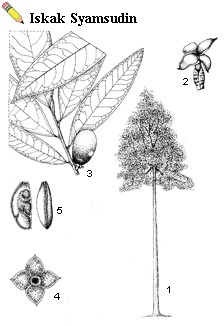 | Diospyros celebica Bakh. – 1, tree habit; 2, flower; 3, fruiting twig; 4, fruiting calyx; 5, lateral and dorsal view of seed. |
Selected Sources
[15]Alrasjid, H., 1985. Percobaan penanaman kayu eboni (Diospyros celebica) di bawah tegakan jati di Jawa [Plantation trial of ebony (Diospyros celebica) under a teak stand in Java]. Buletin Penelitian Hutan 464: 23–37.
[42]Bakhuizen van den Brink, R.C., 1936–1955. Revisio Ebenacearum Malayensium. Contributions a l'Ttude de la flore des Indes NTerlandaises XXXIII. Bulletin du Jardin Botanique de Buitenzorg, STrie III, 15(1–5): 1–515, 92 plates.
[212]Haeruman, H., 1985. Future of tropical forests in Indonesia, resolving land resources conflicts. In: Davidson, J., Pong, T.Y. & Bijleveld, M. (Editors): The future of tropical rain forests in South East Asia. Commission on Ecology Papers No
[376]Lie, G. L., 1969. Kaju ebony (Diospyros spp.) [Ebony wood (Diospyros spp.)]. Seri Bibliografi No 17. Lembaga Perpustakaan Biologi dan Pertanian 'Bibliotheca Bogoriensis', Bogor. 12 pp.
[403]Martawijaya, A. et al., 1986. Indonesian wood atlas. Vol. 1. Forest Products Research and Development Centre, Bogor. 166 pp.
[526]Research Institute of Wood Industry, 1988. Identification, properties and uses of some Southeast Asian woods. Chinese Academy of Forestry, Wan Shou Shan, Beijing & International Tropical Timber Organization, Yokohama. 201 pp.
[537]Rombe, Y.L. & Rahardjo, 1982. Potensi dan penyebaran jenis kayu kurang dikenal II. Ebony [Potential and distribution of lesser-known species II. Ebony]. Edisi Khusus No 56 A. Direktorat Bina Program Kehutanan, Bogor.
[586]Soerianegara, I., 1967. Beberapa keterangan tentang djenis-djenis pohon eboni Indonesia [Some notes on Indonesian ebony tree species]. Rimba Indonesia 12(2–4): 29–54.
[595]Stadelman, R.C., 1966. Forests of Southeast Asia. Princeton, Memphis, Tennessee. 245 pp.
[601]Steup, F.K.M., 1934. Het ebbenhout in Noord-Celebes [Ebony timber in North Sulawesi]. Economisch Weekblad voor Nederlandsch-Indid 3 (part 1): 447–449.
[602]Steup, F.K.M., 1935. Het ebbenhout in den dienstkring Manado [Ebony timber in the management region Manado]. Tectona 28: 45–65.
[42]Bakhuizen van den Brink, R.C., 1936–1955. Revisio Ebenacearum Malayensium. Contributions a l'Ttude de la flore des Indes NTerlandaises XXXIII. Bulletin du Jardin Botanique de Buitenzorg, STrie III, 15(1–5): 1–515, 92 plates.
[212]Haeruman, H., 1985. Future of tropical forests in Indonesia, resolving land resources conflicts. In: Davidson, J., Pong, T.Y. & Bijleveld, M. (Editors): The future of tropical rain forests in South East Asia. Commission on Ecology Papers No
[376]Lie, G. L., 1969. Kaju ebony (Diospyros spp.) [Ebony wood (Diospyros spp.)]. Seri Bibliografi No 17. Lembaga Perpustakaan Biologi dan Pertanian 'Bibliotheca Bogoriensis', Bogor. 12 pp.
[403]Martawijaya, A. et al., 1986. Indonesian wood atlas. Vol. 1. Forest Products Research and Development Centre, Bogor. 166 pp.
[526]Research Institute of Wood Industry, 1988. Identification, properties and uses of some Southeast Asian woods. Chinese Academy of Forestry, Wan Shou Shan, Beijing & International Tropical Timber Organization, Yokohama. 201 pp.
[537]Rombe, Y.L. & Rahardjo, 1982. Potensi dan penyebaran jenis kayu kurang dikenal II. Ebony [Potential and distribution of lesser-known species II. Ebony]. Edisi Khusus No 56 A. Direktorat Bina Program Kehutanan, Bogor.
[586]Soerianegara, I., 1967. Beberapa keterangan tentang djenis-djenis pohon eboni Indonesia [Some notes on Indonesian ebony tree species]. Rimba Indonesia 12(2–4): 29–54.
[595]Stadelman, R.C., 1966. Forests of Southeast Asia. Princeton, Memphis, Tennessee. 245 pp.
[601]Steup, F.K.M., 1934. Het ebbenhout in Noord-Celebes [Ebony timber in North Sulawesi]. Economisch Weekblad voor Nederlandsch-Indid 3 (part 1): 447–449.
[602]Steup, F.K.M., 1935. Het ebbenhout in den dienstkring Manado [Ebony timber in the management region Manado]. Tectona 28: 45–65.
Author(s)
M.S.M. Sosef
Correct Citation of this Article
Sosef, M.S.M., 1995. Diospyros celebica Bakh.. In: Lemmens, R.H.M.J., Soerianegara, I. and Wong, W.C. (Editors): Plant Resources of South-East Asia No 5(2): Timber trees; Minor commercial timbers. PROSEA Foundation, Bogor, Indonesia. Database record: prota4u.org/prosea

All texts are licensed under a Creative Commons Attribution-Noncommercial-Share Alike 3.0 Netherlands License
This license does not include the illustrations (Maps,drawings,pictures); these remain all under copyright.