Record Number
426
PROSEA Handbook Number
12(1): Medicinal and poisonous plants 1
Taxon
Senna tora (L.) Roxb.
This article should be read together with the article on the genus: Senna in the Handbook volume indicated above in this database.
This article should be read together with the article on the genus: Senna in the Handbook volume indicated above in this database.
Protologue
Fl. ind., ed. 2, 2: 340 (1832).
Synonyms
Cassia tora L. (1753), Cassia borneensis Miq. (1850).
Vernacular Names
Foetid cassia, panicled milkwort (En). Casse fétide (Fr). Indonesia: gelenggang kecil, ketepeng kecil (Malay), katepengleutik (Sundanese). Malaysia: gelenggang kechil, gelenggang padang. Philippines: katanda, balatong-aso (Tagalog). Cambodia: d[aa]ng'hët khmaoch ni. Laos: nha leung meum, nha lap mun. Thailand: chum het tai, chum het lek (central), lapmuen noi (northern). Vietnam: th[ar]o quy[ees]t minh, mu[oof]ng h[oo]i, mu[oof]ng ng[ur].
Distribution
The origin of Senna tora is unknown, but nowadays it is only found in the Old World tropics.
Uses
A decoction of the leaves may be used as a purgative, vermifuge or to treat cough. The leaves and seeds are used in the treatment of ringworm and scabies, as a diuretic and an antipyretic. In Indonesia and the Philippines, pounded leaves are smeared on the head of restless children. In Vietnam, seeds are used as a laxative, and roasted seeds are employed to treat insomnia, hypertension and ophthalmia. In India, pounded seeds are used to treat itching. In Chinese medicine, Senna tora is used to improve vision. Cattle do not eat the green plant, but do eat silaged plants and dry pods.
Observations
A foetid smelling herb or undershrub, up to 1 m tall, almost glabrous, with a stout taproot; leaves with 3 pairs of leaflets, petiole 1-4 cm long, rachis 2-3 cm long, with a subulate, 2 mm long gland between the two lowest pairs of leaflets, leaflets obovate, 2-5 cm x 1.5-2.5 cm, upper leaflets largest, thin, base cuneate to rounded, apex rounded; inflorescence a short axillary raceme, 1-2(-3)-flowered; flowers with ovate sepals, 5 mm x 2-4 mm, petals obovate, unequal, up to 10 mm x 6 mm, yellow, stamens 7, almost equal, filaments 1.5-2 mm long, 3 larger anthers, 4 smaller ones 1.5-2.5 mm long, staminodes absent, ovary densely pubescent, style glabrous, stigma truncate; fruit linear, terete, 10-15 cm x 0.5 cm; seeds 20-30 per pod, rhomboidal, 5 mm x 3 mm, glossy, with an areole (1.5-2 mm wide) covering part of the seed surface. Senna tora is common throughout South-East Asia in anthropogenic habitats at lower altitudes. It is reported to be an important weed in pastures and cropped fields in South-East Asia, partly because of its high seed production.
Image
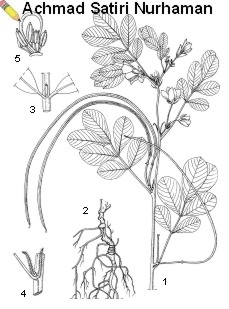 | Senna tora (L.) Roxb. – 1, twig with flowers and fruits; 2, root system; 3, detail of gland on leaf rachis; 4, detail of stipules; 5, detail of stamens and pistil |
Selected Sources
[8] Acharya, T.K. & Chatterjee, I.B., 1975. Isolation of chrysophanic acid-9-anthrone, the major antifungal principle of Cassia tora. Lloydia 38(3): 218-220.
[97] Backer, C.A. & Bakhuizen van den Brink Jr, R.C., 1963-1968. Flora of Java. 3 volumes. Noordhoff, Groningen, the Netherlands. Vol. 1 (1963) 647 pp., Vol. 2 (1965) 641 pp., Vol. 3 (1968) 761 pp.
[190] Brown, W.H., 1951-1957. Useful plants of the Philippines. Reprint of the 1941-1943 edition. 3 volumes. Technical Bulletin 10. Department of Agriculture and Natural Resources. Bureau of Printing, Manila, the Philippines. Vol. 1 (1951) 590 pp., Vol. 2 (1954) 513 pp., Vol. 3 (1957) 507 pp.
[202] Burkill, I.H., 1966. A dictionary of the economic products of the Malay Peninsula. Revised reprint. 2 volumes. Ministry of Agriculture and Co-operatives, Kuala Lumpur, Malaysia. Vol. 1 (A-H) pp. 1-1240. Vol. 2 (I-Z) pp. 1241-2444.
[253] Choi, J.S., Jung, J.H., Hee, J.L., Lee, H.J. & Kang, S.S., 1995. A naphthalene glycoside from Cassia tora. Phytochemistry 40(3): 997-999.
[254] Choi, J.S., Lee, H.J., Park, K.Y., Ha, J.O. & Kang, S.S., 1997. In vitro antimutagenic effects of anthraquinone aglycones and naphthopyrone glycosides from Cassia tora. Planta Medica 63(1): 11-14.
[272] Cock, M.J.W. & Evans, H.C., 1984. Possibilities for biological control of Cassia tora and C. obtusifolia. Tropical Pest Management 30(4): 339-350.
[336] de Wit, H.C.D., 1956. A revision of the genus Cassia (Caesalp.) as occurring in Malaysia. Webbia 11: 197-292.
[357] Ding Hou, Larsen, K. & Larsen, S.S., 1996. Caesalpiniaceae (Leguminosae-Caesalpinioideae). In: Kalkman, C., Kirkup, D.W., Nooteboom, H.P., Stevens, P.F. & de Wilde, W.J.J.O. (Editors): Flora Malesiana. Series 1, Vol. 12(2). Rijksherbarium/Hortus Botanicus, Leiden University, the Netherlands. pp. 409-730.
[364] Doan Thi Nhu, Do Huy Bich, Pham Kim Man, Nguyen Thuong Thuc, Bui Xuan Chuong & Pham Duy Mai (Editors), 1993. Les plants médicinales au Vietnam. Livre 2. Médicine traditionelle et pharmacopée [The medicinal plants of Vietnam. Volume 2. Traditional medicine and pharmacopoeia]. Agence de coopération Culturelle et Technique, Paris, France. 189 pp.
[402] Evans, W.C. (Editor), 1989. Trease and Evans' pharmacognosy. 13th Edition. Baillière Tindall, London, United Kingdom. 832 pp.
[429] Fowler, M.W., 1981. Plant cell biotechnology to produce desirable substances. Chemistry and Industry 7: 229-233.
[503] Grant, G., More, L.J., McKenzie, N.H., Dorward, P.M., Buchan, W.C., Telek, L. & Pusztai, A., 1995. Nutritional and haemagglutination properties of several tropical seeds. Journal of Agricultural Science 124(3): 437-445.
[553] Harborne, J.B., Boulter, D. & Turner, B.L. (Editors), 1971. Chemotaxonomy of the Leguminosae. Academic Press, London, United Kingdom & New York, United States. 612 pp.
[580] Heyne, K., 1950. De nuttige planten van Indonesië [The useful plants of Indonesia]. 3rd Edition. 2 volumes. W. van Hoeve, 's-Gravenhage, the Netherlands/Bandung, Indonesia. 1660 + CCXLI pp.
[817] Larsen, K., Larsen, S.S. & Vidal, J.E., 1980. Légumineuses-Caesalpinioïdées [Leguminosae-Caesalpinioideae]. In: Vidal, J.E. & Vidal, Y. (Editors): Flore du Cambodge, du Laos et du Viêtnam [Flora of Cambodia, Laos and Vietnam]. Vol. 18. Muséum National d'Histoire Naturelle, Paris, France. 227 pp.
[986] Mukherjee, P.K., Saha, K., Saha B.P., Pal, M. & Das, J., 1996. Antifungal activities of the leaf extract of Cassia tora Linn. (Fam. Leguminosae). Phytotherapy Research 10(6): 521-522.
[988] Mukhtar, A., 1989. Feeding diversity of Myllocerus viridanus Fab. (Coleoptera: Curculionidae) from south India. Indian Forester 115(11): 832-838.
[1035] Nguyen Van Duong, 1993. Medicinal plants of Vietnam, Cambodia and Laos. Mekong Printing, Santa Ana, California, United States. 528 pp.
[1126] Perry, L.M., 1980. Medicinal plants of East and Southeast Asia. Attributed properties and uses. MIT Press, Cambridge, Massachusetts, United States & London, United Kingdom. 620 pp.
[1178] Quisumbing, E., 1978. Medicinal plants of the Philippines. Katha Publishing Co., Quezon City, the Philippines. 1262 pp.
[1189] Raghunathan, K., Hariharan, V. & Rangaswami, S., 1974. Chrysophanol-1-'BETA'-gentiobioside, a new anthraquinone glycoside from Cassia tora Linn. Indian Journal of Chemistry 12: 1251-1253.
[1197] Randell, B.R., 1995. Taxonomy and evolution of Senna obtusifolia and S. tora. Journal of the Adelaide Botanic Gardens 16: 55-58.
[1220] Reynolds, J.E.F. (Editor), 1989. Martindale. The extra Pharmacopoeia, 29th Edition. The Pharmaceutical Press, London, United Kingdom. 1896 pp.
[1277] Samuelsson, G. (Editor), 1992. Drugs of natural origin, a textbook of pharmacognosy. Swedish Pharmaceutical Press, Stockholm, Sweden. 320 pp.
[1287] Saralamp, P., Temsiririrkkul, R., Chuakul, W., Riewpaiboon, A., Prathanturarug, S., Suthisisang, C. & Pongcharoensuk, P. (Editors), 1996. Medicinal plants in the Siri Ruckhachati Garden. 2nd Edition. Siambooks and Publications Co., Bangkok, Thailand. 263 pp.
[1520] Verdcourt, B., 1979. A manual of New Guinea legumes. Botany Bulletin No 11. Office of Forests, Division of Botany, Lae, Papua New Guinea. 645 pp.
[1594] Wong, S.M., Wong, M.M., Seligmann, O. & Wagner, H., 1989. New antihepatatotoxic naphtho-pyrone glycosides from the seeds of Cassia tora. Planta Medica 55: 276-280.
[97] Backer, C.A. & Bakhuizen van den Brink Jr, R.C., 1963-1968. Flora of Java. 3 volumes. Noordhoff, Groningen, the Netherlands. Vol. 1 (1963) 647 pp., Vol. 2 (1965) 641 pp., Vol. 3 (1968) 761 pp.
[190] Brown, W.H., 1951-1957. Useful plants of the Philippines. Reprint of the 1941-1943 edition. 3 volumes. Technical Bulletin 10. Department of Agriculture and Natural Resources. Bureau of Printing, Manila, the Philippines. Vol. 1 (1951) 590 pp., Vol. 2 (1954) 513 pp., Vol. 3 (1957) 507 pp.
[202] Burkill, I.H., 1966. A dictionary of the economic products of the Malay Peninsula. Revised reprint. 2 volumes. Ministry of Agriculture and Co-operatives, Kuala Lumpur, Malaysia. Vol. 1 (A-H) pp. 1-1240. Vol. 2 (I-Z) pp. 1241-2444.
[253] Choi, J.S., Jung, J.H., Hee, J.L., Lee, H.J. & Kang, S.S., 1995. A naphthalene glycoside from Cassia tora. Phytochemistry 40(3): 997-999.
[254] Choi, J.S., Lee, H.J., Park, K.Y., Ha, J.O. & Kang, S.S., 1997. In vitro antimutagenic effects of anthraquinone aglycones and naphthopyrone glycosides from Cassia tora. Planta Medica 63(1): 11-14.
[272] Cock, M.J.W. & Evans, H.C., 1984. Possibilities for biological control of Cassia tora and C. obtusifolia. Tropical Pest Management 30(4): 339-350.
[336] de Wit, H.C.D., 1956. A revision of the genus Cassia (Caesalp.) as occurring in Malaysia. Webbia 11: 197-292.
[357] Ding Hou, Larsen, K. & Larsen, S.S., 1996. Caesalpiniaceae (Leguminosae-Caesalpinioideae). In: Kalkman, C., Kirkup, D.W., Nooteboom, H.P., Stevens, P.F. & de Wilde, W.J.J.O. (Editors): Flora Malesiana. Series 1, Vol. 12(2). Rijksherbarium/Hortus Botanicus, Leiden University, the Netherlands. pp. 409-730.
[364] Doan Thi Nhu, Do Huy Bich, Pham Kim Man, Nguyen Thuong Thuc, Bui Xuan Chuong & Pham Duy Mai (Editors), 1993. Les plants médicinales au Vietnam. Livre 2. Médicine traditionelle et pharmacopée [The medicinal plants of Vietnam. Volume 2. Traditional medicine and pharmacopoeia]. Agence de coopération Culturelle et Technique, Paris, France. 189 pp.
[402] Evans, W.C. (Editor), 1989. Trease and Evans' pharmacognosy. 13th Edition. Baillière Tindall, London, United Kingdom. 832 pp.
[429] Fowler, M.W., 1981. Plant cell biotechnology to produce desirable substances. Chemistry and Industry 7: 229-233.
[503] Grant, G., More, L.J., McKenzie, N.H., Dorward, P.M., Buchan, W.C., Telek, L. & Pusztai, A., 1995. Nutritional and haemagglutination properties of several tropical seeds. Journal of Agricultural Science 124(3): 437-445.
[553] Harborne, J.B., Boulter, D. & Turner, B.L. (Editors), 1971. Chemotaxonomy of the Leguminosae. Academic Press, London, United Kingdom & New York, United States. 612 pp.
[580] Heyne, K., 1950. De nuttige planten van Indonesië [The useful plants of Indonesia]. 3rd Edition. 2 volumes. W. van Hoeve, 's-Gravenhage, the Netherlands/Bandung, Indonesia. 1660 + CCXLI pp.
[817] Larsen, K., Larsen, S.S. & Vidal, J.E., 1980. Légumineuses-Caesalpinioïdées [Leguminosae-Caesalpinioideae]. In: Vidal, J.E. & Vidal, Y. (Editors): Flore du Cambodge, du Laos et du Viêtnam [Flora of Cambodia, Laos and Vietnam]. Vol. 18. Muséum National d'Histoire Naturelle, Paris, France. 227 pp.
[986] Mukherjee, P.K., Saha, K., Saha B.P., Pal, M. & Das, J., 1996. Antifungal activities of the leaf extract of Cassia tora Linn. (Fam. Leguminosae). Phytotherapy Research 10(6): 521-522.
[988] Mukhtar, A., 1989. Feeding diversity of Myllocerus viridanus Fab. (Coleoptera: Curculionidae) from south India. Indian Forester 115(11): 832-838.
[1035] Nguyen Van Duong, 1993. Medicinal plants of Vietnam, Cambodia and Laos. Mekong Printing, Santa Ana, California, United States. 528 pp.
[1126] Perry, L.M., 1980. Medicinal plants of East and Southeast Asia. Attributed properties and uses. MIT Press, Cambridge, Massachusetts, United States & London, United Kingdom. 620 pp.
[1178] Quisumbing, E., 1978. Medicinal plants of the Philippines. Katha Publishing Co., Quezon City, the Philippines. 1262 pp.
[1189] Raghunathan, K., Hariharan, V. & Rangaswami, S., 1974. Chrysophanol-1-'BETA'-gentiobioside, a new anthraquinone glycoside from Cassia tora Linn. Indian Journal of Chemistry 12: 1251-1253.
[1197] Randell, B.R., 1995. Taxonomy and evolution of Senna obtusifolia and S. tora. Journal of the Adelaide Botanic Gardens 16: 55-58.
[1220] Reynolds, J.E.F. (Editor), 1989. Martindale. The extra Pharmacopoeia, 29th Edition. The Pharmaceutical Press, London, United Kingdom. 1896 pp.
[1277] Samuelsson, G. (Editor), 1992. Drugs of natural origin, a textbook of pharmacognosy. Swedish Pharmaceutical Press, Stockholm, Sweden. 320 pp.
[1287] Saralamp, P., Temsiririrkkul, R., Chuakul, W., Riewpaiboon, A., Prathanturarug, S., Suthisisang, C. & Pongcharoensuk, P. (Editors), 1996. Medicinal plants in the Siri Ruckhachati Garden. 2nd Edition. Siambooks and Publications Co., Bangkok, Thailand. 263 pp.
[1520] Verdcourt, B., 1979. A manual of New Guinea legumes. Botany Bulletin No 11. Office of Forests, Division of Botany, Lae, Papua New Guinea. 645 pp.
[1594] Wong, S.M., Wong, M.M., Seligmann, O. & Wagner, H., 1989. New antihepatatotoxic naphtho-pyrone glycosides from the seeds of Cassia tora. Planta Medica 55: 276-280.
Author(s)
Anny Victor Toruan-Purba
Correct Citation of this Article
Toruan-Purba, A.V., 1999. Senna tora (L.) Roxb.. In: de Padua, L.S., Bunyapraphatsara, N. and Lemmens, R.H.M.J. (Editors): Plant Resources of South-East Asia No 12(1): Medicinal and poisonous plants 1. PROSEA Foundation, Bogor, Indonesia. Database record: prota4u.org/prosea

All texts are licensed under a Creative Commons Attribution-Noncommercial-Share Alike 3.0 Netherlands License
This license does not include the illustrations (Maps,drawings,pictures); these remain all under copyright.