Record Number
4289
PROSEA Handbook Number
5(2): Timber trees; Minor commercial timbers
Taxon
Koordersiodendron Engl.
Protologue
Koord., Versl. Minahasa, Meded. 's-Lands Plantentuin 19: 410 (1898).
Family
ANACARDIACEAE
Chromosome Numbers
x = unknown; 2n = unknown
Trade Groups
Trade groups Ranggu: medium-weight hardwood, a single species, Koordersiodendron pinnatum (Blanco) Merr., Bull. For. Bur. 1: 33 (1903), synonyms: Koordersiodendron celebicum Engl. (1898), Lannea speciosa (Blume) Engl. ex Perk. (1904), Koordersiodendron papuanum Kaneh. & Hatus. (1942).
Vernacular Names
Ranggu. Indonesia: tabu hitam (Kalimantan), kayu bugis, bugis (Sulawesi), grepau (Irian Jaya). Philippines: amugis (general), dangila (Tagalog), karogkog (Bikol).
Origin and Geographic Distribution
Koordersiodendron consists of a single species and is widely distributed throughout the Philippines, the northern part of Borneo, Sulawesi, the Moluccas and the northern part of Irian Jaya.
Uses
Ranggu timber is excellent for flooring owing to its uniform dark red colour, and is also used for construction under cover (posts, beams, joists, rafters, interior finish), boat and cart construction, furniture, cabinet making and turnery. The wood is suitable for the manufacture of wood-wool board.
The gum from the bark has been used in local medicine.
The gum from the bark has been used in local medicine.
Production and International Trade
In Sabah, ranggu was mainly used locally because it had more defects than other timber species from Sabah and the green logs, which sink in water, are difficult to transport. However, the present export is considerable: in 1987 12 500 m3 of logs with a value of US$ 700 000, and in 1992 8000 m3 (5% as sawn timber, 95% as logs) with a total value of US$ 580 000 (US$ 180/m3 for sawn timber, US$ 67/m3 for logs). Japan imports limited amounts of ranggu, mainly from Sabah and Irian Jaya.
Properties
Ranggu is a medium-weight hardwood. The heartwood is pale pinkish-brown, reddish-brown to dark red-brown, often with black streaks, well demarcated from the greyish-brown or pale pinkish sapwood. The density is (410—)530—915(—1020) kg/m3 at 15% moisture content. The grain is usually interlocked, sometimes straight, occasionally wavy or curly, texture moderately fine. The wood is glossy, and the taste and odour are not perceptible.
Tests of samples of green wood from the Philippines, Sabah and Irian Jaya showed the following mechanical properties: the modulus of rupture 66—86.5 N/mm2, modulus of elasticity 10 625—15 300 N/mm2, compression parallel to grain 31—47 N/mm2, compression perpendicular to grain about 9.5 N/mm2, shear 9—15.5 N/mm2, cleavage about 80.5 N/mm radial and 92 N/mm tangential, Janka side hardness 3400—7120 N and Janka end hardness 3660—6300 N. A test of wood from Sabah showed the following figures at 17% moisture content: modulus of elasticity 17 030 N/mm2, compression parallel to grain 58 N/mm2, shear 13.5 N/mm2, cleavage 76 N/mm radial and 87 N/mm tangential, Janka side hardness 7480 N and Janka end hardness 6865 N. See also the table on wood properties.
The rates of shrinkage are moderately high to high: from green to 15% moisture content 1.7% radial and 2.6% tangential, from green to 12% moisture content 3.1—5.0% radial and 5.6—8.0% tangential. Ranggu is difficult to season because of its distinct tendency to cup and warp, whereas splitting and checking are normally observed when seasoning 25 mm stock. Air drying prior to kiln drying is recommended. Material of 50 mm and thicker is stable in service when properly dried.
Ranggu is rather difficult to saw and causes circular saws to heat up. A band saw rather than a circular blade is recommended for ripping. In planing, a 30° cutting angle is suitable for back-sawn material, but 20° for quarter-sawn stock. Boring and mortising result in a good finish, but support is usually needed at the exit faces. Preboring is essential for nailing. Stock finishes and polishes well, although torn grain is common on quartered faces. The wood has a moderate blunting effect on tools. It is probably not suitable for veneer, because it is too heavy and liable to defects when peeled.
Ranggu is rated as non-durable to moderately durable. It is easily attacked by termites, pinhole borers and probably also marine borers. It is moderately susceptible to Lyctus beetles. Due to tyloses, the heartwood is extremely resistant and the sapwood is moderately resistant to preservative treatment. The wearing properties of ranggu are excellent.
The wood contains 49.3% cellulose, 26.9% lignin, 16.7% pentosan and 1.3% ash. The solubility in alcohol-benzene is 4.9%.
Tests of samples of green wood from the Philippines, Sabah and Irian Jaya showed the following mechanical properties: the modulus of rupture 66—86.5 N/mm2, modulus of elasticity 10 625—15 300 N/mm2, compression parallel to grain 31—47 N/mm2, compression perpendicular to grain about 9.5 N/mm2, shear 9—15.5 N/mm2, cleavage about 80.5 N/mm radial and 92 N/mm tangential, Janka side hardness 3400—7120 N and Janka end hardness 3660—6300 N. A test of wood from Sabah showed the following figures at 17% moisture content: modulus of elasticity 17 030 N/mm2, compression parallel to grain 58 N/mm2, shear 13.5 N/mm2, cleavage 76 N/mm radial and 87 N/mm tangential, Janka side hardness 7480 N and Janka end hardness 6865 N. See also the table on wood properties.
The rates of shrinkage are moderately high to high: from green to 15% moisture content 1.7% radial and 2.6% tangential, from green to 12% moisture content 3.1—5.0% radial and 5.6—8.0% tangential. Ranggu is difficult to season because of its distinct tendency to cup and warp, whereas splitting and checking are normally observed when seasoning 25 mm stock. Air drying prior to kiln drying is recommended. Material of 50 mm and thicker is stable in service when properly dried.
Ranggu is rather difficult to saw and causes circular saws to heat up. A band saw rather than a circular blade is recommended for ripping. In planing, a 30° cutting angle is suitable for back-sawn material, but 20° for quarter-sawn stock. Boring and mortising result in a good finish, but support is usually needed at the exit faces. Preboring is essential for nailing. Stock finishes and polishes well, although torn grain is common on quartered faces. The wood has a moderate blunting effect on tools. It is probably not suitable for veneer, because it is too heavy and liable to defects when peeled.
Ranggu is rated as non-durable to moderately durable. It is easily attacked by termites, pinhole borers and probably also marine borers. It is moderately susceptible to Lyctus beetles. Due to tyloses, the heartwood is extremely resistant and the sapwood is moderately resistant to preservative treatment. The wearing properties of ranggu are excellent.
The wood contains 49.3% cellulose, 26.9% lignin, 16.7% pentosan and 1.3% ash. The solubility in alcohol-benzene is 4.9%.
Description
A large, evergreen tree up to 50 m tall; bole cylindrical, branchless for up to 25(—30) m, up to 80(—200) cm in diameter, sometimes with buttresses up to 2 m high; bark surface usually deeply fissured, dark brown or black, inner bark laminated, fibrous, pink to red, with a little colourless exudate; crown dense and dark green. Leaves arranged spirally, crowded at the end of twigs, imparipinnate, 50—80 cm long, with (6—)10—16 pairs of leaflets, rachis hairy, exstipulate; leaflets subopposite, ovate-oblong to narrowly oblong, 3—20 cm 1.5—5.5 cm, entire, slightly asymmetrical at base, acuminate, with 10—24 pairs of usually bright red secondary veins, glossy green above, yellowish-green below, glabrescent, with short petiolule, without domatia. Flowers in an axillary panicle up to 50 cm long, bisexual, actinomorphic, 5-merous, small, white or yellowish-green; sepals united at base, the lobes 0.7—1 mm long; petals free, imbricate, 2—3 mm long; stamens 10, glabrous, anthers subglobose, connective protruding slightly beyond the thecae; ovary superior, sessile, subglobose, deeply longitudinally 5-furrowed, densely hairy, 5-celled, usually with one fertile cell and one ovule per cell, styles 5, short; disk intrastaminal, round and flat, 10-notched. Fruit a 1(—3)-celled drupe, broadly ellipsoid, 2.5—4 cm long, obtuse at both ends, yellowish when ripe, with cartilaginous endocarp. Seed ellipsoid, with the testa free from the endocarp; cotyledons free, plano-convex. Seedling with epigeal, cryptocotylar germination; cotyledons succulent, enclosed by the persistent, dark brown, cracking and fibrous fruit wall; first 2 leaves opposite and compound, subsequent leaves arranged spirally.
Image
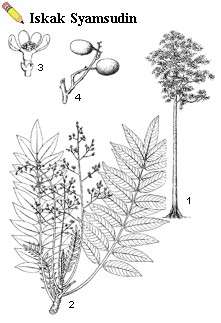 | Koordersiodendron pinnatum (Blanco) Merr. – 1, tree habit; 2, flowering twig; 3, flower with 1 petal removed; 4, branchlet with fruits. |
Wood Anatomy
— Macroscopic characters:
Heartwood pale pinkish-brown to dark red-brown, often with fine dark streaks, fairly distinctly demarcated from the greyish-brown or pale pinkish sapwood. Grain often slightly interlocked, sometimes straight and occasionally wavy. Texture rather fine and even; wood lustrous. Growth rings absent or indistinct, occasionally distinct; vessels indistinct to barely visible to the naked eye, tyloses abundant; vasicentric parenchyma visible with a lens, rays not distinct to the naked eye; ripple marks absent.
— Microscopic characters:
Growth rings, when present, marked by differences in fibre wall thickness. Vessels diffuse, 3—8/mm2, solitary, occasionally in radial multiples of 2—3 or in small clusters of 3—5, round, rarely oval, tangential diameter 90—250 µm; perforations simple; intervessel pits alternate, bordered, rounded to polygonal, 10—15 µm; vessel-ray and vessel-parenchyma pits coarse and of various shapes, with strongly reduced borders to almost simple; helical thickenings absent; tyloses abundant. Fibres 620—1600 µm long, septate, thin-walled to moderately thick-walled (walls 4—6(—10) µm thick), with minutely bordered pits confined to the radial walls. Parenchyma sparse paratracheal, vasicentric, mostly in 1—2-celled sheaths to the vessels, in 3—5-celled strands. Rays 4—12/mm, 1—3(—5)-seriate, up to 0.8 mm high, heterocellular with 1—3 rows of upright cells and/or square marginal cells (Kribs type heterogeneous II and III). Prismatic crystals rare in chambered axial parenchyma cells, common in chambered or enlarged marginal ray parenchyma cells; ray and parenchyma cells often with red or brown deposits. Silica absent. Gum ducts present in wide, fusiform rays. All elements non-storied.
Heartwood pale pinkish-brown to dark red-brown, often with fine dark streaks, fairly distinctly demarcated from the greyish-brown or pale pinkish sapwood. Grain often slightly interlocked, sometimes straight and occasionally wavy. Texture rather fine and even; wood lustrous. Growth rings absent or indistinct, occasionally distinct; vessels indistinct to barely visible to the naked eye, tyloses abundant; vasicentric parenchyma visible with a lens, rays not distinct to the naked eye; ripple marks absent.
— Microscopic characters:
Growth rings, when present, marked by differences in fibre wall thickness. Vessels diffuse, 3—8/mm2, solitary, occasionally in radial multiples of 2—3 or in small clusters of 3—5, round, rarely oval, tangential diameter 90—250 µm; perforations simple; intervessel pits alternate, bordered, rounded to polygonal, 10—15 µm; vessel-ray and vessel-parenchyma pits coarse and of various shapes, with strongly reduced borders to almost simple; helical thickenings absent; tyloses abundant. Fibres 620—1600 µm long, septate, thin-walled to moderately thick-walled (walls 4—6(—10) µm thick), with minutely bordered pits confined to the radial walls. Parenchyma sparse paratracheal, vasicentric, mostly in 1—2-celled sheaths to the vessels, in 3—5-celled strands. Rays 4—12/mm, 1—3(—5)-seriate, up to 0.8 mm high, heterocellular with 1—3 rows of upright cells and/or square marginal cells (Kribs type heterogeneous II and III). Prismatic crystals rare in chambered axial parenchyma cells, common in chambered or enlarged marginal ray parenchyma cells; ray and parenchyma cells often with red or brown deposits. Silica absent. Gum ducts present in wide, fusiform rays. All elements non-storied.
Growth and Development
During germination the taproot and hypocotyl emerge from one pole of the fruit; the cotyledonary petioles elongated and carry the fruit away from the plumule. The taproot is long and slender. After the first two leaves have developed, a resting stage follows.
In the dry season the tree crown becomes lighter, but never loses all foliage.
In Sabah, the mean annual diameter increment of ranggu is 0.2—0.9 cm. The fruits are dispersed by animals, notably hornbills, green pigeons and primates, which feed on the pulp.
In the dry season the tree crown becomes lighter, but never loses all foliage.
In Sabah, the mean annual diameter increment of ranggu is 0.2—0.9 cm. The fruits are dispersed by animals, notably hornbills, green pigeons and primates, which feed on the pulp.
Other Botanical Information
Koordersiodendron belongs to the tribe Spondiadeae and seems most closely related to Pegia or Spondias. The genus is characterized by the many leaflets without domatia, the 10 stamens and the 5-celled ovary with incompletely connate cells. In Sarawak, the vernacular name ranggu is also used for Melia excelsa Jack.
Ecology
Ranggu occurs in humid evergreen lowland forest, but in the Philippines it is reported to be found mainly on the fringes of lowland forest, from near the beach up to 450(—800) m altitude. It is widespread but occurs scattered and almost nowhere abundant. It is occasionally found in inundated locations. It prefers loamy soils. On the island of Seram (the Moluccas), ranggu occurs as an emergent tree over 45 m tall, with an average of 3.3 trees over 50 cm diameter at breast height per ha in a forest type dominated by Canarium vulgare Leenh. In Irian Jaya, it is found on forest fringes along the beach and associated with Celtis philippensis Blanco, Vitex quinata (Lour.) F.N. Williams, Canarium asperum Benth. and Trichadenia philippinensis Merr. on well-drained soils containing gravel and boulders.
Propagation and planting
Information available on propagation from seed indicates that germination in the nursery is fair. Wildlings transferred to the nursery showed 90% survival and a height increment of 34 cm during the first 6 months in the nursery. Compared with the original population from which they came from, the wildlings had a shorter taproot and more lateral roots, which make them better, more sturdy planting stock than the seedlings under the mother tree.
Diseases and Pests
In Sabah a longhorn beetle attacks living trees and causes serious defects of the timber.
Harvesting
As the green logs sink in water (density about 1120 kg/m3 at an estimated moisture content of 60—80%), they cannot be transported by river. Large trees are often hollow.
Yield
In South Sulawesi, the estimated timber volume of a particular forest is 13.8 m3/ha for ranggu trees over 50 cm in diameter. In the Samarinda forest in East Kalimantan, this parameter ranges from 2.0—8.8 m3/ha. In Seram, the Moluccas, ranggu makes up 5% of the total basal area in natural forest.
Genetic Resources
Considering its wide distribution, ranggu does not seem in danger of genetic erosion at present.
Prospects
The wood has an attractive dark-red colour, but there are some problems in converting the timber, as sawing is not very easy and the tools used are easily blunted. As extremely little is known about the silviculture of ranggu, it is doubtful whether the importance of the wood will increase in the future.
Literature
Bolza, E., 1975. Properties and uses of 175 timber species from Papua New Guinea and West Irian. Report No 34. Division of Building Research, Commonwealth Scientific and Industrial Research Organization, Melbourne. 35 pp.
Burgess, P.F., 1966. Timbers of Sabah. Sabah Forest Records No 6. Forest Department Sabah, Sandakan. pp. 16-19.
Capellan, N.M., 1961. Possibilities of bagtikan (Parashorea plicata Brandis), white lauan (Pentacme contorta Merr. & Rolfe), amugis (Koordersiodendron pinnatum (Blanco) Merr.), rain tree (Samanea saman (Jacq.) Merr.) and Spanish cedar (Cedrela odorata Linn.) wildings as nursery planting stocks. Philippine Journal of Forestry 17(1-2): 101-112.
de Guzman, E, Umali, R.M. & Sotalbo, E.D., 1986. Guide to Philippine flora and fauna. Vol. 3: dipterocarps, non-dipterocarps. Natural Resources Management Center, Ministry of Natural Resources & University of the Philippines, Manila. pp. 316-317.
de Vogel, E.F., 1980. Seedlings of dicotyledons. Pudoc, Wageningen. pp. 156-158.
Hou, D., 1978. Anacardiaceae. In: van Steenis, C.G.G.J. & de Wilde, W.J.J.O. (Editors): Flora Malesiana. Ser. 1, Vol. 8. Wolters-Noordhoff, Groningen. pp. 486-488.
Fundter, J.M. & Wisse, J.H., 1977. 40 Belangrijke houtsoorten uit Indonesisch Nieuw Guinea (Irian Jaya) met de anatomische en technische kenmerken [40 Important timber species from Indonesian New Guinea (Irian Jaya) with their anatomical and technical characteristics]. Mededelingen Landbouwhogeschool Wageningen 77-9. pp. 21-23.
Keating, W.G. & Bolza, E., 1982. Characteristics, properties and uses of timbers. Vol. 1: South-East Asia, Northern Australia and the Pacific. Division of Chemical Technology, Commonwealth Scientific and Industrial Research Organization. Inkata Press, Melbourne, Sydney, London. p. 217.
Reyes, L.J., 1938. Philippine woods. Technical Bulletin No 7. Commonwealth of the Philippines, Department of Agriculture and Commerce. Bureau of Printing, Manila. pp. 204-205.
Sidiyasa, K. & Tantra, I.G.M., 1984. Analisis flora pohon hutan dataran rendah Wae Mual, Taman Nasional Manusela, Seram-Maluku [Tree flora analysis of the Wae Mual lowland forest, Manusela National Park, Seram-the Moluccas]. Buletin Penelitian Hutan 462: 19-34.
Burgess, P.F., 1966. Timbers of Sabah. Sabah Forest Records No 6. Forest Department Sabah, Sandakan. pp. 16-19.
Capellan, N.M., 1961. Possibilities of bagtikan (Parashorea plicata Brandis), white lauan (Pentacme contorta Merr. & Rolfe), amugis (Koordersiodendron pinnatum (Blanco) Merr.), rain tree (Samanea saman (Jacq.) Merr.) and Spanish cedar (Cedrela odorata Linn.) wildings as nursery planting stocks. Philippine Journal of Forestry 17(1-2): 101-112.
de Guzman, E, Umali, R.M. & Sotalbo, E.D., 1986. Guide to Philippine flora and fauna. Vol. 3: dipterocarps, non-dipterocarps. Natural Resources Management Center, Ministry of Natural Resources & University of the Philippines, Manila. pp. 316-317.
de Vogel, E.F., 1980. Seedlings of dicotyledons. Pudoc, Wageningen. pp. 156-158.
Hou, D., 1978. Anacardiaceae. In: van Steenis, C.G.G.J. & de Wilde, W.J.J.O. (Editors): Flora Malesiana. Ser. 1, Vol. 8. Wolters-Noordhoff, Groningen. pp. 486-488.
Fundter, J.M. & Wisse, J.H., 1977. 40 Belangrijke houtsoorten uit Indonesisch Nieuw Guinea (Irian Jaya) met de anatomische en technische kenmerken [40 Important timber species from Indonesian New Guinea (Irian Jaya) with their anatomical and technical characteristics]. Mededelingen Landbouwhogeschool Wageningen 77-9. pp. 21-23.
Keating, W.G. & Bolza, E., 1982. Characteristics, properties and uses of timbers. Vol. 1: South-East Asia, Northern Australia and the Pacific. Division of Chemical Technology, Commonwealth Scientific and Industrial Research Organization. Inkata Press, Melbourne, Sydney, London. p. 217.
Reyes, L.J., 1938. Philippine woods. Technical Bulletin No 7. Commonwealth of the Philippines, Department of Agriculture and Commerce. Bureau of Printing, Manila. pp. 204-205.
Sidiyasa, K. & Tantra, I.G.M., 1984. Analisis flora pohon hutan dataran rendah Wae Mual, Taman Nasional Manusela, Seram-Maluku [Tree flora analysis of the Wae Mual lowland forest, Manusela National Park, Seram-the Moluccas]. Buletin Penelitian Hutan 462: 19-34.
Other Selected Sources
[12]All Nippon Checkers Corporation, 1989. Illustrated commercial foreign woods in Japan. Shinagawa-ku, Tokyo. 262 pp.
[69]Browne, F.G., 1955. Forest trees of Sarawak and Brunei and their products. Government Printing Office, Kuching. xviii + 369 pp.
[77]Burgess, P.F., 1966. Timbers of Sabah. Sabah Forest Records No 6. Forest Department, Sabah, Sandakan. xviii + 501 pp.
[92]Chiew, K.Y. & Garcia, A., 1989. Growth and yield studies in the Yayasan Sabah forest concession area. In: Wan Razali Mohd., Chan, H.T. & Appanah, S. (Editors): Growth and yield in tropical mixed/moist forests. Proceedings of the seminar held from 20–24 June, 1988, Kuala Lumpur. Forest Research Institute Malaysia, Kepong. pp. 192–202.
[96]Chudnoff, M., 1984. Tropical timbers of the world. Agricultural Handbook 607. USDA Forest Service, Washington, D.C. 464 pp.
[112]Dadswell, H.E., & Ingle, H.D., 1948. The anatomy of timbers of the South-West Pacific area. Australian Journal of Scientific Research, Series B–Biological Sciences: 1(4): 391–415.
[142]Direktorat Bina Program Kehutanan, 1977. Survey kelompok hutan S. Suramana–S. Tike, Propinsi Dati I, Sulawesi Selatan [A survey of the Suramana river–Tike river forest, Province of South Sulawesi]. Laporan No 664. Direktorat Bina Program, Bogor. 21 pp.
[278]Kalkman, C., 1959. Houtsoorten van Nieuw Guinea – samenvatting van literatuur- en praktijkgegevens voor een dertigtal van de belangrijkste houtsoorten uit Nederlands Nieuw Guinea [Timbers of New Guinea – summary of data from literature and from practice of some thirty of the most important timbers of Dutch New Guinea]. Afdeling Boswezen, onderafdeling bosplanologie en -exploratie, Manokwari. 39 pp.
[283]Karnasudirdja, S., 1961. Analisis kimia pendahuluan beberapa kayu-kayu Indonesia [Proximate chemical analysis of some Indonesian timbers]. Rimba Indonesia 10(2–3): 152–162.
[290]Keith, H.G., 1947. The timbers of North Borneo. North Borneo Forest Records No 3. Forest Department North Borneo, Sandakan. 154 pp.
[299]Kloot, N.H. & Bolza, E., 1961. Properties of timbers imported into Australia. Technological Paper No 12. Division of Forest Products, CSIRO, Melbourne. 79 pp.
[329]Kostermans, A.J.G.H. & Tideman, P., 1948. Bosonderzoek kolonisatie object Momi-Ransiki, Nieuw Guinea. Deel I [Forest research for the colonisation project Momi-Ransiki, Irian Jaya. Part I]. Unpublished. 269 pp.
[330]Kraemer, J.H., 1951. Trees of the western Pacific region. Tri-State Offset Company, Cincinnatti. 436 pp.
[367]Leighton, M. & Leighton, D.R., 1983. Vertebrate responses to fruiting seasonality within a Bornean rain forest. In: Sutton, S.L., Whitmore, T.C. & Chadwick, A.C. (Editors): Tropical rain forest: ecology and management. Special publication number 2 of the British Ecological Society. Blackwell Scientific Publications, Oxford, London, Edinburgh, Boston, Melbourne. pp. 181–196.
[393]Malaysian Timber Industry Board, 1984. Peraturan pemeringkatan kayu keras gergaji Malaysia [The Malaysian grading rules for sawn hardwood timber]. Ministry of Primary Industries, Kuala Lumpur. 109 pp.
[394]Malaysian Timber Industry Board, 1986. 100 Malaysian timbers. Kuala Lumpur. x + 226 pp.
[474]Oey Djoen Seng, 1951. Perbandingan berat dari jenis-jenis kaju Indonesia dan pengartian beratnja kaju untuk keperluan praktek [Specific gravity of Indonesian woods and its significance for practical use]. Laporan No 46. Balai Penjelidikan Kehutanan, Bogor. 183 pp.
[526]Research Institute of Wood Industry, 1988. Identification, properties and uses of some Southeast Asian woods. Chinese Academy of Forestry, Wan Shou Shan, Beijing & International Tropical Timber Organization, Yokohama. 201 pp.
[584]Soepardi, R., 1953. Object exploitasi hutan: Samarinda [Object of forest exploitation: Samarinda]. Rimba Indonesia 2(1–2): 2–57.
[626]Tamesis, F. & Aguilar, L., 1951. Important commercial timbers of the Philippines: their properties and uses. Popular Bulletin No 32. Department of Agriculture and Natural Resources. Bureau of Printing, Manila. 83 pp.
[627]Tamolang, F.B., Espiloy, E.B. & Floresca, A.R., 1990. Ninth progress report on the strength and related properties of Philippine woods. Philippine Lumberman 36: 25–37.
[675]Versteegh, C., 1971. Key to the most important native trees of Irian Barat (Indonesia) based on field characters. Mededelingen Landbouwhogeschool Wageningen 71-19. 63 pp.
[715]Wisse, J.H., 1965. Volumegewichten van een aantal houtmonsters uit West Nieuw Guinea [Specific gravity of some wood samples from West New Guinea]. Afdeling Bosexploitatie en Boshuishoudkunde, Landbouwhogeschool Wageningen. 23 pp.
[69]Browne, F.G., 1955. Forest trees of Sarawak and Brunei and their products. Government Printing Office, Kuching. xviii + 369 pp.
[77]Burgess, P.F., 1966. Timbers of Sabah. Sabah Forest Records No 6. Forest Department, Sabah, Sandakan. xviii + 501 pp.
[92]Chiew, K.Y. & Garcia, A., 1989. Growth and yield studies in the Yayasan Sabah forest concession area. In: Wan Razali Mohd., Chan, H.T. & Appanah, S. (Editors): Growth and yield in tropical mixed/moist forests. Proceedings of the seminar held from 20–24 June, 1988, Kuala Lumpur. Forest Research Institute Malaysia, Kepong. pp. 192–202.
[96]Chudnoff, M., 1984. Tropical timbers of the world. Agricultural Handbook 607. USDA Forest Service, Washington, D.C. 464 pp.
[112]Dadswell, H.E., & Ingle, H.D., 1948. The anatomy of timbers of the South-West Pacific area. Australian Journal of Scientific Research, Series B–Biological Sciences: 1(4): 391–415.
[142]Direktorat Bina Program Kehutanan, 1977. Survey kelompok hutan S. Suramana–S. Tike, Propinsi Dati I, Sulawesi Selatan [A survey of the Suramana river–Tike river forest, Province of South Sulawesi]. Laporan No 664. Direktorat Bina Program, Bogor. 21 pp.
[278]Kalkman, C., 1959. Houtsoorten van Nieuw Guinea – samenvatting van literatuur- en praktijkgegevens voor een dertigtal van de belangrijkste houtsoorten uit Nederlands Nieuw Guinea [Timbers of New Guinea – summary of data from literature and from practice of some thirty of the most important timbers of Dutch New Guinea]. Afdeling Boswezen, onderafdeling bosplanologie en -exploratie, Manokwari. 39 pp.
[283]Karnasudirdja, S., 1961. Analisis kimia pendahuluan beberapa kayu-kayu Indonesia [Proximate chemical analysis of some Indonesian timbers]. Rimba Indonesia 10(2–3): 152–162.
[290]Keith, H.G., 1947. The timbers of North Borneo. North Borneo Forest Records No 3. Forest Department North Borneo, Sandakan. 154 pp.
[299]Kloot, N.H. & Bolza, E., 1961. Properties of timbers imported into Australia. Technological Paper No 12. Division of Forest Products, CSIRO, Melbourne. 79 pp.
[329]Kostermans, A.J.G.H. & Tideman, P., 1948. Bosonderzoek kolonisatie object Momi-Ransiki, Nieuw Guinea. Deel I [Forest research for the colonisation project Momi-Ransiki, Irian Jaya. Part I]. Unpublished. 269 pp.
[330]Kraemer, J.H., 1951. Trees of the western Pacific region. Tri-State Offset Company, Cincinnatti. 436 pp.
[367]Leighton, M. & Leighton, D.R., 1983. Vertebrate responses to fruiting seasonality within a Bornean rain forest. In: Sutton, S.L., Whitmore, T.C. & Chadwick, A.C. (Editors): Tropical rain forest: ecology and management. Special publication number 2 of the British Ecological Society. Blackwell Scientific Publications, Oxford, London, Edinburgh, Boston, Melbourne. pp. 181–196.
[393]Malaysian Timber Industry Board, 1984. Peraturan pemeringkatan kayu keras gergaji Malaysia [The Malaysian grading rules for sawn hardwood timber]. Ministry of Primary Industries, Kuala Lumpur. 109 pp.
[394]Malaysian Timber Industry Board, 1986. 100 Malaysian timbers. Kuala Lumpur. x + 226 pp.
[474]Oey Djoen Seng, 1951. Perbandingan berat dari jenis-jenis kaju Indonesia dan pengartian beratnja kaju untuk keperluan praktek [Specific gravity of Indonesian woods and its significance for practical use]. Laporan No 46. Balai Penjelidikan Kehutanan, Bogor. 183 pp.
[526]Research Institute of Wood Industry, 1988. Identification, properties and uses of some Southeast Asian woods. Chinese Academy of Forestry, Wan Shou Shan, Beijing & International Tropical Timber Organization, Yokohama. 201 pp.
[584]Soepardi, R., 1953. Object exploitasi hutan: Samarinda [Object of forest exploitation: Samarinda]. Rimba Indonesia 2(1–2): 2–57.
[626]Tamesis, F. & Aguilar, L., 1951. Important commercial timbers of the Philippines: their properties and uses. Popular Bulletin No 32. Department of Agriculture and Natural Resources. Bureau of Printing, Manila. 83 pp.
[627]Tamolang, F.B., Espiloy, E.B. & Floresca, A.R., 1990. Ninth progress report on the strength and related properties of Philippine woods. Philippine Lumberman 36: 25–37.
[675]Versteegh, C., 1971. Key to the most important native trees of Irian Barat (Indonesia) based on field characters. Mededelingen Landbouwhogeschool Wageningen 71-19. 63 pp.
[715]Wisse, J.H., 1965. Volumegewichten van een aantal houtmonsters uit West Nieuw Guinea [Specific gravity of some wood samples from West New Guinea]. Afdeling Bosexploitatie en Boshuishoudkunde, Landbouwhogeschool Wageningen. 23 pp.
Author(s)
E. Boer (general part), J.W. Hildebrand (general part), D.S. Alonzo (properties), J.M. Fundter (wood anatomy)
Correct Citation of this Article
Boer, E., Hildebrand, J.W., Alonzo, D.S. & Fundter, J.M., 1995. Koordersiodendron Engl.. In: Lemmens, R.H.M.J., Soerianegara, I. and Wong, W.C. (Editors): Plant Resources of South-East Asia No 5(2): Timber trees; Minor commercial timbers. PROSEA Foundation, Bogor, Indonesia. Database record: prota4u.org/prosea

All texts are licensed under a Creative Commons Attribution-Noncommercial-Share Alike 3.0 Netherlands License
This license does not include the illustrations (Maps,drawings,pictures); these remain all under copyright.