Record Number
473
PROSEA Handbook Number
12(1): Medicinal and poisonous plants 1
Taxon
Verbena officinalis L.
Protologue
Sp. pl. 1: 20 (1753).
Family
VERBENACEAE
Chromosome Numbers
2n = 12, 14
Vernacular Names
Vervain, holy wort (En). Herbe sacrée, verveine officinale (Fr). Malaysia: marphin choo. Philippines: verbena. Thailand: nang dong laang. Vietnam: c[or] roi ng[uwj]a, m[ax] ti[ee]n th[ar]o.
Origin and Geographic Distribution
Verbena officinalis is a species of temperate and subtropical regions, probably originating from the Mediterranean region. It is found at both low and higher elevations in South-East Asia, e.g. in Java, New Guinea, Luzon, northern Thailand and Vietnam. It was introduced for its ornamental value or traditional use in folk medicine in Europe. In general it has become a weed as a follower of cultivation.
Uses
The aerial parts of Verbena officinalis are commonly used in European traditional medicine as digestive aid and mild diuretic, to stimulate the renal excretion of water. Furthermore, it is considered a tonic, galactagogue, emmenagogue, purgative, febrifugal, diaphoretic, astringent, anthelmintic, antihaemorrhagic, antispasmodic and antiscorbutic. Externally, it is applied as a gargle to treat throat problems and stomatitis, and as a compress or poultice against ulcers, cuts, contusions, piles and headache. Topical application as an emollient also includes the relief of itching in cases of skin disorders, sunburn and burns. In Europe, reported indications for its use are treatment of jaundice, chlorosis, dropsy, gout, kidney and bladder stones, rheumatism, haematuria, fever, neuralgia and ophthalmia.
In Indo-China, China, Taiwan and Korea, Verbena officinalis is used internally against colds, fever, inflammations, digestive and intestinal complaints, uterine problems and disorders in the urinary tract. It is also taken after parturition, as a depurative and to help to remove the placenta, in cases of oedema, anaemia, tympanitis, congestion and as antidote after insect bites. Externally, it is used as a poultice or wash to treat skin diseases, wounds, abscesses and tumours. In Vietnam, a decoction of Verbena officinalis is used against dropsy and a poultice against tumours on the scrotum, whereas it is also considered to be useful to regulate menstruation. In Thailand, Verbena officinalis is used in the treatment of liver and gall bladder complaints, colds, fever, bronchitis and mental disorders, whereas the leaves are applied externally to treat rheumatism, wounds and eczemas. In India, the fresh leaves are used as a febrifuge, tonic and as a rubefacient to treat rheumatism or other diseases of the joints, whereas the root is believed to be useful in the treatment of scrofula and snake bite.
Verbena officinalis is applied as an insecticide. Other Verbena species like Verbena laciniata (L.) Briq., Verbena rigida Spreng. and V. xhybrida Voss are cultivated in Java as ornamentals, but Verbena bonariensis L. is naturalized and found in fields, grassland, plantations and roadsides. Medicinal uses have been reported for Verbena rigida in Africa, where root decoctions are used against heartburn and colic and for Verbena bonariensis in Brazil, where it is used to treat fevers and catarrh.
Properties
Verbena officinalis has a bitter taste. It is known to contain iridoids and their glycosides, such as hastatoside, verbenalin (= verbanaloside, cornin) and verbenin (= aucubin), and phenylpropanoid glycosides e.g. verbascoside (= acetoside) and eukovoside (= leucosceptosid-A). Further phytochemical investigations have also revealed the presence of phytoestrogens and phytoprogestins, flavonoids, saponins, tannins, mucilage, adenosine and 'BETA'-carotene. Verbena officinalis leaves from Morocco were found to yield an essential oil containing more than 40 compounds, the predominant ones being spathulenol (10.8%), limonene (7.5%), 1,8-cineole (7.5%), caryophyllene-epoxide (7.3%), ar-curcumene (6.0%), geranial (3.3%), neral (2.5%) and 'ALFA'-terpineol. Verbenalin (= verbanaloside), a monoglycoside of the iridoid verbenalol, is present in all plant parts. It has been shown that iridoid biosynthesis efficiency in Verbena officinalis decreases during the flowering period.
Furthermore, verbenalin is identical to cornin, which has been isolated from Cornus florida L. Verbenalin is non-toxic and has parasympathomimetic properties. It stimulates the uterus in mammals, giving an increased tonus and stronger contractions. In dogs it slightly retards cardiac movements, reduces blood pressure and respiration, causes vasodilation in the kidneys and gives increased and more regular intestinal movements. In rabbits, it has shown antithermic activity, and it stimulates smooth muscle preparations of isolated rabbit intestines. In frogs, verbenalin in large doses is reported to stimulate the motoric activities of the central nervous system, causing stupor, convulsions and paralysis.
Verbenin (= aucubin), another iridoid glycoside, is known to have galactagogue properties. When given to lactating animals it increases milk secretion. The phenylpropanoid verbascoside (= acetoside) is reported to act as an agonist to the antitremor action of laevodopa, and furthermore as an antihypertensive and analgesic.
Pharmacological properties attributed to the plant as a whole include anti-microbial activity and antiviral activity against the murine cytomegalovirus. Its usefulness in the prevention and treatment of kidney-stone formation might be attributed to its disinfectant action and perhaps to the presence of saponins.
Finally, Verbena officinalis is suspected of being poisonous to cattle, Verbena rigida of causing irritation in livestock and Verbena bonariensis of causing abortion in cows.
Description
A perennial herb up to 100 cm tall; stem erect or decumbent at base, shallowly furrowed, glabrous or sparingly pubescent, tough. Leaves opposite, ovate-oblong in outline, pinnatifid to pinnately divided, 2.5-8 cm x 0.8-5 cm, base attenuate, apex acuminate, sessile by a narrowed base. Inflorescence a spike, lax at anthesis, 5-20 cm long, solitary or combined into a lax compound inflorescence. Flowers with a tubular calyx 2.5-3 mm long at anthesis, 5-toothed, densely glandular pubescent, scarcely longer than the fruit; corolla tube 3-4 mm long, corolla limb 5-lobed, 3-5 mm in diameter, pale lilac; stamens 4, inserted on the corolla tube; ovary superior, 4-celled, cells 1-ovuled, style short. Fruit breaking up into 4 closed cocci; cocci about 2 mm long. Seedling with epigeal germination; cotyledons herbaceous, glabrous; hypocotyl elongated, epicotyl present.
Image
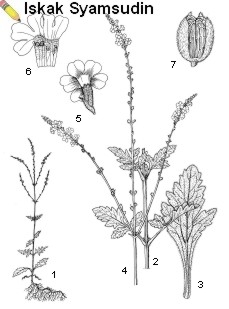 | Verbena officinalis L. — 1, plant habit; 2, part of stem; 3, leaf; 4, inflorescence; 5, back of flower with bracteole; 6, corolla opened out; 7, fruit with part of calyx removed |
Other Botanical Information
Verbena consists of about 200(-450) species, almost exclusively originating from temperate and tropical regions of the Americas. Only 2 species can be considered as originating from Europe or the Near East. A considerable number have been introduced in other parts of the world, mostly as garden ornamentals, and sometimes have become naturalized or even weedy. In North America Verbena hallei Small, indigenous to the south-eastern United States, is now considered as a subspecies of Verbena officinalis (Verbena officinalis L. subsp. hallei (Small) Barber). However, Verbena officinalis L. subsp. officinalis has been introduced from Europe and is now common in the eastern Atlantic part of the United States. In East Africa, the morphological distinctness found is given a taxonomic rank as Verbena officinalis subsp. africana R. Fernandes & Verdcourt.
Ecology
Verbena officinalis seeds germinate only when mean temperatures are above 14°C, with day temperatures higher than 19°C. Flowering is promoted at temperatures of 16°C or higher. Verbena spp. do not tolerate high relative humidity.
Propagation and planting
Verbena officinalis can be propagated through seed, cuttings and rootstock division.
Harvesting
Aerial parts are collected before anthesis.
Handling After Harvest
After collecting, aerial parts and roots can be dried for storage and future use.
Prospects
Although Verbena officinalis is credited with a wide range of medicinal properties, most of these remain to be scientifically confirmed. It might be useful as a remedy for fever and common colds, and to prevent and treat urolithiasis, but more effective and equally innocuous substances are already available.
Literature
Chalchat, J.C. & Garry, R.P., 1996. Chemical composition of the leaf oil of Verbena officinalis L. Journal of Essential Oil Research 8: 419-420.
Chuakul, W., Saralamp, P., Paonil, V. & Temsiririrkkul, R., 1996. Samunpri Puenban Lanna [Medicinal plants in the northern part of Thailand]. Department of Pharmaceutical Botany, Faculty of Pharmacy, Mahidol University. Amarin Printing and Publishing Public Co. Ltd., Bangkok, Thailand. p. 222
Garnier, G., Bézanger-Beauquesne, L. & Debraux, G., 1961. Ressources médicinales de la flore française [Medicinal resources of the French flora]. Vol. 2. Vigot Frères, Paris, France. pp. 1146-1148.
Lahloub, M.F., 1986. Phenylpropanoid and iridoid glycosides from the Egyptian Verbena officinalis. Planta Medica 52: 47.
Moldenke, H.N. & Moldenke, A.L., 1983. Verbena. In: Dassanayake, M.D. & Fosberg, F.R. (Editors): A revised handbook to the flora of Ceylon. Vol. 4. Amerind Publishing Co., New Delhi, India. pp. 198-211.
Newall, C.A., Anderson, L.A. & Phillipson, J.D. (Editors), 1996. Herbal Medicines. The Pharmaceutical Press, London, United Kingdom. p. 263.
Oliver-Bever, B., 1986. Medicinal plants in tropical West Africa. Cambridge University Press, Cambridge, United Kingdom. p. 239.
Perry, L.M., 1980. Medicinal plants of East and Southeast Asia. Attributed properties and uses. The MIT Press, Cambridge, Massachusetts, United States & London, United Kingdom. p. 430.
Pételot, A., 1953. Les plantes médicinales du Cambodge, du Laos et du Vietnam [The medicinal plants of Cambodia, Laos and Vietnam]. Vol. 2. Centre National des Recherches Scientifiques et Techniques, Saigon, Vietnam. p. 243.
Quisumbing, E., 1978. Medicinal plants of the Philippines. Katha Publishing Co., Quezon City, the Philippines. pp. 805-806.
Other Selected Sources
[97] Backer, C.A. & Bakhuizen van den Brink Jr, R.C., 1963-1968. Flora of Java. 3 volumes. Noordhoff, Groningen, the Netherlands. Vol. 1 (1963) 647 pp., Vol. 2 (1965) 641 pp., Vol. 3 (1968) 761 pp.
[124] Barber, S.C., 1982. Taxonomic studies in the Verbena stricta complex (Verbenaceae). Systematic Botany 7(4): 433-456.
[135] Batarda Fernandes, R. & Verdcourt, B., 1989. A new African subspecies of Verbena officinalis L. Boletim da Sociedade Broteriana 62: 305-310.
[151] Bianco, A., Guiso, M. & Passacantilli, P., 1984. Iridoid and phenylpropanoid glycosides from new sources. Journal of Natural Products 47(5): 901-902.
[193] Bruneton, J., 1995. Pharmacognosy, phytochemistry, medicinal plants. Technique & Documentation Lavoisier, Paris, France. 915 pp.
[195] Büchi, G. & Manning, R.E., 1962. Constitution of verbenalin. Tetrahedron Letters 18: 1049-1059.
[215] Carnat, A., Carnat, A.P., Chavignon, O., Heitz, A., Wylde, R. & Lamaison, J.L., 1995. Luteolin 7-diglucuronide, the major flavonoid compound from Aloysia triphylla and Verbena officinalis. Planta Medica 61: 490.
[258] Chopra, R.N., Badhwar, R.L. & Ghosh, S., 1965. Poisonous plants of India. 2 volumes. Indian Council of Agricultural Research, New Delhi, India. 972 pp.
[287] Council of Scientific and Industrial Research, 1948-1976. The wealth of India: a dictionary of Indian raw materials & industrial products. 11 volumes. Publications and Information Directorate, New Delhi, India.
[309] Damtoft, S., Godthjaelpsen, L., Jensen, S.R. & Nielsen, B.J., 1983. Agedependent variations of the efficiency of iridoid biosynthesis in Verbena officinalis. Phytochemistry 22(11): 2614-2615.
[428] Fournier, P., 1948. Le livre des plantes médicinales et vénéneuses de France [The book on medicinal and poisonous plants of France]. Vol. 3. Paul Lechevalier, Paris, France. 636 pp.
[504] Grases, F., Melero, G., Costa-Bauza, A., Prieto, R. & March, J.G., 1994. Urolithiasis and phytotherapy. International Urology and Nephrology 26(5): 507-511.
[508] Grieve, M., 1994. A modern herbal. Tiger Books International, London, United Kingdom. 912 pp.
[548] Hänsel, R. & Kallmann, S., 1986. Identitatsprüfung von Verbenae Herba: verbascosid als Leitstoff. [Proof of identity of Verbenae herba: verbascoside as the main constituent]. Archiv der Pharmazie 319(3): 227-230.
[572] Hegnauer, R., 1962-1997. Chemotaxonomie der Pflanzen [Chemotaxonomy of plants]. 11 volumes. Birkhäuser Verlag, Basel, Switzerland.
[646] Ikram, M. & Inamul, H., 1980. Screening of medicinal plants for antimicrobial activity. Part II. Fitoterapia 51(6): 281-284.
[900] Mansfeld, R., 1986. Verzeichnis landwirtschaflicher und gaertnerischer Kulturpflanzen (ohne Zierpflanzen) [Register of agricultural and horticultural plants (withouth ornamentals)]. 2nd Edition, revised by J. Schultze-Motel. 4 volumes. Springer Verlag, Berlin, Germany. 1998 pp.
[950] Milz, S. & Rimpler, H., 1979. Verbreitung von Iridoiden in der Gattung Verbena und einigen anderen Verbenoideae [Iridoids in Verbena and some other Verbenoideae]. Zeitschrift für Naturforschung, Section C, Biosciences 34: 319-329.
[1035] Nguyen Van Duong, 1993. Medicinal plants of Vietnam, Cambodia and Laos. Mekong Printing, Santa Ana, California, United States. 528 pp.
[1217] Reynaud, J., Couble, A. & Raynaud, J., 1989. Les flavonoides de Verbena officinalis L. (Verbénacées) [The flavonoids of Verbena officinalis L. (Verbenaceae)]. Journal of Plant Physiology 135: 380-381.
[1233] Rimpler, H. & Schäfer, B., 1979. Hastatosid, ein neues Iridoid aus Verbena hastata L. und Verbena officinalis L. [Hastatoside, a new iridoid from Verbena hastata L. and Verbena officinalis L.]. Zeitschrift für Naturforschung. Section C, Biosciences 34: 311-318.
[1476] Tran Dinh Ly, 1993. 1900 Loai cay co ich o Viet nam [1900 useful plant species in Vietnam]. Hanoi, Vietnam. 544 pp.
[1554] Watt, J.M. & Breyer-Brandwijk, M.G., 1962. The medicinal and poisonous plants of southern and eastern Africa - being an account of their medicinal and other uses, chemical composition, pharmacological effects and toxicology in man and animal. Livingstone, Edinburgh, United Kingdom. 1457 pp.
[1583] Winde, E., Echaust, I. & Hänsel, R., 1961. Verbena officinalis: Vorkommen von Adenosin und 'BETA'-Carotin [Verbena officinalis: occurrence of adenosine and 'BETA'-carotene]. Archiv der Pharmazie 294: 220-229.
[1596] Woodward, F.I., 1997. Life at the edge: a 14-year study of a Verbena officinalis population's interactions with climate. Journal of Ecology 85: 899-906.
[1645] Zava, D.T., Dollbaum, C.M. & Blen, M., 1998. Estrogen and progestin bioactivity of foods, herbs and spices. Proceedings of the Society for Experimental Biology and Medicine 217(3): 369-378.
Author(s)
Wongsatit Chuakul, Noppamas Soonthornchareonnon & Promjit Saralamp
Correct Citation of this Article
Chuakul, W., Soonthornchareonnon, N. & Saralamp, P., 1999. Verbena officinalis L.. In: de Padua, L.S., Bunyapraphatsara, N. and Lemmens, R.H.M.J. (Editors): Plant Resources of South-East Asia No 12(1): Medicinal and poisonous plants 1. PROSEA Foundation, Bogor, Indonesia. Database record: prota4u.org/prosea

All texts are licensed under a Creative Commons Attribution-Noncommercial-Share Alike 3.0 Netherlands License
This license does not include the illustrations (Maps,drawings,pictures); these remain all under copyright.