Record Number
4781
PROSEA Handbook Number
5(3): Timber trees; Lesser-known timbers
Taxon
Adenanthera L.
Protologue
Sp. pl. 1: 384 (1753); Gen. pl., ed. 5: 181 (1754).
Family
LEGUMINOSAE
Chromosome Numbers
x = 13; A. microsperma: 2n = 24, A. pavonina: 2n = 26, 64
Vernacular Names
Coralwood (En, trade name). Coral bean, saga bean (En). Bois de corail (Fr). Indonesia: saga (general). Malaysia: saga (general). Philippines: tanglin (Filipino). Burma (Myanmar): ywe, ywegyi. Thailand: ma klam (general), ma daeng (northern), phai (peninsular). Vietnam: lim v[af]ng, tr[aws] qu[aj]ch.
Origin and Geographic Distribution
Adenanthera comprises 12 species occurring in Sri Lanka, southern Burma (Myanmar), Indo-China, southern China, Thailand, the entire Malesian region, the Solomon Islands and northern Australia. Within Malesia 9 species are found. Several species, especially A. pavonina, are widely cultivated and occasionally naturalized within and outside their natural area of distribution, e.g. in Africa, making it difficult to reconstruct their original distribution.
Uses
The wood of Adenanthera is used for bridge and house construction (beams, posts, joists, rafters), flooring, paving blocks and vehicle bodies. It may also be suitable for furniture and cabinet work, and turnery, and yields a very good charcoal. In the Philippines it is often used as a substitute for "ipil"" (Intsia bijuga (Colebr.) O. Kuntze), and sometimes even sold as such.
Several species are planted as ornamentals, notably A. pavonina, because of the glossy red seeds that are used as toys and for necklaces, and in earlier days to weigh gold, silver and diamonds, as the seeds have a narrow range in weight. The seeds can also be eaten when roasted or cooked and contain oil. In Indonesia and Malaysia trees are planted for shade in coffee, clove and rubber plantations. In tropical Africa A. pavonina is planted for agroforestry. A. microsperma is also mixed in teak (Tectona grandis L. f.) plantations. Young leaves of A. pavonina are eaten as a vegetable, and in India they have been used in a decoction against rheumatism and gout. The red dye from the wood has been used for dyeing clothes and for the forehead spot of the Brahmins in India. The bark also contains saponin and has been used to wash hair and clothing. The bark and seeds of A. intermedia have been used to cure snake bites and in applications for headache and rheumatism. The bark of A. microsperma is rich in tannin and has been used to tan leather.
Several species are planted as ornamentals, notably A. pavonina, because of the glossy red seeds that are used as toys and for necklaces, and in earlier days to weigh gold, silver and diamonds, as the seeds have a narrow range in weight. The seeds can also be eaten when roasted or cooked and contain oil. In Indonesia and Malaysia trees are planted for shade in coffee, clove and rubber plantations. In tropical Africa A. pavonina is planted for agroforestry. A. microsperma is also mixed in teak (Tectona grandis L. f.) plantations. Young leaves of A. pavonina are eaten as a vegetable, and in India they have been used in a decoction against rheumatism and gout. The red dye from the wood has been used for dyeing clothes and for the forehead spot of the Brahmins in India. The bark also contains saponin and has been used to wash hair and clothing. The bark and seeds of A. intermedia have been used to cure snake bites and in applications for headache and rheumatism. The bark of A. microsperma is rich in tannin and has been used to tan leather.
Production and International Trade
Small amounts of Adenanthera timber were exported from India to Europe early in the 20th Century. Nowadays utilization is on a local scale only and supplies are very limited. In Malaysia "saga"" wood also includes that of the genus Ormosia (Leguminosae).
Properties
Adenanthera yields a medium-weight to heavy hardwood with a density of 595-1100 kg/m3 at 15% moisture content. Heartwood bright yellow when fresh, turning to golden-brown or dark brown, rarely coral-red in A. pavonina, sharply demarcated from the whitish, yellowish, pinkish or pale brown, up to 5 cm wide sapwood; grain interlocked or wavy; texture moderately fine to slightly coarse and even; wood moderately lustrous. Growth rings indistinct, boundaries tending to distinct, indicated by marginal discontinuous parenchyma; vessels medium-sized to moderately large, solitary and in radial multiples of 2-4, sometimes whitish to yellow deposits or dark-coloured gum-like deposits present; parenchyma moderately abundant to abundant, paratracheal vasicentric, aliform and confluent, the latter two types more towards the end of a growth ring, apotracheal diffuse and in marginal or seemingly marginal bands; rays extremely fine, visible only with a hand lens; ripple marks absent, but observed in A. forbesii.
Shrinkage is low to high and the wood seasons very well with only slight warping but it is very susceptible to sap-stain. The wood is very hard and very strong. It is easy to somewhat difficult to work, easy to plane and takes a high finish. The wood is moderately durable to very durable. The heartwood is resistant to dry-wood termites. The sapwood is susceptible to Lyctus.
The bark of A. microsperma contains 12-26% tannin. Trees should attain at least 25 cm in diameter to have a mean tannin content of 20%.
See also the tables on microscopic wood anatomy and wood properties.
Shrinkage is low to high and the wood seasons very well with only slight warping but it is very susceptible to sap-stain. The wood is very hard and very strong. It is easy to somewhat difficult to work, easy to plane and takes a high finish. The wood is moderately durable to very durable. The heartwood is resistant to dry-wood termites. The sapwood is susceptible to Lyctus.
The bark of A. microsperma contains 12-26% tannin. Trees should attain at least 25 cm in diameter to have a mean tannin content of 20%.
See also the tables on microscopic wood anatomy and wood properties.
Botany
Mostly deciduous, small to medium-sized trees up to 30(-40) m tall, rarely shrubs; bole straight and cylindrical to rather poorly shaped, branchless for up to 16 m, up to 100(-200) cm in diameter, buttresses usually low and small but occasionally up to 4 m high; bark surface smooth to cracked, fissured or flaky, reddish-brown to brown, grey-brown or pale pinkish-grey, inner bark soft, pale brown; crown spreading, diffuse, uneven. Leaves arranged spirally, bipinnate, without glands; leaflets alternate, entire; stipules small, caducous. Inflorescence terminal and axillary, consisting of many-flowered, simple, spike-like racemes, solitary or few together. Flowers 5-merous, small, with jointed pedicels; calyx lobes valvate; petals valvate; stamens 10, free; ovary superior, 1-locular with many ovules, style simple. Fruit a strap-shaped, straight to spirally twisted, many-seeded pod, dehiscent along both sutures. Seed red or red and black, shiny, broadly ellipsoid to broadly obovoid or orbicular. Seedling with epigeal germination; cotyledons emergent, fleshy; hypocotyl elongated; first 2 leaves opposite, subsequent ones arranged spirally, first few leaves pinnate, subsequent ones bipinnate.
Planted A. microsperma starts producing seeds at the age of 3 years. On fertile soil its growth is rapid: 20-22 m in height and 20-22 cm in diameter in 12 years. Most species of Adenanthera are deciduous but stay leafless for just a few days. They have been observed flowering and fruiting almost throughout the year, though for short intervals. Inflorescences appear at the apex of the young shoots. The flowering-to-fruiting period of A. malayana in Peninsular Malaysia is about 15 weeks. Seeds are probably eaten and dispersed by birds.
The seed colour (uniformly red or red with a black dot) is quite constant within a species, despite some contrary reports. Adenanthera belongs to the "Adenanthera group"" within the tribe Mimoseae which is characterized by the jointed pedicels with a persistent basal part and alternating leaflets. Its closest relatives are found in Africa.
Planted A. microsperma starts producing seeds at the age of 3 years. On fertile soil its growth is rapid: 20-22 m in height and 20-22 cm in diameter in 12 years. Most species of Adenanthera are deciduous but stay leafless for just a few days. They have been observed flowering and fruiting almost throughout the year, though for short intervals. Inflorescences appear at the apex of the young shoots. The flowering-to-fruiting period of A. malayana in Peninsular Malaysia is about 15 weeks. Seeds are probably eaten and dispersed by birds.
The seed colour (uniformly red or red with a black dot) is quite constant within a species, despite some contrary reports. Adenanthera belongs to the "Adenanthera group"" within the tribe Mimoseae which is characterized by the jointed pedicels with a persistent basal part and alternating leaflets. Its closest relatives are found in Africa.
Image
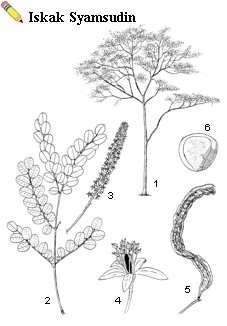 | Adenanthera pavonina L. – 1, tree habit; 2, leaf; 3, inflorescence; 4, flower; 5, pod; 6, seed. |
Ecology
Adenanthera species are found scattered in primary and secondary, evergreen to dry deciduous rain forest, but also in open savanna-like vegetation, from sea-level up to 900 m altitude. A. kostermansii is also found in peat-swamp and freshwater swamp forest. Most species occur on a wide variety of soil types including sand, clay, limestone and other rocks.
Silviculture and Management
Adenanthera can be propagated by seed. Propagation from large cuttings is also reported to be successful in India, but it proved impossible to propagate A. microsperma by stem or root cuttings. Pods of A. intermedia (and probably also of other species) should be collected from the trees, as they open before being shed. Available dry seed counts per kg are 6400 for A. forbesii, 8000-10 500 for A. microsperma and 3750 for A. pavonina. Seed needs scarification by filing or scraping the hard seed-coat to overcome seed-coat dormancy, otherwise germination is erratic and may take up to 10 months. Seeds of A. pavonina become impermeable with time and after being stored for 8 months they fail to germinate. Their viability, however, is not affected, as after mechanical scarification germination is 100% in 1-4 days. Many seedlings of A. microsperma die when grown in full sunlight. Stumps of seedlings of A. microsperma with 5-10 cm of stem, 20 cm roots and a diameter of 0.5-2.5 cm have been successfully planted. Direct sowing using 4 seeds/hole has also been successful. A. microsperma has been well tested in trials in Java. Fairly dense planting at 2-3 m x 1 m is necessary to prevent trees developing poor stem forms or multiple stems. Using these spacings, canopy closure takes 2-3 years. Early thinning is important, as trees tend to die off when the stand becomes too dense. Timber yield at the age of 12 years is 60-96 m3/ha. In timber plantations of A. microsperma a rotation of 50 years has been recommended.
Genetic Resources and Breeding
A. pavonina is widely planted, but there are no known germplasm collections or records of breeding experiments. The other timber-yielding species do not seem to be immediately endangered either.
Prospects
Research into plantation establishment and silvicultural management of some promising Adenanthera species would be worthwhile, to promote their use.
Literature
[12]Aguilar, N.O., Pitargue, F.C. & Cajano, M.O., 1994. Nodulation of legumes in the Philippines. In: Sprent, J.I. & McKey, D. (Editors): Advances in legume systematics 5: The nitrogen factor. Royal Botanic Gardens, Kew. pp. 25-31.
[57]Appanah, S. & Weinland, G., 1993. Planting quality timber trees in Peninsular Malaysia - a review. Malayan Forest Record No 38. Forest Research Institute Malaysia, Kepong. 221 pp.
[130]Bosbouwproefstation, 1948. Tabellarisch overzicht van de beste kiem-, bewaar- en verzendingswijze van zaad van een aantal boomsoorten en groenbemesters [Tabular summary of the best ways to germinate, store and send seed of some tree and green manure species]. Voorlopig rapport No 38. Bosbouwproefstation, Buitenzorg. 15 pp.
[151]Browne, F.G., 1955. Forest trees of Sarawak and Brunei and their products. Government Printing Office, Kuching, Sarawak. xviii + 369 pp.
[162]Burgess, P.F., 1966. Timbers of Sabah. Sabah Forest Records No 6. Forest Department, Sabah, Sandakan. xviii + 501 pp.
[163]Burkill, I.H., 1966. A dictionary of the economic products of the Malay Peninsula. 2nd edition. Ministry of Agriculture and Co-operatives, Kuala Lumpur. Vol. 1 (A-H) pp. 1-1240. Vol. 2 (I-Z) pp. 1241-2444.
[198]Cockburn, P.F., 1976-1980. Trees of Sabah. 2 volumes. Sabah Forest Records No 10. Forest Department Sabah, Sandakan.
[209]Corner, E.J.H., 1988. Wayside trees of Malaya. 3rd edition. 2 volumes. The Malayan Nature Society, Kuala Lumpur. 774 pp.
[218]Dahms, K.-G., 1982. Asiatische, ozeanische und australische Exporthölzer [Asiatic, Pacific and Australian export timbers]. DRW-Verlag, Stuttgart. 304 pp.
[260]den Berger, L.G., 1926. Houtsoorten der cultuurgebieden van Java en Sumatra's oostkust [Tree species of the cultivated areas of Java and the east coast of Sumatra]. Mededeelingen No 13. Proefstation voor het Boschwezen, Buitenzorg. 186 pp.
[261]den Berger, L.G. & Endert, F.H., 1925. Belangrijke houtsoorten van Nederlandsch-Indië, deel I [Important timbers of the Dutch East Indies, part I]. Mededeelingen No 11. Proefstation voor het Boschwezen, Buitenzorg. 136 pp.
[267]Desch, H.E., 1941-1954. Manual of Malayan timbers. Malayan Forest Records No 15. 2 volumes. Malaya Publishing House Ltd., Singapore. 762 pp.
[304]Eddowes, P.J., 1995-1997. The forests and timbers of Papua New Guinea. (unpublished data).
[308]Eidmann, F.E., 1933. Kiemingsonderzoek bij een 55-tal wildhoutsoorten en groenbemesters [Research on the germination of seeds of some 55 tree species and green manures]. Mededeelingen No 26. Boschbouwproefstation, Buitenzorg. 156 pp.
[341]Flora Malesiana (various editors), 1950-. Kluwer Academic Publishers, Dordrecht, Boston, London.
[343]Flore du Cambodge, du Laos et du Viêtnam (various editors), 1960-. Muséum National d'Histoire Naturelle, Paris.
[348]Forest Products Research Centre, 1967. Properties and uses of Papua and New Guinea timbers. Forest Products Research Centre, Port Moresby. 30 pp.
[360]Fundter, J.M. & Wisse, J.H., 1977. 40 belangrijke houtsoorten uit Indonesisch Nieuw Guinea (Irian Jaya) met de anatomische en technische kenmerken [40 important timber species from Indonesian New Guinea (Irian Jaya) with their anatomical and technical characteristics]. Mededelingen Landbouwhogeschool Wageningen 77-9. 223 pp.
[366]Garrard, A., 1955. The germination and longevity of seeds in an equatorial climate. Gardens' Bulletin, Singapore 14: 534-545.
[405]Hardjowasono, M.S., 1942. Gewicht en volume van verschillende vrucht- en zaadsoorten [Weight and volume of various fruits and seeds]. Korte Mededelingen No 20. Bosbouwproefstation, Buitenzorg. 172 pp.
[408]Hart, H.M.J., 1929. Culturen op de slechte mergelgronden van Tanggoeng tot Goendih [Cultivation on poor limestone soils from Tanggung to Gundih]. Mededeelingen No 23. Proefstation voor het Boschwezen, Buitenzorg. 272 pp.
[435]Hermana, 1978. Penilaian beberapa hasil olahan saga (Adenanthera pavonina) [Evaluation of several saga (Adenanthera pavonina) products]. Buletin Perhimpunan Ahli Teknologi Pangan Indonesia 3(1-2): 11-17.
[436]Heyne, K., 1927. De nuttige planten van Nederlands-Indië [The useful plants of the Dutch East Indies]. 2nd edition, 3 volumes. Departement van Landbouw, Nijverheid en Handel in Nederlandsch-Indië. 1953 pp. (3rd edition, 1950. van Hoeve, 's-Gravenhage/Bandung. 1660 pp.).
[464]Ilic, J., 1990. The CSIRO macro key for hardwood identification. CSIRO, Highett. 125 pp.
[487]Japing, C.H., 1961. Houtsoorten van Nieuw Guinea - literatuurstudie [Tree species of Dutch New Guinea - survey of literature]. 2 parts. Wageningen. 220 pp.
[488]Japing, H.W. & Oey Djoen Seng, 1936. Cultuurproeven met wildhoutsoorten in Gadoengan - met overzicht van de literatuur betreffende deze soorten [Trial plantations of non teak wood species in Gadungan (East Java) - with survey of literature about these species]. Korte Mededeelingen No 55, part I to VI. Boschbouwproefstation, Buitenzorg. 270 pp.
[633]Kramer, F., 1925. Kultuurproeven met industrie-, konstruktie- en luxe-houtsoorten [Investigations regarding the cultivation of different Javanese trees]. Mededeelingen No 12. Proefstation voor het Boschwezen, Buitenzorg. 99 pp.
[722]Lukman, A.H., Ketaren, S. & Machfud, 1982. The effect of rolling and cooking time of coralseed (Adenanthera pavonina L.) on the quality of seed oil and the yield of extraction process. Buletin Penelitian Teknologi Industri 1(2): 1-15.
[780]Meniado, J.A. et al., 1975-1981. Wood identification handbook for Philippine timbers. 2 volumes. Government Printing Office, Manila. 370 pp. & 186 pp.
[800]Mohd Ghazali, H.O. & Abd. Rahim, A. S., 1985. Flowering-to-fruiting period of Malaysian forest trees. Malaysian Forester 48: 254-257.
[829]Ng, F.S.P., 1991-1992. Manual of forest fruits, seeds and seedlings. 2 volumes. Malayan Forest Record No 34. Forest Research Institute Malaysia, Kepong. 997 pp.
[831]Ng, F.S.P. & Mat Asri Ngah Sanah, 1991. Germination and seedling records. Research Pamphlet No 108. Forest Research Institute Malaysia, Kepong. 191 pp.
[841]Nielsen, I. & Guinet, P., 1992. Synopsis of Adenanthera (Leguminosae-Mimosoideae). Nordic Journal of Botany 12: 85-114.
[861]Oey Djoen Seng, 1951. De soortelijke gewichten van Indonesische houtsoorten en hun betekenis voor de praktijk [Specific gravity of Indonesian woods and its significance for practical use]. Rapport No 46. Bosbouwproefstation, Bogor. 183 pp.
[889]Phengklai, C. & Khamsai, S., 1985. Some non-timber species of Thailand. Thai Forest Bulletin (Botany) 15: 108-148.
[924]Ramesh Rao, K. & Purkayastha, S.K., 1972. Indian woods: their identification, properties and uses. Vol. 3: Leguminosae to Combretaceae. Manager of Publications, Delhi. 262 pp.
[934]Reyes, L.J., 1938. Philippine woods. Technical Bulletin No 7. Commonwealth of the Philippines, Department of Agriculture and Commerce. Bureau of Printing, Manila. 536 pp. + 88 plates.
[1038]Smitinand, T., 1980. Thai plant names. Royal Forest Department, Bangkok. 379 pp.
[1039]Smitinand, T. & Larsen, K. (Editors), 1970-. Flora of Thailand. The Forest Herbarium, Royal Forest Department, Bangkok.
[1045]Soemartono, 1982. Tinjauan dan laporan tentang usaha promosi saga pohon (Adenanthera pavonina Linn.) sebagai sumber bahan pangan baru [A review and report about Adenanthera pavonina Linn. as a new food source]. In: Prosiding seminar teknologi pangan keempat. Balai Penelitian Kimia, Bogor. pp. 228–245.
[1163]Verdcourt, B., 1979. A manual of New Guinea legumes. Botany Bulletin No 11. Office of Forests, Division of Botany, Lae. 645 pp.
[1169]Vidal, J., 1962. Noms vernaculaires de plantes en usage au Laos [Vernacular names of plants used in Laos]. Ecole française d'Extrême-Orient, Paris. 197 pp.
[1198]Weidelt, H.J. (Editor), 1976. Manual of reforestation and erosion control for the Philippines. Schriftenreihe No 22. Deutsche Gesellschaft für Technische Zusammenarbeit (GTZ) GmbH, Eschborn. 569 pp.
[1221]Whitmore, T.C. & Ng, F.S.P. (Editors), 1972-1989. Tree flora of Malaya. A manual for foresters. 4 volumes. Malayan Forest Records No 26. Longman Malaysia Sdn. Berhad, Kuala Lumpur & Petaling Jaya.
[1242]Wong, T.M., 1982. A dictionary of Malaysian timbers. Malayan Forest Records No 30. Forest Research Institute Malaysia, Kepong. 259 pp.
[57]Appanah, S. & Weinland, G., 1993. Planting quality timber trees in Peninsular Malaysia - a review. Malayan Forest Record No 38. Forest Research Institute Malaysia, Kepong. 221 pp.
[130]Bosbouwproefstation, 1948. Tabellarisch overzicht van de beste kiem-, bewaar- en verzendingswijze van zaad van een aantal boomsoorten en groenbemesters [Tabular summary of the best ways to germinate, store and send seed of some tree and green manure species]. Voorlopig rapport No 38. Bosbouwproefstation, Buitenzorg. 15 pp.
[151]Browne, F.G., 1955. Forest trees of Sarawak and Brunei and their products. Government Printing Office, Kuching, Sarawak. xviii + 369 pp.
[162]Burgess, P.F., 1966. Timbers of Sabah. Sabah Forest Records No 6. Forest Department, Sabah, Sandakan. xviii + 501 pp.
[163]Burkill, I.H., 1966. A dictionary of the economic products of the Malay Peninsula. 2nd edition. Ministry of Agriculture and Co-operatives, Kuala Lumpur. Vol. 1 (A-H) pp. 1-1240. Vol. 2 (I-Z) pp. 1241-2444.
[198]Cockburn, P.F., 1976-1980. Trees of Sabah. 2 volumes. Sabah Forest Records No 10. Forest Department Sabah, Sandakan.
[209]Corner, E.J.H., 1988. Wayside trees of Malaya. 3rd edition. 2 volumes. The Malayan Nature Society, Kuala Lumpur. 774 pp.
[218]Dahms, K.-G., 1982. Asiatische, ozeanische und australische Exporthölzer [Asiatic, Pacific and Australian export timbers]. DRW-Verlag, Stuttgart. 304 pp.
[260]den Berger, L.G., 1926. Houtsoorten der cultuurgebieden van Java en Sumatra's oostkust [Tree species of the cultivated areas of Java and the east coast of Sumatra]. Mededeelingen No 13. Proefstation voor het Boschwezen, Buitenzorg. 186 pp.
[261]den Berger, L.G. & Endert, F.H., 1925. Belangrijke houtsoorten van Nederlandsch-Indië, deel I [Important timbers of the Dutch East Indies, part I]. Mededeelingen No 11. Proefstation voor het Boschwezen, Buitenzorg. 136 pp.
[267]Desch, H.E., 1941-1954. Manual of Malayan timbers. Malayan Forest Records No 15. 2 volumes. Malaya Publishing House Ltd., Singapore. 762 pp.
[304]Eddowes, P.J., 1995-1997. The forests and timbers of Papua New Guinea. (unpublished data).
[308]Eidmann, F.E., 1933. Kiemingsonderzoek bij een 55-tal wildhoutsoorten en groenbemesters [Research on the germination of seeds of some 55 tree species and green manures]. Mededeelingen No 26. Boschbouwproefstation, Buitenzorg. 156 pp.
[341]Flora Malesiana (various editors), 1950-. Kluwer Academic Publishers, Dordrecht, Boston, London.
[343]Flore du Cambodge, du Laos et du Viêtnam (various editors), 1960-. Muséum National d'Histoire Naturelle, Paris.
[348]Forest Products Research Centre, 1967. Properties and uses of Papua and New Guinea timbers. Forest Products Research Centre, Port Moresby. 30 pp.
[360]Fundter, J.M. & Wisse, J.H., 1977. 40 belangrijke houtsoorten uit Indonesisch Nieuw Guinea (Irian Jaya) met de anatomische en technische kenmerken [40 important timber species from Indonesian New Guinea (Irian Jaya) with their anatomical and technical characteristics]. Mededelingen Landbouwhogeschool Wageningen 77-9. 223 pp.
[366]Garrard, A., 1955. The germination and longevity of seeds in an equatorial climate. Gardens' Bulletin, Singapore 14: 534-545.
[405]Hardjowasono, M.S., 1942. Gewicht en volume van verschillende vrucht- en zaadsoorten [Weight and volume of various fruits and seeds]. Korte Mededelingen No 20. Bosbouwproefstation, Buitenzorg. 172 pp.
[408]Hart, H.M.J., 1929. Culturen op de slechte mergelgronden van Tanggoeng tot Goendih [Cultivation on poor limestone soils from Tanggung to Gundih]. Mededeelingen No 23. Proefstation voor het Boschwezen, Buitenzorg. 272 pp.
[435]Hermana, 1978. Penilaian beberapa hasil olahan saga (Adenanthera pavonina) [Evaluation of several saga (Adenanthera pavonina) products]. Buletin Perhimpunan Ahli Teknologi Pangan Indonesia 3(1-2): 11-17.
[436]Heyne, K., 1927. De nuttige planten van Nederlands-Indië [The useful plants of the Dutch East Indies]. 2nd edition, 3 volumes. Departement van Landbouw, Nijverheid en Handel in Nederlandsch-Indië. 1953 pp. (3rd edition, 1950. van Hoeve, 's-Gravenhage/Bandung. 1660 pp.).
[464]Ilic, J., 1990. The CSIRO macro key for hardwood identification. CSIRO, Highett. 125 pp.
[487]Japing, C.H., 1961. Houtsoorten van Nieuw Guinea - literatuurstudie [Tree species of Dutch New Guinea - survey of literature]. 2 parts. Wageningen. 220 pp.
[488]Japing, H.W. & Oey Djoen Seng, 1936. Cultuurproeven met wildhoutsoorten in Gadoengan - met overzicht van de literatuur betreffende deze soorten [Trial plantations of non teak wood species in Gadungan (East Java) - with survey of literature about these species]. Korte Mededeelingen No 55, part I to VI. Boschbouwproefstation, Buitenzorg. 270 pp.
[633]Kramer, F., 1925. Kultuurproeven met industrie-, konstruktie- en luxe-houtsoorten [Investigations regarding the cultivation of different Javanese trees]. Mededeelingen No 12. Proefstation voor het Boschwezen, Buitenzorg. 99 pp.
[722]Lukman, A.H., Ketaren, S. & Machfud, 1982. The effect of rolling and cooking time of coralseed (Adenanthera pavonina L.) on the quality of seed oil and the yield of extraction process. Buletin Penelitian Teknologi Industri 1(2): 1-15.
[780]Meniado, J.A. et al., 1975-1981. Wood identification handbook for Philippine timbers. 2 volumes. Government Printing Office, Manila. 370 pp. & 186 pp.
[800]Mohd Ghazali, H.O. & Abd. Rahim, A. S., 1985. Flowering-to-fruiting period of Malaysian forest trees. Malaysian Forester 48: 254-257.
[829]Ng, F.S.P., 1991-1992. Manual of forest fruits, seeds and seedlings. 2 volumes. Malayan Forest Record No 34. Forest Research Institute Malaysia, Kepong. 997 pp.
[831]Ng, F.S.P. & Mat Asri Ngah Sanah, 1991. Germination and seedling records. Research Pamphlet No 108. Forest Research Institute Malaysia, Kepong. 191 pp.
[841]Nielsen, I. & Guinet, P., 1992. Synopsis of Adenanthera (Leguminosae-Mimosoideae). Nordic Journal of Botany 12: 85-114.
[861]Oey Djoen Seng, 1951. De soortelijke gewichten van Indonesische houtsoorten en hun betekenis voor de praktijk [Specific gravity of Indonesian woods and its significance for practical use]. Rapport No 46. Bosbouwproefstation, Bogor. 183 pp.
[889]Phengklai, C. & Khamsai, S., 1985. Some non-timber species of Thailand. Thai Forest Bulletin (Botany) 15: 108-148.
[924]Ramesh Rao, K. & Purkayastha, S.K., 1972. Indian woods: their identification, properties and uses. Vol. 3: Leguminosae to Combretaceae. Manager of Publications, Delhi. 262 pp.
[934]Reyes, L.J., 1938. Philippine woods. Technical Bulletin No 7. Commonwealth of the Philippines, Department of Agriculture and Commerce. Bureau of Printing, Manila. 536 pp. + 88 plates.
[1038]Smitinand, T., 1980. Thai plant names. Royal Forest Department, Bangkok. 379 pp.
[1039]Smitinand, T. & Larsen, K. (Editors), 1970-. Flora of Thailand. The Forest Herbarium, Royal Forest Department, Bangkok.
[1045]Soemartono, 1982. Tinjauan dan laporan tentang usaha promosi saga pohon (Adenanthera pavonina Linn.) sebagai sumber bahan pangan baru [A review and report about Adenanthera pavonina Linn. as a new food source]. In: Prosiding seminar teknologi pangan keempat. Balai Penelitian Kimia, Bogor. pp. 228–245.
[1163]Verdcourt, B., 1979. A manual of New Guinea legumes. Botany Bulletin No 11. Office of Forests, Division of Botany, Lae. 645 pp.
[1169]Vidal, J., 1962. Noms vernaculaires de plantes en usage au Laos [Vernacular names of plants used in Laos]. Ecole française d'Extrême-Orient, Paris. 197 pp.
[1198]Weidelt, H.J. (Editor), 1976. Manual of reforestation and erosion control for the Philippines. Schriftenreihe No 22. Deutsche Gesellschaft für Technische Zusammenarbeit (GTZ) GmbH, Eschborn. 569 pp.
[1221]Whitmore, T.C. & Ng, F.S.P. (Editors), 1972-1989. Tree flora of Malaya. A manual for foresters. 4 volumes. Malayan Forest Records No 26. Longman Malaysia Sdn. Berhad, Kuala Lumpur & Petaling Jaya.
[1242]Wong, T.M., 1982. A dictionary of Malaysian timbers. Malayan Forest Records No 30. Forest Research Institute Malaysia, Kepong. 259 pp.
Author(s)
J.P. Rojo
Adenanthera forbesii
Adenanthera intermedia
Adenanthera kostermansii
Adenanthera malayana
Adenanthera microsperma
Adenanthera novoguineensis
Adenanthera pavonina
Adenanthera intermedia
Adenanthera kostermansii
Adenanthera malayana
Adenanthera microsperma
Adenanthera novoguineensis
Adenanthera pavonina
Correct Citation of this Article
Rojo, J.P., 1998. Adenanthera L.. In: Sosef, M.S.M., Hong, L.T. and Prawirohatmodjo, S. (Editors): Plant Resources of South-East Asia No 5(3): Timber trees; Lesser-known timbers. PROSEA Foundation, Bogor, Indonesia. Database record: prota4u.org/prosea
Selection of Species
The following species in this genus are important in this commodity group and are treated separatedly in this database:
Adenanthera forbesii
Adenanthera intermedia
Adenanthera kostermansii
Adenanthera malayana
Adenanthera microsperma
Adenanthera novoguineensis
Adenanthera pavonina
Adenanthera forbesii
Adenanthera intermedia
Adenanthera kostermansii
Adenanthera malayana
Adenanthera microsperma
Adenanthera novoguineensis
Adenanthera pavonina

All texts are licensed under a Creative Commons Attribution-Noncommercial-Share Alike 3.0 Netherlands License
This license does not include the illustrations (Maps,drawings,pictures); these remain all under copyright.