Record Number
4806
PROSEA Handbook Number
5(3): Timber trees; Lesser-known timbers
Taxon
Alangium Lamk
Protologue
Encycl. 1: 174 (1783).
Family
ALANGIACEAE
Chromosome Numbers
x = 11; A. chinense: n = 33, 2n = 22, A. salvifolium: n = 11
Vernacular Names
Alangi (En). Indonesia: merlapang. Malaysia: kondolon, satu inchi (Sabah), mentulang (Peninsular). Philippines: malatapai. Burma (Myanmar): tabuya. Thailand: pru. Vietnam: th[oo]i chanh.
Origin and Geographic Distribution
Alangium comprises about 23 species and occurs from tropical Africa and Madagascar to India, Indo-China, China, Japan, Thailand, throughout the Malesian area towards eastern Australia, New Caledonia and Fiji. Within Malesia 15 species occur.
Uses
The timber of Alangium has been used for house construction (beams, flooring, general framing, indoor panelling), furniture and cabinet work, inlaying, carving, bobbins, spindles, shuttles, rice pestles, tool handles, walking sticks, gunstocks and handicraft articles. The root wood has been used to make tobacco pipes.
The pulp of the fruit is astringent but is eaten in India; the fruit kernel is edible. The root bark of A. salvifolium has been used against leprosy and skin diseases. In Indo-China A. chinense is also used for firewood.
The pulp of the fruit is astringent but is eaten in India; the fruit kernel is edible. The root bark of A. salvifolium has been used against leprosy and skin diseases. In Indo-China A. chinense is also used for firewood.
Production and International Trade
Since the supply is limited the timber of Alangium is not commercially important and probably harvested and traded only locally in mixed consignments of medium hardwood.
Properties
Alangium yields a medium-weight to heavy hardwood with a density of 440-1100 kg/m3 at 15% moisture content. Heartwood chocolate to cinnamon-brown, clearly or not clearly demarcated from the wide and buff or yellowish sapwood; grain straight, sometimes interlocked or wavy; texture rather fine and even; in some species the wood tastes slightly bitter. Growth rings not visible, although occasionally marked by narrow dark-coloured marginal parenchyma; vessels moderately small to medium-sized, diffuse porous in section Conostigma Bloemb. and sometimes semi-ring porous in section Marlea Baillon, mostly in radial multiples of 2-4(-more), occasionally white or yellow deposits present; parenchyma abundant, apotracheal diffuse-in-aggregates, marginally zonate bands in section Marlea, distinct with a hand lens; rays moderately fine to medium-sized, visible to the naked eye; ripple marks absent.
The wood seasons well and is not subject to checking. It works well, bends easily and takes a high finish. It is strong and moderately hard to hard. The wood is very durable under cover but not in contact with the ground. It is susceptible to ambrosia beetle attack and marine borers. The sapwood of A. longiflorum is non-susceptible to Lyctus, nor is the heartwood susceptible to dry-wood termites.
The gross energy value of the sapwood of A. rotundifolium is about 20 050 kJ/kg, that of heartwood about 20 195 kJ/kg.
See also the tables on microscopic wood anatomy and wood properties.
The wood seasons well and is not subject to checking. It works well, bends easily and takes a high finish. It is strong and moderately hard to hard. The wood is very durable under cover but not in contact with the ground. It is susceptible to ambrosia beetle attack and marine borers. The sapwood of A. longiflorum is non-susceptible to Lyctus, nor is the heartwood susceptible to dry-wood termites.
The gross energy value of the sapwood of A. rotundifolium is about 20 050 kJ/kg, that of heartwood about 20 195 kJ/kg.
See also the tables on microscopic wood anatomy and wood properties.
Botany
Shrubs or small to fairly large trees up to 40 m tall (rarely woody climbers); bole up to 90 cm in diameter, sometimes with short thin buttresses or stilt roots; bark surface smooth to cracking or flaking into circular scales, lenticellate or pustular, reddish-brown to dark grey, inner bark usually pale brown to orange-yellow, sometimes purplish-red. Leaves arranged spirally, sometimes distichous, simple, entire or occasionally lobed or coarsely dentate, venation varying from palmate to pinnate, exstipulate. Flowers in a sessile or short-stalked, axillary cyme, bisexual; calyx gamosepalous, the rim almost entire or with 4-10 small teeth; petals 4-10, free, valvate, linear; filaments usually hairy inside; intra-staminal disk well developed; ovary inferior, 1-2-locular with 1 pendulous ovule in each cell, style 1. Fruit a drupe, often curved and longitudinally grooved, crowned by a persistent cup-shaped calyx. Seedling with epigeal germination; cotyledons leafy.
Branching is dimorphic, with the leaves arranged spirally on the orthotrophic leader shoot and distichous on the plagiotropic branch shoots. Tree form is according to Massart's architectural model (A. chinense), characterized by an orthotropic, monopodial trunk with rhythmic growth consequently producing tiers of plagiotropic branches, or Roux's architectural model (A. salvifolium), characterized by a continuously growing monopodial trunk with plagiotropic branches. A single 45-year-old A. ridleyi tree in the arboretum of the Forest Research Institute Malaysia, Kepong had attained a diameter of 31 cm, a total height of 22 m and a clear bole of 7 m. Flowering takes place during the dry season, fruiting by the end of the dry season and the beginning of the wet season. Pollination is by insects, mainly small flies. The fruits are eaten by animals like deer and barking deer, and by birds which probably disperse the seeds.
The family Alangiaceae, with Alangium as the sole genus, has sometimes been included in the Cornaceae. The genus is divided into 4 sections which are very distinct, including in their wood structure (see the section on wood anatomy). A. javanicum is very polymorphic, with several varieties, although some authors consider it to be a group of closely related species.
Branching is dimorphic, with the leaves arranged spirally on the orthotrophic leader shoot and distichous on the plagiotropic branch shoots. Tree form is according to Massart's architectural model (A. chinense), characterized by an orthotropic, monopodial trunk with rhythmic growth consequently producing tiers of plagiotropic branches, or Roux's architectural model (A. salvifolium), characterized by a continuously growing monopodial trunk with plagiotropic branches. A single 45-year-old A. ridleyi tree in the arboretum of the Forest Research Institute Malaysia, Kepong had attained a diameter of 31 cm, a total height of 22 m and a clear bole of 7 m. Flowering takes place during the dry season, fruiting by the end of the dry season and the beginning of the wet season. Pollination is by insects, mainly small flies. The fruits are eaten by animals like deer and barking deer, and by birds which probably disperse the seeds.
The family Alangiaceae, with Alangium as the sole genus, has sometimes been included in the Cornaceae. The genus is divided into 4 sections which are very distinct, including in their wood structure (see the section on wood anatomy). A. javanicum is very polymorphic, with several varieties, although some authors consider it to be a group of closely related species.
Image
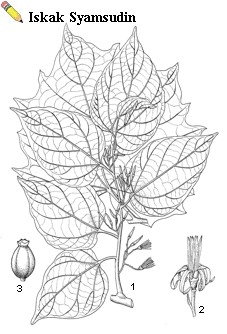 | Alangium chinense (Lour.) Harms – 1, flowering twig; 2, flower; 3, fruit. |
Ecology
Alangium species are found scattered, mainly in primary lowland forest. In Malesia some species ascend up to 1500 m, whereas in the Himalayas A. chinense is found up to 3000 m.
Silviculture and Management
Alangium can be propagated by seed and about 50% of the pyrenes of A. javanicum germinated in 4-15 weeks, whereas for A. ridleyi about 35% germination has been observed in 4-11 weeks. In Peninsular Malaysia A. javanicum is described as a shade-tolerant tree not reaching the canopy top of the forest. Natural regeneration is reported as fairly good.
Genetic Resources and Breeding
There are no records of Alangium in seed or germplasm banks. The wide geographical distribution of most species make them less vulnerable to genetic erosion.
Prospects
Since the supply of Alangium is generally restricted, its importance in international trade is not expected to increase. Due to its good wood characteristics it will probably continue to be used locally for special purposes like toys, handicrafts and indoor panelling.
Literature
[107]Berhaman, A., 1994. Notes on the genus Alangium (Alangiaceae) in Sabah and Sarawak. Sandakania 4: 31-39.
[117]Bloembergen, S., 1939. A revision of the genus Alangium. Bulletin du Jardin Botanique, Buitenzorg, Série III, 16: 139-235.
[162]Burgess, P.F., 1966. Timbers of Sabah. Sabah Forest Records No 6. Forest Department, Sabah, Sandakan. xviii + 501 pp.
[163]Burkill, I.H., 1966. A dictionary of the economic products of the Malay Peninsula. 2nd edition. Ministry of Agriculture and Co-operatives, Kuala Lumpur. Vol. 1 (A-H) pp. 1-1240. Vol. 2 (I-Z) pp. 1241-2444.
[235]de Guzman, E.D., Umali, R.M. & Sotalbo, E.D., 1986. Guide to the Philippine flora and fauna. Vol. 3: Dipterocarps, non-dipterocarps. Natural Resources Management Centre, Ministry of Natural Resources, Quezon City & University of the Philippines, Los Baños. xx + 414 pp.
[267]Desch, H.E., 1941-1954. Manual of Malayan timbers. Malayan Forest Records No 15. 2 volumes. Malaya Publishing House Ltd., Singapore. 762 pp.
[340]Flora of Australia (various editors), 1981-. Australian Government Publishing Service, Canberra.
[343]Flore du Cambodge, du Laos et du Viêtnam (various editors), 1960-. Muséum National d'Histoire Naturelle, Paris.
[402]Hallé, F., Oldeman, R.A.A. & Tomlinson, P.B., 1978. Tropical trees and forests - an architectural analysis. Springer Verlag, Berlin, Heidelberg, New York. 441 pp.
[436]Heyne, K., 1927. De nuttige planten van Nederlands-Indië [The useful plants of the Dutch East Indies]. 2nd edition, 3 volumes. Departement van Landbouw, Nijverheid en Handel in Nederlandsch-Indië. 1953 pp. (3rd edition, 1950. van Hoeve, 's-Gravenhage/Bandung. 1660 pp.).
[438]Hildebrand, F.H., 1951. Daftar nama pohon-pohonan Djawa-Madura dengan keterangan-keterangan tentang penjiaran dan ukurannja (telah diperbaiki) [Revised list of tree species of Java-Madura with notes on their distribution and dimensions]. Laporan No 50. Balai Penjelidikan Kehutanan, Bogor. 183 pp.
[464]Ilic, J., 1990. The CSIRO macro key for hardwood identification. CSIRO, Highett. 125 pp.
[584]Kochummen, K.M., Ng, F.S.P. & Whitmore, T.C., 1968. Notes on the systematy of Malayan phanerogams: VI-X. Federation Museums Journal 13: 133-137.
[780]Meniado, J.A. et al., 1975-1981. Wood identification handbook for Philippine timbers. 2 volumes. Government Printing Office, Manila. 370 pp. & 186 pp.
[823]Ng, F.S.P., 1975. The fruits, seeds and seedlings of Malayan trees I-XI. Malaysian Forester 38: 33-99.
[829]Ng, F.S.P., 1991-1992. Manual of forest fruits, seeds and seedlings. 2 volumes. Malayan Forest Record No 34. Forest Research Institute Malaysia, Kepong. 997 pp.
[831]Ng, F.S.P. & Mat Asri Ngah Sanah, 1991. Germination and seedling records. Research Pamphlet No 108. Forest Research Institute Malaysia, Kepong. 191 pp.
[832]Ng, F.S.P. & Tang, H.T., 1974. Comparative growth rates of Malaysian trees. Malaysian Forester 37: 2-23.
[861]Oey Djoen Seng, 1951. De soortelijke gewichten van Indonesische houtsoorten en hun betekenis voor de praktijk [Specific gravity of Indonesian woods and its significance for practical use]. Rapport No 46. Bosbouwproefstation, Bogor. 183 pp.
[934]Reyes, L.J., 1938. Philippine woods. Technical Bulletin No 7. Commonwealth of the Philippines, Department of Agriculture and Commerce. Bureau of Printing, Manila. 536 pp. + 88 plates.
[947]Rierink, A., 1938. Over de caloriemetrische verbrandingswaarde van een zestigtal Ned. Indische houtsoorten [The calorific value of about 60 woods from the Dutch East Indies]. Tectona 31: 400-418.
[974]Salvosa, F.M., 1963. Lexicon of Philippine trees. Bulletin No 1. Forest Products Research Institute, College, Laguna. 136 pp.
[1038]Smitinand, T., 1980. Thai plant names. Royal Forest Department, Bangkok. 379 pp.
[1048]Soepadmo, E., Wong, K.M. & Saw, L.G. (Editors), 1995-. Tree flora of Sabah and Sarawak. Sabah Forestry Department, Forest Research Institute Malaysia and Sarawak Forestry Department, Kepong.
[1169]Vidal, J., 1962. Noms vernaculaires de plantes en usage au Laos [Vernacular names of plants used in Laos]. Ecole française d'Extrême-Orient, Paris. 197 pp.
[1221]Whitmore, T.C. & Ng, F.S.P. (Editors), 1972-1989. Tree flora of Malaya. A manual for foresters. 4 volumes. Malayan Forest Records No 26. Longman Malaysia Sdn. Berhad, Kuala Lumpur & Petaling Jaya.
[1242]Wong, T.M., 1982. A dictionary of Malaysian timbers. Malayan Forest Records No 30. Forest Research Institute Malaysia, Kepong. 259 pp.
[117]Bloembergen, S., 1939. A revision of the genus Alangium. Bulletin du Jardin Botanique, Buitenzorg, Série III, 16: 139-235.
[162]Burgess, P.F., 1966. Timbers of Sabah. Sabah Forest Records No 6. Forest Department, Sabah, Sandakan. xviii + 501 pp.
[163]Burkill, I.H., 1966. A dictionary of the economic products of the Malay Peninsula. 2nd edition. Ministry of Agriculture and Co-operatives, Kuala Lumpur. Vol. 1 (A-H) pp. 1-1240. Vol. 2 (I-Z) pp. 1241-2444.
[235]de Guzman, E.D., Umali, R.M. & Sotalbo, E.D., 1986. Guide to the Philippine flora and fauna. Vol. 3: Dipterocarps, non-dipterocarps. Natural Resources Management Centre, Ministry of Natural Resources, Quezon City & University of the Philippines, Los Baños. xx + 414 pp.
[267]Desch, H.E., 1941-1954. Manual of Malayan timbers. Malayan Forest Records No 15. 2 volumes. Malaya Publishing House Ltd., Singapore. 762 pp.
[340]Flora of Australia (various editors), 1981-. Australian Government Publishing Service, Canberra.
[343]Flore du Cambodge, du Laos et du Viêtnam (various editors), 1960-. Muséum National d'Histoire Naturelle, Paris.
[402]Hallé, F., Oldeman, R.A.A. & Tomlinson, P.B., 1978. Tropical trees and forests - an architectural analysis. Springer Verlag, Berlin, Heidelberg, New York. 441 pp.
[436]Heyne, K., 1927. De nuttige planten van Nederlands-Indië [The useful plants of the Dutch East Indies]. 2nd edition, 3 volumes. Departement van Landbouw, Nijverheid en Handel in Nederlandsch-Indië. 1953 pp. (3rd edition, 1950. van Hoeve, 's-Gravenhage/Bandung. 1660 pp.).
[438]Hildebrand, F.H., 1951. Daftar nama pohon-pohonan Djawa-Madura dengan keterangan-keterangan tentang penjiaran dan ukurannja (telah diperbaiki) [Revised list of tree species of Java-Madura with notes on their distribution and dimensions]. Laporan No 50. Balai Penjelidikan Kehutanan, Bogor. 183 pp.
[464]Ilic, J., 1990. The CSIRO macro key for hardwood identification. CSIRO, Highett. 125 pp.
[584]Kochummen, K.M., Ng, F.S.P. & Whitmore, T.C., 1968. Notes on the systematy of Malayan phanerogams: VI-X. Federation Museums Journal 13: 133-137.
[780]Meniado, J.A. et al., 1975-1981. Wood identification handbook for Philippine timbers. 2 volumes. Government Printing Office, Manila. 370 pp. & 186 pp.
[823]Ng, F.S.P., 1975. The fruits, seeds and seedlings of Malayan trees I-XI. Malaysian Forester 38: 33-99.
[829]Ng, F.S.P., 1991-1992. Manual of forest fruits, seeds and seedlings. 2 volumes. Malayan Forest Record No 34. Forest Research Institute Malaysia, Kepong. 997 pp.
[831]Ng, F.S.P. & Mat Asri Ngah Sanah, 1991. Germination and seedling records. Research Pamphlet No 108. Forest Research Institute Malaysia, Kepong. 191 pp.
[832]Ng, F.S.P. & Tang, H.T., 1974. Comparative growth rates of Malaysian trees. Malaysian Forester 37: 2-23.
[861]Oey Djoen Seng, 1951. De soortelijke gewichten van Indonesische houtsoorten en hun betekenis voor de praktijk [Specific gravity of Indonesian woods and its significance for practical use]. Rapport No 46. Bosbouwproefstation, Bogor. 183 pp.
[934]Reyes, L.J., 1938. Philippine woods. Technical Bulletin No 7. Commonwealth of the Philippines, Department of Agriculture and Commerce. Bureau of Printing, Manila. 536 pp. + 88 plates.
[947]Rierink, A., 1938. Over de caloriemetrische verbrandingswaarde van een zestigtal Ned. Indische houtsoorten [The calorific value of about 60 woods from the Dutch East Indies]. Tectona 31: 400-418.
[974]Salvosa, F.M., 1963. Lexicon of Philippine trees. Bulletin No 1. Forest Products Research Institute, College, Laguna. 136 pp.
[1038]Smitinand, T., 1980. Thai plant names. Royal Forest Department, Bangkok. 379 pp.
[1048]Soepadmo, E., Wong, K.M. & Saw, L.G. (Editors), 1995-. Tree flora of Sabah and Sarawak. Sabah Forestry Department, Forest Research Institute Malaysia and Sarawak Forestry Department, Kepong.
[1169]Vidal, J., 1962. Noms vernaculaires de plantes en usage au Laos [Vernacular names of plants used in Laos]. Ecole française d'Extrême-Orient, Paris. 197 pp.
[1221]Whitmore, T.C. & Ng, F.S.P. (Editors), 1972-1989. Tree flora of Malaya. A manual for foresters. 4 volumes. Malayan Forest Records No 26. Longman Malaysia Sdn. Berhad, Kuala Lumpur & Petaling Jaya.
[1242]Wong, T.M., 1982. A dictionary of Malaysian timbers. Malayan Forest Records No 30. Forest Research Institute Malaysia, Kepong. 259 pp.
Author(s)
C. Phengklai
Alangium chinense
Alangium griffithii
Alangium javanicum
Alangium kurzii
Alangium longiflorum
Alangium nobile
Alangium ridleyi
Alangium rotundifolium
Alangium salvifolium
Alangium griffithii
Alangium javanicum
Alangium kurzii
Alangium longiflorum
Alangium nobile
Alangium ridleyi
Alangium rotundifolium
Alangium salvifolium
Correct Citation of this Article
Phengklai, C., 1998. Alangium Lamk. In: Sosef, M.S.M., Hong, L.T. and Prawirohatmodjo, S. (Editors): Plant Resources of South-East Asia No 5(3): Timber trees; Lesser-known timbers. PROSEA Foundation, Bogor, Indonesia. Database record: prota4u.org/prosea
Selection of Species
The following species in this genus are important in this commodity group and are treated separatedly in this database:
Alangium chinense
Alangium griffithii
Alangium javanicum
Alangium kurzii
Alangium longiflorum
Alangium nobile
Alangium ridleyi
Alangium rotundifolium
Alangium salvifolium
Alangium chinense
Alangium griffithii
Alangium javanicum
Alangium kurzii
Alangium longiflorum
Alangium nobile
Alangium ridleyi
Alangium rotundifolium
Alangium salvifolium

All texts are licensed under a Creative Commons Attribution-Noncommercial-Share Alike 3.0 Netherlands License
This license does not include the illustrations (Maps,drawings,pictures); these remain all under copyright.