Record Number
4869
PROSEA Handbook Number
5(3): Timber trees; Lesser-known timbers
Taxon
Antiaris Lesch. (timber aspects)
Protologue
Ann. Mus. Natl. Hist. Nat. 16: 478 (1810).
Family
MORACEAE
Chromosome Numbers
x = unknown; A. toxicaria (several subspecies): 2n = 24, 28
Vernacular Names
Antiaris (En, trade name), upas tree (En). Indonesia: upas (general), ancar (Javanese), tatai (Sumatra). Malaysia: terap (general), ipoh (Peninsular), tasem (Sarawak). Papua New Guinea: antiaris (En). Philippines: upas (Filipino). Burma (Myanmar): aseik. Laos: 'nong2. Thailand: yang nong (central, northern), yuan (peninsular). Vietnam: c[aa]y sui.
Origin and Geographic Distribution
Antiaris is a monotypic genus. Its only species, A. toxicaria Lesch. (synonyms: A. africana Engl., A. macrophylla R. Br., A. welwitschii Engl.), is found throughout the Old World tropics, from West Africa to Madagascar, Sri Lanka, India, Indo-China, southern China, Thailand, throughout the Malesian region, the Pacific (east to Fiji and Tonga), and northern Australia.
Uses
The wood of A. toxicaria is used for light construction, interior finish, furniture, moulding, panelling, shuttering, strip flooring, pallets, fruit cases, crates, handles for non-striking tools, plywood, core veneers and when treated also for weatherboards and shingles. It is suitable for the production of blockboard.
The bark yields a latex which is one of the principal components of most dart and arrow poisons in South-East Asia. Seeds, leaves and bark are used as a febrifuge and the seeds also as an antidysenteric. The bark has also been used for dyeing and as a bark cloth to make rough clothing. The fruit is edible.
The bark yields a latex which is one of the principal components of most dart and arrow poisons in South-East Asia. Seeds, leaves and bark are used as a febrifuge and the seeds also as an antidysenteric. The bark has also been used for dyeing and as a bark cloth to make rough clothing. The fruit is edible.
Production and International Trade
In general, the wood of A. toxicaria is used only locally or traded in mixed consignments of lightweight hardwood. Export from Papua New Guinea, however, is fair. In 1987 2.7% of all timber exported to Japan from Papua New Guinea was Antiaris, and in 1992 it ranked in MEP (Minimum Export Price) group 3, yielding a minimum export price for saw logs of US$ 50/m3. In 1996 Papua New Guinea exported about 6570 m3 of Antiaris logs at an average free-on-board (FOB) price of US$ 118/m3. In 1992 the export of "terap"" (also including timber of Parartocarpus and the lightweight Artocarpus species) from Sabah amounted to almost 9000 m3, mainly as logs, with a total value of US$ 630 000.
Properties
A. toxicaria yields a lightweight hardwood with a density of (250-)390-540 kg/m3 at 15% moisture content. Heartwood almost white, pale yellow or pale yellow-brown, not clearly differentiated from the sapwood which is up to 8 cm wide; grain interlocked; texture moderately coarse to coarse and even; wood lustrous and with ribbon figure on quarter-sawn surface. Growth rings indistinct; vessels moderately large to very large, mostly solitary, some in radial multiples of 2-4(-more), rarely in clusters, often with dark-coloured extraneous deposits, tyloses sparse or absent; parenchyma moderately abundant, paratracheal vasicentric and aliform, occasionally confluent; rays medium-sized, not conspicuous on radial surface; ripple marks absent; wood with laticifers, sometimes appearing as brown dots on tangential faces.
Shrinkage upon seasoning is moderate and the wood dries rapidly with little degrade. The wood is soft and very weak. It is fairly easy to work with hand and machine tools, and is easy to saw, but sharp tools are required to prevent crumbling, particularly along the edges. Some tearing may occur in planing, but it produces a very lustrous surface. It nails, glues and polishes well and is easy to peel. The wood is non-durable, but both heartwood and sapwood are permeable to pressure treatment; a retention of 455 kg/m3 and 540 kg/m3 has been determined for heartwood and sapwood, respectively. Rapid conversion and the application of anti-stain chemicals upon felling and immediately after sawing are essential, as the wood is liable to sap-stain. The wood is susceptible to pinhole borers and dry-wood termites. The sapwood is susceptible to Lyctus. Sawdust may cause skin irritation and stomach pain.
See also the tables on microscopic wood anatomy and wood properties.
Botany
A sometimes deciduous, monoecious, small to large tree up to 45(-60) m tall; bole straight, branchless for up to 23 m, up to 180 cm in diameter, sometimes with steep buttresses up to 3 m high; bark surface smooth becoming slightly fissured, greyish-white, inner bark soft and fibrous, pale yellowish, exuding a creamy copious latex which soon darkens to dirty brown and becomes granular upon exposure; crown conical at first, dome-shaped at maturity. Twigs hairy. Leaves distichous, simple, entire to denticulate, rounded to slightly heart-shaped and slightly unequal at base; stipules free, caducous. Inflorescence on a short shoot, in leaf axils or below the leaves, subtended by involucral bracts, in groups of 2-4, the male ones below the female ones on the same twig. Male inflorescence a short-stalked discoid head with many flowers; each flower with 2-7 tepals and 2-4 stamens. Female inflorescence with 1-2 flowers, sessile or stalked; flower pear-shaped; perianth 4-lobed; ovary adnate to the perianth, 1-locular with a single ovule, styles 2. Fruit forming a drupaceous whole together with the enlarged, fleshy receptacle, ellipsoid to pear-shaped, velvety. Seedling with hypogeal germination; cotyledons not emergent; hypocotyl not elongated; epicotyl with a few scale leaves followed by spirally arranged, conduplicate, dentate leaves.
Trees develop according to Roux's architectural tree model, characterized by a continuously growing monopodial orthotropic trunk and plagiotropic branches. In a 27-year-old trial in Indonesia trees measured on average 17 m in height and 27 cm in diameter. In Java A. toxicaria flowers in June on the new shoots.
Formerly, A. toxicaria comprised several species, but is now regarded as a single, though variable species. It has been divided into 5 subspecies; subsp. toxicaria and subsp. macrophylla (R. Br.) C.C. Berg occur within the Malesian region, the first is found from Sri Lanka to Sulawesi, the second from the Philippines to Tonga. The size of the fruit increases from Africa to Polynesia.
Image
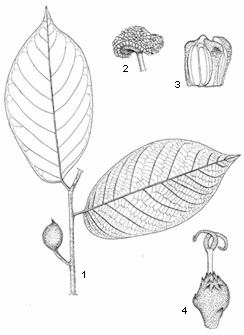 | Antiaris toxicaria Lesch. – 1, fruiting twig; 2, male inflorescence; 3, staminate flower; 4, female inflorescence. |
Ecology
Antiaris is found as a rare, scattered tree in primary forest up to 1500 m altitude. It is occasionally found in grassy savanna and on coastal plateaus. In Africa it occurs under semi-arid conditions.
Silviculture and Management
A. toxicaria can be propagated by seed. About 70-90% of sown stones germinate in 18-89 days. Trees have a good self-pruning ability; they are not resistant to fire. In Ulu Kelantan, Peninsular Malaysia, a density of about 1 tree per 80 ha of natural forest has been observed, but elsewhere in Peninsular Malaysia it is probably even rarer.
Genetic Resources and Breeding
Genetic erosion of A. toxicaria is difficult to assess: on the one hand, trees are not widely harvested throughout their natural area of distribution, on the other, they are rare in natural forest in Peninsular Malaysia.
Prospects
Its good peeling properties make Antiaris acceptable for plywood production, but supply will surely limit an increase in use.
Literature
[40]All Nippon Checkers Corporation, 1989. Illustrated commercial foreign woods in Japan. Tokyo. 262 pp.
[70]Backer, C.A. & Bakhuizen van den Brink Jr., R.C., 1963-1968. Flora of Java. 3 volumes. Wolters-Noordhoff, Groningen.
[105]Berg, C.C., 1977. Revisions of African Moraceae (excluding Dorstenia, Ficus, Musanga and Myrianthus). Bulletin du Jardin Botanique National de Belgique 47: 267-407.
[125]Bolza, E. & Kloot, N.H., 1966. The mechanical properties of 81 New Guinea timbers. Technological Paper No 41. Division of Forest Products, CSIRO, Melbourne. 39 pp.
[151]Browne, F.G., 1955. Forest trees of Sarawak and Brunei and their products. Government Printing Office, Kuching, Sarawak. xviii + 369 pp.
[162]Burgess, P.F., 1966. Timbers of Sabah. Sabah Forest Records No 6. Forest Department, Sabah, Sandakan. xviii + 501 pp.
[163]Burkill, I.H., 1966. A dictionary of the economic products of the Malay Peninsula. 2nd edition. Ministry of Agriculture and Co-operatives, Kuala Lumpur. Vol. 1 (A-H) pp. 1-1240. Vol. 2 (I-Z) pp. 1241-2444.
[205]Corner, E.J.H., 1962. The classification of Moraceae. Gardens' Bulletin, Singapore 19: 187-252.
[209]Corner, E.J.H., 1988. Wayside trees of Malaya. 3rd edition. 2 volumes. The Malayan Nature Society, Kuala Lumpur. 774 pp.
[227]Dassanayake, M.D. & Fosberg, F.R. (Editors), 1980-. A revised handbook to the flora of Ceylon. Amerind Publishing Co. Pvt. Ltd., New Delhi.
[267]Desch, H.E., 1941-1954. Manual of Malayan timbers. Malayan Forest Records No 15. 2 volumes. Malaya Publishing House Ltd., Singapore. 762 pp.
[300]Eddowes, P.J., 1977. Commercial timbers of Papua New Guinea, their properties and uses. Forest Products Research Centre, Department of Primary Industry, Port Moresby. xiv + 195 pp.
[302]Eddowes, P.J., 1980. Lesser known timber species of SEALPA countries. A review and summary. South East Asia Lumber Producers' Association, Jakarta. 132 pp.
[304]Eddowes, P.J., 1995-1997. The forests and timbers of Papua New Guinea. (unpublished data).
[340]Flora of Australia (various editors), 1981-. Australian Government Publishing Service, Canberra.
[348]Forest Products Research Centre, 1967. Properties and uses of Papua and New Guinea timbers. Forest Products Research Centre, Port Moresby. 30 pp.
[402]Hallé, F., Oldeman, R.A.A. & Tomlinson, P.B., 1978. Tropical trees and forests - an architectural analysis. Springer Verlag, Berlin, Heidelberg, New York. 441 pp.
[436]Heyne, K., 1927. De nuttige planten van Nederlands-Indië [The useful plants of the Dutch East Indies]. 2nd edition, 3 volumes. Departement van Landbouw, Nijverheid en Handel in Nederlandsch-Indië. 1953 pp. (3rd edition, 1950. van Hoeve, 's-Gravenhage/Bandung. 1660 pp.).
[536]Keating, W.G. & Bolza, E., 1982. Characteristics, properties and uses of timbers. Vol. 1. South-East Asia, northern Australia and the Pacific. Inkata Press Proprietary Ltd., Melbourne, Sydney & London. 362 pp.
[740]Malaysian Timber Industry Board, 1984. Peraturan pemeringkatan kayu keras gergaji Malaysia [The Malaysian grading rules for sawn hardwood timber]. Ministry of Primary Industries, Kuala Lumpur. 109 pp.
[741]Malaysian Timber Industry Board, 1986. 100 Malaysian timbers. Kuala Lumpur. x + 226 pp.
[758]Masano, 1987. Prospek perkembangan kayu asing di Indonesia [Prospects of exotic trees in Indonesia]. In: Soemarna, K. et al. (Editors): Prosiding diskusi pemanfaatan kayu kurang dikenal, 13-14 Januari 1987, Cisarua, Bogor. Badan Penelitian dan Pengembangan Kehutanan, Bogor. pp. 221-241.
[829]Ng, F.S.P., 1991-1992. Manual of forest fruits, seeds and seedlings. 2 volumes. Malayan Forest Record No 34. Forest Research Institute Malaysia, Kepong. 997 pp.
[831]Ng, F.S.P. & Mat Asri Ngah Sanah, 1991. Germination and seedling records. Research Pamphlet No 108. Forest Research Institute Malaysia, Kepong. 191 pp.
[951]Robillos, Y.U., 1976. Some medicinal forest trees in the Philippines. FORPRIDECOM Technical Note No 169. 3 pp.
[974]Salvosa, F.M., 1963. Lexicon of Philippine trees. Bulletin No 1. Forest Products Research Institute, College, Laguna. 136 pp.
[1038]Smitinand, T., 1980. Thai plant names. Royal Forest Department, Bangkok. 379 pp.
[1087]Tan, Y.E. & Lim, S.C., 1989. Malaysian timbers - terap. Timber Trade Leaflet No 109. Malaysian Timber Industry Board, Kuala Lumpur and Forest Research Institute Malaysia, Kepong. 10 pp.
[1218]Whitmore, T.C., 1984. Tropical rainforest of the Far East. 2nd edition. Clarendon Press, Oxford. xvi + 352 pp.
[1221]Whitmore, T.C. & Ng, F.S.P. (Editors), 1972-1989. Tree flora of Malaya. A manual for foresters. 4 volumes. Malayan Forest Records No 26. Longman Malaysia Sdn. Berhad, Kuala Lumpur & Petaling Jaya.
[1242]Wong, T.M., 1982. A dictionary of Malaysian timbers. Malayan Forest Records No 30. Forest Research Institute Malaysia, Kepong. 259 pp.
[1248]Working group on utilization of tropical woods, 1978. Properties of some Papua New Guinea woods relating with manufacturing processes VI-IX. Bulletin of the Forestry and Forest Products Research Institute Japan No 299: 23-187.
Author(s)
E. Boer & M.S.M. Sosef
Correct Citation of this Article
Boer, E. & Sosef, M.S.M., 1998. Antiaris Lesch. (timber aspects). In: Sosef, M.S.M., Hong, L.T. and Prawirohatmodjo, S. (Editors): Plant Resources of South-East Asia No 5(3): Timber trees; Lesser-known timbers. PROSEA Foundation, Bogor, Indonesia. Database record: prota4u.org/prosea

All texts are licensed under a Creative Commons Attribution-Noncommercial-Share Alike 3.0 Netherlands License
This license does not include the illustrations (Maps,drawings,pictures); these remain all under copyright.