Record Number
4888
PROSEA Handbook Number
5(3): Timber trees; Lesser-known timbers
Taxon
Aporosa Blume
Protologue
Bijdr. fl. Ned. Ind. 10: 514 (1825).
Family
EUPHORBIACEAE
Chromosome Numbers
x = unknown; A. dioica: n = 26
Vernacular Names
Indonesia: sasah (Sundanese). Malaysia: sebasah (Peninsular). Philippines: malabignai. Thailand: mueat. Vietnam: ng[ax]m, th[aaf]u t[as]u.
Origin and Geographic Distribution
Aporosa comprises about 80 species occurring in Sri Lanka and India to Indo-China, southern China, Thailand, throughout the Malesian region (except for the Lesser Sunda Islands) towards the Solomon Islands. Within Malesia some 60 species are present which are distributed as follows: 27 in Peninsular Malaysia, 17 in Sumatra, 6 in Java, 32 in Borneo, 3 in Sulawesi, 5 in the Moluccas, 9 in the Philippines, 22 in New Guinea.
Uses
The wood of Aporosa has been used for local house construction (rafters, flooring etc.), furniture, and small household implements like tool handles and rice pounders. It is suitable for firewood.
The bark and sometimes also the leaves of A. frutescens used to be used in the batik industry as a mordant to fix the red dye from Morinda citrifolia L. The fruit of A. prainiana is reported to be edible.
The bark and sometimes also the leaves of A. frutescens used to be used in the batik industry as a mordant to fix the red dye from Morinda citrifolia L. The fruit of A. prainiana is reported to be edible.
Production and International Trade
As the supply is generally small, the wood of Aporosa is utilized on a local scale only.
Properties
Aporosa yields a medium-weight hardwood with a density of 570-890 kg/m3 at 15% moisture content. Heartwood pale yellow-brown to brown with orange or purple-red tinges, not sharply differentiated from the sapwood; grain straight; texture moderately fine and uneven; wood with appreciable silver grain on quarter-sawn surfaces. Growth rings absent; vessels moderately small to medium-sized, often distinctly angular, solitary in some species but mostly in radial multiples of 2-4, tyloses sparse; parenchyma abundant, apotracheal diffuse-in-aggregates, visible only with a hand lens; rays of 2 sizes, very fine and medium-sized to moderately broad; ripple marks absent.
The wood is moderately hard and strong and is probably easy to work, as it is non-siliceous. It is moderately durable when exposed to the weather or in contact with the ground.
The average fibre length of A. dioica is 1.630 mm. Leaves accumulate aluminium, rendering them pale when dried.
See also the table on microscopic wood anatomy.
The wood is moderately hard and strong and is probably easy to work, as it is non-siliceous. It is moderately durable when exposed to the weather or in contact with the ground.
The average fibre length of A. dioica is 1.630 mm. Leaves accumulate aluminium, rendering them pale when dried.
See also the table on microscopic wood anatomy.
Botany
Evergreen, dioecious, small to medium-sized trees up to 30(-50) m tall; bole usually straight, up to 60 cm in diameter, without buttresses; bark surface smooth to finely scaly or finely fissured, often powdery, inner bark firmly fibrous and dark red-brown or granular and orange-brown. Leaves arranged spirally, simple, entire to toothed, often finely dotted below; petiole usually kneed; stipules caducous or persistent. Flowers small, apetalous; disk absent. Male flowers in solitary or clustered, axillary catkins; sepals 3-4; stamens 2(-5); pistillode minute. Female flowers in a shorter and fewer-flowered spike or cluster, rarely in a more extended raceme; sepals 3-6; ovary superior, 2(-4)-locular with 2 ovules in each cell, styles bifid, persistent. Fruit a few-seeded capsule, splitting regularly or irregularly or not dehiscent, ovoid to globose, with a leathery-fleshy wall. Seed with a dry or fleshy seed-coat. Seedling with epigeal germination; cotyledons emergent, leafy, bilobed; hypocotyl elongated; all leaves arranged spirally.
The flowering-to-fruiting period of A. nigricans in Pennsular Malaysia is about 12 weeks.
Although Aporosa may be quite abundant in some forests, the trees are often overlooked as they show no striking features. Aporosa belongs to the subfamily Phyllanthoideae and the tribe Antidesmeae. The generic name is often spelled as Aporusa; the present spelling, Aporosa, is clearly correct, according to the International Code of Botanical Nomenclature.
The flowering-to-fruiting period of A. nigricans in Pennsular Malaysia is about 12 weeks.
Although Aporosa may be quite abundant in some forests, the trees are often overlooked as they show no striking features. Aporosa belongs to the subfamily Phyllanthoideae and the tribe Antidesmeae. The generic name is often spelled as Aporusa; the present spelling, Aporosa, is clearly correct, according to the International Code of Botanical Nomenclature.
Image
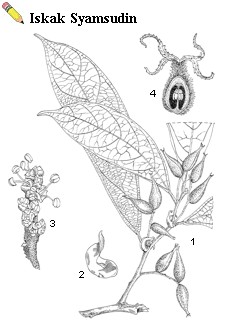 | Aporosa lagenocarpa Airy Shaw – 1, fruiting twig; 2, stipule; 3, male inflorescence; 4, sectioned ovary and styles. |
Ecology
Aporosa is locally common and is usually found in the understorey of primary and secondary lowland rain forest, both in well-drained locations and in seasonal or permanent swamp forest. Individual species can be encountered in more disturbed or more open sites, e.g. in mixed bamboo forest and in montane localities, in New Guinea often in fagaceous forest, up to 2000 m altitude.
Silviculture and Management
Aporosa can be propagated by seed. Seeds sown with adhering pulp generally germinate well (80-98%). Germination was very poor, however, for A. microstachya (6%), A. prainiana (14-25%) and A. stellifera (12%). Germination usually starts 2-3 weeks after sowing and is completed within 2 months. Most species are reported to be fire-resistant.
Genetic Resources and Breeding
There is little risk of genetic erosion in Aporosa, since at present it is rarely felled for timber.
Prospects
As Aporosa is a fairly common forest component in South-East Asia, its wood might become increasingly important.
Literature
[22]Airy Shaw, H.K., 1967. Notes on Malaysian and other Asiatic Euphorbiaceae. LXVII. New species of Aporosa Blume. Kew Bulletin 20: 379-383.
[26]Airy Shaw, H.K., 1972. The Euphorbiaceae of Siam. Kew Bulletin 26: 191-363.
[28]Airy Shaw, H.K., 1975. The Euphorbiaceae of Borneo. Kew Bulletin Additional Series VIII. Her Majesty's Stationery Office, London. 245 pp.
[32]Airy Shaw, H.K., 1980. The Euphorbiaceae of New Guinea. Kew Bulletin Additional Series VIII. Her Majesty's Stationery Office, London. 243 pp.
[33]Airy Shaw, H.K., 1981. An alphabetical enumeration of the Euphorbiaceae of the Philippine islands. Royal Botanic Gardens, Kew. 56 pp.
[34]Airy Shaw, H.K., 1981. The Euphorbiaceae of Sumatra. Kew Bulletin 36: 239-374.
[36]Airy Shaw, H.K., 1983. The Euphorbiaceae of Central Malesia (Celebes, Moluccas, Lesser Sunda Is.). Kew Bulletin 37: 1-40.
[70]Backer, C.A. & Bakhuizen van den Brink Jr., R.C., 1963-1968. Flora of Java. 3 volumes. Wolters-Noordhoff, Groningen.
[162]Burgess, P.F., 1966. Timbers of Sabah. Sabah Forest Records No 6. Forest Department, Sabah, Sandakan. xviii + 501 pp.
[163]Burkill, I.H., 1966. A dictionary of the economic products of the Malay Peninsula. 2nd edition. Ministry of Agriculture and Co-operatives, Kuala Lumpur. Vol. 1 (A-H) pp. 1-1240. Vol. 2 (I-Z) pp. 1241-2444.
[174]Cay go rung Viet nam [Forest trees of Vietnam] (various editors), 1971-1988. Agriculture Publisher, Hanoi.
[189]Chenery, E.M., 1948. Aluminium in the plant world. Part I, general survey in dicotyledons. Kew Bulletin 1948: 173-183.
[209]Corner, E.J.H., 1988. Wayside trees of Malaya. 3rd edition. 2 volumes. The Malayan Nature Society, Kuala Lumpur. 774 pp.
[267]Desch, H.E., 1941-1954. Manual of Malayan timbers. Malayan Forest Records No 15. 2 volumes. Malaya Publishing House Ltd., Singapore. 762 pp.
[436]Heyne, K., 1927. De nuttige planten van Nederlands-Indië [The useful plants of the Dutch East Indies]. 2nd edition, 3 volumes. Departement van Landbouw, Nijverheid en Handel in Nederlandsch-Indië. 1953 pp. (3rd edition, 1950. van Hoeve, 's-Gravenhage/Bandung. 1660 pp.).
[543]Keng, H., 1990. The concise flora of Singapore. Gymnosperms and dicotyledons. Singapore University Press, Singapore. 222 pp.
[553]Kessler, P.J.A. & Sidiyasa, K., 1994. Trees of the Balikpapan-Samarinda area, East Kalimantan, Indonesia. Tropenbos Series 7. The Tropenbos Foundation, Wageningen. 446 pp.
[696]Lemmens, R.H.M.J. & Wulijarni-Soetjipto, N. (Editors), 1991. Plant resources of South-East Asia No 3. Dye and tannin-producing plants. Pudoc, Wageningen. 195 pp.
[800]Mohd Ghazali, H.O. & Abd. Rahim, A. S., 1985. Flowering-to-fruiting period of Malaysian forest trees. Malaysian Forester 48: 254-257.
[829]Ng, F.S.P., 1991-1992. Manual of forest fruits, seeds and seedlings. 2 volumes. Malayan Forest Record No 34. Forest Research Institute Malaysia, Kepong. 997 pp.
[831]Ng, F.S.P. & Mat Asri Ngah Sanah, 1991. Germination and seedling records. Research Pamphlet No 108. Forest Research Institute Malaysia, Kepong. 191 pp.
[834]Nguyen Nghia Thin, 1989. Useful plants of Euphorbiaceae in flora of Vietnam. Forestry Revue, Hanoi 1989: 29-30.
[835]Nguyen Nghia Thin, 1995. Euphorbiaceae of Vietnam. Agriculture Publishing House, Hanoi. 50 pp.
[861]Oey Djoen Seng, 1951. De soortelijke gewichten van Indonesische houtsoorten en hun betekenis voor de praktijk [Specific gravity of Indonesian woods and its significance for practical use]. Rapport No 46. Bosbouwproefstation, Bogor. 183 pp.
[883]Pham Hoang Ho, 1991-1993. An illustrated flora of Vietnam. 2 Volumes. Mekong Publisher, Montreal.
[908]Priasukmana, S. & Silitonga, T., 1972. Dimensi serat beberapa jenis kayu Jawa Barat [Fiber dimensions of several timber species from West Java]. Laporan No 2. Lembaga Penelitian Hasil Hutan, Bogor. 42 pp.
[974]Salvosa, F.M., 1963. Lexicon of Philippine trees. Bulletin No 1. Forest Products Research Institute, College, Laguna. 136 pp.
[996]Schot, A.M., 1995. A synopsis of taxonomic changes in Aporosa Blume (Euphorbiaceae). Blumea 40: 449-460.
[1038]Smitinand, T., 1980. Thai plant names. Royal Forest Department, Bangkok. 379 pp.
[1195]Webster, G.L., 1994. Synopsis of the genera and suprageneric taxa of Euphorbiaceae. Annals of the Missouri Botanical Garden 81: 33-144.
[1221]Whitmore, T.C. & Ng, F.S.P. (Editors), 1972-1989. Tree flora of Malaya. A manual for foresters. 4 volumes. Malayan Forest Records No 26. Longman Malaysia Sdn. Berhad, Kuala Lumpur & Petaling Jaya.
[26]Airy Shaw, H.K., 1972. The Euphorbiaceae of Siam. Kew Bulletin 26: 191-363.
[28]Airy Shaw, H.K., 1975. The Euphorbiaceae of Borneo. Kew Bulletin Additional Series VIII. Her Majesty's Stationery Office, London. 245 pp.
[32]Airy Shaw, H.K., 1980. The Euphorbiaceae of New Guinea. Kew Bulletin Additional Series VIII. Her Majesty's Stationery Office, London. 243 pp.
[33]Airy Shaw, H.K., 1981. An alphabetical enumeration of the Euphorbiaceae of the Philippine islands. Royal Botanic Gardens, Kew. 56 pp.
[34]Airy Shaw, H.K., 1981. The Euphorbiaceae of Sumatra. Kew Bulletin 36: 239-374.
[36]Airy Shaw, H.K., 1983. The Euphorbiaceae of Central Malesia (Celebes, Moluccas, Lesser Sunda Is.). Kew Bulletin 37: 1-40.
[70]Backer, C.A. & Bakhuizen van den Brink Jr., R.C., 1963-1968. Flora of Java. 3 volumes. Wolters-Noordhoff, Groningen.
[162]Burgess, P.F., 1966. Timbers of Sabah. Sabah Forest Records No 6. Forest Department, Sabah, Sandakan. xviii + 501 pp.
[163]Burkill, I.H., 1966. A dictionary of the economic products of the Malay Peninsula. 2nd edition. Ministry of Agriculture and Co-operatives, Kuala Lumpur. Vol. 1 (A-H) pp. 1-1240. Vol. 2 (I-Z) pp. 1241-2444.
[174]Cay go rung Viet nam [Forest trees of Vietnam] (various editors), 1971-1988. Agriculture Publisher, Hanoi.
[189]Chenery, E.M., 1948. Aluminium in the plant world. Part I, general survey in dicotyledons. Kew Bulletin 1948: 173-183.
[209]Corner, E.J.H., 1988. Wayside trees of Malaya. 3rd edition. 2 volumes. The Malayan Nature Society, Kuala Lumpur. 774 pp.
[267]Desch, H.E., 1941-1954. Manual of Malayan timbers. Malayan Forest Records No 15. 2 volumes. Malaya Publishing House Ltd., Singapore. 762 pp.
[436]Heyne, K., 1927. De nuttige planten van Nederlands-Indië [The useful plants of the Dutch East Indies]. 2nd edition, 3 volumes. Departement van Landbouw, Nijverheid en Handel in Nederlandsch-Indië. 1953 pp. (3rd edition, 1950. van Hoeve, 's-Gravenhage/Bandung. 1660 pp.).
[543]Keng, H., 1990. The concise flora of Singapore. Gymnosperms and dicotyledons. Singapore University Press, Singapore. 222 pp.
[553]Kessler, P.J.A. & Sidiyasa, K., 1994. Trees of the Balikpapan-Samarinda area, East Kalimantan, Indonesia. Tropenbos Series 7. The Tropenbos Foundation, Wageningen. 446 pp.
[696]Lemmens, R.H.M.J. & Wulijarni-Soetjipto, N. (Editors), 1991. Plant resources of South-East Asia No 3. Dye and tannin-producing plants. Pudoc, Wageningen. 195 pp.
[800]Mohd Ghazali, H.O. & Abd. Rahim, A. S., 1985. Flowering-to-fruiting period of Malaysian forest trees. Malaysian Forester 48: 254-257.
[829]Ng, F.S.P., 1991-1992. Manual of forest fruits, seeds and seedlings. 2 volumes. Malayan Forest Record No 34. Forest Research Institute Malaysia, Kepong. 997 pp.
[831]Ng, F.S.P. & Mat Asri Ngah Sanah, 1991. Germination and seedling records. Research Pamphlet No 108. Forest Research Institute Malaysia, Kepong. 191 pp.
[834]Nguyen Nghia Thin, 1989. Useful plants of Euphorbiaceae in flora of Vietnam. Forestry Revue, Hanoi 1989: 29-30.
[835]Nguyen Nghia Thin, 1995. Euphorbiaceae of Vietnam. Agriculture Publishing House, Hanoi. 50 pp.
[861]Oey Djoen Seng, 1951. De soortelijke gewichten van Indonesische houtsoorten en hun betekenis voor de praktijk [Specific gravity of Indonesian woods and its significance for practical use]. Rapport No 46. Bosbouwproefstation, Bogor. 183 pp.
[883]Pham Hoang Ho, 1991-1993. An illustrated flora of Vietnam. 2 Volumes. Mekong Publisher, Montreal.
[908]Priasukmana, S. & Silitonga, T., 1972. Dimensi serat beberapa jenis kayu Jawa Barat [Fiber dimensions of several timber species from West Java]. Laporan No 2. Lembaga Penelitian Hasil Hutan, Bogor. 42 pp.
[974]Salvosa, F.M., 1963. Lexicon of Philippine trees. Bulletin No 1. Forest Products Research Institute, College, Laguna. 136 pp.
[996]Schot, A.M., 1995. A synopsis of taxonomic changes in Aporosa Blume (Euphorbiaceae). Blumea 40: 449-460.
[1038]Smitinand, T., 1980. Thai plant names. Royal Forest Department, Bangkok. 379 pp.
[1195]Webster, G.L., 1994. Synopsis of the genera and suprageneric taxa of Euphorbiaceae. Annals of the Missouri Botanical Garden 81: 33-144.
[1221]Whitmore, T.C. & Ng, F.S.P. (Editors), 1972-1989. Tree flora of Malaya. A manual for foresters. 4 volumes. Malayan Forest Records No 26. Longman Malaysia Sdn. Berhad, Kuala Lumpur & Petaling Jaya.
Author(s)
Nguyen Nghia Thin & Tran Van On
Aporosa arborea
Aporosa aurea
Aporosa benthamiana
Aporosa bracteosa
Aporosa bullatissima
Aporosa caloneura
Aporosa decipiens
Aporosa dioica
Aporosa falcifera
Aporosa frutescens
Aporosa hermaphrodita
Aporosa lagenocarpa
Aporosa laxiflora
Aporosa lunata
Aporosa microstachya
Aporosa nervosa
Aporosa nigricans
Aporosa papuana
Aporosa prainiana
Aporosa sphaeridophora
Aporosa stellifera
Aporosa symplocoides
Aporosa vagans
Aporosa aurea
Aporosa benthamiana
Aporosa bracteosa
Aporosa bullatissima
Aporosa caloneura
Aporosa decipiens
Aporosa dioica
Aporosa falcifera
Aporosa frutescens
Aporosa hermaphrodita
Aporosa lagenocarpa
Aporosa laxiflora
Aporosa lunata
Aporosa microstachya
Aporosa nervosa
Aporosa nigricans
Aporosa papuana
Aporosa prainiana
Aporosa sphaeridophora
Aporosa stellifera
Aporosa symplocoides
Aporosa vagans
Correct Citation of this Article
Thin, N.N. & On, T.V., 1998. Aporosa Blume. In: Sosef, M.S.M., Hong, L.T. and Prawirohatmodjo, S. (Editors): Plant Resources of South-East Asia No 5(3): Timber trees; Lesser-known timbers. PROSEA Foundation, Bogor, Indonesia. Database record: prota4u.org/prosea
Selection of Species
The following species in this genus are important in this commodity group and are treated separatedly in this database:
Aporosa arborea
Aporosa aurea
Aporosa benthamiana
Aporosa bracteosa
Aporosa bullatissima
Aporosa caloneura
Aporosa decipiens
Aporosa dioica
Aporosa falcifera
Aporosa frutescens
Aporosa hermaphrodita
Aporosa lagenocarpa
Aporosa laxiflora
Aporosa lunata
Aporosa microstachya
Aporosa nervosa
Aporosa nigricans
Aporosa papuana
Aporosa prainiana
Aporosa sphaeridophora
Aporosa stellifera
Aporosa symplocoides
Aporosa vagans
Aporosa arborea
Aporosa aurea
Aporosa benthamiana
Aporosa bracteosa
Aporosa bullatissima
Aporosa caloneura
Aporosa decipiens
Aporosa dioica
Aporosa falcifera
Aporosa frutescens
Aporosa hermaphrodita
Aporosa lagenocarpa
Aporosa laxiflora
Aporosa lunata
Aporosa microstachya
Aporosa nervosa
Aporosa nigricans
Aporosa papuana
Aporosa prainiana
Aporosa sphaeridophora
Aporosa stellifera
Aporosa symplocoides
Aporosa vagans

All texts are licensed under a Creative Commons Attribution-Noncommercial-Share Alike 3.0 Netherlands License
This license does not include the illustrations (Maps,drawings,pictures); these remain all under copyright.