Record Number
49
PROSEA Handbook Number
8: Vegetables
Taxon
Solanum L.
Protologue
Sp. pl.: 184 (1753); Gen. pl.: 85 (1754).
Family
SOLANACEAE
Chromosome Numbers
x = 12; 2n = 24 (Solanum ferox, Solanum macrocarpon, Solanum violaceum)
Major Taxa and Synonyms
Major species and synonyms
-Solanum americanum Miller -see separate article.
-Solanum ferox L., Sp. pl. ed. 2: 267 (1762), synonyms: Solanum indicum L. (1753), non auct., nomen ambiguum rejiciendum; Solanum lasiocarpum Dunal (1813), Solanum stramonifolium auct., non Jacq.,
-Solanum macrocarpon L., Mant. pl. 2: 205 (1771), synonym: Solanum dasyphyllum Thonn. ex Schum. (1827).
-Solanum melongena L. -see separate article.
-Solanum torvum Swartz -see separate article.
-Solanum violaceum Ortega, Nov. pl. descr. dec.: 56 (1798), synonyms: Solanum indicum auct., non L., Solanum sodomeum L. (1753), nomen ambiguum rejiciendum.
Vernacular Names
-Solanum ferox. Brunei: tarong pasai. Indonesia: terong asam, cung bulu (South Sumatra), terong perat (Madura). Malaysia: terong iban, terong asam, terong dayak. Papua New Guinea: su, su-lamas (Pala, New Ireland), kova-sakau (Lamekot, New Ireland). Philippines: tabanburo (Tagalog), balbalusangi (Ilocano), tagatum (Bisaya). Burma: sinkade, tarabi. Laos: khüa khôn, khüa puux. Thailand: ma-uk (general), mapu (northern), yangkhuidi (Karen). Vietnam: c[af] bung.
-Solanum macrocarpon. African eggplant, gboma eggplant (En). Aubergine gboma (Fr). Indonesia: terong engkol, terong kelapa, terong gayung (Sundanese). Malaysia: terong santan, terong rapoh.
-Solanum violaceum. Malaysia: terong pipit. Philippines: talong-na-puti, talong-pipit (Tagalog). Laos: kh'èèngz khôm. Thailand: mawaeng, mawaeng-ton (central), ma-khwaeng-dam (northern). Vietnam: c[af] d[aj]i hoa t[is]m, c[af] hoang.
Origin and Geographic Distribution
The genus Solanum comprises about 1500 species, chiefly occurring in tropical and subtropical Central and South America with secondary centres of speciation in Australia and Africa. About 25 species occur in South-East Asia.
The origin of Solanum ferox is unknown. It is distributed from India to New Guinea, including all South-East Asian countries, and it occurs wild and cultivated. It is closely related to the South American Solanum candidum Lindley, but has never been reported from South America.
Solanum macrocarpon originates from the wetter parts of tropical and subtropical Africa where wild and cultivated forms occur. The cultivated form has been introduced into South-East Asia (Indonesia, Malaysia) and also into Central and South America.
The origin of Solanum violaceum is unknown. It is distributed wild and cultivated from India to and throughout South-East Asia.
Uses
The mature, acidic fruits of Solanum ferox are used as a sour relish in India, Malaysia and Thailand. They are also used to prepare curries and in Thailand it is an ingredient of the well-known sauce 'nam prek'. In Indonesia the fruits are eaten raw or cooked with rice. In traditional medicine the seeds are used to treat toothache by rolling them in a banana leaf, burning them as a cigar and inhaling the smoke. The roots are used to cure wounds, severe bruises, itch, syphilis and to relieve violent pains all over the body.
Solanum macrocarpon is used as a fruit and leaf vegetable. The young mature fruits are usually cooked and used in curry and soup. The leaves can be eaten raw, cooked or steamed. In South-East Asia its use is limited; in Africa it is an important vegetable.
Solanum violaceum is used as a fruit vegetable: immature and mature fruits are eaten raw, cooked or used for seasoning food. In traditional medicine the root is much used as a remedy in bronchitis and asthma. The seeds are used to relieve toothache.
Production and International Trade
In South-East Asia the three species considered here are home-garden crops or the fruits are collected from the wild (Solanum ferox, Solanum violaceum). No statistics are available. On local vegetable markets in Indonesia, Malaysia and Thailand the useful products are sometimes offered for sale. The economic importance of Solanum macrocarpon is largest in tropical Africa.
Properties
Per 100 g edible portion, mature fruits of Solanum macrocarpon contain: water 89 g, protein 1.4 g, fat 1 g, carbohydrates 8 g, fibre 1.5 g, Ca 13 mg. The energy value is 168 kJ/100 g. Leaves of Solanum macrocarpon contain per 100 g edible portion: water 86 g, protein 4.6 g, fat 1 g, carbohydrates 6 g, fibre 1.6 g, Ca 391 mg. The energy value is 252 kJ/100 g. No information on the nutritive value of Solanum ferox and Solanum violaceum is available. Most wild fruits contain solanine, a not very poisonous alkaloid, acting like a saponin on the blood.
The 1000-seed weight of Solanum ferox is about 2 g, of Solanum macrocarpon 4-5 g and of Solanum violaceum about 1 g.
The 1000-seed weight of Solanum ferox is about 2 g, of Solanum macrocarpon 4-5 g and of Solanum violaceum about 1 g.
Description
Annual or perennial herbs, erect or climbing, shrubs or rarely small trees. Plants unarmed or spiny, usually pubescent with simple, branched, glandular or stellate hairs. Leaves variable, usually alternate, exstipulate, petiolate, simple and entire, or lobed, pinnatisect or imparipinnate. Inflorescence a terminal, usually apparently lateral (by the growth of an axillary bud), often extra-axillary cyme, appearing racemose, subumbellate or paniculate, rarely reduced to a single flower. Flowers usually hermaphrodite; calyx campanulate, rotate or cupular, mostly 5-lobed; corolla stellate, rotate or campanulate, mostly 5-lobed; stamens usually 5, inserted on the corolla throat; anthers often connivent, forming a cone around the style, often dehiscing by terminal pores or slits; ovary superior, locules usually 2 with many ovules; style simple; stigma small, capitate or bifid. Fruit a berry, usually globose, with persistent and sometimes enlarged calyx. Seeds few to many, orbicular or subreniform, compressed, often minutely pitted or reticulate. Germination epigeal, first true leaves usually entire.
-Solanum ferox. Herb or small shrub, up to 1(-2) m tall, densely stellately pubescent, armed with straight sharp prickles or unarmed. Leaves broadly ovate, 5-40 cm x 3-40 cm, markedly discolorous, shallowly pinnatilobed; petiole 5-16 cm long. Inflorescence up to 10-flowered; pedicel up to 2 cm long, armed or unarmed with prickles; calyx broadly campanulate, enveloping the fruit partly or completely, armed or unarmed with prickles; corolla stellate, white or purple. Fruit globose, 1.5-3 cm in diameter, yellow, densely pubescent with long white stellate hairs, glabrescent. Seed 2-2.5 mm long, pale yellow.
-Solanum macrocarpon: Perennial, glabrous, unarmed herb, up to 1.5 m tall with blackish violet stem, woody at the base. Leaves oblong-lanceolate, 10-30 cm x 4-15 cm, more or less deeply pinnatilobed or with undulate margins, discolorous; petiole 1-3 cm long, with narrow tapering wings. Inflorescence 2-7-flowered, lower flowers hermaphrodite, upper ones male; calyx campanulate, lobes much enlarged in fruit; corolla widely campanulate, light lilac with violet veins, up to 5 cm in diameter. Fruit depressed globose, 5-6 cm x 7-8 cm, orange-yellow, on a robust fruit stalk up to 3 cm long.
-Solanum violaceum. Slender armed to almost unarmed shrub, 1-1.5 m tall, densely grey tomentose, prickles variable in quantity, slightly curved. Leaves very variable, broadly ovate in outline, 3-15 cm x 2-12 cm, from sinuate to deeply pinnately 2-3-lobed; petiole 1-6 cm long. Inflorescence opposite a leaf, up to 12-flowered; calyx campanulate; corolla stellate, 2(-3) cm in diameter, pale to dark blue-purple. Fruit globose, about 1 cm in diameter, orange.
Image
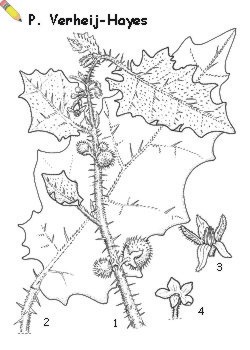 | Solanum ferox L. — 1, flowering and fruiting shoot; 2, outline of lower leaf; 3, flower; 4, calyx |
Growth and Development
Seed of Solanum macrocarpon germinates within 1-2 weeks of sowing, seed of Solanum ferox and Solanum violaceum takes longer. Flowering usually begins 3-4 months after sowing. Bees are the most effective natural pollinators; they vibrate or 'buzz' the anthers to release their pollen. High temperature and humidity in the morning tend to hasten the opening of the flowers and the dehiscence of the anthers. The stigma is receptive from just before flower opening until 2-3 days after opening. Fruits develop from anthesis to maturity in 2-3 months, but picking of green fruits for vegetable use may start 2-4 weeks after anthesis. The number of fruits developing per inflorescence varies from 1-2 in Solanum ferox and Solanum macrocarpon to 2-8 in Solanum violaceum. The plants usually remain productive for about one year, and even longer in Solanum violaceum.
Other Botanical Information
Taxonomically, Solanum ferox is a problematic species. Linnaeus described it as a species from 'Malabaria' (India), with spiny stem, leaves, peduncles, and calyxes, and with a hairy fruit completely enclosed by the calyx. Later authors, whose view is followed here, considered Solanum ferox as a very variable complex species, comprising spiny and spineless forms and forms in which the fruit is completely or only partly enclosed by the calyx. The view that Solanum ferox should be restricted to specimens with hairy fruits, completely enclosed by a spiny calyx, and that other specimens of the complex are derived from the neotropical Solanum candidum Lindley, after an accidental introduction in the 16th Century, and developed into Solanum lasiocarpum Dunal, now distributed throughout South and South-East Asia, seems too artificial. Moreover, the interpretation of Solanum lasiocarpum as having a calyx and pedicel that are not spiny, is not in accordance with the protologue of Dunal.
Linnaeus' concept of his Solanum indicum L. appears to have been Solanum ferox. The name Solanum indicum L. has been rejected as a correct name because it causes confusion; more recent authors have often used the name Solanum indicum L. for plants now named correctly Solanum violaceum. Solanum stramonifolium Jacq. has also been used as the correct name for Solanum ferox. Solanum stramonifolium, however, is a different species, occurring in South America.
Wild and cultivated forms exist within Solanum ferox, both with edible fruits. The cultivated forms can best be classified in cv. groups and cultivars. A tentative classification is proposed here:
- cv. group Cung Bulu (syn. Solanum ferox L. var. ferox): in Indonesia; plants spiny; fruits hairy, 2-2.5 cm in diameter, completely enveloped by the spiny calyx.
- cv. group Domesticum (syn. Solanum lasiocarpum Dunal var. domesticum Heiser): in Thailand; plants unarmed, fruits hairy, over 3 cm in diameter, only at the base enveloped by a non spiny calyx.
- cv. group Involucratum (syn. Solanum involucratum Blume, Solanum ferox var. involucratum (Blume) Miquel): in Indonesia; robust spiny plants with purplish leaves; fruits hairy, 2-2.5 cm in diameter, completely enveloped by the spiny calyx.
- cv. group Sinkade (syn. Solanum ferox L. var. ferox): in Burma; plants spiny, fruits hairy, 2.5 cm in diameter, only at the base enveloped by a spiny calyx.
- cv. group Trongum (syn. Solanum trongum Poiret, Solanum ferox L. var. trongum (Poiret) Kurz): in Burma; plants spiny, fruits hairy, more than 2.5 cm in diameter, glabrescent at maturity, only at the base enveloped by a spiny calyx.
In Papua New Guinea armed (Solanum ferox L. var. ferox) and unarmed (Solanum ferox L. var. repandum (Forster) Bitter) forms exist, both with spiny or non spiny calyx that envelops the fruit only at the base, but they have not been reported as being cultivated.
For the cultivated forms of Solanum macrocarpon the cv. group name Macrocarpon (syn. Solanum macrocarpon L. var. calvum Bitter, Solanum macrocarpon L. ssp. macrocarpon) has been proposed. The cultivated forms are believed to have been derived from the wild form, named Solanum dasyphyllum or Solanum macrocarpon L. ssp. dasyphyllum (Thonn. ex Schum.) Jaeger.
What was formerly collectively called Solanum indicum by many authors is now divided into Solanum anguivi Lamk for Africa and Solanum violaceum Ortega for Asia. Solanum anguivi is considered to be the possible ancestor of Solanum aethiopicum L., the scarlet eggplant, which is a popular vegetable in Africa but hardly known in South-East Asia. Solanum violaceum is not closely related to Solanum anguivi; they differ in many aspects and they are not crossable.
Ecology
Solanum ferox occurs wild in the Asian tropics in forest openings, on disturbed sites and in secondary thickets, often in shady sites, up to 1500 m altitude.
Solanum macrocarpon is sporadically cultivated in Indonesia and Malaysia up to 600 m altitude. It grows on a variety of soils, provided they are fertile. For optimum growth it needs full sun and plenty of water.
Solanum violaceum occurs wild in the Asian tropics as a weed of roadsides, waste places and abandoned fields from sea-level up to 2100 m altitude.
Propagation and planting
Propagation is by seed or by shoot cuttings treated with a growth hormone to stimulate rooting. Before sowing, the seeds may be soaked overnight in water to promote even germination. Seeds are sown 0.5-1 cm deep in pots or seed-beds. Preferred growing conditions are temperatures of 25-32°C, a relative humidity of more than 80% and 50-75% shade. Seedlings with two leaves (2-3 weeks old) are transplanted into small polythene bags and kept under shade until they reach 15-20 cm height. After hardening for a few days the plants can be planted in the field.
Husbandry
Usually a few plants are planted among other crops in the home garden. Solanum macrocarpon is also grown in larger quantities in the field, especially in Africa and India, allowing 1 m² space for each plant. Nitrogenous fertilizer is applied at regular intervals up to the flowering stage, for optimum growth.
Diseases and Pests
Solanum macrocarpon is susceptible to bacterial wilt (Pseudomonas solanacearum), root knot nematode (Meloidogyne arenaria), wilt (Verticillium dahliae) and phomopsis blight (Phomopsis vexans). The shoot and fruit borer Leucinodes orbonalis can cause serious damage. Solanum violaceum has been found susceptible to the root knot nematode Meloidogyne arenaria.
Harvesting
For vegetable use the fruits are harvested at the immature to mature stage, starting 2-4 weeks after anthesis. For seed production fruits are harvested when they are fully ripe, 2-3 months after anthesis. Young leaves of Solanum macrocarpon are also picked for vegetable use.
Yield
Per plant per season, Solanum ferox produces about 15 harvestable fruits, Solanum macrocarpon 3-8, and Solanum violaceum more than 30 fruits. The quality of the fruits usually declines after the first growing season.
Handling After Harvest
After harvesting the fruits are usually immediately consumed. They can be kept for 1-2 days under ambient conditions, and for about 1 week if stored at 10°C.
Genetic Resources
Germplasm collections of solanaceous crops are maintained in the United Kingdom (University of Birmingham), France (INRA, Montfavet), India (NBPGR, New Delhi) and the Netherlands (CPRO-DLO, Wageningen).
Breeding
Some breeding programmes have been conducted on Solanum macrocarpon, especially in Africa, to produce cultivars resistant to diseases and pests and tolerant of drought, and to produce cultivars with a high yield of less bitter fruits.
Resistance to some diseases and pests present in Solanum macrocarpon and Solanum violaceum is interesting for programmes of the economically more important solanaceous crops such as eggplant (Solanum melongena L.). In Solanum macrocarpon, resistance to black root rot (Thielaviopsis basicola), white fly (Trialeurodes vaporariorum) and red spider mite (Tetranychus urticae) has been found; in Solanum violaceum, resistance to phomopsis blight (Phomopsis vexans) and bacterial wilt (Pseudomonas solanacearum) has been observed.
Resistance to some diseases and pests present in Solanum macrocarpon and Solanum violaceum is interesting for programmes of the economically more important solanaceous crops such as eggplant (Solanum melongena L.). In Solanum macrocarpon, resistance to black root rot (Thielaviopsis basicola), white fly (Trialeurodes vaporariorum) and red spider mite (Tetranychus urticae) has been found; in Solanum violaceum, resistance to phomopsis blight (Phomopsis vexans) and bacterial wilt (Pseudomonas solanacearum) has been observed.
Prospects
Solanum ferox and Solanum violaceum will remain commercially minor vegetables in South-East Asia, unless their medicinal properties become more significant. Their importance for breeding programmes of other solanaceous crops is evident.
Solanum macrocarpon may have a brighter future as a commercial crop in South-East Asia, provided yields and cultural practices are improved to make the crop more popular.
Solanum macrocarpon may have a brighter future as a commercial crop in South-East Asia, provided yields and cultural practices are improved to make the crop more popular.
Literature
Backer, C.A. & Bakhuizen van den Brink Jr, R.C., 1965. Flora of Java. Vol. 2. Wolters-Noordhoff, Groningen, the Netherlands, pp. 470-475.
Bitter, G., 1917. Die papuasischen Arten von Solanum [The Solanum species of Papuasia]. Botanische Jahrbücher 55: 59-113.
D'Arcy, W.G. (Editor), 1986. Solanaceae, biology and systematics. Columbia University Press, New York, United States. pp. 91-96, 412-415, 433-456.
Daunay, M.-C., Lester, R.N. & Laterrot, H. (in press). The use of wild species for the genetic improvement of brinjal eggplant (Solanum melongena) and tomato (Lycopersicon esculentum). In: Hawkes, J.G., Lester, R.N., Nee, M. & Estrada, N. (Editors): Solanaceae: taxonomy, chemistry, evolution. Royal Botanic Gardens, Kew, United Kingdom.
Hawkes, J.G., Lester, R.N. & Skelding, A.D. (Editors), 1979. The biology and taxonomy of the Solanaceae. Academic Press, Linnean Society of London, Linnean Society Symposium Series Number 7. 738 pp.
Hepper, F.N., 1978. Typification and name changes of some Old World Solanum species. Botanical Journal of the Linnean Society 76: 287-292.
Stevels, J.M.C., 1990. L‚gumes traditionnels du Cameroun, une ‚tude agro-botanique [Traditional vegetables of Cameroun, an agro-botanic study]. Thesis. Wageningen Agricultural University Papers 90-1, Wageningen, the Netherlands. pp. 213-220.
Symon, D.E., 1981. A revision of the genus Solanum in Australia. Journal of the Adelaide Botanic Gardens 4: 1-367.
Whalen, M.D., Costich, D.E. & Heiser, C.B., 1981. Taxonomy of Solanum section Lasiocarpa. Gentes Herbarum 12(2): 41-129.
Author(s)
Sayed Mohd Zain Hasan & P.C.M. Jansen
Correct Citation of this Article
Sayed Mohd Zain Hasan & Jansen, P.C.M., 1993. Solanum L.. In: Siemonsma, J.S. and Piluek, K. (Editors): Plant Resources of South-East Asia No 8: Vegetables. PROSEA Foundation, Bogor, Indonesia. Database record: prota4u.org/prosea

All texts are licensed under a Creative Commons Attribution-Noncommercial-Share Alike 3.0 Netherlands License
This license does not include the illustrations (Maps,drawings,pictures); these remain all under copyright.