Record Number
4940
PROSEA Handbook Number
5(3): Timber trees; Lesser-known timbers
Taxon
Avicennia L.
Protologue
Sp. pl. 1: 110 (1753); Gen. pl., ed. 5: 119 (1754).
Family
AVICENNIACEAE
Chromosome Numbers
x = unknown; A. alba: 2n = c. 66
Vernacular Names
Api-api (trade name). Papua New Guinea: white mangrove (En). Thailand: samae. Vietnam: m[aws]m.
Origin and Geographic Distribution
Avicennia comprises 8 species and occurs throughout the tropics and Australia, in Asia north to Taiwan. Of these, 4 occur throughout Malesia.
Uses
The wood of Avicennia is used for house building (posts, columns, beams, roofing), mine props, inlaying and other decorative purposes, furniture, boat building (knees, crooks), panelling, rice mortars and mallets. It is thought to be suitable for paving blocks and for the naves and hubs of wheels of light vehicles. Wood chips are used to produce pulp for the manufacture of rayon. It is a poor firewood, burning by smouldering, but for this reason has been used for curing fish and smoking rubber. It is occasionally used to produce charcoal.
The wood ash has been used as soap in India. In the Philippines the wood has been used to obtain salt, in a process in which small amounts of salt-water are poured over the burning wood until all the wood is reduced to ashes. The ashes are then placed in a large funnel and seawater is filtered through. The filtrate is evaporated and yields the salt. The bark is traditionally used for tanning leather but contains only little tannin; it is sometimes used to treat skin parasites and gangrenous wounds. The seeds are edible but only after roasting or boiling to reduce the bitter taste. The resin from the seed is used medicinally as an ointment for ulcers, tumours, and has been applied as a contraceptive. The heartwood of A. alba is used to treat thrush in children, whereas the bark and roots of A. officinalis (or the resin they exude) are believed to be aphrodisiac. Seedlings and young leaves of A. officinalis are edible, and leaves of A. marina are used as green manure and fodder in the Middle East. In the Philippines branches of A. marina are used to make artificial Christmas trees; they are nailed around a post and painted. The same species is thought suitable for small-scale agroforestry in coastal villages, yielding luxury lumber and construction material.
The wood ash has been used as soap in India. In the Philippines the wood has been used to obtain salt, in a process in which small amounts of salt-water are poured over the burning wood until all the wood is reduced to ashes. The ashes are then placed in a large funnel and seawater is filtered through. The filtrate is evaporated and yields the salt. The bark is traditionally used for tanning leather but contains only little tannin; it is sometimes used to treat skin parasites and gangrenous wounds. The seeds are edible but only after roasting or boiling to reduce the bitter taste. The resin from the seed is used medicinally as an ointment for ulcers, tumours, and has been applied as a contraceptive. The heartwood of A. alba is used to treat thrush in children, whereas the bark and roots of A. officinalis (or the resin they exude) are believed to be aphrodisiac. Seedlings and young leaves of A. officinalis are edible, and leaves of A. marina are used as green manure and fodder in the Middle East. In the Philippines branches of A. marina are used to make artificial Christmas trees; they are nailed around a post and painted. The same species is thought suitable for small-scale agroforestry in coastal villages, yielding luxury lumber and construction material.
Production and International Trade
The wood of Avicennia is probably used fairly often, but mainly on a local scale. In 1996 Papua New Guinea exported only 10 m3 of "white mangrove"" logs at an average free-on-board (FOB) price of US$ 100/m3.
Properties
Avicennia yields a medium-weight hardwood with a density of 560-800 kg/m3 at 15% moisture content. Heartwood greyish with a purplish cast, not differentiated from the white to grey-white sapwood; grain sometimes straight, but usually interlocked or irregularly wavy; texture of secondary xylem moderately fine and uneven from included phloem; wood with pronounced watered-silk figure on tangential face; taste slightly salty. Growth rings indistinct, but growth-ring-like bands indicated by anastomosing bands of included phloem; vessels very small to moderately large, mostly in radial multiples of 2-4, sometimes over 4, open; parenchyma moderately abundant, paratracheal vasicentric, occasionally aliform and confluent, distinct; rays moderately fine to medium-sized; ripple marks absent; included phloem in regular bands, alternating with appreciably wider secondary xylem bands.
Shrinkage may be high to very high but, with care, the wood seasons well. The wood is moderately hard to hard, moderately strong and tough to very tough; the heartwood, however, is reported to be brittle. It is rather difficult to work due to the interlocked grain and the presence of stone cells and it splits radially with difficulty. The wood is non-durable, but the rare heartwood is reported to be moderately durable. In a graveyard test in the Philippines the average service life of A. officinalis stakes was about 7 months. Apparently, the wood of A. marina is very durable in water. The sapwood is generally considered to be non-susceptible to Lyctus; the wood of A. marina is considered resistant to termites. The heartwood is extremely resistant to pressure treatment.
The gross energy value of A. officinalis is 18 075-18 755 kJ/kg.
See also the table on microscopic wood anatomy.
Shrinkage may be high to very high but, with care, the wood seasons well. The wood is moderately hard to hard, moderately strong and tough to very tough; the heartwood, however, is reported to be brittle. It is rather difficult to work due to the interlocked grain and the presence of stone cells and it splits radially with difficulty. The wood is non-durable, but the rare heartwood is reported to be moderately durable. In a graveyard test in the Philippines the average service life of A. officinalis stakes was about 7 months. Apparently, the wood of A. marina is very durable in water. The sapwood is generally considered to be non-susceptible to Lyctus; the wood of A. marina is considered resistant to termites. The heartwood is extremely resistant to pressure treatment.
The gross energy value of A. officinalis is 18 075-18 755 kJ/kg.
See also the table on microscopic wood anatomy.
Botany
Shrubs or small to medium-sized trees up to 30 m tall; bole often crooked, branchless for up to 5(-10) m, up to 60(-160) cm in diameter, without buttresses but often with small aerial roots and with numerous thin pneumatophores; bark surface smooth to shallowly fissured, lenticellate, occasionally flaky, grey or reddish-brown, inner bark whitish, producing a little resin. Twigs usually swollen towards the nodes. Leaves decussate, simple, entire, slightly fleshy, usually greyish below, exstipulate. Inflorescence terminal or axillary, spicate or capitate. Flowers sessile, bisexual; calyx enclosed by a bract and 2 bracteoles, 5-lobed; corolla actinomorphic or slightly zygomorphic, campanulate, 4(-6)-lobed, yellow or orange-yellow; stamens 4(-6), alternating with the corolla lobes, inserted basally or at the corolla throat; ovary superior, 1-locular with 4 ovules in 4 imperfect chambers, stigma 2-lobed. Fruit a 2-valved nut, leathery, often beaked, viviparous, splitting upon growth of the cotyledons. Seed 1, lacking a seed-coat. Seedling with epigeal germination; cotyledons emergent, the outer 2-lobed to emarginate, the inner rounded; radicle with hairs developing into secondary roots; hypocotyl elongated; all leaves opposite.
A. marina has a characteristic rooting system with long spreading, unbranched horizontal roots along which short pneumatophores are positioned. Tree shape confirms to Attims' architectural tree model, characterized by a monopodial trunk with equivalent branches showing continuous growth, and the inflorescences not influencing shoot construction. A. marina appears to have a very high minimum temperature requirement for shoot growth: 21°C. In Bangladesh A. officinalis showed a mean annual diameter increment of 0.2 cm. Flowers are protandrous and are produced throughout the year but usually with some peaks; near the equator A. marina flowers chiefly in November and December, in New Guinea A. alba flowers chiefly in December and January whereas A. officinalis flowers chiefly from August to November, and A. rumphiana in October and November. A. officinalis has been observed to be pollinated by flies, A. marina by bees; flowers produce nectar. In A. marina the fruit takes 2-3 months to mature in regions around the equator but up to 10 months in southernmost sites.
Avicennia is sometimes treated as a member of the family Verbenaceae, but most taxonomists agree on its distinctness based on its free central placentation, pendant orthotropous ovules and wood anatomy. A. marina is highly polymorphic and divided into 3 subspecies: subsp. marina in the western part of its area of distribution, subsp. eucalyptifolia (Zipp. ex Moldenke) Everett (synonym: A. eucalyptifolia Zipp. ex Moldenke) in the centre, and subsp. australasica (Walp.) Everett further east.
A. marina has a characteristic rooting system with long spreading, unbranched horizontal roots along which short pneumatophores are positioned. Tree shape confirms to Attims' architectural tree model, characterized by a monopodial trunk with equivalent branches showing continuous growth, and the inflorescences not influencing shoot construction. A. marina appears to have a very high minimum temperature requirement for shoot growth: 21°C. In Bangladesh A. officinalis showed a mean annual diameter increment of 0.2 cm. Flowers are protandrous and are produced throughout the year but usually with some peaks; near the equator A. marina flowers chiefly in November and December, in New Guinea A. alba flowers chiefly in December and January whereas A. officinalis flowers chiefly from August to November, and A. rumphiana in October and November. A. officinalis has been observed to be pollinated by flies, A. marina by bees; flowers produce nectar. In A. marina the fruit takes 2-3 months to mature in regions around the equator but up to 10 months in southernmost sites.
Avicennia is sometimes treated as a member of the family Verbenaceae, but most taxonomists agree on its distinctness based on its free central placentation, pendant orthotropous ovules and wood anatomy. A. marina is highly polymorphic and divided into 3 subspecies: subsp. marina in the western part of its area of distribution, subsp. eucalyptifolia (Zipp. ex Moldenke) Everett (synonym: A. eucalyptifolia Zipp. ex Moldenke) in the centre, and subsp. australasica (Walp.) Everett further east.
Image
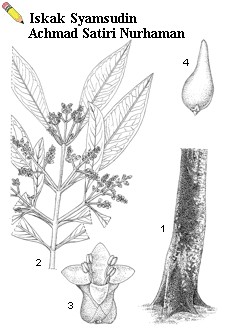 | Avicennia alba Blume – 1, bole; 2, flowering twig; 3, flower; 4, fruit. |
Ecology
Avicennia is a characteristic element of the outer mangrove fringe along the shore or tidal rivers. They are pioneers capable of rapidly colonizing new mud flats or sand banks in the tidal zone. Avicennia often occurs gregariously or in pure stands and is very tolerant of hypersaline conditions. A. marina exhibits an exceptionally wide ecological tolerance of salinity, temperature, intertidal position, and substrate (mud to rocky sites).
Silviculture and Management
Avicennia can be propagated generatively. There are about 175 propagules/kg; a propagule being the viviparous fruit. The fruit can be stored and transported in saline water, but it is regarded as recalcitrant because it does not tolerate prolonged storage. In a germination experiment in Peninsular Malaysia it was found that fresh fruits of A. alba had a germination rate of about 85% in 7-26 days and those of A. officinalis had about 60% in 7-26 days. In the Philippines germination of Avicennia attained 85-100%. In the wild, seed germinates promptly and wildlings may also be collected to serve as planting stock. Crabs consume the propagules and may be the main reason for the absence of A. marina in certain areas. When other mangrove species have been cut for charcoal production, Avicennia often becomes dominant. As it is light-demanding it soon disappears again as succession continues. A dense stand is essential to obtain a straight bole, a spacing of 4 m x 4 m is applied in the Philippines when planting A. officinalis for firewood. The coppicing ability is good and trees are difficult to kill by girdling as new aerial roots soon develop just above the point where the trees have been girdled.
Genetic Resources and Breeding
Although mangroves are generally heavily exploited for charcoal, Avicennia species are often left, as their wood is regarded inferior for this purpose.
Prospects
The potential of Avicennia is limited, as many mangrove species (e.g. Rhizophora) are much more suitable for reforestation and firewood production.
Literature
[38]Aksornkoae, S., 1985. Mangrove resources and the socio-economics of dwellers in mangrove forest in Thailand. In: Kunstadter, P., Bird, E.C.F. & Sabhasri, S. (Editors): Man in the mangroves: the socio-economic situation of human settlements in mangrove forests. Proceedings of the workshop held at Pattaya, Thailand on 27-31 May, 1985. United Nations University, Tokyo. pp. 11-43.
[52]Anonymous, 1985. Mangrove management in Thailand, Malaysia and Indonesia. FAO Environment Paper 4. FAO, Rome. 60 pp.
[60]Arroya, C.A., 1978. Flora of the Philippines mangrove. In: Srivastava, P.B.L., Abdul Manap, A., Dhanarajan, G. & Hamzah, I. (Editors): Mangrove and estuarine vegetation in Southeast Asia. Proceedings of the symposium held at Universiti Pertanian Malaysia, Serdang, Selangor on April 25-28, 1978. BIOTROP Special Publication No 10. BIOTROP-SEAMEO, Bogor. pp. 33-44.
[76]Bakhuizen van den Brink, R.C., 1921. Revisio generis Avicenniae [Revision of the genus Avicennia]. Bulletin du Jardin Botanique, Buitenzorg, Série III, 3: 199-226.
[151]Browne, F.G., 1955. Forest trees of Sarawak and Brunei and their products. Government Printing Office, Kuching, Sarawak. xviii + 369 pp.
[162]Burgess, P.F., 1966. Timbers of Sabah. Sabah Forest Records No 6. Forest Department, Sabah, Sandakan. xviii + 501 pp.
[163]Burkill, I.H., 1966. A dictionary of the economic products of the Malay Peninsula. 2nd edition. Ministry of Agriculture and Co-operatives, Kuala Lumpur. Vol. 1 (A-H) pp. 1-1240. Vol. 2 (I-Z) pp. 1241-2444.
[178]Chai, P.K., 1973. The types of mangrove forest in Sarawak. Forest Department, Sarawak. 34 pp.
[209]Corner, E.J.H., 1988. Wayside trees of Malaya. 3rd edition. 2 volumes. The Malayan Nature Society, Kuala Lumpur. 774 pp.
[267]Desch, H.E., 1941-1954. Manual of Malayan timbers. Malayan Forest Records No 15. 2 volumes. Malaya Publishing House Ltd., Singapore. 762 pp.
[292]Duke, N.C., 1991. A systematic revision of the mangrove genus Avicennia (Avicenniaceae) in Australasia. Australian Systematic Botany 4: 299-324.
[300]Eddowes, P.J., 1977. Commercial timbers of Papua New Guinea, their properties and uses. Forest Products Research Centre, Department of Primary Industry, Port Moresby. xiv + 195 pp.
[304]Eddowes, P.J., 1995-1997. The forests and timbers of Papua New Guinea. (unpublished data).
[348]Forest Products Research Centre, 1967. Properties and uses of Papua and New Guinea timbers. Forest Products Research Centre, Port Moresby. 30 pp.
[402]Hallé, F., Oldeman, R.A.A. & Tomlinson, P.B., 1978. Tropical trees and forests - an architectural analysis. Springer Verlag, Berlin, Heidelberg, New York. 441 pp.
[406]Harker, A.P., Sandels, A. & Burley, J., 1982. Calorific values for wood and bark and a bibliography for fuelwood. Report G 162. Tropical Products Institute, London. 20 pp.
[436]Heyne, K., 1927. De nuttige planten van Nederlands-Indië [The useful plants of the Dutch East Indies]. 2nd edition, 3 volumes. Departement van Landbouw, Nijverheid en Handel in Nederlandsch-Indië. 1953 pp. (3rd edition, 1950. van Hoeve, 's-Gravenhage/Bandung. 1660 pp.).
[438]Hildebrand, F.H., 1951. Daftar nama pohon-pohonan Djawa-Madura dengan keterangan-keterangan tentang penjiaran dan ukurannja (telah diperbaiki) [Revised list of tree species of Java-Madura with notes on their distribution and dimensions]. Laporan No 50. Balai Penjelidikan Kehutanan, Bogor. 183 pp.
[464]Ilic, J., 1990. The CSIRO macro key for hardwood identification. CSIRO, Highett. 125 pp.
[536]Keating, W.G. & Bolza, E., 1982. Characteristics, properties and uses of timbers. Vol. 1. South-East Asia, northern Australia and the Pacific. Inkata Press Proprietary Ltd., Melbourne, Sydney & London. 362 pp.
[632]Kraemer, J.H., 1951. Trees of the western Pacific region. Tri-State Offset Company, Cincinnatti. 436 pp.
[647]Lahiri, A.K., 1991. Aerial seeding in mangrove swamps. Indian Forester 117: 159-161.
[718]Longman, K.A. & Jeník, J., 1987. Tropical forest and its environment. 2nd edition. Longman Scientific and Technical, Essex. 347 pp.
[773]Melana, D.M., Melana, E.E. & Arroyo, C.A., 1980. Germination study of selected mangrove species. Sylvatrop 5(3): 207-211.
[780]Meniado, J.A. et al., 1975-1981. Wood identification handbook for Philippine timbers. 2 volumes. Government Printing Office, Manila. 370 pp. & 186 pp.
[829]Ng, F.S.P., 1991-1992. Manual of forest fruits, seeds and seedlings. 2 volumes. Malayan Forest Record No 34. Forest Research Institute Malaysia, Kepong. 997 pp.
[831]Ng, F.S.P. & Mat Asri Ngah Sanah, 1991. Germination and seedling records. Research Pamphlet No 108. Forest Research Institute Malaysia, Kepong. 191 pp.
[861]Oey Djoen Seng, 1951. De soortelijke gewichten van Indonesische houtsoorten en hun betekenis voor de praktijk [Specific gravity of Indonesian woods and its significance for practical use]. Rapport No 46. Bosbouwproefstation, Bogor. 183 pp.
[880]Percival, M. & Womersley, J.S., 1975. Floristics and ecology of the mangrove vegetation of Papua New Guinea. Botany Bulletin No 8. Department of Forests, Division of Botany, Lae. 96 pp.
[917]Qureshi, M.T., 1990. Experimental plantation rehabilitation of mangrove forest in Pakistan. Mangrove Ecosystems Occasional Papers 4. 37 pp.
[934]Reyes, L.J., 1938. Philippine woods. Technical Bulletin No 7. Commonwealth of the Philippines, Department of Agriculture and Commerce. Bureau of Printing, Manila. 536 pp. + 88 plates.
[1038]Smitinand, T., 1980. Thai plant names. Royal Forest Department, Bangkok. 379 pp.
[1044]Soekardjo, S. & Kartawinata, K., 1978. Mangrove forest of Banyuasin, Musi River estuary, South Sumatra. In: Srivastava, P.B.L., Abdul Manap, A., Dhanarajan, G. & Hamzah, I. (Editors): Mangrove and estuarine vegetation in Southeast Asia. Proceedings of the symposium held at Universiti Pertanian Malaysia, Serdang, Selangor on April 25–28, 1978. BIOTROP Special Publication No 10. BIOTROP-SEAMEO, Bogor. pp. 61–79.
[1079]Swain, E.H.F., 1928. The timbers and forest products of Queensland. Government Printer, Brisbane. 500 pp.
[1111]Uibrig, H., Wagenführ, R. & Roth, B., 1996. Beitrag zur Untersuchung anatomischer und physikalisch-mechanischer Eigenschaften des Holzes von Avicennia officinalis L. und Melaleuca leucadendron L. aus Vietnam [Investigations on anatomical and physical-mechanical wood properties of Avicennia officinalis L. and Melaleuca leucadendron L. from Vietnam]. Holz als Roh- und Werkstoff 54(3): 205–211.
[1113]Umali, R.M., Zamora, P.M., Gotera, R.R., Jara, R.S. & Camacho, A.S. (Editors), 1986. Mangroves of Asia and the Pacific: status and management. Technical report of the UNDP/UNESCO research and training pilot programme on mangrove ecosystems in Asia and the Pacific. 538 pp.
[1189]Watson, J.G., 1928. Mangrove forests of the Malay Peninsula. Malayan Forest Records No 6. Forest Department, Kuala Lumpur. 275 pp.
[1221]Whitmore, T.C. & Ng, F.S.P. (Editors), 1972-1989. Tree flora of Malaya. A manual for foresters. 4 volumes. Malayan Forest Records No 26. Longman Malaysia Sdn. Berhad, Kuala Lumpur & Petaling Jaya.
[1242]Wong, T.M., 1982. A dictionary of Malaysian timbers. Malayan Forest Records No 30. Forest Research Institute Malaysia, Kepong. 259 pp.
[1252]Yao, C.E., 1986. Mangrove reforestation in Central Visayas. Canopy International 12(2): 6-9.
[52]Anonymous, 1985. Mangrove management in Thailand, Malaysia and Indonesia. FAO Environment Paper 4. FAO, Rome. 60 pp.
[60]Arroya, C.A., 1978. Flora of the Philippines mangrove. In: Srivastava, P.B.L., Abdul Manap, A., Dhanarajan, G. & Hamzah, I. (Editors): Mangrove and estuarine vegetation in Southeast Asia. Proceedings of the symposium held at Universiti Pertanian Malaysia, Serdang, Selangor on April 25-28, 1978. BIOTROP Special Publication No 10. BIOTROP-SEAMEO, Bogor. pp. 33-44.
[76]Bakhuizen van den Brink, R.C., 1921. Revisio generis Avicenniae [Revision of the genus Avicennia]. Bulletin du Jardin Botanique, Buitenzorg, Série III, 3: 199-226.
[151]Browne, F.G., 1955. Forest trees of Sarawak and Brunei and their products. Government Printing Office, Kuching, Sarawak. xviii + 369 pp.
[162]Burgess, P.F., 1966. Timbers of Sabah. Sabah Forest Records No 6. Forest Department, Sabah, Sandakan. xviii + 501 pp.
[163]Burkill, I.H., 1966. A dictionary of the economic products of the Malay Peninsula. 2nd edition. Ministry of Agriculture and Co-operatives, Kuala Lumpur. Vol. 1 (A-H) pp. 1-1240. Vol. 2 (I-Z) pp. 1241-2444.
[178]Chai, P.K., 1973. The types of mangrove forest in Sarawak. Forest Department, Sarawak. 34 pp.
[209]Corner, E.J.H., 1988. Wayside trees of Malaya. 3rd edition. 2 volumes. The Malayan Nature Society, Kuala Lumpur. 774 pp.
[267]Desch, H.E., 1941-1954. Manual of Malayan timbers. Malayan Forest Records No 15. 2 volumes. Malaya Publishing House Ltd., Singapore. 762 pp.
[292]Duke, N.C., 1991. A systematic revision of the mangrove genus Avicennia (Avicenniaceae) in Australasia. Australian Systematic Botany 4: 299-324.
[300]Eddowes, P.J., 1977. Commercial timbers of Papua New Guinea, their properties and uses. Forest Products Research Centre, Department of Primary Industry, Port Moresby. xiv + 195 pp.
[304]Eddowes, P.J., 1995-1997. The forests and timbers of Papua New Guinea. (unpublished data).
[348]Forest Products Research Centre, 1967. Properties and uses of Papua and New Guinea timbers. Forest Products Research Centre, Port Moresby. 30 pp.
[402]Hallé, F., Oldeman, R.A.A. & Tomlinson, P.B., 1978. Tropical trees and forests - an architectural analysis. Springer Verlag, Berlin, Heidelberg, New York. 441 pp.
[406]Harker, A.P., Sandels, A. & Burley, J., 1982. Calorific values for wood and bark and a bibliography for fuelwood. Report G 162. Tropical Products Institute, London. 20 pp.
[436]Heyne, K., 1927. De nuttige planten van Nederlands-Indië [The useful plants of the Dutch East Indies]. 2nd edition, 3 volumes. Departement van Landbouw, Nijverheid en Handel in Nederlandsch-Indië. 1953 pp. (3rd edition, 1950. van Hoeve, 's-Gravenhage/Bandung. 1660 pp.).
[438]Hildebrand, F.H., 1951. Daftar nama pohon-pohonan Djawa-Madura dengan keterangan-keterangan tentang penjiaran dan ukurannja (telah diperbaiki) [Revised list of tree species of Java-Madura with notes on their distribution and dimensions]. Laporan No 50. Balai Penjelidikan Kehutanan, Bogor. 183 pp.
[464]Ilic, J., 1990. The CSIRO macro key for hardwood identification. CSIRO, Highett. 125 pp.
[536]Keating, W.G. & Bolza, E., 1982. Characteristics, properties and uses of timbers. Vol. 1. South-East Asia, northern Australia and the Pacific. Inkata Press Proprietary Ltd., Melbourne, Sydney & London. 362 pp.
[632]Kraemer, J.H., 1951. Trees of the western Pacific region. Tri-State Offset Company, Cincinnatti. 436 pp.
[647]Lahiri, A.K., 1991. Aerial seeding in mangrove swamps. Indian Forester 117: 159-161.
[718]Longman, K.A. & Jeník, J., 1987. Tropical forest and its environment. 2nd edition. Longman Scientific and Technical, Essex. 347 pp.
[773]Melana, D.M., Melana, E.E. & Arroyo, C.A., 1980. Germination study of selected mangrove species. Sylvatrop 5(3): 207-211.
[780]Meniado, J.A. et al., 1975-1981. Wood identification handbook for Philippine timbers. 2 volumes. Government Printing Office, Manila. 370 pp. & 186 pp.
[829]Ng, F.S.P., 1991-1992. Manual of forest fruits, seeds and seedlings. 2 volumes. Malayan Forest Record No 34. Forest Research Institute Malaysia, Kepong. 997 pp.
[831]Ng, F.S.P. & Mat Asri Ngah Sanah, 1991. Germination and seedling records. Research Pamphlet No 108. Forest Research Institute Malaysia, Kepong. 191 pp.
[861]Oey Djoen Seng, 1951. De soortelijke gewichten van Indonesische houtsoorten en hun betekenis voor de praktijk [Specific gravity of Indonesian woods and its significance for practical use]. Rapport No 46. Bosbouwproefstation, Bogor. 183 pp.
[880]Percival, M. & Womersley, J.S., 1975. Floristics and ecology of the mangrove vegetation of Papua New Guinea. Botany Bulletin No 8. Department of Forests, Division of Botany, Lae. 96 pp.
[917]Qureshi, M.T., 1990. Experimental plantation rehabilitation of mangrove forest in Pakistan. Mangrove Ecosystems Occasional Papers 4. 37 pp.
[934]Reyes, L.J., 1938. Philippine woods. Technical Bulletin No 7. Commonwealth of the Philippines, Department of Agriculture and Commerce. Bureau of Printing, Manila. 536 pp. + 88 plates.
[1038]Smitinand, T., 1980. Thai plant names. Royal Forest Department, Bangkok. 379 pp.
[1044]Soekardjo, S. & Kartawinata, K., 1978. Mangrove forest of Banyuasin, Musi River estuary, South Sumatra. In: Srivastava, P.B.L., Abdul Manap, A., Dhanarajan, G. & Hamzah, I. (Editors): Mangrove and estuarine vegetation in Southeast Asia. Proceedings of the symposium held at Universiti Pertanian Malaysia, Serdang, Selangor on April 25–28, 1978. BIOTROP Special Publication No 10. BIOTROP-SEAMEO, Bogor. pp. 61–79.
[1079]Swain, E.H.F., 1928. The timbers and forest products of Queensland. Government Printer, Brisbane. 500 pp.
[1111]Uibrig, H., Wagenführ, R. & Roth, B., 1996. Beitrag zur Untersuchung anatomischer und physikalisch-mechanischer Eigenschaften des Holzes von Avicennia officinalis L. und Melaleuca leucadendron L. aus Vietnam [Investigations on anatomical and physical-mechanical wood properties of Avicennia officinalis L. and Melaleuca leucadendron L. from Vietnam]. Holz als Roh- und Werkstoff 54(3): 205–211.
[1113]Umali, R.M., Zamora, P.M., Gotera, R.R., Jara, R.S. & Camacho, A.S. (Editors), 1986. Mangroves of Asia and the Pacific: status and management. Technical report of the UNDP/UNESCO research and training pilot programme on mangrove ecosystems in Asia and the Pacific. 538 pp.
[1189]Watson, J.G., 1928. Mangrove forests of the Malay Peninsula. Malayan Forest Records No 6. Forest Department, Kuala Lumpur. 275 pp.
[1221]Whitmore, T.C. & Ng, F.S.P. (Editors), 1972-1989. Tree flora of Malaya. A manual for foresters. 4 volumes. Malayan Forest Records No 26. Longman Malaysia Sdn. Berhad, Kuala Lumpur & Petaling Jaya.
[1242]Wong, T.M., 1982. A dictionary of Malaysian timbers. Malayan Forest Records No 30. Forest Research Institute Malaysia, Kepong. 259 pp.
[1252]Yao, C.E., 1986. Mangrove reforestation in Central Visayas. Canopy International 12(2): 6-9.
Author(s)
L.S.L. Chua
Avicennia alba
Avicennia marina
Avicennia officinalis
Avicennia rumphiana
Avicennia marina
Avicennia officinalis
Avicennia rumphiana
Correct Citation of this Article
Chua, L.S.L., 1998. Avicennia L.. In: Sosef, M.S.M., Hong, L.T. and Prawirohatmodjo, S. (Editors): Plant Resources of South-East Asia No 5(3): Timber trees; Lesser-known timbers. PROSEA Foundation, Bogor, Indonesia. Database record: prota4u.org/prosea
Selection of Species
The following species in this genus are important in this commodity group and are treated separatedly in this database:
Avicennia alba
Avicennia marina
Avicennia officinalis
Avicennia rumphiana
Avicennia alba
Avicennia marina
Avicennia officinalis
Avicennia rumphiana

All texts are licensed under a Creative Commons Attribution-Noncommercial-Share Alike 3.0 Netherlands License
This license does not include the illustrations (Maps,drawings,pictures); these remain all under copyright.