Record Number
4945
PROSEA Handbook Number
5(3): Timber trees; Lesser-known timbers
Taxon
Baccaurea Lour.
Protologue
Fl. cochinch.: 641, 661 (1790).
Family
EUPHORBIACEAE
Chromosome Numbers
x = 13; B. ramiflora: n = 13, 13 + 1B
Vernacular Names
Tampoi (trade name). Indonesia: kepundung, menteng, tampui (general). Malaysia: tampoi (general), kunau kunau (Sabah), rambai hutan (Peninsular, Sabah). Philippines: dilak. Burma (Myanmar): kanaso, mai-mak-hpa. Laos: fai. Thailand: mafai, rambai, somfai. Vietnam: d[aa]u da.
Origin and Geographic Distribution
Baccaurea comprises about 55 species occurring from India to Indo-China, southern China, the Andaman Islands, Thailand, throughout the Malesian region (except for the Lesser Sunda Islands) towards the Pacific Islands (east to Fiji, Tahiti and Samoa). Some 40 species are found within Malesia and are distributed as follows: Peninsular Malaysia 20 species, Sumatra 22, Java 5, Borneo 2, the Philippines c. 3, Sulawesi c. 5, the Moluccas c. 4 and New Guinea c. 4.
Uses
The wood of Baccaurea is used mainly for poles in native house construction, boat building, wharf piling, furniture (general-utility purposes) and boxes. Additionally, it is suitable for general light construction under cover such as posts, beams, joists and rafters, carving, and for general-utility plywood.
Four Baccaurea species are frequently cultivated for their generally sour-tasting fruits: B. dulcis, B. motleyana, B. racemosa and B. ramiflora. Most other species have edible, but less tasty fruits. Baccaurea species are also considered good support trees for rattan cultivation. The cultivated species are used as shade and avenue trees. The bark of a few species is used, along with other ingredients, to colour silk yellow, red or mauve. The bark is also applied medicinally to treat skin diseases and inflammation of the eyes.
Four Baccaurea species are frequently cultivated for their generally sour-tasting fruits: B. dulcis, B. motleyana, B. racemosa and B. ramiflora. Most other species have edible, but less tasty fruits. Baccaurea species are also considered good support trees for rattan cultivation. The cultivated species are used as shade and avenue trees. The bark of a few species is used, along with other ingredients, to colour silk yellow, red or mauve. The bark is also applied medicinally to treat skin diseases and inflammation of the eyes.
Production and International Trade
As the supply of Baccaurea timber is very limited, the wood is utilized on a local scale only.
Properties
Baccaurea yields a medium-weight to heavy hardwood with a density of 630-950 kg/m3 at 15% moisture content. Heartwood yellowish-brown, darkening to brown with an orange-yellow or purple-red tinge, not clearly differentiated from the sapwood; grain straight or interlocked; texture moderately fine and uneven due to wide rays; wood with slight silver grain on quarter-sawn surface. Growth rings indistinct, sometimes suggested by darker coloured tissue; vessels moderately small to medium-sized, angular, solitary and in radial multiples of 2-4(-more), tyloses sparse; parenchyma abundant, apotracheal diffuse-in-aggregates; rays of 2 kinds, very fine or medium-sized to moderately broad; ripple marks absent.
Shrinkage is moderate and the wood seasons moderately slowly without serious degrade. The wood is moderately hard and moderately strong. It is reputed to be durable and can be treated with preservatives.
The leaves of B. angulata Merr. and possibly other species accumulate aluminium, rendering them pale when dried.
See also the tables on microscopic wood anatomy and wood properties.
Shrinkage is moderate and the wood seasons moderately slowly without serious degrade. The wood is moderately hard and moderately strong. It is reputed to be durable and can be treated with preservatives.
The leaves of B. angulata Merr. and possibly other species accumulate aluminium, rendering them pale when dried.
See also the tables on microscopic wood anatomy and wood properties.
Botany
Evergreen, dioecious, small to medium-sized trees up to 30(-40) m tall; bole straight to rather poorly shaped and/or forked, branchless for up to 20 m, up to 70 cm in diameter, often with small buttresses or prominently fluted; bark very thin, surface shallowly finely dippled or with minute papery scales, red to orange-brown, inner bark softly fibrous, often deep red-brown; crown rather dense. Indumentum of simple to stellate hairs. Leaves arranged spirally, often crowded towards the end of twigs, simple, entire; petiole often long and kneed at the top; stipules early caducous. Inflorescence axillary to cauliflorous; male inflorescence narrowly thyrsoid; female inflorescence narrowly racemose. Flowers unisexual, small; sepals 4-5; petals absent. Male flowers with 4-8 stamens; disk-glands absent or free or connate; pistillode evident. Female flowers somewhat larger; disk absent; ovary superior, 2-5-locular with 2 ovules in each cell, styles bifid. Fruit variably fleshy and indehiscent or sometimes dry and dehiscent, (2-)3(-5)-locular capsule, 1-6-seeded. Seed often enclosed in a juicy, brightly coloured outer layer. Seedling with epigeal germination; cotyledons emergent, leafy, often bilobed; hypocotyl elongated; first pair of leaves opposite or alternate, subsequent ones arranged spirally.
Some species show rhythmic growth, with the branches produced in pseudo-whorls as in Terminalia. Flowering is synchronized, particularly in male trees and takes 2-3 weeks. In Malaysia flowering occurs in January-March and in Papua New Guinea B. papuana flowers in July-August. Flowering and fruiting is annually or biannually. The flowers are pollinated by bees and flies; those of some species are reported as fragrant or with a musky odour. Birds, deer, monkeys and rats eat and disperse the fruits.
The actual morphological origin of the outer seed layer, sometimes erroneously called an aril, is still unknown.
Some species show rhythmic growth, with the branches produced in pseudo-whorls as in Terminalia. Flowering is synchronized, particularly in male trees and takes 2-3 weeks. In Malaysia flowering occurs in January-March and in Papua New Guinea B. papuana flowers in July-August. Flowering and fruiting is annually or biannually. The flowers are pollinated by bees and flies; those of some species are reported as fragrant or with a musky odour. Birds, deer, monkeys and rats eat and disperse the fruits.
The actual morphological origin of the outer seed layer, sometimes erroneously called an aril, is still unknown.
Image
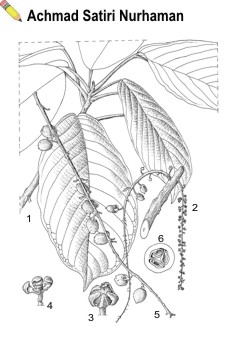 | Baccaurea motleyana (Müll. Arg.) Müll. Arg. – 1. sterile twig; 2, female inflorescence; 3, female flower; 4, male flower with 2 sepals removed; 5, infructescence; 6, fruit in cross section. |
Ecology
Baccaurea species are generally uncommon, but may locally occur as an important element of the lower storey of primary lowland rain forest. They are found in well-drained as well as swampy locations, up to 1000(-1800) m altitude, on a wide range of soils in primary and secondary evergreen rain forest, kerangas and peat-swamp forest.
Silviculture and Management
Baccaurea can be propagated by seed, but some fruit-producing species are also vegetatively propagated by air layering of female trees. Seeds of several species usually germinate in 2-6 weeks after sowing, with a germination rate of over 65%. The germination rate of fruits or seed sown with adhering pulp is less predictable: 3-100% germination in approximately the same time.
Genetic Resources and Breeding
There are no records of Baccaurea in seed and germplasm banks. In several fruit-producing species there appears to be serious genetic erosion. Harvesting for timber, however, is unlikely to have a great impact on the genetic resource base.
Prospects
Since Baccaurea species are fairly widespread and locally common as lower storey trees in primary forest, there is some scope for increased utilization of the wood for timber and wood-based panels.
Literature
[26]Airy Shaw, H.K., 1972. The Euphorbiaceae of Siam. Kew Bulletin 26: 191-363.
[28]Airy Shaw, H.K., 1975. The Euphorbiaceae of Borneo. Kew Bulletin Additional Series VIII. Her Majesty's Stationery Office, London. 245 pp.
[32]Airy Shaw, H.K., 1980. The Euphorbiaceae of New Guinea. Kew Bulletin Additional Series VIII. Her Majesty's Stationery Office, London. 243 pp.
[33]Airy Shaw, H.K., 1981. An alphabetical enumeration of the Euphorbiaceae of the Philippine islands. Royal Botanic Gardens, Kew. 56 pp.
[34]Airy Shaw, H.K., 1981. The Euphorbiaceae of Sumatra. Kew Bulletin 36: 239-374.
[36]Airy Shaw, H.K., 1983. The Euphorbiaceae of Central Malesia (Celebes, Moluccas, Lesser Sunda Is.). Kew Bulletin 37: 1-40.
[70]Backer, C.A. & Bakhuizen van den Brink Jr., R.C., 1963-1968. Flora of Java. 3 volumes. Wolters-Noordhoff, Groningen.
[82]Balan Menon, P.K., 1986. Uses of some Malaysian timbers. (revised edition by S.C. Lim). Malaysian Forest Service Trade Leaflet No 31. Malaysian Timber Industry Board, Kuala Lumpur. 48 pp.
[151]Browne, F.G., 1955. Forest trees of Sarawak and Brunei and their products. Government Printing Office, Kuching, Sarawak. xviii + 369 pp.
[162]Burgess, P.F., 1966. Timbers of Sabah. Sabah Forest Records No 6. Forest Department, Sabah, Sandakan. xviii + 501 pp.
[163]Burkill, I.H., 1966. A dictionary of the economic products of the Malay Peninsula. 2nd edition. Ministry of Agriculture and Co-operatives, Kuala Lumpur. Vol. 1 (A-H) pp. 1-1240. Vol. 2 (I-Z) pp. 1241-2444.
[189]Chenery, E.M., 1948. Aluminium in the plant world. Part I, general survey in dicotyledons. Kew Bulletin 1948: 173-183.
[209]Corner, E.J.H., 1988. Wayside trees of Malaya. 3rd edition. 2 volumes. The Malayan Nature Society, Kuala Lumpur. 774 pp.
[267]Desch, H.E., 1941-1954. Manual of Malayan timbers. Malayan Forest Records No 15. 2 volumes. Malaya Publishing House Ltd., Singapore. 762 pp.
[436]Heyne, K., 1927. De nuttige planten van Nederlands-Indië [The useful plants of the Dutch East Indies]. 2nd edition, 3 volumes. Departement van Landbouw, Nijverheid en Handel in Nederlandsch-Indië. 1953 pp. (3rd edition, 1950. van Hoeve, 's-Gravenhage/Bandung. 1660 pp.).
[464]Ilic, J., 1990. The CSIRO macro key for hardwood identification. CSIRO, Highett. 125 pp.
[543]Keng, H., 1990. The concise flora of Singapore. Gymnosperms and dicotyledons. Singapore University Press, Singapore. 222 pp.
[553]Kessler, P.J.A. & Sidiyasa, K., 1994. Trees of the Balikpapan-Samarinda area, East Kalimantan, Indonesia. Tropenbos Series 7. The Tropenbos Foundation, Wageningen. 446 pp.
[644]Kuswara, T., 1982. Budidaya rotan di Kalimantan Tengah [The cultivation of rattan in Central Kalimantan]. Buletin Kebun Raya 5(4): 85-90.
[740]Malaysian Timber Industry Board, 1984. Peraturan pemeringkatan kayu keras gergaji Malaysia [The Malaysian grading rules for sawn hardwood timber]. Ministry of Primary Industries, Kuala Lumpur. 109 pp.
[741]Malaysian Timber Industry Board, 1986. 100 Malaysian timbers. Kuala Lumpur. x + 226 pp.
[825]Ng, F.S.P., 1978. Strategies of establishment in Malayan forest trees. In: Tomlinson, P.B. & Zimmermann, M.H. (Editors): Tropical trees as living systems. The proceedings of the fourth Cabot symposium held at Harvard Forest, Petersham, Massachusetts on April 26-30, 1976. Cambridge University Press, Cambridge, London, New York, Melbourne. pp. 129-162.
[829]Ng, F.S.P., 1991-1992. Manual of forest fruits, seeds and seedlings. 2 volumes. Malayan Forest Record No 34. Forest Research Institute Malaysia, Kepong. 997 pp.
[831]Ng, F.S.P. & Mat Asri Ngah Sanah, 1991. Germination and seedling records. Research Pamphlet No 108. Forest Research Institute Malaysia, Kepong. 191 pp.
[861]Oey Djoen Seng, 1951. De soortelijke gewichten van Indonesische houtsoorten en hun betekenis voor de praktijk [Specific gravity of Indonesian woods and its significance for practical use]. Rapport No 46. Bosbouwproefstation, Bogor. 183 pp.
[974]Salvosa, F.M., 1963. Lexicon of Philippine trees. Bulletin No 1. Forest Products Research Institute, College, Laguna. 136 pp.
[977]Sarawak Timber Industry Development Corporation, 1987. Manual of Sarawak timber species. Properties and uses. Sarawak Timber Industry Development Corporation, Kuching. 97 pp.
[1038]Smitinand, T., 1980. Thai plant names. Royal Forest Department, Bangkok. 379 pp.
[1043]Soejarto, D.D., 1965. Baccaurea and its uses. Botanical Museum Leaflets, Harvard University 21(3): 65-104.
[1164]Verheij, E.W.M. & Coronel, R.E. (Editors), 1991. Plant resources of South-East Asia No 2. Edible fruits and nuts. Pudoc, Wageningen. 446 pp.
[1169]Vidal, J., 1962. Noms vernaculaires de plantes en usage au Laos [Vernacular names of plants used in Laos]. Ecole française d'Extrême-Orient, Paris. 197 pp.
[1195]Webster, G.L., 1994. Synopsis of the genera and suprageneric taxa of Euphorbiaceae. Annals of the Missouri Botanical Garden 81: 33-144.
[1221]Whitmore, T.C. & Ng, F.S.P. (Editors), 1972-1989. Tree flora of Malaya. A manual for foresters. 4 volumes. Malayan Forest Records No 26. Longman Malaysia Sdn. Berhad, Kuala Lumpur & Petaling Jaya.
[1242]Wong, T.M., 1982. A dictionary of Malaysian timbers. Malayan Forest Records No 30. Forest Research Institute Malaysia, Kepong. 259 pp.
[1259]Yap, S.K., 1982. The phenology of some fruit tree species in a lowland dipterocarp forest. Malaysian Forester 45: 21-35.
[28]Airy Shaw, H.K., 1975. The Euphorbiaceae of Borneo. Kew Bulletin Additional Series VIII. Her Majesty's Stationery Office, London. 245 pp.
[32]Airy Shaw, H.K., 1980. The Euphorbiaceae of New Guinea. Kew Bulletin Additional Series VIII. Her Majesty's Stationery Office, London. 243 pp.
[33]Airy Shaw, H.K., 1981. An alphabetical enumeration of the Euphorbiaceae of the Philippine islands. Royal Botanic Gardens, Kew. 56 pp.
[34]Airy Shaw, H.K., 1981. The Euphorbiaceae of Sumatra. Kew Bulletin 36: 239-374.
[36]Airy Shaw, H.K., 1983. The Euphorbiaceae of Central Malesia (Celebes, Moluccas, Lesser Sunda Is.). Kew Bulletin 37: 1-40.
[70]Backer, C.A. & Bakhuizen van den Brink Jr., R.C., 1963-1968. Flora of Java. 3 volumes. Wolters-Noordhoff, Groningen.
[82]Balan Menon, P.K., 1986. Uses of some Malaysian timbers. (revised edition by S.C. Lim). Malaysian Forest Service Trade Leaflet No 31. Malaysian Timber Industry Board, Kuala Lumpur. 48 pp.
[151]Browne, F.G., 1955. Forest trees of Sarawak and Brunei and their products. Government Printing Office, Kuching, Sarawak. xviii + 369 pp.
[162]Burgess, P.F., 1966. Timbers of Sabah. Sabah Forest Records No 6. Forest Department, Sabah, Sandakan. xviii + 501 pp.
[163]Burkill, I.H., 1966. A dictionary of the economic products of the Malay Peninsula. 2nd edition. Ministry of Agriculture and Co-operatives, Kuala Lumpur. Vol. 1 (A-H) pp. 1-1240. Vol. 2 (I-Z) pp. 1241-2444.
[189]Chenery, E.M., 1948. Aluminium in the plant world. Part I, general survey in dicotyledons. Kew Bulletin 1948: 173-183.
[209]Corner, E.J.H., 1988. Wayside trees of Malaya. 3rd edition. 2 volumes. The Malayan Nature Society, Kuala Lumpur. 774 pp.
[267]Desch, H.E., 1941-1954. Manual of Malayan timbers. Malayan Forest Records No 15. 2 volumes. Malaya Publishing House Ltd., Singapore. 762 pp.
[436]Heyne, K., 1927. De nuttige planten van Nederlands-Indië [The useful plants of the Dutch East Indies]. 2nd edition, 3 volumes. Departement van Landbouw, Nijverheid en Handel in Nederlandsch-Indië. 1953 pp. (3rd edition, 1950. van Hoeve, 's-Gravenhage/Bandung. 1660 pp.).
[464]Ilic, J., 1990. The CSIRO macro key for hardwood identification. CSIRO, Highett. 125 pp.
[543]Keng, H., 1990. The concise flora of Singapore. Gymnosperms and dicotyledons. Singapore University Press, Singapore. 222 pp.
[553]Kessler, P.J.A. & Sidiyasa, K., 1994. Trees of the Balikpapan-Samarinda area, East Kalimantan, Indonesia. Tropenbos Series 7. The Tropenbos Foundation, Wageningen. 446 pp.
[644]Kuswara, T., 1982. Budidaya rotan di Kalimantan Tengah [The cultivation of rattan in Central Kalimantan]. Buletin Kebun Raya 5(4): 85-90.
[740]Malaysian Timber Industry Board, 1984. Peraturan pemeringkatan kayu keras gergaji Malaysia [The Malaysian grading rules for sawn hardwood timber]. Ministry of Primary Industries, Kuala Lumpur. 109 pp.
[741]Malaysian Timber Industry Board, 1986. 100 Malaysian timbers. Kuala Lumpur. x + 226 pp.
[825]Ng, F.S.P., 1978. Strategies of establishment in Malayan forest trees. In: Tomlinson, P.B. & Zimmermann, M.H. (Editors): Tropical trees as living systems. The proceedings of the fourth Cabot symposium held at Harvard Forest, Petersham, Massachusetts on April 26-30, 1976. Cambridge University Press, Cambridge, London, New York, Melbourne. pp. 129-162.
[829]Ng, F.S.P., 1991-1992. Manual of forest fruits, seeds and seedlings. 2 volumes. Malayan Forest Record No 34. Forest Research Institute Malaysia, Kepong. 997 pp.
[831]Ng, F.S.P. & Mat Asri Ngah Sanah, 1991. Germination and seedling records. Research Pamphlet No 108. Forest Research Institute Malaysia, Kepong. 191 pp.
[861]Oey Djoen Seng, 1951. De soortelijke gewichten van Indonesische houtsoorten en hun betekenis voor de praktijk [Specific gravity of Indonesian woods and its significance for practical use]. Rapport No 46. Bosbouwproefstation, Bogor. 183 pp.
[974]Salvosa, F.M., 1963. Lexicon of Philippine trees. Bulletin No 1. Forest Products Research Institute, College, Laguna. 136 pp.
[977]Sarawak Timber Industry Development Corporation, 1987. Manual of Sarawak timber species. Properties and uses. Sarawak Timber Industry Development Corporation, Kuching. 97 pp.
[1038]Smitinand, T., 1980. Thai plant names. Royal Forest Department, Bangkok. 379 pp.
[1043]Soejarto, D.D., 1965. Baccaurea and its uses. Botanical Museum Leaflets, Harvard University 21(3): 65-104.
[1164]Verheij, E.W.M. & Coronel, R.E. (Editors), 1991. Plant resources of South-East Asia No 2. Edible fruits and nuts. Pudoc, Wageningen. 446 pp.
[1169]Vidal, J., 1962. Noms vernaculaires de plantes en usage au Laos [Vernacular names of plants used in Laos]. Ecole française d'Extrême-Orient, Paris. 197 pp.
[1195]Webster, G.L., 1994. Synopsis of the genera and suprageneric taxa of Euphorbiaceae. Annals of the Missouri Botanical Garden 81: 33-144.
[1221]Whitmore, T.C. & Ng, F.S.P. (Editors), 1972-1989. Tree flora of Malaya. A manual for foresters. 4 volumes. Malayan Forest Records No 26. Longman Malaysia Sdn. Berhad, Kuala Lumpur & Petaling Jaya.
[1242]Wong, T.M., 1982. A dictionary of Malaysian timbers. Malayan Forest Records No 30. Forest Research Institute Malaysia, Kepong. 259 pp.
[1259]Yap, S.K., 1982. The phenology of some fruit tree species in a lowland dipterocarp forest. Malaysian Forester 45: 21-35.
Author(s)
Salma Idris
Baccaurea bracteata
Baccaurea brevipes
Baccaurea dasystachya
Baccaurea dulcis
Baccaurea edulis
Baccaurea javanica
Baccaurea kunstleri
Baccaurea lanceolata
Baccaurea macrocarpa
Baccaurea minor
Baccaurea motleyana
Baccaurea nanihua
Baccaurea papuana
Baccaurea parviflora
Baccaurea polyneura
Baccaurea pubera
Baccaurea racemosa
Baccaurea ramiflora
Baccaurea reticulata
Baccaurea sumatrana
Baccaurea brevipes
Baccaurea dasystachya
Baccaurea dulcis
Baccaurea edulis
Baccaurea javanica
Baccaurea kunstleri
Baccaurea lanceolata
Baccaurea macrocarpa
Baccaurea minor
Baccaurea motleyana
Baccaurea nanihua
Baccaurea papuana
Baccaurea parviflora
Baccaurea polyneura
Baccaurea pubera
Baccaurea racemosa
Baccaurea ramiflora
Baccaurea reticulata
Baccaurea sumatrana
Correct Citation of this Article
Idris, S., 1998. Baccaurea Lour.. In: Sosef, M.S.M., Hong, L.T. and Prawirohatmodjo, S. (Editors): Plant Resources of South-East Asia No 5(3): Timber trees; Lesser-known timbers. PROSEA Foundation, Bogor, Indonesia. Database record: prota4u.org/prosea
Selection of Species
The following species in this genus are important in this commodity group and are treated separatedly in this database:
Baccaurea bracteata
Baccaurea brevipes
Baccaurea dasystachya
Baccaurea dulcis
Baccaurea edulis
Baccaurea javanica
Baccaurea kunstleri
Baccaurea lanceolata
Baccaurea macrocarpa
Baccaurea minor
Baccaurea motleyana
Baccaurea nanihua
Baccaurea papuana
Baccaurea parviflora
Baccaurea polyneura
Baccaurea pubera
Baccaurea racemosa
Baccaurea ramiflora
Baccaurea reticulata
Baccaurea sumatrana
Baccaurea bracteata
Baccaurea brevipes
Baccaurea dasystachya
Baccaurea dulcis
Baccaurea edulis
Baccaurea javanica
Baccaurea kunstleri
Baccaurea lanceolata
Baccaurea macrocarpa
Baccaurea minor
Baccaurea motleyana
Baccaurea nanihua
Baccaurea papuana
Baccaurea parviflora
Baccaurea polyneura
Baccaurea pubera
Baccaurea racemosa
Baccaurea ramiflora
Baccaurea reticulata
Baccaurea sumatrana

All texts are licensed under a Creative Commons Attribution-Noncommercial-Share Alike 3.0 Netherlands License
This license does not include the illustrations (Maps,drawings,pictures); these remain all under copyright.