Record Number
4995
PROSEA Handbook Number
5(3): Timber trees; Lesser-known timbers
Taxon
Bombax L.
Protologue
Sp. pl. 1: 511 (1753); Gen. pl., ed. 5: 227 (1754).
Family
BOMBACACEAE
Chromosome Numbers
x = unknown; B. ceiba: 2n = 72
Vernacular Names
Kekabu (trade name). Cottonwood (En). Indonesia: randu alas. Malaysia: kekabu hutan (Peninsular), kapok, tambaluang (Sabah). Papua New Guinea: bombax, kapok. Philippines: malabulak. Burma (Myanmar): didu, letpan, thinbaw. Thailand: ngiu. Vietnam: g[aj]o d[or], g[aj]o hoa trang, p'lang.
Origin and Geographic Distribution
Bombax comprises 8 species occurring in the Old World tropics from tropical Africa to Indo-China, throughout the Malesian area towards northern Australia. Three species are native to Malesia.
Uses
In the Malesian region Bombax is used as a low grade utility timber only. It has been applied for packing cases, matchboxes, matches, core veneer, temporary construction, musical instruments, mouldings, household appliances, buoys, novelties and, when treated, for low grade furniture and interior partitioning. Locally it is used for making canoes. In Papua New Guinea large logs of B. ceiba were formerly peeled for plywood and veneer production. In India, where B. ceiba is much more common, it is the major indigenous source of wood for the production of matches.
The kapok from the fruits of B. ceiba can be used for stuffing pillows etc., and the tree is sometimes planted as an ornamental for its bright red flowers; in Vietnam it is also planted around temples. In Java Bombax is grown in cemeteries and the trees are considered sacred. The gum from the bark and roots has been used as a medicine against diarrhoea, dysentery and fever. Fibres from the bark of B. ceiba are used for making paper pulp, oil from the seed is used in food and for soap making and the flowers are eaten after boiling. Leaves and twigs may be used as a forage for cattle.
The kapok from the fruits of B. ceiba can be used for stuffing pillows etc., and the tree is sometimes planted as an ornamental for its bright red flowers; in Vietnam it is also planted around temples. In Java Bombax is grown in cemeteries and the trees are considered sacred. The gum from the bark and roots has been used as a medicine against diarrhoea, dysentery and fever. Fibres from the bark of B. ceiba are used for making paper pulp, oil from the seed is used in food and for soap making and the flowers are eaten after boiling. Leaves and twigs may be used as a forage for cattle.
Production and International Trade
Within the Malesian region supplies are generally very limited and trade is only local. In Peninsular Malaysia Bombax is often traded as "durian"" wood in small proportions in mixed consignments mainly comprising wood of Durio spp. In 1996 Papua New Guinea exported about 1050 m3 of Bombax logs at an average free-on-board (FOB) price of US$ 97/m3.
Properties
Bombax yields a lightweight hardwood with a density of 120-545 kg/m3 at 15% moisture content. Heartwood straw-coloured, sharply differentiated (B. valetonii) or not (B. ceiba) from the white sapwood; grain straight or slightly interlocked; texture moderately coarse and even. Growth rings indistinct; vessels medium-sized to large, solitary and in radial multiples of 2-4, rarely in clusters; parenchyma abundant, apotracheal diffuse to diffuse-in-aggregates, visible with a lens; rays medium-sized, conspicuous on radial surface, and fine, hardly visible even with a lens; ripple marks present, but not always distinct due to vertical fusion of rays.
Shrinkage is low to moderate and the wood seasons fairly rapidly with negligible degrade except for fungal and insect attacks. Board 13 mm and 38 mm thick boards take respectively 2.5 months and 3.5 months to air dry. The wood is soft and weak. It is easy to work in green as well as in seasoned condition. The wood is non-durable, with an average service life of 0.9 years in a graveyard test in Peninsular Malaysia. It is extremely easy to treat with preservatives: an average absorption of 592 kg/m3 of creosote by the open-tank method is reported, whereas an average absorption of 415 kg/m3 is obtained by the hot and cold tank process using 50% creosote and 50% diesel oil. The sapwood is susceptible to Lyctus and blue stain. The large difference in wood properties between wood samples of B. ceiba originating from India and those from the South-East Asian region, which is often mentioned in literature, is only slightly reflected by data on mechanical properties, the wood from India being only slightly stronger.
See also the tables on microscopic wood anatomy and wood properties.
Shrinkage is low to moderate and the wood seasons fairly rapidly with negligible degrade except for fungal and insect attacks. Board 13 mm and 38 mm thick boards take respectively 2.5 months and 3.5 months to air dry. The wood is soft and weak. It is easy to work in green as well as in seasoned condition. The wood is non-durable, with an average service life of 0.9 years in a graveyard test in Peninsular Malaysia. It is extremely easy to treat with preservatives: an average absorption of 592 kg/m3 of creosote by the open-tank method is reported, whereas an average absorption of 415 kg/m3 is obtained by the hot and cold tank process using 50% creosote and 50% diesel oil. The sapwood is susceptible to Lyctus and blue stain. The large difference in wood properties between wood samples of B. ceiba originating from India and those from the South-East Asian region, which is often mentioned in literature, is only slightly reflected by data on mechanical properties, the wood from India being only slightly stronger.
See also the tables on microscopic wood anatomy and wood properties.
Botany
Deciduous, small to large trees up to 35(-45) m tall; bole straight, branchless for up to 20(-25) m, up to 150(-400) cm in diameter, with large buttresses, up to 6 m high, often fluted, bole or sometimes only the branches armed with sharp woody knobs or spines, often in rows; bark surface shallowly fissured, whitish to pale brownish-grey, inner bark soft and fibrous, red to orange or pink or straw, with slight cream and reddish flames; crown flat. Leaves arranged spirally, palmately compound; leaflets 5-9, entire; stipules caducous. Flowers solitary or in fascicles, large; epicalyx lacking; calyx cup-shaped with 2-4 lobes; petals 5, hairy; stamens numerous, the filaments joined into a short tube and forming 5 bundles, anthers 1-celled; ovary superior, 5-locular with many ovules in each cell, style club-shaped. Fruit a large woody capsule splitting into 5 parts, the inner walls covered with cottony down. Seed embedded in dense woolly hairs. Seedling with epigeal germination; cotyledons heart-shaped; hypocotyl elongated; first leaves alternate and with 3 leaflets up to about the 4th node, then the number of leaflets increases.
Growth is according to Aubréville's architectural tree model, characterized by a monopodial trunk with rhythmic growth, branches with rhythmic growth but modular, each branch plagiotropic by apposition. In a trial in Java growth was very slow and B. ceiba attained a height of 1-4.5 m 5.5 years after planting. For India very fast growth is reported; a mean annual diameter increment of 2.5 cm is not at all exceptional. In Peninsular Malaysia under natural forest conditions mean annual diameter increment of B. valetonii as a dominant or co-dominant tree is 1.2-1.6 cm. Flowers appear when the leaves have fallen. New growth commences after the fruits have matured. In Peninsular Malaysia flowering is from November-February, in Java from April-November and in Papua New Guinea from June-September. Nectar is collected from the flowers by bees, butterflies, birds and bats. Grafted plants start producing viable seed after three years. Seed is dispersed by wind.
The family Bombacaceae is sometimes incorporated in the Malvaceae.
Growth is according to Aubréville's architectural tree model, characterized by a monopodial trunk with rhythmic growth, branches with rhythmic growth but modular, each branch plagiotropic by apposition. In a trial in Java growth was very slow and B. ceiba attained a height of 1-4.5 m 5.5 years after planting. For India very fast growth is reported; a mean annual diameter increment of 2.5 cm is not at all exceptional. In Peninsular Malaysia under natural forest conditions mean annual diameter increment of B. valetonii as a dominant or co-dominant tree is 1.2-1.6 cm. Flowers appear when the leaves have fallen. New growth commences after the fruits have matured. In Peninsular Malaysia flowering is from November-February, in Java from April-November and in Papua New Guinea from June-September. Nectar is collected from the flowers by bees, butterflies, birds and bats. Grafted plants start producing viable seed after three years. Seed is dispersed by wind.
The family Bombacaceae is sometimes incorporated in the Malvaceae.
Image
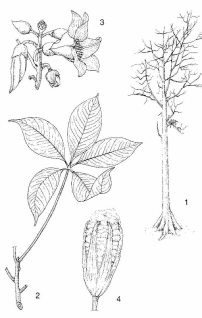 | Bombax valetonii Hochr. – 1, tree habit. Bombax ceiba L. – 2, leaf; 3, inflorescence; 4, fruit. |
Ecology
Bombax can be found in primary and secondary forest, often near rivers, up to 750 m altitude (within Malesia). B. ceiba is often found at forest edges or disturbed forest and can be locally dominant.
Silviculture and Management
Bombax can be propagated by seed, including direct sowing, and by vegetative means through cuttings and grafting. For B. ceiba there are about 28 000 seeds/kg. To obtain seeds the fruits are dried in the sun and when they open the seeds are removed. Seed can be stored in closed receptacles for 1-2 years. About 90% of B. ceiba seeds germinate in 6-18 days. Seedlings can be planted out as bare-rooted stock, as container stock or as stumps. Container stock is not successful in India due to slow development after planting, but 82% survival has also been reported. For stumps, the fleshy taproot should be 50-60 cm long, and the diameter at the collar should be 1-2.5 cm. Direct sowing in lines 45-60 cm apart after the harvest of a field crop showed very good results in India. Cuttings were not effective; high mortality occurred after planting out in the field. For B. ceiba as an ornamental tree, however, propagation by cuttings under mist is very successful and 100% rooting is obtained even without the application of growth hormones. Patch budding is used to establish seed orchards of B. ceiba in India; about 80% of the grafted plants survive, provided they are not transplanted. Weeding and thinning is necessary for up to three years. B. ceiba in India is characterized as a strong light-demander with abundant natural regeneration on open sites and easy natural pruning under forest conditions. It coppices well but only for the first few years. Bombax at first shows pioneer characteristics, but later develops those of a mature phase emergent. Fomes lignosus, a fungal wound parasite causing wood decay, and Dysdercus cingulatus (red cotton bug) nymphs and adults which feed on the sap of tender parts, have been observed on B. ceiba.
Genetic Resources and Breeding
A germplasm bank has been established in Arunachal Pradesh (India) where 22 clones of B. ceiba are available, and 15 clones are present at the Forest Research Institute at Dehra Dun. Seed orchards have been established at 6 locations in the states of Arunchal Pradesh and Uttar Pradesh. B. ceiba shows both self- and cross-pollination, but the rate of outcrossing is unknown.
Prospects
Judging by the experiences gained in India with B. ceiba prospects are promising. The large differences in growth rate reported for B. ceiba in South-East Asia and India, however, need reconfirmation; research is needed to determine whether these differences can be attributed to genetic variation.
Literature
[70]Backer, C.A. & Bakhuizen van den Brink Jr., R.C., 1963-1968. Flora of Java. 3 volumes. Wolters-Noordhoff, Groningen.
[104]Beniwal, B.S. & Singh, N.B., 1990. Genetic improvement of forest trees in Arunachal Pradesh, India. Indian Forester 116: 3-10.
[131]Bose, T.K. & Mondal, D.P., 1970. Propagation of ornamental plants from cuttings under mist. Science and Culture 36(12): 665-666.
[152]Browne, F.G., 1968. Pests and diseases of forest plantation trees. An annotated list of the principal species occurring in the British Commonwealth. Clarendon Press, Oxford. 1330 pp.
[161]Burger, D., 1972. Seedlings of some tropical trees and shrubs mainly of South East Asia. Pudoc, Wageningen. 399 pp.
[162]Burgess, P.F., 1966. Timbers of Sabah. Sabah Forest Records No 6. Forest Department, Sabah, Sandakan. xviii + 501 pp.
[163]Burkill, I.H., 1966. A dictionary of the economic products of the Malay Peninsula. 2nd edition. Ministry of Agriculture and Co-operatives, Kuala Lumpur. Vol. 1 (A-H) pp. 1-1240. Vol. 2 (I-Z) pp. 1241-2444.
[174]Cay go rung Viet nam [Forest trees of Vietnam] (various editors), 1971-1988. Agriculture Publisher, Hanoi.
[209]Corner, E.J.H., 1988. Wayside trees of Malaya. 3rd edition. 2 volumes. The Malayan Nature Society, Kuala Lumpur. 774 pp.
[260]den Berger, L.G., 1926. Houtsoorten der cultuurgebieden van Java en Sumatra's oostkust [Tree species of the cultivated areas of Java and the east coast of Sumatra]. Mededeelingen No 13. Proefstation voor het Boschwezen, Buitenzorg. 186 pp.
[267]Desch, H.E., 1941-1954. Manual of Malayan timbers. Malayan Forest Records No 15. 2 volumes. Malaya Publishing House Ltd., Singapore. 762 pp.
[300]Eddowes, P.J., 1977. Commercial timbers of Papua New Guinea, their properties and uses. Forest Products Research Centre, Department of Primary Industry, Port Moresby. xiv + 195 pp.
[302]Eddowes, P.J., 1980. Lesser known timber species of SEALPA countries. A review and summary. South East Asia Lumber Producers' Association, Jakarta. 132 pp.
[312]Emmanuel, C.J.S.K., Kapoor, M.L. & Sharma, V.K., 1992. Three decades of forest genetics and tree improvement. Indian Forester 118: 489-500.
[348]Forest Products Research Centre, 1967. Properties and uses of Papua and New Guinea timbers. Forest Products Research Centre, Port Moresby. 30 pp.
[387]Grewal, G.S., 1979. Air-seasoning properties of some Malaysian timbers. Malaysian Forest Service Trade Leaflet No 41. Malaysian Timber Industry Board, Kuala Lumpur. 26 pp.
[402]Hallé, F., Oldeman, R.A.A. & Tomlinson, P.B., 1978. Tropical trees and forests - an architectural analysis. Springer Verlag, Berlin, Heidelberg, New York. 441 pp.
[403]Handbooks of the flora of Papua New Guinea (various editors), 1978-. Melbourne University Press, Carlton.
[436]Heyne, K., 1927. De nuttige planten van Nederlands-Indië [The useful plants of the Dutch East Indies]. 2nd edition, 3 volumes. Departement van Landbouw, Nijverheid en Handel in Nederlandsch-Indië. 1953 pp. (3rd edition, 1950. van Hoeve, 's-Gravenhage/Bandung. 1660 pp.).
[438]Hildebrand, F.H., 1951. Daftar nama pohon-pohonan Djawa-Madura dengan keterangan-keterangan tentang penjiaran dan ukurannja (telah diperbaiki) [Revised list of tree species of Java-Madura with notes on their distribution and dimensions]. Laporan No 50. Balai Penjelidikan Kehutanan, Bogor. 183 pp.
[526]Kartasujana, I. & Martawijaya, A., 1979. Kayu perdagangan Indonesia - sifat dan kegunaannya [Commercial woods of Indonesia - their properties and uses]. Lembaga Penelitian Hasil Hutan, Bogor. 28 pp.
[571]Kloot, N.H. & Bolza, E., 1961. Properties of timbers imported into Australia. Technological Paper No 12. Division of Forest Products, CSIRO, Melbourne. 79 pp.
[595]Koorders, S.H. & Valeton, T., 1894-1915. Bijdrage tot de kennis der boomsoorten van Java [Contribution to the knowledge of the tree species of Java]. 13 parts. G. Kolff & Co., Batavia, 's-Gravenhage.
[632]Kraemer, J.H., 1951. Trees of the western Pacific region. Tri-State Offset Company, Cincinnatti. 436 pp.
[633]Kramer, F., 1925. Kultuurproeven met industrie-, konstruktie- en luxe-houtsoorten [Investigations regarding the cultivation of different Javanese trees]. Mededeelingen No 12. Proefstation voor het Boschwezen, Buitenzorg. 99 pp.
[672]Lecomte, H., 1907-1950. Flore générale de l'Indo-Chine [General flora of Indo-China]. 7 vols & Supplément. Masson & Cie, Paris.
[678]Lee, Y.H., Engku Abdul Rahman bin Chik & Chu, Y.P., 1979. The strength properties of some Malaysian timbers. Malaysian Forest Service Trade Leaflet No 34 (revised edition). Malaysian Timber Industry Board, Kuala Lumpur. 107 pp.
[697]Letourneux, C., 1957. Tree planting practices in tropical Asia. FAO Forestry Development Paper No 11. FAO, Rome. 172 pp.
[829]Ng, F.S.P., 1991-1992. Manual of forest fruits, seeds and seedlings. 2 volumes. Malayan Forest Record No 34. Forest Research Institute Malaysia, Kepong. 997 pp.
[831]Ng, F.S.P. & Mat Asri Ngah Sanah, 1991. Germination and seedling records. Research Pamphlet No 108. Forest Research Institute Malaysia, Kepong. 191 pp.
[861]Oey Djoen Seng, 1951. De soortelijke gewichten van Indonesische houtsoorten en hun betekenis voor de praktijk [Specific gravity of Indonesian woods and its significance for practical use]. Rapport No 46. Bosbouwproefstation, Bogor. 183 pp.
[883]Pham Hoang Ho, 1991-1993. An illustrated flora of Vietnam. 2 Volumes. Mekong Publisher, Montreal.
[889]Phengklai, C. & Khamsai, S., 1985. Some non-timber species of Thailand. Thai Forest Bulletin (Botany) 15: 108-148.
[933]Research Institute of Wood Industry, 1988. Identification, properties and uses of some Southeast Asian woods. Chinese Academy of Forestry, Wan Shou Shan, Beijing & International Tropical Timber Organization, Yokohama. 201 pp.
[934]Reyes, L.J., 1938. Philippine woods. Technical Bulletin No 7. Commonwealth of the Philippines, Department of Agriculture and Commerce. Bureau of Printing, Manila. 536 pp. + 88 plates.
[953]Robyns, A., 1963. Essai de monographie du genre Bombax s.l. (Bombacaceae) [A preliminary monograph of the genus Bombax s.l. (Bombacaceae)]. Bulletin du Jardin Botanique de l'Etat 33: 1-311.
[974]Salvosa, F.M., 1963. Lexicon of Philippine trees. Bulletin No 1. Forest Products Research Institute, College, Laguna. 136 pp.
[1038]Smitinand, T., 1980. Thai plant names. Royal Forest Department, Bangkok. 379 pp.
[1104]Troup, R.S., 1921. Silviculture of Indian trees. 3 volumes. Clarendon Press, Oxford.
[1169]Vidal, J., 1962. Noms vernaculaires de plantes en usage au Laos [Vernacular names of plants used in Laos]. Ecole française d'Extrême-Orient, Paris. 197 pp.
[1177]von Meyenfeldt, C.F.W.M. et al., 1978. Restoration of devastated inland forests in South Vietnam. Volume III: List of tree species. Agricultural University, Wageningen. 219 pp.
[1221]Whitmore, T.C. & Ng, F.S.P. (Editors), 1972-1989. Tree flora of Malaya. A manual for foresters. 4 volumes. Malayan Forest Records No 26. Longman Malaysia Sdn. Berhad, Kuala Lumpur & Petaling Jaya.
[1239]Wong, T.M., 1976. Wood structure of the lesser known timbers of Peninsular Malaysia. Malayan Forest Records No 28. Forest Research Institute Malaysia, Kepong. xi + 115 pp.
[1242]Wong, T.M., 1982. A dictionary of Malaysian timbers. Malayan Forest Records No 30. Forest Research Institute Malaysia, Kepong. 259 pp.
[1265]Zainuddin bin Mohd. Yunos, 1985. Malaysian timbers - kekabu. Malaysian Forest Service Trade Leaflet No 98. Malaysian Timber Industry Board, Kuala Lumpur. 4 pp.
[104]Beniwal, B.S. & Singh, N.B., 1990. Genetic improvement of forest trees in Arunachal Pradesh, India. Indian Forester 116: 3-10.
[131]Bose, T.K. & Mondal, D.P., 1970. Propagation of ornamental plants from cuttings under mist. Science and Culture 36(12): 665-666.
[152]Browne, F.G., 1968. Pests and diseases of forest plantation trees. An annotated list of the principal species occurring in the British Commonwealth. Clarendon Press, Oxford. 1330 pp.
[161]Burger, D., 1972. Seedlings of some tropical trees and shrubs mainly of South East Asia. Pudoc, Wageningen. 399 pp.
[162]Burgess, P.F., 1966. Timbers of Sabah. Sabah Forest Records No 6. Forest Department, Sabah, Sandakan. xviii + 501 pp.
[163]Burkill, I.H., 1966. A dictionary of the economic products of the Malay Peninsula. 2nd edition. Ministry of Agriculture and Co-operatives, Kuala Lumpur. Vol. 1 (A-H) pp. 1-1240. Vol. 2 (I-Z) pp. 1241-2444.
[174]Cay go rung Viet nam [Forest trees of Vietnam] (various editors), 1971-1988. Agriculture Publisher, Hanoi.
[209]Corner, E.J.H., 1988. Wayside trees of Malaya. 3rd edition. 2 volumes. The Malayan Nature Society, Kuala Lumpur. 774 pp.
[260]den Berger, L.G., 1926. Houtsoorten der cultuurgebieden van Java en Sumatra's oostkust [Tree species of the cultivated areas of Java and the east coast of Sumatra]. Mededeelingen No 13. Proefstation voor het Boschwezen, Buitenzorg. 186 pp.
[267]Desch, H.E., 1941-1954. Manual of Malayan timbers. Malayan Forest Records No 15. 2 volumes. Malaya Publishing House Ltd., Singapore. 762 pp.
[300]Eddowes, P.J., 1977. Commercial timbers of Papua New Guinea, their properties and uses. Forest Products Research Centre, Department of Primary Industry, Port Moresby. xiv + 195 pp.
[302]Eddowes, P.J., 1980. Lesser known timber species of SEALPA countries. A review and summary. South East Asia Lumber Producers' Association, Jakarta. 132 pp.
[312]Emmanuel, C.J.S.K., Kapoor, M.L. & Sharma, V.K., 1992. Three decades of forest genetics and tree improvement. Indian Forester 118: 489-500.
[348]Forest Products Research Centre, 1967. Properties and uses of Papua and New Guinea timbers. Forest Products Research Centre, Port Moresby. 30 pp.
[387]Grewal, G.S., 1979. Air-seasoning properties of some Malaysian timbers. Malaysian Forest Service Trade Leaflet No 41. Malaysian Timber Industry Board, Kuala Lumpur. 26 pp.
[402]Hallé, F., Oldeman, R.A.A. & Tomlinson, P.B., 1978. Tropical trees and forests - an architectural analysis. Springer Verlag, Berlin, Heidelberg, New York. 441 pp.
[403]Handbooks of the flora of Papua New Guinea (various editors), 1978-. Melbourne University Press, Carlton.
[436]Heyne, K., 1927. De nuttige planten van Nederlands-Indië [The useful plants of the Dutch East Indies]. 2nd edition, 3 volumes. Departement van Landbouw, Nijverheid en Handel in Nederlandsch-Indië. 1953 pp. (3rd edition, 1950. van Hoeve, 's-Gravenhage/Bandung. 1660 pp.).
[438]Hildebrand, F.H., 1951. Daftar nama pohon-pohonan Djawa-Madura dengan keterangan-keterangan tentang penjiaran dan ukurannja (telah diperbaiki) [Revised list of tree species of Java-Madura with notes on their distribution and dimensions]. Laporan No 50. Balai Penjelidikan Kehutanan, Bogor. 183 pp.
[526]Kartasujana, I. & Martawijaya, A., 1979. Kayu perdagangan Indonesia - sifat dan kegunaannya [Commercial woods of Indonesia - their properties and uses]. Lembaga Penelitian Hasil Hutan, Bogor. 28 pp.
[571]Kloot, N.H. & Bolza, E., 1961. Properties of timbers imported into Australia. Technological Paper No 12. Division of Forest Products, CSIRO, Melbourne. 79 pp.
[595]Koorders, S.H. & Valeton, T., 1894-1915. Bijdrage tot de kennis der boomsoorten van Java [Contribution to the knowledge of the tree species of Java]. 13 parts. G. Kolff & Co., Batavia, 's-Gravenhage.
[632]Kraemer, J.H., 1951. Trees of the western Pacific region. Tri-State Offset Company, Cincinnatti. 436 pp.
[633]Kramer, F., 1925. Kultuurproeven met industrie-, konstruktie- en luxe-houtsoorten [Investigations regarding the cultivation of different Javanese trees]. Mededeelingen No 12. Proefstation voor het Boschwezen, Buitenzorg. 99 pp.
[672]Lecomte, H., 1907-1950. Flore générale de l'Indo-Chine [General flora of Indo-China]. 7 vols & Supplément. Masson & Cie, Paris.
[678]Lee, Y.H., Engku Abdul Rahman bin Chik & Chu, Y.P., 1979. The strength properties of some Malaysian timbers. Malaysian Forest Service Trade Leaflet No 34 (revised edition). Malaysian Timber Industry Board, Kuala Lumpur. 107 pp.
[697]Letourneux, C., 1957. Tree planting practices in tropical Asia. FAO Forestry Development Paper No 11. FAO, Rome. 172 pp.
[829]Ng, F.S.P., 1991-1992. Manual of forest fruits, seeds and seedlings. 2 volumes. Malayan Forest Record No 34. Forest Research Institute Malaysia, Kepong. 997 pp.
[831]Ng, F.S.P. & Mat Asri Ngah Sanah, 1991. Germination and seedling records. Research Pamphlet No 108. Forest Research Institute Malaysia, Kepong. 191 pp.
[861]Oey Djoen Seng, 1951. De soortelijke gewichten van Indonesische houtsoorten en hun betekenis voor de praktijk [Specific gravity of Indonesian woods and its significance for practical use]. Rapport No 46. Bosbouwproefstation, Bogor. 183 pp.
[883]Pham Hoang Ho, 1991-1993. An illustrated flora of Vietnam. 2 Volumes. Mekong Publisher, Montreal.
[889]Phengklai, C. & Khamsai, S., 1985. Some non-timber species of Thailand. Thai Forest Bulletin (Botany) 15: 108-148.
[933]Research Institute of Wood Industry, 1988. Identification, properties and uses of some Southeast Asian woods. Chinese Academy of Forestry, Wan Shou Shan, Beijing & International Tropical Timber Organization, Yokohama. 201 pp.
[934]Reyes, L.J., 1938. Philippine woods. Technical Bulletin No 7. Commonwealth of the Philippines, Department of Agriculture and Commerce. Bureau of Printing, Manila. 536 pp. + 88 plates.
[953]Robyns, A., 1963. Essai de monographie du genre Bombax s.l. (Bombacaceae) [A preliminary monograph of the genus Bombax s.l. (Bombacaceae)]. Bulletin du Jardin Botanique de l'Etat 33: 1-311.
[974]Salvosa, F.M., 1963. Lexicon of Philippine trees. Bulletin No 1. Forest Products Research Institute, College, Laguna. 136 pp.
[1038]Smitinand, T., 1980. Thai plant names. Royal Forest Department, Bangkok. 379 pp.
[1104]Troup, R.S., 1921. Silviculture of Indian trees. 3 volumes. Clarendon Press, Oxford.
[1169]Vidal, J., 1962. Noms vernaculaires de plantes en usage au Laos [Vernacular names of plants used in Laos]. Ecole française d'Extrême-Orient, Paris. 197 pp.
[1177]von Meyenfeldt, C.F.W.M. et al., 1978. Restoration of devastated inland forests in South Vietnam. Volume III: List of tree species. Agricultural University, Wageningen. 219 pp.
[1221]Whitmore, T.C. & Ng, F.S.P. (Editors), 1972-1989. Tree flora of Malaya. A manual for foresters. 4 volumes. Malayan Forest Records No 26. Longman Malaysia Sdn. Berhad, Kuala Lumpur & Petaling Jaya.
[1239]Wong, T.M., 1976. Wood structure of the lesser known timbers of Peninsular Malaysia. Malayan Forest Records No 28. Forest Research Institute Malaysia, Kepong. xi + 115 pp.
[1242]Wong, T.M., 1982. A dictionary of Malaysian timbers. Malayan Forest Records No 30. Forest Research Institute Malaysia, Kepong. 259 pp.
[1265]Zainuddin bin Mohd. Yunos, 1985. Malaysian timbers - kekabu. Malaysian Forest Service Trade Leaflet No 98. Malaysian Timber Industry Board, Kuala Lumpur. 4 pp.
Author(s)
Nguyen Ba & Nguyen Nghia Thin
Bombax ceiba
Bombax valetonii
Bombax valetonii
Correct Citation of this Article
Ba, N. & Thin, N.N., 1998. Bombax L.. In: Sosef, M.S.M., Hong, L.T. and Prawirohatmodjo, S. (Editors): Plant Resources of South-East Asia No 5(3): Timber trees; Lesser-known timbers. PROSEA Foundation, Bogor, Indonesia. Database record: prota4u.org/prosea
Selection of Species
The following species in this genus are important in this commodity group and are treated separatedly in this database:
Bombax ceiba
Bombax valetonii
Bombax ceiba
Bombax valetonii

All texts are licensed under a Creative Commons Attribution-Noncommercial-Share Alike 3.0 Netherlands License
This license does not include the illustrations (Maps,drawings,pictures); these remain all under copyright.