Record Number
5009
PROSEA Handbook Number
5(3): Timber trees; Lesser-known timbers
Taxon
Bridelia Willd.
Protologue
Sp. pl. 4(2): 978 (1806).
Family
EUPHORBIACEAE
Chromosome Numbers
x = 13; B. retusa, B. stipularis (L.) Blume: n = 13
Vernacular Names
Indonesia: kanderi (general), kandri (Javanese), kanyere (Sundanese). Malaysia: kenidai, kernam (Peninsular), kerdam (Sarawak). Papua New Guinea: scrub ironbark (En).
Origin and Geographic Distribution
Bridelia comprises about 50 species and is distributed in the Old World tropics. Most species occur in Asia, from Sri Lanka, India and the Himalayas to Burma (Myanmar), Indo-China, southern China, the Ryukyu Islands, Taiwan, Thailand, and throughout the Malesian region towards the Solomon Islands, Vanuatu and northern Australia.
Uses
The wood of Bridelia is used for temporary construction, agricultural implements, interior trim, light framing, joinery, drawer slides and sides, carts, carving, tool handles and other applications requiring toughness and flexibility. Material for tool handles must be properly selected. The attractively mottled silver grain makes the wood suitable for decorative purposes.
A decoction of the leaves or bark of several species, mainly that of B. tomentosa, is applied medicinally against itch, colic, stomach-ache, fever and dysentery. The leaves are attributed to have purgative, laxative and anti-bacterial properties. The fruits of most species can be eaten raw. Those of B. insulana are applied to colour palm wine red.
A decoction of the leaves or bark of several species, mainly that of B. tomentosa, is applied medicinally against itch, colic, stomach-ache, fever and dysentery. The leaves are attributed to have purgative, laxative and anti-bacterial properties. The fruits of most species can be eaten raw. Those of B. insulana are applied to colour palm wine red.
Production and International Trade
Supplies are generally extremely small; this, plus the usual small size of the trees, means that the wood of Bridelia is utilized mainly on a local scale. In 1996 Papua New Guinea exported only 92 m3 of "scrub ironbark"" logs at an average free-on-board (FOB) price of US$ 101/m3.
Properties
Bridelia yields a medium-weight hardwood with a density of 450-880 kg/m3 at 15% moisture content; B. glauca and B. insulana are comparatively light and have a density of 450-610 kg/m3 and 530-630 kg/m3, respectively. Heartwood pink with straw-coloured streaks or olive-grey-brown, distinct only in the green condition from the 3 cm wide, yellow-brown or straw sapwood; grain interlocked and sometimes wavy; texture moderately fine and even; attractive mottled silver grain present on radial surface of B. retusa wood; wood very greasy. Growth rings indistinct; vessels moderately small, mostly in radial multiples of 2-several, tyloses present; parenchyma paratracheal vasicentric, usually not visible; rays moderately fine, visible to the naked eye on the transverse surface; ripple marks absent.
Shrinkage upon seasoning is moderate; B. tomentosa is reported to warp badly during drying but B. retusa can be seasoned without serious degrade. The wood is hard, not very strong and fairly tough. It is easy to work with hand and machine tools, but is somewhat fibrous; B. tomentosa wood is reported to be extremely difficult to hand-saw when green. The durability varies from moderately durable to non-durable under exposed conditions. However, house posts made of B. macrocarpa wood reputedly lasted for 10 years, which classifies it as durable. Wood samples are susceptible to attack by ambrosia beetles. The sapwood is susceptible to Lyctus.
The mean fibre lenght of B. tomentosa is 1.160 mm.
See also the tables on microscopic wood anatomy and wood properties.
Shrinkage upon seasoning is moderate; B. tomentosa is reported to warp badly during drying but B. retusa can be seasoned without serious degrade. The wood is hard, not very strong and fairly tough. It is easy to work with hand and machine tools, but is somewhat fibrous; B. tomentosa wood is reported to be extremely difficult to hand-saw when green. The durability varies from moderately durable to non-durable under exposed conditions. However, house posts made of B. macrocarpa wood reputedly lasted for 10 years, which classifies it as durable. Wood samples are susceptible to attack by ambrosia beetles. The sapwood is susceptible to Lyctus.
The mean fibre lenght of B. tomentosa is 1.160 mm.
See also the tables on microscopic wood anatomy and wood properties.
Botany
Usually monoecious shrubs, climbers or small to medium-sized trees up to 20(-30) m tall; bole straight to fairly irregular, branchless for up to 12(-17) m, up to 50(-85) cm in diameter, occasionally with small buttresses up to 1.8 m high; bark surface smooth to prominently longitudinally fissured, flaking in scales or long strips, dark brown to grey-brown, inner bark fibrous, pink. Leaves alternate, distichous, simple, with the lateral veins close, straight and parallel, short-stalked, margin entire to slightly crenate; stipules caducous. Flowers crowded in a small glomerule that is solitary or grouped in a spike and axillary, unisexual, very small, 5-merous; sepals valvate; petals smaller than the sepals. Male flowers with annular or interrupted disk; filaments connate into a column; pistillode present. Female flowers with annular or cupular disk; ovary superior, 2(-3)-locular with 2 ovules in each cell, styles 2, free or variably united, bifid, stigmas terete to flat. Fruit a small, 1-2(-3)-locular drupe with a persistent calyx and 1 seed per locule. Seed with smooth testa. Seedling with epigeal germination; cotyledons emergent, bilobed; hypocotyl elongated; first pair of leaves opposite, subsequent ones arranged spirally, soon distichous.
The larger figures above related to the tree size and bole all refer to B. macrocarpa. In a nursery in India B. retusa seedlings had attained a height of only 8-15 cm after one year and 15-50 cm after two years. In natural forest a mean annual diameter increment of 0.1-0.4 cm has been recorded; a value of 0.5-1.0 cm is known from wood samples.
There is some discussion about the correct spelling of the name Bridelia. According to nomenclatural rules it should be "Briedelia"" but at the time of writing a proposal to conserve the first spelling has been submitted. Bridelia is one of the 2 genera of the tribe Bridelieae (together with Cleistanthus) within the subfamily Phyllanthoideae.
The larger figures above related to the tree size and bole all refer to B. macrocarpa. In a nursery in India B. retusa seedlings had attained a height of only 8-15 cm after one year and 15-50 cm after two years. In natural forest a mean annual diameter increment of 0.1-0.4 cm has been recorded; a value of 0.5-1.0 cm is known from wood samples.
There is some discussion about the correct spelling of the name Bridelia. According to nomenclatural rules it should be "Briedelia"" but at the time of writing a proposal to conserve the first spelling has been submitted. Bridelia is one of the 2 genera of the tribe Bridelieae (together with Cleistanthus) within the subfamily Phyllanthoideae.
Image
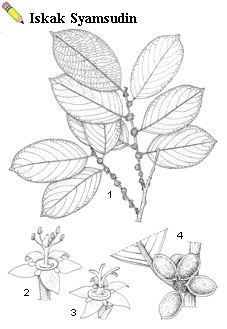 | Bridelia pustulata Hook. f. – 1, flowering twig; 2, male flower; 3, female flower; 4, fruits. |
Ecology
Bridelia is fairly common in secondary, evergreen to semi-deciduous forest, forest margins or scrub vegetation and is found less often in primary forest. It is often associated with streams or rivers and is found in well-drained habitats as well as in peat-swamp forest and occasionally along the edge of mangrove vegetation, from sea-level up to 1800 m altitude. Soil types vary from sandy alluvium to clay soils or black rocky soils. B. tomentosa also occurs in open savanna.
Silviculture and Management
Bridelia can be propagated by seed. For B. retusa 16 000-17 500 pyrenes/kg have been counted. The germination rate of B. insulana is 90-95% in 9-30 days for seeds and 55% in 15-36 days for fruits. B. retusa tolerates moderate shade and regenerates from coppicing and by root suckers.
Genetic Resources and Breeding
As Bridelia is fairly common, especially in secondary vegetation, there seems to be little risk of genetic erosion.
Prospects
Increased utilization is unlikely, but Bridelia wood will probably keep its value for applications where toughness is demanded.
Literature
[25]Airy Shaw, H.K., 1971. Notes on Malesian and other Asiatic Euphorbiaceae. CXXXIII. A new Bridelia from New Guinea. Kew Bulletin 25: 512-514.
[26]Airy Shaw, H.K., 1972. The Euphorbiaceae of Siam. Kew Bulletin 26: 191-363.
[28]Airy Shaw, H.K., 1975. The Euphorbiaceae of Borneo. Kew Bulletin Additional Series VIII. Her Majesty's Stationery Office, London. 245 pp.
[32]Airy Shaw, H.K., 1980. The Euphorbiaceae of New Guinea. Kew Bulletin Additional Series VIII. Her Majesty's Stationery Office, London. 243 pp.
[33]Airy Shaw, H.K., 1981. An alphabetical enumeration of the Euphorbiaceae of the Philippine islands. Royal Botanic Gardens, Kew. 56 pp.
[34]Airy Shaw, H.K., 1981. The Euphorbiaceae of Sumatra. Kew Bulletin 36: 239-374.
[36]Airy Shaw, H.K., 1983. The Euphorbiaceae of Central Malesia (Celebes, Moluccas, Lesser Sunda Is.). Kew Bulletin 37: 1-40.
[70]Backer, C.A. & Bakhuizen van den Brink Jr., R.C., 1963-1968. Flora of Java. 3 volumes. Wolters-Noordhoff, Groningen.
[125]Bolza, E. & Kloot, N.H., 1966. The mechanical properties of 81 New Guinea timbers. Technological Paper No 41. Division of Forest Products, CSIRO, Melbourne. 39 pp.
[151]Browne, F.G., 1955. Forest trees of Sarawak and Brunei and their products. Government Printing Office, Kuching, Sarawak. xviii + 369 pp.
[162]Burgess, P.F., 1966. Timbers of Sabah. Sabah Forest Records No 6. Forest Department, Sabah, Sandakan. xviii + 501 pp.
[163]Burkill, I.H., 1966. A dictionary of the economic products of the Malay Peninsula. 2nd edition. Ministry of Agriculture and Co-operatives, Kuala Lumpur. Vol. 1 (A-H) pp. 1-1240. Vol. 2 (I-Z) pp. 1241-2444.
[209]Corner, E.J.H., 1988. Wayside trees of Malaya. 3rd edition. 2 volumes. The Malayan Nature Society, Kuala Lumpur. 774 pp.
[238]de Vogel, E.F., 1980. Seedlings of dicotyledons. Structure, development, types. Descriptions of 150 woody Malesian taxa. Pudoc, Wageningen. 465 pp.
[267]Desch, H.E., 1941-1954. Manual of Malayan timbers. Malayan Forest Records No 15. 2 volumes. Malaya Publishing House Ltd., Singapore. 762 pp.
[291]Dressler, S., 1996. The genus Bridelia (Euphorbiaceae) in Malesia and Indo-China - A regional revision. Blumea 41: 263-331.
[300]Eddowes, P.J., 1977. Commercial timbers of Papua New Guinea, their properties and uses. Forest Products Research Centre, Department of Primary Industry, Port Moresby. xiv + 195 pp.
[301]Eddowes, P.J., 1979. The utilisation of Papua New Guinea timbers. Forest Products Research Centre, Department of Primary Industry, Port Moresby. 30 pp.
[348]Forest Products Research Centre, 1967. Properties and uses of Papua and New Guinea timbers. Forest Products Research Centre, Port Moresby. 30 pp.
[436]Heyne, K., 1927. De nuttige planten van Nederlands-Indië [The useful plants of the Dutch East Indies]. 2nd edition, 3 volumes. Departement van Landbouw, Nijverheid en Handel in Nederlandsch-Indië. 1953 pp. (3rd edition, 1950. van Hoeve, 's-Gravenhage/Bandung. 1660 pp.).
[543]Keng, H., 1990. The concise flora of Singapore. Gymnosperms and dicotyledons. Singapore University Press, Singapore. 222 pp.
[545]Kesorn, C. & Pawitpok, C., 1980. Study on medicinal plants for the treatment of dysentery and on laxatives. TISTR Bibliographical Series No 6. Abstracts on Medicinal Plants in Thailand No 1, Abstract No 76. Thailand Institute of Scientific and Technological Research, Bangkok. 26 pp.
[671]Leach, A.J., Leach, D.N. & Leach, G.J., 1988. Antibacterial activity of some medicinal plants of Papua New Guinea. Science in New Guinea 14(1): 1-7.
[696]Lemmens, R.H.M.J. & Wulijarni-Soetjipto, N. (Editors), 1991. Plant resources of South-East Asia No 3. Dye and tannin-producing plants. Pudoc, Wageningen. 195 pp.
[829]Ng, F.S.P., 1991-1992. Manual of forest fruits, seeds and seedlings. 2 volumes. Malayan Forest Record No 34. Forest Research Institute Malaysia, Kepong. 997 pp.
[831]Ng, F.S.P. & Mat Asri Ngah Sanah, 1991. Germination and seedling records. Research Pamphlet No 108. Forest Research Institute Malaysia, Kepong. 191 pp.
[861]Oey Djoen Seng, 1951. De soortelijke gewichten van Indonesische houtsoorten en hun betekenis voor de praktijk [Specific gravity of Indonesian woods and its significance for practical use]. Rapport No 46. Bosbouwproefstation, Bogor. 183 pp.
[874]Pearson, R.S. & Brown, H.P., 1932. Commercial timbers of India. Their distribution, supplies, anatomical structure, physical and mechanical properties and uses. 2 Volumes. Government of India, Central Publication Branch, Calcutta. x + 1150 p
[974]Salvosa, F.M., 1963. Lexicon of Philippine trees. Bulletin No 1. Forest Products Research Institute, College, Laguna. 136 pp.
[1038]Smitinand, T., 1980. Thai plant names. Royal Forest Department, Bangkok. 379 pp.
[1104]Troup, R.S., 1921. Silviculture of Indian trees. 3 volumes. Clarendon Press, Oxford.
[1169]Vidal, J., 1962. Noms vernaculaires de plantes en usage au Laos [Vernacular names of plants used in Laos]. Ecole française d'Extrême-Orient, Paris. 197 pp.
[1195]Webster, G.L., 1994. Synopsis of the genera and suprageneric taxa of Euphorbiaceae. Annals of the Missouri Botanical Garden 81: 33-144.
[1221]Whitmore, T.C. & Ng, F.S.P. (Editors), 1972-1989. Tree flora of Malaya. A manual for foresters. 4 volumes. Malayan Forest Records No 26. Longman Malaysia Sdn. Berhad, Kuala Lumpur & Petaling Jaya.
[1232]Wisse, J.H., 1965. Volumegewichten van een aantal houtmonsters uit West Nieuw Guinea [Specific gravity of some wood samples from West New Guinea]. Afdeling Bosexploitatie en Boshuishoudkunde, Landbouwhogeschool, Wageningen. 23 pp.
[1242]Wong, T.M., 1982. A dictionary of Malaysian timbers. Malayan Forest Records No 30. Forest Research Institute Malaysia, Kepong. 259 pp.
[1268]Zamuco, I.T., 1981. Some unexploited plants of the Philippines. Canopy International 7(3): 1, 10-11; 7(4): 10-14; 7(5): 13-14.
[26]Airy Shaw, H.K., 1972. The Euphorbiaceae of Siam. Kew Bulletin 26: 191-363.
[28]Airy Shaw, H.K., 1975. The Euphorbiaceae of Borneo. Kew Bulletin Additional Series VIII. Her Majesty's Stationery Office, London. 245 pp.
[32]Airy Shaw, H.K., 1980. The Euphorbiaceae of New Guinea. Kew Bulletin Additional Series VIII. Her Majesty's Stationery Office, London. 243 pp.
[33]Airy Shaw, H.K., 1981. An alphabetical enumeration of the Euphorbiaceae of the Philippine islands. Royal Botanic Gardens, Kew. 56 pp.
[34]Airy Shaw, H.K., 1981. The Euphorbiaceae of Sumatra. Kew Bulletin 36: 239-374.
[36]Airy Shaw, H.K., 1983. The Euphorbiaceae of Central Malesia (Celebes, Moluccas, Lesser Sunda Is.). Kew Bulletin 37: 1-40.
[70]Backer, C.A. & Bakhuizen van den Brink Jr., R.C., 1963-1968. Flora of Java. 3 volumes. Wolters-Noordhoff, Groningen.
[125]Bolza, E. & Kloot, N.H., 1966. The mechanical properties of 81 New Guinea timbers. Technological Paper No 41. Division of Forest Products, CSIRO, Melbourne. 39 pp.
[151]Browne, F.G., 1955. Forest trees of Sarawak and Brunei and their products. Government Printing Office, Kuching, Sarawak. xviii + 369 pp.
[162]Burgess, P.F., 1966. Timbers of Sabah. Sabah Forest Records No 6. Forest Department, Sabah, Sandakan. xviii + 501 pp.
[163]Burkill, I.H., 1966. A dictionary of the economic products of the Malay Peninsula. 2nd edition. Ministry of Agriculture and Co-operatives, Kuala Lumpur. Vol. 1 (A-H) pp. 1-1240. Vol. 2 (I-Z) pp. 1241-2444.
[209]Corner, E.J.H., 1988. Wayside trees of Malaya. 3rd edition. 2 volumes. The Malayan Nature Society, Kuala Lumpur. 774 pp.
[238]de Vogel, E.F., 1980. Seedlings of dicotyledons. Structure, development, types. Descriptions of 150 woody Malesian taxa. Pudoc, Wageningen. 465 pp.
[267]Desch, H.E., 1941-1954. Manual of Malayan timbers. Malayan Forest Records No 15. 2 volumes. Malaya Publishing House Ltd., Singapore. 762 pp.
[291]Dressler, S., 1996. The genus Bridelia (Euphorbiaceae) in Malesia and Indo-China - A regional revision. Blumea 41: 263-331.
[300]Eddowes, P.J., 1977. Commercial timbers of Papua New Guinea, their properties and uses. Forest Products Research Centre, Department of Primary Industry, Port Moresby. xiv + 195 pp.
[301]Eddowes, P.J., 1979. The utilisation of Papua New Guinea timbers. Forest Products Research Centre, Department of Primary Industry, Port Moresby. 30 pp.
[348]Forest Products Research Centre, 1967. Properties and uses of Papua and New Guinea timbers. Forest Products Research Centre, Port Moresby. 30 pp.
[436]Heyne, K., 1927. De nuttige planten van Nederlands-Indië [The useful plants of the Dutch East Indies]. 2nd edition, 3 volumes. Departement van Landbouw, Nijverheid en Handel in Nederlandsch-Indië. 1953 pp. (3rd edition, 1950. van Hoeve, 's-Gravenhage/Bandung. 1660 pp.).
[543]Keng, H., 1990. The concise flora of Singapore. Gymnosperms and dicotyledons. Singapore University Press, Singapore. 222 pp.
[545]Kesorn, C. & Pawitpok, C., 1980. Study on medicinal plants for the treatment of dysentery and on laxatives. TISTR Bibliographical Series No 6. Abstracts on Medicinal Plants in Thailand No 1, Abstract No 76. Thailand Institute of Scientific and Technological Research, Bangkok. 26 pp.
[671]Leach, A.J., Leach, D.N. & Leach, G.J., 1988. Antibacterial activity of some medicinal plants of Papua New Guinea. Science in New Guinea 14(1): 1-7.
[696]Lemmens, R.H.M.J. & Wulijarni-Soetjipto, N. (Editors), 1991. Plant resources of South-East Asia No 3. Dye and tannin-producing plants. Pudoc, Wageningen. 195 pp.
[829]Ng, F.S.P., 1991-1992. Manual of forest fruits, seeds and seedlings. 2 volumes. Malayan Forest Record No 34. Forest Research Institute Malaysia, Kepong. 997 pp.
[831]Ng, F.S.P. & Mat Asri Ngah Sanah, 1991. Germination and seedling records. Research Pamphlet No 108. Forest Research Institute Malaysia, Kepong. 191 pp.
[861]Oey Djoen Seng, 1951. De soortelijke gewichten van Indonesische houtsoorten en hun betekenis voor de praktijk [Specific gravity of Indonesian woods and its significance for practical use]. Rapport No 46. Bosbouwproefstation, Bogor. 183 pp.
[874]Pearson, R.S. & Brown, H.P., 1932. Commercial timbers of India. Their distribution, supplies, anatomical structure, physical and mechanical properties and uses. 2 Volumes. Government of India, Central Publication Branch, Calcutta. x + 1150 p
[974]Salvosa, F.M., 1963. Lexicon of Philippine trees. Bulletin No 1. Forest Products Research Institute, College, Laguna. 136 pp.
[1038]Smitinand, T., 1980. Thai plant names. Royal Forest Department, Bangkok. 379 pp.
[1104]Troup, R.S., 1921. Silviculture of Indian trees. 3 volumes. Clarendon Press, Oxford.
[1169]Vidal, J., 1962. Noms vernaculaires de plantes en usage au Laos [Vernacular names of plants used in Laos]. Ecole française d'Extrême-Orient, Paris. 197 pp.
[1195]Webster, G.L., 1994. Synopsis of the genera and suprageneric taxa of Euphorbiaceae. Annals of the Missouri Botanical Garden 81: 33-144.
[1221]Whitmore, T.C. & Ng, F.S.P. (Editors), 1972-1989. Tree flora of Malaya. A manual for foresters. 4 volumes. Malayan Forest Records No 26. Longman Malaysia Sdn. Berhad, Kuala Lumpur & Petaling Jaya.
[1232]Wisse, J.H., 1965. Volumegewichten van een aantal houtmonsters uit West Nieuw Guinea [Specific gravity of some wood samples from West New Guinea]. Afdeling Bosexploitatie en Boshuishoudkunde, Landbouwhogeschool, Wageningen. 23 pp.
[1242]Wong, T.M., 1982. A dictionary of Malaysian timbers. Malayan Forest Records No 30. Forest Research Institute Malaysia, Kepong. 259 pp.
[1268]Zamuco, I.T., 1981. Some unexploited plants of the Philippines. Canopy International 7(3): 1, 10-11; 7(4): 10-14; 7(5): 13-14.
Author(s)
H.C. Ong
Bridelia glauca
Bridelia insulana
Bridelia macrocarpa
Bridelia pustulata
Bridelia retusa
Bridelia tomentosa
Bridelia insulana
Bridelia macrocarpa
Bridelia pustulata
Bridelia retusa
Bridelia tomentosa
Correct Citation of this Article
Ong, H.C., 1998. Bridelia Willd.. In: Sosef, M.S.M., Hong, L.T. and Prawirohatmodjo, S. (Editors): Plant Resources of South-East Asia No 5(3): Timber trees; Lesser-known timbers. PROSEA Foundation, Bogor, Indonesia. Database record: prota4u.org/prosea
Selection of Species
The following species in this genus are important in this commodity group and are treated separatedly in this database:
Bridelia glauca
Bridelia insulana
Bridelia macrocarpa
Bridelia pustulata
Bridelia retusa
Bridelia tomentosa
Bridelia glauca
Bridelia insulana
Bridelia macrocarpa
Bridelia pustulata
Bridelia retusa
Bridelia tomentosa

All texts are licensed under a Creative Commons Attribution-Noncommercial-Share Alike 3.0 Netherlands License
This license does not include the illustrations (Maps,drawings,pictures); these remain all under copyright.