Record Number
5052
PROSEA Handbook Number
5(3): Timber trees; Lesser-known timbers
Taxon
Cantleya Ridley
Protologue
Fl. Mal. Pen. 1: 436 (1922).
Family
ICACINACEAE
Chromosome Numbers
x = unknown; 2n = unknown
Vernacular Names
Dedaru (trade name). Brunei: cendana, samala, seranai. Indonesia: bedaru (general), garu buaya (Sumatra), mendaru (Bangka). Malaysia: bedaru (Sarawak), daru-daru (Peninsular), dedadu (Sabah).
Origin and Geographic Distribution
Cantleya is a monotypic genus. The only species, C. corniculata (Becc.) Howard (synonyms: C. johorica Ridley, Stemonurus corniculatus (Becc.) Ridley, Urandra corniculata (Becc.) Foxw.), is found in Peninsular Malaysia (Johore), the Riau and Lingga Archipelago, Bangka, Sumatra and Borneo.
Uses
The heavy and hard wood of Cantleya is used for medium to heavy construction, bridge building, ship building, laboratory benches, heavy duty flooring, piling, flag poles, pepper support poles, vehicle bodies, bedding wood, tool handles, canes and fancy turnings. In Borneo it has been regarded as the second most valuable wood for house building. The reputed usefulness for heavy-duty furniture is doubtful. The fragrant wood may be used as a substitute for sandalwood (Santalum album L.).
The fruits are edible, but said to be of rather poor quality.
The fruits are edible, but said to be of rather poor quality.
Production and International Trade
At the beginning of the 20th Century, "dedaru"" was reported to have been found in the Singapore market, supplies coming from Sumatra and Borneo. It is still exported from the latter areas but it is also used locally. As supplies are very limited, dedaru seldom comes on the market, and when it does it is generally sold in mixed consignments. Some of it may be marketed as "balau"" (heavy Shorea spp.). The fragrant wood is reputed to have been exported to China.
Properties
C. corniculata yields a heavy hardwood with a density of 840-1360 kg/m3 at 15% moisture content. Heartwood yellow-brown, sharply demarcated from the pale yellow-brown, 5 cm wide sapwood; grain interlocked; texture rather fine and even; wood with conspicuous ribbon figure on radial surface; freshly cut material with a fragrant odour. Growth rings absent; vessels medium-sized, mostly solitary with few radial or oblique pairs, open or containing tyloses; parenchyma moderately abundant, just visible to the naked eye, paratracheal vasicentric and slightly aliform; rays moderately fine to medium-sized, visible to the naked eye; ripple marks absent.
Shrinkage upon drying is low. The wood seasons well with a slight risk of surface checking; warping and splitting has been reported, but is probably not a problem. Boards of 13 mm and 38 mm thick take 2.5 and 6 months, respectively, to air dry. The wood is very hard and very strong. It is moderately difficult to saw, but fairly easy to turn and easy to plane. The wood is very durable, even in contact with the ground; the sapwood is susceptible to blue stain.
See also the tables on microscopic wood anatomy and wood properties.
Shrinkage upon drying is low. The wood seasons well with a slight risk of surface checking; warping and splitting has been reported, but is probably not a problem. Boards of 13 mm and 38 mm thick take 2.5 and 6 months, respectively, to air dry. The wood is very hard and very strong. It is moderately difficult to saw, but fairly easy to turn and easy to plane. The wood is very durable, even in contact with the ground; the sapwood is susceptible to blue stain.
See also the tables on microscopic wood anatomy and wood properties.
Botany
An evergreen, medium-sized to fairly large tree up to 40 m tall; bole slender, cylindrical, branchless for up to 20 m, up to 60(-150) cm in diameter, usually expanded at base or rarely with buttresses up to 1.5 m high; bark surface finely, shallowly and rather irregularly, longitudinally fissured, grey or grey-green to brownish, inner bark fibrous, very thin, white; crown dense with small branches; twigs zig-zag. Leaves arranged spirally, simple, entire, abruptly bluntly acuminate, margin slightly curved inward, exstipulate. Flowers bisexual, in an axillary cyme, peduncle covered with small bracts and giving rise to dichotomously branched smaller branches bearing small clusters of sessile flowers; calyx 5-lobed; petals (4-)5, valvate, with inflexed apex; stamens (4-)5, broadening upwards and club-shaped, pubescent distally, anther cells almost horseshoe-shaped; ovary superior, 1-locular with 2 apical ovules, stigma sessile. Fruit a 1-seeded, fusiform drupe with thin, pulpy exocarp and fibrous-corky endocarp, brown to blackish when mature, splitting on one side from below up to the middle.
Trees flower and bear fruit throughout the year. The fruits are eaten by animals.
Trees flower and bear fruit throughout the year. The fruits are eaten by animals.
Image
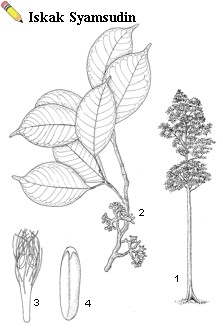 | Cantleya corniculata (Becc.) Howard – 1, tree habit; 2, flowering twig; 3, stamen; 4, petal. |
Ecology
C. corniculata is comparatively rare and scattered, and occurs as a canopy tree in primary forest, from sea-level up to about 300 m altitude. It is found in the drier parts of freshwater and peat-swamp forest, in kerangas as well as in drier hill forest, on marshy or sandy soils. It has been found together with "meranti bakau"" (Shorea uliginosa Foxw.), "punah"" (Tetramerista glabra Miq.) and "kempas"" (Koompassia malaccensis Maingay ex Benth.).
Silviculture and Management
In natural forest, natural regeneration of C. corniculata is generally sparse, although seed production is prolific. In a single germination trial, all seeds failed to germinate. In Bangka C. corniculata made up 3.5% of the total timber volume of trees over 10 cm in diameter.
Genetic Resources and Breeding
C. corniculata may easily become endangered because of destruction of its habitat or overcutting, as it is scattered and the timber is much in demand. There are no records of Cantleya in seed or germplasm banks.
Prospects
As supplies are dwindling, utilization of Cantley wood is expected to decrease. As the timber is held in esteem, the time is ripe for plantation establishment, necessitating research on its silvicultural characteristics.
Literature
[151]Browne, F.G., 1955. Forest trees of Sarawak and Brunei and their products. Government Printing Office, Kuching, Sarawak. xviii + 369 pp.
[162]Burgess, P.F., 1966. Timbers of Sabah. Sabah Forest Records No 6. Forest Department, Sabah, Sandakan. xviii + 501 pp.
[163]Burkill, I.H., 1966. A dictionary of the economic products of the Malay Peninsula. 2nd edition. Ministry of Agriculture and Co-operatives, Kuala Lumpur. Vol. 1 (A-H) pp. 1-1240. Vol. 2 (I-Z) pp. 1241-2444.
[198]Cockburn, P.F., 1976-1980. Trees of Sabah. 2 volumes. Sabah Forest Records No 10. Forest Department Sabah, Sandakan.
[218]Dahms, K.-G., 1982. Asiatische, ozeanische und australische Exporthölzer [Asiatic, Pacific and Australian export timbers]. DRW-Verlag, Stuttgart. 304 pp.
[259]den Berger, L.G., 1926. Mechanical properties of Dutch East Indian timbers. Korte Mededeelingen No 12. Proefstation voor het Boschwezen, Buitenzorg. viii + 63 pp.
[267]Desch, H.E., 1941-1954. Manual of Malayan timbers. Malayan Forest Records No 15. 2 volumes. Malaya Publishing House Ltd., Singapore. 762 pp.
[341]Flora Malesiana (various editors), 1950-. Kluwer Academic Publishers, Dordrecht, Boston, London.
[354]Foxworthy, F.W., 1927. Commercial timber trees of the Malay Peninsula. Malayan Forest Records No 3. Forest Department, Kuala Lumpur. 185 pp.
[387]Grewal, G.S., 1979. Air-seasoning properties of some Malaysian timbers. Malaysian Forest Service Trade Leaflet No 41. Malaysian Timber Industry Board, Kuala Lumpur. 26 pp.
[436]Heyne, K., 1927. De nuttige planten van Nederlands-Indië [The useful plants of the Dutch East Indies]. 2nd edition, 3 volumes. Departement van Landbouw, Nijverheid en Handel in Nederlandsch-Indië. 1953 pp. (3rd edition, 1950. van Hoeve, 's-Gravenhage/Bandung. 1660 pp.).
[453]Howard, R.A., 1940. Studies on the Icacinaceae, I. Preliminary taxonomic notes. Journal of the Arnold Arboretum 21: 461-489.
[526]Kartasujana, I. & Martawijaya, A., 1979. Kayu perdagangan Indonesia - sifat dan kegunaannya [Commercial woods of Indonesia - their properties and uses]. Lembaga Penelitian Hasil Hutan, Bogor. 28 pp.
[537]Keith, H.G., 1938. A preliminary list of North Borneo plant names. North Borneo Forest Records No 2. Government Printing Office, Sandakan. 242 pp.
[678]Lee, Y.H., Engku Abdul Rahman bin Chik & Chu, Y.P., 1979. The strength properties of some Malaysian timbers. Malaysian Forest Service Trade Leaflet No 34 (revised edition). Malaysian Timber Industry Board, Kuala Lumpur. 107 pp.
[743]Malmros, F., 1939. De houtskoolbereiding bij de Bankatinwinning [The manufacture of charcoal for the production of tin in Bangka]. Tectona 32: 687-715.
[861]Oey Djoen Seng, 1951. De soortelijke gewichten van Indonesische houtsoorten en hun betekenis voor de praktijk [Specific gravity of Indonesian woods and its significance for practical use]. Rapport No 46. Bosbouwproefstation, Bogor. 183 pp.
[933]Research Institute of Wood Industry, 1988. Identification, properties and uses of some Southeast Asian woods. Chinese Academy of Forestry, Wan Shou Shan, Beijing & International Tropical Timber Organization, Yokohama. 201 pp.
[1026]Sleumer, H., 1969. Materials towards the knowledge of the Icacinaceae of Asia, Malesia, and adjacent areas. Blumea 17: 181-264.
[1040]Smythies, B.E., 1965. Common Sarawak trees. Borneo Literature Bureau, South China Morning Post, Hong Kong. 153 pp.
[1075]Suprapto, 1989. Invasion of termite Macrotermes gilvus (Hagen) on mounding and its effect on the growth of pepper. Buletin Penelitian Tanaman Rempah dan Obat 4: 87-93.
[1091]Teo, S.P., 1995. A systematic study on the Olacaceae and Icacinaceae of the Malay Peninsula. MSc. thesis, University of Malaya, Kuala Lumpur. Unpublished.
[1099]Timber Research and Technical Training Centre. Unpublished data. Timber Research and Technical Training Centre, Sarawak Forest Department, Kuching.
[1221]Whitmore, T.C. & Ng, F.S.P. (Editors), 1972-1989. Tree flora of Malaya. A manual for foresters. 4 volumes. Malayan Forest Records No 26. Longman Malaysia Sdn. Berhad, Kuala Lumpur & Petaling Jaya.
[1222]Whitmore, T.C., Tantra, I.G.M. & Sutisna, U., 1986-1990. Tree flora of Indonesia. Checklists for Sumatra, Sulawesi, Bali, Nusa Tenggara & Timor, Maluku and Kalimantan. 6 volumes. Agency for Forestry Research and Development, Forest Research and Development Centre, Bogor.
[1242]Wong, T.M., 1982. A dictionary of Malaysian timbers. Malayan Forest Records No 30. Forest Research Institute Malaysia, Kepong. 259 pp.
[162]Burgess, P.F., 1966. Timbers of Sabah. Sabah Forest Records No 6. Forest Department, Sabah, Sandakan. xviii + 501 pp.
[163]Burkill, I.H., 1966. A dictionary of the economic products of the Malay Peninsula. 2nd edition. Ministry of Agriculture and Co-operatives, Kuala Lumpur. Vol. 1 (A-H) pp. 1-1240. Vol. 2 (I-Z) pp. 1241-2444.
[198]Cockburn, P.F., 1976-1980. Trees of Sabah. 2 volumes. Sabah Forest Records No 10. Forest Department Sabah, Sandakan.
[218]Dahms, K.-G., 1982. Asiatische, ozeanische und australische Exporthölzer [Asiatic, Pacific and Australian export timbers]. DRW-Verlag, Stuttgart. 304 pp.
[259]den Berger, L.G., 1926. Mechanical properties of Dutch East Indian timbers. Korte Mededeelingen No 12. Proefstation voor het Boschwezen, Buitenzorg. viii + 63 pp.
[267]Desch, H.E., 1941-1954. Manual of Malayan timbers. Malayan Forest Records No 15. 2 volumes. Malaya Publishing House Ltd., Singapore. 762 pp.
[341]Flora Malesiana (various editors), 1950-. Kluwer Academic Publishers, Dordrecht, Boston, London.
[354]Foxworthy, F.W., 1927. Commercial timber trees of the Malay Peninsula. Malayan Forest Records No 3. Forest Department, Kuala Lumpur. 185 pp.
[387]Grewal, G.S., 1979. Air-seasoning properties of some Malaysian timbers. Malaysian Forest Service Trade Leaflet No 41. Malaysian Timber Industry Board, Kuala Lumpur. 26 pp.
[436]Heyne, K., 1927. De nuttige planten van Nederlands-Indië [The useful plants of the Dutch East Indies]. 2nd edition, 3 volumes. Departement van Landbouw, Nijverheid en Handel in Nederlandsch-Indië. 1953 pp. (3rd edition, 1950. van Hoeve, 's-Gravenhage/Bandung. 1660 pp.).
[453]Howard, R.A., 1940. Studies on the Icacinaceae, I. Preliminary taxonomic notes. Journal of the Arnold Arboretum 21: 461-489.
[526]Kartasujana, I. & Martawijaya, A., 1979. Kayu perdagangan Indonesia - sifat dan kegunaannya [Commercial woods of Indonesia - their properties and uses]. Lembaga Penelitian Hasil Hutan, Bogor. 28 pp.
[537]Keith, H.G., 1938. A preliminary list of North Borneo plant names. North Borneo Forest Records No 2. Government Printing Office, Sandakan. 242 pp.
[678]Lee, Y.H., Engku Abdul Rahman bin Chik & Chu, Y.P., 1979. The strength properties of some Malaysian timbers. Malaysian Forest Service Trade Leaflet No 34 (revised edition). Malaysian Timber Industry Board, Kuala Lumpur. 107 pp.
[743]Malmros, F., 1939. De houtskoolbereiding bij de Bankatinwinning [The manufacture of charcoal for the production of tin in Bangka]. Tectona 32: 687-715.
[861]Oey Djoen Seng, 1951. De soortelijke gewichten van Indonesische houtsoorten en hun betekenis voor de praktijk [Specific gravity of Indonesian woods and its significance for practical use]. Rapport No 46. Bosbouwproefstation, Bogor. 183 pp.
[933]Research Institute of Wood Industry, 1988. Identification, properties and uses of some Southeast Asian woods. Chinese Academy of Forestry, Wan Shou Shan, Beijing & International Tropical Timber Organization, Yokohama. 201 pp.
[1026]Sleumer, H., 1969. Materials towards the knowledge of the Icacinaceae of Asia, Malesia, and adjacent areas. Blumea 17: 181-264.
[1040]Smythies, B.E., 1965. Common Sarawak trees. Borneo Literature Bureau, South China Morning Post, Hong Kong. 153 pp.
[1075]Suprapto, 1989. Invasion of termite Macrotermes gilvus (Hagen) on mounding and its effect on the growth of pepper. Buletin Penelitian Tanaman Rempah dan Obat 4: 87-93.
[1091]Teo, S.P., 1995. A systematic study on the Olacaceae and Icacinaceae of the Malay Peninsula. MSc. thesis, University of Malaya, Kuala Lumpur. Unpublished.
[1099]Timber Research and Technical Training Centre. Unpublished data. Timber Research and Technical Training Centre, Sarawak Forest Department, Kuching.
[1221]Whitmore, T.C. & Ng, F.S.P. (Editors), 1972-1989. Tree flora of Malaya. A manual for foresters. 4 volumes. Malayan Forest Records No 26. Longman Malaysia Sdn. Berhad, Kuala Lumpur & Petaling Jaya.
[1222]Whitmore, T.C., Tantra, I.G.M. & Sutisna, U., 1986-1990. Tree flora of Indonesia. Checklists for Sumatra, Sulawesi, Bali, Nusa Tenggara & Timor, Maluku and Kalimantan. 6 volumes. Agency for Forestry Research and Development, Forest Research and Development Centre, Bogor.
[1242]Wong, T.M., 1982. A dictionary of Malaysian timbers. Malayan Forest Records No 30. Forest Research Institute Malaysia, Kepong. 259 pp.
Author(s)
S.P. Teo
Correct Citation of this Article
Teo, S.P., 1998. Cantleya Ridley. In: Sosef, M.S.M., Hong, L.T. and Prawirohatmodjo, S. (Editors): Plant Resources of South-East Asia No 5(3): Timber trees; Lesser-known timbers. PROSEA Foundation, Bogor, Indonesia. Database record: prota4u.org/prosea

All texts are licensed under a Creative Commons Attribution-Noncommercial-Share Alike 3.0 Netherlands License
This license does not include the illustrations (Maps,drawings,pictures); these remain all under copyright.