Record Number
5063
PROSEA Handbook Number
5(3): Timber trees; Lesser-known timbers
Taxon
Caryota L.
Protologue
Sp. pl. 2: 1189 (1753); Gen. pl., ed. 5: 497 (1754).
Family
PALMAE
Chromosome Numbers
x = 14, 16, 17; C. cumingii: 2n = 17, C. mitis: 2n = 28, 32, 34, C. urens L.: 2n = 32
Vernacular Names
Fishtail palm (En). Indonesia: nibung, sarai. Malaysia: rabok, tukas. Philippines: pugahan (Filipino), anibong (Tagalog). Burma (Myanmar): minbaw. Thailand: tao rang. Vietnam: d[uf]ng d[if]nh, m[os]c.
Origin and Geographic Distribution
Caryota comprises about 12 species occurring from Sri Lanka and India to Indo-China, southern China, Burma (Myanmar), Thailand, throughout the Malesian region towards the Solomon Islands and northern Australia.
Uses
Caryota stems yield an inferior timber sometimes used for construction purposes such as planking, rafters, roofing, partitioning and fencing. In Papua New Guinea it is commonly used for flooring and for making spears.
Most species are multipurpose palms. Several are commonly planted for ornamental purposes. The trunk yields starch (sago). In Sarawak the sago of C. no is favoured by the native Punan for its high yield and sweet flavour. The inflorescences, especially those of C. rumphiana, are tapped to produce sugar or palm wine. The palm cabbage (apical meristem) and palm heart are edible when cooked. The fruits and seeds are edible but the mesocarp contains needle-like crystals that cause irritation. The seeds may be chewed as a substitute for betel nut (Areca catechu L.). The leaf sheath fibre ("kittul"") of the larger species are used to caulk boats, make rope, brushes and brooms, and the finer fibres for tinder and to make fishing lines or sewing thread. In the Philippines the leaf sheath is sometimes split to weave baskets.
Most species are multipurpose palms. Several are commonly planted for ornamental purposes. The trunk yields starch (sago). In Sarawak the sago of C. no is favoured by the native Punan for its high yield and sweet flavour. The inflorescences, especially those of C. rumphiana, are tapped to produce sugar or palm wine. The palm cabbage (apical meristem) and palm heart are edible when cooked. The fruits and seeds are edible but the mesocarp contains needle-like crystals that cause irritation. The seeds may be chewed as a substitute for betel nut (Areca catechu L.). The leaf sheath fibre ("kittul"") of the larger species are used to caulk boats, make rope, brushes and brooms, and the finer fibres for tinder and to make fishing lines or sewing thread. In the Philippines the leaf sheath is sometimes split to weave baskets.
Production and International Trade
The use of Caryota wood and of the other products is fair, but on a local scale only.
Properties
Cortex black with white streaks and narrow; central cylinder delimited by a wide peripheral zone of congested vascular bundles; central vascular bundles diffuse, each with a fibrous phloem sheath, xylem sheathed by parenchyma, metaxylem with 2 wide vessels, phloem undivided; ground parenchyma cells secondarily expanded in old stems, becoming somewhat lobed and enclosing wide air spaces.
The wood of C. rumphiana is the most durable palmwood in the Moluccas. The best quality wood is obtained when harvested just before flowering. This may be partly because less starch is stored at this time in the stem.
The average fibre length of C. cumingii is 1.5-2.2 mm.
The wood of C. rumphiana is the most durable palmwood in the Moluccas. The best quality wood is obtained when harvested just before flowering. This may be partly because less starch is stored at this time in the stem.
The average fibre length of C. cumingii is 1.5-2.2 mm.
Botany
Unarmed, monoecious, hapaxanthic, solitary or clustered, small to large palms up to 40 m tall; pole straight, unbranched, up to 70 cm in diameter, obscured at first by persistent fibrous leaf bases and sheaths, conspicuously ringed with narrow leaf scars, internodes elongated. Leaves bipinnate (pinnate in juveniles), induplicate with a terminal leaflet; sheath triangular, disintegrating into strong black fibres, densely hairy; petiole channelled above; leaflets numerous, obliquely wedge-shaped, upper margin irregularly toothed. Inflorescence axillary, solitary, pendulous, branched to 1 order or rarely unbranched, bisexual; prophyll tubular; peduncular bracts up to 8, large; distal portion of rachis bearing spirally arranged, protandrous triads of 2 male flowers and 1 female flower. Flowers with 3 sepals and 3 petals. Male flower with free petals; stamens 6-many, filaments short, sometimes connate at base. Female flower globose; petals connate up to halfway; ovary superior, 3-locular with a single ovule per cell, stigma 3-lobed. Fruit a globose, smooth drupe, 1-2-seeded, orange or red to dark red or purple; mesocarp fleshy, with irritant, needle-like crystals. Seed with ruminate endosperm. Seedling with epigeal, remote-tubular germination; eophyll bifid with rhombic, divergent, praemorse segments.
Vesicular-arbuscular mycorrhizae have been found in C. urens. When mature, the tree produces an inflorescence from the uppermost leaf axil and in a period of several years it flowers from subsequent downward axils. It dies after the last inflorescence has fruited. C. urens develops according to Holttum's architectural tree model, characterized by a single apical meristem which differentiates completely into an inflorescence after initial vegetative development. In Java C. no was observed to start flowering after 16 years, suggesting a life cycle of about 20 years. The fruits are eaten by monkeys and other mammals, e.g. civet cats and bats, as well as by large birds such as hornbills and cassowaries thus dispersing the seeds.
Caryota is in need of a taxonomic revision, as the identity of many species and forms is unclear. It is closely related to Arenga and Wallichia with which it forms the tribe Caryoteae of the subfamily Arecoideae. Caryota is easily recognized by its double pinnate leaves, bisexual inflorescence and seeds with ruminate endosperm. C. urens is a tall palm from Sri Lanka, India and Burma (Myanmar) that was probably introduced to Vietnam and Thailand, and which has been used for construction and for tapping sugar and palm wine.
Vesicular-arbuscular mycorrhizae have been found in C. urens. When mature, the tree produces an inflorescence from the uppermost leaf axil and in a period of several years it flowers from subsequent downward axils. It dies after the last inflorescence has fruited. C. urens develops according to Holttum's architectural tree model, characterized by a single apical meristem which differentiates completely into an inflorescence after initial vegetative development. In Java C. no was observed to start flowering after 16 years, suggesting a life cycle of about 20 years. The fruits are eaten by monkeys and other mammals, e.g. civet cats and bats, as well as by large birds such as hornbills and cassowaries thus dispersing the seeds.
Caryota is in need of a taxonomic revision, as the identity of many species and forms is unclear. It is closely related to Arenga and Wallichia with which it forms the tribe Caryoteae of the subfamily Arecoideae. Caryota is easily recognized by its double pinnate leaves, bisexual inflorescence and seeds with ruminate endosperm. C. urens is a tall palm from Sri Lanka, India and Burma (Myanmar) that was probably introduced to Vietnam and Thailand, and which has been used for construction and for tapping sugar and palm wine.
Image
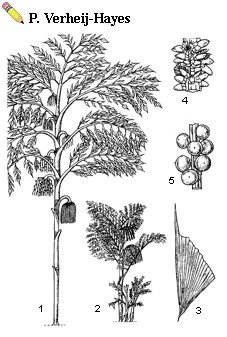 | Caryota mitis Lour. – 1, habit; 2, habit with tillers; 3, leaflet; 4, part of inflorescence; 5, part of infructescence. |
Ecology
Caryota is found in primary and secondary, lowland to montane forest, up to 2000 m altitude. It occurs in monsoon and perhumid climates. In Peninsular Malaysia C. mitis is characteristic of secondary forest and of forest on limestone.
Silviculture and Management
Caryota can be propagated by seed, which remains viable for 4-6 weeks. Seeds of C. urens germinate in 18-30 days but those of C. cumingii do not start germinating until 10 months after soaking in water for several days. The daily yield per tree of sap for wine and sugar from C. urens is 20-27 l; its trunk yields 100-150 kg of starch. The harvest of Caryota for sago and other purposes is mainly from wild and semi-wild populations.
Genetic Resources and Breeding
C. no has been identified as a vulnerable species by the International Union for the Conservation of Nature (IUCN).
Prospects
It is unlikely that the use of Caryota wood will increase in the near future, but it has potential as an ornamental. Furthermore, its products for human consumption (sap, starch, palm cabbage, palm heart) make it an interesting multipurpose agroforestry species, in particular C. mitis.
Literature
[70]Backer, C.A. & Bakhuizen van den Brink Jr., R.C., 1963-1968. Flora of Java. 3 volumes. Wolters-Noordhoff, Groningen.
[86]Balick, M.J. & Beck, H.T. (Editors), 1990. Useful palms of the world. A synoptic bibliography. Columbia University Press, New York. 724 pp.
[150]Brown, W.H., 1951-1957. Useful plants of the Philippines. Reprint of the 1941-1943 edition. 3 volumes. Technical Bulletin 10. Department of Agriculture and Natural Resources. Bureau of Printing, Manila. Vol. 1(1951) 590 pp., Vol. 2 (1954) 513 pp., Vol. 3 (1957) 507 pp.
[163]Burkill, I.H., 1966. A dictionary of the economic products of the Malay Peninsula. 2nd edition. Ministry of Agriculture and Co-operatives, Kuala Lumpur. Vol. 1 (A-H) pp. 1-1240. Vol. 2 (I-Z) pp. 1241-2444.
[236]De Leon, N.J., 1958. Viability of palm seeds. Principes 2: 96-98.
[278]Docters van Leeuwen, W.M., 1935. The dispersal of plants by fruit-eating bats. Gardens' Bulletin, Straits Settlements 9: 58-63.
[285]Dransfield, J., 1974. Notes on Caryota no Becc. and other Malesian Caryota species. Principes 18: 87-93.
[323]Espiloy, Z.B., Maruzzo, M.M., Dionglay, S.P. & Alipon, M.A., 1989. Properties of some Philippine erect palms. FPRDI (Forest Products Research and Development Institute) Journal 18(1-4): 30-45.
[324]Essig, F.B., 1977. A preliminary analysis of the palm flora of New Guinea and the Bismarck Archipelago. Botany Bulletin No 9. Department of Botany, Office of Forests, Lae. 39 pp. + 7 pl.
[338]Flach, M. & Rumawas, F. (Editors), 1996. Plant resources of South-East Asia No 9. Plants yielding non-seed carbohydrates. Backhuys Publishers, Leiden. 237 pp.
[402]Hallé, F., Oldeman, R.A.A. & Tomlinson, P.B., 1978. Tropical trees and forests - an architectural analysis. Springer Verlag, Berlin, Heidelberg, New York. 441 pp.
[436]Heyne, K., 1927. De nuttige planten van Nederlands-Indië [The useful plants of the Dutch East Indies]. 2nd edition, 3 volumes. Departement van Landbouw, Nijverheid en Handel in Nederlandsch-Indië. 1953 pp. (3rd edition, 1950. van Hoeve, 's-Gravenhage/Bandung. 1660 pp.).
[499]Johnson, D. (Editor), 1991. Palms for human needs in Asia. A.A. Balkema, Rotterdam. 258 pp.
[500]Johnson, D.V., 1983. Multi-purpose palms in agroforestry: a classification and assessment. International Tree Crops Journal 2: 217-244.
[563]Kiew, R., 1989. Utilization of palms in Malaysia - Peninsular Malaysia. Malayan Naturalist 43(1/2): 43-67.
[720]Loomis, H.F., 1958. The preparation and germination of palm seeds. Principes 2: 98-102.
[733]Madulid, D.A., 1995. A pictorial cyclopedia of Philippine ornamental plants. Bookmark, Makati, Manila. xiii + 388 pp.
[873]Pearce, K.G., 1989. Utilization of palms in Malaysia - Sarawak. Malayan Naturalist 43(1/2): 68-91.
[978]Sarkar, S.K., 1970. Palmales. In: Sharma, A.K. (Editor): Annual report 1967-1968. Research Bulletin University of Calcutta (Cytogenetics Lab.) 2: 22-23.
[1051]St. John, T.V., 1988. Prospects for application of vesicular-arbuscular mycorrhizae in the culture of tropical palms. In: Balick, M.J. (Editor): The palm – Tree of life: biology, utilization and conservation: proceedings of a symposium at the 1986 Annual Meeting of the Society of Economic Botany held at the New York Botanical Garden, Bronx, New York, 13–14 June 1986. Advances in Economic Botany Vol. 6. pp. 50–55.
[1059]Stewart, L., 1994. A guide to palms and cycads of the world. Cassell Publishers, London. x + 246 pp.
[1100]Tomlinson, P.B., 1961. Anatomy of the Monocotyledons II. Palmae. Clarendon Press, London. xv + 453 pp.
[1110]Uhl, N.W. & Dransfield, J., 1987. Genera palmarum. The L.H. Bailey Hortorium and The International Palm Society, Allen Press, Lawrence, Kansas. 610 pp.
[1176]Visser, M.B.H., 1991. 100 macam palem di Indonesia [100 kinds of palms in Indonesia]. Ministry of Education and Sciences, The Netherlands. 57 pp.
[1210]Whitmore, T.C., 1973. Palms of Malaya. Oxford University Press, London. xv + 132 pp.
[86]Balick, M.J. & Beck, H.T. (Editors), 1990. Useful palms of the world. A synoptic bibliography. Columbia University Press, New York. 724 pp.
[150]Brown, W.H., 1951-1957. Useful plants of the Philippines. Reprint of the 1941-1943 edition. 3 volumes. Technical Bulletin 10. Department of Agriculture and Natural Resources. Bureau of Printing, Manila. Vol. 1(1951) 590 pp., Vol. 2 (1954) 513 pp., Vol. 3 (1957) 507 pp.
[163]Burkill, I.H., 1966. A dictionary of the economic products of the Malay Peninsula. 2nd edition. Ministry of Agriculture and Co-operatives, Kuala Lumpur. Vol. 1 (A-H) pp. 1-1240. Vol. 2 (I-Z) pp. 1241-2444.
[236]De Leon, N.J., 1958. Viability of palm seeds. Principes 2: 96-98.
[278]Docters van Leeuwen, W.M., 1935. The dispersal of plants by fruit-eating bats. Gardens' Bulletin, Straits Settlements 9: 58-63.
[285]Dransfield, J., 1974. Notes on Caryota no Becc. and other Malesian Caryota species. Principes 18: 87-93.
[323]Espiloy, Z.B., Maruzzo, M.M., Dionglay, S.P. & Alipon, M.A., 1989. Properties of some Philippine erect palms. FPRDI (Forest Products Research and Development Institute) Journal 18(1-4): 30-45.
[324]Essig, F.B., 1977. A preliminary analysis of the palm flora of New Guinea and the Bismarck Archipelago. Botany Bulletin No 9. Department of Botany, Office of Forests, Lae. 39 pp. + 7 pl.
[338]Flach, M. & Rumawas, F. (Editors), 1996. Plant resources of South-East Asia No 9. Plants yielding non-seed carbohydrates. Backhuys Publishers, Leiden. 237 pp.
[402]Hallé, F., Oldeman, R.A.A. & Tomlinson, P.B., 1978. Tropical trees and forests - an architectural analysis. Springer Verlag, Berlin, Heidelberg, New York. 441 pp.
[436]Heyne, K., 1927. De nuttige planten van Nederlands-Indië [The useful plants of the Dutch East Indies]. 2nd edition, 3 volumes. Departement van Landbouw, Nijverheid en Handel in Nederlandsch-Indië. 1953 pp. (3rd edition, 1950. van Hoeve, 's-Gravenhage/Bandung. 1660 pp.).
[499]Johnson, D. (Editor), 1991. Palms for human needs in Asia. A.A. Balkema, Rotterdam. 258 pp.
[500]Johnson, D.V., 1983. Multi-purpose palms in agroforestry: a classification and assessment. International Tree Crops Journal 2: 217-244.
[563]Kiew, R., 1989. Utilization of palms in Malaysia - Peninsular Malaysia. Malayan Naturalist 43(1/2): 43-67.
[720]Loomis, H.F., 1958. The preparation and germination of palm seeds. Principes 2: 98-102.
[733]Madulid, D.A., 1995. A pictorial cyclopedia of Philippine ornamental plants. Bookmark, Makati, Manila. xiii + 388 pp.
[873]Pearce, K.G., 1989. Utilization of palms in Malaysia - Sarawak. Malayan Naturalist 43(1/2): 68-91.
[978]Sarkar, S.K., 1970. Palmales. In: Sharma, A.K. (Editor): Annual report 1967-1968. Research Bulletin University of Calcutta (Cytogenetics Lab.) 2: 22-23.
[1051]St. John, T.V., 1988. Prospects for application of vesicular-arbuscular mycorrhizae in the culture of tropical palms. In: Balick, M.J. (Editor): The palm – Tree of life: biology, utilization and conservation: proceedings of a symposium at the 1986 Annual Meeting of the Society of Economic Botany held at the New York Botanical Garden, Bronx, New York, 13–14 June 1986. Advances in Economic Botany Vol. 6. pp. 50–55.
[1059]Stewart, L., 1994. A guide to palms and cycads of the world. Cassell Publishers, London. x + 246 pp.
[1100]Tomlinson, P.B., 1961. Anatomy of the Monocotyledons II. Palmae. Clarendon Press, London. xv + 453 pp.
[1110]Uhl, N.W. & Dransfield, J., 1987. Genera palmarum. The L.H. Bailey Hortorium and The International Palm Society, Allen Press, Lawrence, Kansas. 610 pp.
[1176]Visser, M.B.H., 1991. 100 macam palem di Indonesia [100 kinds of palms in Indonesia]. Ministry of Education and Sciences, The Netherlands. 57 pp.
[1210]Whitmore, T.C., 1973. Palms of Malaya. Oxford University Press, London. xv + 132 pp.
Author(s)
L.G. Saw
Caryota cumingii
Caryota maxima
Caryota mitis
Caryota no
Caryota rumphiana
Caryota maxima
Caryota mitis
Caryota no
Caryota rumphiana
Correct Citation of this Article
Saw, L.G., 1998. Caryota L.. In: Sosef, M.S.M., Hong, L.T. and Prawirohatmodjo, S. (Editors): Plant Resources of South-East Asia No 5(3): Timber trees; Lesser-known timbers. PROSEA Foundation, Bogor, Indonesia. Database record: prota4u.org/prosea
Selection of Species
The following species in this genus are important in this commodity group and are treated separatedly in this database:
Caryota cumingii
Caryota maxima
Caryota mitis
Caryota no
Caryota rumphiana
Caryota cumingii
Caryota maxima
Caryota mitis
Caryota no
Caryota rumphiana

All texts are licensed under a Creative Commons Attribution-Noncommercial-Share Alike 3.0 Netherlands License
This license does not include the illustrations (Maps,drawings,pictures); these remain all under copyright.