Record Number
5075
PROSEA Handbook Number
5(3): Timber trees; Lesser-known timbers
Taxon
Casuarina L.
Protologue
Amoen. acad. 4: 143 (1759).
Family
CASUARINACEAE
Chromosome Numbers
x = 9; C. cunninghamiana Miq., C. glauca Sieber ex Sprengel, C. junghuhniana: 2n = 18, C. equisetifolia: 2n = 18, (20)
Vernacular Names
Agoho (trade name). Casuarina (En). Indonesia: cemara (general). Malaysia: aru, ru (general). Papua New Guinea: she-oak (En), yar (Pidgin). Philippines: agoho. Thailand: son. Vietnam: duong-lieu, phi lao.
Origin and Geographic Distribution
Casuarina comprises 17 species occurring from India to Indo-China, Thailand and throughout the Malesian region towards Melanesia, Polynesia and Australia. Only a few species are native to Malesia, several others have been introduced. Some species have been introduced throughout the tropics, notably Africa and the West Indies, mainly as ornamentals and for the production of firewood.
Uses
Casuarina wood is used for house building under cover (beams, joists, rafters), fence posts, masts, tools handles, shuttles, oars, cartwheels and, when treated, also for shingles, power line transmission poles, mine props and for salt-water and freshwater piling including fish traps (but only when permanently submerged). It yields a very good firewood and produces a high quality charcoal. It is also suitable for the production of chemical and semi-chemical pulps and as raw material for rayon fibres. In Egypt the wood of C. equisetifolia is used extensively to produce chipboard.
Several species are commonly planted as ornamentals. They are also planted for soil improvement and to provide mulch and are suitable as a drought fodder. C. equisetifolia is a popular agroforestry tree in coastal and saline areas where it may also serve as a shelter-belt. It is often used in erosion control, especially to stabilize coastal sands. Its bark contains tannin and is still used locally to tan fishing nets and to dye fabrics a dull pale red. The bark is also applied medicinally to treat diarrhoea, dysentery and stomach-ache, and in Peninsular Malaysia a decoction of the twigs is used as a lotion to treat swellings. In Papua New Guinea C. oligodon is planted in the highlands for soil improvement, fuelwood and as a shade tree in coffee plantations; its needle-like leaves are used to retain heat when stones are used to prepare food in underground ovens.
Several species are commonly planted as ornamentals. They are also planted for soil improvement and to provide mulch and are suitable as a drought fodder. C. equisetifolia is a popular agroforestry tree in coastal and saline areas where it may also serve as a shelter-belt. It is often used in erosion control, especially to stabilize coastal sands. Its bark contains tannin and is still used locally to tan fishing nets and to dye fabrics a dull pale red. The bark is also applied medicinally to treat diarrhoea, dysentery and stomach-ache, and in Peninsular Malaysia a decoction of the twigs is used as a lotion to treat swellings. In Papua New Guinea C. oligodon is planted in the highlands for soil improvement, fuelwood and as a shade tree in coffee plantations; its needle-like leaves are used to retain heat when stones are used to prepare food in underground ovens.
Production and International Trade
The wood of Casuarina occasionally reaches the market, but is mainly traded locally. In 1996 Papua New Guinea exported about 530 m3 of Casuarina logs at an average free-on-board (FOB) price of US$ 100/m3.
Properties
Casuarina yields a medium-weight but usually heavy hardwood with a density of 790-1300 kg/m3. Heartwood pale red or pale brown to dark red-brown, moderately sharply to sharply differentiated from the sapwood which is 5-10 cm wide and yellowish or pale yellow-brown with a pink tinge; grain straight, slightly interlocked or wavy; texture fine to moderately fine and even in C. equisetifolia, uneven in species with wide rays; heartwood with occasional black streaks. Growth rings indistinct except for some marginal parenchyma bands; vessels medium-sized to moderately large, mostly solitary, but with a tendency to radial or oblique arrangement, often containing brown to red-brown gum-like substances, occasionally with chalky white deposits; parenchyma abundant, paratracheal vasicentric and apotracheal in regular, wavy, narrow bands, rarely diffuse; rays extremely fine or very fine in C. equisetifolia, but usually also with broad rays and of 2 distinct widths in most other species, sometimes exceptionally broad compound rays appear to split to very fine rays; ripple marks absent.
Shrinkage is moderate to very high and in the latter case the wood is difficult to season due to severe warping and checking. Stain may be moderate during drying; boards 13 mm and 38 mm thick take respectively about 2.5 and 4 months to air dry from the green condition. The wood is hard to very hard and strong. When dry it is difficult to work with hand and machine tools because of its high density and hardness, but it finishes smoothly. The wood is moderately durable when exposed to the weather or in contact with the ground; the average service life of test stakes of C. equisetifolia in a graveyard test in the Philippines was about 3.5 years whereas test stakes of C. junghuhniana lasted on average 4.5 years. The heartwood is highly resistant to pressure treatment, but sapwood is amenable to such treatment. The heartwood is resistant to dry-wood termites. The sapwood is non-susceptible to Lyctus.
The mean fibre length of C. equisetifolia from Indonesia is 1.414 mm. The gross energy value of the wood of C. equisetifolia is 20 000-24 000 kJ/kg.
See also the tables on microscopic wood anatomy and wood properties.
Shrinkage is moderate to very high and in the latter case the wood is difficult to season due to severe warping and checking. Stain may be moderate during drying; boards 13 mm and 38 mm thick take respectively about 2.5 and 4 months to air dry from the green condition. The wood is hard to very hard and strong. When dry it is difficult to work with hand and machine tools because of its high density and hardness, but it finishes smoothly. The wood is moderately durable when exposed to the weather or in contact with the ground; the average service life of test stakes of C. equisetifolia in a graveyard test in the Philippines was about 3.5 years whereas test stakes of C. junghuhniana lasted on average 4.5 years. The heartwood is highly resistant to pressure treatment, but sapwood is amenable to such treatment. The heartwood is resistant to dry-wood termites. The sapwood is non-susceptible to Lyctus.
The mean fibre length of C. equisetifolia from Indonesia is 1.414 mm. The gross energy value of the wood of C. equisetifolia is 20 000-24 000 kJ/kg.
See also the tables on microscopic wood anatomy and wood properties.
Botany
Evergreen, dioecious or monoecious trees up to 35(-60) m tall; bole straight, cylindrical, usually branchless for up to 10 m, up to 100(-150) cm in diameter, occasionally with buttresses; bark surface ridged or fissured and flaking into oblong pieces, brown, inner bark deep dirty brown. Branchlets slender and wiry, articulated, dimorphic, either deciduous or persistent. Leaves reduced to scales, in whorls of 5-20 that define the articulations. Flowers unisexual; perianth absent, replaced by 2 bracteoles. Male flowers in a terminal, bracteate spike, with a single stamen. Female flowers in a condensed spike on a short lateral branchlet, with thin cone bracts; ovary composed of 2 fused carpels, with 2 ovules and a 2-branched style. Infructescence a woody cone-like structure. Fruit a grey or yellow-brown winged nut (samara). Seed solitary. Seedling with epigeal germination; cotyledons emergent, fleshy; hypocotyl elongated; first whorl with 2 opposite scale leaves, subsequent whorls with increasing numbers of scales.
Early growth can be very rapid, occasionally exceeding 3 m/year. In 11-13.5-year-old trials with C. equisetifolia in Indonesia the mean annual increment was 1.8-2.1 m in height and 1.6-2.0 cm in diameter. Most species fix atmospheric nitrogen by forming root nodules with the symbiont Frankia. Moreover, C. equisetifolia possesses proteoid roots and forms associations with vesicular-arbuscular mycorrhizae. Casuarina is known to be highly variable in tree shape. C. equisetifolia develops according to Attims' architectural tree model, characterized by axes with continuous growth, differentiated into a monopodial trunk and equivalent branches. The crown shape is initially conical and tends to flatten with age. Twigs are either entirely green and deciduous or green only at their tips, becoming woody. Trees of individual species may be entirely unisexual or bisexual. Pollination is by wind. Cones of C. equisetifolia mature in about 18-20 weeks. The fruits are wind-dispersed.
Recently, three genera were split off from Casuarina: Allocasuarina with about 40 species, Gymnostoma with about 20 species and Ceuthostoma with 2 species.
Early growth can be very rapid, occasionally exceeding 3 m/year. In 11-13.5-year-old trials with C. equisetifolia in Indonesia the mean annual increment was 1.8-2.1 m in height and 1.6-2.0 cm in diameter. Most species fix atmospheric nitrogen by forming root nodules with the symbiont Frankia. Moreover, C. equisetifolia possesses proteoid roots and forms associations with vesicular-arbuscular mycorrhizae. Casuarina is known to be highly variable in tree shape. C. equisetifolia develops according to Attims' architectural tree model, characterized by axes with continuous growth, differentiated into a monopodial trunk and equivalent branches. The crown shape is initially conical and tends to flatten with age. Twigs are either entirely green and deciduous or green only at their tips, becoming woody. Trees of individual species may be entirely unisexual or bisexual. Pollination is by wind. Cones of C. equisetifolia mature in about 18-20 weeks. The fruits are wind-dispersed.
Recently, three genera were split off from Casuarina: Allocasuarina with about 40 species, Gymnostoma with about 20 species and Ceuthostoma with 2 species.
Image
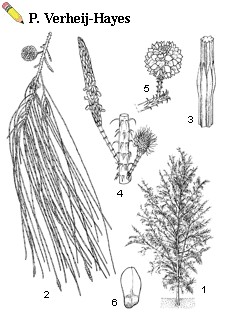 | Casuarina equisetifolia L. – 1, habit of young tree; 2, flowering twig; 3, branchlet; 4, male and female inflorescence; 5, infructescence; 6, fruit. |
Ecology
Casuarina is often found growing gregariously or even in pure stands, commonly along rivers or on rocky locations. C. equisetifolia is a typical pioneer of sandy coasts, but has been reported at up to 800 m altitude in the Philippines. C. grandis is not recorded from above 600 m altitude. C. oligodon chiefly occurs between 1500 and 2500 m altitude, but has been recorded from as low as 250 m. In Java C. junghuhniana grows naturally at 1200-3100 m altitude mainly in montane fire-climax forest, but in the Lesser Sunda Islands it comes down to sea-level. All species prefer a seasonal climate, and C. equisetifolia even tolerates arid conditions with an annual rainfall of 200-300 mm.
Silviculture and Management
Casuarina is usually propagated by seed, the samaras being the unit of sowing, although cuttings are increasingly used; air layering is sometimes practised but is too costly for large-scale operations. There are 300 000-770 000 dry seeds of C. equisetifolia and 1.0-1.8 million of C. junghuhniana per kg. Seeds remain viable for 6 months to 2 years when stored cool and dry. They can be sown without pretreatment but after sowing they should be protected from ants. The germination rate is 30-80% for C. equisetifolia and 20-60% for C. junghuhniana; germination starts after 4-10 days. Appropriate watering and avoiding too dense sowings and too much shade should check damping-off in the nursery. Seedlings can be pricked out when 3-10 cm tall and transferred to beds or containers. They are ready for planting out in the field when about 30-50 cm tall. Shoot cuttings can be prepared from shoots 1-2 mm thick and 10-15 cm long, and several rooting hormones can be used to enhance rooting. It is recommended to inoculate seedlings or rooted cuttings with effective Frankia strains when introducing Casuarina to a new area. To do so it is usually sufficient to mix soil collected in established plantations with soil in the nursery. Casuarina should be planted on well-drained light soils, as planting on clayey soils will result in poor growth and increased susceptibility to diseases and pests. Although often planted at 4 m x 4 m, the recommended spacing for Malaysia and Indonesia is closer, being 2-3 m x 1-2 m to allow for earlier returns from thinnings. Young trees are susceptible to competition from weeds, especially grasses, and to fire. Only C. oligodon in the highlands of Papua New Guinea does not suffer from competition from grasses and is commonly planted to reforest old vegetable gardens as part of an agricultural cycle. Casuarina trees are susceptible to drought until their roots reach the groundwater table, which may take up to 2-3 years after planting. C. equisetifolia is not resistant to fire whereas C. junghuhniana sprouts readily even after a severe fire. Timely thinning is essential, as Casuarina trees are light-demanding. Casuarina does not self-prune readily and may have to be pruned to keep plantations accessible. The most serious disease of C. equisetifolia is the fungus Trichosporum vesiculorum ("black blister disease""). The symptoms of infection are stem wilt, foliar wilt, cracking of the bark and the formation of blisters enclosing a black powdery mass of spores, the black-brown colour of the wood and an alcoholic odour. The wood borers Zeuzera spp. and Hypsipyla robusta are known to cause severe damage to the wood. The rotation for C. equisetifolia for firewood is 6--15 years, that for C. junghuhniana for the production of poles and firewood is as short as 5 years. For C. equisetifolia a mean annual increment of 6-18 m3/ha has been observed on fertile soils in Malaysia and 7-13 m3/ha in trials in Java. For C. junghuhniana 10-15 m3/ha per year is obtainable.
Genetic Resources and Breeding
The Australian Tree Seed Centre of the Division of Forestry of the Commonwealth Scientific and Industrial Research Organisation (CSIRO) has seed collections of both C. equisetifolia and C. junghuhniana. In cultivation C. equisetifolia hybridizes readily with C. glauca and C. junghuhniana. A male hybrid of C. equisetifolia and C. junghuhniana was introduced into Thailand around 1900 and from there to India. It has a good stem form and a symmetrical conical crown.
Prospects
Apart from the well-known C. equisetifolia and C. junghuhniana, C. grandis seems to have economic potential as a fast-growing timber, and hybrids with other Casuarina species may be of particular interest.
Literature
[57]Appanah, S. & Weinland, G., 1993. Planting quality timber trees in Peninsular Malaysia - a review. Malayan Forest Record No 38. Forest Research Institute Malaysia, Kepong. 221 pp.
[130]Bosbouwproefstation, 1948. Tabellarisch overzicht van de beste kiem-, bewaar- en verzendingswijze van zaad van een aantal boomsoorten en groenbemesters [Tabular summary of the best ways to germinate, store and send seed of some tree and green manure species]. Voorlopig rapport No 38. Bosbouwproefstation, Buitenzorg. 15 pp.
[132]Bourke, R.M., 1985. Food, coffee and casuarina: an agroforestry system from the Papua New Guinea highlands. Agroforestry Systems 2(4): 273-279.
[151]Browne, F.G., 1955. Forest trees of Sarawak and Brunei and their products. Government Printing Office, Kuching, Sarawak. xviii + 369 pp.
[162]Burgess, P.F., 1966. Timbers of Sabah. Sabah Forest Records No 6. Forest Department, Sabah, Sandakan. xviii + 501 pp.
[163]Burkill, I.H., 1966. A dictionary of the economic products of the Malay Peninsula. 2nd edition. Ministry of Agriculture and Co-operatives, Kuala Lumpur. Vol. 1 (A-H) pp. 1-1240. Vol. 2 (I-Z) pp. 1241-2444.
[193]Chudnoff, M., 1980. Tropical timbers of the world. Forest Products Laboratory, Forest Service, United States Department of Agriculture, Madison. 831 pp.
[198]Cockburn, P.F., 1976-1980. Trees of Sabah. 2 volumes. Sabah Forest Records No 10. Forest Department Sabah, Sandakan.
[259]den Berger, L.G., 1926. Mechanical properties of Dutch East Indian timbers. Korte Mededeelingen No 12. Proefstation voor het Boschwezen, Buitenzorg. viii + 63 pp.
[260]den Berger, L.G., 1926. Houtsoorten der cultuurgebieden van Java en Sumatra's oostkust [Tree species of the cultivated areas of Java and the east coast of Sumatra]. Mededeelingen No 13. Proefstation voor het Boschwezen, Buitenzorg. 186 pp.
[261]den Berger, L.G. & Endert, F.H., 1925. Belangrijke houtsoorten van Nederlandsch-Indië, deel I [Important timbers of the Dutch East Indies, part I]. Mededeelingen No 11. Proefstation voor het Boschwezen, Buitenzorg. 136 pp.
[267]Desch, H.E., 1941-1954. Manual of Malayan timbers. Malayan Forest Records No 15. 2 volumes. Malaya Publishing House Ltd., Singapore. 762 pp.
[281]Dommergues, Y., 1990. Casuarina equisetifolia: An old-timer with a new future. NFT Highlights 90-02. Nitrogen Fixing Tree Association. 2 pp.
[300]Eddowes, P.J., 1977. Commercial timbers of Papua New Guinea, their properties and uses. Forest Products Research Centre, Department of Primary Industry, Port Moresby. xiv + 195 pp.
[304]Eddowes, P.J., 1995-1997. The forests and timbers of Papua New Guinea. (unpublished data).
[311]El-Lakany, M.H., Turnbull, J.W. & Brewbaker, J.L. (Editors), 1990. Advances in Casuarina research and utilisation. Proceedings of the Second International Casuarina Workshop, January 15-20, 1990, Cairo. Desert Development Centre, American University in Cairo, Cairo. 241 pp.
[333]Faridah Hanum, I. & van der Maesen, L.J.G. (Editors), 1997. Plant resources of South-East Asia No 11. Auxiliary plants. Backhuys Publishers, Leiden. 389 pp.
[340]Flora of Australia (various editors), 1981-. Australian Government Publishing Service, Canberra.
[348]Forest Products Research Centre, 1967. Properties and uses of Papua and New Guinea timbers. Forest Products Research Centre, Port Moresby. 30 pp.
[354]Foxworthy, F.W., 1927. Commercial timber trees of the Malay Peninsula. Malayan Forest Records No 3. Forest Department, Kuala Lumpur. 185 pp.
[359]Friis, I., 1980. The authority and date of publication of the genus Casuarina and its type species. Taxon 29: 499-501.
[387]Grewal, G.S., 1979. Air-seasoning properties of some Malaysian timbers. Malaysian Forest Service Trade Leaflet No 41. Malaysian Timber Industry Board, Kuala Lumpur. 26 pp.
[402]Hallé, F., Oldeman, R.A.A. & Tomlinson, P.B., 1978. Tropical trees and forests - an architectural analysis. Springer Verlag, Berlin, Heidelberg, New York. 441 pp.
[405]Hardjowasono, M.S., 1942. Gewicht en volume van verschillende vrucht- en zaadsoorten [Weight and volume of various fruits and seeds]. Korte Mededelingen No 20. Bosbouwproefstation, Buitenzorg. 172 pp.
[406]Harker, A.P., Sandels, A. & Burley, J., 1982. Calorific values for wood and bark and a bibliography for fuelwood. Report G 162. Tropical Products Institute, London. 20 pp.
[436]Heyne, K., 1927. De nuttige planten van Nederlands-Indië [The useful plants of the Dutch East Indies]. 2nd edition, 3 volumes. Departement van Landbouw, Nijverheid en Handel in Nederlandsch-Indië. 1953 pp. (3rd edition, 1950. van Hoeve, 's-Gravenhage/Bandung. 1660 pp.).
[464]Ilic, J., 1990. The CSIRO macro key for hardwood identification. CSIRO, Highett. 125 pp.
[488]Japing, H.W. & Oey Djoen Seng, 1936. Cultuurproeven met wildhoutsoorten in Gadoengan - met overzicht van de literatuur betreffende deze soorten [Trial plantations of non teak wood species in Gadungan (East Java) - with survey of literature about these species]. Korte Mededeelingen No 55, part I to VI. Boschbouwproefstation, Buitenzorg. 270 pp.
[501]Johnson, L.A.S., 1982. Notes on Casuarinaceae II. Journal of the Adelaide Botanic Garden 6: 73-87.
[526]Kartasujana, I. & Martawijaya, A., 1979. Kayu perdagangan Indonesia - sifat dan kegunaannya [Commercial woods of Indonesia - their properties and uses]. Lembaga Penelitian Hasil Hutan, Bogor. 28 pp.
[536]Keating, W.G. & Bolza, E., 1982. Characteristics, properties and uses of timbers. Vol. 1. South-East Asia, northern Australia and the Pacific. Inkata Press Proprietary Ltd., Melbourne, Sydney & London. 362 pp.
[633]Kramer, F., 1925. Kultuurproeven met industrie-, konstruktie- en luxe-houtsoorten [Investigations regarding the cultivation of different Javanese trees]. Mededeelingen No 12. Proefstation voor het Boschwezen, Buitenzorg. 99 pp.
[678]Lee, Y.H., Engku Abdul Rahman bin Chik & Chu, Y.P., 1979. The strength properties of some Malaysian timbers. Malaysian Forest Service Trade Leaflet No 34 (revised edition). Malaysian Timber Industry Board, Kuala Lumpur. 107 pp.
[696]Lemmens, R.H.M.J. & Wulijarni-Soetjipto, N. (Editors), 1991. Plant resources of South-East Asia No 3. Dye and tannin-producing plants. Pudoc, Wageningen. 195 pp.
[697]Letourneux, C., 1957. Tree planting practices in tropical Asia. FAO Forestry Development Paper No 11. FAO, Rome. 172 pp.
[745]Mandang, Y.I., 1991. Anatomi dan identifikasi 21 jenis kayu kurang dikenal [Anatomy and identification of 21 lesser-known timber species]. Jurnal Penelitian Hasil Hutan 9(1): 5-23.
[780]Meniado, J.A. et al., 1975-1981. Wood identification handbook for Philippine timbers. 2 volumes. Government Printing Office, Manila. 370 pp. & 186 pp.
[792]Midgley, S.J., Turnbull, J.W. & Johnston, R.D. (Editors), 1983. Casuarina ecology, management and utilisation. Proceedings of an International Workshop, 17–21 August 1981, Canberra, Australia. Commonwealth Scientific and Industrial Research Organisation (CSIRO), Melbourne. 286 pp.
[817]National Academy of Sciences, 1980. Firewood crops. Shrub and tree species for firewood production. National Academy Press, Washington, D.C. 237 pp.
[819]National Research Council, 1984. Casuarinas: nitrogen-fixing trees for adverse sites. National Academy Press, Washington, D.C. 118 pp.
[829]Ng, F.S.P., 1991-1992. Manual of forest fruits, seeds and seedlings. 2 volumes. Malayan Forest Record No 34. Forest Research Institute Malaysia, Kepong. 997 pp.
[831]Ng, F.S.P. & Mat Asri Ngah Sanah, 1991. Germination and seedling records. Research Pamphlet No 108. Forest Research Institute Malaysia, Kepong. 191 pp.
[861]Oey Djoen Seng, 1951. De soortelijke gewichten van Indonesische houtsoorten en hun betekenis voor de praktijk [Specific gravity of Indonesian woods and its significance for practical use]. Rapport No 46. Bosbouwproefstation, Bogor. 183 pp.
[897]Pinyopusarerk, K., 1993. Casuarina: An annotated bibliography of C. equisetifolia, C. junghuhniana and C. oligodon. International Centre for Research in Agroforestry (ICRAF), Nairobi. 298 pp.
[898]Pinyopusarerk, K. & Boland, D.J., 1990. Casuarina junghuhniana: a highly adaptable tropical casuarina. NFT Highlights 90-04. Nitrogen Fixing Tree Association, Waimanolo, Hawaii. 2 pp.
[933]Research Institute of Wood Industry, 1988. Identification, properties and uses of some Southeast Asian woods. Chinese Academy of Forestry, Wan Shou Shan, Beijing & International Tropical Timber Organization, Yokohama. 201 pp.
[934]Reyes, L.J., 1938. Philippine woods. Technical Bulletin No 7. Commonwealth of the Philippines, Department of Agriculture and Commerce. Bureau of Printing, Manila. 536 pp. + 88 plates.
[955]Rocafort, J.E., Floresca, A.R. & Siopongco, J.O., 1971. Fourth progress report on the specific gravity of Philippine woods. Philippine Architecture, Engineering & Construction Report 18(5): 17-27.
[1038]Smitinand, T., 1980. Thai plant names. Royal Forest Department, Bangkok. 379 pp.
[1040]Smythies, B.E., 1965. Common Sarawak trees. Borneo Literature Bureau, South China Morning Post, Hong Kong. 153 pp.
[1048]Soepadmo, E., Wong, K.M. & Saw, L.G. (Editors), 1995-. Tree flora of Sabah and Sarawak. Sabah Forestry Department, Forest Research Institute Malaysia and Sarawak Forestry Department, Kepong.
[1068]Subbarao, N.S. & Rodríguez-Barrueco, C., 1995. Casuarinas. Science Publishers, Lebanon, USA. 240 pp.
[1106]Tumaliuan, B.T., 1985. Species and provenance trial of selected fuelwood species. Sylvatrop 10(1): 35-48.
[1177]von Meyenfeldt, C.F.W.M. et al., 1978. Restoration of devastated inland forests in South Vietnam. Volume III: List of tree species. Agricultural University, Wageningen. 219 pp.
[1198]Weidelt, H.J. (Editor), 1976. Manual of reforestation and erosion control for the Philippines. Schriftenreihe No 22. Deutsche Gesellschaft für Technische Zusammenarbeit (GTZ) GmbH, Eschborn. 569 pp.
[1199]Werkgoep Tropische Houtteelt, 1973. Bebossing van geërodeerde gronden op Java - bijlage III: Houtsoorten [Afforestation of eroded lands in Java - Annex III: Tree species]. Landbouwhogeschool Wageningen. 128 pp.
[1221]Whitmore, T.C. & Ng, F.S.P. (Editors), 1972-1989. Tree flora of Malaya. A manual for foresters. 4 volumes. Malayan Forest Records No 26. Longman Malaysia Sdn. Berhad, Kuala Lumpur & Petaling Jaya.
[1242]Wong, T.M., 1982. A dictionary of Malaysian timbers. Malayan Forest Records No 30. Forest Research Institute Malaysia, Kepong. 259 pp.
[130]Bosbouwproefstation, 1948. Tabellarisch overzicht van de beste kiem-, bewaar- en verzendingswijze van zaad van een aantal boomsoorten en groenbemesters [Tabular summary of the best ways to germinate, store and send seed of some tree and green manure species]. Voorlopig rapport No 38. Bosbouwproefstation, Buitenzorg. 15 pp.
[132]Bourke, R.M., 1985. Food, coffee and casuarina: an agroforestry system from the Papua New Guinea highlands. Agroforestry Systems 2(4): 273-279.
[151]Browne, F.G., 1955. Forest trees of Sarawak and Brunei and their products. Government Printing Office, Kuching, Sarawak. xviii + 369 pp.
[162]Burgess, P.F., 1966. Timbers of Sabah. Sabah Forest Records No 6. Forest Department, Sabah, Sandakan. xviii + 501 pp.
[163]Burkill, I.H., 1966. A dictionary of the economic products of the Malay Peninsula. 2nd edition. Ministry of Agriculture and Co-operatives, Kuala Lumpur. Vol. 1 (A-H) pp. 1-1240. Vol. 2 (I-Z) pp. 1241-2444.
[193]Chudnoff, M., 1980. Tropical timbers of the world. Forest Products Laboratory, Forest Service, United States Department of Agriculture, Madison. 831 pp.
[198]Cockburn, P.F., 1976-1980. Trees of Sabah. 2 volumes. Sabah Forest Records No 10. Forest Department Sabah, Sandakan.
[259]den Berger, L.G., 1926. Mechanical properties of Dutch East Indian timbers. Korte Mededeelingen No 12. Proefstation voor het Boschwezen, Buitenzorg. viii + 63 pp.
[260]den Berger, L.G., 1926. Houtsoorten der cultuurgebieden van Java en Sumatra's oostkust [Tree species of the cultivated areas of Java and the east coast of Sumatra]. Mededeelingen No 13. Proefstation voor het Boschwezen, Buitenzorg. 186 pp.
[261]den Berger, L.G. & Endert, F.H., 1925. Belangrijke houtsoorten van Nederlandsch-Indië, deel I [Important timbers of the Dutch East Indies, part I]. Mededeelingen No 11. Proefstation voor het Boschwezen, Buitenzorg. 136 pp.
[267]Desch, H.E., 1941-1954. Manual of Malayan timbers. Malayan Forest Records No 15. 2 volumes. Malaya Publishing House Ltd., Singapore. 762 pp.
[281]Dommergues, Y., 1990. Casuarina equisetifolia: An old-timer with a new future. NFT Highlights 90-02. Nitrogen Fixing Tree Association. 2 pp.
[300]Eddowes, P.J., 1977. Commercial timbers of Papua New Guinea, their properties and uses. Forest Products Research Centre, Department of Primary Industry, Port Moresby. xiv + 195 pp.
[304]Eddowes, P.J., 1995-1997. The forests and timbers of Papua New Guinea. (unpublished data).
[311]El-Lakany, M.H., Turnbull, J.W. & Brewbaker, J.L. (Editors), 1990. Advances in Casuarina research and utilisation. Proceedings of the Second International Casuarina Workshop, January 15-20, 1990, Cairo. Desert Development Centre, American University in Cairo, Cairo. 241 pp.
[333]Faridah Hanum, I. & van der Maesen, L.J.G. (Editors), 1997. Plant resources of South-East Asia No 11. Auxiliary plants. Backhuys Publishers, Leiden. 389 pp.
[340]Flora of Australia (various editors), 1981-. Australian Government Publishing Service, Canberra.
[348]Forest Products Research Centre, 1967. Properties and uses of Papua and New Guinea timbers. Forest Products Research Centre, Port Moresby. 30 pp.
[354]Foxworthy, F.W., 1927. Commercial timber trees of the Malay Peninsula. Malayan Forest Records No 3. Forest Department, Kuala Lumpur. 185 pp.
[359]Friis, I., 1980. The authority and date of publication of the genus Casuarina and its type species. Taxon 29: 499-501.
[387]Grewal, G.S., 1979. Air-seasoning properties of some Malaysian timbers. Malaysian Forest Service Trade Leaflet No 41. Malaysian Timber Industry Board, Kuala Lumpur. 26 pp.
[402]Hallé, F., Oldeman, R.A.A. & Tomlinson, P.B., 1978. Tropical trees and forests - an architectural analysis. Springer Verlag, Berlin, Heidelberg, New York. 441 pp.
[405]Hardjowasono, M.S., 1942. Gewicht en volume van verschillende vrucht- en zaadsoorten [Weight and volume of various fruits and seeds]. Korte Mededelingen No 20. Bosbouwproefstation, Buitenzorg. 172 pp.
[406]Harker, A.P., Sandels, A. & Burley, J., 1982. Calorific values for wood and bark and a bibliography for fuelwood. Report G 162. Tropical Products Institute, London. 20 pp.
[436]Heyne, K., 1927. De nuttige planten van Nederlands-Indië [The useful plants of the Dutch East Indies]. 2nd edition, 3 volumes. Departement van Landbouw, Nijverheid en Handel in Nederlandsch-Indië. 1953 pp. (3rd edition, 1950. van Hoeve, 's-Gravenhage/Bandung. 1660 pp.).
[464]Ilic, J., 1990. The CSIRO macro key for hardwood identification. CSIRO, Highett. 125 pp.
[488]Japing, H.W. & Oey Djoen Seng, 1936. Cultuurproeven met wildhoutsoorten in Gadoengan - met overzicht van de literatuur betreffende deze soorten [Trial plantations of non teak wood species in Gadungan (East Java) - with survey of literature about these species]. Korte Mededeelingen No 55, part I to VI. Boschbouwproefstation, Buitenzorg. 270 pp.
[501]Johnson, L.A.S., 1982. Notes on Casuarinaceae II. Journal of the Adelaide Botanic Garden 6: 73-87.
[526]Kartasujana, I. & Martawijaya, A., 1979. Kayu perdagangan Indonesia - sifat dan kegunaannya [Commercial woods of Indonesia - their properties and uses]. Lembaga Penelitian Hasil Hutan, Bogor. 28 pp.
[536]Keating, W.G. & Bolza, E., 1982. Characteristics, properties and uses of timbers. Vol. 1. South-East Asia, northern Australia and the Pacific. Inkata Press Proprietary Ltd., Melbourne, Sydney & London. 362 pp.
[633]Kramer, F., 1925. Kultuurproeven met industrie-, konstruktie- en luxe-houtsoorten [Investigations regarding the cultivation of different Javanese trees]. Mededeelingen No 12. Proefstation voor het Boschwezen, Buitenzorg. 99 pp.
[678]Lee, Y.H., Engku Abdul Rahman bin Chik & Chu, Y.P., 1979. The strength properties of some Malaysian timbers. Malaysian Forest Service Trade Leaflet No 34 (revised edition). Malaysian Timber Industry Board, Kuala Lumpur. 107 pp.
[696]Lemmens, R.H.M.J. & Wulijarni-Soetjipto, N. (Editors), 1991. Plant resources of South-East Asia No 3. Dye and tannin-producing plants. Pudoc, Wageningen. 195 pp.
[697]Letourneux, C., 1957. Tree planting practices in tropical Asia. FAO Forestry Development Paper No 11. FAO, Rome. 172 pp.
[745]Mandang, Y.I., 1991. Anatomi dan identifikasi 21 jenis kayu kurang dikenal [Anatomy and identification of 21 lesser-known timber species]. Jurnal Penelitian Hasil Hutan 9(1): 5-23.
[780]Meniado, J.A. et al., 1975-1981. Wood identification handbook for Philippine timbers. 2 volumes. Government Printing Office, Manila. 370 pp. & 186 pp.
[792]Midgley, S.J., Turnbull, J.W. & Johnston, R.D. (Editors), 1983. Casuarina ecology, management and utilisation. Proceedings of an International Workshop, 17–21 August 1981, Canberra, Australia. Commonwealth Scientific and Industrial Research Organisation (CSIRO), Melbourne. 286 pp.
[817]National Academy of Sciences, 1980. Firewood crops. Shrub and tree species for firewood production. National Academy Press, Washington, D.C. 237 pp.
[819]National Research Council, 1984. Casuarinas: nitrogen-fixing trees for adverse sites. National Academy Press, Washington, D.C. 118 pp.
[829]Ng, F.S.P., 1991-1992. Manual of forest fruits, seeds and seedlings. 2 volumes. Malayan Forest Record No 34. Forest Research Institute Malaysia, Kepong. 997 pp.
[831]Ng, F.S.P. & Mat Asri Ngah Sanah, 1991. Germination and seedling records. Research Pamphlet No 108. Forest Research Institute Malaysia, Kepong. 191 pp.
[861]Oey Djoen Seng, 1951. De soortelijke gewichten van Indonesische houtsoorten en hun betekenis voor de praktijk [Specific gravity of Indonesian woods and its significance for practical use]. Rapport No 46. Bosbouwproefstation, Bogor. 183 pp.
[897]Pinyopusarerk, K., 1993. Casuarina: An annotated bibliography of C. equisetifolia, C. junghuhniana and C. oligodon. International Centre for Research in Agroforestry (ICRAF), Nairobi. 298 pp.
[898]Pinyopusarerk, K. & Boland, D.J., 1990. Casuarina junghuhniana: a highly adaptable tropical casuarina. NFT Highlights 90-04. Nitrogen Fixing Tree Association, Waimanolo, Hawaii. 2 pp.
[933]Research Institute of Wood Industry, 1988. Identification, properties and uses of some Southeast Asian woods. Chinese Academy of Forestry, Wan Shou Shan, Beijing & International Tropical Timber Organization, Yokohama. 201 pp.
[934]Reyes, L.J., 1938. Philippine woods. Technical Bulletin No 7. Commonwealth of the Philippines, Department of Agriculture and Commerce. Bureau of Printing, Manila. 536 pp. + 88 plates.
[955]Rocafort, J.E., Floresca, A.R. & Siopongco, J.O., 1971. Fourth progress report on the specific gravity of Philippine woods. Philippine Architecture, Engineering & Construction Report 18(5): 17-27.
[1038]Smitinand, T., 1980. Thai plant names. Royal Forest Department, Bangkok. 379 pp.
[1040]Smythies, B.E., 1965. Common Sarawak trees. Borneo Literature Bureau, South China Morning Post, Hong Kong. 153 pp.
[1048]Soepadmo, E., Wong, K.M. & Saw, L.G. (Editors), 1995-. Tree flora of Sabah and Sarawak. Sabah Forestry Department, Forest Research Institute Malaysia and Sarawak Forestry Department, Kepong.
[1068]Subbarao, N.S. & Rodríguez-Barrueco, C., 1995. Casuarinas. Science Publishers, Lebanon, USA. 240 pp.
[1106]Tumaliuan, B.T., 1985. Species and provenance trial of selected fuelwood species. Sylvatrop 10(1): 35-48.
[1177]von Meyenfeldt, C.F.W.M. et al., 1978. Restoration of devastated inland forests in South Vietnam. Volume III: List of tree species. Agricultural University, Wageningen. 219 pp.
[1198]Weidelt, H.J. (Editor), 1976. Manual of reforestation and erosion control for the Philippines. Schriftenreihe No 22. Deutsche Gesellschaft für Technische Zusammenarbeit (GTZ) GmbH, Eschborn. 569 pp.
[1199]Werkgoep Tropische Houtteelt, 1973. Bebossing van geërodeerde gronden op Java - bijlage III: Houtsoorten [Afforestation of eroded lands in Java - Annex III: Tree species]. Landbouwhogeschool Wageningen. 128 pp.
[1221]Whitmore, T.C. & Ng, F.S.P. (Editors), 1972-1989. Tree flora of Malaya. A manual for foresters. 4 volumes. Malayan Forest Records No 26. Longman Malaysia Sdn. Berhad, Kuala Lumpur & Petaling Jaya.
[1242]Wong, T.M., 1982. A dictionary of Malaysian timbers. Malayan Forest Records No 30. Forest Research Institute Malaysia, Kepong. 259 pp.
Author(s)
Suhardi
Casuarina equisetifolia
Casuarina grandis
Casuarina junghuhniana
Casuarina oligodon
Casuarina grandis
Casuarina junghuhniana
Casuarina oligodon
Correct Citation of this Article
Suhardi, 1998. Casuarina L.. In: Sosef, M.S.M., Hong, L.T. and Prawirohatmodjo, S. (Editors): Plant Resources of South-East Asia No 5(3): Timber trees; Lesser-known timbers. PROSEA Foundation, Bogor, Indonesia. Database record: prota4u.org/prosea
Selection of Species
The following species in this genus are important in this commodity group and are treated separatedly in this database:
Casuarina equisetifolia
Casuarina grandis
Casuarina junghuhniana
Casuarina oligodon
Casuarina equisetifolia
Casuarina grandis
Casuarina junghuhniana
Casuarina oligodon

All texts are licensed under a Creative Commons Attribution-Noncommercial-Share Alike 3.0 Netherlands License
This license does not include the illustrations (Maps,drawings,pictures); these remain all under copyright.