Record Number
5220
PROSEA Handbook Number
5(3): Timber trees; Lesser-known timbers
Taxon
Drypetes Vahl
Protologue
Ecolog. amer. 3: 49 (1807).
Family
EUPHORBIACEAE
Chromosome Numbers
x = 10; D. roxburghii: n = 20
Vernacular Names
Drypetes (En). Malaysia: arau (trade name), lidah-lidah (Peninsular), mentulang (Sabah). Philippines: tinaang-pantai (Filipino, trade name).
Origin and Geographic Distribution
Drypetes comprises about 200 species and is pantropical. About 10 species are found in the New World, some 60 in Africa and Madagascar, and the remainder in Asia and Australia. The genus is found throughout the Malesian region where some 60 species occur.
Uses
The exceptionally tough wood of Drypetes is used for general construction under cover (beams, joists, rafters, flooring), temporary construction, bridge and wharf superstructure, industrial flooring, furniture and cabinet making, rice mortars, tool handles, posts, piles, poles and railway sleepers. In the Philippines D. longifolia is considered useful for the manufacture of paper.
Production and International Trade
Supplies are limited and Drypetes wood seldom reaches the market. In the Philippines the wood is traded in mixed consignments of medium-weight hardwood. In Sarawak it is sold as "arau"", together with the wood of 2 other euphorbiaceous genera: Austrobuxus and Cephalomappa. In 1996 Papua New Guinea exported about 1220 m3 of Drypetes logs at an average free-on-board (FOB) price of US$ 101/m3.
Properties
Drypetes yields a medium-weight to heavy hardwood with a density of (650-)740-1100 kg/m3 at 15% moisture content. Heartwood pale yellow-brown occasionally mottled with dark or grey, not sharply demarcated from the paler sapwood; grain straight; texture very fine to moderately fine and even. Growth rings indistinct, boundaries marked by a narrow layer of dense, darker coloured tissue lacking parenchyma; vessels moderately small to medium-sized, mostly in radial multiples of 2-4, open; parenchyma abundant, apotracheal diffuse-in-aggregates forming a square mesh with the rays, distinct with a hand lens; rays moderately fine; ripple marks absent.
Shrinkage upon seasoning is high to very high. The wood stains readily and develops deep splits in the log when drying, but this problem does not occur when sawn fresh and stacked carefully. The wood is moderately hard to hard, strong and extremely tough. It is comparatively easy to work for a hard wood. The wood is durable under cover but perishable when in contact with the ground. The service life in a graveyard experiment in the Philippines was only 15 months. Impregnation of preservatives by pressure treatment is very good. The sapwood of D. lasiogynoides Pax & K. Hoffm. and probably D. longifolia occurring in Papua New Guinea is reported non-susceptible to Lyctus, but that of D. microphylla susceptible.
See also the tables on microscopic wood anatomy and wood properties.
Shrinkage upon seasoning is high to very high. The wood stains readily and develops deep splits in the log when drying, but this problem does not occur when sawn fresh and stacked carefully. The wood is moderately hard to hard, strong and extremely tough. It is comparatively easy to work for a hard wood. The wood is durable under cover but perishable when in contact with the ground. The service life in a graveyard experiment in the Philippines was only 15 months. Impregnation of preservatives by pressure treatment is very good. The sapwood of D. lasiogynoides Pax & K. Hoffm. and probably D. longifolia occurring in Papua New Guinea is reported non-susceptible to Lyctus, but that of D. microphylla susceptible.
See also the tables on microscopic wood anatomy and wood properties.
Botany
Generally evergreen, dioecious, small to medium-sized trees up to 30(-40) m tall; bole straight to somewhat sinuous in smaller trees, branchless for up to 20 m, up to 60(-80) cm in diameter, sometimes fluted or with short buttresses; bark surface smooth to finely fissured, often rugose or lenticellate, grey to grey-green, inner bark fibrous to granular, yellowish or pale brown to orange-brown or mottled orange-brown and fawn; crown usually dense, often rather small. Leaves arranged spirally, simple, entire or dentate, often unequal at base; stipules persistent or caducous. Flowers in an axillary or cauliflorous fascicle; sepals 4-5, imbricate, deciduous in fruit; petals absent. Male flowers with few to many, free stamens; disk annular or sinuate; pistillode small to obsolete. Female flower with an annular disk; ovary superior, 1-3-locular with 2 ovules in each cell, styles 1-3, very short, stigmas broad. Fruit drupaceous, leathery or fleshy, with 1-3 seeds each contained in an often thin stone (pyrene). Seedling with epigeal germination; cotyledons emergent, leafy; hypocotyl elongated; leaves alternate, involute.
In Java most Drypetes species can be observed flowering in August and September.
Drypetes forms a "bridge"" between the Euphorbiaceae and the Flacourtiaceae. There is little support for the suggestion that it should be placed in the latter family.
In Java most Drypetes species can be observed flowering in August and September.
Drypetes forms a "bridge"" between the Euphorbiaceae and the Flacourtiaceae. There is little support for the suggestion that it should be placed in the latter family.
Image
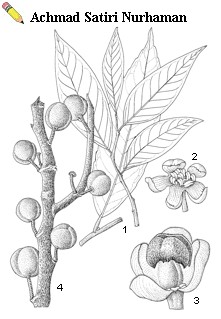 | Drypetes polyneura Airy Shaw – 1, sterile twigs; 2, male flower; 3, female flower; 4, fruiting twig. |
Ecology
Drypetes is found scattered in primary lowland, evergreen rain forest, occasionally in monsoon forest, or in montane forest, up to 1700 m altitude. D. longifolia ascends up to 4000 m on Mount Kinabalu (Sabah). Most species occur in well-drained habitats on sandy to sandy loam soils, occasionally on clay or limestone, or in periodically flooded locations. D. littoralis is found on sandy beaches but also in inland hill forest. D. sibuyanensis is usually found in swamp forest or kerangas.
Silviculture and Management
Drypetes can be propagated by seed. Pyrenes of D. kikir sown with adhering pulp germinated for about 25% in one seed lot and about 95% in another in 1-3.5 months. Pyrenes of D. longifolia with adhering pulp germinated for about 90% in 42-89 days, whereas those of D. pendula germinated for about 30% in 24-68 days. D. longifolia is known to form root suckers.
Genetic Resources and Breeding
Comparatively many Drypetes species are narrow endemics and therefore liable to genetic erosion or extinction through destruction of their habitat.
Prospects
The extremely tough wood of Drypetes makes it very suitable for the handles of striking tools and is therefore likely to be increasingly utilized.
Literature
[26]Airy Shaw, H.K., 1972. The Euphorbiaceae of Siam. Kew Bulletin 26: 191-363.
[28]Airy Shaw, H.K., 1975. The Euphorbiaceae of Borneo. Kew Bulletin Additional Series VIII. Her Majesty's Stationery Office, London. 245 pp.
[32]Airy Shaw, H.K., 1980. The Euphorbiaceae of New Guinea. Kew Bulletin Additional Series VIII. Her Majesty's Stationery Office, London. 243 pp.
[33]Airy Shaw, H.K., 1981. An alphabetical enumeration of the Euphorbiaceae of the Philippine islands. Royal Botanic Gardens, Kew. 56 pp.
[34]Airy Shaw, H.K., 1981. The Euphorbiaceae of Sumatra. Kew Bulletin 36: 239-374.
[36]Airy Shaw, H.K., 1983. The Euphorbiaceae of Central Malesia (Celebes, Moluccas, Lesser Sunda Is.). Kew Bulletin 37: 1-40.
[70]Backer, C.A. & Bakhuizen van den Brink Jr., R.C., 1963-1968. Flora of Java. 3 volumes. Wolters-Noordhoff, Groningen.
[125]Bolza, E. & Kloot, N.H., 1966. The mechanical properties of 81 New Guinea timbers. Technological Paper No 41. Division of Forest Products, CSIRO, Melbourne. 39 pp.
[162]Burgess, P.F., 1966. Timbers of Sabah. Sabah Forest Records No 6. Forest Department, Sabah, Sandakan. xviii + 501 pp.
[163]Burkill, I.H., 1966. A dictionary of the economic products of the Malay Peninsula. 2nd edition. Ministry of Agriculture and Co-operatives, Kuala Lumpur. Vol. 1 (A-H) pp. 1-1240. Vol. 2 (I-Z) pp. 1241-2444.
[209]Corner, E.J.H., 1988. Wayside trees of Malaya. 3rd edition. 2 volumes. The Malayan Nature Society, Kuala Lumpur. 774 pp.
[235]de Guzman, E.D., Umali, R.M. & Sotalbo, E.D., 1986. Guide to the Philippine flora and fauna. Vol. 3: Dipterocarps, non-dipterocarps. Natural Resources Management Centre, Ministry of Natural Resources, Quezon City & University of the Philippines, Los Baños. xx + 414 pp.
[238]de Vogel, E.F., 1980. Seedlings of dicotyledons. Structure, development, types. Descriptions of 150 woody Malesian taxa. Pudoc, Wageningen. 465 pp.
[267]Desch, H.E., 1941-1954. Manual of Malayan timbers. Malayan Forest Records No 15. 2 volumes. Malaya Publishing House Ltd., Singapore. 762 pp.
[300]Eddowes, P.J., 1977. Commercial timbers of Papua New Guinea, their properties and uses. Forest Products Research Centre, Department of Primary Industry, Port Moresby. xiv + 195 pp.
[301]Eddowes, P.J., 1979. The utilisation of Papua New Guinea timbers. Forest Products Research Centre, Department of Primary Industry, Port Moresby. 30 pp.
[348]Forest Products Research Centre, 1967. Properties and uses of Papua and New Guinea timbers. Forest Products Research Centre, Port Moresby. 30 pp.
[436]Heyne, K., 1927. De nuttige planten van Nederlands-Indië [The useful plants of the Dutch East Indies]. 2nd edition, 3 volumes. Departement van Landbouw, Nijverheid en Handel in Nederlandsch-Indië. 1953 pp. (3rd edition, 1950. van Hoeve, 's-Gravenhage/Bandung. 1660 pp.).
[464]Ilic, J., 1990. The CSIRO macro key for hardwood identification. CSIRO, Highett. 125 pp.
[525]Karnasudirdja, S. & Ginoga, B., 1975. Sifat fisik dan mekanik beberapa jenis kayu dari Jawa [Physical and mechanical properties of some timber species from Java]. Laporan No 53. Lembaga Penelitian Hasil Hutan, Bogor. 26 pp.
[543]Keng, H., 1990. The concise flora of Singapore. Gymnosperms and dicotyledons. Singapore University Press, Singapore. 222 pp.
[553]Kessler, P.J.A. & Sidiyasa, K., 1994. Trees of the Balikpapan-Samarinda area, East Kalimantan, Indonesia. Tropenbos Series 7. The Tropenbos Foundation, Wageningen. 446 pp.
[780]Meniado, J.A. et al., 1975-1981. Wood identification handbook for Philippine timbers. 2 volumes. Government Printing Office, Manila. 370 pp. & 186 pp.
[829]Ng, F.S.P., 1991-1992. Manual of forest fruits, seeds and seedlings. 2 volumes. Malayan Forest Record No 34. Forest Research Institute Malaysia, Kepong. 997 pp.
[831]Ng, F.S.P. & Mat Asri Ngah Sanah, 1991. Germination and seedling records. Research Pamphlet No 108. Forest Research Institute Malaysia, Kepong. 191 pp.
[861]Oey Djoen Seng, 1951. De soortelijke gewichten van Indonesische houtsoorten en hun betekenis voor de praktijk [Specific gravity of Indonesian woods and its significance for practical use]. Rapport No 46. Bosbouwproefstation, Bogor. 183 pp.
[934]Reyes, L.J., 1938. Philippine woods. Technical Bulletin No 7. Commonwealth of the Philippines, Department of Agriculture and Commerce. Bureau of Printing, Manila. 536 pp. + 88 plates.
[955]Rocafort, J.E., Floresca, A.R. & Siopongco, J.O., 1971. Fourth progress report on the specific gravity of Philippine woods. Philippine Architecture, Engineering & Construction Report 18(5): 17-27.
[974]Salvosa, F.M., 1963. Lexicon of Philippine trees. Bulletin No 1. Forest Products Research Institute, College, Laguna. 136 pp.
[1038]Smitinand, T., 1980. Thai plant names. Royal Forest Department, Bangkok. 379 pp.
[1195]Webster, G.L., 1994. Synopsis of the genera and suprageneric taxa of Euphorbiaceae. Annals of the Missouri Botanical Garden 81: 33-144.
[1221]Whitmore, T.C. & Ng, F.S.P. (Editors), 1972-1989. Tree flora of Malaya. A manual for foresters. 4 volumes. Malayan Forest Records No 26. Longman Malaysia Sdn. Berhad, Kuala Lumpur & Petaling Jaya.
[1242]Wong, T.M., 1982. A dictionary of Malaysian timbers. Malayan Forest Records No 30. Forest Research Institute Malaysia, Kepong. 259 pp.
[28]Airy Shaw, H.K., 1975. The Euphorbiaceae of Borneo. Kew Bulletin Additional Series VIII. Her Majesty's Stationery Office, London. 245 pp.
[32]Airy Shaw, H.K., 1980. The Euphorbiaceae of New Guinea. Kew Bulletin Additional Series VIII. Her Majesty's Stationery Office, London. 243 pp.
[33]Airy Shaw, H.K., 1981. An alphabetical enumeration of the Euphorbiaceae of the Philippine islands. Royal Botanic Gardens, Kew. 56 pp.
[34]Airy Shaw, H.K., 1981. The Euphorbiaceae of Sumatra. Kew Bulletin 36: 239-374.
[36]Airy Shaw, H.K., 1983. The Euphorbiaceae of Central Malesia (Celebes, Moluccas, Lesser Sunda Is.). Kew Bulletin 37: 1-40.
[70]Backer, C.A. & Bakhuizen van den Brink Jr., R.C., 1963-1968. Flora of Java. 3 volumes. Wolters-Noordhoff, Groningen.
[125]Bolza, E. & Kloot, N.H., 1966. The mechanical properties of 81 New Guinea timbers. Technological Paper No 41. Division of Forest Products, CSIRO, Melbourne. 39 pp.
[162]Burgess, P.F., 1966. Timbers of Sabah. Sabah Forest Records No 6. Forest Department, Sabah, Sandakan. xviii + 501 pp.
[163]Burkill, I.H., 1966. A dictionary of the economic products of the Malay Peninsula. 2nd edition. Ministry of Agriculture and Co-operatives, Kuala Lumpur. Vol. 1 (A-H) pp. 1-1240. Vol. 2 (I-Z) pp. 1241-2444.
[209]Corner, E.J.H., 1988. Wayside trees of Malaya. 3rd edition. 2 volumes. The Malayan Nature Society, Kuala Lumpur. 774 pp.
[235]de Guzman, E.D., Umali, R.M. & Sotalbo, E.D., 1986. Guide to the Philippine flora and fauna. Vol. 3: Dipterocarps, non-dipterocarps. Natural Resources Management Centre, Ministry of Natural Resources, Quezon City & University of the Philippines, Los Baños. xx + 414 pp.
[238]de Vogel, E.F., 1980. Seedlings of dicotyledons. Structure, development, types. Descriptions of 150 woody Malesian taxa. Pudoc, Wageningen. 465 pp.
[267]Desch, H.E., 1941-1954. Manual of Malayan timbers. Malayan Forest Records No 15. 2 volumes. Malaya Publishing House Ltd., Singapore. 762 pp.
[300]Eddowes, P.J., 1977. Commercial timbers of Papua New Guinea, their properties and uses. Forest Products Research Centre, Department of Primary Industry, Port Moresby. xiv + 195 pp.
[301]Eddowes, P.J., 1979. The utilisation of Papua New Guinea timbers. Forest Products Research Centre, Department of Primary Industry, Port Moresby. 30 pp.
[348]Forest Products Research Centre, 1967. Properties and uses of Papua and New Guinea timbers. Forest Products Research Centre, Port Moresby. 30 pp.
[436]Heyne, K., 1927. De nuttige planten van Nederlands-Indië [The useful plants of the Dutch East Indies]. 2nd edition, 3 volumes. Departement van Landbouw, Nijverheid en Handel in Nederlandsch-Indië. 1953 pp. (3rd edition, 1950. van Hoeve, 's-Gravenhage/Bandung. 1660 pp.).
[464]Ilic, J., 1990. The CSIRO macro key for hardwood identification. CSIRO, Highett. 125 pp.
[525]Karnasudirdja, S. & Ginoga, B., 1975. Sifat fisik dan mekanik beberapa jenis kayu dari Jawa [Physical and mechanical properties of some timber species from Java]. Laporan No 53. Lembaga Penelitian Hasil Hutan, Bogor. 26 pp.
[543]Keng, H., 1990. The concise flora of Singapore. Gymnosperms and dicotyledons. Singapore University Press, Singapore. 222 pp.
[553]Kessler, P.J.A. & Sidiyasa, K., 1994. Trees of the Balikpapan-Samarinda area, East Kalimantan, Indonesia. Tropenbos Series 7. The Tropenbos Foundation, Wageningen. 446 pp.
[780]Meniado, J.A. et al., 1975-1981. Wood identification handbook for Philippine timbers. 2 volumes. Government Printing Office, Manila. 370 pp. & 186 pp.
[829]Ng, F.S.P., 1991-1992. Manual of forest fruits, seeds and seedlings. 2 volumes. Malayan Forest Record No 34. Forest Research Institute Malaysia, Kepong. 997 pp.
[831]Ng, F.S.P. & Mat Asri Ngah Sanah, 1991. Germination and seedling records. Research Pamphlet No 108. Forest Research Institute Malaysia, Kepong. 191 pp.
[861]Oey Djoen Seng, 1951. De soortelijke gewichten van Indonesische houtsoorten en hun betekenis voor de praktijk [Specific gravity of Indonesian woods and its significance for practical use]. Rapport No 46. Bosbouwproefstation, Bogor. 183 pp.
[934]Reyes, L.J., 1938. Philippine woods. Technical Bulletin No 7. Commonwealth of the Philippines, Department of Agriculture and Commerce. Bureau of Printing, Manila. 536 pp. + 88 plates.
[955]Rocafort, J.E., Floresca, A.R. & Siopongco, J.O., 1971. Fourth progress report on the specific gravity of Philippine woods. Philippine Architecture, Engineering & Construction Report 18(5): 17-27.
[974]Salvosa, F.M., 1963. Lexicon of Philippine trees. Bulletin No 1. Forest Products Research Institute, College, Laguna. 136 pp.
[1038]Smitinand, T., 1980. Thai plant names. Royal Forest Department, Bangkok. 379 pp.
[1195]Webster, G.L., 1994. Synopsis of the genera and suprageneric taxa of Euphorbiaceae. Annals of the Missouri Botanical Garden 81: 33-144.
[1221]Whitmore, T.C. & Ng, F.S.P. (Editors), 1972-1989. Tree flora of Malaya. A manual for foresters. 4 volumes. Malayan Forest Records No 26. Longman Malaysia Sdn. Berhad, Kuala Lumpur & Petaling Jaya.
[1242]Wong, T.M., 1982. A dictionary of Malaysian timbers. Malayan Forest Records No 30. Forest Research Institute Malaysia, Kepong. 259 pp.
Author(s)
E. Boer (general part), M.S.M. Sosef (general part, selection of species)
Drypetes crassipes
Drypetes cumingii
Drypetes fusiformis
Drypetes grandifolia
Drypetes indica
Drypetes kikir
Drypetes laevis
Drypetes lasiogynoides
Drypetes littoralis
Drypetes longifolia
Drypetes macrostigma
Drypetes maquilingensis
Drypetes microphylla
Drypetes neglecta
Drypetes ovalis
Drypetes pendula
Drypetes polyneura
Drypetes roxburghii
Drypetes sibuyanensis
Drypetes simalurensis
Drypetes subsymmetrica
Drypetes cumingii
Drypetes fusiformis
Drypetes grandifolia
Drypetes indica
Drypetes kikir
Drypetes laevis
Drypetes lasiogynoides
Drypetes littoralis
Drypetes longifolia
Drypetes macrostigma
Drypetes maquilingensis
Drypetes microphylla
Drypetes neglecta
Drypetes ovalis
Drypetes pendula
Drypetes polyneura
Drypetes roxburghii
Drypetes sibuyanensis
Drypetes simalurensis
Drypetes subsymmetrica
Correct Citation of this Article
Boer, E. & Sosef, M.S.M., 1998. Drypetes Vahl. In: Sosef, M.S.M., Hong, L.T. and Prawirohatmodjo, S. (Editors): Plant Resources of South-East Asia No 5(3): Timber trees; Lesser-known timbers. PROSEA Foundation, Bogor, Indonesia. Database record: prota4u.org/prosea
Selection of Species
The following species in this genus are important in this commodity group and are treated separatedly in this database:
Drypetes crassipes
Drypetes cumingii
Drypetes fusiformis
Drypetes grandifolia
Drypetes indica
Drypetes kikir
Drypetes laevis
Drypetes lasiogynoides
Drypetes littoralis
Drypetes longifolia
Drypetes macrostigma
Drypetes maquilingensis
Drypetes microphylla
Drypetes neglecta
Drypetes ovalis
Drypetes pendula
Drypetes polyneura
Drypetes roxburghii
Drypetes sibuyanensis
Drypetes simalurensis
Drypetes subsymmetrica
Drypetes crassipes
Drypetes cumingii
Drypetes fusiformis
Drypetes grandifolia
Drypetes indica
Drypetes kikir
Drypetes laevis
Drypetes lasiogynoides
Drypetes littoralis
Drypetes longifolia
Drypetes macrostigma
Drypetes maquilingensis
Drypetes microphylla
Drypetes neglecta
Drypetes ovalis
Drypetes pendula
Drypetes polyneura
Drypetes roxburghii
Drypetes sibuyanensis
Drypetes simalurensis
Drypetes subsymmetrica

All texts are licensed under a Creative Commons Attribution-Noncommercial-Share Alike 3.0 Netherlands License
This license does not include the illustrations (Maps,drawings,pictures); these remain all under copyright.