Record Number
5242
PROSEA Handbook Number
5(3): Timber trees; Lesser-known timbers
Taxon
Dysoxylum Blume
Protologue
Bijdr. fl. Ned. Ind. 4: 172 (1825).
Family
MELIACEAE
Chromosome Numbers
x = unknown; D. excelsum, D. mollissimum: n = 40 (2n = 20 and 84 have been reported for extra-Malesian species)
Vernacular Names
Dysox, membalun (trade names). Onion wood, rose mahogany (En). Indonesia: cempaga (general), bangkiring payo (Sumatra), kapinango (Sundanese). Malaysia: jarum-jarum, pasak lingga (Peninsular), lantupak (Sabah). Papua New Guinea: red dysox (En), buk-buk (Pidgin). Thailand: ta suea. Vietnam: huynh d[uw][owf]ng.
Origin and Geographic Distribution
Dysoxylum is a large genus comprising about 80 species occurring from India and Sri Lanka to Burma (Myanmar), Indo-China, southern China, Thailand and throughout the Malesian region, east towards the Pacific and south towards Australia and New Zealand. The highest number of endemic species are found in New Guinea and on islands in the Pacific. At least 46 species are present within Malesia.
Uses
The wood of Dysoxylum is used for a wide variety of products such as general construction, boat construction, heavy decking, flooring, posts, foundation piles, doors, window frames and sills, mouldings, interior finish, decorative wall panelling, high grade furniture, cabinet work, coffins, vats, pallets, cart wheels, carving, turnery, tool handles, billiard cue butts, and match splints and matchboxes. It is also used for the production of sliced veneer, plywood and blockboard, and is suitable for the production of pulp. The wood of D. acutangulum (particularly that of its buttresses) is decoratively figured and has been used for furniture, cartwheels and coffins.
D. excelsum may be useful for reforestation purposes. D. macrocarpum has been planted as cover crop in Java at 600-1400 m altitude in forest plantations for soil protection and improvement. Dysoxylum species are well-known in the Philippines for their medicinal properties; an infusion of the bark is widely used as an emetic. The bark also shows piscidal and insecticidal properties and is sometimes poisonous to man. Seeds of some species are said to be poisonous, whereas those of others, e.g. D. alliaceum, smell of garlic and have been used in fish sauces. Young leaves of the same species smell of onions and have been cooked with fish. Fruits of D. excelsum are reported as edible, and those of several species are used as fish bait. In Fiji the fruit of D. mollissimum is used for the treatment of wounds.
D. excelsum may be useful for reforestation purposes. D. macrocarpum has been planted as cover crop in Java at 600-1400 m altitude in forest plantations for soil protection and improvement. Dysoxylum species are well-known in the Philippines for their medicinal properties; an infusion of the bark is widely used as an emetic. The bark also shows piscidal and insecticidal properties and is sometimes poisonous to man. Seeds of some species are said to be poisonous, whereas those of others, e.g. D. alliaceum, smell of garlic and have been used in fish sauces. Young leaves of the same species smell of onions and have been cooked with fish. Fruits of D. excelsum are reported as edible, and those of several species are used as fish bait. In Fiji the fruit of D. mollissimum is used for the treatment of wounds.
Production and International Trade
Small amounts of Dysoxylum are exported to Japan mainly from Papua New Guinea and the Solomon Islands. In 1996 Papua New Guinea a fair volume of about 23 650 m3 of "dysox"" logs at an average free-on-board (FOB) price of US$ 109/m3. In Irian Jaya Dysoxylum is traded mixed with Aglaia timber and is one of the principal commercial timbers.
Properties
Dysoxylum yields a medium-weight to heavy hardwood with a density of (400-)440-1020 kg/m3 at 15% moisture content. Heartwood pale reddish-brown or reddish-yellow, generally well or occasionally not distinctly demarcated from the up to 20 cm wide, white, yellowish or rather bright yellow or pale brown sapwood; grain interlocked or wavy, occasionally straight; texture fine to slightly coarse and uneven due to the abundance of wood parenchyma; wood with some watered-silk figure in material with broad rays; wood of some species with cedar-like or onion-like odour. Growth rings often indistinct, when distinct marked by dense wood and by a narrow layer of marginal parenchyma; vessels small to moderately large, solitary and in radial multiples of 2-4(-6), with occasional white deposits; parenchyma abundant, apotracheal in more or less continuous bands, wavy, occasional straighter bands indicating growth ring boundaries, visible to the naked eye; rays very fine to moderately broad, generally visible to the naked eye; ripple marks absent; pith flecks not unusual.
Shrinkage is moderate and the wood seasons well, but may check or twist slightly; preliminary air drying is recommended for 50 mm thick quarter-sawn material. Stock should be carefully stacked when kiln dried; the recommended kiln schedule consists of a temperature of 38-70°C and a relative humidity of 86-38%. The wood is moderately hard to hard and strong. It is moderately easy to easy to work and is satisfactory to machine and peel. The wood is reported to be non-durable to moderately durable when exposed to the weather or in contact with the ground. However, it is probably only moderately durable under exposed conditions. The wood is readily treated; the retention by the pressure method is 421-450 kg/m3 for heartwood of D. excelsum and 536-549 kg/m3 for heartwood of D. gaudichaudianum, but from Papua New Guinea it is reported that the heartwood is highly resistant to pressure impregnation. The resistance to fungal and insect attack is very variable but the sapwood of most species is susceptible to Lyctus.
The sawdust of some species may cause irritation to mucous membranes. Seeds of several species contain the toxic dysoxylum acid.
See also the tables on microscopic wood anatomy and wood properties.
Shrinkage is moderate and the wood seasons well, but may check or twist slightly; preliminary air drying is recommended for 50 mm thick quarter-sawn material. Stock should be carefully stacked when kiln dried; the recommended kiln schedule consists of a temperature of 38-70°C and a relative humidity of 86-38%. The wood is moderately hard to hard and strong. It is moderately easy to easy to work and is satisfactory to machine and peel. The wood is reported to be non-durable to moderately durable when exposed to the weather or in contact with the ground. However, it is probably only moderately durable under exposed conditions. The wood is readily treated; the retention by the pressure method is 421-450 kg/m3 for heartwood of D. excelsum and 536-549 kg/m3 for heartwood of D. gaudichaudianum, but from Papua New Guinea it is reported that the heartwood is highly resistant to pressure impregnation. The resistance to fungal and insect attack is very variable but the sapwood of most species is susceptible to Lyctus.
The sawdust of some species may cause irritation to mucous membranes. Seeds of several species contain the toxic dysoxylum acid.
See also the tables on microscopic wood anatomy and wood properties.
Botany
Evergreen, dioecious (seldom with bisexual flowers) shrubs or small to fairly large or rarely large trees up to 35(-47) m tall; bole variable in shape, branchless for up to 20(-28) m, up to 80(-150) cm in diameter, sometimes with buttresses up to 3(-5) m high, sometimes fluted at base; bark surface smooth and lenticellate to fissured, becoming cracked, grey or grey-brown to blackish, inner bark often fibrous, straw-coloured to brown, sometimes with pinkish bands or mottled brown to orange, often fragrant or sometimes sour or pungent. Leaves arranged spirally or seldom opposite, paripinnate or rarely imparipinnate, exstipulate; leaflets opposite, entire. Flowers in an axillary to cauliflorous, paniculate to racemose inflorescence, sometimes reduced to a fascicle or solitary, functionally unisexual; calyx 3-5(-6)-lobed or with free sepals; petals 3-6, free or adnate to the lower half of the staminal tube; staminal tube cylindrical to urceolate with 6-16 anthers; disk free; ovary superior, 2-6-locular with 1-2 seeds in each cell, style head capitate to discoid. Fruit a 2-6-valved capsule. Seed usually with an opaque, orange-yellow to red aril or sarcotesta. Seedling with hypogeal germination; cotyledons occasionally emergent, peltate; hypocotyl not or only slightly elongated; first pair of leaves opposite or spiral, simple to 5-foliolate.
Flowers are pollinated by insects. In West Java flowering is generally from January-May, whereas fruits are found from April-December. The lipid-rich and colourful seeds are mainly dispersed by birds, e.g. hornbills and pigeons, occasionally by bats, and are also eaten by monkeys. Seeds of the rheophyte D. angustifolium King are eaten and dispersed by fish and render their flesh poisonous or unpalatable.
D. mollissimum has been divided into 2 subspecies, the first (subsp. mollissimum) occurring from India east to Bali and the second (subsp. molle (Miq.) Mabb.) occurring from Flores and Sulawesi eastward. D. acutangulum also comprises 2 subspecies, the typical one occurring in Peninsular Malaysia, Sumatra, Borneo and the Philippines, the second (subsp. foveolatum (Radlk.) Mabb.) in Sumatra, West Java, the Lesser Sunda Islands, the southern Moluccas and New Guinea.
Flowers are pollinated by insects. In West Java flowering is generally from January-May, whereas fruits are found from April-December. The lipid-rich and colourful seeds are mainly dispersed by birds, e.g. hornbills and pigeons, occasionally by bats, and are also eaten by monkeys. Seeds of the rheophyte D. angustifolium King are eaten and dispersed by fish and render their flesh poisonous or unpalatable.
D. mollissimum has been divided into 2 subspecies, the first (subsp. mollissimum) occurring from India east to Bali and the second (subsp. molle (Miq.) Mabb.) occurring from Flores and Sulawesi eastward. D. acutangulum also comprises 2 subspecies, the typical one occurring in Peninsular Malaysia, Sumatra, Borneo and the Philippines, the second (subsp. foveolatum (Radlk.) Mabb.) in Sumatra, West Java, the Lesser Sunda Islands, the southern Moluccas and New Guinea.
Image
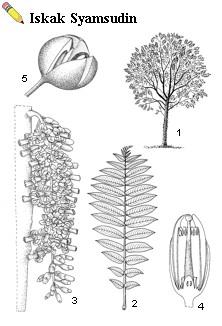 | Dysoxylum parasiticum (Osbeck) Kosterm. – 1, habit of young tree; 2, leaf; 3, inflorescence; 4, cross section of male flower; 5, dehisced fruit. |
Ecology
Dysoxylum species are found scattered and are rarely common. Few reach the canopy top. They occur in evergreen or rarely semi-deciduous, primary or sometimes secondary forest and regrowth. Most species are found in well-drained habitats in the lowland on clayey to sandy soils, several extend into the montane zones, up to 2000(-2900) m altitude, in perhumid to seasonal climates. Forest types include swamp forest, coastal forest, riverine forest, ridge forest, kerangas and forest on limestone. D. alliaceum is found in Agathis forest on peat overlying sand. In Papua New Guinea some common associates of Dysoxylum are Cinnamomum, Cryptocarya, Diploglottis, Heritiera and Sloanea species.
Silviculture and Management
Dysoxylum can be propagated by seed. Per kg D. parasiticum has about 4400 dry seeds and D. gaudichaudianum about 1100 fresh seeds. Seeds sown without pulp generally germinate faster than those sown with pulp. Seeds of D. arborescens have a germination rate of 70% in 2-10 months, those of D. cauliflorum 95% in 1-3 months and those of D. angustifolium King 90-100% in 3 weeks to 2 months. When sown with adhering pulp, seeds of D. cauliflorum have a germination rate of 80% in 3.5-8 months, those of D. densiflorum 30-75% in 1.5-8.5 months, and those of D. excelsum 80% in 1-4 months. In Belitung Island, Indonesia, plantation trials revealed slow growth of D. acutangulum and planting was abandoned. In natural forest in West Java at an altitude of 1100-1500 m Dysoxylum species were among the few major commercial species; their natural regeneration, however, was very erratic. The few seedlings which did come up, were found in open areas as well as under shade and had a height increment of only about 25 cm in three years. Dysoxylum species are not resistant to fire and seedlings die in 7-11 days when exposed to waterlogged conditions. Locally in Papua New Guinea Dysoxylum species may constitute 4% of the total exploitable timber volume of trees over 50 cm diameter.
Genetic Resources and Breeding
Apart from some individual trees kept in botanical gardens and parks, none of the Dysoxylum species is conserved ex situ. Practically all rare and endemic species are found in New Guinea. As this is also the area with the highest trade figures for Dysoxylum timber, there is a potential risk of genetic erosion and maybe even extinction of some of the rarer species.
Prospects
Although the quality of Dysoxylum wood is renowned, surprisingly little is known on silvicultural management of natural forest containing Dysoxylum species. Research is needed on their behaviour in plantations or enrichment plantings.
Literature
[40]All Nippon Checkers Corporation, 1989. Illustrated commercial foreign woods in Japan. Tokyo. 262 pp.
[57]Appanah, S. & Weinland, G., 1993. Planting quality timber trees in Peninsular Malaysia - a review. Malayan Forest Record No 38. Forest Research Institute Malaysia, Kepong. 221 pp.
[75]Bakhoven, A.C., 1930. Vul-, drijf- en dekkingshout in wildhoutbergculturen, dan wel, de in bergwildhoutculturen in te brengen houtsoorten voor blijvend onderbestand en ondergroei [Auxiliary, nursing and soil-covering tree species in the montane non-teak plantations and tree species to mix in the montane non-teak plantations to form a permanent understorey tree layer and undergrowth]. Tectona 23: 558-569.
[101]Beekman, H., 1920. 78 Preanger houtsoorten. Beschrijving, afbeelding en determinatietabel [78 Priangan wood species. Description, pictures and identification key]. Mededeelingen No 5. Proefstation voor het Boschwezen, Buitenzorg. 186 pp.
[121]Boland, D.J. et al., 1984. Forest trees of Australia. Industrial Research Organisation, Melbourne. 687 pp.
[125]Bolza, E. & Kloot, N.H., 1966. The mechanical properties of 81 New Guinea timbers. Technological Paper No 41. Division of Forest Products, CSIRO, Melbourne. 39 pp.
[126]Bolza, E. & Kloot, N.H., 1972. The mechanical properties of 56 Fijian timbers. Technological Paper No 62. Division of Forest Products, CSIRO, Melbourne. 51 pp.
[161]Burger, D., 1972. Seedlings of some tropical trees and shrubs mainly of South East Asia. Pudoc, Wageningen. 399 pp.
[162]Burgess, P.F., 1966. Timbers of Sabah. Sabah Forest Records No 6. Forest Department, Sabah, Sandakan. xviii + 501 pp.
[209]Corner, E.J.H., 1988. Wayside trees of Malaya. 3rd edition. 2 volumes. The Malayan Nature Society, Kuala Lumpur. 774 pp.
[211]Coster, C., 1935. Wortelstudiën in de tropen. V. Gebergtehoutsoorten [Root studies in the tropics. V. Montane tree species]. Tectona 28: 861-878.
[235]de Guzman, E.D., Umali, R.M. & Sotalbo, E.D., 1986. Guide to the Philippine flora and fauna. Vol. 3: Dipterocarps, non-dipterocarps. Natural Resources Management Centre, Ministry of Natural Resources, Quezon City & University of the Philippines, Los Baños. xx + 414 pp.
[238]de Vogel, E.F., 1980. Seedlings of dicotyledons. Structure, development, types. Descriptions of 150 woody Malesian taxa. Pudoc, Wageningen. 465 pp.
[259]den Berger, L.G., 1926. Mechanical properties of Dutch East Indian timbers. Korte Mededeelingen No 12. Proefstation voor het Boschwezen, Buitenzorg. viii + 63 pp.
[260]den Berger, L.G., 1926. Houtsoorten der cultuurgebieden van Java en Sumatra's oostkust [Tree species of the cultivated areas of Java and the east coast of Sumatra]. Mededeelingen No 13. Proefstation voor het Boschwezen, Buitenzorg. 186 pp.
[267]Desch, H.E., 1941-1954. Manual of Malayan timbers. Malayan Forest Records No 15. 2 volumes. Malaya Publishing House Ltd., Singapore. 762 pp.
[300]Eddowes, P.J., 1977. Commercial timbers of Papua New Guinea, their properties and uses. Forest Products Research Centre, Department of Primary Industry, Port Moresby. xiv + 195 pp.
[302]Eddowes, P.J., 1980. Lesser known timber species of SEALPA countries. A review and summary. South East Asia Lumber Producers' Association, Jakarta. 132 pp.
[304]Eddowes, P.J., 1995-1997. The forests and timbers of Papua New Guinea. (unpublished data).
[341]Flora Malesiana (various editors), 1950-. Kluwer Academic Publishers, Dordrecht, Boston, London.
[346]Foreman, D.B., 1971. A check list of the vascular plants of Bougainville with descriptions of some common forest trees. Botany Bulletin No 5. Division of Botany, Department of Forests, Lae. 194 pp.
[348]Forest Products Research Centre, 1967. Properties and uses of Papua and New Guinea timbers. Forest Products Research Centre, Port Moresby. 30 pp.
[356]Francis, W.D., 1970. Australian rain-forest trees. Australian Government Publication Service, Canberra. 468 pp.
[364]Gamble, J.S., 1922. A manual of Indian timbers. 2nd edition. Sampsom Low, Marston & Company, London. 868 pp.
[405]Hardjowasono, M.S., 1942. Gewicht en volume van verschillende vrucht- en zaadsoorten [Weight and volume of various fruits and seeds]. Korte Mededelingen No 20. Bosbouwproefstation, Buitenzorg. 172 pp.
[423]Havel, J.J., 1975. Forest botany. Part 2: Botanical taxonomy. Training Manual for the Forestry College Vol. 3. Department of Forests, Port Moresby. 317 pp.
[433]Henty, E.E., 1980. Harmful plants in Papua New Guinea. Botany Bulletin No 12. Department of Forests, Division of Botany, Lae. 153 pp.
[438]Hildebrand, F.H., 1951. Daftar nama pohon-pohonan Djawa-Madura dengan keterangan-keterangan tentang penjiaran dan ukurannja (telah diperbaiki) [Revised list of tree species of Java-Madura with notes on their distribution and dimensions]. Laporan No 50. Balai Penjelidikan Kehutanan, Bogor. 183 pp.
[464]Ilic, J., 1990. The CSIRO macro key for hardwood identification. CSIRO, Highett. 125 pp.
[487]Japing, C.H., 1961. Houtsoorten van Nieuw Guinea - literatuurstudie [Tree species of Dutch New Guinea - survey of literature]. 2 parts. Wageningen. 220 pp.
[536]Keating, W.G. & Bolza, E., 1982. Characteristics, properties and uses of timbers. Vol. 1. South-East Asia, northern Australia and the Pacific. Inkata Press Proprietary Ltd., Melbourne, Sydney & London. 362 pp.
[568]Kingston, R.S.T. & Risdon, C.J.E., 1961. Shrinkage and density of Australian and other South-West Pacific woods. Technological Paper No 13. Division of Forest Products, CSIRO, Melbourne. 65 pp.
[590]Koopman, M.J.F., 1938. Boschverjonging op Biliton [Forest regeneration in Belitung]. Voorlopig Rapport Boschbouwproefstation No 15. Buitenzorg. 20 pp.
[632]Kraemer, J.H., 1951. Trees of the western Pacific region. Tri-State Offset Company, Cincinnatti. 436 pp.
[634]Kramer, F., 1926. Onderzoek naar de natuurlijke verjonging en den uitkap in Preanger gebergtebosch [Research on natural regeneration and selective cutting in the Priangan mountain forest]. Thesis. Agricultural University Wageningen. 182 pp.
[694]Leighton, M. & Leighton, D.R., 1983. Vertebrate responses to fruiting seasonality within a Bornean rain forest. In: Sutton, S.L., Whitmore, T.C. & Chadwick, A.C. (Editors): Tropical rain forest: ecology and management. Special publication number 2 of the British Ecological Society. Blackwell Scientific Publications, Oxford, London, Edinburgh, Boston, Melbourne. pp. 181-196.
[730]Mabberley, D.J., 1994. New species of Dysoxylum (Meliaceae). Blumea 38: 303-312.
[757]Martawijaya, A., Kartasujana, I., Kadir, K. & Prawira, S.A., 1992. Indonesian wood atlas. Vol. 2. Forest Products Research and Development Centre, Bogor. 168 pp.
[780]Meniado, J.A. et al., 1975-1981. Wood identification handbook for Philippine timbers. 2 volumes. Government Printing Office, Manila. 370 pp. & 186 pp.
[825]Ng, F.S.P., 1978. Strategies of establishment in Malayan forest trees. In: Tomlinson, P.B. & Zimmermann, M.H. (Editors): Tropical trees as living systems. The proceedings of the fourth Cabot symposium held at Harvard Forest, Petersham, Massachusetts on April 26-30, 1976. Cambridge University Press, Cambridge, London, New York, Melbourne. pp. 129-162.
[829]Ng, F.S.P., 1991-1992. Manual of forest fruits, seeds and seedlings. 2 volumes. Malayan Forest Record No 34. Forest Research Institute Malaysia, Kepong. 997 pp.
[831]Ng, F.S.P. & Mat Asri Ngah Sanah, 1991. Germination and seedling records. Research Pamphlet No 108. Forest Research Institute Malaysia, Kepong. 191 pp.
[861]Oey Djoen Seng, 1951. De soortelijke gewichten van Indonesische houtsoorten en hun betekenis voor de praktijk [Specific gravity of Indonesian woods and its significance for practical use]. Rapport No 46. Bosbouwproefstation, Bogor. 183 pp.
[878]Pennington, T.D. & Styles, B.T., 1975. A generic monograph of the Meliaceae. Blumea 22: 419-540.
[933]Research Institute of Wood Industry, 1988. Identification, properties and uses of some Southeast Asian woods. Chinese Academy of Forestry, Wan Shou Shan, Beijing & International Tropical Timber Organization, Yokohama. 201 pp.
[934]Reyes, L.J., 1938. Philippine woods. Technical Bulletin No 7. Commonwealth of the Philippines, Department of Agriculture and Commerce. Bureau of Printing, Manila. 536 pp. + 88 plates.
[1012]Siaguru, P., 1992. Effect of shade on growth of lowland forest tree seedlings in Papua New Guinea. PhD thesis. University of Aberdeen, Scotland. 227 pp.
[1052]Stadelman, R.C., 1966. Forests of Southeast Asia. Princeton, Memphis, Tennessee. 245 pp.
[1065]Styles, B.T. & Khosla, P.K., 1976. Cytology and reproductive biology of Meliaceae. In: Burley, J. & Styles, B.T. (Editors): Tropical trees. Variation, breeding and conservation. Linnean Society Symposium Series No 2. Academic Press, London. pp. 61-67.
[1086]Tamesis, F. & Aguilar, L., 1951. Important commercial timbers of the Philippines: their properties and uses. Popular Bulletin No 32. Department of Agriculture and Natural Resources. Bureau of Printing, Manila. 83 pp.
[1123]van der Pijl, L., 1957. The dispersal of plants by bats (chiropterochory). Acta Botanica Neerlandica 6: 291-315.
[1209]Whitmore, T.C., 1966. Guide to the forests of the British Solomon Islands. Oxford University Press, London. 208 pp.
[1218]Whitmore, T.C., 1984. Tropical rainforest of the Far East. 2nd edition. Clarendon Press, Oxford. xvi + 352 pp.
[1221]Whitmore, T.C. & Ng, F.S.P. (Editors), 1972-1989. Tree flora of Malaya. A manual for foresters. 4 volumes. Malayan Forest Records No 26. Longman Malaysia Sdn. Berhad, Kuala Lumpur & Petaling Jaya.
[1232]Wisse, J.H., 1965. Volumegewichten van een aantal houtmonsters uit West Nieuw Guinea [Specific gravity of some wood samples from West New Guinea]. Afdeling Bosexploitatie en Boshuishoudkunde, Landbouwhogeschool, Wageningen. 23 pp.
[1242]Wong, T.M., 1982. A dictionary of Malaysian timbers. Malayan Forest Records No 30. Forest Research Institute Malaysia, Kepong. 259 pp.
[1248]Working group on utilization of tropical woods, 1978. Properties of some Papua New Guinea woods relating with manufacturing processes VI-IX. Bulletin of the Forestry and Forest Products Research Institute Japan No 299: 23-187.
[57]Appanah, S. & Weinland, G., 1993. Planting quality timber trees in Peninsular Malaysia - a review. Malayan Forest Record No 38. Forest Research Institute Malaysia, Kepong. 221 pp.
[75]Bakhoven, A.C., 1930. Vul-, drijf- en dekkingshout in wildhoutbergculturen, dan wel, de in bergwildhoutculturen in te brengen houtsoorten voor blijvend onderbestand en ondergroei [Auxiliary, nursing and soil-covering tree species in the montane non-teak plantations and tree species to mix in the montane non-teak plantations to form a permanent understorey tree layer and undergrowth]. Tectona 23: 558-569.
[101]Beekman, H., 1920. 78 Preanger houtsoorten. Beschrijving, afbeelding en determinatietabel [78 Priangan wood species. Description, pictures and identification key]. Mededeelingen No 5. Proefstation voor het Boschwezen, Buitenzorg. 186 pp.
[121]Boland, D.J. et al., 1984. Forest trees of Australia. Industrial Research Organisation, Melbourne. 687 pp.
[125]Bolza, E. & Kloot, N.H., 1966. The mechanical properties of 81 New Guinea timbers. Technological Paper No 41. Division of Forest Products, CSIRO, Melbourne. 39 pp.
[126]Bolza, E. & Kloot, N.H., 1972. The mechanical properties of 56 Fijian timbers. Technological Paper No 62. Division of Forest Products, CSIRO, Melbourne. 51 pp.
[161]Burger, D., 1972. Seedlings of some tropical trees and shrubs mainly of South East Asia. Pudoc, Wageningen. 399 pp.
[162]Burgess, P.F., 1966. Timbers of Sabah. Sabah Forest Records No 6. Forest Department, Sabah, Sandakan. xviii + 501 pp.
[209]Corner, E.J.H., 1988. Wayside trees of Malaya. 3rd edition. 2 volumes. The Malayan Nature Society, Kuala Lumpur. 774 pp.
[211]Coster, C., 1935. Wortelstudiën in de tropen. V. Gebergtehoutsoorten [Root studies in the tropics. V. Montane tree species]. Tectona 28: 861-878.
[235]de Guzman, E.D., Umali, R.M. & Sotalbo, E.D., 1986. Guide to the Philippine flora and fauna. Vol. 3: Dipterocarps, non-dipterocarps. Natural Resources Management Centre, Ministry of Natural Resources, Quezon City & University of the Philippines, Los Baños. xx + 414 pp.
[238]de Vogel, E.F., 1980. Seedlings of dicotyledons. Structure, development, types. Descriptions of 150 woody Malesian taxa. Pudoc, Wageningen. 465 pp.
[259]den Berger, L.G., 1926. Mechanical properties of Dutch East Indian timbers. Korte Mededeelingen No 12. Proefstation voor het Boschwezen, Buitenzorg. viii + 63 pp.
[260]den Berger, L.G., 1926. Houtsoorten der cultuurgebieden van Java en Sumatra's oostkust [Tree species of the cultivated areas of Java and the east coast of Sumatra]. Mededeelingen No 13. Proefstation voor het Boschwezen, Buitenzorg. 186 pp.
[267]Desch, H.E., 1941-1954. Manual of Malayan timbers. Malayan Forest Records No 15. 2 volumes. Malaya Publishing House Ltd., Singapore. 762 pp.
[300]Eddowes, P.J., 1977. Commercial timbers of Papua New Guinea, their properties and uses. Forest Products Research Centre, Department of Primary Industry, Port Moresby. xiv + 195 pp.
[302]Eddowes, P.J., 1980. Lesser known timber species of SEALPA countries. A review and summary. South East Asia Lumber Producers' Association, Jakarta. 132 pp.
[304]Eddowes, P.J., 1995-1997. The forests and timbers of Papua New Guinea. (unpublished data).
[341]Flora Malesiana (various editors), 1950-. Kluwer Academic Publishers, Dordrecht, Boston, London.
[346]Foreman, D.B., 1971. A check list of the vascular plants of Bougainville with descriptions of some common forest trees. Botany Bulletin No 5. Division of Botany, Department of Forests, Lae. 194 pp.
[348]Forest Products Research Centre, 1967. Properties and uses of Papua and New Guinea timbers. Forest Products Research Centre, Port Moresby. 30 pp.
[356]Francis, W.D., 1970. Australian rain-forest trees. Australian Government Publication Service, Canberra. 468 pp.
[364]Gamble, J.S., 1922. A manual of Indian timbers. 2nd edition. Sampsom Low, Marston & Company, London. 868 pp.
[405]Hardjowasono, M.S., 1942. Gewicht en volume van verschillende vrucht- en zaadsoorten [Weight and volume of various fruits and seeds]. Korte Mededelingen No 20. Bosbouwproefstation, Buitenzorg. 172 pp.
[423]Havel, J.J., 1975. Forest botany. Part 2: Botanical taxonomy. Training Manual for the Forestry College Vol. 3. Department of Forests, Port Moresby. 317 pp.
[433]Henty, E.E., 1980. Harmful plants in Papua New Guinea. Botany Bulletin No 12. Department of Forests, Division of Botany, Lae. 153 pp.
[438]Hildebrand, F.H., 1951. Daftar nama pohon-pohonan Djawa-Madura dengan keterangan-keterangan tentang penjiaran dan ukurannja (telah diperbaiki) [Revised list of tree species of Java-Madura with notes on their distribution and dimensions]. Laporan No 50. Balai Penjelidikan Kehutanan, Bogor. 183 pp.
[464]Ilic, J., 1990. The CSIRO macro key for hardwood identification. CSIRO, Highett. 125 pp.
[487]Japing, C.H., 1961. Houtsoorten van Nieuw Guinea - literatuurstudie [Tree species of Dutch New Guinea - survey of literature]. 2 parts. Wageningen. 220 pp.
[536]Keating, W.G. & Bolza, E., 1982. Characteristics, properties and uses of timbers. Vol. 1. South-East Asia, northern Australia and the Pacific. Inkata Press Proprietary Ltd., Melbourne, Sydney & London. 362 pp.
[568]Kingston, R.S.T. & Risdon, C.J.E., 1961. Shrinkage and density of Australian and other South-West Pacific woods. Technological Paper No 13. Division of Forest Products, CSIRO, Melbourne. 65 pp.
[590]Koopman, M.J.F., 1938. Boschverjonging op Biliton [Forest regeneration in Belitung]. Voorlopig Rapport Boschbouwproefstation No 15. Buitenzorg. 20 pp.
[632]Kraemer, J.H., 1951. Trees of the western Pacific region. Tri-State Offset Company, Cincinnatti. 436 pp.
[634]Kramer, F., 1926. Onderzoek naar de natuurlijke verjonging en den uitkap in Preanger gebergtebosch [Research on natural regeneration and selective cutting in the Priangan mountain forest]. Thesis. Agricultural University Wageningen. 182 pp.
[694]Leighton, M. & Leighton, D.R., 1983. Vertebrate responses to fruiting seasonality within a Bornean rain forest. In: Sutton, S.L., Whitmore, T.C. & Chadwick, A.C. (Editors): Tropical rain forest: ecology and management. Special publication number 2 of the British Ecological Society. Blackwell Scientific Publications, Oxford, London, Edinburgh, Boston, Melbourne. pp. 181-196.
[730]Mabberley, D.J., 1994. New species of Dysoxylum (Meliaceae). Blumea 38: 303-312.
[757]Martawijaya, A., Kartasujana, I., Kadir, K. & Prawira, S.A., 1992. Indonesian wood atlas. Vol. 2. Forest Products Research and Development Centre, Bogor. 168 pp.
[780]Meniado, J.A. et al., 1975-1981. Wood identification handbook for Philippine timbers. 2 volumes. Government Printing Office, Manila. 370 pp. & 186 pp.
[825]Ng, F.S.P., 1978. Strategies of establishment in Malayan forest trees. In: Tomlinson, P.B. & Zimmermann, M.H. (Editors): Tropical trees as living systems. The proceedings of the fourth Cabot symposium held at Harvard Forest, Petersham, Massachusetts on April 26-30, 1976. Cambridge University Press, Cambridge, London, New York, Melbourne. pp. 129-162.
[829]Ng, F.S.P., 1991-1992. Manual of forest fruits, seeds and seedlings. 2 volumes. Malayan Forest Record No 34. Forest Research Institute Malaysia, Kepong. 997 pp.
[831]Ng, F.S.P. & Mat Asri Ngah Sanah, 1991. Germination and seedling records. Research Pamphlet No 108. Forest Research Institute Malaysia, Kepong. 191 pp.
[861]Oey Djoen Seng, 1951. De soortelijke gewichten van Indonesische houtsoorten en hun betekenis voor de praktijk [Specific gravity of Indonesian woods and its significance for practical use]. Rapport No 46. Bosbouwproefstation, Bogor. 183 pp.
[878]Pennington, T.D. & Styles, B.T., 1975. A generic monograph of the Meliaceae. Blumea 22: 419-540.
[933]Research Institute of Wood Industry, 1988. Identification, properties and uses of some Southeast Asian woods. Chinese Academy of Forestry, Wan Shou Shan, Beijing & International Tropical Timber Organization, Yokohama. 201 pp.
[934]Reyes, L.J., 1938. Philippine woods. Technical Bulletin No 7. Commonwealth of the Philippines, Department of Agriculture and Commerce. Bureau of Printing, Manila. 536 pp. + 88 plates.
[1012]Siaguru, P., 1992. Effect of shade on growth of lowland forest tree seedlings in Papua New Guinea. PhD thesis. University of Aberdeen, Scotland. 227 pp.
[1052]Stadelman, R.C., 1966. Forests of Southeast Asia. Princeton, Memphis, Tennessee. 245 pp.
[1065]Styles, B.T. & Khosla, P.K., 1976. Cytology and reproductive biology of Meliaceae. In: Burley, J. & Styles, B.T. (Editors): Tropical trees. Variation, breeding and conservation. Linnean Society Symposium Series No 2. Academic Press, London. pp. 61-67.
[1086]Tamesis, F. & Aguilar, L., 1951. Important commercial timbers of the Philippines: their properties and uses. Popular Bulletin No 32. Department of Agriculture and Natural Resources. Bureau of Printing, Manila. 83 pp.
[1123]van der Pijl, L., 1957. The dispersal of plants by bats (chiropterochory). Acta Botanica Neerlandica 6: 291-315.
[1209]Whitmore, T.C., 1966. Guide to the forests of the British Solomon Islands. Oxford University Press, London. 208 pp.
[1218]Whitmore, T.C., 1984. Tropical rainforest of the Far East. 2nd edition. Clarendon Press, Oxford. xvi + 352 pp.
[1221]Whitmore, T.C. & Ng, F.S.P. (Editors), 1972-1989. Tree flora of Malaya. A manual for foresters. 4 volumes. Malayan Forest Records No 26. Longman Malaysia Sdn. Berhad, Kuala Lumpur & Petaling Jaya.
[1232]Wisse, J.H., 1965. Volumegewichten van een aantal houtmonsters uit West Nieuw Guinea [Specific gravity of some wood samples from West New Guinea]. Afdeling Bosexploitatie en Boshuishoudkunde, Landbouwhogeschool, Wageningen. 23 pp.
[1242]Wong, T.M., 1982. A dictionary of Malaysian timbers. Malayan Forest Records No 30. Forest Research Institute Malaysia, Kepong. 259 pp.
[1248]Working group on utilization of tropical woods, 1978. Properties of some Papua New Guinea woods relating with manufacturing processes VI-IX. Bulletin of the Forestry and Forest Products Research Institute Japan No 299: 23-187.
Author(s)
S. Aggarwal (general part, selection of species), M.S.M. Sosef (selection of species)
Dysoxylum acutangulum
Dysoxylum alliaceum
Dysoxylum annae
Dysoxylum arborescens
Dysoxylum brassii
Dysoxylum carolinae
Dysoxylum cauliflorum
Dysoxylum crassum
Dysoxylum cyrtobotryum
Dysoxylum densiflorum
Dysoxylum excelsum
Dysoxylum flavescens
Dysoxylum gaudichaudianum
Dysoxylum grande
Dysoxylum inopinatum
Dysoxylum kaniense
Dysoxylum latifolium
Dysoxylum macrocarpum
Dysoxylum mollissimum
Dysoxylum oppositifolium
Dysoxylum papuanum
Dysoxylum parasiticum
Dysoxylum pettigrewianum
Dysoxylum randianum
Dysoxylum rigidum
Dysoxylum setosum
Dysoxylum stellatopuberulum
Dysoxylum alliaceum
Dysoxylum annae
Dysoxylum arborescens
Dysoxylum brassii
Dysoxylum carolinae
Dysoxylum cauliflorum
Dysoxylum crassum
Dysoxylum cyrtobotryum
Dysoxylum densiflorum
Dysoxylum excelsum
Dysoxylum flavescens
Dysoxylum gaudichaudianum
Dysoxylum grande
Dysoxylum inopinatum
Dysoxylum kaniense
Dysoxylum latifolium
Dysoxylum macrocarpum
Dysoxylum mollissimum
Dysoxylum oppositifolium
Dysoxylum papuanum
Dysoxylum parasiticum
Dysoxylum pettigrewianum
Dysoxylum randianum
Dysoxylum rigidum
Dysoxylum setosum
Dysoxylum stellatopuberulum
Correct Citation of this Article
Aggarwal, S. & Sosef, M.S.M., 1998. Dysoxylum Blume. In: Sosef, M.S.M., Hong, L.T. and Prawirohatmodjo, S. (Editors): Plant Resources of South-East Asia No 5(3): Timber trees; Lesser-known timbers. PROSEA Foundation, Bogor, Indonesia. Database record: prota4u.org/prosea
Selection of Species
The following species in this genus are important in this commodity group and are treated separatedly in this database:
Dysoxylum acutangulum
Dysoxylum alliaceum
Dysoxylum annae
Dysoxylum arborescens
Dysoxylum brassii
Dysoxylum carolinae
Dysoxylum cauliflorum
Dysoxylum crassum
Dysoxylum cyrtobotryum
Dysoxylum densiflorum
Dysoxylum excelsum
Dysoxylum flavescens
Dysoxylum gaudichaudianum
Dysoxylum grande
Dysoxylum inopinatum
Dysoxylum kaniense
Dysoxylum latifolium
Dysoxylum macrocarpum
Dysoxylum mollissimum
Dysoxylum oppositifolium
Dysoxylum papuanum
Dysoxylum parasiticum
Dysoxylum pettigrewianum
Dysoxylum randianum
Dysoxylum rigidum
Dysoxylum setosum
Dysoxylum stellatopuberulum
Dysoxylum acutangulum
Dysoxylum alliaceum
Dysoxylum annae
Dysoxylum arborescens
Dysoxylum brassii
Dysoxylum carolinae
Dysoxylum cauliflorum
Dysoxylum crassum
Dysoxylum cyrtobotryum
Dysoxylum densiflorum
Dysoxylum excelsum
Dysoxylum flavescens
Dysoxylum gaudichaudianum
Dysoxylum grande
Dysoxylum inopinatum
Dysoxylum kaniense
Dysoxylum latifolium
Dysoxylum macrocarpum
Dysoxylum mollissimum
Dysoxylum oppositifolium
Dysoxylum papuanum
Dysoxylum parasiticum
Dysoxylum pettigrewianum
Dysoxylum randianum
Dysoxylum rigidum
Dysoxylum setosum
Dysoxylum stellatopuberulum

All texts are licensed under a Creative Commons Attribution-Noncommercial-Share Alike 3.0 Netherlands License
This license does not include the illustrations (Maps,drawings,pictures); these remain all under copyright.