Record Number
5275
PROSEA Handbook Number
5(3): Timber trees; Lesser-known timbers
Taxon
Elaeocarpus L.
Protologue
Sp. pl. 1: 515 (1753); Gen. pl., ed. 5: 230 (1754).
Family
ELAEOCARPACEAE
Chromosome Numbers
x = unknown; 2n = unknown
Vernacular Names
Jenitri, quandong (trade names). Oil-fruit (En). Brunei: perius-perius, sengkurat, suragam. Indonesia: bengkinang, mendang (Indonesian, Kalimantan), mentanahan (Kutai, East Kalimantan). Malaysia: sengkurat (general), kungkurad (Sabah), mendong (Peninsular). Papua New Guinea: Papua New Guinea quandong (En). Philippines: kalomala (general), hunggo (Filipino). Burma (Myanmar): thitpwe. Thailand: ma mun. Vietnam: c[oo]m.
Origin and Geographic Distribution
Elaeocarpus comprises some 300 species occurring from Madagascar and Mauritius to Sri Lanka, India, Indo-China, China, Japan, Thailand, throughout the Malesian region, east to Hawaii and Polynesia (as far as Rarotonga), south to Australia and New Zealand. Malesia harbours the majority of species (some 250); Papua New Guinea alone has about 70 species, Borneo at least 50 and Peninsular Malaysia about 30.
Uses
The wood of Elaeocarpus is used for light interior construction, weatherboard, boat building, aircraft building, furniture, joinery, scantlings, mouldings, boxes, pallets, shuttering, brushware, turnery, oars, match splints and carvings. It is occasionally used for the production of blockboard and as core stock and face veneer for plywood. It is suitable for the manufacture of particle board, fibreboard and pulp and paper.
E. angustifolius has been used for reforestation in Java whereas E. grandiflorus is planted as an ornamental. Elaeocarpus logs are suitable for the cultivation of shiitake mushrooms. The fruits of most species are edible. Leaves and seeds are sometimes applied medicinally, principally as a tonic, but also against sores, syphilis and as a diuretic. A decoction of the bark and leaves of E. floribundus has been used in Palembang, Sumatra to treat inflammation of the gums. The fruits of E. angustifolius are well-known in Hindu religion and the ancient Indian system of medicine in the treatment of mental diseases, epilepsy, hypertension, asthma and liver diseases. Stones are sometimes polished and used to make necklaces, bead chains or rosaries, formerly also for various buttons. Bark is used as twine in house construction.
E. angustifolius has been used for reforestation in Java whereas E. grandiflorus is planted as an ornamental. Elaeocarpus logs are suitable for the cultivation of shiitake mushrooms. The fruits of most species are edible. Leaves and seeds are sometimes applied medicinally, principally as a tonic, but also against sores, syphilis and as a diuretic. A decoction of the bark and leaves of E. floribundus has been used in Palembang, Sumatra to treat inflammation of the gums. The fruits of E. angustifolius are well-known in Hindu religion and the ancient Indian system of medicine in the treatment of mental diseases, epilepsy, hypertension, asthma and liver diseases. Stones are sometimes polished and used to make necklaces, bead chains or rosaries, formerly also for various buttons. Bark is used as twine in house construction.
Production and International Trade
As supplies are generally limited, Elaeocarpus wood is mainly sold in mixed consignments of medium-weight hardwood. In 1996 Papua New Guinea exported almost 7000 m3 of "quandong"" logs at an average free-on-board (FOB) price of US$ 99/m3.
Properties
Elaeocarpus yields a lightweight to medium-weight hardwood with a density of (265-)315-700(-820) kg/m3 at 15% moisture content. Heartwood straw, yellowish-white to pale yellow-brown or pinkish-brown, not clearly differentiated from the white to pale grey-brown, 4-8 cm wide sapwood; grain usually straight, sometimes shallowly interlocked; texture very fine to moderately fine and even; wood lustrous. Growth rings indistinct to the naked eye but distinct with a hand lens, very variable in width, sometimes boundaries indicated by thicker-walled fibres in latewood and a band of marginal parenchyma in the earlywood; vessels moderately small to medium-sized, occasionally moderately large, solitary and in radial multiples of 2-4(-7), multiples predominating, with occasional clusters, tyloses present and abundant in some species including E. calomala and E. undulatus; parenchyma sparse to absent, apotracheal in marginal or seemingly marginal bands, just visible to the naked eye, sometimes paratracheal vasicentric, indistinct even with a hand lens; rays of 2 distinct sizes very distinct, moderately fine to medium-sized, visible on transverse section, and extremely fine, visible only with a hand lens; ripple marks absent; vertical traumatic canals present in tangential series in some species.
Shrinkage upon seasoning is low but the wood is prone to blue stain, sap-stain and insect attack. Prophylactic treatment should be undertaken prior to seasoning. Boards 13 mm and 38 mm thick of E. angustifolius take respectively 3 and 4.5 months to air dry. Back-sawn stock of 50 mm may develop slight warp and surface checks. The wood is soft to hard and very weak. It is generally easy to saw and work, takes a moderate to good finish and stock turns and moulds easily. It rotary peels well. The wood is non-durable when exposed to the weather or in contact with the ground. The sapwood is permeable, penetration of heartwood good in some material, patchy in others; the retention of E. angustifolius by the pressure treating method is 526 kg/m3 for sapwood and 43 kg/m3 for heartwood. The heartwood of Elaeocarpus is susceptible to dry-wood termites. The sapwood is susceptible to Lyctus.
The gross energy value of the wood of an unidentified Elaeocarpus species was reported to be about 20 535 kJ/kg.
See also the tables on microscopic wood anatomy and wood properties.
Shrinkage upon seasoning is low but the wood is prone to blue stain, sap-stain and insect attack. Prophylactic treatment should be undertaken prior to seasoning. Boards 13 mm and 38 mm thick of E. angustifolius take respectively 3 and 4.5 months to air dry. Back-sawn stock of 50 mm may develop slight warp and surface checks. The wood is soft to hard and very weak. It is generally easy to saw and work, takes a moderate to good finish and stock turns and moulds easily. It rotary peels well. The wood is non-durable when exposed to the weather or in contact with the ground. The sapwood is permeable, penetration of heartwood good in some material, patchy in others; the retention of E. angustifolius by the pressure treating method is 526 kg/m3 for sapwood and 43 kg/m3 for heartwood. The heartwood of Elaeocarpus is susceptible to dry-wood termites. The sapwood is susceptible to Lyctus.
The gross energy value of the wood of an unidentified Elaeocarpus species was reported to be about 20 535 kJ/kg.
See also the tables on microscopic wood anatomy and wood properties.
Botany
Shrubs or small to fairly large, or occasionally large trees up to 40(-50) m tall; bole straight, cylindrical, columnar or poorly shaped, branchless for up to 18 m, up to 80(-160) cm in diameter, sometimes with steep buttresses up to 3(-5) m high, rarely with stilt roots; bark surface smooth to cracked or rugose or fissured, sometimes lenticellate, brown or grey, inner bark fibrous to granular, brown or yellowish-brown to reddish-brown or pink; crown often symmetrical. Leaves arranged spirally or alternate, simple, dentate or crenate or occasionally entire, with or without stipules; petiole often kneed at apex. Flowers in an axillary raceme, pendulous, 4-5-merous; sepals valvate; petals only slightly longer than the sepals, white, cream or greenish, generally toothed and/or fringed at apex; disk lobed, glabrous or hairy; stamens 10-many, inserted between disk and ovary or rarely on the disk, anthers with transverse apical slits; ovary superior, 2-7-locular with 2-12 ovules in each cell, style simple. Fruit an often bluish, purplish or brownish-green drupe; stone hard, with 1-7 seeds. Seedling with epigeal germination; cotyledons emergent, leafy; hypocotyl elongated; first 2 leaves opposite or alternate, subsequent ones alternate.
E. angustifolius has been planted in trials in Java where the mean annual increment of 10.5-year-old trees planted at about 60 m altitude was 1.1-1.3 m in height and 1.9-2.1 cm in diameter. When planted at about 650 m altitude the mean annual increment of isolated trees was 2.5 m in height and 4.7 cm in diameter. In the Solomon Islands the annual increment of E. angustifolius in gaps in natural forest is 0.4 m in height and in plantations 2.9 m in height and 3.9 cm in diameter. Trees often show Terminalia-like branching. Growth form is according to Aubréville's architectural tree model, characterized by a monopodial trunk with rhythmic growth and spiral or decussate phyllotaxis bearing tiers of branches with similar phyllotaxis and indefinite growth of branches. Young leaves are red, pink or purple; old leaves wither red or occasionally yellow. Trees are generally evergreen, but some, e.g. E. angustifolius, are briefly deciduous. They flower at regular intervals, often after a dry period, sometimes 2-3 times a year. In Peninsular Malaysia flowering often takes place in March-May and August-October. In West Java E. angustifolius carries fruits more or less throughout the year, but in Sulawesi only in October-November. Birds (including cassowaries), bats, rodents and pigs eat the fruits and thus disperse the seeds.
Probably because of ongoing speciation processes and hybridization, some species groups are regarded as "complexes"" within which it is hard to recognize individual species. Several formerly recognized species have, for example, now been incorporated into one of the 7 subspecies of E. submonoceras. The genus Acronodia has been incorporated into Elaeocarpus. Elaeocarpus is occasionally regarded as a member of the tribe Elaeocarpeae within the family Tiliaceae.
E. angustifolius has been planted in trials in Java where the mean annual increment of 10.5-year-old trees planted at about 60 m altitude was 1.1-1.3 m in height and 1.9-2.1 cm in diameter. When planted at about 650 m altitude the mean annual increment of isolated trees was 2.5 m in height and 4.7 cm in diameter. In the Solomon Islands the annual increment of E. angustifolius in gaps in natural forest is 0.4 m in height and in plantations 2.9 m in height and 3.9 cm in diameter. Trees often show Terminalia-like branching. Growth form is according to Aubréville's architectural tree model, characterized by a monopodial trunk with rhythmic growth and spiral or decussate phyllotaxis bearing tiers of branches with similar phyllotaxis and indefinite growth of branches. Young leaves are red, pink or purple; old leaves wither red or occasionally yellow. Trees are generally evergreen, but some, e.g. E. angustifolius, are briefly deciduous. They flower at regular intervals, often after a dry period, sometimes 2-3 times a year. In Peninsular Malaysia flowering often takes place in March-May and August-October. In West Java E. angustifolius carries fruits more or less throughout the year, but in Sulawesi only in October-November. Birds (including cassowaries), bats, rodents and pigs eat the fruits and thus disperse the seeds.
Probably because of ongoing speciation processes and hybridization, some species groups are regarded as "complexes"" within which it is hard to recognize individual species. Several formerly recognized species have, for example, now been incorporated into one of the 7 subspecies of E. submonoceras. The genus Acronodia has been incorporated into Elaeocarpus. Elaeocarpus is occasionally regarded as a member of the tribe Elaeocarpeae within the family Tiliaceae.
Image
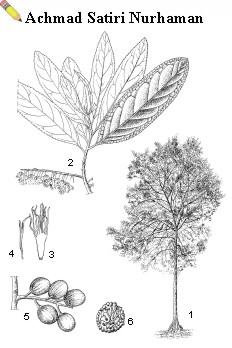 | Elaeocarpus angustifolius Blume – 1, tree habit; 2, flowering twig; 3, petal; 4, anther; 5, infructescence; 6, pyrene. |
Ecology
Elaeocarpus may be encountered in primary but more often in secondary rain forest at low to medium altitudes, but sometimes as high as 3500 m and, in Papua New Guinea, can be locally common in montane forest in association with Nothofagus. It may occur gregariously and is found in a wide range of habitats including coastal forest, freshwater swamp forest, kerangas and on ultrabasic soils.
Silviculture and Management
Elaeocarpus can be propagated from seeds (which do not tolerate desiccation). E. angustifolius has about 510 dry stones/kg and E. glaber about 590 dry stones/kg. The stones should be sown in the shade and those of E. floribundus have about 15% germination in 4-8 months, those of E. glaber about 50% and those of E. stipularis about 15% in 2.5-4.5 months. Sown fruits of E. petiolatus (Jack) Wallich have about 50% germination in 2.5-4 months. It has been recommended to open the stones and to sow the seeds. Elaeocarpus is not resistant to fire.
There are techniques for partially ring-barking flowering branches of E. angustifolius which results in smaller fruits and stones. These stones are highly esteemed by trade, mainly in India and Peninsular Malaysia.
There are techniques for partially ring-barking flowering branches of E. angustifolius which results in smaller fruits and stones. These stones are highly esteemed by trade, mainly in India and Peninsular Malaysia.
Genetic Resources and Breeding
Most of the Elaeocarpus species are endemic and hence have a fair risk of genetic erosion.
Prospects
The very fast growth of Elaeocarpus holds potential for increased use in plantations for the production of raw material for wood-based panels or paper manufacture.
Literature
[40]All Nippon Checkers Corporation, 1989. Illustrated commercial foreign woods in Japan. Tokyo. 262 pp.
[70]Backer, C.A. & Bakhuizen van den Brink Jr., R.C., 1963-1968. Flora of Java. 3 volumes. Wolters-Noordhoff, Groningen.
[101]Beekman, H., 1920. 78 Preanger houtsoorten. Beschrijving, afbeelding en determinatietabel [78 Priangan wood species. Description, pictures and identification key]. Mededeelingen No 5. Proefstation voor het Boschwezen, Buitenzorg. 186 pp.
[125]Bolza, E. & Kloot, N.H., 1966. The mechanical properties of 81 New Guinea timbers. Technological Paper No 41. Division of Forest Products, CSIRO, Melbourne. 39 pp.
[130]Bosbouwproefstation, 1948. Tabellarisch overzicht van de beste kiem-, bewaar- en verzendingswijze van zaad van een aantal boomsoorten en groenbemesters [Tabular summary of the best ways to germinate, store and send seed of some tree and green manure species]. Voorlopig rapport No 38. Bosbouwproefstation, Buitenzorg. 15 pp.
[150]Brown, W.H., 1951-1957. Useful plants of the Philippines. Reprint of the 1941-1943 edition. 3 volumes. Technical Bulletin 10. Department of Agriculture and Natural Resources. Bureau of Printing, Manila. Vol. 1(1951) 590 pp., Vol. 2 (1954) 513 pp., Vol. 3 (1957) 507 pp.
[151]Browne, F.G., 1955. Forest trees of Sarawak and Brunei and their products. Government Printing Office, Kuching, Sarawak. xviii + 369 pp.
[162]Burgess, P.F., 1966. Timbers of Sabah. Sabah Forest Records No 6. Forest Department, Sabah, Sandakan. xviii + 501 pp.
[163]Burkill, I.H., 1966. A dictionary of the economic products of the Malay Peninsula. 2nd edition. Ministry of Agriculture and Co-operatives, Kuala Lumpur. Vol. 1 (A-H) pp. 1-1240. Vol. 2 (I-Z) pp. 1241-2444.
[198]Cockburn, P.F., 1976-1980. Trees of Sabah. 2 volumes. Sabah Forest Records No 10. Forest Department Sabah, Sandakan.
[202]Coode, M.J.E., 1996. Elaeocarpus for Flora Malesiana - notes, new taxa and combinations in sect. Elaeocarpus: 2. Kew Bulletin 51: 83-101.
[202a]Coode, M.J.E., 1996. Elaeocarpus for Flora Malesiana - notes, new taxa and combinations in the Acronodia group. Kew Bulletin 51: 267-300.
[203]Coode, M.J.E. & Weibel, R., 1994. Elaeocarpus for Flora Malesiana - notes, new taxa and combinations in sect. Elaeocarpus: 1. Kew Bulletin 49: 235-259.
[209]Corner, E.J.H., 1988. Wayside trees of Malaya. 3rd edition. 2 volumes. The Malayan Nature Society, Kuala Lumpur. 774 pp.
[235]de Guzman, E.D., Umali, R.M. & Sotalbo, E.D., 1986. Guide to the Philippine flora and fauna. Vol. 3: Dipterocarps, non-dipterocarps. Natural Resources Management Centre, Ministry of Natural Resources, Quezon City & University of the Philippines, Los Baños. xx + 414 pp.
[238]de Vogel, E.F., 1980. Seedlings of dicotyledons. Structure, development, types. Descriptions of 150 woody Malesian taxa. Pudoc, Wageningen. 465 pp.
[260]den Berger, L.G., 1926. Houtsoorten der cultuurgebieden van Java en Sumatra's oostkust [Tree species of the cultivated areas of Java and the east coast of Sumatra]. Mededeelingen No 13. Proefstation voor het Boschwezen, Buitenzorg. 186 pp.
[267]Desch, H.E., 1941-1954. Manual of Malayan timbers. Malayan Forest Records No 15. 2 volumes. Malaya Publishing House Ltd., Singapore. 762 pp.
[298]Eddowes, P.J., 1975. Report on the botanical and wood collection expedition to Mount Giluwe, Mendi, Southern Highland District. Research Notes. Forest Products Research Centre, Hohola.
[300]Eddowes, P.J., 1977. Commercial timbers of Papua New Guinea, their properties and uses. Forest Products Research Centre, Department of Primary Industry, Port Moresby. xiv + 195 pp.
[302]Eddowes, P.J., 1980. Lesser known timber species of SEALPA countries. A review and summary. South East Asia Lumber Producers' Association, Jakarta. 132 pp.
[304]Eddowes, P.J., 1995-1997. The forests and timbers of Papua New Guinea. (unpublished data).
[346]Foreman, D.B., 1971. A check list of the vascular plants of Bougainville with descriptions of some common forest trees. Botany Bulletin No 5. Division of Botany, Department of Forests, Lae. 194 pp.
[348]Forest Products Research Centre, 1967. Properties and uses of Papua and New Guinea timbers. Forest Products Research Centre, Port Moresby. 30 pp.
[360]Fundter, J.M. & Wisse, J.H., 1977. 40 belangrijke houtsoorten uit Indonesisch Nieuw Guinea (Irian Jaya) met de anatomische en technische kenmerken [40 important timber species from Indonesian New Guinea (Irian Jaya) with their anatomical and technical characteristics]. Mededelingen Landbouwhogeschool Wageningen 77-9. 223 pp.
[387]Grewal, G.S., 1979. Air-seasoning properties of some Malaysian timbers. Malaysian Forest Service Trade Leaflet No 41. Malaysian Timber Industry Board, Kuala Lumpur. 26 pp.
[402]Hallé, F., Oldeman, R.A.A. & Tomlinson, P.B., 1978. Tropical trees and forests - an architectural analysis. Springer Verlag, Berlin, Heidelberg, New York. 441 pp.
[403]Handbooks of the flora of Papua New Guinea (various editors), 1978-. Melbourne University Press, Carlton.
[405]Hardjowasono, M.S., 1942. Gewicht en volume van verschillende vrucht- en zaadsoorten [Weight and volume of various fruits and seeds]. Korte Mededelingen No 20. Bosbouwproefstation, Buitenzorg. 172 pp.
[406]Harker, A.P., Sandels, A. & Burley, J., 1982. Calorific values for wood and bark and a bibliography for fuelwood. Report G 162. Tropical Products Institute, London. 20 pp.
[427]Hellinga, G., 1950. Resultaten van de proeftuinen voor boomgewassen sedert 1937. Loofhoutsoorten II [Results from trial plots for trees since 1937. Deciduous trees II]. Rapport No 27. Bosbouwproefstation, Buitenzorg. 29 pp.
[436]Heyne, K., 1927. De nuttige planten van Nederlands-Indië [The useful plants of the Dutch East Indies]. 2nd edition, 3 volumes. Departement van Landbouw, Nijverheid en Handel in Nederlandsch-Indië. 1953 pp. (3rd edition, 1950. van Hoeve, 's-Gravenhage/Bandung. 1660 pp.).
[464]Ilic, J., 1990. The CSIRO macro key for hardwood identification. CSIRO, Highett. 125 pp.
[487]Japing, C.H., 1961. Houtsoorten van Nieuw Guinea - literatuurstudie [Tree species of Dutch New Guinea - survey of literature]. 2 parts. Wageningen. 220 pp.
[536]Keating, W.G. & Bolza, E., 1982. Characteristics, properties and uses of timbers. Vol. 1. South-East Asia, northern Australia and the Pacific. Inkata Press Proprietary Ltd., Melbourne, Sydney & London. 362 pp.
[553]Kessler, P.J.A. & Sidiyasa, K., 1994. Trees of the Balikpapan-Samarinda area, East Kalimantan, Indonesia. Tropenbos Series 7. The Tropenbos Foundation, Wageningen. 446 pp.
[632]Kraemer, J.H., 1951. Trees of the western Pacific region. Tri-State Offset Company, Cincinnatti. 436 pp.
[678]Lee, Y.H., Engku Abdul Rahman bin Chik & Chu, Y.P., 1979. The strength properties of some Malaysian timbers. Malaysian Forest Service Trade Leaflet No 34 (revised edition). Malaysian Timber Industry Board, Kuala Lumpur. 107 pp.
[780]Meniado, J.A. et al., 1975-1981. Wood identification handbook for Philippine timbers. 2 volumes. Government Printing Office, Manila. 370 pp. & 186 pp.
[829]Ng, F.S.P., 1991-1992. Manual of forest fruits, seeds and seedlings. 2 volumes. Malayan Forest Record No 34. Forest Research Institute Malaysia, Kepong. 997 pp.
[831]Ng, F.S.P. & Mat Asri Ngah Sanah, 1991. Germination and seedling records. Research Pamphlet No 108. Forest Research Institute Malaysia, Kepong. 191 pp.
[861]Oey Djoen Seng, 1951. De soortelijke gewichten van Indonesische houtsoorten en hun betekenis voor de praktijk [Specific gravity of Indonesian woods and its significance for practical use]. Rapport No 46. Bosbouwproefstation, Bogor. 183 pp.
[933]Research Institute of Wood Industry, 1988. Identification, properties and uses of some Southeast Asian woods. Chinese Academy of Forestry, Wan Shou Shan, Beijing & International Tropical Timber Organization, Yokohama. 201 pp.
[934]Reyes, L.J., 1938. Philippine woods. Technical Bulletin No 7. Commonwealth of the Philippines, Department of Agriculture and Commerce. Bureau of Printing, Manila. 536 pp. + 88 plates.
[974]Salvosa, F.M., 1963. Lexicon of Philippine trees. Bulletin No 1. Forest Products Research Institute, College, Laguna. 136 pp.
[1038]Smitinand, T., 1980. Thai plant names. Royal Forest Department, Bangkok. 379 pp.
[1039]Smitinand, T. & Larsen, K. (Editors), 1970-. Flora of Thailand. The Forest Herbarium, Royal Forest Department, Bangkok.
[1123]van der Pijl, L., 1957. The dispersal of plants by bats (chiropterochory). Acta Botanica Neerlandica 6: 291-315.
[1164]Verheij, E.W.M. & Coronel, R.E. (Editors), 1991. Plant resources of South-East Asia No 2. Edible fruits and nuts. Pudoc, Wageningen. 446 pp.
[1196]Weibel, R., 1975. Espèces nouvelles du genre Elaeocarpus provenant de Bornéo [New species of the genus Elaeocarpus from Borneo]. Candollea 30: 263-283.
[1197]Weibel, R., 1980. Espèces nouvelles du genre Elaeocarpus provenant des îles de Samar (Philippines), de Bornéo, de Sumatra, de Flores et de Soembawa [New species of the genus Elaeocarpus from the islands Samar (Philippines), Borneo, Sumatra, Flores and Sumbawa]. Candollea 35: 511–540.
[1218]Whitmore, T.C., 1984. Tropical rainforest of the Far East. 2nd edition. Clarendon Press, Oxford. xvi + 352 pp.
[1221]Whitmore, T.C. & Ng, F.S.P. (Editors), 1972-1989. Tree flora of Malaya. A manual for foresters. 4 volumes. Malayan Forest Records No 26. Longman Malaysia Sdn. Berhad, Kuala Lumpur & Petaling Jaya.
[1232]Wisse, J.H., 1965. Volumegewichten van een aantal houtmonsters uit West Nieuw Guinea [Specific gravity of some wood samples from West New Guinea]. Afdeling Bosexploitatie en Boshuishoudkunde, Landbouwhogeschool, Wageningen. 23 pp.
[1239]Wong, T.M., 1976. Wood structure of the lesser known timbers of Peninsular Malaysia. Malayan Forest Records No 28. Forest Research Institute Malaysia, Kepong. xi + 115 pp.
[1242]Wong, T.M., 1982. A dictionary of Malaysian timbers. Malayan Forest Records No 30. Forest Research Institute Malaysia, Kepong. 259 pp.
[1248]Working group on utilization of tropical woods, 1978. Properties of some Papua New Guinea woods relating with manufacturing processes VI-IX. Bulletin of the Forestry and Forest Products Research Institute Japan No 299: 23-187.
[70]Backer, C.A. & Bakhuizen van den Brink Jr., R.C., 1963-1968. Flora of Java. 3 volumes. Wolters-Noordhoff, Groningen.
[101]Beekman, H., 1920. 78 Preanger houtsoorten. Beschrijving, afbeelding en determinatietabel [78 Priangan wood species. Description, pictures and identification key]. Mededeelingen No 5. Proefstation voor het Boschwezen, Buitenzorg. 186 pp.
[125]Bolza, E. & Kloot, N.H., 1966. The mechanical properties of 81 New Guinea timbers. Technological Paper No 41. Division of Forest Products, CSIRO, Melbourne. 39 pp.
[130]Bosbouwproefstation, 1948. Tabellarisch overzicht van de beste kiem-, bewaar- en verzendingswijze van zaad van een aantal boomsoorten en groenbemesters [Tabular summary of the best ways to germinate, store and send seed of some tree and green manure species]. Voorlopig rapport No 38. Bosbouwproefstation, Buitenzorg. 15 pp.
[150]Brown, W.H., 1951-1957. Useful plants of the Philippines. Reprint of the 1941-1943 edition. 3 volumes. Technical Bulletin 10. Department of Agriculture and Natural Resources. Bureau of Printing, Manila. Vol. 1(1951) 590 pp., Vol. 2 (1954) 513 pp., Vol. 3 (1957) 507 pp.
[151]Browne, F.G., 1955. Forest trees of Sarawak and Brunei and their products. Government Printing Office, Kuching, Sarawak. xviii + 369 pp.
[162]Burgess, P.F., 1966. Timbers of Sabah. Sabah Forest Records No 6. Forest Department, Sabah, Sandakan. xviii + 501 pp.
[163]Burkill, I.H., 1966. A dictionary of the economic products of the Malay Peninsula. 2nd edition. Ministry of Agriculture and Co-operatives, Kuala Lumpur. Vol. 1 (A-H) pp. 1-1240. Vol. 2 (I-Z) pp. 1241-2444.
[198]Cockburn, P.F., 1976-1980. Trees of Sabah. 2 volumes. Sabah Forest Records No 10. Forest Department Sabah, Sandakan.
[202]Coode, M.J.E., 1996. Elaeocarpus for Flora Malesiana - notes, new taxa and combinations in sect. Elaeocarpus: 2. Kew Bulletin 51: 83-101.
[202a]Coode, M.J.E., 1996. Elaeocarpus for Flora Malesiana - notes, new taxa and combinations in the Acronodia group. Kew Bulletin 51: 267-300.
[203]Coode, M.J.E. & Weibel, R., 1994. Elaeocarpus for Flora Malesiana - notes, new taxa and combinations in sect. Elaeocarpus: 1. Kew Bulletin 49: 235-259.
[209]Corner, E.J.H., 1988. Wayside trees of Malaya. 3rd edition. 2 volumes. The Malayan Nature Society, Kuala Lumpur. 774 pp.
[235]de Guzman, E.D., Umali, R.M. & Sotalbo, E.D., 1986. Guide to the Philippine flora and fauna. Vol. 3: Dipterocarps, non-dipterocarps. Natural Resources Management Centre, Ministry of Natural Resources, Quezon City & University of the Philippines, Los Baños. xx + 414 pp.
[238]de Vogel, E.F., 1980. Seedlings of dicotyledons. Structure, development, types. Descriptions of 150 woody Malesian taxa. Pudoc, Wageningen. 465 pp.
[260]den Berger, L.G., 1926. Houtsoorten der cultuurgebieden van Java en Sumatra's oostkust [Tree species of the cultivated areas of Java and the east coast of Sumatra]. Mededeelingen No 13. Proefstation voor het Boschwezen, Buitenzorg. 186 pp.
[267]Desch, H.E., 1941-1954. Manual of Malayan timbers. Malayan Forest Records No 15. 2 volumes. Malaya Publishing House Ltd., Singapore. 762 pp.
[298]Eddowes, P.J., 1975. Report on the botanical and wood collection expedition to Mount Giluwe, Mendi, Southern Highland District. Research Notes. Forest Products Research Centre, Hohola.
[300]Eddowes, P.J., 1977. Commercial timbers of Papua New Guinea, their properties and uses. Forest Products Research Centre, Department of Primary Industry, Port Moresby. xiv + 195 pp.
[302]Eddowes, P.J., 1980. Lesser known timber species of SEALPA countries. A review and summary. South East Asia Lumber Producers' Association, Jakarta. 132 pp.
[304]Eddowes, P.J., 1995-1997. The forests and timbers of Papua New Guinea. (unpublished data).
[346]Foreman, D.B., 1971. A check list of the vascular plants of Bougainville with descriptions of some common forest trees. Botany Bulletin No 5. Division of Botany, Department of Forests, Lae. 194 pp.
[348]Forest Products Research Centre, 1967. Properties and uses of Papua and New Guinea timbers. Forest Products Research Centre, Port Moresby. 30 pp.
[360]Fundter, J.M. & Wisse, J.H., 1977. 40 belangrijke houtsoorten uit Indonesisch Nieuw Guinea (Irian Jaya) met de anatomische en technische kenmerken [40 important timber species from Indonesian New Guinea (Irian Jaya) with their anatomical and technical characteristics]. Mededelingen Landbouwhogeschool Wageningen 77-9. 223 pp.
[387]Grewal, G.S., 1979. Air-seasoning properties of some Malaysian timbers. Malaysian Forest Service Trade Leaflet No 41. Malaysian Timber Industry Board, Kuala Lumpur. 26 pp.
[402]Hallé, F., Oldeman, R.A.A. & Tomlinson, P.B., 1978. Tropical trees and forests - an architectural analysis. Springer Verlag, Berlin, Heidelberg, New York. 441 pp.
[403]Handbooks of the flora of Papua New Guinea (various editors), 1978-. Melbourne University Press, Carlton.
[405]Hardjowasono, M.S., 1942. Gewicht en volume van verschillende vrucht- en zaadsoorten [Weight and volume of various fruits and seeds]. Korte Mededelingen No 20. Bosbouwproefstation, Buitenzorg. 172 pp.
[406]Harker, A.P., Sandels, A. & Burley, J., 1982. Calorific values for wood and bark and a bibliography for fuelwood. Report G 162. Tropical Products Institute, London. 20 pp.
[427]Hellinga, G., 1950. Resultaten van de proeftuinen voor boomgewassen sedert 1937. Loofhoutsoorten II [Results from trial plots for trees since 1937. Deciduous trees II]. Rapport No 27. Bosbouwproefstation, Buitenzorg. 29 pp.
[436]Heyne, K., 1927. De nuttige planten van Nederlands-Indië [The useful plants of the Dutch East Indies]. 2nd edition, 3 volumes. Departement van Landbouw, Nijverheid en Handel in Nederlandsch-Indië. 1953 pp. (3rd edition, 1950. van Hoeve, 's-Gravenhage/Bandung. 1660 pp.).
[464]Ilic, J., 1990. The CSIRO macro key for hardwood identification. CSIRO, Highett. 125 pp.
[487]Japing, C.H., 1961. Houtsoorten van Nieuw Guinea - literatuurstudie [Tree species of Dutch New Guinea - survey of literature]. 2 parts. Wageningen. 220 pp.
[536]Keating, W.G. & Bolza, E., 1982. Characteristics, properties and uses of timbers. Vol. 1. South-East Asia, northern Australia and the Pacific. Inkata Press Proprietary Ltd., Melbourne, Sydney & London. 362 pp.
[553]Kessler, P.J.A. & Sidiyasa, K., 1994. Trees of the Balikpapan-Samarinda area, East Kalimantan, Indonesia. Tropenbos Series 7. The Tropenbos Foundation, Wageningen. 446 pp.
[632]Kraemer, J.H., 1951. Trees of the western Pacific region. Tri-State Offset Company, Cincinnatti. 436 pp.
[678]Lee, Y.H., Engku Abdul Rahman bin Chik & Chu, Y.P., 1979. The strength properties of some Malaysian timbers. Malaysian Forest Service Trade Leaflet No 34 (revised edition). Malaysian Timber Industry Board, Kuala Lumpur. 107 pp.
[780]Meniado, J.A. et al., 1975-1981. Wood identification handbook for Philippine timbers. 2 volumes. Government Printing Office, Manila. 370 pp. & 186 pp.
[829]Ng, F.S.P., 1991-1992. Manual of forest fruits, seeds and seedlings. 2 volumes. Malayan Forest Record No 34. Forest Research Institute Malaysia, Kepong. 997 pp.
[831]Ng, F.S.P. & Mat Asri Ngah Sanah, 1991. Germination and seedling records. Research Pamphlet No 108. Forest Research Institute Malaysia, Kepong. 191 pp.
[861]Oey Djoen Seng, 1951. De soortelijke gewichten van Indonesische houtsoorten en hun betekenis voor de praktijk [Specific gravity of Indonesian woods and its significance for practical use]. Rapport No 46. Bosbouwproefstation, Bogor. 183 pp.
[933]Research Institute of Wood Industry, 1988. Identification, properties and uses of some Southeast Asian woods. Chinese Academy of Forestry, Wan Shou Shan, Beijing & International Tropical Timber Organization, Yokohama. 201 pp.
[934]Reyes, L.J., 1938. Philippine woods. Technical Bulletin No 7. Commonwealth of the Philippines, Department of Agriculture and Commerce. Bureau of Printing, Manila. 536 pp. + 88 plates.
[974]Salvosa, F.M., 1963. Lexicon of Philippine trees. Bulletin No 1. Forest Products Research Institute, College, Laguna. 136 pp.
[1038]Smitinand, T., 1980. Thai plant names. Royal Forest Department, Bangkok. 379 pp.
[1039]Smitinand, T. & Larsen, K. (Editors), 1970-. Flora of Thailand. The Forest Herbarium, Royal Forest Department, Bangkok.
[1123]van der Pijl, L., 1957. The dispersal of plants by bats (chiropterochory). Acta Botanica Neerlandica 6: 291-315.
[1164]Verheij, E.W.M. & Coronel, R.E. (Editors), 1991. Plant resources of South-East Asia No 2. Edible fruits and nuts. Pudoc, Wageningen. 446 pp.
[1196]Weibel, R., 1975. Espèces nouvelles du genre Elaeocarpus provenant de Bornéo [New species of the genus Elaeocarpus from Borneo]. Candollea 30: 263-283.
[1197]Weibel, R., 1980. Espèces nouvelles du genre Elaeocarpus provenant des îles de Samar (Philippines), de Bornéo, de Sumatra, de Flores et de Soembawa [New species of the genus Elaeocarpus from the islands Samar (Philippines), Borneo, Sumatra, Flores and Sumbawa]. Candollea 35: 511–540.
[1218]Whitmore, T.C., 1984. Tropical rainforest of the Far East. 2nd edition. Clarendon Press, Oxford. xvi + 352 pp.
[1221]Whitmore, T.C. & Ng, F.S.P. (Editors), 1972-1989. Tree flora of Malaya. A manual for foresters. 4 volumes. Malayan Forest Records No 26. Longman Malaysia Sdn. Berhad, Kuala Lumpur & Petaling Jaya.
[1232]Wisse, J.H., 1965. Volumegewichten van een aantal houtmonsters uit West Nieuw Guinea [Specific gravity of some wood samples from West New Guinea]. Afdeling Bosexploitatie en Boshuishoudkunde, Landbouwhogeschool, Wageningen. 23 pp.
[1239]Wong, T.M., 1976. Wood structure of the lesser known timbers of Peninsular Malaysia. Malayan Forest Records No 28. Forest Research Institute Malaysia, Kepong. xi + 115 pp.
[1242]Wong, T.M., 1982. A dictionary of Malaysian timbers. Malayan Forest Records No 30. Forest Research Institute Malaysia, Kepong. 259 pp.
[1248]Working group on utilization of tropical woods, 1978. Properties of some Papua New Guinea woods relating with manufacturing processes VI-IX. Bulletin of the Forestry and Forest Products Research Institute Japan No 299: 23-187.
Author(s)
W.G. Keating (general part, selection of species), M.S.M. Sosef (selection of species)
Elaeocarpus amplifolius
Elaeocarpus angustifolius
Elaeocarpus apiculatus
Elaeocarpus batudulangii
Elaeocarpus blepharoceras
Elaeocarpus brunneo-tomentosus
Elaeocarpus calomala
Elaeocarpus candollei
Elaeocarpus clementis
Elaeocarpus coloides
Elaeocarpus cumingii
Elaeocarpus densiflorus
Elaeocarpus dolichostylus
Elaeocarpus ferrugineus
Elaeocarpus floribundus
Elaeocarpus floridanus
Elaeocarpus glaber
Elaeocarpus grandiflorus
Elaeocarpus griffithii
Elaeocarpus gustaviifolius
Elaeocarpus hochreutineri
Elaeocarpus kaniensis
Elaeocarpus ledermannii
Elaeocarpus lingualis
Elaeocarpus longifolius
Elaeocarpus macranthus
Elaeocarpus macrocerus
Elaeocarpus macrophyllus
Elaeocarpus marafunganus
Elaeocarpus mastersii
Elaeocarpus miegei
Elaeocarpus monocera
Elaeocarpus multiflorus
Elaeocarpus murukkai
Elaeocarpus mutabilis
Elaeocarpus nervosus
Elaeocarpus nitidus
Elaeocarpus nouhuysii
Elaeocarpus obtusus
Elaeocarpus pedunculatus
Elaeocarpus piestocarpus
Elaeocarpus poculiferus
Elaeocarpus polydactylus
Elaeocarpus polystachyus
Elaeocarpus ptilanthus
Elaeocarpus robustus
Elaeocarpus roslii
Elaeocarpus rugosus
Elaeocarpus sallehiana
Elaeocarpus schoddei
Elaeocarpus sericoloides
Elaeocarpus stipularis
Elaeocarpus subglobosus
Elaeocarpus submonoceras
Elaeocarpus teijsmannii
Elaeocarpus undulatus
Elaeocarpus valetonii
Elaeocarpus venosus
Elaeocarpus verticillatus
Elaeocarpus wenzelii
Elaeocarpus womersleyi
Elaeocarpus angustifolius
Elaeocarpus apiculatus
Elaeocarpus batudulangii
Elaeocarpus blepharoceras
Elaeocarpus brunneo-tomentosus
Elaeocarpus calomala
Elaeocarpus candollei
Elaeocarpus clementis
Elaeocarpus coloides
Elaeocarpus cumingii
Elaeocarpus densiflorus
Elaeocarpus dolichostylus
Elaeocarpus ferrugineus
Elaeocarpus floribundus
Elaeocarpus floridanus
Elaeocarpus glaber
Elaeocarpus grandiflorus
Elaeocarpus griffithii
Elaeocarpus gustaviifolius
Elaeocarpus hochreutineri
Elaeocarpus kaniensis
Elaeocarpus ledermannii
Elaeocarpus lingualis
Elaeocarpus longifolius
Elaeocarpus macranthus
Elaeocarpus macrocerus
Elaeocarpus macrophyllus
Elaeocarpus marafunganus
Elaeocarpus mastersii
Elaeocarpus miegei
Elaeocarpus monocera
Elaeocarpus multiflorus
Elaeocarpus murukkai
Elaeocarpus mutabilis
Elaeocarpus nervosus
Elaeocarpus nitidus
Elaeocarpus nouhuysii
Elaeocarpus obtusus
Elaeocarpus pedunculatus
Elaeocarpus piestocarpus
Elaeocarpus poculiferus
Elaeocarpus polydactylus
Elaeocarpus polystachyus
Elaeocarpus ptilanthus
Elaeocarpus robustus
Elaeocarpus roslii
Elaeocarpus rugosus
Elaeocarpus sallehiana
Elaeocarpus schoddei
Elaeocarpus sericoloides
Elaeocarpus stipularis
Elaeocarpus subglobosus
Elaeocarpus submonoceras
Elaeocarpus teijsmannii
Elaeocarpus undulatus
Elaeocarpus valetonii
Elaeocarpus venosus
Elaeocarpus verticillatus
Elaeocarpus wenzelii
Elaeocarpus womersleyi
Correct Citation of this Article
Keating, W.G. & Sosef, M.S.M., 1998. Elaeocarpus L.. In: Sosef, M.S.M., Hong, L.T. and Prawirohatmodjo, S. (Editors): Plant Resources of South-East Asia No 5(3): Timber trees; Lesser-known timbers. PROSEA Foundation, Bogor, Indonesia. Database record: prota4u.org/prosea
Selection of Species
The following species in this genus are important in this commodity group and are treated separatedly in this database:
Elaeocarpus amplifolius
Elaeocarpus angustifolius
Elaeocarpus apiculatus
Elaeocarpus batudulangii
Elaeocarpus blepharoceras
Elaeocarpus brunneo-tomentosus
Elaeocarpus calomala
Elaeocarpus candollei
Elaeocarpus clementis
Elaeocarpus coloides
Elaeocarpus cumingii
Elaeocarpus densiflorus
Elaeocarpus dolichostylus
Elaeocarpus ferrugineus
Elaeocarpus floribundus
Elaeocarpus floridanus
Elaeocarpus glaber
Elaeocarpus grandiflorus
Elaeocarpus griffithii
Elaeocarpus gustaviifolius
Elaeocarpus hochreutineri
Elaeocarpus kaniensis
Elaeocarpus ledermannii
Elaeocarpus lingualis
Elaeocarpus longifolius
Elaeocarpus macranthus
Elaeocarpus macrocerus
Elaeocarpus macrophyllus
Elaeocarpus marafunganus
Elaeocarpus mastersii
Elaeocarpus miegei
Elaeocarpus monocera
Elaeocarpus multiflorus
Elaeocarpus murukkai
Elaeocarpus mutabilis
Elaeocarpus nervosus
Elaeocarpus nitidus
Elaeocarpus nouhuysii
Elaeocarpus obtusus
Elaeocarpus pedunculatus
Elaeocarpus piestocarpus
Elaeocarpus poculiferus
Elaeocarpus polydactylus
Elaeocarpus polystachyus
Elaeocarpus ptilanthus
Elaeocarpus robustus
Elaeocarpus roslii
Elaeocarpus rugosus
Elaeocarpus sallehiana
Elaeocarpus schoddei
Elaeocarpus sericoloides
Elaeocarpus stipularis
Elaeocarpus subglobosus
Elaeocarpus submonoceras
Elaeocarpus teijsmannii
Elaeocarpus undulatus
Elaeocarpus valetonii
Elaeocarpus venosus
Elaeocarpus verticillatus
Elaeocarpus wenzelii
Elaeocarpus womersleyi
Elaeocarpus amplifolius
Elaeocarpus angustifolius
Elaeocarpus apiculatus
Elaeocarpus batudulangii
Elaeocarpus blepharoceras
Elaeocarpus brunneo-tomentosus
Elaeocarpus calomala
Elaeocarpus candollei
Elaeocarpus clementis
Elaeocarpus coloides
Elaeocarpus cumingii
Elaeocarpus densiflorus
Elaeocarpus dolichostylus
Elaeocarpus ferrugineus
Elaeocarpus floribundus
Elaeocarpus floridanus
Elaeocarpus glaber
Elaeocarpus grandiflorus
Elaeocarpus griffithii
Elaeocarpus gustaviifolius
Elaeocarpus hochreutineri
Elaeocarpus kaniensis
Elaeocarpus ledermannii
Elaeocarpus lingualis
Elaeocarpus longifolius
Elaeocarpus macranthus
Elaeocarpus macrocerus
Elaeocarpus macrophyllus
Elaeocarpus marafunganus
Elaeocarpus mastersii
Elaeocarpus miegei
Elaeocarpus monocera
Elaeocarpus multiflorus
Elaeocarpus murukkai
Elaeocarpus mutabilis
Elaeocarpus nervosus
Elaeocarpus nitidus
Elaeocarpus nouhuysii
Elaeocarpus obtusus
Elaeocarpus pedunculatus
Elaeocarpus piestocarpus
Elaeocarpus poculiferus
Elaeocarpus polydactylus
Elaeocarpus polystachyus
Elaeocarpus ptilanthus
Elaeocarpus robustus
Elaeocarpus roslii
Elaeocarpus rugosus
Elaeocarpus sallehiana
Elaeocarpus schoddei
Elaeocarpus sericoloides
Elaeocarpus stipularis
Elaeocarpus subglobosus
Elaeocarpus submonoceras
Elaeocarpus teijsmannii
Elaeocarpus undulatus
Elaeocarpus valetonii
Elaeocarpus venosus
Elaeocarpus verticillatus
Elaeocarpus wenzelii
Elaeocarpus womersleyi

All texts are licensed under a Creative Commons Attribution-Noncommercial-Share Alike 3.0 Netherlands License
This license does not include the illustrations (Maps,drawings,pictures); these remain all under copyright.