Record Number
5373
PROSEA Handbook Number
5(3): Timber trees; Lesser-known timbers
Taxon
Engelhardtia Lesch. ex Blume
Protologue
Bijdr. fl. Ned. Ind. 10: 528 (1826).
Family
JUGLANDACEAE
Chromosome Numbers
x = 16; E. roxburghiana, E. spicata: n = 16
Vernacular Names
Kayu hujan (trade name). Malay beam (En). Indonesia: ki hujan (Sundanese). Malaysua: dungun paya (general), sansanglang, tansanglang (Sarawak). Papua New Guinea: engel. Philippines: lupisan (Filipino). Thailand: kha hot (general). Vietnam: ch[ej]o.
Origin and Geographic Distribution
Engelhardtia comprises 12 species, 3 of which occur in Central America and the remainder in the Old World tropics from the western Himalayas and northern India to Burma (Myanmar), Indo-China, southern China, Taiwan, Thailand and throughout the Malesian region. All 9 Asian species are present in Borneo.
Uses
The wood of Engelhardtia is used for light construction under cover (planking, posts), weatherboard, cartwheels, agricultural implements, mouldings, turnery, gunstocks, packing cases and crates, and canoe building. In India the wood has been used for tea boxes and in Burma (Myanmar) for the production of matches. The darker corewood may be used for furniture. The wood is suitable for the production of plywood, and is occasionally used for fuel.
The bark of E. roxburghiana has been used as a fish poison. It repels leeches.
The bark of E. roxburghiana has been used as a fish poison. It repels leeches.
Production and International Trade
Supplies of Engelhardtia timber are sometimes fair but use is generally limited and on a local scale only. It is reputed to be commercially traded in Taiwan. Occasionally, small amounts may be exported from Papua New Guinea in mixed consignments of logs.
Properties
Engelhardtia yields a lightweight to medium-weight hardwood with a density of 380-715 kg/m3 at 15% moisture content. Heartwood pink-brown to greyish-brown, not clearly differentiated from the whitish, pale grey or pale brown, 3 to over 10 cm wide sapwood; grain straight or interlocked or slightly wavy; texture moderately fine to slightly coarse and even; wood lustrous; corewood up to 30 cm in diameter, black or streaked in some trees. Growth rings sometimes distinct, boundaries indicated by darker-coloured tissue; vessels medium-sized to moderately large, solitary and in radial multiples of 2-3(-6), occasionally also in clusters, usually open, rarely with tyloses; parenchyma moderately abundant, scanty paratracheal and apotracheal in narrow, interrupted bands, sometimes diffuse-in-aggregates, parenchyma indistinct due to lack of contrast with fibres; rays extremely fine or moderately fine; ripple marks absent.
The wood seasons well, although end-splitting and some surface checking have been reported for E. roxburghiana. It is moderately soft to moderately hard, moderately strong and rather tough. It saws easily but planes to a slightly rough surface. Sawing slightly blunts the saw teeth. The wood is non-durable. Graveyard test stakes of E. roxburghiana were destroyed in 3 years. Large or over-mature logs may sometimes be defective. The heartwood of E. spicata is moderately resistant to dry-wood termites. The sapwood is susceptible to Lyctus.
See also the tables on microscopic wood anatomy and wood properties.
The wood seasons well, although end-splitting and some surface checking have been reported for E. roxburghiana. It is moderately soft to moderately hard, moderately strong and rather tough. It saws easily but planes to a slightly rough surface. Sawing slightly blunts the saw teeth. The wood is non-durable. Graveyard test stakes of E. roxburghiana were destroyed in 3 years. Large or over-mature logs may sometimes be defective. The heartwood of E. spicata is moderately resistant to dry-wood termites. The sapwood is susceptible to Lyctus.
See also the tables on microscopic wood anatomy and wood properties.
Botany
Evergreen or deciduous, monoecious or dioecious, small to medium-sized or occasionally large trees up to 35(-50) m tall; bole straight, cylindrical, or sometimes poorly shaped, branchless for up to 15 m, up to 90(-280) cm in diameter, with buttresses up to 3(-4) m high; bark surface smooth to fissured, peeling off in often papery flakes, pale grey or brown-grey to red-brown, inner bark fibrous, yellow to pinkish or brown. Indumentum of golden yellow glandular scales. Leaves arranged spirally, paripinnate, exstipulate; leaflets 4-17, opposite to subopposite, entire or serrate, asymmetrical at base. Inflorescence an axillary or occasionally terminal panicle of catkins, unisexual. Flowers tiny, fused with a 3-lobed bract; perianth 4-lobed and persistent in fruit. Male flower often with a reduced perianth; stamens 4-13, sessile or on short filaments. Female flower with perianth lobes in 2 whorls and partly connate with the ovary; ovary inferior, 2-carpellate, each carpel 1-locular with a single ovule, style 1 with 2-4 stigmas. Fruit a small, indehiscent, 1-seeded nut attached to the base of the enlarged, dry, prominently veined bract. Seedling with epigeal germination; cotyledons emergent, palmately 4-lobed; hypocotyl elongated; all leaves arranged spirally, simple at first, then 3-foliate, then 5-foliate, and finally paripinnate with a small terminal appendage.
In India the mean annual diameter increment of E. spicata trees of up to 57 years old is 0.7-1.0 cm. Trees are often briefly deciduous and then flower. The inconspicuous flowers suggest pollination is by wind, but the male catkins of E. roxburghiana are reputed to be slightly fragrant and may be pollinated by insects. The winged fruits are adapted to wind dispersal, spinning and tumbling when they fall.
Sterile trees can easily be mistaken for a member of the Sapindaceae because of the similar leaves. Blume originally spelled the generic name as "Engelhardia"" which is an orthographic error and should be corrected according to botanical nomenclatural rules, but some authors still use the original spelling. A recent proposal to incorporate E. roxburghiana into the South American genus Alfaroa has not been accepted yet.
In India the mean annual diameter increment of E. spicata trees of up to 57 years old is 0.7-1.0 cm. Trees are often briefly deciduous and then flower. The inconspicuous flowers suggest pollination is by wind, but the male catkins of E. roxburghiana are reputed to be slightly fragrant and may be pollinated by insects. The winged fruits are adapted to wind dispersal, spinning and tumbling when they fall.
Sterile trees can easily be mistaken for a member of the Sapindaceae because of the similar leaves. Blume originally spelled the generic name as "Engelhardia"" which is an orthographic error and should be corrected according to botanical nomenclatural rules, but some authors still use the original spelling. A recent proposal to incorporate E. roxburghiana into the South American genus Alfaroa has not been accepted yet.
Image
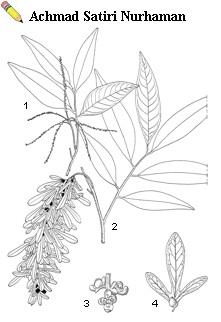 | Engelhardtia roxburghiana Wallich – 1, twig with male inflorescence; 2, fruiting twig; 3, part of male inflorescence; 4, fruit. |
Ecology
Engelhardtia is found scattered in evergreen, primary, lowland or montane rain forest to more open bush-savanna vegetation, often on leached acid yellow soils, up to 2000(-2700) m altitude. It occurs on dry land as well as in swamp forest and is a regular constituent of the montane oak-laurel forest. E. spicata locally forms pure stands in East Java and is especially frequent in Casuarina forest. E. rigida may be locally common in New Guinea in lower montane rain forest in association with Castanopsis, Lithocarpus or Nothofagus.
Silviculture and Management
Engelhardtia can be propagated by seed. E. spicata has 89 000-123 000 dry nuts without wings/kg and these can be stored in airtight containers for only 2 months. Sown de-winged nuts of E. roxburghiana had about 65% germination in 17-34 days in a germination trial in Peninsular Malaysia. In a trial in Indonesia those of E. spicata showed only 2-15% germination. Nuts should be sown in the shade. Seedlings of E. roxburghiana never survived in the nursery.
Genetic Resources and Breeding
Several recently described and narrowly defined Engelhardtia species from Borneo are very rare and known from only single collections. Some species may become endangered through destruction of their habitat.
Prospects
No increase in the use of Engelhardtia wood in the near future is foreseen.
Literature
[61]Ashton, P.S., 1988. Manual of the non-dipterocarp trees of Sarawak. Vol. 2. Dewan Bahasa dan Pustaka, Kuala Lumpur. 490 pp.
[70]Backer, C.A. & Bakhuizen van den Brink Jr., R.C., 1963-1968. Flora of Java. 3 volumes. Wolters-Noordhoff, Groningen.
[101]Beekman, H., 1920. 78 Preanger houtsoorten. Beschrijving, afbeelding en determinatietabel [78 Priangan wood species. Description, pictures and identification key]. Mededeelingen No 5. Proefstation voor het Boschwezen, Buitenzorg. 186 pp.
[130]Bosbouwproefstation, 1948. Tabellarisch overzicht van de beste kiem-, bewaar- en verzendingswijze van zaad van een aantal boomsoorten en groenbemesters [Tabular summary of the best ways to germinate, store and send seed of some tree and green manure species]. Voorlopig rapport No 38. Bosbouwproefstation, Buitenzorg. 15 pp.
[162]Burgess, P.F., 1966. Timbers of Sabah. Sabah Forest Records No 6. Forest Department, Sabah, Sandakan. xviii + 501 pp.
[163]Burkill, I.H., 1966. A dictionary of the economic products of the Malay Peninsula. 2nd edition. Ministry of Agriculture and Co-operatives, Kuala Lumpur. Vol. 1 (A-H) pp. 1-1240. Vol. 2 (I-Z) pp. 1241-2444.
[198]Cockburn, P.F., 1976-1980. Trees of Sabah. 2 volumes. Sabah Forest Records No 10. Forest Department Sabah, Sandakan.
[209]Corner, E.J.H., 1988. Wayside trees of Malaya. 3rd edition. 2 volumes. The Malayan Nature Society, Kuala Lumpur. 774 pp.
[238]de Vogel, E.F., 1980. Seedlings of dicotyledons. Structure, development, types. Descriptions of 150 woody Malesian taxa. Pudoc, Wageningen. 465 pp.
[260]den Berger, L.G., 1926. Houtsoorten der cultuurgebieden van Java en Sumatra's oostkust [Tree species of the cultivated areas of Java and the east coast of Sumatra]. Mededeelingen No 13. Proefstation voor het Boschwezen, Buitenzorg. 186 pp.
[261]den Berger, L.G. & Endert, F.H., 1925. Belangrijke houtsoorten van Nederlandsch-Indië, deel I [Important timbers of the Dutch East Indies, part I]. Mededeelingen No 11. Proefstation voor het Boschwezen, Buitenzorg. 136 pp.
[267]Desch, H.E., 1941-1954. Manual of Malayan timbers. Malayan Forest Records No 15. 2 volumes. Malaya Publishing House Ltd., Singapore. 762 pp.
[304]Eddowes, P.J., 1995-1997. The forests and timbers of Papua New Guinea. (unpublished data).
[341]Flora Malesiana (various editors), 1950-. Kluwer Academic Publishers, Dordrecht, Boston, London.
[343]Flore du Cambodge, du Laos et du Viêtnam (various editors), 1960-. Muséum National d'Histoire Naturelle, Paris.
[348]Forest Products Research Centre, 1967. Properties and uses of Papua and New Guinea timbers. Forest Products Research Centre, Port Moresby. 30 pp.
[403]Handbooks of the flora of Papua New Guinea (various editors), 1978-. Melbourne University Press, Carlton.
[405]Hardjowasono, M.S., 1942. Gewicht en volume van verschillende vrucht- en zaadsoorten [Weight and volume of various fruits and seeds]. Korte Mededelingen No 20. Bosbouwproefstation, Buitenzorg. 172 pp.
[436]Heyne, K., 1927. De nuttige planten van Nederlands-Indië [The useful plants of the Dutch East Indies]. 2nd edition, 3 volumes. Departement van Landbouw, Nijverheid en Handel in Nederlandsch-Indië. 1953 pp. (3rd edition, 1950. van Hoeve, 's-Gravenhage/Bandung. 1660 pp.).
[458]Hutchinson, J., 1967. The genera of flowering plants. Vol. 2. The Clarendon Press, Oxford. 659 pp.
[464]Ilic, J., 1990. The CSIRO macro key for hardwood identification. CSIRO, Highett. 125 pp.
[466]Iljinskaja, I.A., 1990. On the taxonomy and phylogeny of the Juglandaceae family. Botanicheskii Zhurnal 75: 792-803.
[536]Keating, W.G. & Bolza, E., 1982. Characteristics, properties and uses of timbers. Vol. 1. South-East Asia, northern Australia and the Pacific. Inkata Press Proprietary Ltd., Melbourne, Sydney & London. 362 pp.
[553]Kessler, P.J.A. & Sidiyasa, K., 1994. Trees of the Balikpapan-Samarinda area, East Kalimantan, Indonesia. Tropenbos Series 7. The Tropenbos Foundation, Wageningen. 446 pp.
[632]Kraemer, J.H., 1951. Trees of the western Pacific region. Tri-State Offset Company, Cincinnatti. 436 pp.
[748]Manning, W.E., 1966. New combinations and notes on Engelhardia (Juglandaceae) of the Old World. Bulletin of the Torrey Botanical Club 93: 34-52.
[785]Merrill, E.D., 1923-1926. An enumeration of Philippine flowering plants. 4 volumes. Bureau of Printing, Manila.
[829]Ng, F.S.P., 1991-1992. Manual of forest fruits, seeds and seedlings. 2 volumes. Malayan Forest Record No 34. Forest Research Institute Malaysia, Kepong. 997 pp.
[831]Ng, F.S.P. & Mat Asri Ngah Sanah, 1991. Germination and seedling records. Research Pamphlet No 108. Forest Research Institute Malaysia, Kepong. 191 pp.
[861]Oey Djoen Seng, 1951. De soortelijke gewichten van Indonesische houtsoorten en hun betekenis voor de praktijk [Specific gravity of Indonesian woods and its significance for practical use]. Rapport No 46. Bosbouwproefstation, Bogor. 183 pp.
[882]Perry, L.M., 1980. Medicinal plants of East and Southeast Asia. Attributed properties and uses. The MIT Press, Cambridge, Massachusetts. 620 pp.
[933]Research Institute of Wood Industry, 1988. Identification, properties and uses of some Southeast Asian woods. Chinese Academy of Forestry, Wan Shou Shan, Beijing & International Tropical Timber Organization, Yokohama. 201 pp.
[934]Reyes, L.J., 1938. Philippine woods. Technical Bulletin No 7. Commonwealth of the Philippines, Department of Agriculture and Commerce. Bureau of Printing, Manila. 536 pp. + 88 plates.
[974]Salvosa, F.M., 1963. Lexicon of Philippine trees. Bulletin No 1. Forest Products Research Institute, College, Laguna. 136 pp.
[1038]Smitinand, T., 1980. Thai plant names. Royal Forest Department, Bangkok. 379 pp.
[1221]Whitmore, T.C. & Ng, F.S.P. (Editors), 1972-1989. Tree flora of Malaya. A manual for foresters. 4 volumes. Malayan Forest Records No 26. Longman Malaysia Sdn. Berhad, Kuala Lumpur & Petaling Jaya.
[1242]Wong, T.M., 1982. A dictionary of Malaysian timbers. Malayan Forest Records No 30. Forest Research Institute Malaysia, Kepong. 259 pp.
[70]Backer, C.A. & Bakhuizen van den Brink Jr., R.C., 1963-1968. Flora of Java. 3 volumes. Wolters-Noordhoff, Groningen.
[101]Beekman, H., 1920. 78 Preanger houtsoorten. Beschrijving, afbeelding en determinatietabel [78 Priangan wood species. Description, pictures and identification key]. Mededeelingen No 5. Proefstation voor het Boschwezen, Buitenzorg. 186 pp.
[130]Bosbouwproefstation, 1948. Tabellarisch overzicht van de beste kiem-, bewaar- en verzendingswijze van zaad van een aantal boomsoorten en groenbemesters [Tabular summary of the best ways to germinate, store and send seed of some tree and green manure species]. Voorlopig rapport No 38. Bosbouwproefstation, Buitenzorg. 15 pp.
[162]Burgess, P.F., 1966. Timbers of Sabah. Sabah Forest Records No 6. Forest Department, Sabah, Sandakan. xviii + 501 pp.
[163]Burkill, I.H., 1966. A dictionary of the economic products of the Malay Peninsula. 2nd edition. Ministry of Agriculture and Co-operatives, Kuala Lumpur. Vol. 1 (A-H) pp. 1-1240. Vol. 2 (I-Z) pp. 1241-2444.
[198]Cockburn, P.F., 1976-1980. Trees of Sabah. 2 volumes. Sabah Forest Records No 10. Forest Department Sabah, Sandakan.
[209]Corner, E.J.H., 1988. Wayside trees of Malaya. 3rd edition. 2 volumes. The Malayan Nature Society, Kuala Lumpur. 774 pp.
[238]de Vogel, E.F., 1980. Seedlings of dicotyledons. Structure, development, types. Descriptions of 150 woody Malesian taxa. Pudoc, Wageningen. 465 pp.
[260]den Berger, L.G., 1926. Houtsoorten der cultuurgebieden van Java en Sumatra's oostkust [Tree species of the cultivated areas of Java and the east coast of Sumatra]. Mededeelingen No 13. Proefstation voor het Boschwezen, Buitenzorg. 186 pp.
[261]den Berger, L.G. & Endert, F.H., 1925. Belangrijke houtsoorten van Nederlandsch-Indië, deel I [Important timbers of the Dutch East Indies, part I]. Mededeelingen No 11. Proefstation voor het Boschwezen, Buitenzorg. 136 pp.
[267]Desch, H.E., 1941-1954. Manual of Malayan timbers. Malayan Forest Records No 15. 2 volumes. Malaya Publishing House Ltd., Singapore. 762 pp.
[304]Eddowes, P.J., 1995-1997. The forests and timbers of Papua New Guinea. (unpublished data).
[341]Flora Malesiana (various editors), 1950-. Kluwer Academic Publishers, Dordrecht, Boston, London.
[343]Flore du Cambodge, du Laos et du Viêtnam (various editors), 1960-. Muséum National d'Histoire Naturelle, Paris.
[348]Forest Products Research Centre, 1967. Properties and uses of Papua and New Guinea timbers. Forest Products Research Centre, Port Moresby. 30 pp.
[403]Handbooks of the flora of Papua New Guinea (various editors), 1978-. Melbourne University Press, Carlton.
[405]Hardjowasono, M.S., 1942. Gewicht en volume van verschillende vrucht- en zaadsoorten [Weight and volume of various fruits and seeds]. Korte Mededelingen No 20. Bosbouwproefstation, Buitenzorg. 172 pp.
[436]Heyne, K., 1927. De nuttige planten van Nederlands-Indië [The useful plants of the Dutch East Indies]. 2nd edition, 3 volumes. Departement van Landbouw, Nijverheid en Handel in Nederlandsch-Indië. 1953 pp. (3rd edition, 1950. van Hoeve, 's-Gravenhage/Bandung. 1660 pp.).
[458]Hutchinson, J., 1967. The genera of flowering plants. Vol. 2. The Clarendon Press, Oxford. 659 pp.
[464]Ilic, J., 1990. The CSIRO macro key for hardwood identification. CSIRO, Highett. 125 pp.
[466]Iljinskaja, I.A., 1990. On the taxonomy and phylogeny of the Juglandaceae family. Botanicheskii Zhurnal 75: 792-803.
[536]Keating, W.G. & Bolza, E., 1982. Characteristics, properties and uses of timbers. Vol. 1. South-East Asia, northern Australia and the Pacific. Inkata Press Proprietary Ltd., Melbourne, Sydney & London. 362 pp.
[553]Kessler, P.J.A. & Sidiyasa, K., 1994. Trees of the Balikpapan-Samarinda area, East Kalimantan, Indonesia. Tropenbos Series 7. The Tropenbos Foundation, Wageningen. 446 pp.
[632]Kraemer, J.H., 1951. Trees of the western Pacific region. Tri-State Offset Company, Cincinnatti. 436 pp.
[748]Manning, W.E., 1966. New combinations and notes on Engelhardia (Juglandaceae) of the Old World. Bulletin of the Torrey Botanical Club 93: 34-52.
[785]Merrill, E.D., 1923-1926. An enumeration of Philippine flowering plants. 4 volumes. Bureau of Printing, Manila.
[829]Ng, F.S.P., 1991-1992. Manual of forest fruits, seeds and seedlings. 2 volumes. Malayan Forest Record No 34. Forest Research Institute Malaysia, Kepong. 997 pp.
[831]Ng, F.S.P. & Mat Asri Ngah Sanah, 1991. Germination and seedling records. Research Pamphlet No 108. Forest Research Institute Malaysia, Kepong. 191 pp.
[861]Oey Djoen Seng, 1951. De soortelijke gewichten van Indonesische houtsoorten en hun betekenis voor de praktijk [Specific gravity of Indonesian woods and its significance for practical use]. Rapport No 46. Bosbouwproefstation, Bogor. 183 pp.
[882]Perry, L.M., 1980. Medicinal plants of East and Southeast Asia. Attributed properties and uses. The MIT Press, Cambridge, Massachusetts. 620 pp.
[933]Research Institute of Wood Industry, 1988. Identification, properties and uses of some Southeast Asian woods. Chinese Academy of Forestry, Wan Shou Shan, Beijing & International Tropical Timber Organization, Yokohama. 201 pp.
[934]Reyes, L.J., 1938. Philippine woods. Technical Bulletin No 7. Commonwealth of the Philippines, Department of Agriculture and Commerce. Bureau of Printing, Manila. 536 pp. + 88 plates.
[974]Salvosa, F.M., 1963. Lexicon of Philippine trees. Bulletin No 1. Forest Products Research Institute, College, Laguna. 136 pp.
[1038]Smitinand, T., 1980. Thai plant names. Royal Forest Department, Bangkok. 379 pp.
[1221]Whitmore, T.C. & Ng, F.S.P. (Editors), 1972-1989. Tree flora of Malaya. A manual for foresters. 4 volumes. Malayan Forest Records No 26. Longman Malaysia Sdn. Berhad, Kuala Lumpur & Petaling Jaya.
[1242]Wong, T.M., 1982. A dictionary of Malaysian timbers. Malayan Forest Records No 30. Forest Research Institute Malaysia, Kepong. 259 pp.
Author(s)
J.S. Rahajoe
Engelhardtia apoensis
Engelhardtia rigida
Engelhardtia roxburghiana
Engelhardtia serrata
Engelhardtia spicata
Engelhardtia rigida
Engelhardtia roxburghiana
Engelhardtia serrata
Engelhardtia spicata
Correct Citation of this Article
Rahajoe, J.S., 1998. Engelhardtia Lesch. ex Blume. In: Sosef, M.S.M., Hong, L.T. and Prawirohatmodjo, S. (Editors): Plant Resources of South-East Asia No 5(3): Timber trees; Lesser-known timbers. PROSEA Foundation, Bogor, Indonesia. Database record: prota4u.org/prosea
Selection of Species
The following species in this genus are important in this commodity group and are treated separatedly in this database:
Engelhardtia apoensis
Engelhardtia rigida
Engelhardtia roxburghiana
Engelhardtia serrata
Engelhardtia spicata
Engelhardtia apoensis
Engelhardtia rigida
Engelhardtia roxburghiana
Engelhardtia serrata
Engelhardtia spicata

All texts are licensed under a Creative Commons Attribution-Noncommercial-Share Alike 3.0 Netherlands License
This license does not include the illustrations (Maps,drawings,pictures); these remain all under copyright.