Record Number
5403
PROSEA Handbook Number
5(3): Timber trees; Lesser-known timbers
Taxon
Ficus L.
Protologue
Sp. pl. 2: 1059 (1753); Gen. pl., ed. 5: 482 (1754).
Family
MORACEAE
Chromosome Numbers
x = 13; 2n = 26 for the vast majority of species, 2n = 52 for few species
Vernacular Names
Ficus, fig (En). Figue (Fr). Indonesia: ara, bunut, karet. Malaysia: ara, ara kelumpong (stem figs), ara tanah (geocarpic figs), nunok (strangling figs, Dusun, Sarawak), giwit (geocarpic figs, Dusun, Sarawak). Papua New Guinea: Papua New Guinea fig (trade name). Philippines: balete (Filipino). Burma (Myanmar): nyaung. Thailand: sai. Vietnam: chi da, d[eef], sung.
Origin and Geographic Distribution
Ficus comprises about 1000 species and occurs in tropical and subtropical regions, about half of them in Malesia. Few species are found in warm temperate areas.
Uses
Few Ficus species become large enough to be useful for timber. The wood of these is used for temporary construction, mouldings, interior work, cladding, drawers, concrete formwork, dugouts, laundry tubs, small domestic articles, fruit crates, floats and firewood. The wood of some species is suitable for the production of matches and matchboxes. A low grade plywood can be manufactured from the wood. It may become valuable for the production of fibreboard.
The fruits of some species are edible but are generally not sought after or prized. Some species have poisonous fruits. The latex has been used medicinally, mainly to cover and cure wounds, and as a wax in dyeing batik cloth; that of F. elastica Roxb. ex Hornem. is the source of India rubber and was once cultivated before para rubber (Hevea brasiliensis (Willd. ex A.L. Juss.) Müll. Arg.) was introduced to the region. The latex is also used as birdlime and in Papua New Guinea for sealing leaks in canoes, whereas that of some species is highly toxic and applied as dart poison. The tough and fibrous bark of a few species is a well-known raw material for rough cordage and matting and used to be used for clothing; it is still used for bow strings. Young leaves of several species are eaten raw in salads or cooked with meat wrapped in them, the latter dish is considered a delicacy in the highlands of New Guinea. They have also been used as fodder, and leaves of other species are applied as sandpaper or to scour cooking pots. Several species are planted as wayside trees. One of these is F. benjamina which is often regarded as a sacred tree and is a popular pot plant in temperate regions. F. benghalensis is sacred to Hindus and Buddhists. F. racemosa and F. nota (Blanco) Merr. are used for slope, gully and river bank stabilization as they produce a deep and wide-spreading root system. As natural regeneration of F. variegata is easy, it has been proposed as green manure and cover crop.
The fruits of some species are edible but are generally not sought after or prized. Some species have poisonous fruits. The latex has been used medicinally, mainly to cover and cure wounds, and as a wax in dyeing batik cloth; that of F. elastica Roxb. ex Hornem. is the source of India rubber and was once cultivated before para rubber (Hevea brasiliensis (Willd. ex A.L. Juss.) Müll. Arg.) was introduced to the region. The latex is also used as birdlime and in Papua New Guinea for sealing leaks in canoes, whereas that of some species is highly toxic and applied as dart poison. The tough and fibrous bark of a few species is a well-known raw material for rough cordage and matting and used to be used for clothing; it is still used for bow strings. Young leaves of several species are eaten raw in salads or cooked with meat wrapped in them, the latter dish is considered a delicacy in the highlands of New Guinea. They have also been used as fodder, and leaves of other species are applied as sandpaper or to scour cooking pots. Several species are planted as wayside trees. One of these is F. benjamina which is often regarded as a sacred tree and is a popular pot plant in temperate regions. F. benghalensis is sacred to Hindus and Buddhists. F. racemosa and F. nota (Blanco) Merr. are used for slope, gully and river bank stabilization as they produce a deep and wide-spreading root system. As natural regeneration of F. variegata is easy, it has been proposed as green manure and cover crop.
Production and International Trade
Small amounts of Ficus timber are traded, most often in mixed consignments of lightweight hardwood. In 1987 Japan imported 442 logs from Papua New Guinea comprising 0.7% of the total of imports from that country. In the same year, Japan imported very small amounts of ficus from the Solomon Islands. In Papua New Guinea ficus timber is ranked in MEP (Minimum Export Price) group 5 and fetched a minimum export price of US$ 40/m3 for logs in 1992. In 1996 Papua New Guinea exported a volume of about 12 000 m3 of ficus logs at an average free-on-board (FOB) price of US$ 100/m3.
Properties
Ficus yields a lightweight to medium-weight hardwood with a density of 190-740 kg/m3 at 15% moisture content. Heartwood pale yellow-brown or various shades from yellow to pink-grey, not clearly differentiated from the sapwood; grain straight, interlocked to deeply interlocked; texture moderately coarse to coarse and uneven due to abundant parenchyma; darker-coloured streaks produced by parenchyma giving rise to watered-silk figure on tangential surfaces and palisade effect on radial surfaces. Growth rings indistinct, when present marked by marginal parenchyma; vessels medium-sized to very large, solitary and in radial multiples of 2-3(-6), occasionally filled with gum-like deposits and tyloses; parenchyma abundant, in wide apotracheal bands, conspicuous, and paratracheal vasicentric; rays medium-sized to moderately broad; with a tendency to ripple marks in some species and observed in F. benjamina, but usually absent.
Shrinkage of the wood upon air drying is low to medium. The wood seasons well, but is susceptible to sap-stain and slight degrade in the form of twisting, cupping and bowing. The sawn timber should be treated immediately with anti-stain chemicals. It takes about 2.5 months to air dry boards 13 mm thick, and about 3 months for boards 38 mm thick, which is fairly rapid. The wood is soft and not strong. It is very easy to work, and although a little woolly; a fairly smooth finish can be obtained. The wood is non-durable and not resistant to termite and fungal attack. The sapwood is susceptible to Lyctus. It is extremely easy to treat with preservatives.
The sapwood of F. benghalensis has a gross energy value of 18 565 kJ/kg.
See also the tables on microscopic wood anatomy and wood properties.
Shrinkage of the wood upon air drying is low to medium. The wood seasons well, but is susceptible to sap-stain and slight degrade in the form of twisting, cupping and bowing. The sawn timber should be treated immediately with anti-stain chemicals. It takes about 2.5 months to air dry boards 13 mm thick, and about 3 months for boards 38 mm thick, which is fairly rapid. The wood is soft and not strong. It is very easy to work, and although a little woolly; a fairly smooth finish can be obtained. The wood is non-durable and not resistant to termite and fungal attack. The sapwood is susceptible to Lyctus. It is extremely easy to treat with preservatives.
The sapwood of F. benghalensis has a gross energy value of 18 565 kJ/kg.
See also the tables on microscopic wood anatomy and wood properties.
Botany
Evergreen or sometimes deciduous, woody, epiphytic climbers or stranglers, creepers, shrubs or small to large, trees up to 40(-50) m tall, or banyans, i.e. trees whose branches send down aerial roots that thicken ("pillar-roots"") which function as props; bole fairly straight in tree-like species, sometimes fluted, up to 100(-190) cm in diameter, sometimes heavily buttressed; bark surface smooth, often pale grey, sometimes whitish or brown, sometimes lenticellate, inner bark yellowish, exuding white or yellow latex. Leaves arranged spirally, alternate or opposite, simple or palmately lobed, symmetrical to asymmetrical, dentate to entire, often with glands below in the axil of the lateral or basal veins or abaxial at the apex of the petiole; stipules free or connate. Inflorescence axillary or rami- to cauliflorous, sometimes subterranean, solitary or clustered, monoecious or gynodioecious, with the flowers set inside an urn-shaped receptacle (syconium; a fig). Flowers unisexual; tepals 2-8, free or joined; stamens 1-7; ovary unilocular with a single ovule, style single. Infructescence a more or less fleshy fig; individual fruit a drupelet. Seedling with epigeal germination; cotyledons emergent; hypocotyl elongated; all leaves arranged spirally.
The strangling figs start as epiphytic plants and send down aerial roots that eventually form a false trunk composed of a trellis-work of interlacing and anastomosing roots. Many species have more than one kind of leaf (heterophylly).
The symbiotic relation of figs with specialized wasps is well-known. Figs can only be pollinated by female agaonid wasps (Hymenoptera, Chalcidoidea, Agaonidae). The wasp species are highly species-specific. Fig species are divided into 2 groups: monoecious species and gynodioecious ones. In the first the wasps arrive when only female flowers are receptive. They enter the fig via the osteole, a bract-covered apical pore. Once inside they pollinate the female flowers and deposit their eggs in the ovaries. As style length varies greatly within these figs and because the wasp can only reach the ovary of short-styled flowers, only some of the flowers obtain an egg, while in others the seed develops. Male and female wasps emerge after a few weeks, and mate takes place within the fig. The females then emerge from the fig and, in so doing pick up pollen from the newly mature anthers. Figs on a single tree mature at the same time, while different trees of the same species flower out of synchrony, thus inducing cross-pollination. The gynodioecious fig species carry either hermaphrodite figs or figs with female flowers only. In hermaphrodite ones the styles are uniformly short. Wasps can oviposit every female flower and such trees rear the pollinators' offspring and function as pollen donors. Figs with female flowers have long-styled flowers only. The wasps can only deposit pollen and such figs produce large amounts of seed.
An individual F. virens tree in Peninsular Malaysia flowered at intervals varying from 5 months to 3.5 years, whereas F. sumatrana Miq., a large strangler, flowered in a regular cycle of 4-5 months, apparently under endogenous control. During daytime the figs are eaten by birds (e.g. pigeons, hornbills, bulbuls, cassowaries), monkeys and squirrels. At night they are visited by bats and civet cats. Cauliflorous figs are eaten by deer and pigs. The latter also uproot the geocarpic figs. Even elephants, rhinoceros, tapir and wild cattle have been reported to feed on figs. As fig fruits are often available year-round, they constitute an extremely important forest food, a so-called keystone resource that sustains frugivorous animals at the famine period of the year when few species if any are fruiting.
F. obscura Blume forms cavities in parts of its twigs which open via slits and are inhabited by non-specific tree-dwelling ants. The plant produces a sugary secretion from extra-floral nectaries on the lower leaf surface.
In Asia and Australia the large genus Ficus has been subdivided into 4 subgenera and 14 sections and numerous smaller taxonomic groups.
The strangling figs start as epiphytic plants and send down aerial roots that eventually form a false trunk composed of a trellis-work of interlacing and anastomosing roots. Many species have more than one kind of leaf (heterophylly).
The symbiotic relation of figs with specialized wasps is well-known. Figs can only be pollinated by female agaonid wasps (Hymenoptera, Chalcidoidea, Agaonidae). The wasp species are highly species-specific. Fig species are divided into 2 groups: monoecious species and gynodioecious ones. In the first the wasps arrive when only female flowers are receptive. They enter the fig via the osteole, a bract-covered apical pore. Once inside they pollinate the female flowers and deposit their eggs in the ovaries. As style length varies greatly within these figs and because the wasp can only reach the ovary of short-styled flowers, only some of the flowers obtain an egg, while in others the seed develops. Male and female wasps emerge after a few weeks, and mate takes place within the fig. The females then emerge from the fig and, in so doing pick up pollen from the newly mature anthers. Figs on a single tree mature at the same time, while different trees of the same species flower out of synchrony, thus inducing cross-pollination. The gynodioecious fig species carry either hermaphrodite figs or figs with female flowers only. In hermaphrodite ones the styles are uniformly short. Wasps can oviposit every female flower and such trees rear the pollinators' offspring and function as pollen donors. Figs with female flowers have long-styled flowers only. The wasps can only deposit pollen and such figs produce large amounts of seed.
An individual F. virens tree in Peninsular Malaysia flowered at intervals varying from 5 months to 3.5 years, whereas F. sumatrana Miq., a large strangler, flowered in a regular cycle of 4-5 months, apparently under endogenous control. During daytime the figs are eaten by birds (e.g. pigeons, hornbills, bulbuls, cassowaries), monkeys and squirrels. At night they are visited by bats and civet cats. Cauliflorous figs are eaten by deer and pigs. The latter also uproot the geocarpic figs. Even elephants, rhinoceros, tapir and wild cattle have been reported to feed on figs. As fig fruits are often available year-round, they constitute an extremely important forest food, a so-called keystone resource that sustains frugivorous animals at the famine period of the year when few species if any are fruiting.
F. obscura Blume forms cavities in parts of its twigs which open via slits and are inhabited by non-specific tree-dwelling ants. The plant produces a sugary secretion from extra-floral nectaries on the lower leaf surface.
In Asia and Australia the large genus Ficus has been subdivided into 4 subgenera and 14 sections and numerous smaller taxonomic groups.
Image
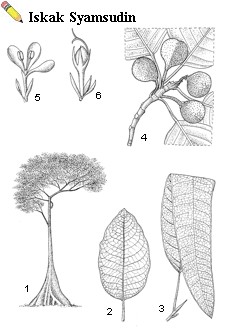 | Ficus callosa Willd. – 1, tree habit; 2, leaf of young tree; 3, sapling leaf; 4, fruiting twig; 5, male flower; 6, female flower. |
Ecology
Ficus species are common and form an important element of lowland rain forest, both as canopy and understorey trees. Most species prefer perhumid forest, but several are found in areas with a monsoon climate and in teak forest, also in locations where the soil dries out. Ficus does not occur in mangrove vegetation but is often present in brackish swamps behind the mangrove. Ficus species are generally found below 1500 m altitude, some between 1500 and 2750 m or rarely up to 3200 m. Many species are epiphytic and/or strangling.
Silviculture and Management
Ficus can be propagated from seed and vegetatively. Per kg there are about 1.9-2.3 million dry seeds of F. racemosa and 2.1-2.5 million seeds of F. benghalensis. The drupelets are usually the unit of sowing. These cannot be stored without a serious decrease in viability. An 8% germination rate is achieved in 16-87 days in F. benjamina, in 8-40 days in F. grossularioides, in 18-34 days in F. microcarpa, in 11-12 days in F. sundaica and in 11-55 days in F. virens. In India pretreatment with hot water of 60°C for 10 minutes was found to increase the germination of seed of F. benghalensis from 20% to 24% and of F. racemosa from 19% to 28% in 7-15 days. The tiny seedlings are pricked out twice, first in clumps and later individually. The young seedlings are sensitive to excess of water. Both large and small cuttings are used in vegetative propagation, but small cuttings are less successful. Except for F. racemosa and F. virens, most species are not resistant to fire. In the transition zone from mangrove to inland forest in Peninsular Malaysia, F. microcarpa makes up an important part of the trees over 5 cm in diameter, accounting for about 123 trees/ha (14% of the total) with a basal area of 2.4 m2/ha (12% of the total).
Genetic Resources and Breeding
There are no records of ex situ conservation of Ficus species, except for some, like F. benghalensis and F. benjamina, which are widely planted or cultivated. As most of the species are fairly common and widespread, the risk of genetic erosion seems comparatively low.
Prospects
It is unlikely that its importance as a timber tree will increase, because of the growth form of many Ficus species and the poor quality of the wood.
Literature
[40]All Nippon Checkers Corporation, 1989. Illustrated commercial foreign woods in Japan. Tokyo. 262 pp.
[70]Backer, C.A. & Bakhuizen van den Brink Jr., R.C., 1963-1968. Flora of Java. 3 volumes. Wolters-Noordhoff, Groningen.
[124]Bolza, E. & Kloot, N.H., 1963. The mechanical properties of 174 Australian timbers. Technological Paper No 25. Division of Forest Products, CSIRO, Melbourne. 112 pp.
[146]Bronstein, J.L. & McKey, D., 1989. The fig/pollinator mutualism: A model system for comparative biology. Experientia 45: 601-611.
[151]Browne, F.G., 1955. Forest trees of Sarawak and Brunei and their products. Government Printing Office, Kuching, Sarawak. xviii + 369 pp.
[163]Burkill, I.H., 1966. A dictionary of the economic products of the Malay Peninsula. 2nd edition. Ministry of Agriculture and Co-operatives, Kuala Lumpur. Vol. 1 (A-H) pp. 1-1240. Vol. 2 (I-Z) pp. 1241-2444.
[182]Chan, H.T., 1989. A note on tree species and productivity of a natural dryland mangrove forest in Matang, Peninsular Malaysia. Journal of Tropical Forest Science 1(4): 399-400.
[206]Corner, E.J.H., 1965. Check-list of Ficus in Asia and Australia. Gardens' Bulletin, Singapore 21: 1-186.
[209]Corner, E.J.H., 1988. Wayside trees of Malaya. 3rd edition. 2 volumes. The Malayan Nature Society, Kuala Lumpur. 774 pp.
[260]den Berger, L.G., 1926. Houtsoorten der cultuurgebieden van Java en Sumatra's oostkust [Tree species of the cultivated areas of Java and the east coast of Sumatra]. Mededeelingen No 13. Proefstation voor het Boschwezen, Buitenzorg. 186 pp.
[267]Desch, H.E., 1941-1954. Manual of Malayan timbers. Malayan Forest Records No 15. 2 volumes. Malaya Publishing House Ltd., Singapore. 762 pp.
[300]Eddowes, P.J., 1977. Commercial timbers of Papua New Guinea, their properties and uses. Forest Products Research Centre, Department of Primary Industry, Port Moresby. xiv + 195 pp.
[340]Flora of Australia (various editors), 1981-. Australian Government Publishing Service, Canberra.
[348]Forest Products Research Centre, 1967. Properties and uses of Papua and New Guinea timbers. Forest Products Research Centre, Port Moresby. 30 pp.
[375]Ginoga, B. & Karnasudirdja, S., 1977. Sifat fisis dan mekanis beberapa jenis kayu Jawa Barat [Physical and mechanical properties of some timber species from West Java]. Laporan No 90. Lembaga Penelitian Hasil Hutan, Bogor. 22 pp.
[387]Grewal, G.S., 1979. Air-seasoning properties of some Malaysian timbers. Malaysian Forest Service Trade Leaflet No 41. Malaysian Timber Industry Board, Kuala Lumpur. 26 pp.
[405]Hardjowasono, M.S., 1942. Gewicht en volume van verschillende vrucht- en zaadsoorten [Weight and volume of various fruits and seeds]. Korte Mededelingen No 20. Bosbouwproefstation, Buitenzorg. 172 pp.
[406]Harker, A.P., Sandels, A. & Burley, J., 1982. Calorific values for wood and bark and a bibliography for fuelwood. Report G 162. Tropical Products Institute, London. 20 pp.
[436]Heyne, K., 1927. De nuttige planten van Nederlands-Indië [The useful plants of the Dutch East Indies]. 2nd edition, 3 volumes. Departement van Landbouw, Nijverheid en Handel in Nederlandsch-Indië. 1953 pp. (3rd edition, 1950. van Hoeve, 's-Gravenhage/Bandung. 1660 pp.).
[464]Ilic, J., 1990. The CSIRO macro key for hardwood identification. CSIRO, Highett. 125 pp.
[525]Karnasudirdja, S. & Ginoga, B., 1975. Sifat fisik dan mekanik beberapa jenis kayu dari Jawa [Physical and mechanical properties of some timber species from Java]. Laporan No 53. Lembaga Penelitian Hasil Hutan, Bogor. 26 pp.
[543]Keng, H., 1990. The concise flora of Singapore. Gymnosperms and dicotyledons. Singapore University Press, Singapore. 222 pp.
[568]Kingston, R.S.T. & Risdon, C.J.E., 1961. Shrinkage and density of Australian and other South-West Pacific woods. Technological Paper No 13. Division of Forest Products, CSIRO, Melbourne. 65 pp.
[678]Lee, Y.H., Engku Abdul Rahman bin Chik & Chu, Y.P., 1979. The strength properties of some Malaysian timbers. Malaysian Forest Service Trade Leaflet No 34 (revised edition). Malaysian Timber Industry Board, Kuala Lumpur. 107 pp.
[694]Leighton, M. & Leighton, D.R., 1983. Vertebrate responses to fruiting seasonality within a Bornean rain forest. In: Sutton, S.L., Whitmore, T.C. & Chadwick, A.C. (Editors): Tropical rain forest: ecology and management. Special publication number 2 of the British Ecological Society. Blackwell Scientific Publications, Oxford, London, Edinburgh, Boston, Melbourne. pp. 181-196.
[740]Malaysian Timber Industry Board, 1984. Peraturan pemeringkatan kayu keras gergaji Malaysia [The Malaysian grading rules for sawn hardwood timber]. Ministry of Primary Industries, Kuala Lumpur. 109 pp.
[741]Malaysian Timber Industry Board, 1986. 100 Malaysian timbers. Kuala Lumpur. x + 226 pp.
[760]Maschwitz, U., Fiala, B., Saw, L.G., Norma-Rashid Yusoff & Azarae Haji Idris, 1994. Ficus obscura var. borneensis (Moraceae), a new non-specific ant-plant from Malesia. Malayan Nature Journal 47: 409-416.
[770]Medway, Lord, 1972. Phenology of a tropical rain forest in Malaya. Biological Journal of the Linnean Society 4(2): 117-146.
[780]Meniado, J.A. et al., 1975-1981. Wood identification handbook for Philippine timbers. 2 volumes. Government Printing Office, Manila. 370 pp. & 186 pp.
[829]Ng, F.S.P., 1991-1992. Manual of forest fruits, seeds and seedlings. 2 volumes. Malayan Forest Record No 34. Forest Research Institute Malaysia, Kepong. 997 pp.
[831]Ng, F.S.P. & Mat Asri Ngah Sanah, 1991. Germination and seedling records. Research Pamphlet No 108. Forest Research Institute Malaysia, Kepong. 191 pp.
[861]Oey Djoen Seng, 1951. De soortelijke gewichten van Indonesische houtsoorten en hun betekenis voor de praktijk [Specific gravity of Indonesian woods and its significance for practical use]. Rapport No 46. Bosbouwproefstation, Bogor. 183 pp.
[889]Phengklai, C. & Khamsai, S., 1985. Some non-timber species of Thailand. Thai Forest Bulletin (Botany) 15: 108-148.
[921]Rai, S.N., Nagaveni, H.C. & Ananth Padmanabha, H.S., 1988. Germination and nursery technique of four species of Ficus. Indian Forester 114: 63-68.
[933]Research Institute of Wood Industry, 1988. Identification, properties and uses of some Southeast Asian woods. Chinese Academy of Forestry, Wan Shou Shan, Beijing & International Tropical Timber Organization, Yokohama. 201 pp.
[934]Reyes, L.J., 1938. Philippine woods. Technical Bulletin No 7. Commonwealth of the Philippines, Department of Agriculture and Commerce. Bureau of Printing, Manila. 536 pp. + 88 plates.
[955]Rocafort, J.E., Floresca, A.R. & Siopongco, J.O., 1971. Fourth progress report on the specific gravity of Philippine woods. Philippine Architecture, Engineering & Construction Report 18(5): 17-27.
[974]Salvosa, F.M., 1963. Lexicon of Philippine trees. Bulletin No 1. Forest Products Research Institute, College, Laguna. 136 pp.
[1038]Smitinand, T., 1980. Thai plant names. Royal Forest Department, Bangkok. 379 pp.
[1123]van der Pijl, L., 1957. The dispersal of plants by bats (chiropterochory). Acta Botanica Neerlandica 6: 291-315.
[1169]Vidal, J., 1962. Noms vernaculaires de plantes en usage au Laos [Vernacular names of plants used in Laos]. Ecole française d'Extrême-Orient, Paris. 197 pp.
[1198]Weidelt, H.J. (Editor), 1976. Manual of reforestation and erosion control for the Philippines. Schriftenreihe No 22. Deutsche Gesellschaft für Technische Zusammenarbeit (GTZ) GmbH, Eschborn. 569 pp.
[1221]Whitmore, T.C. & Ng, F.S.P. (Editors), 1972-1989. Tree flora of Malaya. A manual for foresters. 4 volumes. Malayan Forest Records No 26. Longman Malaysia Sdn. Berhad, Kuala Lumpur & Petaling Jaya.
[1242]Wong, T.M., 1982. A dictionary of Malaysian timbers. Malayan Forest Records No 30. Forest Research Institute Malaysia, Kepong. 259 pp.
[70]Backer, C.A. & Bakhuizen van den Brink Jr., R.C., 1963-1968. Flora of Java. 3 volumes. Wolters-Noordhoff, Groningen.
[124]Bolza, E. & Kloot, N.H., 1963. The mechanical properties of 174 Australian timbers. Technological Paper No 25. Division of Forest Products, CSIRO, Melbourne. 112 pp.
[146]Bronstein, J.L. & McKey, D., 1989. The fig/pollinator mutualism: A model system for comparative biology. Experientia 45: 601-611.
[151]Browne, F.G., 1955. Forest trees of Sarawak and Brunei and their products. Government Printing Office, Kuching, Sarawak. xviii + 369 pp.
[163]Burkill, I.H., 1966. A dictionary of the economic products of the Malay Peninsula. 2nd edition. Ministry of Agriculture and Co-operatives, Kuala Lumpur. Vol. 1 (A-H) pp. 1-1240. Vol. 2 (I-Z) pp. 1241-2444.
[182]Chan, H.T., 1989. A note on tree species and productivity of a natural dryland mangrove forest in Matang, Peninsular Malaysia. Journal of Tropical Forest Science 1(4): 399-400.
[206]Corner, E.J.H., 1965. Check-list of Ficus in Asia and Australia. Gardens' Bulletin, Singapore 21: 1-186.
[209]Corner, E.J.H., 1988. Wayside trees of Malaya. 3rd edition. 2 volumes. The Malayan Nature Society, Kuala Lumpur. 774 pp.
[260]den Berger, L.G., 1926. Houtsoorten der cultuurgebieden van Java en Sumatra's oostkust [Tree species of the cultivated areas of Java and the east coast of Sumatra]. Mededeelingen No 13. Proefstation voor het Boschwezen, Buitenzorg. 186 pp.
[267]Desch, H.E., 1941-1954. Manual of Malayan timbers. Malayan Forest Records No 15. 2 volumes. Malaya Publishing House Ltd., Singapore. 762 pp.
[300]Eddowes, P.J., 1977. Commercial timbers of Papua New Guinea, their properties and uses. Forest Products Research Centre, Department of Primary Industry, Port Moresby. xiv + 195 pp.
[340]Flora of Australia (various editors), 1981-. Australian Government Publishing Service, Canberra.
[348]Forest Products Research Centre, 1967. Properties and uses of Papua and New Guinea timbers. Forest Products Research Centre, Port Moresby. 30 pp.
[375]Ginoga, B. & Karnasudirdja, S., 1977. Sifat fisis dan mekanis beberapa jenis kayu Jawa Barat [Physical and mechanical properties of some timber species from West Java]. Laporan No 90. Lembaga Penelitian Hasil Hutan, Bogor. 22 pp.
[387]Grewal, G.S., 1979. Air-seasoning properties of some Malaysian timbers. Malaysian Forest Service Trade Leaflet No 41. Malaysian Timber Industry Board, Kuala Lumpur. 26 pp.
[405]Hardjowasono, M.S., 1942. Gewicht en volume van verschillende vrucht- en zaadsoorten [Weight and volume of various fruits and seeds]. Korte Mededelingen No 20. Bosbouwproefstation, Buitenzorg. 172 pp.
[406]Harker, A.P., Sandels, A. & Burley, J., 1982. Calorific values for wood and bark and a bibliography for fuelwood. Report G 162. Tropical Products Institute, London. 20 pp.
[436]Heyne, K., 1927. De nuttige planten van Nederlands-Indië [The useful plants of the Dutch East Indies]. 2nd edition, 3 volumes. Departement van Landbouw, Nijverheid en Handel in Nederlandsch-Indië. 1953 pp. (3rd edition, 1950. van Hoeve, 's-Gravenhage/Bandung. 1660 pp.).
[464]Ilic, J., 1990. The CSIRO macro key for hardwood identification. CSIRO, Highett. 125 pp.
[525]Karnasudirdja, S. & Ginoga, B., 1975. Sifat fisik dan mekanik beberapa jenis kayu dari Jawa [Physical and mechanical properties of some timber species from Java]. Laporan No 53. Lembaga Penelitian Hasil Hutan, Bogor. 26 pp.
[543]Keng, H., 1990. The concise flora of Singapore. Gymnosperms and dicotyledons. Singapore University Press, Singapore. 222 pp.
[568]Kingston, R.S.T. & Risdon, C.J.E., 1961. Shrinkage and density of Australian and other South-West Pacific woods. Technological Paper No 13. Division of Forest Products, CSIRO, Melbourne. 65 pp.
[678]Lee, Y.H., Engku Abdul Rahman bin Chik & Chu, Y.P., 1979. The strength properties of some Malaysian timbers. Malaysian Forest Service Trade Leaflet No 34 (revised edition). Malaysian Timber Industry Board, Kuala Lumpur. 107 pp.
[694]Leighton, M. & Leighton, D.R., 1983. Vertebrate responses to fruiting seasonality within a Bornean rain forest. In: Sutton, S.L., Whitmore, T.C. & Chadwick, A.C. (Editors): Tropical rain forest: ecology and management. Special publication number 2 of the British Ecological Society. Blackwell Scientific Publications, Oxford, London, Edinburgh, Boston, Melbourne. pp. 181-196.
[740]Malaysian Timber Industry Board, 1984. Peraturan pemeringkatan kayu keras gergaji Malaysia [The Malaysian grading rules for sawn hardwood timber]. Ministry of Primary Industries, Kuala Lumpur. 109 pp.
[741]Malaysian Timber Industry Board, 1986. 100 Malaysian timbers. Kuala Lumpur. x + 226 pp.
[760]Maschwitz, U., Fiala, B., Saw, L.G., Norma-Rashid Yusoff & Azarae Haji Idris, 1994. Ficus obscura var. borneensis (Moraceae), a new non-specific ant-plant from Malesia. Malayan Nature Journal 47: 409-416.
[770]Medway, Lord, 1972. Phenology of a tropical rain forest in Malaya. Biological Journal of the Linnean Society 4(2): 117-146.
[780]Meniado, J.A. et al., 1975-1981. Wood identification handbook for Philippine timbers. 2 volumes. Government Printing Office, Manila. 370 pp. & 186 pp.
[829]Ng, F.S.P., 1991-1992. Manual of forest fruits, seeds and seedlings. 2 volumes. Malayan Forest Record No 34. Forest Research Institute Malaysia, Kepong. 997 pp.
[831]Ng, F.S.P. & Mat Asri Ngah Sanah, 1991. Germination and seedling records. Research Pamphlet No 108. Forest Research Institute Malaysia, Kepong. 191 pp.
[861]Oey Djoen Seng, 1951. De soortelijke gewichten van Indonesische houtsoorten en hun betekenis voor de praktijk [Specific gravity of Indonesian woods and its significance for practical use]. Rapport No 46. Bosbouwproefstation, Bogor. 183 pp.
[889]Phengklai, C. & Khamsai, S., 1985. Some non-timber species of Thailand. Thai Forest Bulletin (Botany) 15: 108-148.
[921]Rai, S.N., Nagaveni, H.C. & Ananth Padmanabha, H.S., 1988. Germination and nursery technique of four species of Ficus. Indian Forester 114: 63-68.
[933]Research Institute of Wood Industry, 1988. Identification, properties and uses of some Southeast Asian woods. Chinese Academy of Forestry, Wan Shou Shan, Beijing & International Tropical Timber Organization, Yokohama. 201 pp.
[934]Reyes, L.J., 1938. Philippine woods. Technical Bulletin No 7. Commonwealth of the Philippines, Department of Agriculture and Commerce. Bureau of Printing, Manila. 536 pp. + 88 plates.
[955]Rocafort, J.E., Floresca, A.R. & Siopongco, J.O., 1971. Fourth progress report on the specific gravity of Philippine woods. Philippine Architecture, Engineering & Construction Report 18(5): 17-27.
[974]Salvosa, F.M., 1963. Lexicon of Philippine trees. Bulletin No 1. Forest Products Research Institute, College, Laguna. 136 pp.
[1038]Smitinand, T., 1980. Thai plant names. Royal Forest Department, Bangkok. 379 pp.
[1123]van der Pijl, L., 1957. The dispersal of plants by bats (chiropterochory). Acta Botanica Neerlandica 6: 291-315.
[1169]Vidal, J., 1962. Noms vernaculaires de plantes en usage au Laos [Vernacular names of plants used in Laos]. Ecole française d'Extrême-Orient, Paris. 197 pp.
[1198]Weidelt, H.J. (Editor), 1976. Manual of reforestation and erosion control for the Philippines. Schriftenreihe No 22. Deutsche Gesellschaft für Technische Zusammenarbeit (GTZ) GmbH, Eschborn. 569 pp.
[1221]Whitmore, T.C. & Ng, F.S.P. (Editors), 1972-1989. Tree flora of Malaya. A manual for foresters. 4 volumes. Malayan Forest Records No 26. Longman Malaysia Sdn. Berhad, Kuala Lumpur & Petaling Jaya.
[1242]Wong, T.M., 1982. A dictionary of Malaysian timbers. Malayan Forest Records No 30. Forest Research Institute Malaysia, Kepong. 259 pp.
Author(s)
E. Boer (general part), M.S.M. Sosef (general part, selection of species)
Ficus adenosperma
Ficus albipila
Ficus annulata
Ficus benghalensis
Ficus benjamina
Ficus callosa
Ficus drupacea
Ficus erythrosperma
Ficus fistulosa
Ficus grossularioides
Ficus hadroneura
Ficus hesperidiiformis
Ficus hombroniana
Ficus ihuensis
Ficus kerkhovenii
Ficus lamponga
Ficus magnoliifolia
Ficus melinocarpa
Ficus microcarpa
Ficus nodosa
Ficus polyantha
Ficus primaria
Ficus pseudojaca
Ficus pubinervis
Ficus racemosa
Ficus robusta
Ficus semivestita
Ficus subcuneata
Ficus sundaica
Ficus superba
Ficus tinctoria
Ficus trachypison
Ficus variegata
Ficus vasculosa
Ficus virens
Ficus virgata
Ficus viridicarpa
Ficus xylophylla
Ficus albipila
Ficus annulata
Ficus benghalensis
Ficus benjamina
Ficus callosa
Ficus drupacea
Ficus erythrosperma
Ficus fistulosa
Ficus grossularioides
Ficus hadroneura
Ficus hesperidiiformis
Ficus hombroniana
Ficus ihuensis
Ficus kerkhovenii
Ficus lamponga
Ficus magnoliifolia
Ficus melinocarpa
Ficus microcarpa
Ficus nodosa
Ficus polyantha
Ficus primaria
Ficus pseudojaca
Ficus pubinervis
Ficus racemosa
Ficus robusta
Ficus semivestita
Ficus subcuneata
Ficus sundaica
Ficus superba
Ficus tinctoria
Ficus trachypison
Ficus variegata
Ficus vasculosa
Ficus virens
Ficus virgata
Ficus viridicarpa
Ficus xylophylla
Correct Citation of this Article
Boer, E. & Sosef, M.S.M., 1998. Ficus L.. In: Sosef, M.S.M., Hong, L.T. and Prawirohatmodjo, S. (Editors): Plant Resources of South-East Asia No 5(3): Timber trees; Lesser-known timbers. PROSEA Foundation, Bogor, Indonesia. Database record: prota4u.org/prosea
Selection of Species
The following species in this genus are important in this commodity group and are treated separatedly in this database:
Ficus adenosperma
Ficus albipila
Ficus annulata
Ficus benghalensis
Ficus benjamina
Ficus callosa
Ficus drupacea
Ficus erythrosperma
Ficus fistulosa
Ficus grossularioides
Ficus hadroneura
Ficus hesperidiiformis
Ficus hombroniana
Ficus ihuensis
Ficus kerkhovenii
Ficus lamponga
Ficus magnoliifolia
Ficus melinocarpa
Ficus microcarpa
Ficus nodosa
Ficus polyantha
Ficus primaria
Ficus pseudojaca
Ficus pubinervis
Ficus racemosa
Ficus robusta
Ficus semivestita
Ficus subcuneata
Ficus sundaica
Ficus superba
Ficus tinctoria
Ficus trachypison
Ficus variegata
Ficus vasculosa
Ficus virens
Ficus virgata
Ficus viridicarpa
Ficus xylophylla
Ficus adenosperma
Ficus albipila
Ficus annulata
Ficus benghalensis
Ficus benjamina
Ficus callosa
Ficus drupacea
Ficus erythrosperma
Ficus fistulosa
Ficus grossularioides
Ficus hadroneura
Ficus hesperidiiformis
Ficus hombroniana
Ficus ihuensis
Ficus kerkhovenii
Ficus lamponga
Ficus magnoliifolia
Ficus melinocarpa
Ficus microcarpa
Ficus nodosa
Ficus polyantha
Ficus primaria
Ficus pseudojaca
Ficus pubinervis
Ficus racemosa
Ficus robusta
Ficus semivestita
Ficus subcuneata
Ficus sundaica
Ficus superba
Ficus tinctoria
Ficus trachypison
Ficus variegata
Ficus vasculosa
Ficus virens
Ficus virgata
Ficus viridicarpa
Ficus xylophylla

All texts are licensed under a Creative Commons Attribution-Noncommercial-Share Alike 3.0 Netherlands License
This license does not include the illustrations (Maps,drawings,pictures); these remain all under copyright.