Record Number
5452
PROSEA Handbook Number
5(3): Timber trees; Lesser-known timbers
Taxon
Ganophyllum Blume
Protologue
Mus. Bot. Lugd.-Bat. 1: 230 (1850).
Family
SAPINDACEAE
Chromosome Numbers
x = unknown; 2n = unknown
Vernacular Names
Mangir (trade name). Scaly ash (En). Indonesia: kayu mangir (Indonesian), ki angir (Sundanese), tapus (Sumatra). Malaysia: panapok ayer (Dusun, Sabah). Philippines: arangen (general), lulibas (Tagalog), salngen (Iloko).
Origin and Geographic Distribution
Ganophyllum comprises 2 species, one in West and Central Africa, the other, G. falcatum Blume (synonym: Dictyoneura integerrima Radlk.), is found from the Nicobar and Andaman Islands, throughout the Malesian region towards the Solomon Islands and northern Australia.
Uses
The strong and fairly durable wood of Ganophyllum is used for house and bridge construction, scantlings, lining, light framing, panelling, flooring, door and window frames, furniture, cabinet work, moulding, boat building (decking, planking), poles for transmission lines, fresh and salt-water piling, railway sleepers, mine timber, vehicle bodies, striking tool handles, sporting goods (e.g. badminton rackets), pestles, archery bows, brush ware, clog soles, toys, match splints and matchboxes, pattern making and turnery. It is suitable for the manufacture of plywood, face veneer, and pulp and paper. It has been used for fuel.
The wood and the bark contain saponin and have been used to make soap, against head lice and as a fish poison. The sawdust has been proven to be an appropriate medium for oyster mushroom (Pleurotus ostreatus Fries) cultivation. The seed yields a solid fat used for illumination and to make a hard soap.
The wood and the bark contain saponin and have been used to make soap, against head lice and as a fish poison. The sawdust has been proven to be an appropriate medium for oyster mushroom (Pleurotus ostreatus Fries) cultivation. The seed yields a solid fat used for illumination and to make a hard soap.
Production and International Trade
G. falcatum is generally traded in mixed consignments of medium-weight hardwood. Small amounts are occasionally imported in such consignments into Japan from Papua New Guinea and the Solomon Islands. In 1996 Papua New Guinea exported 2785 m3 of "scaly ash"" logs at an average free-on-board (FOB) price of US$ 100/m3.
Properties
G. falcatum yields a medium-weight to heavy hardwood with a density of 650-1000 kg/m3 at 15% moisture content. Heartwood pale yellow-brown to pale brown, not clearly differentiated from the pale yellow-white to pale brown, 1.3-3.0 cm wide sapwood; grain usually straight, occasionally slightly interlocked; texture moderately fine and even; sometimes with slight flame figure on back-sawn face; fresh wood occasionally with unpleasant smell. Growth rings indistinct to very distinct; vessels very small to medium-sized, solitary and in radial multiples of 2-3, barely visible to the naked eye, chalky white deposits present; parenchyma paratracheal vasicentric tending to aliform and confluent, apotracheal in marginal or in seemingly marginal bands, or diffuse; rays extremely fine to very fine; ripple marks absent to irregular.
Shrinkage of the wood is high, it seasons well, but checks negligibly when back-sawn. It takes about 8 weeks to air dry boards 25 mm thick from green to air dry, and 5-8 days to kiln dry them. The wood is moderately hard, strong and tough. It is usually fairly easy to saw and machine, but some trees are considerably harder than others. The peeling properties are good and the bond strength of both steamed and unsteamed veneer using casein glue meets standard requirements. The wood is durable under cover, but non-durable when exposed to the weather or in contact with the ground. The sapwood is permeable, the heartwood is extremely resistant to preservative treatment. The wood is resistant to dry-wood termites when under cover; the sapwood is non-susceptible to Lyctus. Sawdust and exudate from the wood may cause irritation to the eyes and throat whereas splinters may cause skin infection.
The energy value of the wood is 17 785 kJ/kg. Wood extractives have been proved to possess termiticidal activity.
See also the tables on microscopic wood anatomy and wood properties.
Shrinkage of the wood is high, it seasons well, but checks negligibly when back-sawn. It takes about 8 weeks to air dry boards 25 mm thick from green to air dry, and 5-8 days to kiln dry them. The wood is moderately hard, strong and tough. It is usually fairly easy to saw and machine, but some trees are considerably harder than others. The peeling properties are good and the bond strength of both steamed and unsteamed veneer using casein glue meets standard requirements. The wood is durable under cover, but non-durable when exposed to the weather or in contact with the ground. The sapwood is permeable, the heartwood is extremely resistant to preservative treatment. The wood is resistant to dry-wood termites when under cover; the sapwood is non-susceptible to Lyctus. Sawdust and exudate from the wood may cause irritation to the eyes and throat whereas splinters may cause skin infection.
The energy value of the wood is 17 785 kJ/kg. Wood extractives have been proved to possess termiticidal activity.
See also the tables on microscopic wood anatomy and wood properties.
Botany
A possibly monoecious, medium-sized to large tree up to 43 m tall; bole usually straight and cylindrical, sometimes poorly shaped with flutes or bosses, branchless for up to 30 m, up to 150 cm in diameter, sometimes with small, thick buttresses; bark surface scaly, red-brown to dark grey-brown or dark purple-brown, paler where it peels off in papery scales, inner bark pinkish to pale yellow or yellowish-brown; slash with some watery exudate; crown spreading. Twigs, leaves and inflorescence with glandular scales. Leaves arranged spirally, paripinnate, (4-)5-8(-10)-jugate, exstipulate; leaflets alternate or rarely opposite, entire, distinctly oblique at base. Flowers in an axillary inflorescence, solitary or in cymules on racemoid branches, unisexual, male and female ones in different inflorescences; sepals (4-)5(-7), almost free to connate up to half of their length; petals absent; disk annular, short-haired. Male flower with 5(-7) stamens; pistillode well-developed. Female flower with a superior, 2(-3)-locular ovary with 2 ovules in each cell, style short, columnar. Fruit a 1-2-seeded drupe. Seed without arillode. Seedling with epigeal germination; cotyledons emergent; hypocotyl elongated; first 2 leaves opposite or subopposite, paripinnate, petiole and rachis channelled, subsequent leaves alternate, leaflets crenate, not or only slightly oblique at base.
Early growth is rapid with an average height of 8.2 m and an average diameter of 6.0 cm at the age of 2.5 years. When planted in a mixed plantation with Tristaniopsis at 1500 m altitude, growth was slower with an average height of 19 m and an average diameter of 22 cm at the age of 22 years. The main flowering period is from August to November. Flowers are pollinated by insects, probably bees. Fruits occur in November-March, and are eaten and dispersed by birds.
In the Philippines the name Ganophyllum obliquum (Blanco) Merr. has sometimes been applied erroneously to G. falcatum. The name actually refers to a species of Dysoxylum (Meliaceae).
Early growth is rapid with an average height of 8.2 m and an average diameter of 6.0 cm at the age of 2.5 years. When planted in a mixed plantation with Tristaniopsis at 1500 m altitude, growth was slower with an average height of 19 m and an average diameter of 22 cm at the age of 22 years. The main flowering period is from August to November. Flowers are pollinated by insects, probably bees. Fruits occur in November-March, and are eaten and dispersed by birds.
In the Philippines the name Ganophyllum obliquum (Blanco) Merr. has sometimes been applied erroneously to G. falcatum. The name actually refers to a species of Dysoxylum (Meliaceae).
Image
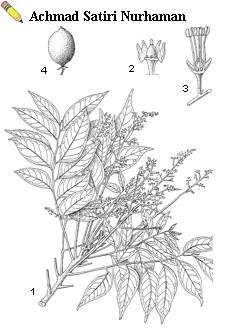 | Ganophyllum falcatum Blume – 1, flowering twig; 2, female flower; 3, male flower; 4, fruit. |
Ecology
G. falcatum is scattered in primary and secondary, evergreen to monsoon rain forest, sometimes in savanna vegetation or along forest edges, up to 700(-1200) m altitude. It is generally found in well-drained locations on clay, sand, or rocky soils overlying limestone but is also found on river banks, along the inner edge of mangrove forest and on floodplains. In Java it may be quite common in teak forest.
Silviculture and Management
G. falcatum can be raised from seed. The fruit pulp should be removed by maceration and the seeds dried. Fresh seeds have a germination rate of about 80% in 2-4 weeks. When stored under ambient conditions, viability drops fairly rapidly and seeds stored for 10 weeks have only 20% germination. Seedlings are not resistant to oxygen deficiency of the soil and die after 8 days. In a trial in West Java containerized planting stock of G. falcatum planted at 3 m x 1 m grew satisfactorily on only moderately fertile soil. It tolerated a fairly large amount of shade, but only a few stems were well-formed and most had over-heavy branches. The canopy closed at the age of 2.5 years. On the basis of this trial it was recommended to use a spacing of 2 m x 1 m. For the production of sawn timber the estimated rotation is 100 years with an estimated annual production of 0.9 m3/ha of sawn timber, 0.7 m3/ha of wood for poles and 1.6 m3/ha of fuelwood. G. falcatum is not fire-resistant.
Genetic Resources and Breeding
There are no records of present-day ex situ conservation of G. falcatum. As it is quite common and relatively widespread there seems to be no risk of genetic erosion.
Prospects
G. falcatum may have potential for increased use from natural sources. Its potential as a plantation crop deserves increased attention.
Literature
[40]All Nippon Checkers Corporation, 1989. Illustrated commercial foreign woods in Japan. Tokyo. 262 pp.
[70]Backer, C.A. & Bakhuizen van den Brink Jr., R.C., 1963-1968. Flora of Java. 3 volumes. Wolters-Noordhoff, Groningen.
[119]Boerlage, J.G. & Koorders, S.H., 1897. De mangirboom van Java - Ganophyllum falcatum Bl. [The mangir tree from Java - Ganophyllum falcatum Bl.]. Teysmannia 7: 485-487.
[124]Bolza, E. & Kloot, N.H., 1963. The mechanical properties of 174 Australian timbers. Technological Paper No 25. Division of Forest Products, CSIRO, Melbourne. 112 pp.
[125]Bolza, E. & Kloot, N.H., 1966. The mechanical properties of 81 New Guinea timbers. Technological Paper No 41. Division of Forest Products, CSIRO, Melbourne. 39 pp.
[161]Burger, D., 1972. Seedlings of some tropical trees and shrubs mainly of South East Asia. Pudoc, Wageningen. 399 pp.
[163]Burkill, I.H., 1966. A dictionary of the economic products of the Malay Peninsula. 2nd edition. Ministry of Agriculture and Co-operatives, Kuala Lumpur. Vol. 1 (A-H) pp. 1-1240. Vol. 2 (I-Z) pp. 1241-2444.
[260]den Berger, L.G., 1926. Houtsoorten der cultuurgebieden van Java en Sumatra's oostkust [Tree species of the cultivated areas of Java and the east coast of Sumatra]. Mededeelingen No 13. Proefstation voor het Boschwezen, Buitenzorg. 186 pp.
[300]Eddowes, P.J., 1977. Commercial timbers of Papua New Guinea, their properties and uses. Forest Products Research Centre, Department of Primary Industry, Port Moresby. xiv + 195 pp.
[302]Eddowes, P.J., 1980. Lesser known timber species of SEALPA countries. A review and summary. South East Asia Lumber Producers' Association, Jakarta. 132 pp.
[304]Eddowes, P.J., 1995-1997. The forests and timbers of Papua New Guinea. (unpublished data).
[340]Flora of Australia (various editors), 1981-. Australian Government Publishing Service, Canberra.
[341]Flora Malesiana (various editors), 1950-. Kluwer Academic Publishers, Dordrecht, Boston, London.
[346]Foreman, D.B., 1971. A check list of the vascular plants of Bougainville with descriptions of some common forest trees. Botany Bulletin No 5. Division of Botany, Department of Forests, Lae. 194 pp.
[348]Forest Products Research Centre, 1967. Properties and uses of Papua and New Guinea timbers. Forest Products Research Centre, Port Moresby. 30 pp.
[405]Hardjowasono, M.S., 1942. Gewicht en volume van verschillende vrucht- en zaadsoorten [Weight and volume of various fruits and seeds]. Korte Mededelingen No 20. Bosbouwproefstation, Buitenzorg. 172 pp.
[436]Heyne, K., 1927. De nuttige planten van Nederlands-Indië [The useful plants of the Dutch East Indies]. 2nd edition, 3 volumes. Departement van Landbouw, Nijverheid en Handel in Nederlandsch-Indië. 1953 pp. (3rd edition, 1950. van Hoeve, 's-Gravenhage/Bandung. 1660 pp.).
[464]Ilic, J., 1990. The CSIRO macro key for hardwood identification. CSIRO, Highett. 125 pp.
[488]Japing, H.W. & Oey Djoen Seng, 1936. Cultuurproeven met wildhoutsoorten in Gadoengan - met overzicht van de literatuur betreffende deze soorten [Trial plantations of non teak wood species in Gadungan (East Java) - with survey of literature about these species]. Korte Mededeelingen No 55, part I to VI. Boschbouwproefstation, Buitenzorg. 270 pp.
[533]Kartawinata, K. & Sastrapradja, S. (Editors), 1980. Jenis-jenis kayu Indonesia [Indonesian timber species]. PN. Balai Pustaka, Jakarta. 117 pp.
[536]Keating, W.G. & Bolza, E., 1982. Characteristics, properties and uses of timbers. Vol. 1. South-East Asia, northern Australia and the Pacific. Inkata Press Proprietary Ltd., Melbourne, Sydney & London. 362 pp.
[595]Koorders, S.H. & Valeton, T., 1894-1915. Bijdrage tot de kennis der boomsoorten van Java [Contribution to the knowledge of the tree species of Java]. 13 parts. G. Kolff & Co., Batavia, 's-Gravenhage.
[780]Meniado, J.A. et al., 1975-1981. Wood identification handbook for Philippine timbers. 2 volumes. Government Printing Office, Manila. 370 pp. & 186 pp.
[861]Oey Djoen Seng, 1951. De soortelijke gewichten van Indonesische houtsoorten en hun betekenis voor de praktijk [Specific gravity of Indonesian woods and its significance for practical use]. Rapport No 46. Bosbouwproefstation, Bogor. 183 pp.
[868]Paribotro & Kamil, N., 1974. Kayu mangir (Ganophyllum falcatum Bl.) untuk bahan kayu lapis [Mangir wood (Ganophyllum falcatum Bl.) for plywood manufacture]. Laporan No 37. Lembaga Penelitian Hasil Hutan, Bogor. 11 pp.
[908]Priasukmana, S. & Silitonga, T., 1972. Dimensi serat beberapa jenis kayu Jawa Barat [Fiber dimensions of several timber species from West Java]. Laporan No 2. Lembaga Penelitian Hasil Hutan, Bogor. 42 pp.
[933]Research Institute of Wood Industry, 1988. Identification, properties and uses of some Southeast Asian woods. Chinese Academy of Forestry, Wan Shou Shan, Beijing & International Tropical Timber Organization, Yokohama. 201 pp.
[934]Reyes, L.J., 1938. Philippine woods. Technical Bulletin No 7. Commonwealth of the Philippines, Department of Agriculture and Commerce. Bureau of Printing, Manila. 536 pp. + 88 plates.
[947]Rierink, A., 1938. Over de caloriemetrische verbrandingswaarde van een zestigtal Ned. Indische houtsoorten [The calorific value of about 60 woods from the Dutch East Indies]. Tectona 31: 400-418.
[1048]Soepadmo, E., Wong, K.M. & Saw, L.G. (Editors), 1995-. Tree flora of Sabah and Sarawak. Sabah Forestry Department, Forest Research Institute Malaysia and Sarawak Forestry Department, Kepong.
[1074]Suprapti, S., 1987. Pemanfaatan limbah industri penggergajian untuk media tumbuh jamur tiram putih [Utilization of lumber waste for oyster mushroom substrate]. Duta Rimba 13(87-88): 38-40.
[1083]Syachri, T.N., 1987. Pemanfaatan kayu kurang dikenal sebagai sumber energi [The utilization of lesser-known timbers for energy]. In: Soemarna, K. et al. (Editors): Prosiding diskusi pemanfaatan kayu kurang dikenal, 13-14 Januari 1987, Cisarua, Bogor. Badan Penelitian dan Pengembangan Kehutanan, Bogor. pp. 269–279.
[1132]van Royen, P., 1964-1969. Manual of the forest trees of Papua and New Guinea. 9 parts in 6 volumes. Division of Botany, Department of Forests, Port Moresby.
[1199]Werkgoep Tropische Houtteelt, 1973. Bebossing van geërodeerde gronden op Java - bijlage III: Houtsoorten [Afforestation of eroded lands in Java - Annex III: Tree species]. Landbouwhogeschool Wageningen. 128 pp.
[1221]Whitmore, T.C. & Ng, F.S.P. (Editors), 1972-1989. Tree flora of Malaya. A manual for foresters. 4 volumes. Malayan Forest Records No 26. Longman Malaysia Sdn. Berhad, Kuala Lumpur & Petaling Jaya.
[1261]Yazaki, Y., 1982. Termiticidal extracts from the wood of Ganophyllum falcatum Bl. Holzforschung 36(5): 249-253.
[70]Backer, C.A. & Bakhuizen van den Brink Jr., R.C., 1963-1968. Flora of Java. 3 volumes. Wolters-Noordhoff, Groningen.
[119]Boerlage, J.G. & Koorders, S.H., 1897. De mangirboom van Java - Ganophyllum falcatum Bl. [The mangir tree from Java - Ganophyllum falcatum Bl.]. Teysmannia 7: 485-487.
[124]Bolza, E. & Kloot, N.H., 1963. The mechanical properties of 174 Australian timbers. Technological Paper No 25. Division of Forest Products, CSIRO, Melbourne. 112 pp.
[125]Bolza, E. & Kloot, N.H., 1966. The mechanical properties of 81 New Guinea timbers. Technological Paper No 41. Division of Forest Products, CSIRO, Melbourne. 39 pp.
[161]Burger, D., 1972. Seedlings of some tropical trees and shrubs mainly of South East Asia. Pudoc, Wageningen. 399 pp.
[163]Burkill, I.H., 1966. A dictionary of the economic products of the Malay Peninsula. 2nd edition. Ministry of Agriculture and Co-operatives, Kuala Lumpur. Vol. 1 (A-H) pp. 1-1240. Vol. 2 (I-Z) pp. 1241-2444.
[260]den Berger, L.G., 1926. Houtsoorten der cultuurgebieden van Java en Sumatra's oostkust [Tree species of the cultivated areas of Java and the east coast of Sumatra]. Mededeelingen No 13. Proefstation voor het Boschwezen, Buitenzorg. 186 pp.
[300]Eddowes, P.J., 1977. Commercial timbers of Papua New Guinea, their properties and uses. Forest Products Research Centre, Department of Primary Industry, Port Moresby. xiv + 195 pp.
[302]Eddowes, P.J., 1980. Lesser known timber species of SEALPA countries. A review and summary. South East Asia Lumber Producers' Association, Jakarta. 132 pp.
[304]Eddowes, P.J., 1995-1997. The forests and timbers of Papua New Guinea. (unpublished data).
[340]Flora of Australia (various editors), 1981-. Australian Government Publishing Service, Canberra.
[341]Flora Malesiana (various editors), 1950-. Kluwer Academic Publishers, Dordrecht, Boston, London.
[346]Foreman, D.B., 1971. A check list of the vascular plants of Bougainville with descriptions of some common forest trees. Botany Bulletin No 5. Division of Botany, Department of Forests, Lae. 194 pp.
[348]Forest Products Research Centre, 1967. Properties and uses of Papua and New Guinea timbers. Forest Products Research Centre, Port Moresby. 30 pp.
[405]Hardjowasono, M.S., 1942. Gewicht en volume van verschillende vrucht- en zaadsoorten [Weight and volume of various fruits and seeds]. Korte Mededelingen No 20. Bosbouwproefstation, Buitenzorg. 172 pp.
[436]Heyne, K., 1927. De nuttige planten van Nederlands-Indië [The useful plants of the Dutch East Indies]. 2nd edition, 3 volumes. Departement van Landbouw, Nijverheid en Handel in Nederlandsch-Indië. 1953 pp. (3rd edition, 1950. van Hoeve, 's-Gravenhage/Bandung. 1660 pp.).
[464]Ilic, J., 1990. The CSIRO macro key for hardwood identification. CSIRO, Highett. 125 pp.
[488]Japing, H.W. & Oey Djoen Seng, 1936. Cultuurproeven met wildhoutsoorten in Gadoengan - met overzicht van de literatuur betreffende deze soorten [Trial plantations of non teak wood species in Gadungan (East Java) - with survey of literature about these species]. Korte Mededeelingen No 55, part I to VI. Boschbouwproefstation, Buitenzorg. 270 pp.
[533]Kartawinata, K. & Sastrapradja, S. (Editors), 1980. Jenis-jenis kayu Indonesia [Indonesian timber species]. PN. Balai Pustaka, Jakarta. 117 pp.
[536]Keating, W.G. & Bolza, E., 1982. Characteristics, properties and uses of timbers. Vol. 1. South-East Asia, northern Australia and the Pacific. Inkata Press Proprietary Ltd., Melbourne, Sydney & London. 362 pp.
[595]Koorders, S.H. & Valeton, T., 1894-1915. Bijdrage tot de kennis der boomsoorten van Java [Contribution to the knowledge of the tree species of Java]. 13 parts. G. Kolff & Co., Batavia, 's-Gravenhage.
[780]Meniado, J.A. et al., 1975-1981. Wood identification handbook for Philippine timbers. 2 volumes. Government Printing Office, Manila. 370 pp. & 186 pp.
[861]Oey Djoen Seng, 1951. De soortelijke gewichten van Indonesische houtsoorten en hun betekenis voor de praktijk [Specific gravity of Indonesian woods and its significance for practical use]. Rapport No 46. Bosbouwproefstation, Bogor. 183 pp.
[868]Paribotro & Kamil, N., 1974. Kayu mangir (Ganophyllum falcatum Bl.) untuk bahan kayu lapis [Mangir wood (Ganophyllum falcatum Bl.) for plywood manufacture]. Laporan No 37. Lembaga Penelitian Hasil Hutan, Bogor. 11 pp.
[908]Priasukmana, S. & Silitonga, T., 1972. Dimensi serat beberapa jenis kayu Jawa Barat [Fiber dimensions of several timber species from West Java]. Laporan No 2. Lembaga Penelitian Hasil Hutan, Bogor. 42 pp.
[933]Research Institute of Wood Industry, 1988. Identification, properties and uses of some Southeast Asian woods. Chinese Academy of Forestry, Wan Shou Shan, Beijing & International Tropical Timber Organization, Yokohama. 201 pp.
[934]Reyes, L.J., 1938. Philippine woods. Technical Bulletin No 7. Commonwealth of the Philippines, Department of Agriculture and Commerce. Bureau of Printing, Manila. 536 pp. + 88 plates.
[947]Rierink, A., 1938. Over de caloriemetrische verbrandingswaarde van een zestigtal Ned. Indische houtsoorten [The calorific value of about 60 woods from the Dutch East Indies]. Tectona 31: 400-418.
[1048]Soepadmo, E., Wong, K.M. & Saw, L.G. (Editors), 1995-. Tree flora of Sabah and Sarawak. Sabah Forestry Department, Forest Research Institute Malaysia and Sarawak Forestry Department, Kepong.
[1074]Suprapti, S., 1987. Pemanfaatan limbah industri penggergajian untuk media tumbuh jamur tiram putih [Utilization of lumber waste for oyster mushroom substrate]. Duta Rimba 13(87-88): 38-40.
[1083]Syachri, T.N., 1987. Pemanfaatan kayu kurang dikenal sebagai sumber energi [The utilization of lesser-known timbers for energy]. In: Soemarna, K. et al. (Editors): Prosiding diskusi pemanfaatan kayu kurang dikenal, 13-14 Januari 1987, Cisarua, Bogor. Badan Penelitian dan Pengembangan Kehutanan, Bogor. pp. 269–279.
[1132]van Royen, P., 1964-1969. Manual of the forest trees of Papua and New Guinea. 9 parts in 6 volumes. Division of Botany, Department of Forests, Port Moresby.
[1199]Werkgoep Tropische Houtteelt, 1973. Bebossing van geërodeerde gronden op Java - bijlage III: Houtsoorten [Afforestation of eroded lands in Java - Annex III: Tree species]. Landbouwhogeschool Wageningen. 128 pp.
[1221]Whitmore, T.C. & Ng, F.S.P. (Editors), 1972-1989. Tree flora of Malaya. A manual for foresters. 4 volumes. Malayan Forest Records No 26. Longman Malaysia Sdn. Berhad, Kuala Lumpur & Petaling Jaya.
[1261]Yazaki, Y., 1982. Termiticidal extracts from the wood of Ganophyllum falcatum Bl. Holzforschung 36(5): 249-253.
Author(s)
U.A. Dasuki
Correct Citation of this Article
Dasuki, U.A., 1998. Ganophyllum Blume. In: Sosef, M.S.M., Hong, L.T. and Prawirohatmodjo, S. (Editors): Plant Resources of South-East Asia No 5(3): Timber trees; Lesser-known timbers. PROSEA Foundation, Bogor, Indonesia. Database record: prota4u.org/prosea

All texts are licensed under a Creative Commons Attribution-Noncommercial-Share Alike 3.0 Netherlands License
This license does not include the illustrations (Maps,drawings,pictures); these remain all under copyright.