Record Number
5531
PROSEA Handbook Number
5(3): Timber trees; Lesser-known timbers
Taxon
Grevillea R. Br. ex Knight
Protologue
Cult. Prot.: 120 (1809).
Family
PROTEACEAE
Chromosome Numbers
x = 10; G. banksii, G. robusta: 2n = 20
Vernacular Names
Silky oak (En, trade name), grevillea (En). Lacewood (Am).
Origin and Geographic Distribution
Grevillea comprises about 270 species ocurring mainly in Australia, 9 occur in New Caledonia and 4 are native to the Malesian region. The latter are found in Sulawesi, the Moluccas and New Guinea. A few Australian species are cultivated within Malesia.
Uses
The wood of Grevillea is used for light construction, boat building, interior trim, fine finish, furniture, cabinet work, parquet flooring, panelling, turnery, boxes, toys and novelties. It is also applied as decorative veneer and for the production of blockboard, particle board and hardboard, and is suitable as a pulpwood. It also yields a high-quality firewood, particularly in semi-arid regions.
G. robusta is a well-known auxiliary plant used widely throughout Asia and Africa in agroforestry systems (e.g. as a shade tree). It is also widely planted as an ornamental because of its attractive fern-like foliage and bright orange inflorescences. G. banksii is also planted as wind-break, for firewood, to provide fodder for goats, and as an ornamental.
G. robusta is a well-known auxiliary plant used widely throughout Asia and Africa in agroforestry systems (e.g. as a shade tree). It is also widely planted as an ornamental because of its attractive fern-like foliage and bright orange inflorescences. G. banksii is also planted as wind-break, for firewood, to provide fodder for goats, and as an ornamental.
Production and International Trade
In 1996 only 58 m3 of "silky oak"" logs were exported from Papua New Guinea at an average free-on-board (FOB) price of US$ 102/m3.
Properties
Grevillea yields a medium-weight hardwood with a density of 540-720 kg/m3 at 15% moisture content. Heartwood pale pink-brown turning to yellow-brown or red-brown upon exposure, moderately clearly differentiated from the cream-coloured to pale pink, up to 4 cm wide sapwood; grain straight to wavy; texture medium to coarse and uneven; wood lustrous; prominent silver grain on radial surface. Growth rings indistinct; vessels moderately small to moderately large, solitary and in short radial multiples, in tangential arrangement, also in clusters, vessels with white, infrequent yellowish or pinkish to dark brown substances present; parenchyma apotracheal in narrow regularly spaced bands looping from ray to ray, paratracheal vasicentric, aliform or confluent; rays of 2 sizes, moderately fine and moderately broad to extremely broad, prominent on all surfaces; ripple marks absent; axial canals occasionally present.
Shrinkage upon seasoning is low to moderate; seasoning properties are rated from good to poor; wood air dries slowly. It has a tendency to warp and check and thick material should be air dried slowly followed by a mild kiln schedule to avoid honeycombing. When used as a firewood it needs only a few days drying. The wood is hard, of low strength, but elastic. It is easy to work with hand and machine tools but a cutting angle of 10° is required to obtain a good finish on quarter-sawn faces. Some fair-skinned people are allergic to the sawdust which can cause skin irritation. The wood can be peeled and sliced satisfactorily. It is moderately durable to non-durable and the heartwood of G. robusta shows an absorption of creosote of 128 kg/m3 and 321 kg/m3, respectively, when treated by the open tank method and pressure treatment. The wood is susceptible to marine borer, pinhole borer and termite attack. The sapwood is susceptible to Lyctus.
The gross energy value of G. robusta wood is about 20 400 kJ/kg. The average fibre length of G. robusta is 1.50-1.75 mm and it is suitable as a raw material to produce chemical pulp.
See also the tables on microscopic wood anatomy and wood properties.
Shrinkage upon seasoning is low to moderate; seasoning properties are rated from good to poor; wood air dries slowly. It has a tendency to warp and check and thick material should be air dried slowly followed by a mild kiln schedule to avoid honeycombing. When used as a firewood it needs only a few days drying. The wood is hard, of low strength, but elastic. It is easy to work with hand and machine tools but a cutting angle of 10° is required to obtain a good finish on quarter-sawn faces. Some fair-skinned people are allergic to the sawdust which can cause skin irritation. The wood can be peeled and sliced satisfactorily. It is moderately durable to non-durable and the heartwood of G. robusta shows an absorption of creosote of 128 kg/m3 and 321 kg/m3, respectively, when treated by the open tank method and pressure treatment. The wood is susceptible to marine borer, pinhole borer and termite attack. The sapwood is susceptible to Lyctus.
The gross energy value of G. robusta wood is about 20 400 kJ/kg. The average fibre length of G. robusta is 1.50-1.75 mm and it is suitable as a raw material to produce chemical pulp.
See also the tables on microscopic wood anatomy and wood properties.
Botany
Small to medium-sized shrubs or trees up to 25(-40) m tall; bole straight, branchless for up to 15 m, up to 80(-120) cm in diameter, usually without buttresses; bark surface fissured, sometimes pustulate, dark grey to dark brown, inner bark reddish-brown; crown conical, dense, with branches projecting upwards. Leaves arranged spirally to alternate, simple to pinnate with linear to pinnatifid segments, often dimorphous even within a single tree, exstipulate. Flowers in a terminal or axillary, simple or branched raceme, often in pairs, protandrous; tepals 4, united into a tube that is mostly recurved under the broadened apex (limb), eventually splitting open; stamens 4, sessile in the concave limb segments; disk annular or semi-annular, sometimes bi-lobed; ovary superior, 1-locular with 2 ovules, style curved and protruding from a slit in the perianth tube before the apex is free from the limb, eventually straight, persistent. Fruit a coriaceous to woody follicle, usually oblique and opening along the ventral margin. Seeds 1-2, flat, generally winged all around. Seedling with epigeal germination; cotyledons emergent; hypocotyl elongated.
In its natural range G. robusta is semi-deciduous, shedding most of its leaves in the dry season. Trials in Java have confirmed that under suitable circumstances G. robusta may show an annual height and diameter increment of about 2 m and 2 cm, respectively, during the first 10 years. On the most favourable sites height increments of 3 m have been observed. In Thailand the average height and diameter 1 year after planting of G. baileyana are 0.5-1.6 m and 0.8-1.7 cm, respectively. It first flowers when about 6 years old; in October-November in its natural environment but sporadically throughout the year in equatorial latitudes. In Java G. robusta has mature fruits in September-January. The main flowering period of G. banksii in Australia is from August to October, whereas in Java and Peninsular Malaysia it flowers throughout the year. In Papua New Guinea Grevillea flowers mainly in April-September particularly in the monsoonal areas. It may produce viable seeds already when 3-4 years old. Flowers contain nectar and pollination is presumably by birds and/or arboreal marsupials (Phalangeridae). Seed dispersal is by wind. Grevillea is known to form vesicular-arbuscular mycorrhizae.
Grevillea belongs to the tribe Grevilleeae and is closely related to Finschia which differs mainly by the indehiscent fruits.
In its natural range G. robusta is semi-deciduous, shedding most of its leaves in the dry season. Trials in Java have confirmed that under suitable circumstances G. robusta may show an annual height and diameter increment of about 2 m and 2 cm, respectively, during the first 10 years. On the most favourable sites height increments of 3 m have been observed. In Thailand the average height and diameter 1 year after planting of G. baileyana are 0.5-1.6 m and 0.8-1.7 cm, respectively. It first flowers when about 6 years old; in October-November in its natural environment but sporadically throughout the year in equatorial latitudes. In Java G. robusta has mature fruits in September-January. The main flowering period of G. banksii in Australia is from August to October, whereas in Java and Peninsular Malaysia it flowers throughout the year. In Papua New Guinea Grevillea flowers mainly in April-September particularly in the monsoonal areas. It may produce viable seeds already when 3-4 years old. Flowers contain nectar and pollination is presumably by birds and/or arboreal marsupials (Phalangeridae). Seed dispersal is by wind. Grevillea is known to form vesicular-arbuscular mycorrhizae.
Grevillea belongs to the tribe Grevilleeae and is closely related to Finschia which differs mainly by the indehiscent fruits.
Image
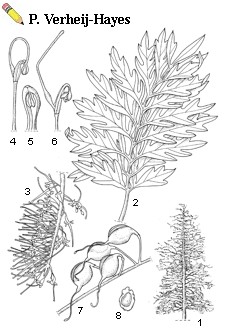 | Grevillea robusta A. Cunn. ex R. Br. – 1, tree habit; 2, leaf; 3, inflorescence; 4, 5, 6, flowers and flower parts; 7, fruits; 8, seed. |
Ecology
Malesian Grevillea species generally occur in dry savanna forest, up to 1800 m altitude. They are found on well-drained sites on slopes and ridges, but also along rivers, sometimes associated with Melaleuca or Eucalyptus. G. baileyana also occurs in monsoon forest.
Silviculture and Management
Grevillea can be propagated by seed and by vegetative techniques (cuttings, air layering). Wildlings of G. robusta are used by farmers as planting stock. G. robusta has 24 000-110 000 seeds/kg. Seeds can be stored for at least 2 years when dried to below 8% moisture content and stored cool (20°C or less). Seeds do not need a pretreatment before sowing and have 60-80% germination starting approximately 2 weeks after sowing. Seedlings are pricked out when their second leaf pair starts to develop. The fast-growing taproot needs to be pruned several times in the nursery. G. robusta is usually planted at 2.5-3 m x 3-4 m. The survival rate of G. baileyana 1 year after planting in a trial in Thailand was 56-73%. For optimal development G. robusta needs deep and loose soils and is not very demanding with regard to soil fertility. The relative open canopy of G. robusta plantations make it less suitable for areas with erosion hazard. G. robusta coppices poorly, but can be pruned and pollarded with good regrowth. It also easily regenerates naturally, especially in agricultural fields. Older trees are fairly resistant to frost and wind. For firewood production rotations of 10-20 years are applied and annual volume increments of 5-15 m3/ha may be expected. A growth reduction after 20 years is reported for G. robusta. G. robusta is known to produce substances toxic to its own seedlings.
Genetic Resources and Breeding
The Australian Tree Seed Centre of the Commonwealth Scientific and Industrial Research Organization (CSIRO) and the Queensland Forest Service have distributed seed from 27 natural provenances of G. robusta, covering the altitudinal and geographical range of sites where it occurs, for evaluation in other countries. G. banksii cv. Fosteri is a dense shrub planted in fences, whereas several hybrids of G. banksii are planted as an ornamental.
Prospects
The conspicuous silver grain of Grevillea wood makes it attractive for decorative purposes. G. robusta has potential as a multipurpose tree in the highlands of South-East Asia.
Literature
[124]Bolza, E. & Kloot, N.H., 1963. The mechanical properties of 174 Australian timbers. Technological Paper No 25. Division of Forest Products, CSIRO, Melbourne. 112 pp.
[163]Burkill, I.H., 1966. A dictionary of the economic products of the Malay Peninsula. 2nd edition. Ministry of Agriculture and Co-operatives, Kuala Lumpur. Vol. 1 (A-H) pp. 1-1240. Vol. 2 (I-Z) pp. 1241-2444.
[193]Chudnoff, M., 1980. Tropical timbers of the world. Forest Products Laboratory, Forest Service, United States Department of Agriculture, Madison. 831 pp.
[209]Corner, E.J.H., 1988. Wayside trees of Malaya. 3rd edition. 2 volumes. The Malayan Nature Society, Kuala Lumpur. 774 pp.
[238]de Vogel, E.F., 1980. Seedlings of dicotyledons. Structure, development, types. Descriptions of 150 woody Malesian taxa. Pudoc, Wageningen. 465 pp.
[265]Department of Scientific and Industrial Research, 1960. Identification of hardwoods - a lens key (second edition). Forest Products Research Bulletin No 25. Her Majesty's Stationery Office, London. 126 pp.
[300]Eddowes, P.J., 1977. Commercial timbers of Papua New Guinea, their properties and uses. Forest Products Research Centre, Department of Primary Industry, Port Moresby. xiv + 195 pp.
[301]Eddowes, P.J., 1979. The utilisation of Papua New Guinea timbers. Forest Products Research Centre, Department of Primary Industry, Port Moresby. 30 pp.
[304]Eddowes, P.J., 1995-1997. The forests and timbers of Papua New Guinea. (unpublished data).
[333]Faridah Hanum, I. & van der Maesen, L.J.G. (Editors), 1997. Plant resources of South-East Asia No 11. Auxiliary plants. Backhuys Publishers, Leiden. 389 pp.
[341]Flora Malesiana (various editors), 1950-. Kluwer Academic Publishers, Dordrecht, Boston, London.
[343]Flore du Cambodge, du Laos et du Viêtnam (various editors), 1960-. Muséum National d'Histoire Naturelle, Paris.
[348]Forest Products Research Centre, 1967. Properties and uses of Papua and New Guinea timbers. Forest Products Research Centre, Port Moresby. 30 pp.
[364]Gamble, J.S., 1922. A manual of Indian timbers. 2nd edition. Sampsom Low, Marston & Company, London. 868 pp.
[403]Handbooks of the flora of Papua New Guinea (various editors), 1978-. Melbourne University Press, Carlton.
[406]Harker, A.P., Sandels, A. & Burley, J., 1982. Calorific values for wood and bark and a bibliography for fuelwood. Report G 162. Tropical Products Institute, London. 20 pp.
[418]Harwood, C., 1990. Provenance collections of Grevillea robusta (silky oak). Forest Genetic Resources Information 18: 17-20.
[419]Harwood, C.E. (Editor), 1992. Grevillea robusta in agroforestry and forestry: proceedings of an international workshop. International Council for Research in Agroforestry (ICRAF), Nairobi. 123 pp.
[436]Heyne, K., 1927. De nuttige planten van Nederlands-Indië [The useful plants of the Dutch East Indies]. 2nd edition, 3 volumes. Departement van Landbouw, Nijverheid en Handel in Nederlandsch-Indië. 1953 pp. (3rd edition, 1950. van Hoeve, 's-Gravenhage/Bandung. 1660 pp.).
[464]Ilic, J., 1990. The CSIRO macro key for hardwood identification. CSIRO, Highett. 125 pp.
[488]Japing, H.W. & Oey Djoen Seng, 1936. Cultuurproeven met wildhoutsoorten in Gadoengan - met overzicht van de literatuur betreffende deze soorten [Trial plantations of non teak wood species in Gadungan (East Java) - with survey of literature about these species]. Korte Mededeelingen No 55, part I to VI. Boschbouwproefstation, Buitenzorg. 270 pp.
[493]Jensen, M., 1995. Trees commonly cultivated in Southeast Asia - an illustrated field guide. RAP Publication 1995/38. FAO Regional Office for Asia and the Pacific, Bangkok. 229 pp.
[536]Keating, W.G. & Bolza, E., 1982. Characteristics, properties and uses of timbers. Vol. 1. South-East Asia, northern Australia and the Pacific. Inkata Press Proprietary Ltd., Melbourne, Sydney & London. 362 pp.
[658]Lamprecht, H., 1989. Silviculture in the tropics; tropical forest ecosystems and their tree species, possibilities and methods for their long-term utilization. Deutsche Gesellschaft für Technische Zusammenarbeit (GTZ) GmbH, Eschborn. 296 pp.
[660]Lanyon, J.W., 1981. Card key for the identification of the commercial timbers used in New South Wales (second edition). Research Note No 40. Forestry Comission of New South Wales, Sydney. 87 pp.
[697]Letourneux, C., 1957. Tree planting practices in tropical Asia. FAO Forestry Development Paper No 11. FAO, Rome. 172 pp.
[736]Magini, E. & Tulstrup, N.P., 1955. Tree seed notes. I. Arid Areas II. Humid Tropics. FAO Forestry Development Paper 5. FAO, Rome. 354 pp.
[768]McGillivray, D.J., 1992. A taxonomic revision of Grevillea R. Br. (Proteaceae). Melbourne University Press, Melbourne. xiii + 465 pp.
[817]National Academy of Sciences, 1980. Firewood crops. Shrub and tree species for firewood production. National Academy Press, Washington, D.C. 237 pp.
[861]Oey Djoen Seng, 1951. De soortelijke gewichten van Indonesische houtsoorten en hun betekenis voor de praktijk [Specific gravity of Indonesian woods and its significance for practical use]. Rapport No 46. Bosbouwproefstation, Bogor. 183 pp.
[896]Pinyopusarerk, K., 1989. Growth and survival of Australian tree species in field trials in Thailand. In: Boland, D.J. (Editor): Trees for the tropics. Growing Australian multipurpose trees and shrubs in developing countries. Australian Centre for International Agricultural Research, Canberra. pp. 109–127.
[1177]von Meyenfeldt, C.F.W.M. et al., 1978. Restoration of devastated inland forests in South Vietnam. Volume III: List of tree species. Agricultural University, Wageningen. 219 pp.
[1199]Werkgoep Tropische Houtteelt, 1973. Bebossing van geërodeerde gronden op Java - bijlage III: Houtsoorten [Afforestation of eroded lands in Java - Annex III: Tree species]. Landbouwhogeschool Wageningen. 128 pp.
[163]Burkill, I.H., 1966. A dictionary of the economic products of the Malay Peninsula. 2nd edition. Ministry of Agriculture and Co-operatives, Kuala Lumpur. Vol. 1 (A-H) pp. 1-1240. Vol. 2 (I-Z) pp. 1241-2444.
[193]Chudnoff, M., 1980. Tropical timbers of the world. Forest Products Laboratory, Forest Service, United States Department of Agriculture, Madison. 831 pp.
[209]Corner, E.J.H., 1988. Wayside trees of Malaya. 3rd edition. 2 volumes. The Malayan Nature Society, Kuala Lumpur. 774 pp.
[238]de Vogel, E.F., 1980. Seedlings of dicotyledons. Structure, development, types. Descriptions of 150 woody Malesian taxa. Pudoc, Wageningen. 465 pp.
[265]Department of Scientific and Industrial Research, 1960. Identification of hardwoods - a lens key (second edition). Forest Products Research Bulletin No 25. Her Majesty's Stationery Office, London. 126 pp.
[300]Eddowes, P.J., 1977. Commercial timbers of Papua New Guinea, their properties and uses. Forest Products Research Centre, Department of Primary Industry, Port Moresby. xiv + 195 pp.
[301]Eddowes, P.J., 1979. The utilisation of Papua New Guinea timbers. Forest Products Research Centre, Department of Primary Industry, Port Moresby. 30 pp.
[304]Eddowes, P.J., 1995-1997. The forests and timbers of Papua New Guinea. (unpublished data).
[333]Faridah Hanum, I. & van der Maesen, L.J.G. (Editors), 1997. Plant resources of South-East Asia No 11. Auxiliary plants. Backhuys Publishers, Leiden. 389 pp.
[341]Flora Malesiana (various editors), 1950-. Kluwer Academic Publishers, Dordrecht, Boston, London.
[343]Flore du Cambodge, du Laos et du Viêtnam (various editors), 1960-. Muséum National d'Histoire Naturelle, Paris.
[348]Forest Products Research Centre, 1967. Properties and uses of Papua and New Guinea timbers. Forest Products Research Centre, Port Moresby. 30 pp.
[364]Gamble, J.S., 1922. A manual of Indian timbers. 2nd edition. Sampsom Low, Marston & Company, London. 868 pp.
[403]Handbooks of the flora of Papua New Guinea (various editors), 1978-. Melbourne University Press, Carlton.
[406]Harker, A.P., Sandels, A. & Burley, J., 1982. Calorific values for wood and bark and a bibliography for fuelwood. Report G 162. Tropical Products Institute, London. 20 pp.
[418]Harwood, C., 1990. Provenance collections of Grevillea robusta (silky oak). Forest Genetic Resources Information 18: 17-20.
[419]Harwood, C.E. (Editor), 1992. Grevillea robusta in agroforestry and forestry: proceedings of an international workshop. International Council for Research in Agroforestry (ICRAF), Nairobi. 123 pp.
[436]Heyne, K., 1927. De nuttige planten van Nederlands-Indië [The useful plants of the Dutch East Indies]. 2nd edition, 3 volumes. Departement van Landbouw, Nijverheid en Handel in Nederlandsch-Indië. 1953 pp. (3rd edition, 1950. van Hoeve, 's-Gravenhage/Bandung. 1660 pp.).
[464]Ilic, J., 1990. The CSIRO macro key for hardwood identification. CSIRO, Highett. 125 pp.
[488]Japing, H.W. & Oey Djoen Seng, 1936. Cultuurproeven met wildhoutsoorten in Gadoengan - met overzicht van de literatuur betreffende deze soorten [Trial plantations of non teak wood species in Gadungan (East Java) - with survey of literature about these species]. Korte Mededeelingen No 55, part I to VI. Boschbouwproefstation, Buitenzorg. 270 pp.
[493]Jensen, M., 1995. Trees commonly cultivated in Southeast Asia - an illustrated field guide. RAP Publication 1995/38. FAO Regional Office for Asia and the Pacific, Bangkok. 229 pp.
[536]Keating, W.G. & Bolza, E., 1982. Characteristics, properties and uses of timbers. Vol. 1. South-East Asia, northern Australia and the Pacific. Inkata Press Proprietary Ltd., Melbourne, Sydney & London. 362 pp.
[658]Lamprecht, H., 1989. Silviculture in the tropics; tropical forest ecosystems and their tree species, possibilities and methods for their long-term utilization. Deutsche Gesellschaft für Technische Zusammenarbeit (GTZ) GmbH, Eschborn. 296 pp.
[660]Lanyon, J.W., 1981. Card key for the identification of the commercial timbers used in New South Wales (second edition). Research Note No 40. Forestry Comission of New South Wales, Sydney. 87 pp.
[697]Letourneux, C., 1957. Tree planting practices in tropical Asia. FAO Forestry Development Paper No 11. FAO, Rome. 172 pp.
[736]Magini, E. & Tulstrup, N.P., 1955. Tree seed notes. I. Arid Areas II. Humid Tropics. FAO Forestry Development Paper 5. FAO, Rome. 354 pp.
[768]McGillivray, D.J., 1992. A taxonomic revision of Grevillea R. Br. (Proteaceae). Melbourne University Press, Melbourne. xiii + 465 pp.
[817]National Academy of Sciences, 1980. Firewood crops. Shrub and tree species for firewood production. National Academy Press, Washington, D.C. 237 pp.
[861]Oey Djoen Seng, 1951. De soortelijke gewichten van Indonesische houtsoorten en hun betekenis voor de praktijk [Specific gravity of Indonesian woods and its significance for practical use]. Rapport No 46. Bosbouwproefstation, Bogor. 183 pp.
[896]Pinyopusarerk, K., 1989. Growth and survival of Australian tree species in field trials in Thailand. In: Boland, D.J. (Editor): Trees for the tropics. Growing Australian multipurpose trees and shrubs in developing countries. Australian Centre for International Agricultural Research, Canberra. pp. 109–127.
[1177]von Meyenfeldt, C.F.W.M. et al., 1978. Restoration of devastated inland forests in South Vietnam. Volume III: List of tree species. Agricultural University, Wageningen. 219 pp.
[1199]Werkgoep Tropische Houtteelt, 1973. Bebossing van geërodeerde gronden op Java - bijlage III: Houtsoorten [Afforestation of eroded lands in Java - Annex III: Tree species]. Landbouwhogeschool Wageningen. 128 pp.
Author(s)
W.G. Keating (general part), E. Boer (general part), M.S.M. Sosef (general part, selection of species)
Grevillea baileyana
Grevillea banksii
Grevillea papuana
Grevillea robusta
Grevillea banksii
Grevillea papuana
Grevillea robusta
Correct Citation of this Article
Keating, W.G., Boer, E. & Sosef, M.S.M., 1998. Grevillea R. Br. ex Knight. In: Sosef, M.S.M., Hong, L.T. and Prawirohatmodjo, S. (Editors): Plant Resources of South-East Asia No 5(3): Timber trees; Lesser-known timbers. PROSEA Foundation, Bogor, Indonesia. Database record: prota4u.org/prosea
Selection of Species
The following species in this genus are important in this commodity group and are treated separatedly in this database:
Grevillea baileyana
Grevillea banksii
Grevillea papuana
Grevillea robusta
Grevillea baileyana
Grevillea banksii
Grevillea papuana
Grevillea robusta

All texts are licensed under a Creative Commons Attribution-Noncommercial-Share Alike 3.0 Netherlands License
This license does not include the illustrations (Maps,drawings,pictures); these remain all under copyright.