Record Number
5649
PROSEA Handbook Number
5(3): Timber trees; Lesser-known timbers
Taxon
Irvingia Hook. f.
Protologue
Trans. Linn. Soc., London 23: 167 (1860).
Family
SIMAROUBACEAE
Chromosome Numbers
x = unknown; I. gabonensis (Aubry-Lecomte ex O'Rorke) Baillon: 2n = 28
Vernacular Names
Kabok (trade name). Barking deer's mango (En). Indonesia: bongin (general, trade name), kayu batu (Borneo), pauh kijang (Sumatra). Malaysia: pauh kijang (general), patok entilit (Sarawak), selangan tandok (Sabah). Burma (Myanmar): taung-thayet. Thailand: kra bok (central), ma muen (northern), maak bok (north-eastern).
Origin and Geographic Distribution
Irvingia comprises about 5 species, 4 of which occur in tropical Africa. In South-East Asia only I. malayana Oliv. ex A.W. Bennett (synonyms: I. harmandiana Pierre, I. longipedicellata Gagnep., I. oliveri Pierre) is found; it occurs in Indo-China, Burma (Myanmar), Thailand, Peninsular Malaysia, Sumatra, Bawean Island and Borneo.
Uses
The wood of I. malayana is suitable for heavy construction (but not in contact with the ground or weather, except when treated), wall panelling, cabinet work, furniture, piles, railway sleepers and sporting goods, possibly also for flooring; it is also used to make knife handles. Tests indicate that the wood might be suitable for pulp for making paper. In Thailand it is used for making charcoal.
The whitish or yellowish fat from the seeds has a pleasant taste and smell, and is used to produce soap, wax and candles, and as a substitute for cacao butter. The seeds are also eaten fresh or cooked.
The whitish or yellowish fat from the seeds has a pleasant taste and smell, and is used to produce soap, wax and candles, and as a substitute for cacao butter. The seeds are also eaten fresh or cooked.
Production and International Trade
The timber of I. malayana is often not exploited because of its hardness, density (logs sink in water), and the very tall buttresses. The trees are often left standing after the forest has been logged. Small amounts of timber are exported to Japan from Sabah and Sarawak.
Properties
I. malayana yields a heavy hardwood with a density of 930-1250 kg/m3 at 15% moisture content. Heartwood yellow-brown with a greenish tinge, moderately sharply differentiated from the pale yellow-brown or pale brown, up to 7.5 cm wide sapwood; grain shallowly interlocked; texture moderately fine and even; wood with attractive fleck pattern on truly radial surface due to rays; some logs have a grey-brown striped core. Growth rings indistinct; vessels medium-sized, mostly solitary, some in radial multiples of 2-3, tyloses abundant; parenchyma abundant, apotracheal in narrow bands, distinct to the naked eye; rays moderately fine, just visible to the naked eye, but conspicuous on radial surface; ripple marks absent.
Shrinkage upon seasoning is moderate to high. The wood suffers severely from insect attack and stains moderately during drying. Surface- and end-checking occurs and the wood seasons slowly. Boards of 13 mm thick take 5 months to air dry and 38 mm thick boards take about 7 months; kiln schedule C is recommended in Malaysia. The wood is very hard and very strong. It is slightly difficult to work when green and difficult when dry. Planing is difficult, the wood turns well, and machining usually produces a moderately smooth to rough finish. The wood is moderately durable; in a graveyard test an average service life of 3.1 years was established. It absorbs preservatives moderately easy: an absorption of 128 kg/m3 was obtained using a 50/50 creosote-diesel fuel mixture in the standard open-tank treatment, whereas the net dry salt retention using the vacuum-pressure method was 9.8 kg/m3. The wood is not resistant to termites and slightly resistant to fungi.
See also the tables on microscopic wood anatomy and wood properties.
Shrinkage upon seasoning is moderate to high. The wood suffers severely from insect attack and stains moderately during drying. Surface- and end-checking occurs and the wood seasons slowly. Boards of 13 mm thick take 5 months to air dry and 38 mm thick boards take about 7 months; kiln schedule C is recommended in Malaysia. The wood is very hard and very strong. It is slightly difficult to work when green and difficult when dry. Planing is difficult, the wood turns well, and machining usually produces a moderately smooth to rough finish. The wood is moderately durable; in a graveyard test an average service life of 3.1 years was established. It absorbs preservatives moderately easy: an absorption of 128 kg/m3 was obtained using a 50/50 creosote-diesel fuel mixture in the standard open-tank treatment, whereas the net dry salt retention using the vacuum-pressure method was 9.8 kg/m3. The wood is not resistant to termites and slightly resistant to fungi.
See also the tables on microscopic wood anatomy and wood properties.
Botany
A variably deciduous, large to very large tree up to 60 m tall; bole straight, up to 150 cm in diameter, with prominent, thin and steep buttresses up to 8 m high; bark surface smooth with widely spaced loose scales, sometimes peeling off in large pieces, grey or fawn-coloured, inner bark mottled, cream-yellow; crown shallowly domed with big limbs. Leaves arranged spirally, simple, entire, elliptical-oblong to lanceolate, glabrous, midrib grooved above; stipules large, forming a cap surrounding the terminal bud, caducous and leaving annular scars. Flowers in an axillary or terminal panicle, small, (4-)5-merous; sepals connate at base, imbricate; petals longer than sepals, imbricate, greenish-white or yellowish; disk large; stamens (8-)10, with long sinuous filaments; ovary superior, 2-locular with a single ovule in each cell, style 1, sinuous. Fruit a large drupe (resembling a mango) with thick, fleshy, very fibrous mesocarp, 1(-2)-seeded. Seed with leathery testa, endosperm absent or very little. Seedling with epigeal germination; cotyledons fleshy, whitish; first two leaves opposite, subsequent ones alternate.
The trees flower before or just after the appearance of new leaves. The fruits are reported to be eaten by barking deer.
Irvingia differs from most other Simaroubaceae in having stipules that leave an annular scar, and lysigenous mucilage cavities in the cortex and pith of branches and petioles. This has led to a separate family being distinguished: Irvingiaceae. However, Irvingia readily links up with some genera in Simaroubaceae morphologically, anatomically and chemically, and inclusion in this family seems justified. It is often placed in the subfamily Irvingioideae together with the entirely African genus Klainedoxa.
The tree's shape, flowers and fruits are reminiscent of those of wild mangoes (Mangifera spp.), the buttresses and hard pale wood are similar to those of Dialium, and the leafy twigs resemble those of figs (Ficus spp., but latex is absent).
Seeds of I. gabonensis are used in Africa in similar ways as I. malayana.
The trees flower before or just after the appearance of new leaves. The fruits are reported to be eaten by barking deer.
Irvingia differs from most other Simaroubaceae in having stipules that leave an annular scar, and lysigenous mucilage cavities in the cortex and pith of branches and petioles. This has led to a separate family being distinguished: Irvingiaceae. However, Irvingia readily links up with some genera in Simaroubaceae morphologically, anatomically and chemically, and inclusion in this family seems justified. It is often placed in the subfamily Irvingioideae together with the entirely African genus Klainedoxa.
The tree's shape, flowers and fruits are reminiscent of those of wild mangoes (Mangifera spp.), the buttresses and hard pale wood are similar to those of Dialium, and the leafy twigs resemble those of figs (Ficus spp., but latex is absent).
Seeds of I. gabonensis are used in Africa in similar ways as I. malayana.
Image
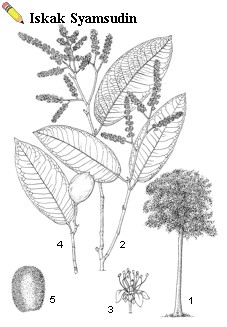 | Irvingia malayana Oliv. ex A.W. Bennett – 1, tree habit; 2, flowering twig; 3, flower; 4, twig with fruit; 5, fibrous mesocarp of fruit. |
Ecology
I. malayana occurs scattered in primary lowland rain forest in drier locations, up to 300 m altitude. In Thailand it is frequently present in dry deciduous and evergreen dipterocarp forest.
Silviculture and Management
I. malayana can be raised from seed. Stones germinate readily, with 90-100% germination in 4-9 weeks after sowing, but complete fruits have only about 15% germination in 5-11 weeks. Mature trees may be hollow. In Thailand structural timber has been attacked by the beetle Stromatium longicorne, but damage was limited.
Genetic Resources and Breeding
I. malayana is usually not favoured in logging operations because of its large buttresses and hard, heavy wood, and is often left after logging. However, it seems slightly vulnerable because it occurs scattered in primary lowland rain forest in drier locations which are endangered in many regions.
Prospects
The use of the timber of I. malayana will probably remain restricted, as the timber is only moderately durable, heavy and difficult to work.
Literature
[40]All Nippon Checkers Corporation, 1989. Illustrated commercial foreign woods in Japan. Tokyo. 262 pp.
[54]Anuwongse, B., 1972. A species of wood-destroying beetle recently found in Thailand. Vanasarn 30(3): 205-215.
[162]Burgess, P.F., 1966. Timbers of Sabah. Sabah Forest Records No 6. Forest Department, Sabah, Sandakan. xviii + 501 pp.
[163]Burkill, I.H., 1966. A dictionary of the economic products of the Malay Peninsula. 2nd edition. Ministry of Agriculture and Co-operatives, Kuala Lumpur. Vol. 1 (A-H) pp. 1-1240. Vol. 2 (I-Z) pp. 1241-2444.
[198]Cockburn, P.F., 1976-1980. Trees of Sabah. 2 volumes. Sabah Forest Records No 10. Forest Department Sabah, Sandakan.
[209]Corner, E.J.H., 1988. Wayside trees of Malaya. 3rd edition. 2 volumes. The Malayan Nature Society, Kuala Lumpur. 774 pp.
[238]de Vogel, E.F., 1980. Seedlings of dicotyledons. Structure, development, types. Descriptions of 150 woody Malesian taxa. Pudoc, Wageningen. 465 pp.
[267]Desch, H.E., 1941-1954. Manual of Malayan timbers. Malayan Forest Records No 15. 2 volumes. Malaya Publishing House Ltd., Singapore. 762 pp.
[341]Flora Malesiana (various editors), 1950-. Kluwer Academic Publishers, Dordrecht, Boston, London.
[387]Grewal, G.S., 1979. Air-seasoning properties of some Malaysian timbers. Malaysian Forest Service Trade Leaflet No 41. Malaysian Timber Industry Board, Kuala Lumpur. 26 pp.
[436]Heyne, K., 1927. De nuttige planten van Nederlands-Indië [The useful plants of the Dutch East Indies]. 2nd edition, 3 volumes. Departement van Landbouw, Nijverheid en Handel in Nederlandsch-Indië. 1953 pp. (3rd edition, 1950. van Hoeve, 's-Gravenhage/Bandung. 1660 pp.).
[474]Jackson, W.F., 1965. The durability of Malaysian timbers. Malaysian Forest Service Trade Leaflet No 28. Malaysian Timber Industry Board, Kuala Lumpur. 11 pp.
[553]Kessler, P.J.A. & Sidiyasa, K., 1994. Trees of the Balikpapan-Samarinda area, East Kalimantan, Indonesia. Tropenbos Series 7. The Tropenbos Foundation, Wageningen. 446 pp.
[677]Lee, Y.H. & Chu, Y.P., 1965. The strength properties of Malayan timbers. Malayan Forester 28: 307-319.
[678]Lee, Y.H., Engku Abdul Rahman bin Chik & Chu, Y.P., 1979. The strength properties of some Malaysian timbers. Malaysian Forest Service Trade Leaflet No 34 (revised edition). Malaysian Timber Industry Board, Kuala Lumpur. 107 pp.
[740]Malaysian Timber Industry Board, 1984. Peraturan pemeringkatan kayu keras gergaji Malaysia [The Malaysian grading rules for sawn hardwood timber]. Ministry of Primary Industries, Kuala Lumpur. 109 pp.
[741]Malaysian Timber Industry Board, 1986. 100 Malaysian timbers. Kuala Lumpur. x + 226 pp.
[829]Ng, F.S.P., 1991-1992. Manual of forest fruits, seeds and seedlings. 2 volumes. Malayan Forest Record No 34. Forest Research Institute Malaysia, Kepong. 997 pp.
[831]Ng, F.S.P. & Mat Asri Ngah Sanah, 1991. Germination and seedling records. Research Pamphlet No 108. Forest Research Institute Malaysia, Kepong. 191 pp.
[861]Oey Djoen Seng, 1951. De soortelijke gewichten van Indonesische houtsoorten en hun betekenis voor de praktijk [Specific gravity of Indonesian woods and its significance for practical use]. Rapport No 46. Bosbouwproefstation, Bogor. 183 pp.
[885]Phengklai, C., 1975. Studies in Flora of Thailand. Thai Forest Bulletin (Botany) No 9: 1-11.
[889]Phengklai, C. & Khamsai, S., 1985. Some non-timber species of Thailand. Thai Forest Bulletin (Botany) 15: 108-148.
[972]Sahri, M.M., Harun, J. & Hung, L.K., 1989. Treatability study of four under-utilized species of Malaysian hardwoods using the pressure treatment method. IAWA Bulletin n.s. 10: 345-346.
[1048]Soepadmo, E., Wong, K.M. & Saw, L.G. (Editors), 1995-. Tree flora of Sabah and Sarawak. Sabah Forestry Department, Forest Research Institute Malaysia and Sarawak Forestry Department, Kepong.
[1221]Whitmore, T.C. & Ng, F.S.P. (Editors), 1972-1989. Tree flora of Malaya. A manual for foresters. 4 volumes. Malayan Forest Records No 26. Longman Malaysia Sdn. Berhad, Kuala Lumpur & Petaling Jaya.
[1239]Wong, T.M., 1976. Wood structure of the lesser known timbers of Peninsular Malaysia. Malayan Forest Records No 28. Forest Research Institute Malaysia, Kepong. xi + 115 pp.
[1242]Wong, T.M., 1982. A dictionary of Malaysian timbers. Malayan Forest Records No 30. Forest Research Institute Malaysia, Kepong. 259 pp.
[1266]Zaitun Said, 1985. Malaysian timbers - pauh kijang. Malaysian Forest Service Trade Leaflet No 99. Malaysian Timber Industry Board, Kuala Lumpur. 4 pp.
[54]Anuwongse, B., 1972. A species of wood-destroying beetle recently found in Thailand. Vanasarn 30(3): 205-215.
[162]Burgess, P.F., 1966. Timbers of Sabah. Sabah Forest Records No 6. Forest Department, Sabah, Sandakan. xviii + 501 pp.
[163]Burkill, I.H., 1966. A dictionary of the economic products of the Malay Peninsula. 2nd edition. Ministry of Agriculture and Co-operatives, Kuala Lumpur. Vol. 1 (A-H) pp. 1-1240. Vol. 2 (I-Z) pp. 1241-2444.
[198]Cockburn, P.F., 1976-1980. Trees of Sabah. 2 volumes. Sabah Forest Records No 10. Forest Department Sabah, Sandakan.
[209]Corner, E.J.H., 1988. Wayside trees of Malaya. 3rd edition. 2 volumes. The Malayan Nature Society, Kuala Lumpur. 774 pp.
[238]de Vogel, E.F., 1980. Seedlings of dicotyledons. Structure, development, types. Descriptions of 150 woody Malesian taxa. Pudoc, Wageningen. 465 pp.
[267]Desch, H.E., 1941-1954. Manual of Malayan timbers. Malayan Forest Records No 15. 2 volumes. Malaya Publishing House Ltd., Singapore. 762 pp.
[341]Flora Malesiana (various editors), 1950-. Kluwer Academic Publishers, Dordrecht, Boston, London.
[387]Grewal, G.S., 1979. Air-seasoning properties of some Malaysian timbers. Malaysian Forest Service Trade Leaflet No 41. Malaysian Timber Industry Board, Kuala Lumpur. 26 pp.
[436]Heyne, K., 1927. De nuttige planten van Nederlands-Indië [The useful plants of the Dutch East Indies]. 2nd edition, 3 volumes. Departement van Landbouw, Nijverheid en Handel in Nederlandsch-Indië. 1953 pp. (3rd edition, 1950. van Hoeve, 's-Gravenhage/Bandung. 1660 pp.).
[474]Jackson, W.F., 1965. The durability of Malaysian timbers. Malaysian Forest Service Trade Leaflet No 28. Malaysian Timber Industry Board, Kuala Lumpur. 11 pp.
[553]Kessler, P.J.A. & Sidiyasa, K., 1994. Trees of the Balikpapan-Samarinda area, East Kalimantan, Indonesia. Tropenbos Series 7. The Tropenbos Foundation, Wageningen. 446 pp.
[677]Lee, Y.H. & Chu, Y.P., 1965. The strength properties of Malayan timbers. Malayan Forester 28: 307-319.
[678]Lee, Y.H., Engku Abdul Rahman bin Chik & Chu, Y.P., 1979. The strength properties of some Malaysian timbers. Malaysian Forest Service Trade Leaflet No 34 (revised edition). Malaysian Timber Industry Board, Kuala Lumpur. 107 pp.
[740]Malaysian Timber Industry Board, 1984. Peraturan pemeringkatan kayu keras gergaji Malaysia [The Malaysian grading rules for sawn hardwood timber]. Ministry of Primary Industries, Kuala Lumpur. 109 pp.
[741]Malaysian Timber Industry Board, 1986. 100 Malaysian timbers. Kuala Lumpur. x + 226 pp.
[829]Ng, F.S.P., 1991-1992. Manual of forest fruits, seeds and seedlings. 2 volumes. Malayan Forest Record No 34. Forest Research Institute Malaysia, Kepong. 997 pp.
[831]Ng, F.S.P. & Mat Asri Ngah Sanah, 1991. Germination and seedling records. Research Pamphlet No 108. Forest Research Institute Malaysia, Kepong. 191 pp.
[861]Oey Djoen Seng, 1951. De soortelijke gewichten van Indonesische houtsoorten en hun betekenis voor de praktijk [Specific gravity of Indonesian woods and its significance for practical use]. Rapport No 46. Bosbouwproefstation, Bogor. 183 pp.
[885]Phengklai, C., 1975. Studies in Flora of Thailand. Thai Forest Bulletin (Botany) No 9: 1-11.
[889]Phengklai, C. & Khamsai, S., 1985. Some non-timber species of Thailand. Thai Forest Bulletin (Botany) 15: 108-148.
[972]Sahri, M.M., Harun, J. & Hung, L.K., 1989. Treatability study of four under-utilized species of Malaysian hardwoods using the pressure treatment method. IAWA Bulletin n.s. 10: 345-346.
[1048]Soepadmo, E., Wong, K.M. & Saw, L.G. (Editors), 1995-. Tree flora of Sabah and Sarawak. Sabah Forestry Department, Forest Research Institute Malaysia and Sarawak Forestry Department, Kepong.
[1221]Whitmore, T.C. & Ng, F.S.P. (Editors), 1972-1989. Tree flora of Malaya. A manual for foresters. 4 volumes. Malayan Forest Records No 26. Longman Malaysia Sdn. Berhad, Kuala Lumpur & Petaling Jaya.
[1239]Wong, T.M., 1976. Wood structure of the lesser known timbers of Peninsular Malaysia. Malayan Forest Records No 28. Forest Research Institute Malaysia, Kepong. xi + 115 pp.
[1242]Wong, T.M., 1982. A dictionary of Malaysian timbers. Malayan Forest Records No 30. Forest Research Institute Malaysia, Kepong. 259 pp.
[1266]Zaitun Said, 1985. Malaysian timbers - pauh kijang. Malaysian Forest Service Trade Leaflet No 99. Malaysian Timber Industry Board, Kuala Lumpur. 4 pp.
Author(s)
R. Yusuf
Correct Citation of this Article
R. Yusuf, 1998. Irvingia Hook. f.. In: Sosef, M.S.M., Hong, L.T. and Prawirohatmodjo, S. (Editors): Plant Resources of South-East Asia No 5(3): Timber trees; Lesser-known timbers. PROSEA Foundation, Bogor, Indonesia. Database record: prota4u.org/prosea

All texts are licensed under a Creative Commons Attribution-Noncommercial-Share Alike 3.0 Netherlands License
This license does not include the illustrations (Maps,drawings,pictures); these remain all under copyright.