Record Number
5704
PROSEA Handbook Number
5(3): Timber trees; Lesser-known timbers
Taxon
Lagerstroemia L.
Protologue
Syst. nat., ed. 10, 2: 1068, 1076, 1372 (1759).
Family
LYTHRACEAE
Chromosome Numbers
x = 24, 25; L. floribunda Jack: 2n = 48, L. indica L., L. speciosa: 2n = 48, 50
Vernacular Names
Banglang (Fr). Jarul (Am, En, Fr). Pyinma (Am, En). Brunei: kokonang. Indonesia: bungur (trade name). Malaysia: bungor (general). Philippines: banaba. Burma (Myanmar): pyinma. Cambodia: sralao. Laos: puay 'khao. Thailand: inthanin, tabaek. Vietnam: b[awf]ng l[aw]ng.
Origin and Geographic Distribution
Lagerstroemia comprises about 55 species and is distributed from India and the Himalayas to Burma (Myanmar), Indo-China, China, Japan, Taiwan, Thailand, throughout the Malesian region and northern Australia. About 25 species occur within Malesia. A few species are cultivated as ornamentals in tropical and subtropical countries around the world.
Uses
The wood of Lagerstroemia, which is often regarded as being similar in some respects to teak (Tectona grandis L. f.), is used for medium heavy construction under cover (posts, beams, scantlings, door and window frames), bridge and wharf building, boat building, vehicle bodies, mine timbers, railway sleepers, panelling, flooring, joinery, cooperage, agricultural and domestic implements, boxes, paddles, spear shafts, gunstocks, tool handles and sporting goods. The wood seems suitable for the production of sliced veneer and yields a good firewood.
Several species, notably L. floribunda, L. indica and L. speciosa, are cultivated for ornamental purposes, the latter also as a wayside tree and in Kalimantan as a support for rattan. It is also applied in erosion control as it produces a dense and widespread root system. A decoction of its bark has been applied in Java against diarrhoea and in Peninsular Malaysia for abdominal pains. Bark and leaves of L. speciosa contain tannin.
Several species, notably L. floribunda, L. indica and L. speciosa, are cultivated for ornamental purposes, the latter also as a wayside tree and in Kalimantan as a support for rattan. It is also applied in erosion control as it produces a dense and widespread root system. A decoction of its bark has been applied in Java against diarrhoea and in Peninsular Malaysia for abdominal pains. Bark and leaves of L. speciosa contain tannin.
Production and International Trade
As Lagerstroemia seldom reaches large sizes and supplies within Malesia are small, trade is generally on a local scale only. However, considerable export takes place from Burma (Myanmar) and India.
Properties
Lagerstroemia yields a medium-weight hardwood with a density of 505-810 kg/m3 at 15% moisture content. Heartwood pale brown, yellow-brown, greyish or reddish to red-brown, not clearly differentiated from the white or grey-white to yellow-brown, up to 8 cm wide sapwood; grain straight or slightly interlocked, occasionally conspicuously wavy (fiddle back); texture moderately fine to rather coarse, uneven in material with distinct vessel rings; wood lustrous. Growth rings usually distinct as the wood tends to be ring-porous; vessels moderately small to very large, the larger vessels arranged in single, rarely double rows in concentric rings in the earlywood, usually solitary, also in radial multiples of 2-3(-8), tyloses abundant, rarely with red-brown deposits; parenchyma abundant, paratracheal aliform and confluent, the latter being conspicuous, decreasing in frequency and width from the inner side of a growth ring towards the outer side, and apotracheal parenchyma in marginal or seemingly marginal bands; rays very fine to moderately fine, indistinct to the naked eye; ripple marks absent; pith flecks observed in some samples.
Shrinkage upon seasoning is low, occasionally moderate. The wood seasons slowly with little degrade; boards 25 mm thick take 42 days (Indonesia) to air dry, but 6 months is also reported; boards 40 mm thick take about 3 months to air dry. Boards of L. speciosa 25 mm thick take about 6 days to kiln dry to a final moisture content of approximately 10% using a kiln schedule with a temperature of 43-72°C and a relative humidity of 84-38%. It is moderately hard to hard, strong, very tough and resistant to shock. The wood is easy to work, only boring gives poor results, and it takes a high finish. It is very difficult to peel, even after boiling for 48 hours. The wood is moderately durable to durable when exposed to the weather or in contact with the ground. In a graveyard test in the Philippines the average service life of test stakes of L. speciosa was about 7 years and of L. piriformis 5.8 years. The heartwood is resistant to preservative treatment but the sapwood is amenable. The heartwood is resistant to very resistant to dry-wood termites. The sapwood of L. piriformis is non-susceptible to Lyctus. The reported susceptibility of the sapwood of L. speciosa to Lyctus is contradictory.
The average fibre length of L. piriformis is 1.07 mm. The gross energy value of L. speciosa wood is 18 855-19 230 kJ/kg.
See also the tables on microscopic wood anatomy and wood properties.
Shrinkage upon seasoning is low, occasionally moderate. The wood seasons slowly with little degrade; boards 25 mm thick take 42 days (Indonesia) to air dry, but 6 months is also reported; boards 40 mm thick take about 3 months to air dry. Boards of L. speciosa 25 mm thick take about 6 days to kiln dry to a final moisture content of approximately 10% using a kiln schedule with a temperature of 43-72°C and a relative humidity of 84-38%. It is moderately hard to hard, strong, very tough and resistant to shock. The wood is easy to work, only boring gives poor results, and it takes a high finish. It is very difficult to peel, even after boiling for 48 hours. The wood is moderately durable to durable when exposed to the weather or in contact with the ground. In a graveyard test in the Philippines the average service life of test stakes of L. speciosa was about 7 years and of L. piriformis 5.8 years. The heartwood is resistant to preservative treatment but the sapwood is amenable. The heartwood is resistant to very resistant to dry-wood termites. The sapwood of L. piriformis is non-susceptible to Lyctus. The reported susceptibility of the sapwood of L. speciosa to Lyctus is contradictory.
The average fibre length of L. piriformis is 1.07 mm. The gross energy value of L. speciosa wood is 18 855-19 230 kJ/kg.
See also the tables on microscopic wood anatomy and wood properties.
Botany
Deciduous or semi-deciduous shrubs or small to medium-sized or rarely large trees up to 40(-45) m tall; bole fairly straight to crooked, branchless for up to 18 m, up to 100(-150) cm in diameter, often fluted and sometimes with small buttresses; bark surface smooth or with small papery flakes, grey to light fawn-brown mottled, inner bark fibrous, grey-fawn to yellow, turning dirty mauve or purple upon exposure; crown usually bushy and spreading. Axillary buds pointed. Leaves opposite, distichous, simple, entire; stipules minute or absent. Flowers in a large, axillary or terminal panicle, often showy; calyx funnel- or bell-shaped, 6(-9)-lobed; petals usually 6, inserted near the mouth of the calyx tube, white to pink or purple, clawed, wrinkled; stamens many, in several rows; ovary superior, 3-6-locular with many ovules in each cell, style 1. Fruit a large, woody capsule seated on the persistent calyx. Seed with an apical wing. Seedling with epigeal germination; cotyledons emergent, leafy, 2-lobed; hypocotyl elongated; first few leaves alternate, becoming subopposite and eventually opposite.
In trials on fertile soil in East Java 15.5-year-old L. speciosa trees attained a mean annual increment of 0.9-1.1 cm in diameter and 0.7-0.9 m in height. The growth rate is slower at an older age. Three extra-Malesian species have been planted on an experimental scale in Java and have attained annual increments of 0.9-1.6 cm in diameter and 0.6-1.1 m in height for trees of 13-25 years old. Trees shed their leaves during the dry season. Saplings start to flower when only a few years old, but reportedly only start producing viable seed when 15 years old. Flowering is frequent, usually annually or even twice a year. Each flower lasts for only 2-3 days. In the Philippines L. speciosa flowers in April-June, in Java in July-October, and in Papua New Guinea in May-July, although flowers and fruits may be found throughout the year. Pollination is by large bees; seed dispersal is by wind.
In trials on fertile soil in East Java 15.5-year-old L. speciosa trees attained a mean annual increment of 0.9-1.1 cm in diameter and 0.7-0.9 m in height. The growth rate is slower at an older age. Three extra-Malesian species have been planted on an experimental scale in Java and have attained annual increments of 0.9-1.6 cm in diameter and 0.6-1.1 m in height for trees of 13-25 years old. Trees shed their leaves during the dry season. Saplings start to flower when only a few years old, but reportedly only start producing viable seed when 15 years old. Flowering is frequent, usually annually or even twice a year. Each flower lasts for only 2-3 days. In the Philippines L. speciosa flowers in April-June, in Java in July-October, and in Papua New Guinea in May-July, although flowers and fruits may be found throughout the year. Pollination is by large bees; seed dispersal is by wind.
Image
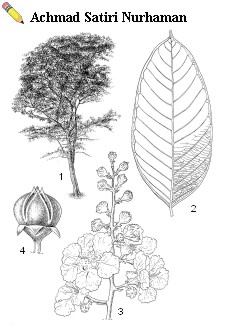 | Lagerstroemia speciosa (L.) Pers. – 1, tree habit; 2, leaf; 3, inflorescence; 4, fruit. |
Ecology
Most Lagerstroemia species are found at low to medium altitudes in comparatively open habitats, in disturbed or secondary forest, grassland, and are especially common along rivers. L. ovalifolia, however, is a primary forest species. Most species are scattered but may become locally dominant. The habitat may vary from well-drained to occasionally flooded, but not peaty.
Silviculture and Management
Lagerstroemia can be propagated by seed. Branch and root cuttings have been used occasionally and tissue culture has been successful on an experimental scale. L. speciosa has 165 000-235 000 dry seeds/kg. Seeds can be stored without temperature control in airtight containers for about 2 years without a serious decline in viability; germination increases during the first 3 months to 1 year of storage. Seeds should be sown in the shade; those of L. langkawiensis Furtado & Srisuko show about 40% germination in 11-40 days and seeds of L. speciosa germinate in 15-56 days. After germination the small seedlings can be pricked out and transferred to containers. Stumps of L. speciosa with a shoot length of 5-10 cm, a root length of 10-20 cm and a diameter of 0.5-2.5 cm showed 90-100% survival. Lagerstroemia requires moderately fertile soil. In trials with L. speciosa planted at 3 m x 1 m on fertile soils in East Java the canopy closed after 6 years and the first thinning was necessary after 8 years. As growth is fairly slow and natural pruning poor, it is recommended to use a closer spacing, namely 2.5 m x 1 m. At 15.5 years the clear bole volume yield in these trials was 47-55 m3/ha. It has been proposed to girdle trees 2 years before harvest to allow for easier seasoning. Lagerstroemia coppices freely and L. speciosa is fairly resistant to fire.
Genetic Resources and Breeding
There is little risk of genetic erosion of Lagerstroemia.
Prospects
Increased use of Lagerstroemia timber may be expected as growth is satisfactory and information on propagation and plantation establishment is becoming available.
Literature
[11]Aguilar, L., 1950. Calorific values of Philippine woods. Philippine Journal of Forestry 6(2): 217-225.
[70]Backer, C.A. & Bakhuizen van den Brink Jr., R.C., 1963-1968. Flora of Java. 3 volumes. Wolters-Noordhoff, Groningen.
[101]Beekman, H., 1920. 78 Preanger houtsoorten. Beschrijving, afbeelding en determinatietabel [78 Priangan wood species. Description, pictures and identification key]. Mededeelingen No 5. Proefstation voor het Boschwezen, Buitenzorg. 186 pp.
[130]Bosbouwproefstation, 1948. Tabellarisch overzicht van de beste kiem-, bewaar- en verzendingswijze van zaad van een aantal boomsoorten en groenbemesters [Tabular summary of the best ways to germinate, store and send seed of some tree and green manure species]. Voorlopig rapport No 38. Bosbouwproefstation, Buitenzorg. 15 pp.
[151]Browne, F.G., 1955. Forest trees of Sarawak and Brunei and their products. Government Printing Office, Kuching, Sarawak. xviii + 369 pp.
[162]Burgess, P.F., 1966. Timbers of Sabah. Sabah Forest Records No 6. Forest Department, Sabah, Sandakan. xviii + 501 pp.
[163]Burkill, I.H., 1966. A dictionary of the economic products of the Malay Peninsula. 2nd edition. Ministry of Agriculture and Co-operatives, Kuala Lumpur. Vol. 1 (A-H) pp. 1-1240. Vol. 2 (I-Z) pp. 1241-2444.
[193]Chudnoff, M., 1980. Tropical timbers of the world. Forest Products Laboratory, Forest Service, United States Department of Agriculture, Madison. 831 pp.
[198]Cockburn, P.F., 1976-1980. Trees of Sabah. 2 volumes. Sabah Forest Records No 10. Forest Department Sabah, Sandakan.
[209]Corner, E.J.H., 1988. Wayside trees of Malaya. 3rd edition. 2 volumes. The Malayan Nature Society, Kuala Lumpur. 774 pp.
[218]Dahms, K.-G., 1982. Asiatische, ozeanische und australische Exporthölzer [Asiatic, Pacific and Australian export timbers]. DRW-Verlag, Stuttgart. 304 pp.
[235]de Guzman, E.D., Umali, R.M. & Sotalbo, E.D., 1986. Guide to the Philippine flora and fauna. Vol. 3: Dipterocarps, non-dipterocarps. Natural Resources Management Centre, Ministry of Natural Resources, Quezon City & University of the Philippines, Los Baños. xx + 414 pp.
[259]den Berger, L.G., 1926. Mechanical properties of Dutch East Indian timbers. Korte Mededeelingen No 12. Proefstation voor het Boschwezen, Buitenzorg. viii + 63 pp.
[260]den Berger, L.G., 1926. Houtsoorten der cultuurgebieden van Java en Sumatra's oostkust [Tree species of the cultivated areas of Java and the east coast of Sumatra]. Mededeelingen No 13. Proefstation voor het Boschwezen, Buitenzorg. 186 pp.
[267]Desch, H.E., 1941-1954. Manual of Malayan timbers. Malayan Forest Records No 15. 2 volumes. Malaya Publishing House Ltd., Singapore. 762 pp.
[308]Eidmann, F.E., 1933. Kiemingsonderzoek bij een 55-tal wildhoutsoorten en groenbemesters [Research on the germination of seeds of some 55 tree species and green manures]. Mededeelingen No 26. Boschbouwproefstation, Buitenzorg. 156 pp.
[309]Eidmann, F.E., 1933. Stekken en stumps [Cuttings and stumps]. Korte Mededeelingen No 36. Boschbouwproefstation, Buitenzorg. 63 pp.
[348]Forest Products Research Centre, 1967. Properties and uses of Papua and New Guinea timbers. Forest Products Research Centre, Port Moresby. 30 pp.
[354]Foxworthy, F.W., 1927. Commercial timber trees of the Malay Peninsula. Malayan Forest Records No 3. Forest Department, Kuala Lumpur. 185 pp.
[362]Furtado, C.X. & Srisuko, M., 1969. A revision of Lagerstroemia L. (Lythraceae). Gardens' Bulletin, Singapore 24: 185-335.
[365]Garcia, L.L. et al., 1987. Pharmaceutico-chemical and pharmacological studies on a crude drug from Lagerstroemia speciosa (L.) Pers. Philippine Journal of Science 116(4): 361-375.
[405]Hardjowasono, M.S., 1942. Gewicht en volume van verschillende vrucht- en zaadsoorten [Weight and volume of various fruits and seeds]. Korte Mededelingen No 20. Bosbouwproefstation, Buitenzorg. 172 pp.
[434]Heringa, P.K., 1916. Iets over de verbrandingswaarde van eenige Indische houtsoorten [Remarks on the energy value of some wood species from the Dutch East Indies]. Tectona 9: 375-382.
[436]Heyne, K., 1927. De nuttige planten van Nederlands-Indië [The useful plants of the Dutch East Indies]. 2nd edition, 3 volumes. Departement van Landbouw, Nijverheid en Handel in Nederlandsch-Indië. 1953 pp. (3rd edition, 1950. van Hoeve, 's-Gravenhage/Bandung. 1660 pp.).
[477]Jain, J.D. & Dangwal, M.N., 1984. A note on physical and mechanical properties of Lagerstroemia speciosa from Kerala, India. Indian Forester 110: 503-509.
[488]Japing, H.W. & Oey Djoen Seng, 1936. Cultuurproeven met wildhoutsoorten in Gadoengan - met overzicht van de literatuur betreffende deze soorten [Trial plantations of non teak wood species in Gadungan (East Java) - with survey of literature about these species]. Korte Mededeelingen No 55, part I to VI. Boschbouwproefstation, Buitenzorg. 270 pp.
[536]Keating, W.G. & Bolza, E., 1982. Characteristics, properties and uses of timbers. Vol. 1. South-East Asia, northern Australia and the Pacific. Inkata Press Proprietary Ltd., Melbourne, Sydney & London. 362 pp.
[571]Kloot, N.H. & Bolza, E., 1961. Properties of timbers imported into Australia. Technological Paper No 12. Division of Forest Products, CSIRO, Melbourne. 79 pp.
[644]Kuswara, T., 1982. Budidaya rotan di Kalimantan Tengah [The cultivation of rattan in Central Kalimantan]. Buletin Kebun Raya 5(4): 85-90.
[697]Letourneux, C., 1957. Tree planting practices in tropical Asia. FAO Forestry Development Paper No 11. FAO, Rome. 172 pp.
[736]Magini, E. & Tulstrup, N.P., 1955. Tree seed notes. I. Arid Areas II. Humid Tropics. FAO Forestry Development Paper 5. FAO, Rome. 354 pp.
[757]Martawijaya, A., Kartasujana, I., Kadir, K. & Prawira, S.A., 1992. Indonesian wood atlas. Vol. 2. Forest Products Research and Development Centre, Bogor. 168 pp.
[758]Masano, 1987. Prospek perkembangan kayu asing di Indonesia [Prospects of exotic trees in Indonesia]. In: Soemarna, K. et al. (Editors): Prosiding diskusi pemanfaatan kayu kurang dikenal, 13-14 Januari 1987, Cisarua, Bogor. Badan Penelitian dan Pengembangan Kehutanan, Bogor. pp. 221-241.
[804]Monsalud, M.R. & Tamolang, F.N., 1969. General information on Philippine hardwoods. Philippine Lumberman 15(7): 14-38.
[823]Ng, F.S.P., 1975. The fruits, seeds and seedlings of Malayan trees I-XI. Malaysian Forester 38: 33-99.
[829]Ng, F.S.P., 1991-1992. Manual of forest fruits, seeds and seedlings. 2 volumes. Malayan Forest Record No 34. Forest Research Institute Malaysia, Kepong. 997 pp.
[831]Ng, F.S.P. & Mat Asri Ngah Sanah, 1991. Germination and seedling records. Research Pamphlet No 108. Forest Research Institute Malaysia, Kepong. 191 pp.
[933]Research Institute of Wood Industry, 1988. Identification, properties and uses of some Southeast Asian woods. Chinese Academy of Forestry, Wan Shou Shan, Beijing & International Tropical Timber Organization, Yokohama. 201 pp.
[934]Reyes, L.J., 1938. Philippine woods. Technical Bulletin No 7. Commonwealth of the Philippines, Department of Agriculture and Commerce. Bureau of Printing, Manila. 536 pp. + 88 plates.
[974]Salvosa, F.M., 1963. Lexicon of Philippine trees. Bulletin No 1. Forest Products Research Institute, College, Laguna. 136 pp.
[1038]Smitinand, T., 1980. Thai plant names. Royal Forest Department, Bangkok. 379 pp.
[1048]Soepadmo, E., Wong, K.M. & Saw, L.G. (Editors), 1995-. Tree flora of Sabah and Sarawak. Sabah Forestry Department, Forest Research Institute Malaysia and Sarawak Forestry Department, Kepong.
[1052]Stadelman, R.C., 1966. Forests of Southeast Asia. Princeton, Memphis, Tennessee. 245 pp.
[1086]Tamesis, F. & Aguilar, L., 1951. Important commercial timbers of the Philippines: their properties and uses. Popular Bulletin No 32. Department of Agriculture and Natural Resources. Bureau of Printing, Manila. 83 pp.
[1090]Tavita, Y.L. & Palisoc, J.G., 1979. Morphological characteristics of some Philippine hardwoods and other plant fibres. Forpride Digest 8(3-4): 31-47.
[1098]Timber Research and Development Association, 1979. Timbers of the world. Volume 1. Africa, S. America, Southern Asia, S.E. Asia. TRADA/The Construction Press, Lancaster. 463 pp.
[1177]von Meyenfeldt, C.F.W.M. et al., 1978. Restoration of devastated inland forests in South Vietnam. Volume III: List of tree species. Agricultural University, Wageningen. 219 pp.
[1198]Weidelt, H.J. (Editor), 1976. Manual of reforestation and erosion control for the Philippines. Schriftenreihe No 22. Deutsche Gesellschaft für Technische Zusammenarbeit (GTZ) GmbH, Eschborn. 569 pp.
[1199]Werkgoep Tropische Houtteelt, 1973. Bebossing van geërodeerde gronden op Java - bijlage III: Houtsoorten [Afforestation of eroded lands in Java - Annex III: Tree species]. Landbouwhogeschool Wageningen. 128 pp.
[1221]Whitmore, T.C. & Ng, F.S.P. (Editors), 1972-1989. Tree flora of Malaya. A manual for foresters. 4 volumes. Malayan Forest Records No 26. Longman Malaysia Sdn. Berhad, Kuala Lumpur & Petaling Jaya.
[1242]Wong, T.M., 1982. A dictionary of Malaysian timbers. Malayan Forest Records No 30. Forest Research Institute Malaysia, Kepong. 259 pp.
[70]Backer, C.A. & Bakhuizen van den Brink Jr., R.C., 1963-1968. Flora of Java. 3 volumes. Wolters-Noordhoff, Groningen.
[101]Beekman, H., 1920. 78 Preanger houtsoorten. Beschrijving, afbeelding en determinatietabel [78 Priangan wood species. Description, pictures and identification key]. Mededeelingen No 5. Proefstation voor het Boschwezen, Buitenzorg. 186 pp.
[130]Bosbouwproefstation, 1948. Tabellarisch overzicht van de beste kiem-, bewaar- en verzendingswijze van zaad van een aantal boomsoorten en groenbemesters [Tabular summary of the best ways to germinate, store and send seed of some tree and green manure species]. Voorlopig rapport No 38. Bosbouwproefstation, Buitenzorg. 15 pp.
[151]Browne, F.G., 1955. Forest trees of Sarawak and Brunei and their products. Government Printing Office, Kuching, Sarawak. xviii + 369 pp.
[162]Burgess, P.F., 1966. Timbers of Sabah. Sabah Forest Records No 6. Forest Department, Sabah, Sandakan. xviii + 501 pp.
[163]Burkill, I.H., 1966. A dictionary of the economic products of the Malay Peninsula. 2nd edition. Ministry of Agriculture and Co-operatives, Kuala Lumpur. Vol. 1 (A-H) pp. 1-1240. Vol. 2 (I-Z) pp. 1241-2444.
[193]Chudnoff, M., 1980. Tropical timbers of the world. Forest Products Laboratory, Forest Service, United States Department of Agriculture, Madison. 831 pp.
[198]Cockburn, P.F., 1976-1980. Trees of Sabah. 2 volumes. Sabah Forest Records No 10. Forest Department Sabah, Sandakan.
[209]Corner, E.J.H., 1988. Wayside trees of Malaya. 3rd edition. 2 volumes. The Malayan Nature Society, Kuala Lumpur. 774 pp.
[218]Dahms, K.-G., 1982. Asiatische, ozeanische und australische Exporthölzer [Asiatic, Pacific and Australian export timbers]. DRW-Verlag, Stuttgart. 304 pp.
[235]de Guzman, E.D., Umali, R.M. & Sotalbo, E.D., 1986. Guide to the Philippine flora and fauna. Vol. 3: Dipterocarps, non-dipterocarps. Natural Resources Management Centre, Ministry of Natural Resources, Quezon City & University of the Philippines, Los Baños. xx + 414 pp.
[259]den Berger, L.G., 1926. Mechanical properties of Dutch East Indian timbers. Korte Mededeelingen No 12. Proefstation voor het Boschwezen, Buitenzorg. viii + 63 pp.
[260]den Berger, L.G., 1926. Houtsoorten der cultuurgebieden van Java en Sumatra's oostkust [Tree species of the cultivated areas of Java and the east coast of Sumatra]. Mededeelingen No 13. Proefstation voor het Boschwezen, Buitenzorg. 186 pp.
[267]Desch, H.E., 1941-1954. Manual of Malayan timbers. Malayan Forest Records No 15. 2 volumes. Malaya Publishing House Ltd., Singapore. 762 pp.
[308]Eidmann, F.E., 1933. Kiemingsonderzoek bij een 55-tal wildhoutsoorten en groenbemesters [Research on the germination of seeds of some 55 tree species and green manures]. Mededeelingen No 26. Boschbouwproefstation, Buitenzorg. 156 pp.
[309]Eidmann, F.E., 1933. Stekken en stumps [Cuttings and stumps]. Korte Mededeelingen No 36. Boschbouwproefstation, Buitenzorg. 63 pp.
[348]Forest Products Research Centre, 1967. Properties and uses of Papua and New Guinea timbers. Forest Products Research Centre, Port Moresby. 30 pp.
[354]Foxworthy, F.W., 1927. Commercial timber trees of the Malay Peninsula. Malayan Forest Records No 3. Forest Department, Kuala Lumpur. 185 pp.
[362]Furtado, C.X. & Srisuko, M., 1969. A revision of Lagerstroemia L. (Lythraceae). Gardens' Bulletin, Singapore 24: 185-335.
[365]Garcia, L.L. et al., 1987. Pharmaceutico-chemical and pharmacological studies on a crude drug from Lagerstroemia speciosa (L.) Pers. Philippine Journal of Science 116(4): 361-375.
[405]Hardjowasono, M.S., 1942. Gewicht en volume van verschillende vrucht- en zaadsoorten [Weight and volume of various fruits and seeds]. Korte Mededelingen No 20. Bosbouwproefstation, Buitenzorg. 172 pp.
[434]Heringa, P.K., 1916. Iets over de verbrandingswaarde van eenige Indische houtsoorten [Remarks on the energy value of some wood species from the Dutch East Indies]. Tectona 9: 375-382.
[436]Heyne, K., 1927. De nuttige planten van Nederlands-Indië [The useful plants of the Dutch East Indies]. 2nd edition, 3 volumes. Departement van Landbouw, Nijverheid en Handel in Nederlandsch-Indië. 1953 pp. (3rd edition, 1950. van Hoeve, 's-Gravenhage/Bandung. 1660 pp.).
[477]Jain, J.D. & Dangwal, M.N., 1984. A note on physical and mechanical properties of Lagerstroemia speciosa from Kerala, India. Indian Forester 110: 503-509.
[488]Japing, H.W. & Oey Djoen Seng, 1936. Cultuurproeven met wildhoutsoorten in Gadoengan - met overzicht van de literatuur betreffende deze soorten [Trial plantations of non teak wood species in Gadungan (East Java) - with survey of literature about these species]. Korte Mededeelingen No 55, part I to VI. Boschbouwproefstation, Buitenzorg. 270 pp.
[536]Keating, W.G. & Bolza, E., 1982. Characteristics, properties and uses of timbers. Vol. 1. South-East Asia, northern Australia and the Pacific. Inkata Press Proprietary Ltd., Melbourne, Sydney & London. 362 pp.
[571]Kloot, N.H. & Bolza, E., 1961. Properties of timbers imported into Australia. Technological Paper No 12. Division of Forest Products, CSIRO, Melbourne. 79 pp.
[644]Kuswara, T., 1982. Budidaya rotan di Kalimantan Tengah [The cultivation of rattan in Central Kalimantan]. Buletin Kebun Raya 5(4): 85-90.
[697]Letourneux, C., 1957. Tree planting practices in tropical Asia. FAO Forestry Development Paper No 11. FAO, Rome. 172 pp.
[736]Magini, E. & Tulstrup, N.P., 1955. Tree seed notes. I. Arid Areas II. Humid Tropics. FAO Forestry Development Paper 5. FAO, Rome. 354 pp.
[757]Martawijaya, A., Kartasujana, I., Kadir, K. & Prawira, S.A., 1992. Indonesian wood atlas. Vol. 2. Forest Products Research and Development Centre, Bogor. 168 pp.
[758]Masano, 1987. Prospek perkembangan kayu asing di Indonesia [Prospects of exotic trees in Indonesia]. In: Soemarna, K. et al. (Editors): Prosiding diskusi pemanfaatan kayu kurang dikenal, 13-14 Januari 1987, Cisarua, Bogor. Badan Penelitian dan Pengembangan Kehutanan, Bogor. pp. 221-241.
[804]Monsalud, M.R. & Tamolang, F.N., 1969. General information on Philippine hardwoods. Philippine Lumberman 15(7): 14-38.
[823]Ng, F.S.P., 1975. The fruits, seeds and seedlings of Malayan trees I-XI. Malaysian Forester 38: 33-99.
[829]Ng, F.S.P., 1991-1992. Manual of forest fruits, seeds and seedlings. 2 volumes. Malayan Forest Record No 34. Forest Research Institute Malaysia, Kepong. 997 pp.
[831]Ng, F.S.P. & Mat Asri Ngah Sanah, 1991. Germination and seedling records. Research Pamphlet No 108. Forest Research Institute Malaysia, Kepong. 191 pp.
[933]Research Institute of Wood Industry, 1988. Identification, properties and uses of some Southeast Asian woods. Chinese Academy of Forestry, Wan Shou Shan, Beijing & International Tropical Timber Organization, Yokohama. 201 pp.
[934]Reyes, L.J., 1938. Philippine woods. Technical Bulletin No 7. Commonwealth of the Philippines, Department of Agriculture and Commerce. Bureau of Printing, Manila. 536 pp. + 88 plates.
[974]Salvosa, F.M., 1963. Lexicon of Philippine trees. Bulletin No 1. Forest Products Research Institute, College, Laguna. 136 pp.
[1038]Smitinand, T., 1980. Thai plant names. Royal Forest Department, Bangkok. 379 pp.
[1048]Soepadmo, E., Wong, K.M. & Saw, L.G. (Editors), 1995-. Tree flora of Sabah and Sarawak. Sabah Forestry Department, Forest Research Institute Malaysia and Sarawak Forestry Department, Kepong.
[1052]Stadelman, R.C., 1966. Forests of Southeast Asia. Princeton, Memphis, Tennessee. 245 pp.
[1086]Tamesis, F. & Aguilar, L., 1951. Important commercial timbers of the Philippines: their properties and uses. Popular Bulletin No 32. Department of Agriculture and Natural Resources. Bureau of Printing, Manila. 83 pp.
[1090]Tavita, Y.L. & Palisoc, J.G., 1979. Morphological characteristics of some Philippine hardwoods and other plant fibres. Forpride Digest 8(3-4): 31-47.
[1098]Timber Research and Development Association, 1979. Timbers of the world. Volume 1. Africa, S. America, Southern Asia, S.E. Asia. TRADA/The Construction Press, Lancaster. 463 pp.
[1177]von Meyenfeldt, C.F.W.M. et al., 1978. Restoration of devastated inland forests in South Vietnam. Volume III: List of tree species. Agricultural University, Wageningen. 219 pp.
[1198]Weidelt, H.J. (Editor), 1976. Manual of reforestation and erosion control for the Philippines. Schriftenreihe No 22. Deutsche Gesellschaft für Technische Zusammenarbeit (GTZ) GmbH, Eschborn. 569 pp.
[1199]Werkgoep Tropische Houtteelt, 1973. Bebossing van geërodeerde gronden op Java - bijlage III: Houtsoorten [Afforestation of eroded lands in Java - Annex III: Tree species]. Landbouwhogeschool Wageningen. 128 pp.
[1221]Whitmore, T.C. & Ng, F.S.P. (Editors), 1972-1989. Tree flora of Malaya. A manual for foresters. 4 volumes. Malayan Forest Records No 26. Longman Malaysia Sdn. Berhad, Kuala Lumpur & Petaling Jaya.
[1242]Wong, T.M., 1982. A dictionary of Malaysian timbers. Malayan Forest Records No 30. Forest Research Institute Malaysia, Kepong. 259 pp.
Author(s)
D.S. Alonzo
Lagerstroemia borneensis
Lagerstroemia koehneana
Lagerstroemia moluccana
Lagerstroemia ovalifolia
Lagerstroemia paniculata
Lagerstroemia piriformis
Lagerstroemia speciosa
Lagerstroemia subcostata
Lagerstroemia koehneana
Lagerstroemia moluccana
Lagerstroemia ovalifolia
Lagerstroemia paniculata
Lagerstroemia piriformis
Lagerstroemia speciosa
Lagerstroemia subcostata
Correct Citation of this Article
Alonzo, D.S., 1998. Lagerstroemia L.. In: Sosef, M.S.M., Hong, L.T. and Prawirohatmodjo, S. (Editors): Plant Resources of South-East Asia No 5(3): Timber trees; Lesser-known timbers. PROSEA Foundation, Bogor, Indonesia. Database record: prota4u.org/prosea
Selection of Species
The following species in this genus are important in this commodity group and are treated separatedly in this database:
Lagerstroemia borneensis
Lagerstroemia koehneana
Lagerstroemia moluccana
Lagerstroemia ovalifolia
Lagerstroemia paniculata
Lagerstroemia piriformis
Lagerstroemia speciosa
Lagerstroemia subcostata
Lagerstroemia borneensis
Lagerstroemia koehneana
Lagerstroemia moluccana
Lagerstroemia ovalifolia
Lagerstroemia paniculata
Lagerstroemia piriformis
Lagerstroemia speciosa
Lagerstroemia subcostata

All texts are licensed under a Creative Commons Attribution-Noncommercial-Share Alike 3.0 Netherlands License
This license does not include the illustrations (Maps,drawings,pictures); these remain all under copyright.