Record Number
5744
PROSEA Handbook Number
5(3): Timber trees; Lesser-known timbers
Taxon
Lumnitzera Willd.
Protologue
Ges. Naturf. Freunde Berlin Neue Schriften 4: 186 (1803).
Family
COMBRETACEAE
Chromosome Numbers
x = 13; L. racemosa: 2n = 26
Vernacular Names
Teruntum (trade name). Indonesia: duduk, tarungtung (Java, Sumatra), sesop (Sumatra). Malaysia: geriting (Sabah), sop sop, teruntum (Peninsular, Sarawak). Papua New Guinea: brown mangrove (En). Philippines: tabau. Thailand: faat.
Origin and Geographic Distribution
Lumnitzera comprises 2 species found along the coasts of eastern Africa and Madagascar to tropical Asia, Japan, Polynesia and northern Australia. Both are found throughout the Malesian region.
Uses
The timber of Lumnitzera is used for salt-water piling (with the bark on) and fencing and to a lesser extent for heavy construction, house posts, railway sleepers, boat building, tool handles, turnery, furniture, parquet flooring, panelling, mouldings, skirtings, door and window frames, wooden pallets and packing crates, and other purposes where toughness and hardness are required and small-sized timber can be applied. It is also used for chipboard and as firewood. The pale, hard and very fine-textured wood of L. racemosa could be used as a substitute for boxwood (Buxus spp.) for small articles such as rulers, canes, bobbins, shuttles and novelties.
The leaves are used as a remedy for sprue. The bark of L. littorea yields tannin used to dye clothes yellowish-brown and to tan nets and leather.
The leaves are used as a remedy for sprue. The bark of L. littorea yields tannin used to dye clothes yellowish-brown and to tan nets and leather.
Production and International Trade
Supplies of Lumnitzera timber are generally limited. It has been logged commercially for wood chips in Sabah, but as the wood is generally mixed with that of other mangrove species no specific trade figures are available.
Properties
Lumnitzera yields a medium-weight to heavy hardwood with a density of 750-970 kg/m3 at 15% moisture content, L. racemosa having heavier wood than L. littorea. Heartwood pale brownish-red to pale grey-brownor yellowish-brown, not clearly differentiated from the narrow, paler sapwood; grain straight to shallowly interlocked; texture fine (L. littorea) or very fine (L. racemosa) and even; wood lustrous and that of L. littorea with a scent of roses or with spicy odour when freshly cut. Growth rings usually visible to the naked eye, prominent on radial surface, marked by denser and darker tissues; vessels moderately small, solitary and in radial multiples of 2-7(-9) fewer multiples in L. racemosa, radial pattern evident, occasionally with tyloses or chalky deposits; parenchyma sparse, sometimes apotracheal in marginal or seemingly marginal bands, paratracheal scanty to vasicentric and with some apotracheal diffuse; rays extremely fine to moderately fine; ripple marks absent.
Shrinkage is low and the wood seasons well with little degrade, but end splits may develop. The wood is very stable in use. It takes about 2 months and 3.5 months respectively to air dry 13 mm and 38 mm thick boards of L. littorea. The wood is hard, strong and tough, L. racemosa having harder and stronger wood than L. littorea. The bole of L. littorea is often of poor form and may be knotty. It is easy to saw and cross-cut and produces a good finish; planing produces a silky sheen and the wood turns excellently. The wood is moderately durable to durable and in the Philippines it had a service life of about 3.5 years in graveyard tests. In marine piling (with bark on) it is serviceable for about 7 years, but a range of 2-30 years has been reported, the wide range being attributed to local differences in marine borer attack and probably to salinity conditions. It is not resistant to termites, however. The sapwood is rarely susceptible to Lyctus. The wood, probably the heartwood of L. littorea, absorbed only about 46.5 kg/m3 of a mixture of creosote and diesel fuel when treated with the open tank method.
The mean fibre lenght of L. littorea from Indonesia is 1.134 mm. The bark of L. racemosa contains about 19% tannin.
See also the tables on microscopic wood anatomy and wood properties.
Shrinkage is low and the wood seasons well with little degrade, but end splits may develop. The wood is very stable in use. It takes about 2 months and 3.5 months respectively to air dry 13 mm and 38 mm thick boards of L. littorea. The wood is hard, strong and tough, L. racemosa having harder and stronger wood than L. littorea. The bole of L. littorea is often of poor form and may be knotty. It is easy to saw and cross-cut and produces a good finish; planing produces a silky sheen and the wood turns excellently. The wood is moderately durable to durable and in the Philippines it had a service life of about 3.5 years in graveyard tests. In marine piling (with bark on) it is serviceable for about 7 years, but a range of 2-30 years has been reported, the wide range being attributed to local differences in marine borer attack and probably to salinity conditions. It is not resistant to termites, however. The sapwood is rarely susceptible to Lyctus. The wood, probably the heartwood of L. littorea, absorbed only about 46.5 kg/m3 of a mixture of creosote and diesel fuel when treated with the open tank method.
The mean fibre lenght of L. littorea from Indonesia is 1.134 mm. The bark of L. racemosa contains about 19% tannin.
See also the tables on microscopic wood anatomy and wood properties.
Botany
Evergreen, small to fairly large trees up to 37 m tall (L. racemosa usually much smaller); bole straight and cylindrical under favourable conditions, otherwise rather poorly shaped, often twisted, branchless for up to 12 m, up to 60(-100) cm in diameter, without buttresses but producing pneumatophores and sometimes stilt roots; bark surface shallowly fissured, lenticellate, fawn-brown to greyish, inner bark deep red outwards, orange within; crown pale green, irregular. Leaves arranged spirally, in tufts towards the end of twigs, simple, obovate, rather fleshy, margin slightly notched, subsessile, exstipulate. Flowers in a short, axillary or terminal spike or raceme, 5-merous; receptacle (calyx tube) bearing 2 adnate, persistent bracteoles; petals free, scarlet or white, caducous; stamens 5-10, borne on the inner wall of the receptacle tube; disk absent or obscure; ovary inferior, 1-locular with 2-5 ovules, style 1, persistent. Fruit a more or less woody, compressed ellipsoid pseudocarp, 1-seeded, crowned by the persistent calyx. Seedling with epigeal germination; cotyledons emergent; hypocotyl elongated.
L. racemosa develops according to Attims' architectural model, characterized by axes with continuous growth, differentiated into a monopodial trunk and equivalent branches. L. littorea develops according to Scarrone's model with an indeterminate trunk bearing tiers of orthotropic branches, which branch sympodially as a result of terminal flowering. L. littorea flowers throughout the year; fruit development takes 3-4 months. The flowers of L. racemosa are pollinated predominantly by honey-eaters (Melphagidea), bees, wasps and presumably also by small birds sipping the nectar inaccessible to insects. The flowers of L. littorea are frequently visited by wasps, bees, butterflies and day-active moths. This difference is probably related to the fact that the flowers of the former are slightly zygomorphic whereas those of the latter are actinomorphic.
L. x rosea Gaud., the hybrid of L. littorea and L. racemosa, has occasionally been observed. It is distinguishable by its pink flowers of intermediate length. Yellow-flowered plants of L. racemosa have been distinguished as var. lutea (Gaud.) Exell.
L. racemosa develops according to Attims' architectural model, characterized by axes with continuous growth, differentiated into a monopodial trunk and equivalent branches. L. littorea develops according to Scarrone's model with an indeterminate trunk bearing tiers of orthotropic branches, which branch sympodially as a result of terminal flowering. L. littorea flowers throughout the year; fruit development takes 3-4 months. The flowers of L. racemosa are pollinated predominantly by honey-eaters (Melphagidea), bees, wasps and presumably also by small birds sipping the nectar inaccessible to insects. The flowers of L. littorea are frequently visited by wasps, bees, butterflies and day-active moths. This difference is probably related to the fact that the flowers of the former are slightly zygomorphic whereas those of the latter are actinomorphic.
L. x rosea Gaud., the hybrid of L. littorea and L. racemosa, has occasionally been observed. It is distinguishable by its pink flowers of intermediate length. Yellow-flowered plants of L. racemosa have been distinguished as var. lutea (Gaud.) Exell.
Image
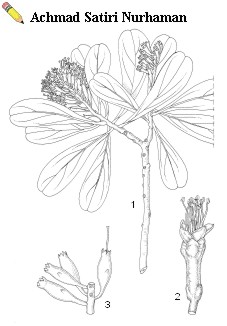 | Lumnitzera littorea (Jack) Voigt. – 1, flowering twig; 2, flower; 3, fruits. |
Ecology
Both Lumnitzera species are frequent and sometimes even gregarious elements occurring in the dry inner fringe of mangrove vegetation and along tidal rivers, mainly associated with Bruguiera spp. and Xylocarpus spp. They occasionally occur on exposed beaches or on rocks along the coast. Although both species seem to prefer the same ecological conditions, they seldom co-occur. L. littorea appears to prefer less saline, well-drained sites, often in association with Heritiera littoralis Aiton.
Silviculture and Management
Lumnitzera can be propagated by seed. In Micronesia seeds are collected from nets placed under seed-bearing trees. They are then stored dry. There are about 22 500 dry fruits/kg. Large trees of L. littorea are often hollow and green logs are sinkers. Natural regeneration is good, with locally over 700 seedlings/ha.
Genetic Resources and Breeding
L. littorea is becoming scarce because of its popularity for piling; it was already scarce in the 1960's in Sabah. In general, mangrove forests are fragmented because of exploitation for charcoal and firewood and conversion to other land uses.
Prospects
Lumnitzera is considered inferior to Rhizophora spp. for the reforestation of mangrove areas.
Literature
[61]Ashton, P.S., 1988. Manual of the non-dipterocarp trees of Sarawak. Vol. 2. Dewan Bahasa dan Pustaka, Kuala Lumpur. 490 pp.
[151]Browne, F.G., 1955. Forest trees of Sarawak and Brunei and their products. Government Printing Office, Kuching, Sarawak. xviii + 369 pp.
[162]Burgess, P.F., 1966. Timbers of Sabah. Sabah Forest Records No 6. Forest Department, Sabah, Sandakan. xviii + 501 pp.
[163]Burkill, I.H., 1966. A dictionary of the economic products of the Malay Peninsula. 2nd edition. Ministry of Agriculture and Co-operatives, Kuala Lumpur. Vol. 1 (A-H) pp. 1-1240. Vol. 2 (I-Z) pp. 1241-2444.
[238]de Vogel, E.F., 1980. Seedlings of dicotyledons. Structure, development, types. Descriptions of 150 woody Malesian taxa. Pudoc, Wageningen. 465 pp.
[267]Desch, H.E., 1941-1954. Manual of Malayan timbers. Malayan Forest Records No 15. 2 volumes. Malaya Publishing House Ltd., Singapore. 762 pp.
[305]Eddowes, P.J. & Ingle, H.D., 1969. Anatomical structure of the Combretaceae. In: Coode, M.J.E. (Editor): Manual of the forest trees of Papua New Guinea - part 1: Combretaceae. Division of Botany, Department of Forests, Lae. 86 pp.
[340]Flora of Australia (various editors), 1981-. Australian Government Publishing Service, Canberra.
[341]Flora Malesiana (various editors), 1950-. Kluwer Academic Publishers, Dordrecht, Boston, London.
[343]Flore du Cambodge, du Laos et du Viêtnam (various editors), 1960-. Muséum National d'Histoire Naturelle, Paris.
[402]Hallé, F., Oldeman, R.A.A. & Tomlinson, P.B., 1978. Tropical trees and forests - an architectural analysis. Springer Verlag, Berlin, Heidelberg, New York. 441 pp.
[403]Handbooks of the flora of Papua New Guinea (various editors), 1978-. Melbourne University Press, Carlton.
[405]Hardjowasono, M.S., 1942. Gewicht en volume van verschillende vrucht- en zaadsoorten [Weight and volume of various fruits and seeds]. Korte Mededelingen No 20. Bosbouwproefstation, Buitenzorg. 172 pp.
[436]Heyne, K., 1927. De nuttige planten van Nederlands-Indië [The useful plants of the Dutch East Indies]. 2nd edition, 3 volumes. Departement van Landbouw, Nijverheid en Handel in Nederlandsch-Indië. 1953 pp. (3rd edition, 1950. van Hoeve, 's-Gravenhage/Bandung. 1660 pp.).
[464]Ilic, J., 1990. The CSIRO macro key for hardwood identification. CSIRO, Highett. 125 pp.
[536]Keating, W.G. & Bolza, E., 1982. Characteristics, properties and uses of timbers. Vol. 1. South-East Asia, northern Australia and the Pacific. Inkata Press Proprietary Ltd., Melbourne, Sydney & London. 362 pp.
[703]Liew, T.C., 1980. Mangrove forests in Sabah. In: Srivasta, P.B.L. & Razali, A.K. (Editors): Mangroves and estuarine vegetation. The proceedings of the workshop held at Universiti Pertanian Malaysia, Serdang, Selangor on 10 December 1977. Universiti Pertanian Malaysia, Serdang. pp. 6–31.
[717]Lomibao, B.A., 1978. Wood anatomy of Philippine mangrove species. Forpride Digest 7(1): 23-34.
[740]Malaysian Timber Industry Board, 1984. Peraturan pemeringkatan kayu keras gergaji Malaysia [The Malaysian grading rules for sawn hardwood timber]. Ministry of Primary Industries, Kuala Lumpur. 109 pp.
[741]Malaysian Timber Industry Board, 1986. 100 Malaysian timbers. Kuala Lumpur. x + 226 pp.
[745]Mandang, Y.I., 1991. Anatomi dan identifikasi 21 jenis kayu kurang dikenal [Anatomy and identification of 21 lesser-known timber species]. Jurnal Penelitian Hasil Hutan 9(1): 5-23.
[880]Percival, M. & Womersley, J.S., 1975. Floristics and ecology of the mangrove vegetation of Papua New Guinea. Botany Bulletin No 8. Department of Forests, Division of Botany, Lae. 96 pp.
[889]Phengklai, C. & Khamsai, S., 1985. Some non-timber species of Thailand. Thai Forest Bulletin (Botany) 15: 108-148.
[924]Ramesh Rao, K. & Purkayastha, S.K., 1972. Indian woods: their identification, properties and uses. Vol. 3: Leguminosae to Combretaceae. Manager of Publications, Delhi. 262 pp.
[934]Reyes, L.J., 1938. Philippine woods. Technical Bulletin No 7. Commonwealth of the Philippines, Department of Agriculture and Commerce. Bureau of Printing, Manila. 536 pp. + 88 plates.
[974]Salvosa, F.M., 1963. Lexicon of Philippine trees. Bulletin No 1. Forest Products Research Institute, College, Laguna. 136 pp.
[1038]Smitinand, T., 1980. Thai plant names. Royal Forest Department, Bangkok. 379 pp.
[1103]Tomlinson, P.B., Bunt, J.S., Primack, R.B. & Duke, N.C., 1978. Lumnitzera rosea (Combretaceae) - its status and floral morphology. Journal of the Arnold Arboretum 59: 342-351.
[1113]Umali, R.M., Zamora, P.M., Gotera, R.R., Jara, R.S. & Camacho, A.S. (Editors), 1986. Mangroves of Asia and the Pacific: status and management. Technical report of the UNDP/UNESCO research and training pilot programme on mangrove ecosystems in Asia and the Pacific. 538 pp.
[1221]Whitmore, T.C. & Ng, F.S.P. (Editors), 1972-1989. Tree flora of Malaya. A manual for foresters. 4 volumes. Malayan Forest Records No 26. Longman Malaysia Sdn. Berhad, Kuala Lumpur & Petaling Jaya.
[1242]Wong, T.M., 1982. A dictionary of Malaysian timbers. Malayan Forest Records No 30. Forest Research Institute Malaysia, Kepong. 259 pp.
[151]Browne, F.G., 1955. Forest trees of Sarawak and Brunei and their products. Government Printing Office, Kuching, Sarawak. xviii + 369 pp.
[162]Burgess, P.F., 1966. Timbers of Sabah. Sabah Forest Records No 6. Forest Department, Sabah, Sandakan. xviii + 501 pp.
[163]Burkill, I.H., 1966. A dictionary of the economic products of the Malay Peninsula. 2nd edition. Ministry of Agriculture and Co-operatives, Kuala Lumpur. Vol. 1 (A-H) pp. 1-1240. Vol. 2 (I-Z) pp. 1241-2444.
[238]de Vogel, E.F., 1980. Seedlings of dicotyledons. Structure, development, types. Descriptions of 150 woody Malesian taxa. Pudoc, Wageningen. 465 pp.
[267]Desch, H.E., 1941-1954. Manual of Malayan timbers. Malayan Forest Records No 15. 2 volumes. Malaya Publishing House Ltd., Singapore. 762 pp.
[305]Eddowes, P.J. & Ingle, H.D., 1969. Anatomical structure of the Combretaceae. In: Coode, M.J.E. (Editor): Manual of the forest trees of Papua New Guinea - part 1: Combretaceae. Division of Botany, Department of Forests, Lae. 86 pp.
[340]Flora of Australia (various editors), 1981-. Australian Government Publishing Service, Canberra.
[341]Flora Malesiana (various editors), 1950-. Kluwer Academic Publishers, Dordrecht, Boston, London.
[343]Flore du Cambodge, du Laos et du Viêtnam (various editors), 1960-. Muséum National d'Histoire Naturelle, Paris.
[402]Hallé, F., Oldeman, R.A.A. & Tomlinson, P.B., 1978. Tropical trees and forests - an architectural analysis. Springer Verlag, Berlin, Heidelberg, New York. 441 pp.
[403]Handbooks of the flora of Papua New Guinea (various editors), 1978-. Melbourne University Press, Carlton.
[405]Hardjowasono, M.S., 1942. Gewicht en volume van verschillende vrucht- en zaadsoorten [Weight and volume of various fruits and seeds]. Korte Mededelingen No 20. Bosbouwproefstation, Buitenzorg. 172 pp.
[436]Heyne, K., 1927. De nuttige planten van Nederlands-Indië [The useful plants of the Dutch East Indies]. 2nd edition, 3 volumes. Departement van Landbouw, Nijverheid en Handel in Nederlandsch-Indië. 1953 pp. (3rd edition, 1950. van Hoeve, 's-Gravenhage/Bandung. 1660 pp.).
[464]Ilic, J., 1990. The CSIRO macro key for hardwood identification. CSIRO, Highett. 125 pp.
[536]Keating, W.G. & Bolza, E., 1982. Characteristics, properties and uses of timbers. Vol. 1. South-East Asia, northern Australia and the Pacific. Inkata Press Proprietary Ltd., Melbourne, Sydney & London. 362 pp.
[703]Liew, T.C., 1980. Mangrove forests in Sabah. In: Srivasta, P.B.L. & Razali, A.K. (Editors): Mangroves and estuarine vegetation. The proceedings of the workshop held at Universiti Pertanian Malaysia, Serdang, Selangor on 10 December 1977. Universiti Pertanian Malaysia, Serdang. pp. 6–31.
[717]Lomibao, B.A., 1978. Wood anatomy of Philippine mangrove species. Forpride Digest 7(1): 23-34.
[740]Malaysian Timber Industry Board, 1984. Peraturan pemeringkatan kayu keras gergaji Malaysia [The Malaysian grading rules for sawn hardwood timber]. Ministry of Primary Industries, Kuala Lumpur. 109 pp.
[741]Malaysian Timber Industry Board, 1986. 100 Malaysian timbers. Kuala Lumpur. x + 226 pp.
[745]Mandang, Y.I., 1991. Anatomi dan identifikasi 21 jenis kayu kurang dikenal [Anatomy and identification of 21 lesser-known timber species]. Jurnal Penelitian Hasil Hutan 9(1): 5-23.
[880]Percival, M. & Womersley, J.S., 1975. Floristics and ecology of the mangrove vegetation of Papua New Guinea. Botany Bulletin No 8. Department of Forests, Division of Botany, Lae. 96 pp.
[889]Phengklai, C. & Khamsai, S., 1985. Some non-timber species of Thailand. Thai Forest Bulletin (Botany) 15: 108-148.
[924]Ramesh Rao, K. & Purkayastha, S.K., 1972. Indian woods: their identification, properties and uses. Vol. 3: Leguminosae to Combretaceae. Manager of Publications, Delhi. 262 pp.
[934]Reyes, L.J., 1938. Philippine woods. Technical Bulletin No 7. Commonwealth of the Philippines, Department of Agriculture and Commerce. Bureau of Printing, Manila. 536 pp. + 88 plates.
[974]Salvosa, F.M., 1963. Lexicon of Philippine trees. Bulletin No 1. Forest Products Research Institute, College, Laguna. 136 pp.
[1038]Smitinand, T., 1980. Thai plant names. Royal Forest Department, Bangkok. 379 pp.
[1103]Tomlinson, P.B., Bunt, J.S., Primack, R.B. & Duke, N.C., 1978. Lumnitzera rosea (Combretaceae) - its status and floral morphology. Journal of the Arnold Arboretum 59: 342-351.
[1113]Umali, R.M., Zamora, P.M., Gotera, R.R., Jara, R.S. & Camacho, A.S. (Editors), 1986. Mangroves of Asia and the Pacific: status and management. Technical report of the UNDP/UNESCO research and training pilot programme on mangrove ecosystems in Asia and the Pacific. 538 pp.
[1221]Whitmore, T.C. & Ng, F.S.P. (Editors), 1972-1989. Tree flora of Malaya. A manual for foresters. 4 volumes. Malayan Forest Records No 26. Longman Malaysia Sdn. Berhad, Kuala Lumpur & Petaling Jaya.
[1242]Wong, T.M., 1982. A dictionary of Malaysian timbers. Malayan Forest Records No 30. Forest Research Institute Malaysia, Kepong. 259 pp.
Author(s)
L.S.L. Chua
Lumnitzera littorea
Lumnitzera racemosa
Lumnitzera racemosa
Correct Citation of this Article
Chua, L.S.L., 1998. Lumnitzera Willd.. In: Sosef, M.S.M., Hong, L.T. and Prawirohatmodjo, S. (Editors): Plant Resources of South-East Asia No 5(3): Timber trees; Lesser-known timbers. PROSEA Foundation, Bogor, Indonesia. Database record: prota4u.org/prosea
Selection of Species
The following species in this genus are important in this commodity group and are treated separatedly in this database:
Lumnitzera littorea
Lumnitzera racemosa
Lumnitzera littorea
Lumnitzera racemosa

All texts are licensed under a Creative Commons Attribution-Noncommercial-Share Alike 3.0 Netherlands License
This license does not include the illustrations (Maps,drawings,pictures); these remain all under copyright.