Record Number
5805
PROSEA Handbook Number
5(3): Timber trees; Lesser-known timbers
Taxon
Maranthes Blume
Protologue
Bijdr. fl. Ned. Ind. 2: 89 (1825).
Family
CHRYSOBALANACEAE
Chromosome Numbers
x = unknown; 2n = unknown
Vernacular Names
Merbatu (trade name). Liusin (En, Fr), sea beam (En). Indonesia: kayu batu (general), kalek kureseng (Sumatra), kolaka (Sulawesi). Malaysia: bangkawang (Dusun, Malay, Sabah), merbatu laut (Peninsular), nyalin laut (Sarawak). Papua New Guinea: busu plum (En). Philippines: liusin (general), alamag (Tagalog), bingas (Iloko). Thailand: chi khat phen, chi ot phen (peninsular).
Origin and Geographic Distribution
Maranthes comprises 12 species, 10 of which occur in tropical Africa, one in Central America and one in peninsular Thailand, throughout the Malesian region, northern Australia, the Solomon Islands and the Caroline Islands. The latter species is M. corymbosa Blume (synonyms: Parinarium corymbosum (Blume) Miq., Parinarium griffithianum Benth., Parinarium palauense Kanehira).
Uses
The wood of Maranthes is used for medium to heavy construction under cover, generally in the round, such as beams, columns and posts. It is also suitable for parquet flooring, cart poles and wheels, package for heavy articles, dunnage and plywood. When treated it can be used for salt-water piling and other marine constructions and ship building. The wood yields a good fuel and excellent charcoal.
The fruit is edible and the seed kernel contains 70-75% oil, which has been applied in the manufacture of paint. In Peninsular Malaysia the tree is planted as an ornamental along roads and avenues.
The fruit is edible and the seed kernel contains 70-75% oil, which has been applied in the manufacture of paint. In Peninsular Malaysia the tree is planted as an ornamental along roads and avenues.
Production and International Trade
Wood of Maranthes is probably traded in mixed consignments of medium-weight timber, or together with that of the genera Atuna and Parinari as "merbatu"". Production is generally limited, but a fairly large volume of merbatu is exported to Japan from Papua New Guinea and the Solomon Islands. In 1996 Papua New Guinea exported a fair volume of about 17 500 m3 of "busu plum"" logs at an average free-on-board (FOB) price of US$ 94/m3.
Properties
M. corymbosa yields a medium-weight to heavy hardwood with a density of 680-1090 kg/m3 at 15% moisture content. Heartwood red-brown to dark brown with occasional purplish tinge, not clearly demarcated from the pale brown to straw-coloured sapwood; grain straight to slightly interlocked, occasionally spiral; texture rather coarse but even; watered-silk figure may occur on tangential surface; wood with a sweet odour. Growth rings indistinct; vessels medium-sized to very large, exclusively solitary, with a tendency to oblique arrangement; parenchyma moderately abundant to abundant, apotracheal in narrow bands, distinct to the naked eye, and diffuse-in-aggregates; rays very fine and not distinct to the naked eye; ripple marks absent.
Shrinkage upon seasoning is high; the wood seasons fairly rapidly, but is liable to check and warp. It is very hard and strong. Because of its siliceous nature it is very difficult to saw and work with tools, especially when seasoned; it splits well. It is moderately durable in protected situations. The sapwood is permeable and the heartwood is moderately permeable to impregnation, with a retention of about 350 kg/m3 under the pressure treating method. The wood is resistant to dry-wood termites and fairly resistant to marine borers after being pressure-treated, but an outer coat of creosote is recommended for salt-water piling. The sapwood is non-susceptible to Lyctus, but liable to pinhole borer attack.
See also the tables on microscopic wood anatomy and wood properties.
Shrinkage upon seasoning is high; the wood seasons fairly rapidly, but is liable to check and warp. It is very hard and strong. Because of its siliceous nature it is very difficult to saw and work with tools, especially when seasoned; it splits well. It is moderately durable in protected situations. The sapwood is permeable and the heartwood is moderately permeable to impregnation, with a retention of about 350 kg/m3 under the pressure treating method. The wood is resistant to dry-wood termites and fairly resistant to marine borers after being pressure-treated, but an outer coat of creosote is recommended for salt-water piling. The sapwood is non-susceptible to Lyctus, but liable to pinhole borer attack.
See also the tables on microscopic wood anatomy and wood properties.
Botany
A medium-sized to fairly large tree up to 40 m tall; bole straight, cylindrical, slightly tapering, branchless for up to 25 m, up to 100(-160) cm in diameter, without buttresses, sometimes spur-rooted; bark surface smooth to shallowly grooved, lenticellate, pale grey-brown, peeling off in large and thick pieces below the crown, inner bark fibrous, pink to red-brown, occasionally with a watery exudate. Leaves arranged spirally, simple, entire, glabrous when mature, with paired glands at the junction of blade and petiole; stipules caducous. Flowers in a many-flowered corymbose panicle, slightly zygomorphic, with an obconical receptacle; sepals 5, unequal; petals 5; stamens 25-35, inserted on one side of the throat of the receptacle and staminodes on the opposite side; ovary inserted laterally at the mouth of the receptacle, 2-locular with 1 ovule in each cell, style basal. Fruit a large, fleshy, smooth drupe, ripening dark purple and with hairs between seed-coat and endocarp. Seedling with epigeal germination; cotyledons emergent; hypocotyl elongated; scale leaves absent; first 2 leaves opposite, subsequent ones alternate.
In a perhumid climate trees measured on average 10.9 m in height and 9.6 cm in diameter after 6 years. For a seasonal climate these figures were 17.8 m and 18.5 cm respectively, after 10.5 years. In West Java flowering is from July to October and ripe fruits have been observed from September to December. In Peninsular Malaysia the trees may flower twice a year. Fruits are eaten and dispersed by birds, e.g. hornbills and fruit pigeons, and are also scatter-hoarded by squirrels.
The family Chrysobalanaceae has sometimes been treated as a subfamily of the Rosaceae.
In a perhumid climate trees measured on average 10.9 m in height and 9.6 cm in diameter after 6 years. For a seasonal climate these figures were 17.8 m and 18.5 cm respectively, after 10.5 years. In West Java flowering is from July to October and ripe fruits have been observed from September to December. In Peninsular Malaysia the trees may flower twice a year. Fruits are eaten and dispersed by birds, e.g. hornbills and fruit pigeons, and are also scatter-hoarded by squirrels.
The family Chrysobalanaceae has sometimes been treated as a subfamily of the Rosaceae.
Image
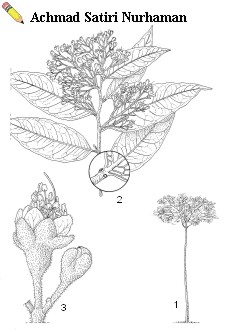 | Maranthes corymbosa Blume – 1, tree habit; 2, flowering twig; 3, flower and bud. |
Ecology
M. corymbosa is generally found in sandy or rocky coastal areas, sometimes more inland in primary and secondary forest up to 600(-1500) m altitude. In Australia it has also been observed in gallery forest.
Silviculture and Management
M. corymbosa can be propagated by seed. There are about 335 dry seeds/kg. Germination tests in Peninsular Malaysia showed 22% germination of cleaned stones in 3-12 months and 14% germination of whole fruits in 5-12 months. Seeds are sown under shade and seedlings can be planted out 5 months later when they have attained 15 cm. Seedlings do not tolerate stumping before planting. In Indonesia the seedlings are planted at 1 m x 3 m with Leucaena leucocephala (Lamk) de Wit as a cover crop between the lines. The canopy closes at 2 years and the first thinning is done after 4 years. The mean annual increment excluding yield from thinnings for the first ten years is 8 m3/ha. Under natural conditions, seedlings establish themselves and grow up in dense forest; therefore planting on open sites is not recommended.
Genetic Resources and Breeding
As M. corymbosa occurs throughout and beyond Malesia, the risk of genetic erosion posed by logging is very low.
Prospects
M. corymbosa is too hard and too difficult to work to become a valuable sawn timber. The use of round logs for marine construction and posts and poles, especially when pressure-treated, will probably remain important in the near future.
Literature
[40]All Nippon Checkers Corporation, 1989. Illustrated commercial foreign woods in Japan. Tokyo. 262 pp.
[151]Browne, F.G., 1955. Forest trees of Sarawak and Brunei and their products. Government Printing Office, Kuching, Sarawak. xviii + 369 pp.
[161]Burger, D., 1972. Seedlings of some tropical trees and shrubs mainly of South East Asia. Pudoc, Wageningen. 399 pp.
[162]Burgess, P.F., 1966. Timbers of Sabah. Sabah Forest Records No 6. Forest Department, Sabah, Sandakan. xviii + 501 pp.
[163]Burkill, I.H., 1966. A dictionary of the economic products of the Malay Peninsula. 2nd edition. Ministry of Agriculture and Co-operatives, Kuala Lumpur. Vol. 1 (A-H) pp. 1-1240. Vol. 2 (I-Z) pp. 1241-2444.
[198]Cockburn, P.F., 1976-1980. Trees of Sabah. 2 volumes. Sabah Forest Records No 10. Forest Department Sabah, Sandakan.
[209]Corner, E.J.H., 1988. Wayside trees of Malaya. 3rd edition. 2 volumes. The Malayan Nature Society, Kuala Lumpur. 774 pp.
[267]Desch, H.E., 1941-1954. Manual of Malayan timbers. Malayan Forest Records No 15. 2 volumes. Malaya Publishing House Ltd., Singapore. 762 pp.
[300]Eddowes, P.J., 1977. Commercial timbers of Papua New Guinea, their properties and uses. Forest Products Research Centre, Department of Primary Industry, Port Moresby. xiv + 195 pp.
[301]Eddowes, P.J., 1979. The utilisation of Papua New Guinea timbers. Forest Products Research Centre, Department of Primary Industry, Port Moresby. 30 pp.
[304]Eddowes, P.J., 1995-1997. The forests and timbers of Papua New Guinea. (unpublished data).
[341]Flora Malesiana (various editors), 1950-. Kluwer Academic Publishers, Dordrecht, Boston, London.
[346]Foreman, D.B., 1971. A check list of the vascular plants of Bougainville with descriptions of some common forest trees. Botany Bulletin No 5. Division of Botany, Department of Forests, Lae. 194 pp.
[348]Forest Products Research Centre, 1967. Properties and uses of Papua and New Guinea timbers. Forest Products Research Centre, Port Moresby. 30 pp.
[405]Hardjowasono, M.S., 1942. Gewicht en volume van verschillende vrucht- en zaadsoorten [Weight and volume of various fruits and seeds]. Korte Mededelingen No 20. Bosbouwproefstation, Buitenzorg. 172 pp.
[426]Hellinga, G., 1950. Houtsoorten voor aanplant op bedrijfsgrootte [Forest tree species for planting on a large scale]. Tectona 40: 179-229.
[427]Hellinga, G., 1950. Resultaten van de proeftuinen voor boomgewassen sedert 1937. Loofhoutsoorten II [Results from trial plots for trees since 1937. Deciduous trees II]. Rapport No 27. Bosbouwproefstation, Buitenzorg. 29 pp.
[464]Ilic, J., 1990. The CSIRO macro key for hardwood identification. CSIRO, Highett. 125 pp.
[536]Keating, W.G. & Bolza, E., 1982. Characteristics, properties and uses of timbers. Vol. 1. South-East Asia, northern Australia and the Pacific. Inkata Press Proprietary Ltd., Melbourne, Sydney & London. 362 pp.
[615]Kostermans, A.J.G.H., 1965. A monograph of the genera Maranthes Bl. and Cyclandrophora Hassk. (Chrysobalanaceae) of the Asiatic and Pacific area. Candollea 20: 103-158.
[741]Malaysian Timber Industry Board, 1986. 100 Malaysian timbers. Kuala Lumpur. x + 226 pp.
[757]Martawijaya, A., Kartasujana, I., Kadir, K. & Prawira, S.A., 1992. Indonesian wood atlas. Vol. 2. Forest Products Research and Development Centre, Bogor. 168 pp.
[829]Ng, F.S.P., 1991-1992. Manual of forest fruits, seeds and seedlings. 2 volumes. Malayan Forest Record No 34. Forest Research Institute Malaysia, Kepong. 997 pp.
[831]Ng, F.S.P. & Mat Asri Ngah Sanah, 1991. Germination and seedling records. Research Pamphlet No 108. Forest Research Institute Malaysia, Kepong. 191 pp.
[861]Oey Djoen Seng, 1951. De soortelijke gewichten van Indonesische houtsoorten en hun betekenis voor de praktijk [Specific gravity of Indonesian woods and its significance for practical use]. Rapport No 46. Bosbouwproefstation, Bogor. 183 pp.
[905]Prance, G.T. & White, F., 1988. The genera of Chrysobalanaceae: a study in practical and theoretical taxonomy and its relevance to evolutionary biology. Philosophical Transactions of the Royal Society of London, B. Biological Sciences 320: 1-184.
[933]Research Institute of Wood Industry, 1988. Identification, properties and uses of some Southeast Asian woods. Chinese Academy of Forestry, Wan Shou Shan, Beijing & International Tropical Timber Organization, Yokohama. 201 pp.
[934]Reyes, L.J., 1938. Philippine woods. Technical Bulletin No 7. Commonwealth of the Philippines, Department of Agriculture and Commerce. Bureau of Printing, Manila. 536 pp. + 88 plates.
[1039]Smitinand, T. & Larsen, K. (Editors), 1970-. Flora of Thailand. The Forest Herbarium, Royal Forest Department, Bangkok.
[1048]Soepadmo, E., Wong, K.M. & Saw, L.G. (Editors), 1995-. Tree flora of Sabah and Sarawak. Sabah Forestry Department, Forest Research Institute Malaysia and Sarawak Forestry Department, Kepong.
[1221]Whitmore, T.C. & Ng, F.S.P. (Editors), 1972-1989. Tree flora of Malaya. A manual for foresters. 4 volumes. Malayan Forest Records No 26. Longman Malaysia Sdn. Berhad, Kuala Lumpur & Petaling Jaya.
[1239]Wong, T.M., 1976. Wood structure of the lesser known timbers of Peninsular Malaysia. Malayan Forest Records No 28. Forest Research Institute Malaysia, Kepong. xi + 115 pp.
[1242]Wong, T.M., 1982. A dictionary of Malaysian timbers. Malayan Forest Records No 30. Forest Research Institute Malaysia, Kepong. 259 pp.
[1248]Working group on utilization of tropical woods, 1978. Properties of some Papua New Guinea woods relating with manufacturing processes VI-IX. Bulletin of the Forestry and Forest Products Research Institute Japan No 299: 23-187.
[151]Browne, F.G., 1955. Forest trees of Sarawak and Brunei and their products. Government Printing Office, Kuching, Sarawak. xviii + 369 pp.
[161]Burger, D., 1972. Seedlings of some tropical trees and shrubs mainly of South East Asia. Pudoc, Wageningen. 399 pp.
[162]Burgess, P.F., 1966. Timbers of Sabah. Sabah Forest Records No 6. Forest Department, Sabah, Sandakan. xviii + 501 pp.
[163]Burkill, I.H., 1966. A dictionary of the economic products of the Malay Peninsula. 2nd edition. Ministry of Agriculture and Co-operatives, Kuala Lumpur. Vol. 1 (A-H) pp. 1-1240. Vol. 2 (I-Z) pp. 1241-2444.
[198]Cockburn, P.F., 1976-1980. Trees of Sabah. 2 volumes. Sabah Forest Records No 10. Forest Department Sabah, Sandakan.
[209]Corner, E.J.H., 1988. Wayside trees of Malaya. 3rd edition. 2 volumes. The Malayan Nature Society, Kuala Lumpur. 774 pp.
[267]Desch, H.E., 1941-1954. Manual of Malayan timbers. Malayan Forest Records No 15. 2 volumes. Malaya Publishing House Ltd., Singapore. 762 pp.
[300]Eddowes, P.J., 1977. Commercial timbers of Papua New Guinea, their properties and uses. Forest Products Research Centre, Department of Primary Industry, Port Moresby. xiv + 195 pp.
[301]Eddowes, P.J., 1979. The utilisation of Papua New Guinea timbers. Forest Products Research Centre, Department of Primary Industry, Port Moresby. 30 pp.
[304]Eddowes, P.J., 1995-1997. The forests and timbers of Papua New Guinea. (unpublished data).
[341]Flora Malesiana (various editors), 1950-. Kluwer Academic Publishers, Dordrecht, Boston, London.
[346]Foreman, D.B., 1971. A check list of the vascular plants of Bougainville with descriptions of some common forest trees. Botany Bulletin No 5. Division of Botany, Department of Forests, Lae. 194 pp.
[348]Forest Products Research Centre, 1967. Properties and uses of Papua and New Guinea timbers. Forest Products Research Centre, Port Moresby. 30 pp.
[405]Hardjowasono, M.S., 1942. Gewicht en volume van verschillende vrucht- en zaadsoorten [Weight and volume of various fruits and seeds]. Korte Mededelingen No 20. Bosbouwproefstation, Buitenzorg. 172 pp.
[426]Hellinga, G., 1950. Houtsoorten voor aanplant op bedrijfsgrootte [Forest tree species for planting on a large scale]. Tectona 40: 179-229.
[427]Hellinga, G., 1950. Resultaten van de proeftuinen voor boomgewassen sedert 1937. Loofhoutsoorten II [Results from trial plots for trees since 1937. Deciduous trees II]. Rapport No 27. Bosbouwproefstation, Buitenzorg. 29 pp.
[464]Ilic, J., 1990. The CSIRO macro key for hardwood identification. CSIRO, Highett. 125 pp.
[536]Keating, W.G. & Bolza, E., 1982. Characteristics, properties and uses of timbers. Vol. 1. South-East Asia, northern Australia and the Pacific. Inkata Press Proprietary Ltd., Melbourne, Sydney & London. 362 pp.
[615]Kostermans, A.J.G.H., 1965. A monograph of the genera Maranthes Bl. and Cyclandrophora Hassk. (Chrysobalanaceae) of the Asiatic and Pacific area. Candollea 20: 103-158.
[741]Malaysian Timber Industry Board, 1986. 100 Malaysian timbers. Kuala Lumpur. x + 226 pp.
[757]Martawijaya, A., Kartasujana, I., Kadir, K. & Prawira, S.A., 1992. Indonesian wood atlas. Vol. 2. Forest Products Research and Development Centre, Bogor. 168 pp.
[829]Ng, F.S.P., 1991-1992. Manual of forest fruits, seeds and seedlings. 2 volumes. Malayan Forest Record No 34. Forest Research Institute Malaysia, Kepong. 997 pp.
[831]Ng, F.S.P. & Mat Asri Ngah Sanah, 1991. Germination and seedling records. Research Pamphlet No 108. Forest Research Institute Malaysia, Kepong. 191 pp.
[861]Oey Djoen Seng, 1951. De soortelijke gewichten van Indonesische houtsoorten en hun betekenis voor de praktijk [Specific gravity of Indonesian woods and its significance for practical use]. Rapport No 46. Bosbouwproefstation, Bogor. 183 pp.
[905]Prance, G.T. & White, F., 1988. The genera of Chrysobalanaceae: a study in practical and theoretical taxonomy and its relevance to evolutionary biology. Philosophical Transactions of the Royal Society of London, B. Biological Sciences 320: 1-184.
[933]Research Institute of Wood Industry, 1988. Identification, properties and uses of some Southeast Asian woods. Chinese Academy of Forestry, Wan Shou Shan, Beijing & International Tropical Timber Organization, Yokohama. 201 pp.
[934]Reyes, L.J., 1938. Philippine woods. Technical Bulletin No 7. Commonwealth of the Philippines, Department of Agriculture and Commerce. Bureau of Printing, Manila. 536 pp. + 88 plates.
[1039]Smitinand, T. & Larsen, K. (Editors), 1970-. Flora of Thailand. The Forest Herbarium, Royal Forest Department, Bangkok.
[1048]Soepadmo, E., Wong, K.M. & Saw, L.G. (Editors), 1995-. Tree flora of Sabah and Sarawak. Sabah Forestry Department, Forest Research Institute Malaysia and Sarawak Forestry Department, Kepong.
[1221]Whitmore, T.C. & Ng, F.S.P. (Editors), 1972-1989. Tree flora of Malaya. A manual for foresters. 4 volumes. Malayan Forest Records No 26. Longman Malaysia Sdn. Berhad, Kuala Lumpur & Petaling Jaya.
[1239]Wong, T.M., 1976. Wood structure of the lesser known timbers of Peninsular Malaysia. Malayan Forest Records No 28. Forest Research Institute Malaysia, Kepong. xi + 115 pp.
[1242]Wong, T.M., 1982. A dictionary of Malaysian timbers. Malayan Forest Records No 30. Forest Research Institute Malaysia, Kepong. 259 pp.
[1248]Working group on utilization of tropical woods, 1978. Properties of some Papua New Guinea woods relating with manufacturing processes VI-IX. Bulletin of the Forestry and Forest Products Research Institute Japan No 299: 23-187.
Author(s)
G.T. Prance
Correct Citation of this Article
Prance, G.T., 1998. Maranthes Blume. In: Sosef, M.S.M., Hong, L.T. and Prawirohatmodjo, S. (Editors): Plant Resources of South-East Asia No 5(3): Timber trees; Lesser-known timbers. PROSEA Foundation, Bogor, Indonesia. Database record: prota4u.org/prosea

All texts are licensed under a Creative Commons Attribution-Noncommercial-Share Alike 3.0 Netherlands License
This license does not include the illustrations (Maps,drawings,pictures); these remain all under copyright.