Record Number
5845
PROSEA Handbook Number
5(3): Timber trees; Lesser-known timbers
Taxon
Memecylon L.
Protologue
Sp. pl. 1: 349 (1753); Gen. pl., ed. 5: 481 (1754).
Family
MELASTOMATACEAE
Chromosome Numbers
x = unknown; M. edule: n = 7, 2n = 24, M. caeruleum: 2n = 24
Vernacular Names
Brunei: gelam-gelam. Malaysia: nipis kulit (general), bangas, delek (Peninsular). Thailand: phlong.
Origin and Geographic Distribution
Memecylon comprises about 300 species distributed in the Old World tropics, from tropical Africa to the whole of the Malesian region, northern Australia and the Pacific. Within Malesia some 80 species are found: 28 in Peninsular Malaysia, 18 in Sumatra, 12 in Java, 27 in Borneo, 4 in Sulawesi and 5 in the Moluccas. No up-to-date figures are available for the Philippines and New Guinea; each has some 20-30 species.
Uses
The wood of Memecylon has been applied for local house building (e.g. poles, beams and rafters), temporary construction, ship and boat building, furniture, paddles, tool handles, rice pestles, anchors, household utensils and walking sticks. It also yields a good-quality charcoal and fuelwood.
The leaves of M. caeruleum are edible. The fruits of all species are edible with a sweet to sour taste, but the pericarp is generally thin. In India and Thailand a yellow dye has been obtained from leaves of M. edule, whereas a decoction of the leaves has been applied against gonorrhoea. The bark of the same species has been used for poulticing bruises. A decoction of the root of M. dichotomum has been used as a lotion for rheumatism and given internally after childbirth. Its leaves, pounded with cumin seeds and onions, have been used to poultice the head for vertigo, whereas the fruits stupefy fish.
The leaves of M. caeruleum are edible. The fruits of all species are edible with a sweet to sour taste, but the pericarp is generally thin. In India and Thailand a yellow dye has been obtained from leaves of M. edule, whereas a decoction of the leaves has been applied against gonorrhoea. The bark of the same species has been used for poulticing bruises. A decoction of the root of M. dichotomum has been used as a lotion for rheumatism and given internally after childbirth. Its leaves, pounded with cumin seeds and onions, have been used to poultice the head for vertigo, whereas the fruits stupefy fish.
Production and International Trade
There is no information on trade of the wood of Memecylon; utilization is probably on a local scale only.
Properties
Memecylon yields a heavy hardwood with a density of 770-1150 kg/m3 at 15% moisture content. Heartwood yellow-brown or brown to dark brown with a purplish tinge, not sharply demarcated from the sapwood; grain interlocked and sometimes irregular; texture fine or moderately fine and uneven due to the islands of included phloem. Growth rings indistinct, occasionally distinct; vessels moderately small to medium-sized, solitary, in radial multiples of 2-3, or in clusters of 2-3, in oblique or tangential arrangement, open or some filled with dark-coloured solid deposits; parenchyma moderately abundant, paratracheal vasicentric, aliform and infrequently confluent, linking up several vessels, microscopically diffuse and diffuse-in-aggregates parenchyma is visible; rays of two distinct sizes, very fine to medium-sized, the broader ones visible to the naked eye; ripple marks absent; islands of included phloem scattered, in transverse section 2-3 times the area of a vessel.
Shrinkage upon seasoning is low to very high. Boards 13 mm and 38 mm thick take respectively 3.5-4 months and 5-6 months to air dry with slight bowing, twisting or end-checking and with moderate insect attack during drying. The wood is hard to very hard and strong. It is easy to work and saw, but saw teeth are rapidly blunted. Planing is difficult, especially the radial surface which has a tendency to pick up. The wood is durable under cover, but not durable when exposed to the weather or in contact with the ground. An absorption of 128-226 kg/m3 was determined when treated in the open tank method with a mixture of 50% creosote and 50% fuel oil, the heartwood being almost impermeable and the sapwood very permeable in this test. The sapwood is very susceptible to Bostrychid borers but the heartwood is only slightly susceptible.
See also the tables on microscopic wood anatomy and wood properties.
Botany
Shrubs or small to medium-sized trees, up to 25(-30) m tall; bole sometimes twisted, up to 100(-200) cm in diameter, often fluted, infrequently with buttresses; bark extremely thin, the surface very shallowly closely fissured or cracked, sometimes smooth and slightly scaly, grey or greyish-brown, inner bark thin, yellow or pinkish to orange or brown; branches terete or flattened, grooved, angled or winged. Leaves opposite, simple, entire, glabrous, with 1 main vein and straight or looping intramarginal veins, exstipulate. Flowers in an axillary or occasionally terminal cyme, sometimes paniculate or reduced to glomerules or umbels, 4-merous; calyx cup- to funnel-shaped with a truncate to shortly lobed margin; petals reflexed at anthesis and caducous after fertilization, white, pink, blue or purple; stamens 8, equal, anthers curved like a walking stick to crescent-shaped, opening with a vertical slit; ovary inferior and united with the calyx tube, unilocular with 2-20 ovules, style 1. Fruit a 1(-2)-seeded berry, ripening red, purplish or black, crowned by the persistent calyx, smooth or with 8 vertical grooves. Seedling with epigeal germination; cotyledons emergent and leafy; hypocotyl elongated; all leaves opposite.
M. edule develops according to Rauh's architectural tree model, determined by a monopodial trunk which grows rhythmically and so develops tiers of branches. The flowering-to-fruiting period of Memecylon sp. in a lowland dipterocarp forest in Peninsular Malaysia is about 13 weeks. The fruits are readily eaten and dispersed by birds, making it sometimes difficult to collect specimens with ripe fruits.
Memecylon belongs to the tribe Memecyleae within the subfamily Memecyloideae. The fairly common species M. oligoneurum Blume has recently been transferred to the genus Lijndenia; its correct name is L. laurina Zoll. & Moritzi.
Image
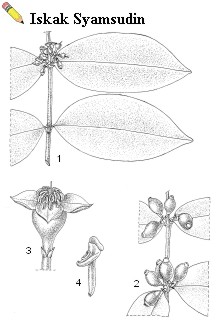 | Memecylon edule Roxb. – 1, flowering twig; 2, fruiting twig; 3, flower; 4, stamen. |
Ecology
Memecylon species are comparatively common, sometimes occurring gregariously in the lower part of the canopy of primary lowland to montane forest, up to 1800 m altitude. They are also found in freshwater and peat-swamp forest and kerangas. Some, e.g. M. edule, prefer more open forest or localities near the seashore.
Silviculture and Management
Memecylon can be propagated by seed. In germination trials in Peninsular Malaysia fruits of M. cantleyi Ridley had a germination of about 35% in 36-56 days, whereas 8 seeds of M. intermedium all germinated in 23-49 days.
Genetic Resources and Breeding
M. edule is recorded in a germplasm collection in Malaysia at the Rimba Ilmu of the University of Malaya. As most Memecylon species are rather rare with a restricted geographic distribution, the destruction of their natural habitat is probably a much greater threat than their utilization for timber.
Prospects
Although Memecylon timber is of fairly good quality, its utilization is restricted due to the often poor form of the trees and their scarcity.
Literature
[70]Backer, C.A. & Bakhuizen van den Brink Jr., R.C., 1963-1968. Flora of Java. 3 volumes. Wolters-Noordhoff, Groningen.
[79]Bakhuizen van den Brink, R.C., 1946. A contribution to the knowledge of the Melastomataceae occurring in the Malay archipelago especially in the Netherlands East Indies. Recueil des Travaux Botaniques Néerlandais 40: 1-391.
[140]Bremer, K., 1982. A check-list of the Memecylon species (Melastomataceae) in Borneo, Java, Malaya and Sumatra. Gardens' Bulletin, Singapore 35: 45-49.
[141]Bremer, K., 1983. Taxonomy of Memecylon (Melastomataceae) in Borneo. Opera Botanica 69: 1-47.
[151]Browne, F.G., 1955. Forest trees of Sarawak and Brunei and their products. Government Printing Office, Kuching, Sarawak. xviii + 369 pp.
[163]Burkill, I.H., 1966. A dictionary of the economic products of the Malay Peninsula. 2nd edition. Ministry of Agriculture and Co-operatives, Kuala Lumpur. Vol. 1 (A-H) pp. 1-1240. Vol. 2 (I-Z) pp. 1241-2444.
[209]Corner, E.J.H., 1988. Wayside trees of Malaya. 3rd edition. 2 volumes. The Malayan Nature Society, Kuala Lumpur. 774 pp.
[238]de Vogel, E.F., 1980. Seedlings of dicotyledons. Structure, development, types. Descriptions of 150 woody Malesian taxa. Pudoc, Wageningen. 465 pp.
[267]Desch, H.E., 1941-1954. Manual of Malayan timbers. Malayan Forest Records No 15. 2 volumes. Malaya Publishing House Ltd., Singapore. 762 pp.
[387]Grewal, G.S., 1979. Air-seasoning properties of some Malaysian timbers. Malaysian Forest Service Trade Leaflet No 41. Malaysian Timber Industry Board, Kuala Lumpur. 26 pp.
[436]Heyne, K., 1927. De nuttige planten van Nederlands-Indië [The useful plants of the Dutch East Indies]. 2nd edition, 3 volumes. Departement van Landbouw, Nijverheid en Handel in Nederlandsch-Indië. 1953 pp. (3rd edition, 1950. van Hoeve, 's-Gravenhage/Bandung. 1660 pp.).
[438]Hildebrand, F.H., 1951. Daftar nama pohon-pohonan Djawa-Madura dengan keterangan-keterangan tentang penjiaran dan ukurannja (telah diperbaiki) [Revised list of tree species of Java-Madura with notes on their distribution and dimensions]. Laporan No 50. Balai Penjelidikan Kehutanan, Bogor. 183 pp.
[464]Ilic, J., 1990. The CSIRO macro key for hardwood identification. CSIRO, Highett. 125 pp.
[677]Lee, Y.H. & Chu, Y.P., 1965. The strength properties of Malayan timbers. Malayan Forester 28: 307-319.
[678]Lee, Y.H., Engku Abdul Rahman bin Chik & Chu, Y.P., 1979. The strength properties of some Malaysian timbers. Malaysian Forest Service Trade Leaflet No 34 (revised edition). Malaysian Timber Industry Board, Kuala Lumpur. 107 pp.
[696]Lemmens, R.H.M.J. & Wulijarni-Soetjipto, N. (Editors), 1991. Plant resources of South-East Asia No 3. Dye and tannin-producing plants. Pudoc, Wageningen. 195 pp.
[750]Mansfeld, R., 1925. Die Melastomataceen von Papuasien [The Melastomataceae of Papuasia]. Botanische Jahrbücher 60: 105-143.
[766]Maxwell, J.F., 1980. Revision of Memecylon L. (Melastomataceae) from the Malay Peninsula. Gardens' Bulletin, Singapore 33: 31-150.
[785]Merrill, E.D., 1923-1926. An enumeration of Philippine flowering plants. 4 volumes. Bureau of Printing, Manila.
[800]Mohd Ghazali, H.O. & Abd. Rahim, A. S., 1985. Flowering-to-fruiting period of Malaysian forest trees. Malaysian Forester 48: 254-257.
[810]Mukhtar, A.S. & Elvizar, 1986. Arsitektur dan karakteristik pohon habitat burung di berbagai tipe hutan suaka margasatwa Way Kambas, Lampung [Architecture and tree characteristics of bird habitats in some forest types of Way Kambas game reserve, Lampung]. Buletin Penelitian Hutan 484: 41-54.
[831]Ng, F.S.P. & Mat Asri Ngah Sanah, 1991. Germination and seedling records. Research Pamphlet No 108. Forest Research Institute Malaysia, Kepong. 191 pp.
[861]Oey Djoen Seng, 1951. De soortelijke gewichten van Indonesische houtsoorten en hun betekenis voor de praktijk [Specific gravity of Indonesian woods and its significance for practical use]. Rapport No 46. Bosbouwproefstation, Bogor. 183 pp.
[889]Phengklai, C. & Khamsai, S., 1985. Some non-timber species of Thailand. Thai Forest Bulletin (Botany) 15: 108-148.
[933]Research Institute of Wood Industry, 1988. Identification, properties and uses of some Southeast Asian woods. Chinese Academy of Forestry, Wan Shou Shan, Beijing & International Tropical Timber Organization, Yokohama. 201 pp.
[974]Salvosa, F.M., 1963. Lexicon of Philippine trees. Bulletin No 1. Forest Products Research Institute, College, Laguna. 136 pp.
[988]Saw, L.G. & Raja Barizan Raja Sulaiman, 1991. Directory of plant genetic resources in Malaysia. Research Pamphlet No 109. Forest Research Institute Malaysia, Kepong. 161 pp.
[1038]Smitinand, T., 1980. Thai plant names. Royal Forest Department, Bangkok. 379 pp.
[1151]van Vliet, G.J.C.M., 1981. Wood anatomy of the palaeotropical Melastomataceae. Blumea 27: 395-462.
[1169]Vidal, J., 1962. Noms vernaculaires de plantes en usage au Laos [Vernacular names of plants used in Laos]. Ecole française d'Extrême-Orient, Paris. 197 pp.
[1221]Whitmore, T.C. & Ng, F.S.P. (Editors), 1972-1989. Tree flora of Malaya. A manual for foresters. 4 volumes. Malayan Forest Records No 26. Longman Malaysia Sdn. Berhad, Kuala Lumpur & Petaling Jaya.
[1242]Wong, T.M., 1982. A dictionary of Malaysian timbers. Malayan Forest Records No 30. Forest Research Institute Malaysia, Kepong. 259 pp.
[1250]Wyatt-Smith, J. & Kochummen, K.M., 1964. Pocket check list of timber trees, 2nd edition. Malayan Forest Records No 17. Nan Yang Press, Kuala Lumpur. 428 + 126 pp.
Author(s)
Noorma Wati Haron
Memecylon acuminatum
Memecylon amplexicaule
Memecylon caeruleum
Memecylon campanulatum
Memecylon dichotomum
Memecylon edule
Memecylon excelsum
Memecylon floridum
Memecylon garcinioides
Memecylon intermedium
Memecylon lilacinum
Memecylon minutiflorum
Memecylon oleifolium
Memecylon paniculatum
Memecylon pubescens
Memecylon schraderbergense
Memecylon schumannianum
Correct Citation of this Article
Haron, N.W., 1998. Memecylon L.. In: Sosef, M.S.M., Hong, L.T. and Prawirohatmodjo, S. (Editors): Plant Resources of South-East Asia No 5(3): Timber trees; Lesser-known timbers. PROSEA Foundation, Bogor, Indonesia. Database record: prota4u.org/prosea
Selection of Species
The following species in this genus are important in this commodity group and are treated separatedly in this database:
Memecylon acuminatum
Memecylon amplexicaule
Memecylon caeruleum
Memecylon campanulatum
Memecylon dichotomum
Memecylon edule
Memecylon excelsum
Memecylon floridum
Memecylon garcinioides
Memecylon intermedium
Memecylon lilacinum
Memecylon minutiflorum
Memecylon oleifolium
Memecylon paniculatum
Memecylon pubescens
Memecylon schraderbergense
Memecylon schumannianum

All texts are licensed under a Creative Commons Attribution-Noncommercial-Share Alike 3.0 Netherlands License
This license does not include the illustrations (Maps,drawings,pictures); these remain all under copyright.