Record Number
5870
PROSEA Handbook Number
5(3): Timber trees; Lesser-known timbers
Taxon
Michelia L.
Protologue
Sp. pl. 1: 536 (1753); Gen. pl., ed. 5: 240 (1754).
Family
MAGNOLIACEAE
Chromosome Numbers
x = 19; M. x alba DC., M. champaca, M. figo (Lour.) Spreng., M. montana, and many other non-Malesian species: 2n = 38
Vernacular Names
Chempaka (trade name). Indonesia: cempaka (trade name). Malaysia: champaka (Peninsular, Sabah). Philippines: champaka (general). Burma (Myanmar): safan, sagah, sagawa. Laos: cham pa. Thailand: champa. Vietnam: gi[ows]i, ng[oj]c lan, su.
Origin and Geographic Distribution
Michelia comprises about 30 species and is distributed from Sri Lanka and India towards the Himalayas, Indo-China, China, southern Japan, Taiwan, Thailand, Peninsular Malaysia, Sumatra, Java, Borneo, the Philippines and the Lesser Sunda Islands. Some species are commonly cultivated throughout the tropics. Within Malesia 7 species are native.
Uses
Michelia wood is used for general light construction, bridge building, flooring, door panels, vehicle bodies, packing cases and formerly also for battery separators. The nicely figured wood of M. champaca is particularly used for furniture and cabinet work, carvings, turnery and pattern making. Michelia has also been used for the production of veneer and plywood, sometimes as a substitute for "American whitewood"" (Liriodendron tulipifera L.), cement-bonded wood-wool board, and as firewood. The wood may be suitable for the production of hardboard.
In West Java M. champaca is used to reforest badly eroded areas, and is suitable as a wayside tree in low-traffic areas. M. champaca and M. x alba are often cultivated for ornamental purposes, also near temples. Their fragrant flowers yield an essential oil used as a perfume though with a different odour, and in India and Indonesia the flowers are used in religious ceremonies, in Bali e.g. in the "Ngaben"" ceremony. The seed oil of M. champaca shows antibacterial activity. Its leaves are used to feed silkworms. A decoction of the bark and sometimes also of the leaves of M. champaca is commonly given after childbirth. The bark is also used as a febrifuge. In Burma (Myanmar) the flowers are used to treat leprosy and the leaves for colic.
In West Java M. champaca is used to reforest badly eroded areas, and is suitable as a wayside tree in low-traffic areas. M. champaca and M. x alba are often cultivated for ornamental purposes, also near temples. Their fragrant flowers yield an essential oil used as a perfume though with a different odour, and in India and Indonesia the flowers are used in religious ceremonies, in Bali e.g. in the "Ngaben"" ceremony. The seed oil of M. champaca shows antibacterial activity. Its leaves are used to feed silkworms. A decoction of the bark and sometimes also of the leaves of M. champaca is commonly given after childbirth. The bark is also used as a febrifuge. In Burma (Myanmar) the flowers are used to treat leprosy and the leaves for colic.
Production and International Trade
"Chempaka"" is a general trade name which apart from Michelia wood includes wood of Elmerrillia (usually), Magnolia and Manglietia. Small amounts of chempaka are imported by Japan from Sabah and Sarawak. Supplies are limited and in 1992 only about 900 m3 of chempaka timber with a value of about US$ 87 000 were exported from Sabah. The flowers are marketed locally.
Properties
Michelia yields a medium-weight or occasionally lightweight hardwood with a density of (310-)460-695 kg/m3 at 15% moisture content. Heartwood olive-brown turning to dark brown with a greenish tinge upon exposure, clearly differentiated from the pale brown, up to 8 cm wide sapwood; grain straight or slightly interlocked; texture fine to moderately fine and even; wood slightly greasy to the touch, sometimes with camphor-like odour. Growth rings distinct, boundaries indicated by marginal parenchyma; vessels moderately small to medium-sized, solitary and in radial multiples of 2-5, usually open; parenchyma sparse, apotracheal in marginal bands; rays very fine to moderately fine, oil cells at the margins of the rays sometimes visible with a hand lens; ripple marks absent.
Shrinkage upon air drying is very low. In Peninsular Malaysia the wood air dries without degrade, but insect attack may be severe during seasoning. It takes about 2 and 4 months, respectively, to air dry boards 13 mm and 38 mm thick. In India it has been recommended to ring girdle M. champaca trees about 3 years before felling and conversion to prevent possible warping and checking of the wood. The wood is soft to moderately hard and of low to moderate strength. It can be worked easily, but occasional specimens of M. philippinensis have hard chalky deposits which dull cutting edges. The wood is non-durable to moderately durable depending on species and provenance. The wood of M. montana is reportedly very resistant to fungal attack. The heartwood is resistant to dry-wood termites and refractory to treatment with preservatives. The sapwood is considered to be non-susceptible to Lyctus.
The gross energy value of the heartwood of M. champaca is about 21 070 kJ/kg. The mean fibre length of M. champaca is 1.560-1.590 mm and of M. montana 1.710 mm.
See also the tables on microscopic wood anatomy and wood properties.
Botany
Evergreen or semi-deciduous, small to large trees up to 50 m tall; bole straight, cylindrical, up to 200 cm in diameter, without buttresses; bark surface smooth, grey to greyish-white, inner bark fibrous, yellow to brown; crown conical to cylindrical. Leaves arranged spirally, simple, entire; stipules adnate to or free from the petiole. Flowers on short, axillary brachyblast, solitary or rarely in pairs, large; tepals 6-21, in 3-6 usually subequal whorls, white to yellow; stamens many, anthers with a short to prominently elongated connective; gynoecium stipitate, with few-many, spirally arranged, free or connate carpels containing 2-many ovules. Fruiting carpels dehiscing along the dorsal suture when free or fused and forming a fleshy or woody syncarp. Seed hanging from its funicle. Seedling with epigeal germination; cotyledons emergent, leafy; hypocotyl elongated; all leaves arranged spirally.
Growth form is according to Roux's architectural tree model, characterized by a continuously growing monopodial orthotropic trunk with plagiotropic branches. Vesicular-arbuscular mycorrhizae have been observed on M. champaca roots in India. In Java the mean annual increment of 10-27-year-old M. champaca trees is 1.0-1.8 m in height and 1.5-2.0 cm in diameter, the corresponding figures for almost 10-year-old M. montana trees in East Java are 1.3 m and 2.9 cm respectively. M. x alba, M. champaca, M. koordersiana and M. montana flower and fruit throughout the year, M. philippinensis in January and February, M. salicifolia in March and July, and M. scortechinii in April-May. The flowers are protogynous and pollinated by beetles which feed on the stigmas, pollen, nectar and secretion of the petals.
Michelia belongs to the tribe Michelieae and is closely related to Elmerrillia which differs in having a sessile gynoecium. M. x alba has probably arisen by hybridization between M. champaca and M. montana. It only rarely produces fruit and is unknown in the wild.
Image
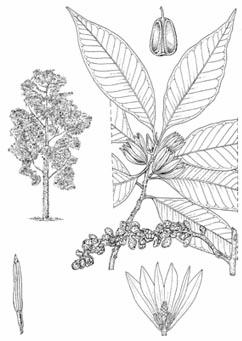 | Michelia champaca L. – 1, tree habit; 2, flowering twig; 3, infructescence; 4, sectioned flower; 5, stamen; 6, seed. |
Ecology
Michelia is found scattered in primary lowland to montane rain forest, up to 2100 m altitude. The absolute maximum temperature for M. champaca is 35-40°C, the absolute minimum temperature 3-10°C.
Silviculture and Management
Michelia can be propagated by seed. For ornamental purposes it is also propagated by various vegetative techniques. M. champaca has 10 000-29 500 dry seeds/kg and M. montana about 1900 dry fruitlets/kg. Seeds should be dried in the shade; they lose their viability very fast, often within 2 weeks. Seed viability can be maintained by moist storage at 5°C for about 7 months or by storage in pits at 13°C for about 4 months. Seed should be sown in the shade, but shade should be removed after germination. Before sowing, the seeds may be treated with insecticide, as they are susceptible to insect attack. Seedlings of 12-15 months old are usually made into stumps with a diameter of at least 1.5 cm before planting in the field. M. champaca requires moist, deep and fertile soils and is a moderate light-demander. In Java it is planted at 3 m x 2.5-3 m but the open canopy makes weed control or planting of cover crops necessary. Although planted M. montana grows very fast, the stem is crooked. M. champaca can attain an annual increment of 20-25 m3/ha during the first 10 years. A rotation of 50 years is recommended to produce sawn timber. M. champaca is susceptible to fire; it coppices well. Moreover, it is intolerant of air pollution when planted as a roadside tree.
Genetic Resources and Breeding
In Arunachal Pradesh, India a germplasm bank with 33 clones and 2 seed orchards with 25 clones each of M. champaca have been established.
Prospects
The favourable wood properties and fairly fast growth as observed in a few trials suggest that M. champaca is promising for increased use. Although it is commonly cultivated, more information needs to be obtained on its silvicultural aspects through research.
Literature
[9]Adnyana, P.B., 1994. Struktur kayu yang digunakan untuk bahan patung dan ukiran kayu Bali [The structure of wood used for woodcarving in Bali]. Master thesis, Department of Biology, Bandung Institute of Technology.
[40]All Nippon Checkers Corporation, 1989. Illustrated commercial foreign woods in Japan. Tokyo. 262 pp.
[70]Backer, C.A. & Bakhuizen van den Brink Jr., R.C., 1963-1968. Flora of Java. 3 volumes. Wolters-Noordhoff, Groningen.
[99]Becking, J.H., 1948. Korte beschrijving van de houtsoorten aanbevolen voor bos-culturen op Java en Madoera [Brief description of tree species recommended for forest plantations in Java and Madura]. Unpublished. 115 pp.
[101]Beekman, H., 1920. 78 Preanger houtsoorten. Beschrijving, afbeelding en determinatietabel [78 Priangan wood species. Description, pictures and identification key]. Mededeelingen No 5. Proefstation voor het Boschwezen, Buitenzorg. 186 pp.
[103]Beniwal, B.S. & Pyare Lal, 1993. Study of effective insecticide/fungicide to protect seeds of Michelia champaca Linn. for getting higher germination in the nursery. Indian Forester 119: 151-153.
[104]Beniwal, B.S. & Singh, N.B., 1990. Genetic improvement of forest trees in Arunachal Pradesh, India. Indian Forester 116: 3-10.
[129]Bosbouwproefstation, 1937. Vezelonderzoek [Fibre research]. Voorlopig rapport No 1. Bosbouwproefstation, Buitenzorg. 5 pp.
[150]Brown, W.H., 1951-1957. Useful plants of the Philippines. Reprint of the 1941-1943 edition. 3 volumes. Technical Bulletin 10. Department of Agriculture and Natural Resources. Bureau of Printing, Manila. Vol. 1(1951) 590 pp., Vol. 2 (1954) 513 pp., Vol. 3 (1957) 507 pp.
[161]Burger, D., 1972. Seedlings of some tropical trees and shrubs mainly of South East Asia. Pudoc, Wageningen. 399 pp.
[163]Burkill, I.H., 1966. A dictionary of the economic products of the Malay Peninsula. 2nd edition. Ministry of Agriculture and Co-operatives, Kuala Lumpur. Vol. 1 (A-H) pp. 1-1240. Vol. 2 (I-Z) pp. 1241-2444.
[170]Canright, J.E., 1955. The comparative morphology and relationships of the Magnoliaceae. IV. Wood and nodal anatomy. Journal of the Arnold Arboretum 36: 119-140.
[193]Chudnoff, M., 1980. Tropical timbers of the world. Forest Products Laboratory, Forest Service, United States Department of Agriculture, Madison. 831 pp.
[198]Cockburn, P.F., 1976-1980. Trees of Sabah. 2 volumes. Sabah Forest Records No 10. Forest Department Sabah, Sandakan.
[209]Corner, E.J.H., 1988. Wayside trees of Malaya. 3rd edition. 2 volumes. The Malayan Nature Society, Kuala Lumpur. 774 pp.
[218]Dahms, K.-G., 1982. Asiatische, ozeanische und australische Exporthölzer [Asiatic, Pacific and Australian export timbers]. DRW-Verlag, Stuttgart. 304 pp.
[222]Danaatmadja, O., 1990. Penghutanan G. Kaledong dan G. Haruman [Reforestation of Mt. Kaledong and Mt. Haruman]. Duta Rimba 121-122 (16): 44-49.
[235]de Guzman, E.D., Umali, R.M. & Sotalbo, E.D., 1986. Guide to the Philippine flora and fauna. Vol. 3: Dipterocarps, non-dipterocarps. Natural Resources Management Centre, Ministry of Natural Resources, Quezon City & University of the Philippines, Los Baños. xx + 414 pp.
[258]den Berger, L.G., 1922. Inleiding tot de herkenning van hout in de praktijk [An introduction to the practical identification of wood]. Mededeelingen No 7. Proefstation voor het Boschwezen, Buitenzorg. 55 pp.
[259]den Berger, L.G., 1926. Mechanical properties of Dutch East Indian timbers. Korte Mededeelingen No 12. Proefstation voor het Boschwezen, Buitenzorg. viii + 63 pp.
[260]den Berger, L.G., 1926. Houtsoorten der cultuurgebieden van Java en Sumatra's oostkust [Tree species of the cultivated areas of Java and the east coast of Sumatra]. Mededeelingen No 13. Proefstation voor het Boschwezen, Buitenzorg. 186 pp.
[261]den Berger, L.G. & Endert, F.H., 1925. Belangrijke houtsoorten van Nederlandsch-Indië, deel I [Important timbers of the Dutch East Indies, part I]. Mededeelingen No 11. Proefstation voor het Boschwezen, Buitenzorg. 136 pp.
[267]Desch, H.E., 1941-1954. Manual of Malayan timbers. Malayan Forest Records No 15. 2 volumes. Malaya Publishing House Ltd., Singapore. 762 pp.
[306]Edlmann Abbate, M.L., 1977. Caratteristiche anatomiche, fisiche e di lavorazione di 22 specie legnose provenienti dalla Thailandia [Anatomical, physical and working properties of 22 timber species from Thailand]. Contributi Scientifico-Pratici per una Migliore Conoscenza ed Utilizzazione del Legno 21. 75 pp.
[341]Flora Malesiana (various editors), 1950-. Kluwer Academic Publishers, Dordrecht, Boston, London.
[387]Grewal, G.S., 1979. Air-seasoning properties of some Malaysian timbers. Malaysian Forest Service Trade Leaflet No 41. Malaysian Timber Industry Board, Kuala Lumpur. 26 pp.
[402]Hallé, F., Oldeman, R.A.A. & Tomlinson, P.B., 1978. Tropical trees and forests - an architectural analysis. Springer Verlag, Berlin, Heidelberg, New York. 441 pp.
[405]Hardjowasono, M.S., 1942. Gewicht en volume van verschillende vrucht- en zaadsoorten [Weight and volume of various fruits and seeds]. Korte Mededelingen No 20. Bosbouwproefstation, Buitenzorg. 172 pp.
[406]Harker, A.P., Sandels, A. & Burley, J., 1982. Calorific values for wood and bark and a bibliography for fuelwood. Report G 162. Tropical Products Institute, London. 20 pp.
[427]Hellinga, G., 1950. Resultaten van de proeftuinen voor boomgewassen sedert 1937. Loofhoutsoorten II [Results from trial plots for trees since 1937. Deciduous trees II]. Rapport No 27. Bosbouwproefstation, Buitenzorg. 29 pp.
[436]Heyne, K., 1927. De nuttige planten van Nederlands-Indië [The useful plants of the Dutch East Indies]. 2nd edition, 3 volumes. Departement van Landbouw, Nijverheid en Handel in Nederlandsch-Indië. 1953 pp. (3rd edition, 1950. van Hoeve, 's-Gravenhage/Bandung. 1660 pp.).
[464]Ilic, J., 1990. The CSIRO macro key for hardwood identification. CSIRO, Highett. 125 pp.
[480]Jain, P.P. et al., 1987. Fatty oils from oilseeds of forest origin as antibacterial agents. Indian Forester 113: 297-299.
[706]Lim, S.C., 1988. Lesser known timbers - XVIII. Cempaka. Timber Digest No 89. Forest Research Institute Malaysia, Kepong. 2 pp.
[758]Masano, 1987. Prospek perkembangan kayu asing di Indonesia [Prospects of exotic trees in Indonesia]. In: Soemarna, K. et al. (Editors): Prosiding diskusi pemanfaatan kayu kurang dikenal, 13-14 Januari 1987, Cisarua, Bogor. Badan Penelitian dan Pengembangan Kehutanan, Bogor. pp. 335-336. kayu kurang dikenal, 13-14 Januari 1987, Cisarua, Bogor. Badan Penelitian dan Pengembangan Kehutanan, Bogor. pp. 221-241.
[822]Negi, Y.S. & Gupta, V.K., 1987. A note on the physical and mechanical properties of Michelia champaca (champ) from Digboi Division, Assam. Indian Forester 113: 202-213.
[829]Ng, F.S.P., 1991-1992. Manual of forest fruits, seeds and seedlings. 2 volumes. Malayan Forest Record No 34. Forest Research Institute Malaysia, Kepong. 997 pp.
[850]Nooteboom, H.P., 1985. Notes on Magnoliaceae with a revision of Pachylarnax and Elmerrillia and the Malesian species of Manglietia and Michelia. Blumea 31: 65-121.
[861]Oey Djoen Seng, 1951. De soortelijke gewichten van Indonesische houtsoorten en hun betekenis voor de praktijk [Specific gravity of Indonesian woods and its significance for practical use]. Rapport No 46. Bosbouwproefstation, Bogor. 183 pp.
[882]Perry, L.M., 1980. Medicinal plants of East and Southeast Asia. Attributed properties and uses. The MIT Press, Cambridge, Massachusetts. 620 pp.
[908]Priasukmana, S. & Silitonga, T., 1972. Dimensi serat beberapa jenis kayu Jawa Barat [Fiber dimensions of several timber species from West Java]. Laporan No 2. Lembaga Penelitian Hasil Hutan, Bogor. 42 pp.
[920]Rai, S.N., 1985. Notes on nursery and regeneration technique of some species occurring in southern tropical wet evergreen and semi-evergreen forests of Karnataka (India) part II. Indian Forester 111: 645-657.
[933]Research Institute of Wood Industry, 1988. Identification, properties and uses of some Southeast Asian woods. Chinese Academy of Forestry, Wan Shou Shan, Beijing & International Tropical Timber Organization, Yokohama. 201 pp.
[934]Reyes, L.J., 1938. Philippine woods. Technical Bulletin No 7. Commonwealth of the Philippines, Department of Agriculture and Commerce. Bureau of Printing, Manila. 536 pp. + 88 plates.
[974]Salvosa, F.M., 1963. Lexicon of Philippine trees. Bulletin No 1. Forest Products Research Institute, College, Laguna. 136 pp.
[1038]Smitinand, T., 1980. Thai plant names. Royal Forest Department, Bangkok. 379 pp.
[1052]Stadelman, R.C., 1966. Forests of Southeast Asia. Princeton, Memphis, Tennessee. 245 pp.
[1089]Tantra, I.G.M., 1987. Kayu kurang dikenal yang mungkin dipasarkan di Bali untuk kerajinan [The possibilities for marketing lesser-known tree species in Bali for handicrafts]. In: Soemarna, K. et al. (Editors): Prosiding diskusi pemanfaatan kayu kurang dikenal, 13-14 Januari 1987, Cisarua, Bogor. Badan Penelitian dan Pengembangan Kehutanan, Bogor. pp. 335-336.
[1095]Thapar, H.S., Vijyan, A.K. & Kamla Uniyal, 1992. Vesicular-arbuscular mycorrhizal associations and root colonization in some important tree species. Indian Forester 118: 207-212.
[1098]Timber Research and Development Association, 1979. Timbers of the world. Volume 1. Africa, S. America, Southern Asia, S.E. Asia. TRADA/The Construction Press, Lancaster. 463 pp.
[1169]Vidal, J., 1962. Noms vernaculaires de plantes en usage au Laos [Vernacular names of plants used in Laos]. Ecole française d'Extrême-Orient, Paris. 197 pp.
[1177]von Meyenfeldt, C.F.W.M. et al., 1978. Restoration of devastated inland forests in South Vietnam. Volume III: List of tree species. Agricultural University, Wageningen. 219 pp.
[1198]Weidelt, H.J. (Editor), 1976. Manual of reforestation and erosion control for the Philippines. Schriftenreihe No 22. Deutsche Gesellschaft für Technische Zusammenarbeit (GTZ) GmbH, Eschborn. 569 pp.
[1199]Werkgoep Tropische Houtteelt, 1973. Bebossing van geërodeerde gronden op Java - bijlage III: Houtsoorten [Afforestation of eroded lands in Java - Annex III: Tree species]. Landbouwhogeschool Wageningen. 128 pp.
[1221]Whitmore, T.C. & Ng, F.S.P. (Editors), 1972-1989. Tree flora of Malaya. A manual for foresters. 4 volumes. Malayan Forest Records No 26. Longman Malaysia Sdn. Berhad, Kuala Lumpur & Petaling Jaya.
[1242]Wong, T.M., 1982. A dictionary of Malaysian timbers. Malayan Forest Records No 30. Forest Research Institute Malaysia, Kepong. 259 pp.
Author(s)
U.A. Dasuki
Michelia ×alba
Michelia champaca
Michelia koordersiana
Michelia montana
Michelia philippinensis
Michelia salicifolia
Michelia scortechinii
Michelia champaca
Michelia koordersiana
Michelia montana
Michelia philippinensis
Michelia salicifolia
Michelia scortechinii
Correct Citation of this Article
Dasuki, U.A., 1998. Michelia L.. In: Sosef, M.S.M., Hong, L.T. and Prawirohatmodjo, S. (Editors): Plant Resources of South-East Asia No 5(3): Timber trees; Lesser-known timbers. PROSEA Foundation, Bogor, Indonesia. Database record: prota4u.org/prosea
Selection of Species
The following species in this genus are important in this commodity group and are treated separatedly in this database:
Michelia ×alba
Michelia champaca
Michelia koordersiana
Michelia montana
Michelia philippinensis
Michelia salicifolia
Michelia scortechinii
Michelia ×alba
Michelia champaca
Michelia koordersiana
Michelia montana
Michelia philippinensis
Michelia salicifolia
Michelia scortechinii

All texts are licensed under a Creative Commons Attribution-Noncommercial-Share Alike 3.0 Netherlands License
This license does not include the illustrations (Maps,drawings,pictures); these remain all under copyright.