Record Number
5896
PROSEA Handbook Number
5(3): Timber trees; Lesser-known timbers
Taxon
Mimusops L.
Protologue
Sp. pl. 1: 349 (1753); Gen. pl., ed. 5: 165 (1754).
Family
SAPOTACEAE
Chromosome Numbers
x = 12; M. elengi: 2n = 24
Vernacular Names
Asian bulletwood (En). Bukal, tanjung (En, Fr). Indonesia: tanjung (general, trade name), karikis (North Sulawesi), tanjung laut (Moluccas). Malaysia: bitis (general, trade name), elengi (general), mengkula (Peninsular), nyatoh batu (Peninsular, Sabah). Philippines: betis (general, trade name), bansalagin (general), kabiki (Tagalog). Burma (Myanmar): kaya. Laos: 'sa koun, phi koun. Thailand: kun (peninsular), kaeo (northern), phikun (central). Vietnam: c[aa]y vi[eef]t, s[eef]n c[as]t.
Origin and Geographic Distribution
Mimusops comprises about 40 species, 20 of which occur in Africa, some 15 in Madagascar, 5 in the Mascarenes and Seychelles and 1, M. elengi L. (synonyms: M. parvifolia R. Br., M. elengi var. parvifolia (R. Br.) H.J. Lam), in Asia and the Pacific. The latter is probably native to India, Sri Lanka, Burma (Myanmar), Indo-China, Thailand and the Andaman Islands, but is commonly planted throughout Malesia towards the Solomon Islands, New Caledonia, Vanuatu and northern Australia, and many other tropical countries.
Uses
The heavy, strong and durable wood of M. elengi is suitable for heavy general construction, bridge building, boat and ship building, marine construction, flooring, bearings, doors and framing. It has also been used for poles and piles, foundation sills, railway sleepers, paving blocks, mine timber, furniture and cabinet work, vehicle bodies, turnery, tool handles, wheelwrighting, walking sticks, weaving shuttles, bobbins, toys, sporting goods and musical instruments. A good-quality veneer and plywood can be manufactured from the wood. It also yields a good "hot"" fuelwood.
M. elengi has fragrant flowers and is often planted as an ornamental in gardens and along roads, including coastal sites. The leaves are used medicinally for headache and sore eyes, and are smoked to cure infections of the nose and mouth. A decoction of the bark, sometimes mixed with the flowers, has been used against fever, diarrhoea, inflammation of the gums and gonorrhoea and, mixed with tamarind bark, as a lotion for skin complaints. The young fruits have been employed in a gargle for treating sprue. The pounded seeds are used to cure obstinate constipation. Fresh flowers yield an oil used as perfume and are also strung in garlands or necklaces for decoration, or placed in linen-cupboards. In Java the flowers have been used against diarrhoea. The seeds yield an oil after pressing which has been used for cooking and illumination. The fruits are edible but reported as tasteless and/or astringent. In India the bark has been use for tanning, but the amount of tannin is low.
M. elengi has fragrant flowers and is often planted as an ornamental in gardens and along roads, including coastal sites. The leaves are used medicinally for headache and sore eyes, and are smoked to cure infections of the nose and mouth. A decoction of the bark, sometimes mixed with the flowers, has been used against fever, diarrhoea, inflammation of the gums and gonorrhoea and, mixed with tamarind bark, as a lotion for skin complaints. The young fruits have been employed in a gargle for treating sprue. The pounded seeds are used to cure obstinate constipation. Fresh flowers yield an oil used as perfume and are also strung in garlands or necklaces for decoration, or placed in linen-cupboards. In Java the flowers have been used against diarrhoea. The seeds yield an oil after pressing which has been used for cooking and illumination. The fruits are edible but reported as tasteless and/or astringent. In India the bark has been use for tanning, but the amount of tannin is low.
Production and International Trade
M. elengi wood is regarded as a commercial wood in Indonesia, but no trade figures are available. It is probably traded in mixed consignments of "bitis"" wood, which comprises many other Sapotaceae genera, such as Madhuca, Palaquium, Payena and Pouteria. M. elengi wood is traded locally in the Philippines. In Burma (Myanmar) and Sri Lanka, plantations of M. elengi have been established.
Properties
M. elengi yields a heavy hardwood with a density of 780-1120 kg/m3 at 15% moisture content. Heartwood deep red or dark red-brown, often with darker streaks, distinct, but not sharply demarcated from the paler 5-7 cm wide sapwood; grain straight, wavy or slightly interlocked; texture very fine to fine and even; occasional watered-silk figure on tangential face of sapwood; taste bitter; wood contains saponin and lathers when rubbed with water. Growth rings indistinct, boundary occasionally indicated by zone without parenchyma; vessels very small to medium-sized, in radial multiples of 2-5(-more), sometimes solitary, tyloses abundant and with dark coloured deposits; parenchyma abundant, apotracheal diffuse-in-aggregates to more or less continuous and closely spaced bands, distinct with a hand lens; rays very fine to moderately fine, usually visible only with a hand lens; ripple marks absent.
Shrinkage of the wood is moderate to very high and it takes about 2 months to air dry boards 3 cm thick from 40% to 15% moisture content. It is liable to end-splitting, warping and surface checking if not carefully seasoned. The wood is very hard, very strong and tough. It is generally considered rather difficult to difficult to work, especially in sawing, due to the presence of silica, but is easier to work when still green; it finishes very well using sharp tools. The sawdust is irritating to nose and throat. The wood is very durable, even when exposed to the weather or in contact with the ground. The heartwood is very resistant to impregnation with preservatives. The wood is reportedly resistant to marine borer attack and to dry-wood termites. The sapwood is susceptible to Lyctus. The gross energy value of the heartwood is 21 340 kJ/kg, that of the sapwood 21 090 kJ/kg.
See also the tables on microscopic wood anatomy and wood properties.
Shrinkage of the wood is moderate to very high and it takes about 2 months to air dry boards 3 cm thick from 40% to 15% moisture content. It is liable to end-splitting, warping and surface checking if not carefully seasoned. The wood is very hard, very strong and tough. It is generally considered rather difficult to difficult to work, especially in sawing, due to the presence of silica, but is easier to work when still green; it finishes very well using sharp tools. The sawdust is irritating to nose and throat. The wood is very durable, even when exposed to the weather or in contact with the ground. The heartwood is very resistant to impregnation with preservatives. The wood is reportedly resistant to marine borer attack and to dry-wood termites. The sapwood is susceptible to Lyctus. The gross energy value of the heartwood is 21 340 kJ/kg, that of the sapwood 21 090 kJ/kg.
See also the tables on microscopic wood anatomy and wood properties.
Botany
Evergreen, monoecious, small to medium-sized tree up to 30(-40) m tall; bole often short and divided into several large main branches but sometimes branchless for up to 15(-20) m, up to 100 cm in diameter, buttresses absent or up to 2 m high; bark surface becoming deeply fissured and sometimes peeling off in thin scales, grey, brown or dark red to blackish, inner bark fibrous, pink or reddish, with scanty watery or white sticky latex; crown dense, rounded and spreading, glossy dark green. Leaves alternate or distantly spiral, simple, with wavy, upcurled margins; stipules minute and caducous. Flowers bisexual or functionally male or functionally female, solitary or fasciculate in leaf axils; sepals in 2 whorls of 4; corolla white, fragrant, with a short tube and 8 lobes each divided in three; stamens 8, alternating with 8 staminodes and inserted on the corolla tube; ovary superior, (6-)8-locular with 1 ovule in each cell, style 1. Fruit a 1-2-seeded, ovoid to ellipsoid berry, ripening orange then red. Seedling with epigeal germination; cotyledons emergent, leafy; hypocotyl elongated; all leaves alternate-spiral; taproot strongly developed.
Seedlings and trees are considered to grow slowly, although in the arboretum of the Forest Research Insitute Malaysia, Kepong a 21-year-old individual was 34.5 m tall with a clear bole of 18.6 m and a diameter at breast height of 53.4 cm, i.e. a mean annual diameter increment of 2.5 cm. In Java trees flower and fruit throughout the year. The scented flowers produce nectar at the base of the ovary, and infrequent visits of insects and bats have been observed. Still, pollination is most likely by wind. The stigma is receptive before the pollen is released, stimulating cross-pollination. The seed is known to be dispersed by bats, but monkeys, squirrels and wild pigs probably also eat the fruits.
Seedlings and trees are considered to grow slowly, although in the arboretum of the Forest Research Insitute Malaysia, Kepong a 21-year-old individual was 34.5 m tall with a clear bole of 18.6 m and a diameter at breast height of 53.4 cm, i.e. a mean annual diameter increment of 2.5 cm. In Java trees flower and fruit throughout the year. The scented flowers produce nectar at the base of the ovary, and infrequent visits of insects and bats have been observed. Still, pollination is most likely by wind. The stigma is receptive before the pollen is released, stimulating cross-pollination. The seed is known to be dispersed by bats, but monkeys, squirrels and wild pigs probably also eat the fruits.
Image
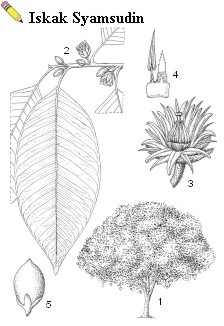 | Mimusops elengi L. – 1, tree habit; 2, flowering twig; 3, flower; 4, stamen and staminode; 5, fruit. |
Ecology
M. elengi is fairly common near the sea, but may also be found in rocky locations and inland forest, up to 600 m altitude. It thrives in areas with perhumid or slightly seasonal rainfall types, is usually found in seasonally dry habitats but can stand waterlogging for up to 2 months. It requires a fertile soil.
Silviculture and Management
M. elengi can be propagated by seed or cuttings. Seed can be stored for about 9 months and needs "after-ripening"" during the first month of storage. There are about 2000 dry seeds/kg. Seeds have 70-90% germination in 17-82 days. It is best sown directly in containers. The seedlings can be planted out when 20-30 cm tall. The rooting success of cuttings 10-15 cm long and with a diameter of 0.5-1 cm is 70-90%. It is a shade-tolerant species which retains a full crown and reproduces satisfactorily under fairly dense shade.
Genetic Resources and Breeding
M. elengi is stored in a germplasm collection in Malaysia, chiefly for its medicinal value. Trees may differ markedly in size depending on the site and origin, which offers potential for initiating selection and possibly breeding activities. In the Philippines M. elengi is classified as a vanishing timber tree.
Prospects
Because of its superior wood quality, it is worthwhile starting silvicultural trials with M. elengi. It has good potential for increased utilization in suitable silvicultural schemes. M. elengi is recommended as an ornamental and shade tree in Malaysia.
Literature
[71]Baehni, C., 1965. Mémoire sur les Sapotacées. III. Inventaire des genres [Note on the Sapotaceae. III. Inventory of genera]. Boissiera 11: 1-262.
[80]Balai Penjelidikan Kehutanan, 1950. Daftar ichtisar aturan berketjambah, penjimpanan dan pengiriman bidji dari beberapa djenis pohon dan pupuk hidjau [Tabular summary of the best ways to germinate, store and send seed of some tree and green manure species]. Laporan No 42. Balai Penjelidikan Kehutanan, Bogor. 23 pp.
[162]Burgess, P.F., 1966. Timbers of Sabah. Sabah Forest Records No 6. Forest Department, Sabah, Sandakan. xviii + 501 pp.
[163]Burkill, I.H., 1966. A dictionary of the economic products of the Malay Peninsula. 2nd edition. Ministry of Agriculture and Co-operatives, Kuala Lumpur. Vol. 1 (A-H) pp. 1-1240. Vol. 2 (I-Z) pp. 1241-2444.
[209]Corner, E.J.H., 1988. Wayside trees of Malaya. 3rd edition. 2 volumes. The Malayan Nature Society, Kuala Lumpur. 774 pp.
[218]Dahms, K.-G., 1982. Asiatische, ozeanische und australische Exporthölzer [Asiatic, Pacific and Australian export timbers]. DRW-Verlag, Stuttgart. 304 pp.
[235]de Guzman, E.D., Umali, R.M. & Sotalbo, E.D., 1986. Guide to the Philippine flora and fauna. Vol. 3: Dipterocarps, non-dipterocarps. Natural Resources Management Centre, Ministry of Natural Resources, Quezon City & University of the Philippines, Los Baños. xx + 414 pp.
[267]Desch, H.E., 1941-1954. Manual of Malayan timbers. Malayan Forest Records No 15. 2 volumes. Malaya Publishing House Ltd., Singapore. 762 pp.
[300]Eddowes, P.J., 1977. Commercial timbers of Papua New Guinea, their properties and uses. Forest Products Research Centre, Department of Primary Industry, Port Moresby. xiv + 195 pp.
[343]Flore du Cambodge, du Laos et du Viêtnam (various editors), 1960-. Muséum National d'Histoire Naturelle, Paris.
[375]Ginoga, B. & Karnasudirdja, S., 1977. Sifat fisis dan mekanis beberapa jenis kayu Jawa Barat [Physical and mechanical properties of some timber species from West Java]. Laporan No 90. Lembaga Penelitian Hasil Hutan, Bogor. 22 pp.
[405]Hardjowasono, M.S., 1942. Gewicht en volume van verschillende vrucht- en zaadsoorten [Weight and volume of various fruits and seeds]. Korte Mededelingen No 20. Bosbouwproefstation, Buitenzorg. 172 pp.
[406]Harker, A.P., Sandels, A. & Burley, J., 1982. Calorific values for wood and bark and a bibliography for fuelwood. Report G 162. Tropical Products Institute, London. 20 pp.
[436]Heyne, K., 1927. De nuttige planten van Nederlands-Indië [The useful plants of the Dutch East Indies]. 2nd edition, 3 volumes. Departement van Landbouw, Nijverheid en Handel in Nederlandsch-Indië. 1953 pp. (3rd edition, 1950. van Hoeve, 's-Gravenhage/Bandung. 1660 pp.).
[464]Ilic, J., 1990. The CSIRO macro key for hardwood identification. CSIRO, Highett. 125 pp.
[487]Japing, C.H., 1961. Houtsoorten van Nieuw Guinea - literatuurstudie [Tree species of Dutch New Guinea - survey of literature]. 2 parts. Wageningen. 220 pp.
[513]Kalkman, C., 1959. Houtsoorten van Nieuw Guinea - samenvatting van literatuur- en praktijkgegevens voor een dertigtal van de belangrijkste houtsoorten uit Nederlands Nieuw Guinea [Timbers of New Guinea - summary of data from literature and from practice of some thirty of the most important timbers of Dutch New Guinea]. Afdeling Boswezen, onderafdeling bosplanologie en - exploratie, Manokwari. 39 pp.
[526]Kartasujana, I. & Martawijaya, A., 1979. Kayu perdagangan Indonesia - sifat dan kegunaannya [Commercial woods of Indonesia - their properties and uses]. Lembaga Penelitian Hasil Hutan, Bogor. 28 pp.
[536]Keating, W.G. & Bolza, E., 1982. Characteristics, properties and uses of timbers. Vol. 1. South-East Asia, northern Australia and the Pacific. Inkata Press Proprietary Ltd., Melbourne, Sydney & London. 362 pp.
[568]Kingston, R.S.T. & Risdon, C.J.E., 1961. Shrinkage and density of Australian and other South-West Pacific woods. Technological Paper No 13. Division of Forest Products, CSIRO, Melbourne. 65 pp.
[571]Kloot, N.H. & Bolza, E., 1961. Properties of timbers imported into Australia. Technological Paper No 12. Division of Forest Products, CSIRO, Melbourne. 79 pp.
[572]Kloppenburg-Versteegh, J., 1978. Wenken en raadgevingen betreffende het gebruik van Indische planten, vruchten, enz. [Tips and advices concerning the use of Indonesian plants, fruits, etc.]. 5th edition. Servire, Katwijk aan Zee. 364 pp.
[632]Kraemer, J.H., 1951. Trees of the western Pacific region. Tri-State Offset Company, Cincinnatti. 436 pp.
[757]Martawijaya, A., Kartasujana, I., Kadir, K. & Prawira, S.A., 1992. Indonesian wood atlas. Vol. 2. Forest Products Research and Development Centre, Bogor. 168 pp.
[780]Meniado, J.A. et al., 1975-1981. Wood identification handbook for Philippine timbers. 2 volumes. Government Printing Office, Manila. 370 pp. & 186 pp.
[796]Mitchell, B.A., 1964. Ornamental, roadside, and shade trees. Malayan Forester 27: 131-132.
[828]Ng, F.S.P., 1989. Guide to garden plants 5. Nature Malaysiana 14(3): 84-93.
[829]Ng, F.S.P., 1991-1992. Manual of forest fruits, seeds and seedlings. 2 volumes. Malayan Forest Record No 34. Forest Research Institute Malaysia, Kepong. 997 pp.
[831]Ng, F.S.P. & Mat Asri Ngah Sanah, 1991. Germination and seedling records. Research Pamphlet No 108. Forest Research Institute Malaysia, Kepong. 191 pp.
[832]Ng, F.S.P. & Tang, H.T., 1974. Comparative growth rates of Malaysian trees. Malaysian Forester 37: 2-23.
[861]Oey Djoen Seng, 1951. De soortelijke gewichten van Indonesische houtsoorten en hun betekenis voor de praktijk [Specific gravity of Indonesian woods and its significance for practical use]. Rapport No 46. Bosbouwproefstation, Bogor. 183 pp.
[877]Pennington, T.D., 1991. The genera of Sapotaceae. Royal Botanic Gardens, Kew & New York Botanical Garden, New York. 295 pp.
[889]Phengklai, C. & Khamsai, S., 1985. Some non-timber species of Thailand. Thai Forest Bulletin (Botany) 15: 108-148.
[934]Reyes, L.J., 1938. Philippine woods. Technical Bulletin No 7. Commonwealth of the Philippines, Department of Agriculture and Commerce. Bureau of Printing, Manila. 536 pp. + 88 plates.
[974]Salvosa, F.M., 1963. Lexicon of Philippine trees. Bulletin No 1. Forest Products Research Institute, College, Laguna. 136 pp.
[988]Saw, L.G. & Raja Barizan Raja Sulaiman, 1991. Directory of plant genetic resources in Malaysia. Research Pamphlet No 109. Forest Research Institute Malaysia, Kepong. 161 pp.
[1037]Smith, W.J., Kynaston, W.T., Cause, M.L. & Grimmett, J.G., 1991. Building timbers, properties & recommendations for their use in Queensland. Technical Pamphlet No 1. Queensland Forest Service, Department of Primary Industries, Queensland. 117 pp.
[1038]Smitinand, T., 1980. Thai plant names. Royal Forest Department, Bangkok. 379 pp.
[1040]Smythies, B.E., 1965. Common Sarawak trees. Borneo Literature Bureau, South China Morning Post, Hong Kong. 153 pp.
[1050]Soerianegara, I. & Lemmens, R.H.M.J. (Editors), 1993. Plant resources of South-East Asia No 5(1). Timber trees: Major commercial timbers. Pudoc Scientific Publishers, Wageningen. 610 pp.
[1067]Subba Reddi, C. & Janaki Bai, A., 1981. Floral biology of Mimusops elengi Linn. Journal of the Bombay Natural History Society 77: 471-475.
[1086]Tamesis, F. & Aguilar, L., 1951. Important commercial timbers of the Philippines: their properties and uses. Popular Bulletin No 32. Department of Agriculture and Natural Resources. Bureau of Printing, Manila. 83 pp.
[1096]Thomas, A.V., 1950. Malayan timbers: jelutong, nyatoh. Malayan Forester 13: 158-163.
[1098]Timber Research and Development Association, 1979. Timbers of the world. Volume 1. Africa, S. America, Southern Asia, S.E. Asia. TRADA/The Construction Press, Lancaster. 463 pp.
[1104]Troup, R.S., 1921. Silviculture of Indian trees. 3 volumes. Clarendon Press, Oxford.
[1123]van der Pijl, L., 1957. The dispersal of plants by bats (chiropterochory). Acta Botanica Neerlandica 6: 291-315.
[1169]Vidal, J., 1962. Noms vernaculaires de plantes en usage au Laos [Vernacular names of plants used in Laos]. Ecole française d'Extrême-Orient, Paris. 197 pp.
[1174]Vink, W., 1958. Revision of the Sapotaceae of the Malaysian area in a wider sense XIII. Chrysophyllum L. Blumea 9: 21-74.
[1202]Wheatley, J.I., 1992. A guide to the common trees of Vanuatu. Department of Forestry, Port Vila. 308 pp.
[1221]Whitmore, T.C. & Ng, F.S.P. (Editors), 1972-1989. Tree flora of Malaya. A manual for foresters. 4 volumes. Malayan Forest Records No 26. Longman Malaysia Sdn. Berhad, Kuala Lumpur & Petaling Jaya.
[80]Balai Penjelidikan Kehutanan, 1950. Daftar ichtisar aturan berketjambah, penjimpanan dan pengiriman bidji dari beberapa djenis pohon dan pupuk hidjau [Tabular summary of the best ways to germinate, store and send seed of some tree and green manure species]. Laporan No 42. Balai Penjelidikan Kehutanan, Bogor. 23 pp.
[162]Burgess, P.F., 1966. Timbers of Sabah. Sabah Forest Records No 6. Forest Department, Sabah, Sandakan. xviii + 501 pp.
[163]Burkill, I.H., 1966. A dictionary of the economic products of the Malay Peninsula. 2nd edition. Ministry of Agriculture and Co-operatives, Kuala Lumpur. Vol. 1 (A-H) pp. 1-1240. Vol. 2 (I-Z) pp. 1241-2444.
[209]Corner, E.J.H., 1988. Wayside trees of Malaya. 3rd edition. 2 volumes. The Malayan Nature Society, Kuala Lumpur. 774 pp.
[218]Dahms, K.-G., 1982. Asiatische, ozeanische und australische Exporthölzer [Asiatic, Pacific and Australian export timbers]. DRW-Verlag, Stuttgart. 304 pp.
[235]de Guzman, E.D., Umali, R.M. & Sotalbo, E.D., 1986. Guide to the Philippine flora and fauna. Vol. 3: Dipterocarps, non-dipterocarps. Natural Resources Management Centre, Ministry of Natural Resources, Quezon City & University of the Philippines, Los Baños. xx + 414 pp.
[267]Desch, H.E., 1941-1954. Manual of Malayan timbers. Malayan Forest Records No 15. 2 volumes. Malaya Publishing House Ltd., Singapore. 762 pp.
[300]Eddowes, P.J., 1977. Commercial timbers of Papua New Guinea, their properties and uses. Forest Products Research Centre, Department of Primary Industry, Port Moresby. xiv + 195 pp.
[343]Flore du Cambodge, du Laos et du Viêtnam (various editors), 1960-. Muséum National d'Histoire Naturelle, Paris.
[375]Ginoga, B. & Karnasudirdja, S., 1977. Sifat fisis dan mekanis beberapa jenis kayu Jawa Barat [Physical and mechanical properties of some timber species from West Java]. Laporan No 90. Lembaga Penelitian Hasil Hutan, Bogor. 22 pp.
[405]Hardjowasono, M.S., 1942. Gewicht en volume van verschillende vrucht- en zaadsoorten [Weight and volume of various fruits and seeds]. Korte Mededelingen No 20. Bosbouwproefstation, Buitenzorg. 172 pp.
[406]Harker, A.P., Sandels, A. & Burley, J., 1982. Calorific values for wood and bark and a bibliography for fuelwood. Report G 162. Tropical Products Institute, London. 20 pp.
[436]Heyne, K., 1927. De nuttige planten van Nederlands-Indië [The useful plants of the Dutch East Indies]. 2nd edition, 3 volumes. Departement van Landbouw, Nijverheid en Handel in Nederlandsch-Indië. 1953 pp. (3rd edition, 1950. van Hoeve, 's-Gravenhage/Bandung. 1660 pp.).
[464]Ilic, J., 1990. The CSIRO macro key for hardwood identification. CSIRO, Highett. 125 pp.
[487]Japing, C.H., 1961. Houtsoorten van Nieuw Guinea - literatuurstudie [Tree species of Dutch New Guinea - survey of literature]. 2 parts. Wageningen. 220 pp.
[513]Kalkman, C., 1959. Houtsoorten van Nieuw Guinea - samenvatting van literatuur- en praktijkgegevens voor een dertigtal van de belangrijkste houtsoorten uit Nederlands Nieuw Guinea [Timbers of New Guinea - summary of data from literature and from practice of some thirty of the most important timbers of Dutch New Guinea]. Afdeling Boswezen, onderafdeling bosplanologie en - exploratie, Manokwari. 39 pp.
[526]Kartasujana, I. & Martawijaya, A., 1979. Kayu perdagangan Indonesia - sifat dan kegunaannya [Commercial woods of Indonesia - their properties and uses]. Lembaga Penelitian Hasil Hutan, Bogor. 28 pp.
[536]Keating, W.G. & Bolza, E., 1982. Characteristics, properties and uses of timbers. Vol. 1. South-East Asia, northern Australia and the Pacific. Inkata Press Proprietary Ltd., Melbourne, Sydney & London. 362 pp.
[568]Kingston, R.S.T. & Risdon, C.J.E., 1961. Shrinkage and density of Australian and other South-West Pacific woods. Technological Paper No 13. Division of Forest Products, CSIRO, Melbourne. 65 pp.
[571]Kloot, N.H. & Bolza, E., 1961. Properties of timbers imported into Australia. Technological Paper No 12. Division of Forest Products, CSIRO, Melbourne. 79 pp.
[572]Kloppenburg-Versteegh, J., 1978. Wenken en raadgevingen betreffende het gebruik van Indische planten, vruchten, enz. [Tips and advices concerning the use of Indonesian plants, fruits, etc.]. 5th edition. Servire, Katwijk aan Zee. 364 pp.
[632]Kraemer, J.H., 1951. Trees of the western Pacific region. Tri-State Offset Company, Cincinnatti. 436 pp.
[757]Martawijaya, A., Kartasujana, I., Kadir, K. & Prawira, S.A., 1992. Indonesian wood atlas. Vol. 2. Forest Products Research and Development Centre, Bogor. 168 pp.
[780]Meniado, J.A. et al., 1975-1981. Wood identification handbook for Philippine timbers. 2 volumes. Government Printing Office, Manila. 370 pp. & 186 pp.
[796]Mitchell, B.A., 1964. Ornamental, roadside, and shade trees. Malayan Forester 27: 131-132.
[828]Ng, F.S.P., 1989. Guide to garden plants 5. Nature Malaysiana 14(3): 84-93.
[829]Ng, F.S.P., 1991-1992. Manual of forest fruits, seeds and seedlings. 2 volumes. Malayan Forest Record No 34. Forest Research Institute Malaysia, Kepong. 997 pp.
[831]Ng, F.S.P. & Mat Asri Ngah Sanah, 1991. Germination and seedling records. Research Pamphlet No 108. Forest Research Institute Malaysia, Kepong. 191 pp.
[832]Ng, F.S.P. & Tang, H.T., 1974. Comparative growth rates of Malaysian trees. Malaysian Forester 37: 2-23.
[861]Oey Djoen Seng, 1951. De soortelijke gewichten van Indonesische houtsoorten en hun betekenis voor de praktijk [Specific gravity of Indonesian woods and its significance for practical use]. Rapport No 46. Bosbouwproefstation, Bogor. 183 pp.
[877]Pennington, T.D., 1991. The genera of Sapotaceae. Royal Botanic Gardens, Kew & New York Botanical Garden, New York. 295 pp.
[889]Phengklai, C. & Khamsai, S., 1985. Some non-timber species of Thailand. Thai Forest Bulletin (Botany) 15: 108-148.
[934]Reyes, L.J., 1938. Philippine woods. Technical Bulletin No 7. Commonwealth of the Philippines, Department of Agriculture and Commerce. Bureau of Printing, Manila. 536 pp. + 88 plates.
[974]Salvosa, F.M., 1963. Lexicon of Philippine trees. Bulletin No 1. Forest Products Research Institute, College, Laguna. 136 pp.
[988]Saw, L.G. & Raja Barizan Raja Sulaiman, 1991. Directory of plant genetic resources in Malaysia. Research Pamphlet No 109. Forest Research Institute Malaysia, Kepong. 161 pp.
[1037]Smith, W.J., Kynaston, W.T., Cause, M.L. & Grimmett, J.G., 1991. Building timbers, properties & recommendations for their use in Queensland. Technical Pamphlet No 1. Queensland Forest Service, Department of Primary Industries, Queensland. 117 pp.
[1038]Smitinand, T., 1980. Thai plant names. Royal Forest Department, Bangkok. 379 pp.
[1040]Smythies, B.E., 1965. Common Sarawak trees. Borneo Literature Bureau, South China Morning Post, Hong Kong. 153 pp.
[1050]Soerianegara, I. & Lemmens, R.H.M.J. (Editors), 1993. Plant resources of South-East Asia No 5(1). Timber trees: Major commercial timbers. Pudoc Scientific Publishers, Wageningen. 610 pp.
[1067]Subba Reddi, C. & Janaki Bai, A., 1981. Floral biology of Mimusops elengi Linn. Journal of the Bombay Natural History Society 77: 471-475.
[1086]Tamesis, F. & Aguilar, L., 1951. Important commercial timbers of the Philippines: their properties and uses. Popular Bulletin No 32. Department of Agriculture and Natural Resources. Bureau of Printing, Manila. 83 pp.
[1096]Thomas, A.V., 1950. Malayan timbers: jelutong, nyatoh. Malayan Forester 13: 158-163.
[1098]Timber Research and Development Association, 1979. Timbers of the world. Volume 1. Africa, S. America, Southern Asia, S.E. Asia. TRADA/The Construction Press, Lancaster. 463 pp.
[1104]Troup, R.S., 1921. Silviculture of Indian trees. 3 volumes. Clarendon Press, Oxford.
[1123]van der Pijl, L., 1957. The dispersal of plants by bats (chiropterochory). Acta Botanica Neerlandica 6: 291-315.
[1169]Vidal, J., 1962. Noms vernaculaires de plantes en usage au Laos [Vernacular names of plants used in Laos]. Ecole française d'Extrême-Orient, Paris. 197 pp.
[1174]Vink, W., 1958. Revision of the Sapotaceae of the Malaysian area in a wider sense XIII. Chrysophyllum L. Blumea 9: 21-74.
[1202]Wheatley, J.I., 1992. A guide to the common trees of Vanuatu. Department of Forestry, Port Vila. 308 pp.
[1221]Whitmore, T.C. & Ng, F.S.P. (Editors), 1972-1989. Tree flora of Malaya. A manual for foresters. 4 volumes. Malayan Forest Records No 26. Longman Malaysia Sdn. Berhad, Kuala Lumpur & Petaling Jaya.
Author(s)
Noorma Wati Haron
Correct Citation of this Article
Haron, N.W., 1998. Mimusops L.. In: Sosef, M.S.M., Hong, L.T. and Prawirohatmodjo, S. (Editors): Plant Resources of South-East Asia No 5(3): Timber trees; Lesser-known timbers. PROSEA Foundation, Bogor, Indonesia. Database record: prota4u.org/prosea

All texts are licensed under a Creative Commons Attribution-Noncommercial-Share Alike 3.0 Netherlands License
This license does not include the illustrations (Maps,drawings,pictures); these remain all under copyright.