Record Number
603
PROSEA Handbook Number
13: Spices
Taxon
Zingiber G.R. Boehmer
Protologue
C.G. Ludwig, Def. gen. pl. ed. 3: 89 (1760).
Family
ZINGIBERACEAE
Chromosome Numbers
x = 11; 2n = 22 (Zingiber montanum, Zingiber spectabile, Zingiber zerumbet)
Major Taxa and Synonyms
Major species and synonyms
- Zingiber montanum (Koenig) Dietrich, Sp. pl. ed. 6, 1: 52 (1831), synonyms: Amomum montanum Koenig (1783), Zingiber purpureum Roscoe (1807), Zingiber cassumunar Roxb. (1810).
- Zingiber officinale Roscoe - see separate article.
- Zingiber spectabile Griffith, Not. pl. asiat. 3: 413 (1853).
- Zingiber zerumbet (L.) J.E. Smith, Exot. bot. 2: 105, t. 112 (1806), synonyms: Amomum zerumbet L. (1753), Zingiber amaricans Blume (1827), Zingiber aromaticum Valeton (1918), Zingiber littorale Valeton (1918).
For other Zingiber species, see chapter on Minor spices.
- Zingiber montanum (Koenig) Dietrich, Sp. pl. ed. 6, 1: 52 (1831), synonyms: Amomum montanum Koenig (1783), Zingiber purpureum Roscoe (1807), Zingiber cassumunar Roxb. (1810).
- Zingiber officinale Roscoe - see separate article.
- Zingiber spectabile Griffith, Not. pl. asiat. 3: 413 (1853).
- Zingiber zerumbet (L.) J.E. Smith, Exot. bot. 2: 105, t. 112 (1806), synonyms: Amomum zerumbet L. (1753), Zingiber amaricans Blume (1827), Zingiber aromaticum Valeton (1918), Zingiber littorale Valeton (1918).
For other Zingiber species, see chapter on Minor spices.
Vernacular Names
Ginger (En). Gingembre (Fr). Vietnam: g[uwf]ng.
- Zingiber montanum: Cassumunar ginger, Bengal root (En). Gingembre marron (Fr). Indonesia: banglai (general), bengle (Javanese), panglay (Sundanese). Malaysia: bunglai, bangle, bolai. Laos: hva:nz ph'ai, hva:nz kè:z hva:nz. Thailand: puloei (northern), phlai (central), wan-fai (central). Vietnam: g[uwf]ng d[aj]i, g[uwf]ng d[or].
- Zingiber spectabile: Black gingerwort (En). Malaysia: tepus tanah, tepai, tepus halia. Thailand: cha-ngoe (Pattani), dakngoe (Pattani).
- Zingiber zerumbet: Wild ginger, zerumbet ginger (En). Shampoo plant (Am). Zerumbet, gingembre fou, gingembre blanc (Fr). Indonesia: lampuyang (Sundanese), lempuyang (Javanese), lampojang (Madurese). Malaysia: lampoyang. Philippines: barik, langkawas (Tagalog), lampuyang (Ilonggo). Cambodia: khnhei phtu, prateal vong prenh atit. Laos: hva:nz ph'ai chai hlüang. Thailand: kathue (central), kathue-pa (northern), kawaen (northern). Vietnam: g[uwf]ng gi[os], ng[ar]i xanh.
- var. amaricans (Blume) Theilade: Indonesia: lampuyang pahit (Sundanese), lempuyang pait (javanese), lempuyang emprit (Javanese). Thailand: hiu-dam (Mae Hong Son).
- var. aromaticum (Valeton) Theilade: Indonesia: lampuyang wangi (Sundanese), lempuyang wangi (Javanese), lampojang ruum (Madurese). Malaysia: lampoyang, lempoyang, tepus.
- var. zerumbet: Indonesia: lempuyang gajah (Javanese), lempuyang kapur (Javanese), lempuyang kebo (Javanese).
- Zingiber montanum: Cassumunar ginger, Bengal root (En). Gingembre marron (Fr). Indonesia: banglai (general), bengle (Javanese), panglay (Sundanese). Malaysia: bunglai, bangle, bolai. Laos: hva:nz ph'ai, hva:nz kè:z hva:nz. Thailand: puloei (northern), phlai (central), wan-fai (central). Vietnam: g[uwf]ng d[aj]i, g[uwf]ng d[or].
- Zingiber spectabile: Black gingerwort (En). Malaysia: tepus tanah, tepai, tepus halia. Thailand: cha-ngoe (Pattani), dakngoe (Pattani).
- Zingiber zerumbet: Wild ginger, zerumbet ginger (En). Shampoo plant (Am). Zerumbet, gingembre fou, gingembre blanc (Fr). Indonesia: lampuyang (Sundanese), lempuyang (Javanese), lampojang (Madurese). Malaysia: lampoyang. Philippines: barik, langkawas (Tagalog), lampuyang (Ilonggo). Cambodia: khnhei phtu, prateal vong prenh atit. Laos: hva:nz ph'ai chai hlüang. Thailand: kathue (central), kathue-pa (northern), kawaen (northern). Vietnam: g[uwf]ng gi[os], ng[ar]i xanh.
- var. amaricans (Blume) Theilade: Indonesia: lampuyang pahit (Sundanese), lempuyang pait (javanese), lempuyang emprit (Javanese). Thailand: hiu-dam (Mae Hong Son).
- var. aromaticum (Valeton) Theilade: Indonesia: lampuyang wangi (Sundanese), lempuyang wangi (Javanese), lampojang ruum (Madurese). Malaysia: lampoyang, lempoyang, tepus.
- var. zerumbet: Indonesia: lempuyang gajah (Javanese), lempuyang kapur (Javanese), lempuyang kebo (Javanese).
Origin and Geographic Distribution
Zingiber contains about 100 species and its centre of diversity is located in South-East Asia. It is found throughout tropical Asia, in tropical Australia and in Japan.
- Zingiber montanum is probably native to India and is now widely cultivated in tropical Asia. It occurs widely as a home-garden plant in South-East Asia.
- Zingiber spectabile is found in Peninsular Malaysia and peninsular Thailand. Throughout the tropics it is occasionally cultivated as an ornamental.
- Zingiber zerumbet is probably indigenous to India. It is cultivated in India, Sri Lanka, China and throughout South-East Asia as a home-garden plant. It is also cultivated on Martinique. In Java, var. amaricans occurs wild and cultivated, var. aromaticum is often found cultivated and sometimes wild or naturalized, whereas var. zerumbet is only known from cultivation.
- Zingiber montanum is probably native to India and is now widely cultivated in tropical Asia. It occurs widely as a home-garden plant in South-East Asia.
- Zingiber spectabile is found in Peninsular Malaysia and peninsular Thailand. Throughout the tropics it is occasionally cultivated as an ornamental.
- Zingiber zerumbet is probably indigenous to India. It is cultivated in India, Sri Lanka, China and throughout South-East Asia as a home-garden plant. It is also cultivated on Martinique. In Java, var. amaricans occurs wild and cultivated, var. aromaticum is often found cultivated and sometimes wild or naturalized, whereas var. zerumbet is only known from cultivation.
Uses
Zingiber is valued as a spice, for its medicinal properties and for its essential oil.
Zingiber montanum. Its rhizomes are used for food flavouring, often as a substitute for Zingiber officinale. The plant is applied medicinally throughout tropical Asia, primarily as a carminative and stimulant for the stomach, and against diarrhoea and colic. In Indonesia, the pounded rhizome is used as a poultice against headache, and in a variety of medicinal mixtures. In Malaysia, the rhizome is administered internally as a vermifuge, whereas various poultices, lotions, decoctions and applications are rubbed over the body after childbirth and used against swellings, rheumatism, contusions, numb feet, gonorrhoea and pain in various places. In Laos, it is applied against abscesses, fever, colic, diarrhoea and other intestinal disorders, and as a depurative. It is also used as a poison antidote in Laos. In Thai traditional medicine, the rhizomes are taken against asthma and muscle and joint pain.
Zingiber spectabile. Used for flavouring in Malaysia. In traditional medicine, pounded leaves are applied to poultice swellings, whereas cold water infusions are used to bathe inflamed eyelids. It is in use by forest tribes (Orang Asli) to treat headache and back-aches. The large inflorescences are sometimes cut for ornamental purposes.
Zingiber zerumbet. Its rhizomes are used as a spice as well as for medicinal purposes. In Indonesia, Zingiber zerumbet is considered a stimulant for the mucous membrane of the stomach and bowels and it is applied against diarrhoea, dysentery and stomachache, and externally to relieve pain. In Brunei Darussalam, rhizome decoctions are put in a bath after childbirth, whereas warmed leaves are applied as a poultice against arthritis and aching joints. In the Philippines, the dried, powdered rhizome is used as an anti-diarrhetic, whereas rhizome decoctions are administered against asthma and as a topical against rheumatism. In New Guinea, the plant is used in masculine rituals and reported to make women sterile. In Indo-China, the rhizome is considered tonic, stimulant and depurative. Macerated in alcohol, it is taken in the case of vertigo and in the first two weeks after giving birth. It is also reported to be applied to the head of children in convulsions and to the head and stomach of children with fever. The essential oil is applied in India as a perfume in soaps and toilet articles, after blending with other perfumes.
- var. amaricans. The rhizomes are used for seasoning, and in Indonesia, rhizomes and rhizome tips are reported to be eaten as 'lalab'. This 'lalab' is also reputed to be depurative and effective against sprue. Young flower spikes, without the bracts, are also eaten, raw or cooked. The juice of fresh rhizomes is taken to stimulate the appetite. In Malaysia, the rhizome is applied against stomachache with leg cramps, against puerperal infection and as a tonic. Externally, it is used against fever and numb feet, where it acts as a rubefacient and irritant.
- var. aromaticum. Fresh shoots are eaten as a vegetable in Java. Young ends of rhizomes are consumed raw as 'lalab', like those of Zingiber amaricans. Medicinally, Zingiber aromaticum rhizomes are used in Java against biliousness, chlorosis and whooping cough. In Java as well as Malaysia, powdered rhizomes are applied to the body after childbirth.
- var. zerumbet. In Indonesia, rhizome juice or decoctions are reported to be used against biliousness, gall stones, ulcers, rash and languor, and to increase the appetite.
Zingiber montanum. Its rhizomes are used for food flavouring, often as a substitute for Zingiber officinale. The plant is applied medicinally throughout tropical Asia, primarily as a carminative and stimulant for the stomach, and against diarrhoea and colic. In Indonesia, the pounded rhizome is used as a poultice against headache, and in a variety of medicinal mixtures. In Malaysia, the rhizome is administered internally as a vermifuge, whereas various poultices, lotions, decoctions and applications are rubbed over the body after childbirth and used against swellings, rheumatism, contusions, numb feet, gonorrhoea and pain in various places. In Laos, it is applied against abscesses, fever, colic, diarrhoea and other intestinal disorders, and as a depurative. It is also used as a poison antidote in Laos. In Thai traditional medicine, the rhizomes are taken against asthma and muscle and joint pain.
Zingiber spectabile. Used for flavouring in Malaysia. In traditional medicine, pounded leaves are applied to poultice swellings, whereas cold water infusions are used to bathe inflamed eyelids. It is in use by forest tribes (Orang Asli) to treat headache and back-aches. The large inflorescences are sometimes cut for ornamental purposes.
Zingiber zerumbet. Its rhizomes are used as a spice as well as for medicinal purposes. In Indonesia, Zingiber zerumbet is considered a stimulant for the mucous membrane of the stomach and bowels and it is applied against diarrhoea, dysentery and stomachache, and externally to relieve pain. In Brunei Darussalam, rhizome decoctions are put in a bath after childbirth, whereas warmed leaves are applied as a poultice against arthritis and aching joints. In the Philippines, the dried, powdered rhizome is used as an anti-diarrhetic, whereas rhizome decoctions are administered against asthma and as a topical against rheumatism. In New Guinea, the plant is used in masculine rituals and reported to make women sterile. In Indo-China, the rhizome is considered tonic, stimulant and depurative. Macerated in alcohol, it is taken in the case of vertigo and in the first two weeks after giving birth. It is also reported to be applied to the head of children in convulsions and to the head and stomach of children with fever. The essential oil is applied in India as a perfume in soaps and toilet articles, after blending with other perfumes.
- var. amaricans. The rhizomes are used for seasoning, and in Indonesia, rhizomes and rhizome tips are reported to be eaten as 'lalab'. This 'lalab' is also reputed to be depurative and effective against sprue. Young flower spikes, without the bracts, are also eaten, raw or cooked. The juice of fresh rhizomes is taken to stimulate the appetite. In Malaysia, the rhizome is applied against stomachache with leg cramps, against puerperal infection and as a tonic. Externally, it is used against fever and numb feet, where it acts as a rubefacient and irritant.
- var. aromaticum. Fresh shoots are eaten as a vegetable in Java. Young ends of rhizomes are consumed raw as 'lalab', like those of Zingiber amaricans. Medicinally, Zingiber aromaticum rhizomes are used in Java against biliousness, chlorosis and whooping cough. In Java as well as Malaysia, powdered rhizomes are applied to the body after childbirth.
- var. zerumbet. In Indonesia, rhizome juice or decoctions are reported to be used against biliousness, gall stones, ulcers, rash and languor, and to increase the appetite.
Production and International Trade
Zingiber is either gathered from the wild or planted in home gardens for local use. In Indonesia, companies trading in traditional medicines and cosmetics occasionally purchase some Zingiber rhizomes (usually dried), but no statistics are available.
Properties
The rhizomes of Zingiber montanum are usually larger than those of Zingiber officinale. They are valued for their aroma and taste. The odour has been described as strong and reminiscent of a mixture of ginger, camphor and turmeric, the taste as hot and camphorous. However, the rhizomes have also been reported to have a bitter and unpleasant taste. Dried rhizomes of Zingiber montanum yield 0.5% essential oil on steam distillation. The main constituent, terpinen-4-ol, is widely used in perfumery in artificial geranium, pepper, rose and other oils, (soap) perfumes and flavour compositions. Terpinen-4-ol has also been found to be effective against a range of pathogenic bacteria, including Escherichia coli, Klebsiella pneumoniae, Salmonella paratyphi, S. typhi and Shigella flexneri, and to have antifungal activity. The anti-inflammatory and antioxidant activity of Zingiber montanum rhizomes has been linked to the presence of curcuminoids. The anti-inflammatory as well as the analgesic and antipyretic effects have also been related to the presence of phenylbutenoids. The phenylbutenoid (E)-4-(3',4'-dimethoxyphenyl)-but-3-en-1-ol has shown relaxant effects on isolated rat uteri. Methanolic extracts of the rhizomes of Zingiber montanum and Zingiber zerumbet have shown cholagogic effects in anaesthetized rats. The fungitoxic activity of Zingiber montanum rhizomes against Rhizoctonia solani has been found to be due to zerumbone. Zingiber montanum rhizome extracts have shown insecticidal activity in bioassays with Spodoptera littoralis larvae, due to the presence of phenylbutanoids. Zingiber montanum rhizome extracts have also shown in vitro anthelmintic activity against Ascaridia galli.
Essential oil isolated from stems (0.01%) and leaves (0.027%) of Zingiber spectabile from Tahiti were found to contain 60-80% monoterpene hydrocarbons. The addition of powdered leaves of Zingiber spectabile and Zingiber zerumbet to cowpea (Vigna unguiculata (L.) Walp.) seeds led to a reduction in the number of Callosobruchus eggs.
The rhizomes of Zingiber zerumbet are thicker, but less aromatic than those of Zingiber officinale, whereas they are also said to be more bitter. Therefore, they are less valued for culinary purposes than those of Zingiber officinale. The rhizomes of var. amaricans have a sharp and intensely bitter taste, but no aroma, whereas those of var. aromaticum have a sharp and bitter taste and a pleasant aroma. The rhizomes of var. zerumbet are said to be aromatic, but to have a less agreeable odour and taste than var. aromaticum. They are also less sharp, and therefore considered less powerful than those of var. aromaticum. Essential oil obtained from fresh Zingiber zerumbet rhizomes (0.35-0.37%) from Vietnam and the Philippines contained monoterpenes and sesquiterpenes. The main constituent is the monocyclic sesquiterpene ketone zerumbone (35-72%). Zerumbone is also the major component of the stem oil (0.05%). The major compound of the essential oils from the leaves (0.07%) and the flowers (0.15%) of Zingiber zerumbet is (Z)-neridol. The methylene chloride soluble fraction of the rhizomes of Zingiber zerumbet contains zerumbone, zerumbone epoxide, curcumin, flavonols and flavonoid glycosides. Zerumbone from Zingiber zerumbet is reported to inhibit the growth of Micrococcus pyogenes and Mycobacterium tuberculosis. Zerumbone epoxide has shown in vitro cytotoxic activity against tumour (hepatoma) cells but little activity against normal fibroblasts, whereas zerumbone has shown toxicity against both. Curcumin is reported to have antioxidant activity. Methanol extracts of Zingiber zerumbet from Sri Lanka have shown antifungal activity against Cladosporium cladosporoides.
Essential oil isolated from stems (0.01%) and leaves (0.027%) of Zingiber spectabile from Tahiti were found to contain 60-80% monoterpene hydrocarbons. The addition of powdered leaves of Zingiber spectabile and Zingiber zerumbet to cowpea (Vigna unguiculata (L.) Walp.) seeds led to a reduction in the number of Callosobruchus eggs.
The rhizomes of Zingiber zerumbet are thicker, but less aromatic than those of Zingiber officinale, whereas they are also said to be more bitter. Therefore, they are less valued for culinary purposes than those of Zingiber officinale. The rhizomes of var. amaricans have a sharp and intensely bitter taste, but no aroma, whereas those of var. aromaticum have a sharp and bitter taste and a pleasant aroma. The rhizomes of var. zerumbet are said to be aromatic, but to have a less agreeable odour and taste than var. aromaticum. They are also less sharp, and therefore considered less powerful than those of var. aromaticum. Essential oil obtained from fresh Zingiber zerumbet rhizomes (0.35-0.37%) from Vietnam and the Philippines contained monoterpenes and sesquiterpenes. The main constituent is the monocyclic sesquiterpene ketone zerumbone (35-72%). Zerumbone is also the major component of the stem oil (0.05%). The major compound of the essential oils from the leaves (0.07%) and the flowers (0.15%) of Zingiber zerumbet is (Z)-neridol. The methylene chloride soluble fraction of the rhizomes of Zingiber zerumbet contains zerumbone, zerumbone epoxide, curcumin, flavonols and flavonoid glycosides. Zerumbone from Zingiber zerumbet is reported to inhibit the growth of Micrococcus pyogenes and Mycobacterium tuberculosis. Zerumbone epoxide has shown in vitro cytotoxic activity against tumour (hepatoma) cells but little activity against normal fibroblasts, whereas zerumbone has shown toxicity against both. Curcumin is reported to have antioxidant activity. Methanol extracts of Zingiber zerumbet from Sri Lanka have shown antifungal activity against Cladosporium cladosporoides.
Adulterations and Substitutes
Zingiber zerumbet has been mentioned as an adulterant of Zingiber officinale, Zingiber montanum more as a substitute.
Description
Erect, robust perennial herbs, with several leafy stems, 0.5-3.5 m tall. Rhizome horizontal, fleshy, aromatic, at or near soil surface. Leaves distichous, linear to oblong-lanceolate, petiole short or absent, ligulate, entire or deeply 2-lobed, plane of leaves parallel with the rhizome. Inflorescence a spike, usually radical, sometimes terminal on a leafy stem; scape erect, procumbent or very short at base of leafy stem; spike compact, fusiform or ovoid to cylindrical; bracts persistent, closely imbricating or with apices free, 1-flowered, initially green, yellow or reddish, later bright red or yellow; bracteoles 1 per flower, facing the bract, narrower than bract, usually persisting and enclosing the fruit; calyx hyaline, tubular-spathaceous, generally shorter than bracteole, 3-partite; corolla with slender tube, dorsal lobe broader than lateral ones, concave, lateral lobes below the lip, usually partly joined to each other and to the lip; labellum 3-lobed, midlobe oblong-obovate, apex cleft or retuse, with adnate, acute or rounded petaloid lateral staminodes forming the side-lobes, cream or white, sometimes purple-mottled; filament short, anther 1-1.5 cm long, narrow, connective prolonged into a slender, curved beak, embracing the style; stigma protruding below the apex of the appendage, with a circular apical aperture surrounded by stiff hairs; ovary 3-locular, with 2 epigyneous glands. Fruit a capsule, 3-locular, with axile placentation, dehiscing loculicidally within the bracts, wall fleshy when fresh, leathery when dry. Seeds numerous, ellipsoidal, maroon to black, with a white or yellow, saccate, fleshy, lacerate aril.
- Zingiber montanum. Rhizome pale orange inside, with strong aroma. Leafy stems 1.2-1.8 m tall with subsessile leaves. Leaf sheath glabrous or hairy near edges; ligule bilobed, hairy, about 2 mm long; blade linear, 20-35 cm x 2-4 cm, evenly narrowed to the tip, lower surface pubescent. Inflorescence fusiform or cylindrical-ovoid, 10-16 cm x 3-3.5 cm, apex acute, on erect scape 20-25 cm long; bracts ovate, 3-3.5 cm long, pubescent, brownish-green, edges papery; bracteole 1-1.5 cm long; calyx 1.2 cm long; corolla 6 cm long, pale yellow, labellum 6 cm long, pale yellow, midlobe 2 cm long, broadly rounded, apex bilobed, deeply split when old, side-lobes oblong.
- Zingiber spectabile. Leafy stems 2.0-3.5 m tall, basal leafless stem part up to 1 m tall, swollen at base. Leaf sheath sparsely pilose, margin scarious; ligule deeply 2-lobed, lobes up to 1.5 cm long, broad, pale green; blade lanceolate, 30-50 cm x 6-10 cm, glabrous or slightly hairy at the base below. Inflorescence a cylindrical spike, 10-30 cm x 6-7 cm, with rounded apex; scape radical, erect, 20-40 cm long; bracts obovate, 4.5 cm long, turning red from yellow through orange, fleshy, curved outwards with the edge incurved forming pouches; bracteole linear, up to 4 cm long; calyx up to 3.5 cm long, cream to pinkish; corolla 7 cm long, yellow, dorsal lobe up to 3 cm x 1.7 cm, lateral lobes 1.8 cm x 0.6 cm, labellum 4-6 cm long, dark purple with yellow spots, midlobe ovate, 1.6 cm x 1.4 cm, shorter than or as long as the lateral corolla lobes, apex cleft, side-lobes 1 cm x 1 cm, broadly rounded; anther yellow, anther appendage purple. Fruit an ovoid capsule, 3 cm x 1 cm, sparsely pilose.
- Zingiber zerumbet. Rhizome tuberous, aromatic, pale to brighter yellow inside. Leafy stems 1.25-1.75 m tall. Leaf sheath sparsely hairy; ligule entire, 1.5-2.5 cm long, papery, scarious; petiole finely hairy; blade broadly lanceolate, 25-40 cm x 5-8 cm, apex acuminate. Inflorescence a cylindrical to ovoid spike, 6-14 cm x 4-5 cm, apex obtuse; scape radical, erect, 10-30 cm long, sheath green; bracts obovate, 3-4 cm x 2.5 cm, green when young, red when old, convex near upper edge, apex broadly rounded with papery margin; bracteoles linear to lanceolate, 2.5-3.5 cm long; calyx 2.5 cm long, shorter than bracteole, white; corolla 5.5 cm long, lemon yellow, dorsal lobe 2.5 cm x 2 cm, lateral lobes 1.6 cm x 0.7 cm; labellum 5.5 cm long, with crenate margin, white or yellow, midlobe oblong to almost round, 1.5 cm long, apex cleft, side-lobes ovate, 0.8 cm long; anther pale yellow. Fruit a cylindrical capsule, 1.5 cm long, red.
- Zingiber montanum. Rhizome pale orange inside, with strong aroma. Leafy stems 1.2-1.8 m tall with subsessile leaves. Leaf sheath glabrous or hairy near edges; ligule bilobed, hairy, about 2 mm long; blade linear, 20-35 cm x 2-4 cm, evenly narrowed to the tip, lower surface pubescent. Inflorescence fusiform or cylindrical-ovoid, 10-16 cm x 3-3.5 cm, apex acute, on erect scape 20-25 cm long; bracts ovate, 3-3.5 cm long, pubescent, brownish-green, edges papery; bracteole 1-1.5 cm long; calyx 1.2 cm long; corolla 6 cm long, pale yellow, labellum 6 cm long, pale yellow, midlobe 2 cm long, broadly rounded, apex bilobed, deeply split when old, side-lobes oblong.
- Zingiber spectabile. Leafy stems 2.0-3.5 m tall, basal leafless stem part up to 1 m tall, swollen at base. Leaf sheath sparsely pilose, margin scarious; ligule deeply 2-lobed, lobes up to 1.5 cm long, broad, pale green; blade lanceolate, 30-50 cm x 6-10 cm, glabrous or slightly hairy at the base below. Inflorescence a cylindrical spike, 10-30 cm x 6-7 cm, with rounded apex; scape radical, erect, 20-40 cm long; bracts obovate, 4.5 cm long, turning red from yellow through orange, fleshy, curved outwards with the edge incurved forming pouches; bracteole linear, up to 4 cm long; calyx up to 3.5 cm long, cream to pinkish; corolla 7 cm long, yellow, dorsal lobe up to 3 cm x 1.7 cm, lateral lobes 1.8 cm x 0.6 cm, labellum 4-6 cm long, dark purple with yellow spots, midlobe ovate, 1.6 cm x 1.4 cm, shorter than or as long as the lateral corolla lobes, apex cleft, side-lobes 1 cm x 1 cm, broadly rounded; anther yellow, anther appendage purple. Fruit an ovoid capsule, 3 cm x 1 cm, sparsely pilose.
- Zingiber zerumbet. Rhizome tuberous, aromatic, pale to brighter yellow inside. Leafy stems 1.25-1.75 m tall. Leaf sheath sparsely hairy; ligule entire, 1.5-2.5 cm long, papery, scarious; petiole finely hairy; blade broadly lanceolate, 25-40 cm x 5-8 cm, apex acuminate. Inflorescence a cylindrical to ovoid spike, 6-14 cm x 4-5 cm, apex obtuse; scape radical, erect, 10-30 cm long, sheath green; bracts obovate, 3-4 cm x 2.5 cm, green when young, red when old, convex near upper edge, apex broadly rounded with papery margin; bracteoles linear to lanceolate, 2.5-3.5 cm long; calyx 2.5 cm long, shorter than bracteole, white; corolla 5.5 cm long, lemon yellow, dorsal lobe 2.5 cm x 2 cm, lateral lobes 1.6 cm x 0.7 cm; labellum 5.5 cm long, with crenate margin, white or yellow, midlobe oblong to almost round, 1.5 cm long, apex cleft, side-lobes ovate, 0.8 cm long; anther pale yellow. Fruit a cylindrical capsule, 1.5 cm long, red.
Image
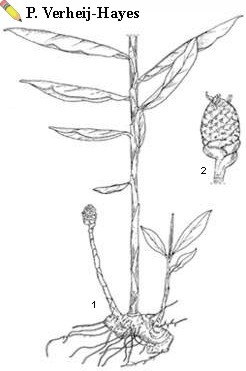 | Zingiber zerumbet (L.) J.E. Smith — 1, habit; 2, inflorescence |
Growth and Development
In Malaysia, Zingiber spectabile flowers from July to September and fruits in November, whereas Zingiber zerumbet flowers in the period from June to September and fruits from October to January. Zingiber spectabile inflorescences from Malaysia may contain 95-175 flowers. Only a few flowers are produced on an inflorescence at a time, with flowering occurring over 40-55 days in an acropetal sequence. The flowers last less than 24 h and open between 10 a.m. and 2 p.m.
Other Botanical Information
Zingiber purpureum Roscoe or Zingiber cassumunar Roxb. has long been considered to be a different species from Zingiber montanum (Koenig) Dietrich. Zingiber montanum is based on Amomum montanum Koenig, a name for which, for a long time, only a description existed. When type material of A. montanum was rediscovered it has become clear that the 3 taxa are the same species. Zingiber montanum is related to Zingiber zerumbet but can be easily distinguished by the linear leaves, the very short ligules and the brown bracts.
Zingiber spectabile can be easily recognized by the large (largest in Malesia), orange inflorescence with incurved bracts forming open pouches.
Zingiber zerumbet is an extraordinarily variable species, also in respect to the rhizome. The following groups (here considered varieties) have been described as separate species but are not sharply delimitated:
- var. amaricans: spikes ellipsoidal, 1.7-2 times longer than wide, apex rounded, bracts with involute apex, occurring wild and cultivated;
- var. aromaticum: spikes ovoid, 2-2.5 times longer than wide, apex acute, bracts with flat apex, occurring wild and cultivated;
- var. zerumbet: spikes subglobose, 1.5-1.7 times longer than wide, apex rounded, bracts with flat apex; occurring wild and cultivated.
A fourth group, only occurring wild, can be distinguished, but no specific uses are reported:
- var. littorale (Valeton) Theilade: spikes spindle-shaped or oblong-globose, 3-5 times longer than wide, apex acute, bracts often with incurved apex, occurring only wild;
The rhizomes of Zingiber mioga (Thunb.) Roscoe (mioga ginger), cultivated in Japan, China and Hawaii, have a bergamot-like flavour and are the source of Japanese ginger, whereas the flowers, fruits and sprouts are used for flavouring.
Zingiber spectabile can be easily recognized by the large (largest in Malesia), orange inflorescence with incurved bracts forming open pouches.
Zingiber zerumbet is an extraordinarily variable species, also in respect to the rhizome. The following groups (here considered varieties) have been described as separate species but are not sharply delimitated:
- var. amaricans: spikes ellipsoidal, 1.7-2 times longer than wide, apex rounded, bracts with involute apex, occurring wild and cultivated;
- var. aromaticum: spikes ovoid, 2-2.5 times longer than wide, apex acute, bracts with flat apex, occurring wild and cultivated;
- var. zerumbet: spikes subglobose, 1.5-1.7 times longer than wide, apex rounded, bracts with flat apex; occurring wild and cultivated.
A fourth group, only occurring wild, can be distinguished, but no specific uses are reported:
- var. littorale (Valeton) Theilade: spikes spindle-shaped or oblong-globose, 3-5 times longer than wide, apex acute, bracts often with incurved apex, occurring only wild;
The rhizomes of Zingiber mioga (Thunb.) Roscoe (mioga ginger), cultivated in Japan, China and Hawaii, have a bergamot-like flavour and are the source of Japanese ginger, whereas the flowers, fruits and sprouts are used for flavouring.
Ecology
Zingiber is commonly found in moist, partially shaded evergreen and monsoon forests on soils rich in organic matter, but also in secondary forests, open habitats at forest edges, disturbed sites and bamboo thickets on rocky soils, at altitudes up to 3000 m. Zingiber spectabile grows in evergreen forests, but also along trails, roadsides, streams and forest edges, on hillsides and disturbed sites, at altitudes up to 1000 m. Zingiber zerumbet is cultivated or naturalized in forest margins, brushwood, mixed forests, teak forests and waste places near villages, at altitudes up to 1200 m. In Java, Zingiber montanum is found up to 1300 m.
Propagation and planting
Zingiber is generally propagated by division of rhizomes. Propagules should be 4-7.5 cm long and weigh 50-80 g, but those of Zingiber zerumbet should weigh 70-100 g. The propagules must be kept moist in order to prevent drying out. To plant 1 ha, 1-2.5 t of planting material is needed.
Zingiber spectabile has also been propagated in vitro by placing rhizome axillary buds on Murashige and Skoog medium with various combinations of plant growth regulators, such as indole-3-acetic acid (IAA), naphthaleneacetic acid (NAA) and 6-benzyladenine (BA) at 26°C and 16 h photoperiod.
Zingiber can be planted on level fields or on raised beds. Raised beds 40-50 cm high, surrounded by ditches 30-40 cm deep are recommended, because the plants do not tolerate waterlogging. The soil should be well tilled to a depth of 40 cm. Plenty of organic matter, some sand, and limestone can be added to improve the soil. Planting holes should be 5-10 cm deep and plant spacing 30-50 cm x 60-90 cm. When supplemental irrigation is not used, it is advisable to plant during the rainy season to ensure rapid crop establishment and optimal growth.
Zingiber spectabile has also been propagated in vitro by placing rhizome axillary buds on Murashige and Skoog medium with various combinations of plant growth regulators, such as indole-3-acetic acid (IAA), naphthaleneacetic acid (NAA) and 6-benzyladenine (BA) at 26°C and 16 h photoperiod.
Zingiber can be planted on level fields or on raised beds. Raised beds 40-50 cm high, surrounded by ditches 30-40 cm deep are recommended, because the plants do not tolerate waterlogging. The soil should be well tilled to a depth of 40 cm. Plenty of organic matter, some sand, and limestone can be added to improve the soil. Planting holes should be 5-10 cm deep and plant spacing 30-50 cm x 60-90 cm. When supplemental irrigation is not used, it is advisable to plant during the rainy season to ensure rapid crop establishment and optimal growth.
Husbandry
Zingiber plots must be weeded and irrigated regularly. The soil around the plants should be loosened every month, taking care not to injure the underground organs. Zingiber is prone to lodging, especially in windy areas, so should be staked. One stake per clump is recommended, with stems loosely tied to the stakes halfway up. The crop may be fertilized with standard NPK fertilizer.
Diseases and Pests
Udaspes sp. and Kerranadiocles sp. are reported as diseases on Zingiber and can be controlled with fungicides. Zingiber is attacked by several insect pests, including Tribolium sp., which bores into the stem, and Agrotis ipsilon grubs attacking the underground organs.
Harvesting
Rhizomes of Zingiber are generally dug up when about 1 year old, but may be harvested earlier. The soil around the plant should be moistened to facilitate harvesting and to minimize damage to the rhizomes.
Yield
In Indonesia, yields of fresh rhizomes of Zingiber zerumbet range from 18-25 t/ha for var. amaricans and var. aromaticum, and from 20-32 t/ha for var. zerumbet.
Handling After Harvest
Harvested rhizomes of Zingiber are used either fresh, in which case they are washed, sliced or grated, or dried. In the latter case they are cleaned, cut into thin strips, air-dried and, once dry, ground into powder.
Genetic Resources and Breeding
As Zingiber montanum and Zingiber zerumbet are widely found throughout South-East Asia, they are not threatened genetically. There are no known germplasm collections and breeding programmes.
Prospects
The role of these Zingiber species as spices will remain limited compared with that of Zingiber officinale. Increased interest worldwide, and especially in South-East Asia, for traditional medicines and cosmetics may spur commercial production, especially for Zingiber montanum and Zingiber zerumbet. The identification of active components in different plant parts, especially the rhizome, may lead to increased research and production.
Literature
Casey, T.E., Dougan, J., Matthews, W.S. & Nabney, J., 1971. Essential oil of 'phlai', Zingiber cassumunar Roxb., from Thailand. Tropical Science 13(3): 199-202.
Hariyanto, S.N., 1983. Petunjuk bertanam dan kegunaan lempuyang [Guide to planting and utilization of lempuyang]. Karya Anda, Surabaya, Indonesia. 27 pp.
Nguyen Xuan Dung, Trinh Dinh Chinh, Do Dinh Rang & Leclercq, P.A., 1993. The constituents of the rhizome oil of Zingiber zerumbet (L.) Sm. from Vietnam. Journal of Essential Oil Research 5(5): 553-555.
Ochse, J.J. & Bakhuizen van den Brink, R.C., 1980. Vegetables of the Dutch East Indies. 3rd English edition (translation of 'Indische groenten', 1931). Asher & Co., Amsterdam, the Netherlands. pp. 760-770.
Perry, L.M., 1980. Medicinal plants of East and Southeast Asia. Attributed properties and uses. The MIT Press, Cambridge, Massachusetts, United States. pp. 443-444.
Smith, R.M., 1987. Zingiberaceae. In: Flora of Australia. Australian Government Publishing Service, Canberra, Australia. Vol. 45. pp. 19-34.
Theilade, I., 1996. Revision of the genus Zingiber in Peninsular Malaysia. The Gardens' Bulletin Singapore 48(1-2): 207-236.
The Wealth of India (various editors), 1948-1976. A dictionary of Indian raw materials and industrial products: raw materials. Publications and Information Directorate, Council of Scientific and Industrial Research, New Delhi, India. Vol. 11. pp. 89-106.
Vahirua-Lechat, I., Menut, C., Lamaty, G. & Bessiere, J.M., 1996. Aromatic plants of French Polynesia. II. Composition of the essential oils of Zingiber spectabile Griffith. Journal of Essential Oil Research 8(6): 671-673.
Hariyanto, S.N., 1983. Petunjuk bertanam dan kegunaan lempuyang [Guide to planting and utilization of lempuyang]. Karya Anda, Surabaya, Indonesia. 27 pp.
Nguyen Xuan Dung, Trinh Dinh Chinh, Do Dinh Rang & Leclercq, P.A., 1993. The constituents of the rhizome oil of Zingiber zerumbet (L.) Sm. from Vietnam. Journal of Essential Oil Research 5(5): 553-555.
Ochse, J.J. & Bakhuizen van den Brink, R.C., 1980. Vegetables of the Dutch East Indies. 3rd English edition (translation of 'Indische groenten', 1931). Asher & Co., Amsterdam, the Netherlands. pp. 760-770.
Perry, L.M., 1980. Medicinal plants of East and Southeast Asia. Attributed properties and uses. The MIT Press, Cambridge, Massachusetts, United States. pp. 443-444.
Smith, R.M., 1987. Zingiberaceae. In: Flora of Australia. Australian Government Publishing Service, Canberra, Australia. Vol. 45. pp. 19-34.
Theilade, I., 1996. Revision of the genus Zingiber in Peninsular Malaysia. The Gardens' Bulletin Singapore 48(1-2): 207-236.
The Wealth of India (various editors), 1948-1976. A dictionary of Indian raw materials and industrial products: raw materials. Publications and Information Directorate, Council of Scientific and Industrial Research, New Delhi, India. Vol. 11. pp. 89-106.
Vahirua-Lechat, I., Menut, C., Lamaty, G. & Bessiere, J.M., 1996. Aromatic plants of French Polynesia. II. Composition of the essential oils of Zingiber spectabile Griffith. Journal of Essential Oil Research 8(6): 671-673.
Author(s)
X.Y. Wolff, I.P. Astuti & M. Brink
Correct Citation of this Article
Wolff, X.Y., Astuti, I.P. & Brink, M., 1999. Zingiber G.R. Boehmer. In: de Guzman, C.C. and Siemonsma, J.S. (Editors): Plant Resources of South-East Asia No 13: Spices. PROSEA Foundation, Bogor, Indonesia. Database record: prota4u.org/prosea

All texts are licensed under a Creative Commons Attribution-Noncommercial-Share Alike 3.0 Netherlands License
This license does not include the illustrations (Maps,drawings,pictures); these remain all under copyright.