Record Number
6109
PROSEA Handbook Number
5(3): Timber trees; Lesser-known timbers
Taxon
Polyalthia Blume
Protologue
Fl. Javae Anonac.: 68 (1830).
Family
ANNONACEAE
Chromosome Numbers
x = 9; P. affinis Teijsm. & Binnend.: 2n = 16, P. glauca, P. lateriflora, P. longifolia, P. micrantha (Hassk.) Boerl., P. rumphii: 2n = 18, P. littoralis (Blume) Boerl.: 2n = 36
Vernacular Names
Mempisang, polyalthia (trade names). Brunei: karai. Indonesia: tepis (general). Malaysia: karai (Sarawak), pisang-pisang (Peninsular, Sabah). Philippines: lanutan (Filipino). Vietnam: nh[oj]c, n[os]c, qu[aaf]n d[aaf]u.
Origin and Geographic Distribution
Polyalthia comprises about 150 species and is distributed in the Asian tropics from India to Indo-China, China, Taiwan, Thailand, throughout the Malesian region, Australia, the Solomon Islands and Fiji. The largest number of species is found in South-East Asia, especially in Malesia.
Uses
The generally tough and flexible wood of Polyalthia is used for temporary construction, house building, furniture, interior trim, mouldings, light framing, decorative wall panelling, masts, oars, wooden shoes, tool handles, sporting goods, novelties, toys, match splints, packing cases and boxes. It is also suitable for the production of veneer and plywood and is used as firewood (especially P. glauca). The wood of several species including that of P. cauliflora is often decoratively figured.
The fibrous bark of several species, but notably of P. sumatrana and P. hypoleuca, is used to make rope. A poultice of crushed leaves of P. cauliflora is used locally in Indonesia to treat skin diseases. P. longifolia is planted in Peninsular Malaysia as an ornamental; an extract of its leaves shows antibacterial and antifungal activities; its seeds yield an oil and in India its bark is used as a febrifuge.
The fibrous bark of several species, but notably of P. sumatrana and P. hypoleuca, is used to make rope. A poultice of crushed leaves of P. cauliflora is used locally in Indonesia to treat skin diseases. P. longifolia is planted in Peninsular Malaysia as an ornamental; an extract of its leaves shows antibacterial and antifungal activities; its seeds yield an oil and in India its bark is used as a febrifuge.
Production and International Trade
"Mempisang"" is a general trade name comprising most of the genera of Annonaceae, and Polyalthia comprises an important part of the timber traded under this name. In 1992 the export of mempisang wood from Sabah amounted to 25 000 m3 of sawn timber and 42 500 m3 of logs with a total value of about US$ 7.2 million. Most of the small amounts of mempisang imported by Japan comes from Sabah, Sarawak and Papua New Guinea. In 1996 Papua New Guinea exported 1845 m3 of Polyalthia logs at an average free-on-board (FOB) price of US$ 103/m3.
Properties
Polyalthia yields a medium-weight hardwood with a density of (555-)645-900 kg/m3 at 15% moisture content; wood of P. glauca and P. oblongifolia are lightweight to medium-weight with a density of 390-730 kg/m3 at 15% moisture content. Heartwood yellow to yellowish-brown with a pink or green tinge, not clearly differentiated from the pale yellow sapwood; grain straight; texture moderately coarse to fine and even; wood with silver grain; occasionally dark, hard core present. Growth rings rather distinct, sometimes indistinct, boundaries indicated by denser tissue; vessels moderately small to medium-sized, mostly in radial multiples of 2-4, rarely in clusters, occasional white deposits present; parenchyma abundant, apotracheal in regular, narrow bands (scalariform); rays moderately broad or rarely fine, distinct; ripple marks absent.
Shrinkage of the wood during seasoning is very low to moderate. The wood is moderately soft to hard and fairly weak to strong and tough with a wide variation between species. The wood is non-durable and needs chemical treatment to prevent stain immediately after sawing. In a graveyard test in the Philippines the average service life of test stakes (probably of P. rumphii) was about 21 months. The wood of P. flava is resistant to dry-wood termites and the sapwood is non-susceptible to Lyctus. The sapwood of most other species is susceptible to Lyctus. The wood is fairly resistant to pressure preservative treatment.
Leaves of P. cauliflora and other species contain alkaloids.
See also the tables on microscopic wood anatomy and wood properties.
Botany
Evergreen or briefly deciduous, small to medium-sized or occasionally large trees up to 40(-50) m tall; bole straight, cylindrical, up to 60(-90) cm in diameter, occasionally fluted at base or with small buttresses, sometimes with pneumatophores (P. glauca); bark surface smooth to cracking or scaly to papery flaky, sometimes with hoop marks and/or lenticels, light grey to yellowish-white or brown, inner bark fibrous, pale yellow or yellow-brown with red spots or entirely pinkish. Leaves alternate, simple, entire, often narrowly elliptical, exstipulate. Flowers axillary or leaf-opposed, sometimes cauliflorous, solitary or in fascicles, bisexual; sepals 3, valvate or imbricate, free or connate; petals 6, valvate or imbricate, in 2 rows, subequal, often large and red, orange, yellow, greenish or white; stamens many, with flat-topped or convex connective; carpels few to many, free, each with 1-5 ovules in 1 row, style often absent. Fruit apocarpous, with 1-50(-80) monocarps, each monocarp sessile or stalked, oblong or ovoid to transversely broadly elliptical. Seed with a papery to woody wall; endosperm ruminate. Seedling with epigeal or hypogeal germination; cotyledons emergent and leafy or not emergent; hypocotyl may or may not be elongated; leaves arranged spirally on the orthotropic leader, distichous on the branches.
Early growth is reputed to be slow, becoming more rapid afterwards. A 19-year-old P. sclerophylla Hook. f. & Thomson tree in the Arboretum of the Forest Research Institute Malaysia, Kepong was 14 m tall and 13 cm in diameter. Growth is rhythmic with suspension of the terminal bud of the vertical shoot, followed by plagiotropic branch growth, after which the vertical shoot resumes growth. Polyalthia develops according to Roux's architectural tree model, characterized by a monopodial orthotropic trunk with plagiotropic branches inserted continuously and with distichous leaf arrangement, flowering not influencing the architecture. Flowering can occur twice a year and flowers appear just before the new leaves. P. flava flowers from February to April. In Peninsular Malaysia the flowering-to-fruiting period of P. jenkensii is about 19 weeks. In general, Annonaceae fruits are eaten and dispersed by birds, mainly pigeons; fruits of P. longifolia are eaten and dispersed by bats.
Many of the individual Polyalthia species are rather poorly known botanically and in need of a thorough taxonomic revision. Polyalthia species reported for Africa and Madagascar probably all belong to Greenwayodendron, rendering Polyalthia in the present sense purely Asian.
Image
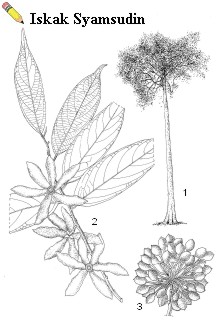 | Polyalthia rumphii (Blume) Merr. – 1, tree habit; 2, flowering twig; 3, infructescence. |
Ecology
Polyalthia species occur scattered as understorey or main canopy trees in primary or secondary, lowland to lower montane rain forest, up to 1200(-1800) m altitude. They are found in evergreen and monsoon forest, both on well-drained hills and poorly drained level sites. Individual Polyalthia species may occur as common elements of peat-swamp forest, occasionally also in kerangas.
Silviculture and Management
Polyalthia can be propagated by seed. Germination experiments in Peninsular Malaysia, however, showed that germination is unpredictable. The best results were obtained for P. cinnamomea, the seeds of which were sown with pulp and had about 95% germination in 1-2 months. Seeds of several other species showed 10-35% germination in 1-10 months. Sowing of fruits of P. sumatrana yielded a very low germination. P. cauliflora and P. cinnamomea are highly vulnerable in the nursery, as the cotyledons and epicotyl are easily trapped in the testa and then rot. Sufficient watering and manual removal of the testa may resolve the problem. In natural forest the regeneration of Polyalthia is generally profuse.
Genetic Resources and Breeding
Some Polyalthia species have a rather narrow geographical distribution and face the risk of genetic erosion by deforestation.
Prospects
Polyalthia is considered to be rather fast-growing and may be promising in timber plantations. However, only little silvicultural information is available and it seems justifiable to increase the research on propagation and planting, and on growth and yield.
Literature
[40]All Nippon Checkers Corporation, 1989. Illustrated commercial foreign woods in Japan. Tokyo. 262 pp.
[70]Backer, C.A. & Bakhuizen van den Brink Jr., R.C., 1963-1968. Flora of Java. 3 volumes. Wolters-Noordhoff, Groningen.
[125]Bolza, E. & Kloot, N.H., 1966. The mechanical properties of 81 New Guinea timbers. Technological Paper No 41. Division of Forest Products, CSIRO, Melbourne. 39 pp.
[151]Browne, F.G., 1955. Forest trees of Sarawak and Brunei and their products. Government Printing Office, Kuching, Sarawak. xviii + 369 pp.
[162]Burgess, P.F., 1966. Timbers of Sabah. Sabah Forest Records No 6. Forest Department, Sabah, Sandakan. xviii + 501 pp.
[163]Burkill, I.H., 1966. A dictionary of the economic products of the Malay Peninsula. 2nd edition. Ministry of Agriculture and Co-operatives, Kuala Lumpur. Vol. 1 (A-H) pp. 1-1240. Vol. 2 (I-Z) pp. 1241-2444.
[209]Corner, E.J.H., 1988. Wayside trees of Malaya. 3rd edition. 2 volumes. The Malayan Nature Society, Kuala Lumpur. 774 pp.
[238]de Vogel, E.F., 1980. Seedlings of dicotyledons. Structure, development, types. Descriptions of 150 woody Malesian taxa. Pudoc, Wageningen. 465 pp.
[267]Desch, H.E., 1941-1954. Manual of Malayan timbers. Malayan Forest Records No 15. 2 volumes. Malaya Publishing House Ltd., Singapore. 762 pp.
[300]Eddowes, P.J., 1977. Commercial timbers of Papua New Guinea, their properties and uses. Forest Products Research Centre, Department of Primary Industry, Port Moresby. xiv + 195 pp.
[304]Eddowes, P.J., 1995-1997. The forests and timbers of Papua New Guinea. (unpublished data).
[348]Forest Products Research Centre, 1967. Properties and uses of Papua and New Guinea timbers. Forest Products Research Centre, Port Moresby. 30 pp.
[358]Fries, R.E., 1964. Annonaceae. In: Engler, A. & Prantl, K. (Editors): Die natürlichen Pflanzenfamilien [The natural plant families]. 2nd edition edited by Melchior, H. Band 17aII. Duncker & Humblot, Berlin. pp. 1-171.
[402]Hallé, F., Oldeman, R.A.A. & Tomlinson, P.B., 1978. Tropical trees and forests - an architectural analysis. Springer Verlag, Berlin, Heidelberg, New York. 441 pp.
[436]Heyne, K., 1927. De nuttige planten van Nederlands-Indië [The useful plants of the Dutch East Indies]. 2nd edition, 3 volumes. Departement van Landbouw, Nijverheid en Handel in Nederlandsch-Indië. 1953 pp. (3rd edition, 1950. van Hoeve, 's-Gravenhage/Bandung. 1660 pp.).
[438]Hildebrand, F.H., 1951. Daftar nama pohon-pohonan Djawa-Madura dengan keterangan-keterangan tentang penjiaran dan ukurannja (telah diperbaiki) [Revised list of tree species of Java-Madura with notes on their distribution and dimensions]. Laporan No 50. Balai Penjelidikan Kehutanan, Bogor. 183 pp.
[464]Ilic, J., 1990. The CSIRO macro key for hardwood identification. CSIRO, Highett. 125 pp.
[468]Ingle, H.D. & Dadswell, H.E., 1953. The anatomy of the timbers of the south-west Pacific area. II. Apocynaceae and Annonaceae. Australian Journal of Botany 1: 1-26.
[496]Johns, R.J., 1983. Common forest trees of Papua New Guinea. Part two: the angiosperms, order 1: Ranales, order 2: Santanales. Revised edition. Forestry Department, University of Technology, Lae. pp. 43-89.
[507]Jossang, A., Leboeuf, M. & Cave, A., 1984. Alcaloides des Annonaceae, L: alcaloides de Polyalthia cauliflora [Alkaloids of the Annonaceae, L: alkaloids of Polyalthia cauliflora]. Journal of Natural Products 47: 504-513.
[526]Kartasujana, I. & Martawijaya, A., 1979. Kayu perdagangan Indonesia - sifat dan kegunaannya [Commercial woods of Indonesia - their properties and uses]. Lembaga Penelitian Hasil Hutan, Bogor. 28 pp.
[547]Kessler, P.J.A., 1987. Some interesting distribution patterns in Annonaceae. Annonaceae Newsletter 6: 14-23.
[632]Kraemer, J.H., 1951. Trees of the western Pacific region. Tri-State Offset Company, Cincinnatti. 436 pp.
[672]Lecomte, H., 1907-1950. Flore générale de l'Indo-Chine [General flora of Indo-China]. 7 vols & Supplément. Masson & Cie, Paris.
[673]Lecomte, H., 1926. Les bois de l'Indochine [Timbers of Indo-China]. 2 volumes. Publication de l'Agence Economique de l'Indochine XIII, Paris. 311 pp + 83 pl.
[707]Lim, S.C., 1988. Malaysian timbers - mempisang. Timber Trade Leaflet No 106. The Malaysian Timber Industry Board, Kuala Lumpur & Forest Research Institute Malaysia, Kepong. 8 pp.
[800]Mohd Ghazali, H.O. & Abd. Rahim, A. S., 1985. Flowering-to-fruiting period of Malaysian forest trees. Malaysian Forester 48: 254-257.
[825]Ng, F.S.P., 1978. Strategies of establishment in Malayan forest trees. In: Tomlinson, P.B. & Zimmermann, M.H. (Editors): Tropical trees as living systems. The proceedings of the fourth Cabot symposium held at Harvard Forest, Petersham, Massachusetts on April 26-30, 1976. Cambridge University Press, Cambridge, London, New York, Melbourne. pp. 129-162.
[827]Ng, F.S.P., 1983. Ecological principles of tropical lowland rain forest conservation. In: Sutton, S.L., Whitmore, T.C. & Chadwick, A.C. (Editors): Tropical rain forest: ecology and management. Special Publication number 2 of the British Ecological Society. Blackwell Scientific Publications, Oxford, London, Edinburgh, Boston, Melbourne. pp. 359-375.
[829]Ng, F.S.P., 1991-1992. Manual of forest fruits, seeds and seedlings. 2 volumes. Malayan Forest Record No 34. Forest Research Institute Malaysia, Kepong. 997 pp.
[831]Ng, F.S.P. & Mat Asri Ngah Sanah, 1991. Germination and seedling records. Research Pamphlet No 108. Forest Research Institute Malaysia, Kepong. 191 pp.
[832]Ng, F.S.P. & Tang, H.T., 1974. Comparative growth rates of Malaysian trees. Malaysian Forester 37: 2-23.
[836]Nguyen Tien Ban, 1974. Zametki o nekotorykh vidakh roda Polyanthia Blume [Notes on several species of the genus Polyalthia Blume]. Novitates Systematicae Plantarum Vascularum 11: 182-191.
[837]Nguyen Tien Ban, 1994. The taxa of family Annonaceae in the flora of Vietnam. Journal of Biology 16(4), special volume: 1-15.
[861]Oey Djoen Seng, 1951. De soortelijke gewichten van Indonesische houtsoorten en hun betekenis voor de praktijk [Specific gravity of Indonesian woods and its significance for practical use]. Rapport No 46. Bosbouwproefstation, Bogor. 183 pp.
[863]Okada, H. & Ueda, K., 1984. Cytotaxonomical studies on Asian Annonaceae. Plant Systematics and Evolution 144: 165-177.
[883]Pham Hoang Ho, 1991-1993. An illustrated flora of Vietnam. 2 Volumes. Mekong Publisher, Montreal.
[934]Reyes, L.J., 1938. Philippine woods. Technical Bulletin No 7. Commonwealth of the Philippines, Department of Agriculture and Commerce. Bureau of Printing, Manila. 536 pp. + 88 plates.
[955]Rocafort, J.E., Floresca, A.R. & Siopongco, J.O., 1971. Fourth progress report on the specific gravity of Philippine woods. Philippine Architecture, Engineering & Construction Report 18(5): 17-27.
[957]Rogstad, S.H., 1989. The biosystematics and evolution of the Polyalthia hypoleuca complex (Annonaceae) of Malesia, I. Systematic treatment. Journal of the Arnold Arboretum 70: 153-246.
[974]Salvosa, F.M., 1963. Lexicon of Philippine trees. Bulletin No 1. Forest Products Research Institute, College, Laguna. 136 pp.
[1017]Sinclair, J., 1955. A revision of the Malayan Annonaceae. Gardens' Bulletin, Singapore 14: 149-516.
[1038]Smitinand, T., 1980. Thai plant names. Royal Forest Department, Bangkok. 379 pp.
[1098]Timber Research and Development Association, 1979. Timbers of the world. Volume 1. Africa, S. America, Southern Asia, S.E. Asia. TRADA/The Construction Press, Lancaster. 463 pp.
[1123]van der Pijl, L., 1957. The dispersal of plants by bats (chiropterochory). Acta Botanica Neerlandica 6: 291-315.
[1126]van Heusden, E.C.H., 1992. Flowers of Annonaceae: morphology, classification, and evolution. Blumea Supplement 7. 218 pp.
[1134]van Setten, A.K. & Koek-Noorman, J., 1992. Fruits and seeds of Annonaceae, morphology and its significance for classification. Studies in Annonaceae XVII. Bibliotheca Botanica 142. 101 pp. & 50 plates.
[1221]Whitmore, T.C. & Ng, F.S.P. (Editors), 1972-1989. Tree flora of Malaya. A manual for foresters. 4 volumes. Malayan Forest Records No 26. Longman Malaysia Sdn. Berhad, Kuala Lumpur & Petaling Jaya.
[1242]Wong, T.M., 1982. A dictionary of Malaysian timbers. Malayan Forest Records No 30. Forest Research Institute Malaysia, Kepong. 259 pp.
Author(s)
Nguyen Tien Ban
Polyalthia cauliflora
Polyalthia cinnamomea
Polyalthia discolor
Polyalthia flava
Polyalthia glauca
Polyalthia hypoleuca
Polyalthia jenkensii
Polyalthia lateriflora
Polyalthia longifolia
Polyalthia motleyana
Polyalthia oblongifolia
Polyalthia ovalifolia
Polyalthia rumphii
Polyalthia sumatrana
Polyalthia cinnamomea
Polyalthia discolor
Polyalthia flava
Polyalthia glauca
Polyalthia hypoleuca
Polyalthia jenkensii
Polyalthia lateriflora
Polyalthia longifolia
Polyalthia motleyana
Polyalthia oblongifolia
Polyalthia ovalifolia
Polyalthia rumphii
Polyalthia sumatrana
Correct Citation of this Article
Ban, N.T., 1998. Polyalthia Blume. In: Sosef, M.S.M., Hong, L.T. and Prawirohatmodjo, S. (Editors): Plant Resources of South-East Asia No 5(3): Timber trees; Lesser-known timbers. PROSEA Foundation, Bogor, Indonesia. Database record: prota4u.org/prosea
Selection of Species
The following species in this genus are important in this commodity group and are treated separatedly in this database:
Polyalthia cauliflora
Polyalthia cinnamomea
Polyalthia discolor
Polyalthia flava
Polyalthia glauca
Polyalthia hypoleuca
Polyalthia jenkensii
Polyalthia lateriflora
Polyalthia longifolia
Polyalthia motleyana
Polyalthia oblongifolia
Polyalthia ovalifolia
Polyalthia rumphii
Polyalthia sumatrana
Polyalthia cauliflora
Polyalthia cinnamomea
Polyalthia discolor
Polyalthia flava
Polyalthia glauca
Polyalthia hypoleuca
Polyalthia jenkensii
Polyalthia lateriflora
Polyalthia longifolia
Polyalthia motleyana
Polyalthia oblongifolia
Polyalthia ovalifolia
Polyalthia rumphii
Polyalthia sumatrana

All texts are licensed under a Creative Commons Attribution-Noncommercial-Share Alike 3.0 Netherlands License
This license does not include the illustrations (Maps,drawings,pictures); these remain all under copyright.