Record Number
6149
PROSEA Handbook Number
5(3): Timber trees; Lesser-known timbers
Taxon
Prunus L.
Protologue
Sp. pl. 1: 473 (1753); Gen. pl., ed. 5: 212 (1754).
Family
ROSACEAE
Chromosome Numbers
x = 8; 2n = unknown for Malesian species
Vernacular Names
Tenangau (trade name). Indonesia: kawoyang (Sundanese). Malaysia: pepijat (general), kelanus (Sabah), medang kelanus (Peninsular). Philippines: lago (Filipino), amugan (Tagalog). Thailand: nang-phaya-sua-khrong. Vietnam: d[af]o, m[ow].
Origin and Geographic Distribution
Prunus comprises over 200 species occurring all over the world. Within Malesia about 35 species are present apart from a few exotic species, which are cultivated. The native species are distributed as follows: Peninsular Malaysia 8 species, Sumatra 8, Java 4, Borneo 12, the Philippines 10, Sulawesi 5, the Lesser Sunda Islands 3, the Moluccas 6, and New Guinea 14.
Uses
The wood of Prunus is used for general construction, house building (poles, rafters), furniture, cabinet work, mouldings, interior finish, and also for firewood. In Vietnam wood of P. arborea is used for plywood manufacture.
A number of extra-Malesian Prunus species have been introduced into South-East Asia and are cultivated for their edible fruits. The most important ones are P. mume Siebold & Zucc. (Japanese apricot) and P. persica (L.) Batsch (peach, nectarine). P. arborea is reputed to be used in Bali for reforestation. P. grisea is planted as an ornamental in the Philippines; its bark yields a dark greenish-brown dye. In New Guinea the bark of several species is used to make belts. In East Kalimantan the bark of P. arborea and P. beccarii (Ridley) Kalkman is used for partitions in temporary shelters. The bark of P. marsupialis yields a dark greenish-brown dye, whereas that of several other species has been used for rice-bins, as a vermicide for buffaloes and as a fish poison, and is probably the source of local medicines to treat headache and skin eruptions. A decoction of the leaves of P. arborea has been used by women as a stimulant when working. Leaves of P. dolichobotrys are reputed to be used to flavour soup or cooked vegetables.
A number of extra-Malesian Prunus species have been introduced into South-East Asia and are cultivated for their edible fruits. The most important ones are P. mume Siebold & Zucc. (Japanese apricot) and P. persica (L.) Batsch (peach, nectarine). P. arborea is reputed to be used in Bali for reforestation. P. grisea is planted as an ornamental in the Philippines; its bark yields a dark greenish-brown dye. In New Guinea the bark of several species is used to make belts. In East Kalimantan the bark of P. arborea and P. beccarii (Ridley) Kalkman is used for partitions in temporary shelters. The bark of P. marsupialis yields a dark greenish-brown dye, whereas that of several other species has been used for rice-bins, as a vermicide for buffaloes and as a fish poison, and is probably the source of local medicines to treat headache and skin eruptions. A decoction of the leaves of P. arborea has been used by women as a stimulant when working. Leaves of P. dolichobotrys are reputed to be used to flavour soup or cooked vegetables.
Production and International Trade
Prunus wood is mainly used on a local scale. In 1996 Papua New Guinea exported about 1035 m3 of Prunus logs at an average free-on-board (FOB) price of US$ 103/m3.
Properties
Prunus yields a lightweight to medium-weight hardwood with a density of (345-)410-770(-830) kg/m3 at 15% moisture content. Heartwood pink-brown to red-brown, not sharply demarcated from the paler sapwood; grain wavy to deeply interlocked, sometimes straight; texture moderately fine to moderately coarse and even; wood lustrous. Growth rings indistinct or occasionally distinct; vessels moderately small to moderately large, solitary and in radial multiples of 2-3(-4), sometimes dark gum-like deposits present; parenchyma rather sparse, paratracheal scanty to vasicentric, and apotracheal diffuse; rays very fine or medium-sized, the latter visible to the naked eye; ripple marks absent; traumatic axial canals occasionally present.
Shrinkage upon air drying is moderate to high, but the wood seasons well with little degrade. It is moderately soft to hard, moderately strong and fairly tough. It is reasonably easy to work. The wood is moderately durable to non-durable. The sapwood is susceptible to Lyctus and the heartwood is susceptible to dry-wood termites.
The bark contains cyanogenetic glucosides.
See also the tables on microscopic wood anatomy and wood properties.
Shrinkage upon air drying is moderate to high, but the wood seasons well with little degrade. It is moderately soft to hard, moderately strong and fairly tough. It is reasonably easy to work. The wood is moderately durable to non-durable. The sapwood is susceptible to Lyctus and the heartwood is susceptible to dry-wood termites.
The bark contains cyanogenetic glucosides.
See also the tables on microscopic wood anatomy and wood properties.
Botany
Evergreen or rarely deciduous (e.g. P. polystachya), small to fairly large trees up to 35(-40) m tall, rarely shrubs; bole crooked or straight and cylindrical, branchless for up to 15 m, up to 100 cm in diameter, occasionally with small buttresses or spurs; bark surface smooth or sometimes shallowly fissured, often lenticellate, sometimes flaking, dark brown to greyish-brown, inner bark usually fibrous, pink or red-brown to straw, smelling of almonds or cyanide. Leaves arranged spirally, simple, entire or incised, with glands along the margin and/or on the lower side or on the petiole; stipules free or connate, caducous. Inflorescence axillary or ramiflorous, a simple or sometimes branched raceme, solitary or in bundles. Flowers usually bisexual; hypanthium cup-, bell-, or funnel-shaped, circumscissile and persistent in fruit; sepals and petals comprising 5-14 segments, often subequal in size and similar in colour (within Malesia) or petals white or pink; stamens many; ovary superior, 1-locular with 2 ovules, style 1, apical. Fruit a drupe with hard endocarp. Seed with thin testa. In Malesia seedling with hypogeal germination; cotyledons not emergent; hypocotyl not elongated; epicotyl pubescent; first 2 leaves opposite, subsequent ones arranged spirally.
Pollination is by insects and seeds are dispersed by animals.
Within Malesia only species of the subgenus Laurocerasus (Tourn. ex Duhamel) Rehder are native. The formerly distinguished genus Pygeum has been included in this subgenus.
Pollination is by insects and seeds are dispersed by animals.
Within Malesia only species of the subgenus Laurocerasus (Tourn. ex Duhamel) Rehder are native. The formerly distinguished genus Pygeum has been included in this subgenus.
Image
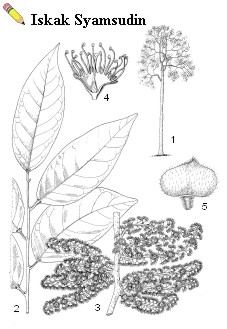 | Prunus arborea (Blume) Kalkman – 1, tree habit; 2, sterile twig; 3, inflorescence; 4, sectioned flower; 5, fruit. |
Ecology
Prunus species are found in primary and secondary, lowland to montane forest, sometimes even in alpine scrub, up to 3700 m altitude. Individual species occur in evergreen to deciduous forest types, and on soils on a wide variety of parent materials, including volcanic sand, ultrabasic rocks and limestone. They are regularly reported from river banks.
Silviculture and Management
Prunus can be propagated by seed. Sown fruits of P. arborea have a germination rate of about 70% in 5-24 weeks and for P. polystachya the rate is about 60% in 24-47 days. Sown seeds of P. grisea have a germination rate of about 90%; in a plantation trial in the Philippines they had only 2% survival. Trees are not resistant to fire.
Genetic Resources and Breeding
Collection, conservation and research is still needed for many Prunus species to determine their suitability for plantations. As they are seldom cut for timber they do not seem directly endangered.
Prospects
The use of Prunus timber is unlikely to increase in the near future.
Literature
[101]Beekman, H., 1920. 78 Preanger houtsoorten. Beschrijving, afbeelding en determinatietabel [78 Priangan wood species. Description, pictures and identification key]. Mededeelingen No 5. Proefstation voor het Boschwezen, Buitenzorg. 186 pp.
[124]Bolza, E. & Kloot, N.H., 1963. The mechanical properties of 174 Australian timbers. Technological Paper No 25. Division of Forest Products, CSIRO, Melbourne. 112 pp.
[150]Brown, W.H., 1951-1957. Useful plants of the Philippines. Reprint of the 1941-1943 edition. 3 volumes. Technical Bulletin 10. Department of Agriculture and Natural Resources. Bureau of Printing, Manila. Vol. 1(1951) 590 pp., Vol. 2 (1954) 513 pp., Vol. 3 (1957) 507 pp.
[163]Burkill, I.H., 1966. A dictionary of the economic products of the Malay Peninsula. 2nd edition. Ministry of Agriculture and Co-operatives, Kuala Lumpur. Vol. 1 (A-H) pp. 1-1240. Vol. 2 (I-Z) pp. 1241-2444.
[198]Cockburn, P.F., 1976-1980. Trees of Sabah. 2 volumes. Sabah Forest Records No 10. Forest Department Sabah, Sandakan.
[209]Corner, E.J.H., 1988. Wayside trees of Malaya. 3rd edition. 2 volumes. The Malayan Nature Society, Kuala Lumpur. 774 pp.
[238]de Vogel, E.F., 1980. Seedlings of dicotyledons. Structure, development, types. Descriptions of 150 woody Malesian taxa. Pudoc, Wageningen. 465 pp.
[260]den Berger, L.G., 1926. Houtsoorten der cultuurgebieden van Java en Sumatra's oostkust [Tree species of the cultivated areas of Java and the east coast of Sumatra]. Mededeelingen No 13. Proefstation voor het Boschwezen, Buitenzorg. 186 pp.
[261]den Berger, L.G. & Endert, F.H., 1925. Belangrijke houtsoorten van Nederlandsch-Indië, deel I [Important timbers of the Dutch East Indies, part I]. Mededeelingen No 11. Proefstation voor het Boschwezen, Buitenzorg. 136 pp.
[267]Desch, H.E., 1941-1954. Manual of Malayan timbers. Malayan Forest Records No 15. 2 volumes. Malaya Publishing House Ltd., Singapore. 762 pp.
[341]Flora Malesiana (various editors), 1950-. Kluwer Academic Publishers, Dordrecht, Boston, London.
[343]Flore du Cambodge, du Laos et du Viêtnam (various editors), 1960-. Muséum National d'Histoire Naturelle, Paris.
[348]Forest Products Research Centre, 1967. Properties and uses of Papua and New Guinea timbers. Forest Products Research Centre, Port Moresby. 30 pp.
[436]Heyne, K., 1927. De nuttige planten van Nederlands-Indië [The useful plants of the Dutch East Indies]. 2nd edition, 3 volumes. Departement van Landbouw, Nijverheid en Handel in Nederlandsch-Indië. 1953 pp. (3rd edition, 1950. van Hoeve, 's-Gravenhage/Bandung. 1660 pp.).
[464]Ilic, J., 1990. The CSIRO macro key for hardwood identification. CSIRO, Highett. 125 pp.
[514]Kalkman, C., 1965. The Old World species of Prunus subg. Laurocerasus including those formerly referred to Pygeum. Blumea 13: 1-115.
[568]Kingston, R.S.T. & Risdon, C.J.E., 1961. Shrinkage and density of Australian and other South-West Pacific woods. Technological Paper No 13. Division of Forest Products, CSIRO, Melbourne. 65 pp.
[595]Koorders, S.H. & Valeton, T., 1894-1915. Bijdrage tot de kennis der boomsoorten van Java [Contribution to the knowledge of the tree species of Java]. 13 parts. G. Kolff & Co., Batavia, 's-Gravenhage.
[632]Kraemer, J.H., 1951. Trees of the western Pacific region. Tri-State Offset Company, Cincinnatti. 436 pp.
[825]Ng, F.S.P., 1978. Strategies of establishment in Malayan forest trees. In: Tomlinson, P.B. & Zimmermann, M.H. (Editors): Tropical trees as living systems. The proceedings of the fourth Cabot symposium held at Harvard Forest, Petersham, Massachusetts on April 26-30, 1976. Cambridge University Press, Cambridge, London, New York, Melbourne. pp. 129-162.
[829]Ng, F.S.P., 1991-1992. Manual of forest fruits, seeds and seedlings. 2 volumes. Malayan Forest Record No 34. Forest Research Institute Malaysia, Kepong. 997 pp.
[831]Ng, F.S.P. & Mat Asri Ngah Sanah, 1991. Germination and seedling records. Research Pamphlet No 108. Forest Research Institute Malaysia, Kepong. 191 pp.
[861]Oey Djoen Seng, 1951. De soortelijke gewichten van Indonesische houtsoorten en hun betekenis voor de praktijk [Specific gravity of Indonesian woods and its significance for practical use]. Rapport No 46. Bosbouwproefstation, Bogor. 183 pp.
[933]Research Institute of Wood Industry, 1988. Identification, properties and uses of some Southeast Asian woods. Chinese Academy of Forestry, Wan Shou Shan, Beijing & International Tropical Timber Organization, Yokohama. 201 pp.
[934]Reyes, L.J., 1938. Philippine woods. Technical Bulletin No 7. Commonwealth of the Philippines, Department of Agriculture and Commerce. Bureau of Printing, Manila. 536 pp. + 88 plates.
[955]Rocafort, J.E., Floresca, A.R. & Siopongco, J.O., 1971. Fourth progress report on the specific gravity of Philippine woods. Philippine Architecture, Engineering & Construction Report 18(5): 17-27.
[974]Salvosa, F.M., 1963. Lexicon of Philippine trees. Bulletin No 1. Forest Products Research Institute, College, Laguna. 136 pp.
[1038]Smitinand, T., 1980. Thai plant names. Royal Forest Department, Bangkok. 379 pp.
[1039]Smitinand, T. & Larsen, K. (Editors), 1970-. Flora of Thailand. The Forest Herbarium, Royal Forest Department, Bangkok.
[1147]van Valkenburg, J.L.C.H., 1997. Non-timber forest products of East Kalimantan - potentials for sustainable forest use. Tropenbos Series 16. Tropenbos Foundation, Wageningen. 202 pp.
[1164]Verheij, E.W.M. & Coronel, R.E. (Editors), 1991. Plant resources of South-East Asia No 2. Edible fruits and nuts. Pudoc, Wageningen. 446 pp.
[1221]Whitmore, T.C. & Ng, F.S.P. (Editors), 1972-1989. Tree flora of Malaya. A manual for foresters. 4 volumes. Malayan Forest Records No 26. Longman Malaysia Sdn. Berhad, Kuala Lumpur & Petaling Jaya.
[1232]Wisse, J.H., 1965. Volumegewichten van een aantal houtmonsters uit West Nieuw Guinea [Specific gravity of some wood samples from West New Guinea]. Afdeling Bosexploitatie en Boshuishoudkunde, Landbouwhogeschool, Wageningen. 23 pp.
[1242]Wong, T.M., 1982. A dictionary of Malaysian timbers. Malayan Forest Records No 30. Forest Research Institute Malaysia, Kepong. 259 pp.
[1255]Yao, C.E., 1993. Technolink 1. Species trial of some indigenous species in Siquijor. Canopy International 19(6): 7-10.
[1268]Zamuco, I.T., 1981. Some unexploited plants of the Philippines. Canopy International 7(3): 1, 10-11; 7(4): 10-14; 7(5): 13-14.
[124]Bolza, E. & Kloot, N.H., 1963. The mechanical properties of 174 Australian timbers. Technological Paper No 25. Division of Forest Products, CSIRO, Melbourne. 112 pp.
[150]Brown, W.H., 1951-1957. Useful plants of the Philippines. Reprint of the 1941-1943 edition. 3 volumes. Technical Bulletin 10. Department of Agriculture and Natural Resources. Bureau of Printing, Manila. Vol. 1(1951) 590 pp., Vol. 2 (1954) 513 pp., Vol. 3 (1957) 507 pp.
[163]Burkill, I.H., 1966. A dictionary of the economic products of the Malay Peninsula. 2nd edition. Ministry of Agriculture and Co-operatives, Kuala Lumpur. Vol. 1 (A-H) pp. 1-1240. Vol. 2 (I-Z) pp. 1241-2444.
[198]Cockburn, P.F., 1976-1980. Trees of Sabah. 2 volumes. Sabah Forest Records No 10. Forest Department Sabah, Sandakan.
[209]Corner, E.J.H., 1988. Wayside trees of Malaya. 3rd edition. 2 volumes. The Malayan Nature Society, Kuala Lumpur. 774 pp.
[238]de Vogel, E.F., 1980. Seedlings of dicotyledons. Structure, development, types. Descriptions of 150 woody Malesian taxa. Pudoc, Wageningen. 465 pp.
[260]den Berger, L.G., 1926. Houtsoorten der cultuurgebieden van Java en Sumatra's oostkust [Tree species of the cultivated areas of Java and the east coast of Sumatra]. Mededeelingen No 13. Proefstation voor het Boschwezen, Buitenzorg. 186 pp.
[261]den Berger, L.G. & Endert, F.H., 1925. Belangrijke houtsoorten van Nederlandsch-Indië, deel I [Important timbers of the Dutch East Indies, part I]. Mededeelingen No 11. Proefstation voor het Boschwezen, Buitenzorg. 136 pp.
[267]Desch, H.E., 1941-1954. Manual of Malayan timbers. Malayan Forest Records No 15. 2 volumes. Malaya Publishing House Ltd., Singapore. 762 pp.
[341]Flora Malesiana (various editors), 1950-. Kluwer Academic Publishers, Dordrecht, Boston, London.
[343]Flore du Cambodge, du Laos et du Viêtnam (various editors), 1960-. Muséum National d'Histoire Naturelle, Paris.
[348]Forest Products Research Centre, 1967. Properties and uses of Papua and New Guinea timbers. Forest Products Research Centre, Port Moresby. 30 pp.
[436]Heyne, K., 1927. De nuttige planten van Nederlands-Indië [The useful plants of the Dutch East Indies]. 2nd edition, 3 volumes. Departement van Landbouw, Nijverheid en Handel in Nederlandsch-Indië. 1953 pp. (3rd edition, 1950. van Hoeve, 's-Gravenhage/Bandung. 1660 pp.).
[464]Ilic, J., 1990. The CSIRO macro key for hardwood identification. CSIRO, Highett. 125 pp.
[514]Kalkman, C., 1965. The Old World species of Prunus subg. Laurocerasus including those formerly referred to Pygeum. Blumea 13: 1-115.
[568]Kingston, R.S.T. & Risdon, C.J.E., 1961. Shrinkage and density of Australian and other South-West Pacific woods. Technological Paper No 13. Division of Forest Products, CSIRO, Melbourne. 65 pp.
[595]Koorders, S.H. & Valeton, T., 1894-1915. Bijdrage tot de kennis der boomsoorten van Java [Contribution to the knowledge of the tree species of Java]. 13 parts. G. Kolff & Co., Batavia, 's-Gravenhage.
[632]Kraemer, J.H., 1951. Trees of the western Pacific region. Tri-State Offset Company, Cincinnatti. 436 pp.
[825]Ng, F.S.P., 1978. Strategies of establishment in Malayan forest trees. In: Tomlinson, P.B. & Zimmermann, M.H. (Editors): Tropical trees as living systems. The proceedings of the fourth Cabot symposium held at Harvard Forest, Petersham, Massachusetts on April 26-30, 1976. Cambridge University Press, Cambridge, London, New York, Melbourne. pp. 129-162.
[829]Ng, F.S.P., 1991-1992. Manual of forest fruits, seeds and seedlings. 2 volumes. Malayan Forest Record No 34. Forest Research Institute Malaysia, Kepong. 997 pp.
[831]Ng, F.S.P. & Mat Asri Ngah Sanah, 1991. Germination and seedling records. Research Pamphlet No 108. Forest Research Institute Malaysia, Kepong. 191 pp.
[861]Oey Djoen Seng, 1951. De soortelijke gewichten van Indonesische houtsoorten en hun betekenis voor de praktijk [Specific gravity of Indonesian woods and its significance for practical use]. Rapport No 46. Bosbouwproefstation, Bogor. 183 pp.
[933]Research Institute of Wood Industry, 1988. Identification, properties and uses of some Southeast Asian woods. Chinese Academy of Forestry, Wan Shou Shan, Beijing & International Tropical Timber Organization, Yokohama. 201 pp.
[934]Reyes, L.J., 1938. Philippine woods. Technical Bulletin No 7. Commonwealth of the Philippines, Department of Agriculture and Commerce. Bureau of Printing, Manila. 536 pp. + 88 plates.
[955]Rocafort, J.E., Floresca, A.R. & Siopongco, J.O., 1971. Fourth progress report on the specific gravity of Philippine woods. Philippine Architecture, Engineering & Construction Report 18(5): 17-27.
[974]Salvosa, F.M., 1963. Lexicon of Philippine trees. Bulletin No 1. Forest Products Research Institute, College, Laguna. 136 pp.
[1038]Smitinand, T., 1980. Thai plant names. Royal Forest Department, Bangkok. 379 pp.
[1039]Smitinand, T. & Larsen, K. (Editors), 1970-. Flora of Thailand. The Forest Herbarium, Royal Forest Department, Bangkok.
[1147]van Valkenburg, J.L.C.H., 1997. Non-timber forest products of East Kalimantan - potentials for sustainable forest use. Tropenbos Series 16. Tropenbos Foundation, Wageningen. 202 pp.
[1164]Verheij, E.W.M. & Coronel, R.E. (Editors), 1991. Plant resources of South-East Asia No 2. Edible fruits and nuts. Pudoc, Wageningen. 446 pp.
[1221]Whitmore, T.C. & Ng, F.S.P. (Editors), 1972-1989. Tree flora of Malaya. A manual for foresters. 4 volumes. Malayan Forest Records No 26. Longman Malaysia Sdn. Berhad, Kuala Lumpur & Petaling Jaya.
[1232]Wisse, J.H., 1965. Volumegewichten van een aantal houtmonsters uit West Nieuw Guinea [Specific gravity of some wood samples from West New Guinea]. Afdeling Bosexploitatie en Boshuishoudkunde, Landbouwhogeschool, Wageningen. 23 pp.
[1242]Wong, T.M., 1982. A dictionary of Malaysian timbers. Malayan Forest Records No 30. Forest Research Institute Malaysia, Kepong. 259 pp.
[1255]Yao, C.E., 1993. Technolink 1. Species trial of some indigenous species in Siquijor. Canopy International 19(6): 7-10.
[1268]Zamuco, I.T., 1981. Some unexploited plants of the Philippines. Canopy International 7(3): 1, 10-11; 7(4): 10-14; 7(5): 13-14.
Author(s)
H.C. Ong
Prunus arborea
Prunus clementis
Prunus dolichobotrys
Prunus gazelle-peninsulae
Prunus grisea
Prunus javanica
Prunus malayana
Prunus marsupialis
Prunus polystachya
Prunus schlechteri
Prunus turneriana
Prunus wallaceana
Prunus clementis
Prunus dolichobotrys
Prunus gazelle-peninsulae
Prunus grisea
Prunus javanica
Prunus malayana
Prunus marsupialis
Prunus polystachya
Prunus schlechteri
Prunus turneriana
Prunus wallaceana
Correct Citation of this Article
Ong, H.C., 1998. Prunus L.. In: Sosef, M.S.M., Hong, L.T. and Prawirohatmodjo, S. (Editors): Plant Resources of South-East Asia No 5(3): Timber trees; Lesser-known timbers. PROSEA Foundation, Bogor, Indonesia. Database record: prota4u.org/prosea
Selection of Species
The following species in this genus are important in this commodity group and are treated separatedly in this database:
Prunus arborea
Prunus clementis
Prunus dolichobotrys
Prunus gazelle-peninsulae
Prunus grisea
Prunus javanica
Prunus malayana
Prunus marsupialis
Prunus polystachya
Prunus schlechteri
Prunus turneriana
Prunus wallaceana
Prunus arborea
Prunus clementis
Prunus dolichobotrys
Prunus gazelle-peninsulae
Prunus grisea
Prunus javanica
Prunus malayana
Prunus marsupialis
Prunus polystachya
Prunus schlechteri
Prunus turneriana
Prunus wallaceana

All texts are licensed under a Creative Commons Attribution-Noncommercial-Share Alike 3.0 Netherlands License
This license does not include the illustrations (Maps,drawings,pictures); these remain all under copyright.