Record Number
6169
PROSEA Handbook Number
5(3): Timber trees; Lesser-known timbers
Taxon
Pterospermum Schreb.
Protologue
Gen. pl. 2: 461 (1791).
Family
STERCULIACEAE
Chromosome Numbers
x = 19; P. acerifolium and several non-Malesian species: 2n = 38
Vernacular Names
Bayur (trade name). Malaysia: bayor, litak (Sabah). Philippines: bayok (general). Vietnam: l[of]ng mang.
Origin and Geographic Distribution
Pterospermum comprises about 40 species occurring in India, Burma (Myanmar), Indo-China, southern China, Thailand and throughout Malesia except for New Guinea. About 15 species are found in Malesia; the Philippines and Peninsular Malaysia are richest with about 9 and 6 species, respectively. Thailand is also rich in species (about 10).
Uses
The wood of Pterospermum is used for joinery, flooring, furniture, cladding, striking tool handles, implements and plywood; it is also used in ship and bridge building. It is suitable for construction under cover, e.g. for boards, beams, joists and rafters. The wood is suitable for matches and for the production of wood-wool board. The pulp is suitable for making paper.
The bark is sometimes used to obtain a yellow dye. Leaves and bark, which are rich in tannin, are occasionally applied in traditional medicine, e.g. as a poultice against itch and to treat wounds, and internally against dysentery. The bark is locally used for toughening fishing nets.
The bark is sometimes used to obtain a yellow dye. Leaves and bark, which are rich in tannin, are occasionally applied in traditional medicine, e.g. as a poultice against itch and to treat wounds, and internally against dysentery. The bark is locally used for toughening fishing nets.
Production and International Trade
In Peninsular Malaysia Pterospermum trees are too scattered and the form of the bole is often too poor to be of importance. In Borneo, particularly in Sabah, Pterospermum is locally abundant. In 1987 the export of round logs from Sabah was 17 000 m3 with a value of US$ 1.05 million (US$ 62/m3), and in 1992 it was 24 000 m3 (6% as sawn timber and 94% as logs) with a total value of US$ 1.7 million (US$ 151/m3 for sawn timber and US$ 68/m3 for logs). Japan imports this timber in comparatively small amounts from Sabah and Sarawak.
Properties
Pterospermum yields a lightweight to medium-weight hardwood with a density of 300-780 kg/m3 at 15% moisture content. Heartwood pale brown to pale red-brown with a purplish tinge, not clearly demarcated from the paler sapwood; grain straight or shallowly interlocked; texture moderately fine to slightly coarse, even. Growth rings distinct to indistinct, boundaries irregular and fairly ill-defined; vessels moderately small to moderately large, solitary and in radial multiples of 2-3(-4), occasionally in clusters, open, sometimes with tyloses or pale brown deposits; parenchyma abundant, paratracheal vasicentric, apotracheal diffuse and diffuse-in-aggregates, both types rather indistinct with a hand lens; rays very fine; ripple marks present due to storeying of lower rays and axial parenchyma, rather inconspicuous; axial traumatic canals observed in P. javanicum.
Shrinkage of the wood upon seasoning is moderate and the only risk of degrade is stain, therefore stock should be treated with anti-stain chemicals immediately after sawing. The wood air dries fairly rapidly; air drying of 13 mm, 25 mm and 38 mm thick boards of P. javanicum takes 1.5 months, 2 months and 3.5 months, respectively. Kiln drying of 25 mm thick boards from green to 10% moisture content takes 5 days with a drying temperature of 54°C to 83°C and a relative humidity of 84% to 30%. The wood is soft to moderately hard, moderately strong and tough. It is easy to work and gives a smooth finish; the machining properties of P. celebicum are rated lowest and those of P. diversifolium highest. The wood is durable for interior use and reputedly for use under water. The sapwood is susceptible to moderately resistant to Lyctus. The resistance of the wood to termites is variable. The wood of P. javanicum is resistant to wood-rotting fungi. The wood is moderately easy to easy to treat with preservatives.
The gross energy value of the wood of P. diversifolium is 19 530-20 350 kJ/kg, that of the heartwood of P. javanicum is 20 350 kJ/kg.
See also the tables on microscopic wood anatomy and wood properties.
Shrinkage of the wood upon seasoning is moderate and the only risk of degrade is stain, therefore stock should be treated with anti-stain chemicals immediately after sawing. The wood air dries fairly rapidly; air drying of 13 mm, 25 mm and 38 mm thick boards of P. javanicum takes 1.5 months, 2 months and 3.5 months, respectively. Kiln drying of 25 mm thick boards from green to 10% moisture content takes 5 days with a drying temperature of 54°C to 83°C and a relative humidity of 84% to 30%. The wood is soft to moderately hard, moderately strong and tough. It is easy to work and gives a smooth finish; the machining properties of P. celebicum are rated lowest and those of P. diversifolium highest. The wood is durable for interior use and reputedly for use under water. The sapwood is susceptible to moderately resistant to Lyctus. The resistance of the wood to termites is variable. The wood of P. javanicum is resistant to wood-rotting fungi. The wood is moderately easy to easy to treat with preservatives.
The gross energy value of the wood of P. diversifolium is 19 530-20 350 kJ/kg, that of the heartwood of P. javanicum is 20 350 kJ/kg.
See also the tables on microscopic wood anatomy and wood properties.
Botany
Medium-sized to large trees up to 45 m tall; bole short or crooked but sometimes fairly straight and branchless for up to 30 m, often fluted, up to 100(-120) cm in diameter, buttresses usually present, short to stout (up to 2 m high), rounded; bark surface smooth, distantly scaly or shallowly fissured, lenticellate, pale brown to grey or sometimes dark brown, inner bark fibrous, red or red-brown with white streaks; crown usually becoming somewhat flattened, coppery. Leaves alternate, simple, often unequal at base (often peltate in young trees), entire, wavy or toothed, densely hairy below; stipules present. Flowers solitary or up to 3 together in leaf axils or pseudoterminal, generally large and showy, bisexual, 5-merous, white or yellow; calyx appearing tubular with cohering or free sepals; petals strap-shaped; short androgynophore present; stamens in 5 bundles of 3, staminodes 5; ovary superior, 5-locular with many ovules in each cell, style slender. Fruit an oblong, woody, many-seeded capsule. Seed flattened, winged on one side. Seedling with epigeal germination; cotyledons emergent, leafy; hypocotyl elongated; leaves conduplicate, all arranged spirally.
The leaves of saplings are different from those of mature trees; they are often peltate and lobed or toothed. Growth is rapid, as observed in trials in Java. The mean height and mean diameter of P. javanicum trees are 11.9-12.5 m and 11.4-11.8 cm when 5.5 years old and 18.1 m and 24.3 cm when 13 years old. In another trial 17-year-old trees even measured 24 m in height and 40 cm in diameter. The trees flower every year or sometimes even twice a year. In Java P. javanicum flowers in June-July and bears ripe fruits in October-December. In Thailand P. diversifolium flowers in February-April and fruits in March-May.
P. javanicum var. montanum Koord. & Valeton has been described from Java. No complete taxonomical revision exists. It seems probable that the number of species will be considerably reduced when specimens and species from different regions are compared.
The leaves of saplings are different from those of mature trees; they are often peltate and lobed or toothed. Growth is rapid, as observed in trials in Java. The mean height and mean diameter of P. javanicum trees are 11.9-12.5 m and 11.4-11.8 cm when 5.5 years old and 18.1 m and 24.3 cm when 13 years old. In another trial 17-year-old trees even measured 24 m in height and 40 cm in diameter. The trees flower every year or sometimes even twice a year. In Java P. javanicum flowers in June-July and bears ripe fruits in October-December. In Thailand P. diversifolium flowers in February-April and fruits in March-May.
P. javanicum var. montanum Koord. & Valeton has been described from Java. No complete taxonomical revision exists. It seems probable that the number of species will be considerably reduced when specimens and species from different regions are compared.
Image
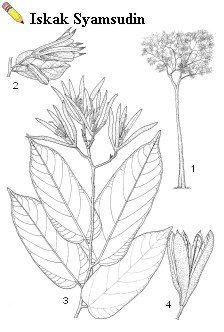 | Pterospermum javanicum Jungh. – 1, tree habit; 2, inflorescence in leaf axil; 3, flowering twig with petals fallen; 4, dehisced fruit. |
Ecology
Pterospermum occurs scattered in primary forest or locally abundantly in secondary forest and especially on river banks, often on alluvial soils, up to 1400 m altitude.
Silviculture and Management
Pterospermum can be propagated by seed. P. diversifolium has about 19 500 dry seeds without wings per kg, for P. javanicum the range is wide, being 7000-54 000 dry seeds/kg. Seeds can be stored for a maximum of two weeks, hence they should be transported in the form of fruits. Seeds of P. javanicum gave 45-100% germination in 4-20 days. They should be sown in the shade and at the final spacing in nursery beds, as the young seedlings cannot withstand being pricked out. Direct sowing or planting of wildlings has been done, in the latter case development of the seedlings is fairly slow. When seedlings are planted in the field at 3 m x 1 m or 3 m x 2 m, the canopy closes after three years and the first thinning is necessary after five years. Early thinning is important to prevent the formation of too slender stems which tend to bend. The yield in these trials was 51-64 m3/ha when 8 years old and 98 m3/ha when 13 years old, irrespective of the stem wood volume of thinnings. Trees generally coppice well and resprout after fire. Pterospermum trees are fast-growing and light-demanding and regeneration in natural forest is restricted to gaps and forest fringes. P. lanceaefolium Roxb. originating from Vietnam has been planted in Java and measured 13.0 m in height and 21.5 cm in diameter at the age of 24 years.
Genetic Resources and Breeding
Several Pterospermum species are at least locally common, and they do not seem endangered. However, other species are now considered as rather narrow endemics, especially in the Philippines, and this calls for caution, at least as long as a thorough taxonomical revision is wanting. The major drawback for its use for timber is the often poor form of the bole. P. javanicum var. montanum, however, has a superior bole form and could be of interest for future breeding activities.
Prospects
Pterospermum seems to have good prospects for enrichment planting in selective logging systems and for plantations, as it regenerates usually well in disturbed forest and grows fast. Moreover, the wood is of fair quality, but breeding for a better bole form seems essential.
Literature
[40]All Nippon Checkers Corporation, 1989. Illustrated commercial foreign woods in Japan. Tokyo. 262 pp.
[61]Ashton, P.S., 1988. Manual of the non-dipterocarp trees of Sarawak. Vol. 2. Dewan Bahasa dan Pustaka, Kuala Lumpur. 490 pp.
[70]Backer, C.A. & Bakhuizen van den Brink Jr., R.C., 1963-1968. Flora of Java. 3 volumes. Wolters-Noordhoff, Groningen.
[101]Beekman, H., 1920. 78 Preanger houtsoorten. Beschrijving, afbeelding en determinatietabel [78 Priangan wood species. Description, pictures and identification key]. Mededeelingen No 5. Proefstation voor het Boschwezen, Buitenzorg. 186 pp.
[130]Bosbouwproefstation, 1948. Tabellarisch overzicht van de beste kiem-, bewaar- en verzendingswijze van zaad van een aantal boomsoorten en groenbemesters [Tabular summary of the best ways to germinate, store and send seed of some tree and green manure species]. Voorlopig rapport No 38. Bosbouwproefstation, Buitenzorg. 15 pp.
[151]Browne, F.G., 1955. Forest trees of Sarawak and Brunei and their products. Government Printing Office, Kuching, Sarawak. xviii + 369 pp.
[163]Burkill, I.H., 1966. A dictionary of the economic products of the Malay Peninsula. 2nd edition. Ministry of Agriculture and Co-operatives, Kuala Lumpur. Vol. 1 (A-H) pp. 1-1240. Vol. 2 (I-Z) pp. 1241-2444.
[198]Cockburn, P.F., 1976-1980. Trees of Sabah. 2 volumes. Sabah Forest Records No 10. Forest Department Sabah, Sandakan.
[209]Corner, E.J.H., 1988. Wayside trees of Malaya. 3rd edition. 2 volumes. The Malayan Nature Society, Kuala Lumpur. 774 pp.
[235]de Guzman, E.D., Umali, R.M. & Sotalbo, E.D., 1986. Guide to the Philippine flora and fauna. Vol. 3: Dipterocarps, non-dipterocarps. Natural Resources Management Centre, Ministry of Natural Resources, Quezon City & University of the Philippines, Los Baños. xx + 414 pp.
[259]den Berger, L.G., 1926. Mechanical properties of Dutch East Indian timbers. Korte Mededeelingen No 12. Proefstation voor het Boschwezen, Buitenzorg. viii + 63 pp.
[260]den Berger, L.G., 1926. Houtsoorten der cultuurgebieden van Java en Sumatra's oostkust [Tree species of the cultivated areas of Java and the east coast of Sumatra]. Mededeelingen No 13. Proefstation voor het Boschwezen, Buitenzorg. 186 pp.
[267]Desch, H.E., 1941-1954. Manual of Malayan timbers. Malayan Forest Records No 15. 2 volumes. Malaya Publishing House Ltd., Singapore. 762 pp.
[376]Ginoga, B. & Karnasudirdja, S., 1978. Sifat mekanis sepuluh jenis kayu Indonesia [Mechanical properties of ten Indonesian timber species]. Laporan No 114. Lembaga Penelitian Hasil Hutan, Bogor. pp. 1-12.
[387]Grewal, G.S., 1979. Air-seasoning properties of some Malaysian timbers. Malaysian Forest Service Trade Leaflet No 41. Malaysian Timber Industry Board, Kuala Lumpur. 26 pp.
[405]Hardjowasono, M.S., 1942. Gewicht en volume van verschillende vrucht- en zaadsoorten [Weight and volume of various fruits and seeds]. Korte Mededelingen No 20. Bosbouwproefstation, Buitenzorg. 172 pp.
[406]Harker, A.P., Sandels, A. & Burley, J., 1982. Calorific values for wood and bark and a bibliography for fuelwood. Report G 162. Tropical Products Institute, London. 20 pp.
[427]Hellinga, G., 1950. Resultaten van de proeftuinen voor boomgewassen sedert 1937. Loofhoutsoorten II [Results from trial plots for trees since 1937. Deciduous trees II]. Rapport No 27. Bosbouwproefstation, Buitenzorg. 29 pp.
[436]Heyne, K., 1927. De nuttige planten van Nederlands-Indië [The useful plants of the Dutch East Indies]. 2nd edition, 3 volumes. Departement van Landbouw, Nijverheid en Handel in Nederlandsch-Indië. 1953 pp. (3rd edition, 1950. van Hoeve, 's-Gravenhage/Bandung. 1660 pp.).
[464]Ilic, J., 1990. The CSIRO macro key for hardwood identification. CSIRO, Highett. 125 pp.
[488]Japing, H.W. & Oey Djoen Seng, 1936. Cultuurproeven met wildhoutsoorten in Gadoengan - met overzicht van de literatuur betreffende deze soorten [Trial plantations of non teak wood species in Gadungan (East Java) - with survey of literature about these species]. Korte Mededeelingen No 55, part I to VI. Boschbouwproefstation, Buitenzorg. 270 pp.
[633]Kramer, F., 1925. Kultuurproeven met industrie-, konstruktie- en luxe-houtsoorten [Investigations regarding the cultivation of different Javanese trees]. Mededeelingen No 12. Proefstation voor het Boschwezen, Buitenzorg. 99 pp.
[678]Lee, Y.H., Engku Abdul Rahman bin Chik & Chu, Y.P., 1979. The strength properties of some Malaysian timbers. Malaysian Forest Service Trade Leaflet No 34 (revised edition). Malaysian Timber Industry Board, Kuala Lumpur. 107 pp.
[740]Malaysian Timber Industry Board, 1984. Peraturan pemeringkatan kayu keras gergaji Malaysia [The Malaysian grading rules for sawn hardwood timber]. Ministry of Primary Industries, Kuala Lumpur. 109 pp.
[741]Malaysian Timber Industry Board, 1986. 100 Malaysian timbers. Kuala Lumpur. x + 226 pp.
[757]Martawijaya, A., Kartasujana, I., Kadir, K. & Prawira, S.A., 1992. Indonesian wood atlas. Vol. 2. Forest Products Research and Development Centre, Bogor. 168 pp.
[758]Masano, 1987. Prospek perkembangan kayu asing di Indonesia [Prospects of exotic trees in Indonesia]. In: Soemarna, K. et al. (Editors): Prosiding diskusi pemanfaatan kayu kurang dikenal, 13-14 Januari 1987, Cisarua, Bogor. Badan Penelitian dan Pengembangan Kehutanan, Bogor. pp. 221-241.
[780]Meniado, J.A. et al., 1975-1981. Wood identification handbook for Philippine timbers. 2 volumes. Government Printing Office, Manila. 370 pp. & 186 pp.
[783]Mercado, L.U. & Matundan, F.U., 1981. Lesser-known tree species: their potential for toys, sporting goods, and other uses. Canopy International 7(11): 4-5.
[829]Ng, F.S.P., 1991-1992. Manual of forest fruits, seeds and seedlings. 2 volumes. Malayan Forest Record No 34. Forest Research Institute Malaysia, Kepong. 997 pp.
[831]Ng, F.S.P. & Mat Asri Ngah Sanah, 1991. Germination and seedling records. Research Pamphlet No 108. Forest Research Institute Malaysia, Kepong. 191 pp.
[861]Oey Djoen Seng, 1951. De soortelijke gewichten van Indonesische houtsoorten en hun betekenis voor de praktijk [Specific gravity of Indonesian woods and its significance for practical use]. Rapport No 46. Bosbouwproefstation, Bogor. 183 pp.
[888]Phengklai, C., 1995. Sterculiaceae. Thai Forest Bulletin (Botany) 23: 65-110.
[933]Research Institute of Wood Industry, 1988. Identification, properties and uses of some Southeast Asian woods. Chinese Academy of Forestry, Wan Shou Shan, Beijing & International Tropical Timber Organization, Yokohama. 201 pp.
[934]Reyes, L.J., 1938. Philippine woods. Technical Bulletin No 7. Commonwealth of the Philippines, Department of Agriculture and Commerce. Bureau of Printing, Manila. 536 pp. + 88 plates.
[947]Rierink, A., 1938. Over de caloriemetrische verbrandingswaarde van een zestigtal Ned. Indische houtsoorten [The calorific value of about 60 woods from the Dutch East Indies]. Tectona 31: 400-418.
[1177]von Meyenfeldt, C.F.W.M. et al., 1978. Restoration of devastated inland forests in South Vietnam. Volume III: List of tree species. Agricultural University, Wageningen. 219 pp.
[1199]Werkgoep Tropische Houtteelt, 1973. Bebossing van geërodeerde gronden op Java - bijlage III: Houtsoorten [Afforestation of eroded lands in Java - Annex III: Tree species]. Landbouwhogeschool Wageningen. 128 pp.
[1221]Whitmore, T.C. & Ng, F.S.P. (Editors), 1972-1989. Tree flora of Malaya. A manual for foresters. 4 volumes. Malayan Forest Records No 26. Longman Malaysia Sdn. Berhad, Kuala Lumpur & Petaling Jaya.
[1239]Wong, T.M., 1976. Wood structure of the lesser known timbers of Peninsular Malaysia. Malayan Forest Records No 28. Forest Research Institute Malaysia, Kepong. xi + 115 pp.
[1242]Wong, T.M., 1982. A dictionary of Malaysian timbers. Malayan Forest Records No 30. Forest Research Institute Malaysia, Kepong. 259 pp.
[61]Ashton, P.S., 1988. Manual of the non-dipterocarp trees of Sarawak. Vol. 2. Dewan Bahasa dan Pustaka, Kuala Lumpur. 490 pp.
[70]Backer, C.A. & Bakhuizen van den Brink Jr., R.C., 1963-1968. Flora of Java. 3 volumes. Wolters-Noordhoff, Groningen.
[101]Beekman, H., 1920. 78 Preanger houtsoorten. Beschrijving, afbeelding en determinatietabel [78 Priangan wood species. Description, pictures and identification key]. Mededeelingen No 5. Proefstation voor het Boschwezen, Buitenzorg. 186 pp.
[130]Bosbouwproefstation, 1948. Tabellarisch overzicht van de beste kiem-, bewaar- en verzendingswijze van zaad van een aantal boomsoorten en groenbemesters [Tabular summary of the best ways to germinate, store and send seed of some tree and green manure species]. Voorlopig rapport No 38. Bosbouwproefstation, Buitenzorg. 15 pp.
[151]Browne, F.G., 1955. Forest trees of Sarawak and Brunei and their products. Government Printing Office, Kuching, Sarawak. xviii + 369 pp.
[163]Burkill, I.H., 1966. A dictionary of the economic products of the Malay Peninsula. 2nd edition. Ministry of Agriculture and Co-operatives, Kuala Lumpur. Vol. 1 (A-H) pp. 1-1240. Vol. 2 (I-Z) pp. 1241-2444.
[198]Cockburn, P.F., 1976-1980. Trees of Sabah. 2 volumes. Sabah Forest Records No 10. Forest Department Sabah, Sandakan.
[209]Corner, E.J.H., 1988. Wayside trees of Malaya. 3rd edition. 2 volumes. The Malayan Nature Society, Kuala Lumpur. 774 pp.
[235]de Guzman, E.D., Umali, R.M. & Sotalbo, E.D., 1986. Guide to the Philippine flora and fauna. Vol. 3: Dipterocarps, non-dipterocarps. Natural Resources Management Centre, Ministry of Natural Resources, Quezon City & University of the Philippines, Los Baños. xx + 414 pp.
[259]den Berger, L.G., 1926. Mechanical properties of Dutch East Indian timbers. Korte Mededeelingen No 12. Proefstation voor het Boschwezen, Buitenzorg. viii + 63 pp.
[260]den Berger, L.G., 1926. Houtsoorten der cultuurgebieden van Java en Sumatra's oostkust [Tree species of the cultivated areas of Java and the east coast of Sumatra]. Mededeelingen No 13. Proefstation voor het Boschwezen, Buitenzorg. 186 pp.
[267]Desch, H.E., 1941-1954. Manual of Malayan timbers. Malayan Forest Records No 15. 2 volumes. Malaya Publishing House Ltd., Singapore. 762 pp.
[376]Ginoga, B. & Karnasudirdja, S., 1978. Sifat mekanis sepuluh jenis kayu Indonesia [Mechanical properties of ten Indonesian timber species]. Laporan No 114. Lembaga Penelitian Hasil Hutan, Bogor. pp. 1-12.
[387]Grewal, G.S., 1979. Air-seasoning properties of some Malaysian timbers. Malaysian Forest Service Trade Leaflet No 41. Malaysian Timber Industry Board, Kuala Lumpur. 26 pp.
[405]Hardjowasono, M.S., 1942. Gewicht en volume van verschillende vrucht- en zaadsoorten [Weight and volume of various fruits and seeds]. Korte Mededelingen No 20. Bosbouwproefstation, Buitenzorg. 172 pp.
[406]Harker, A.P., Sandels, A. & Burley, J., 1982. Calorific values for wood and bark and a bibliography for fuelwood. Report G 162. Tropical Products Institute, London. 20 pp.
[427]Hellinga, G., 1950. Resultaten van de proeftuinen voor boomgewassen sedert 1937. Loofhoutsoorten II [Results from trial plots for trees since 1937. Deciduous trees II]. Rapport No 27. Bosbouwproefstation, Buitenzorg. 29 pp.
[436]Heyne, K., 1927. De nuttige planten van Nederlands-Indië [The useful plants of the Dutch East Indies]. 2nd edition, 3 volumes. Departement van Landbouw, Nijverheid en Handel in Nederlandsch-Indië. 1953 pp. (3rd edition, 1950. van Hoeve, 's-Gravenhage/Bandung. 1660 pp.).
[464]Ilic, J., 1990. The CSIRO macro key for hardwood identification. CSIRO, Highett. 125 pp.
[488]Japing, H.W. & Oey Djoen Seng, 1936. Cultuurproeven met wildhoutsoorten in Gadoengan - met overzicht van de literatuur betreffende deze soorten [Trial plantations of non teak wood species in Gadungan (East Java) - with survey of literature about these species]. Korte Mededeelingen No 55, part I to VI. Boschbouwproefstation, Buitenzorg. 270 pp.
[633]Kramer, F., 1925. Kultuurproeven met industrie-, konstruktie- en luxe-houtsoorten [Investigations regarding the cultivation of different Javanese trees]. Mededeelingen No 12. Proefstation voor het Boschwezen, Buitenzorg. 99 pp.
[678]Lee, Y.H., Engku Abdul Rahman bin Chik & Chu, Y.P., 1979. The strength properties of some Malaysian timbers. Malaysian Forest Service Trade Leaflet No 34 (revised edition). Malaysian Timber Industry Board, Kuala Lumpur. 107 pp.
[740]Malaysian Timber Industry Board, 1984. Peraturan pemeringkatan kayu keras gergaji Malaysia [The Malaysian grading rules for sawn hardwood timber]. Ministry of Primary Industries, Kuala Lumpur. 109 pp.
[741]Malaysian Timber Industry Board, 1986. 100 Malaysian timbers. Kuala Lumpur. x + 226 pp.
[757]Martawijaya, A., Kartasujana, I., Kadir, K. & Prawira, S.A., 1992. Indonesian wood atlas. Vol. 2. Forest Products Research and Development Centre, Bogor. 168 pp.
[758]Masano, 1987. Prospek perkembangan kayu asing di Indonesia [Prospects of exotic trees in Indonesia]. In: Soemarna, K. et al. (Editors): Prosiding diskusi pemanfaatan kayu kurang dikenal, 13-14 Januari 1987, Cisarua, Bogor. Badan Penelitian dan Pengembangan Kehutanan, Bogor. pp. 221-241.
[780]Meniado, J.A. et al., 1975-1981. Wood identification handbook for Philippine timbers. 2 volumes. Government Printing Office, Manila. 370 pp. & 186 pp.
[783]Mercado, L.U. & Matundan, F.U., 1981. Lesser-known tree species: their potential for toys, sporting goods, and other uses. Canopy International 7(11): 4-5.
[829]Ng, F.S.P., 1991-1992. Manual of forest fruits, seeds and seedlings. 2 volumes. Malayan Forest Record No 34. Forest Research Institute Malaysia, Kepong. 997 pp.
[831]Ng, F.S.P. & Mat Asri Ngah Sanah, 1991. Germination and seedling records. Research Pamphlet No 108. Forest Research Institute Malaysia, Kepong. 191 pp.
[861]Oey Djoen Seng, 1951. De soortelijke gewichten van Indonesische houtsoorten en hun betekenis voor de praktijk [Specific gravity of Indonesian woods and its significance for practical use]. Rapport No 46. Bosbouwproefstation, Bogor. 183 pp.
[888]Phengklai, C., 1995. Sterculiaceae. Thai Forest Bulletin (Botany) 23: 65-110.
[933]Research Institute of Wood Industry, 1988. Identification, properties and uses of some Southeast Asian woods. Chinese Academy of Forestry, Wan Shou Shan, Beijing & International Tropical Timber Organization, Yokohama. 201 pp.
[934]Reyes, L.J., 1938. Philippine woods. Technical Bulletin No 7. Commonwealth of the Philippines, Department of Agriculture and Commerce. Bureau of Printing, Manila. 536 pp. + 88 plates.
[947]Rierink, A., 1938. Over de caloriemetrische verbrandingswaarde van een zestigtal Ned. Indische houtsoorten [The calorific value of about 60 woods from the Dutch East Indies]. Tectona 31: 400-418.
[1177]von Meyenfeldt, C.F.W.M. et al., 1978. Restoration of devastated inland forests in South Vietnam. Volume III: List of tree species. Agricultural University, Wageningen. 219 pp.
[1199]Werkgoep Tropische Houtteelt, 1973. Bebossing van geërodeerde gronden op Java - bijlage III: Houtsoorten [Afforestation of eroded lands in Java - Annex III: Tree species]. Landbouwhogeschool Wageningen. 128 pp.
[1221]Whitmore, T.C. & Ng, F.S.P. (Editors), 1972-1989. Tree flora of Malaya. A manual for foresters. 4 volumes. Malayan Forest Records No 26. Longman Malaysia Sdn. Berhad, Kuala Lumpur & Petaling Jaya.
[1239]Wong, T.M., 1976. Wood structure of the lesser known timbers of Peninsular Malaysia. Malayan Forest Records No 28. Forest Research Institute Malaysia, Kepong. xi + 115 pp.
[1242]Wong, T.M., 1982. A dictionary of Malaysian timbers. Malayan Forest Records No 30. Forest Research Institute Malaysia, Kepong. 259 pp.
Author(s)
E. Boer (general part), R.H.M.J. Lemmens (general part, selection of species)
Pterospermum acerifolium
Pterospermum celebicum
Pterospermum diversifolium
Pterospermum elongatum
Pterospermum javanicum
Pterospermum obliquum
Pterospermum subpeltatum
Pterospermum celebicum
Pterospermum diversifolium
Pterospermum elongatum
Pterospermum javanicum
Pterospermum obliquum
Pterospermum subpeltatum
Correct Citation of this Article
Boer, E. & Lemmens, R.H.M.J., 1998. Pterospermum Schreb.. In: Sosef, M.S.M., Hong, L.T. and Prawirohatmodjo, S. (Editors): Plant Resources of South-East Asia No 5(3): Timber trees; Lesser-known timbers. PROSEA Foundation, Bogor, Indonesia. Database record: prota4u.org/prosea
Selection of Species
The following species in this genus are important in this commodity group and are treated separatedly in this database:
Pterospermum acerifolium
Pterospermum celebicum
Pterospermum diversifolium
Pterospermum elongatum
Pterospermum javanicum
Pterospermum obliquum
Pterospermum subpeltatum
Pterospermum acerifolium
Pterospermum celebicum
Pterospermum diversifolium
Pterospermum elongatum
Pterospermum javanicum
Pterospermum obliquum
Pterospermum subpeltatum

All texts are licensed under a Creative Commons Attribution-Noncommercial-Share Alike 3.0 Netherlands License
This license does not include the illustrations (Maps,drawings,pictures); these remain all under copyright.