Record Number
6191
PROSEA Handbook Number
5(3): Timber trees; Lesser-known timbers
Taxon
Radermachera Zoll. & Moritzi
Protologue
Zoll., Syst. Verz. 3: 53 (1855).
Family
BIGNONIACEAE
Chromosome Numbers
x = probably 20 as in most Bignoniaceae; 2n = unknown
Vernacular Names
Philippines: banai-banai.
Origin and Geographic Distribution
Radermachera comprises about 17 species occurring in India, Indo-China, southern China, Taiwan, the Ryukyu Islands, Thailand, and almost throughout the Malesian region (but only in the western Moluccas (Sulu Islands) and not in New Guinea).
Uses
The wood of Radermachera is used solely for purposes under cover like house building, furniture, cabinets, sculpture and carving, and is suitable for matchboxes and matches. The reported use for bridges seems doubtful. The wood has also been applied as fuelwood and in India for charcoal production.
R. gigantea seems suitable for reforestation and erosion control.
R. gigantea seems suitable for reforestation and erosion control.
Production and International Trade
In the Philippines Radermachera wood is traded in mixed consignments and supplies are limited. Elsewhere, use is on a local scale only.
Properties
Radermachera yields a lightweight to medium-weight hardwood with a density of 440-750 kg/m3 at 15% moisture content. Heartwood pale reddish-yellow to pale reddish-brown turning cinnamon-buff upon exposure, not clearly differentiated from the sapwood; grain slightly interlocked; texture moderately fine; wood with silver grain, lustrous. Growth rings distinct, boundaries indicated by denser tissue and often a line of marginal parenchyma; vessels small to moderately small, solitary or in radial or occasionally tangential multiples of 2-4, open; parenchyma paratracheal aliform and confluent; rays very fine; ripple marks absent.
Shrinkage is low and the wood seasons with little defects. It is easy to work and is non-durable when exposed to the weather or in contact with the ground, durable under cover.
See also the table on microscopic wood anatomy.
Shrinkage is low and the wood seasons with little defects. It is easy to work and is non-durable when exposed to the weather or in contact with the ground, durable under cover.
See also the table on microscopic wood anatomy.
Botany
Evergreen, small to large trees up to 40 m tall; bole straight, usually short, branchless for up to 12 m, up to 80 cm in diameter, fluted to prominently buttressed at base; bark surface deeply fissured and slightly scaly, grey, inner bark laminated, soft, whitish to pale yellow; innovations resinous. Leaves opposite, 1-3-pinnate, exstipulate; leaflets opposite, entire, with scattered or clustered glands below. Flowers in a terminal thyrse (rarely rami- or cauliflorous); calyx closed in bud, truncate or irregelarly 2-5-lobed; corolla 5-lobed, slightly 2-lipped; stamens 5, the 5th often rudimentary, inserted in the corolla tube, not exserted; ovary superior, 2-locular with many ovules, stigma 2-lipped. Fruit a long linear capsule with thin valves, a terete corky septum and many small hyaline-winged seeds. Seedling with epigeal germination; cotyledons emergent, reniform and emarginate; hypocotyl elongated; first few leaves simple, subsequent ones increasingly compound.
Flowering is throughout the year in some species, but concentrated in January to April and July to October. Pollination of the narrowly tubular orange flowers of some species is probably by birds, whereas hawk-moths seem the most likely pollinators of the species with wider white and nocturnal flowers. Fruits develop within a month.
R. pinnata has been subdivided into two subspecies: subsp. pinnata from the Philippines, Sulawesi and the Moluccas and subsp. acuminata (v. Steenis) v. Steenis from Thailand, Sumatra, Borneo and the south-western Philippines.
Flowering is throughout the year in some species, but concentrated in January to April and July to October. Pollination of the narrowly tubular orange flowers of some species is probably by birds, whereas hawk-moths seem the most likely pollinators of the species with wider white and nocturnal flowers. Fruits develop within a month.
R. pinnata has been subdivided into two subspecies: subsp. pinnata from the Philippines, Sulawesi and the Moluccas and subsp. acuminata (v. Steenis) v. Steenis from Thailand, Sumatra, Borneo and the south-western Philippines.
Image
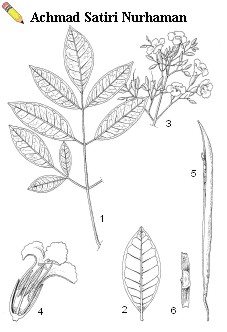 | Radermachera pinnata (Blanco) Seem. – 1, leaf; 2, lower side leaflet; 3, inflorescence; 4, sectioned flower; 5, fruit; 6, seed. |
Ecology
Radermachera is found in lowland to submontane primary or more often secondary forest or open forest or thickets, up to 1600 m altitude. They are not rare (pioneer species occur in disturbed locations) or may be locally common, and occur in both perhumid and seasonal areas, often along streams. R. pinnata is associated with ultramafic and limestone soils in Sabah and Sarawak. In Timor R. gigantea occurs in evergreen forest on soils with a high groundwater table.
Silviculture and Management
Radermachera can be propagated by seed or by branch cuttings. One kg of dry winged seeds of R. gigantea contains 590 000-780 000 seeds. Seeds of R. glandulosa gave about 12% germination in 28-70 days, those of R. gigantea about 25%. As seeds cannot be stored without a serious decline in viability, they should be sown immediately after collection. Immersing seeds in water at 60°C and allowing them to cool for 24 hours enhances germination. It is recommended to sow seeds under shade. The beetle Cionus radermacherae has been observed in Indonesia puncturing shoots of Radermachera.
Genetic Resources and Breeding
As the timber-yielding Radermachera species are widespread and occur in both primary and secondary habitats, they are not threathened.
Prospects
The silvicultural characteristics of Radermachera, as yet ill-known, merit further attention for possible plantation establishment and erosion control.
Literature
[130]Bosbouwproefstation, 1948. Tabellarisch overzicht van de beste kiem-, bewaar- en verzendingswijze van zaad van een aantal boomsoorten en groenbemesters [Tabular summary of the best ways to germinate, store and send seed of some tree and green manure species]. Voorlopig rapport No 38. Bosbouwproefstation, Buitenzorg. 15 pp.
[163]Burkill, I.H., 1966. A dictionary of the economic products of the Malay Peninsula. 2nd edition. Ministry of Agriculture and Co-operatives, Kuala Lumpur. Vol. 1 (A-H) pp. 1-1240. Vol. 2 (I-Z) pp. 1241-2444.
[198]Cockburn, P.F., 1976-1980. Trees of Sabah. 2 volumes. Sabah Forest Records No 10. Forest Department Sabah, Sandakan.
[209]Corner, E.J.H., 1988. Wayside trees of Malaya. 3rd edition. 2 volumes. The Malayan Nature Society, Kuala Lumpur. 774 pp.
[260]den Berger, L.G., 1926. Houtsoorten der cultuurgebieden van Java en Sumatra's oostkust [Tree species of the cultivated areas of Java and the east coast of Sumatra]. Mededeelingen No 13. Proefstation voor het Boschwezen, Buitenzorg. 186 pp.
[341]Flora Malesiana (various editors), 1950-. Kluwer Academic Publishers, Dordrecht, Boston, London.
[343]Flore du Cambodge, du Laos et du Viêtnam (various editors), 1960-. Muséum National d'Histoire Naturelle, Paris.
[405]Hardjowasono, M.S., 1942. Gewicht en volume van verschillende vrucht- en zaadsoorten [Weight and volume of various fruits and seeds]. Korte Mededelingen No 20. Bosbouwproefstation, Buitenzorg. 172 pp.
[436]Heyne, K., 1927. De nuttige planten van Nederlands-Indië [The useful plants of the Dutch East Indies]. 2nd edition, 3 volumes. Departement van Landbouw, Nijverheid en Handel in Nederlandsch-Indië. 1953 pp. (3rd edition, 1950. van Hoeve, 's-Gravenhage/Bandung. 1660 pp.).
[519]Kalshoven, L.G.E., 1934. Topbeschadigingen door insecten in boschculturen [Insect injuries to tops in forest plantations]. Tectona 27: pp. 724-743.
[772]Meijer Drees, E., 1951. Distribution, ecology and silvicultural possibilities of the trees and shrubs from the savanna-forest region in eastern Sumbawa and Timor (Lesser Sunda Islands). Communication No 33. Forest Research Institute, Bogor. 145 pp.
[829]Ng, F.S.P., 1991-1992. Manual of forest fruits, seeds and seedlings. 2 volumes. Malayan Forest Record No 34. Forest Research Institute Malaysia, Kepong. 997 pp.
[831]Ng, F.S.P. & Mat Asri Ngah Sanah, 1991. Germination and seedling records. Research Pamphlet No 108. Forest Research Institute Malaysia, Kepong. 191 pp.
[861]Oey Djoen Seng, 1951. De soortelijke gewichten van Indonesische houtsoorten en hun betekenis voor de praktijk [Specific gravity of Indonesian woods and its significance for practical use]. Rapport No 46. Bosbouwproefstation, Bogor. 183 pp.
[934]Reyes, L.J., 1938. Philippine woods. Technical Bulletin No 7. Commonwealth of the Philippines, Department of Agriculture and Commerce. Bureau of Printing, Manila. 536 pp. + 88 plates.
[1048]Soepadmo, E., Wong, K.M. & Saw, L.G. (Editors), 1995-. Tree flora of Sabah and Sarawak. Sabah Forestry Department, Forest Research Institute Malaysia and Sarawak Forestry Department, Kepong.
[1144]van Steenis, C.G.G.J., 1976. Conspectus of the genera Radermachera and Fernandoa in Indo-Malesia (Bignoniaceae). Blumea 23: 121-138.
[1221]Whitmore, T.C. & Ng, F.S.P. (Editors), 1972-1989. Tree flora of Malaya. A manual for foresters. 4 volumes. Malayan Forest Records No 26. Longman Malaysia Sdn. Berhad, Kuala Lumpur & Petaling Jaya.
[1274]Zwart, W.G.J., 1928. Herbebosschingswerk in Bagelen 1875-1925 [Reforestation in Bagelen, 1875-1925]. Mededeelingen No 17. Proefstation voor het Boschwezen, Buitenzorg. 233 pp.
[163]Burkill, I.H., 1966. A dictionary of the economic products of the Malay Peninsula. 2nd edition. Ministry of Agriculture and Co-operatives, Kuala Lumpur. Vol. 1 (A-H) pp. 1-1240. Vol. 2 (I-Z) pp. 1241-2444.
[198]Cockburn, P.F., 1976-1980. Trees of Sabah. 2 volumes. Sabah Forest Records No 10. Forest Department Sabah, Sandakan.
[209]Corner, E.J.H., 1988. Wayside trees of Malaya. 3rd edition. 2 volumes. The Malayan Nature Society, Kuala Lumpur. 774 pp.
[260]den Berger, L.G., 1926. Houtsoorten der cultuurgebieden van Java en Sumatra's oostkust [Tree species of the cultivated areas of Java and the east coast of Sumatra]. Mededeelingen No 13. Proefstation voor het Boschwezen, Buitenzorg. 186 pp.
[341]Flora Malesiana (various editors), 1950-. Kluwer Academic Publishers, Dordrecht, Boston, London.
[343]Flore du Cambodge, du Laos et du Viêtnam (various editors), 1960-. Muséum National d'Histoire Naturelle, Paris.
[405]Hardjowasono, M.S., 1942. Gewicht en volume van verschillende vrucht- en zaadsoorten [Weight and volume of various fruits and seeds]. Korte Mededelingen No 20. Bosbouwproefstation, Buitenzorg. 172 pp.
[436]Heyne, K., 1927. De nuttige planten van Nederlands-Indië [The useful plants of the Dutch East Indies]. 2nd edition, 3 volumes. Departement van Landbouw, Nijverheid en Handel in Nederlandsch-Indië. 1953 pp. (3rd edition, 1950. van Hoeve, 's-Gravenhage/Bandung. 1660 pp.).
[519]Kalshoven, L.G.E., 1934. Topbeschadigingen door insecten in boschculturen [Insect injuries to tops in forest plantations]. Tectona 27: pp. 724-743.
[772]Meijer Drees, E., 1951. Distribution, ecology and silvicultural possibilities of the trees and shrubs from the savanna-forest region in eastern Sumbawa and Timor (Lesser Sunda Islands). Communication No 33. Forest Research Institute, Bogor. 145 pp.
[829]Ng, F.S.P., 1991-1992. Manual of forest fruits, seeds and seedlings. 2 volumes. Malayan Forest Record No 34. Forest Research Institute Malaysia, Kepong. 997 pp.
[831]Ng, F.S.P. & Mat Asri Ngah Sanah, 1991. Germination and seedling records. Research Pamphlet No 108. Forest Research Institute Malaysia, Kepong. 191 pp.
[861]Oey Djoen Seng, 1951. De soortelijke gewichten van Indonesische houtsoorten en hun betekenis voor de praktijk [Specific gravity of Indonesian woods and its significance for practical use]. Rapport No 46. Bosbouwproefstation, Bogor. 183 pp.
[934]Reyes, L.J., 1938. Philippine woods. Technical Bulletin No 7. Commonwealth of the Philippines, Department of Agriculture and Commerce. Bureau of Printing, Manila. 536 pp. + 88 plates.
[1048]Soepadmo, E., Wong, K.M. & Saw, L.G. (Editors), 1995-. Tree flora of Sabah and Sarawak. Sabah Forestry Department, Forest Research Institute Malaysia and Sarawak Forestry Department, Kepong.
[1144]van Steenis, C.G.G.J., 1976. Conspectus of the genera Radermachera and Fernandoa in Indo-Malesia (Bignoniaceae). Blumea 23: 121-138.
[1221]Whitmore, T.C. & Ng, F.S.P. (Editors), 1972-1989. Tree flora of Malaya. A manual for foresters. 4 volumes. Malayan Forest Records No 26. Longman Malaysia Sdn. Berhad, Kuala Lumpur & Petaling Jaya.
[1274]Zwart, W.G.J., 1928. Herbebosschingswerk in Bagelen 1875-1925 [Reforestation in Bagelen, 1875-1925]. Mededeelingen No 17. Proefstation voor het Boschwezen, Buitenzorg. 233 pp.
Author(s)
D. Sasmitamihardja
Radermachera gigantea
Radermachera glandulosa
Radermachera pinnata
Radermachera glandulosa
Radermachera pinnata
Correct Citation of this Article
Sasmitamihardja, D., 1998. Radermachera Zoll. & Moritzi. In: Sosef, M.S.M., Hong, L.T. and Prawirohatmodjo, S. (Editors): Plant Resources of South-East Asia No 5(3): Timber trees; Lesser-known timbers. PROSEA Foundation, Bogor, Indonesia. Database record: prota4u.org/prosea
Selection of Species
The following species in this genus are important in this commodity group and are treated separatedly in this database:
Radermachera gigantea
Radermachera glandulosa
Radermachera pinnata
Radermachera gigantea
Radermachera glandulosa
Radermachera pinnata

All texts are licensed under a Creative Commons Attribution-Noncommercial-Share Alike 3.0 Netherlands License
This license does not include the illustrations (Maps,drawings,pictures); these remain all under copyright.