Record Number
6253
PROSEA Handbook Number
5(3): Timber trees; Lesser-known timbers
Taxon
Schoutenia Korth.
Protologue
Ned. Kruidk. Arch. 1: 312 (1848).
Family
TILIACEAE
Chromosome Numbers
x = unknown; 2n = unknown
Vernacular Names
Indonesia: walikukun (general). Malaysia: bayur bukit (Peninsular).
Origin and Geographic Distribution
Schoutenia comprises 9 species occurring in Burma (Myanmar), Indo-China, Thailand, Peninsular Malaysia, Sumatra, Java, Borneo and the Lesser Sunda Islands.
Uses
The hard, heavy and flexible wood of Schoutenia is used for house building, tool handles, agricultural implements, spokes and wheels, poles of vehicles, sporting goods and pegs for boat construction. In Java the wood is used as a substitute for that of Lagerstroemia speciosa (L.) Pers. The wood is also used to produce charcoal.
The bark yields rough rope for binding.
The bark yields rough rope for binding.
Production and International Trade
Schoutenia wood is highly valued locally and traded on a local scale, but no exact figures are available. In Indonesia it is classified as a commercial timber.
Properties
Schoutenia yields a heavy hardwood with a density of 770-1080 kg/m3 at 15% moisture content. Heartwood purple-grey-brown to dark purple-brown, not clearly differentiated from the sapwood; grain straight or interlocked; texture moderately fine and even. Growth rings indistinct or indicated by darker tissue, sometimes also indicated by marginal parenchyma bands; vessels moderately small to medium-sized, solitary and in radial multiples of 2-4, solitary vessels predominating in some areas, the multiples in others, open; parenchyma abundant, apotracheal diffuse and diffuse-in-aggregates rarely grading into narrow bands, sometimes in marginal or seemingly marginal bands, and scanty paratracheal to vasicentric visible; rays extremely fine to moderately fine, visible with a hand lens; ripple marks present, distinct in S. ovata but reportedly absent for S. accrescens.
The wood is very hard, very strong and extremely tough. Although hard, it is easy to work. It is moderately durable to very durable, even in contact with the ground or when exposed to the weather.
The gross energy value of the sapwood of S. ovata is about 20 070 kJ/kg and of the heartwood about 20 310 kJ/kg.
See also the tables on microscopic wood anatomy and wood properties.
The wood is very hard, very strong and extremely tough. Although hard, it is easy to work. It is moderately durable to very durable, even in contact with the ground or when exposed to the weather.
The gross energy value of the sapwood of S. ovata is about 20 070 kJ/kg and of the heartwood about 20 310 kJ/kg.
See also the tables on microscopic wood anatomy and wood properties.
Botany
Evergreen or deciduous, small to medium-sized trees up to 35 m tall, rarely shrubs; bole usually fairly short, up to 60(-80) cm in diameter, sometimes prominently fluted or with buttresses up to 1.7 m high; bark surface closely fissured and flaky, dark reddish-brown to greyish-brown, inner bark fibrous, yellowish to reddish or pinkish. Indumentum of stellate hairs or scales. Leaves alternate, distichous, simple, margin entire to sinuate, base usually unequal, 3-veined; stipules caducous or persistent. Flowers in a few-flowered, paniculate or racemose, axillary or terminal inflorescence, bisexual; pedicel jointed; calyx membranous, usually campanulate, (4-)5(-6)-lobed, conspicuously veined, white to yellow; petals usually absent (5 in S. ovata); disk usually present, narrowly annular; stamens 15-many, usually in 5 bundles, persistent; ovary superior, (3-)5-locular with 2 basal ovules in each cell, densely stellate pilose, style 1 with 5 stigmas. Fruit a globular, usually 1-seeded capsule with a strongly enlarged, parachute-shaped, papery calyx and persistent style. Seedling with epigeal germination; cotyledons emergent, bilobed; hypocotyl elongated; first 2 leaves opposite or the first few alternate-spiral, subsequent ones alternate-distichous.
Tree growth is according to Troll's architectural model, characterized by all axes being plagiotropic, the proximal parts becoming erect and forming the main axis. Mean annual diameter and height increment of S. ovata in an 8-year-old plantation were 1.4 cm and 1.5 m, respectively; in a mixed plantation with Dalbergia latifolia Roxb. of 11 years old they were respectively 0.8 cm and 0.8 m. S. accrescens flowers gregariously in March on the bare branches or with the new leaves, whereas fruits are found in April-May. In Java S. ovata flowers in March-June(-November) and ripe fruits can be found in (April-)May-September(-December). In Thailand flowers and fruits are found in September-December. Seed is dispersed by wind or water.
S. accrescens is very variable and can be divided into 2-3 subspecies.
Tree growth is according to Troll's architectural model, characterized by all axes being plagiotropic, the proximal parts becoming erect and forming the main axis. Mean annual diameter and height increment of S. ovata in an 8-year-old plantation were 1.4 cm and 1.5 m, respectively; in a mixed plantation with Dalbergia latifolia Roxb. of 11 years old they were respectively 0.8 cm and 0.8 m. S. accrescens flowers gregariously in March on the bare branches or with the new leaves, whereas fruits are found in April-May. In Java S. ovata flowers in March-June(-November) and ripe fruits can be found in (April-)May-September(-December). In Thailand flowers and fruits are found in September-December. Seed is dispersed by wind or water.
S. accrescens is very variable and can be divided into 2-3 subspecies.
Image
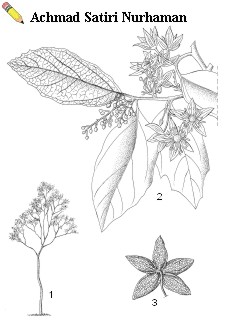 | Schoutenia ovata Korth. – 1, tree habit; 2, flowering twig; 3, fruiting calyx. |
Ecology
Schoutenia species are locally common and sometimes occur gregariously in moist locations in primary rain forest, up to 900(-1100) m altitude. S. ovata is found in slightly seasonal climates.
Silviculture and Management
Schoutenia may be propagated by seed and by vegetative means. Fruits of S. ovata should be collected from the ground to avoid the inclusion of immature seed. There are about 42 500 dry seeds/kg. After-ripening of the seed is very important and germination is optimal after 3-5 months of storage when collected seeds are exposed daily to sunlight, or after 17 months of storage in airtight containers. Seeds should be sown in full sunlight and show about 30% germination in 7-21 days. Fresh fruits of S. accrescens without a calyx have 2-50% germination in 8-36 days. Fresh fruits of S. kunstleri have about 80% germination in 9-14 days. S. ovata seed over 3 mm in diameter had a significantly higher germination percentage and all the seedlings survived, whereas seedlings from smaller seed all died. Therefore, the small seeds should be discarded. Seedlings of S. ovata can be stumped to leave 20 cm shoot and 20 cm root and a diameter of 0.5-2.5 cm and may attain 90-100% survival. Stem cuttings have also been successful (70-95% survival), whereas the survival for root cuttings was slightly more variable but still 35-90%. S. ovata suckers easily; cut or injured roots produce root suckers profusely. On infertile soils S. ovata grows very poorly, whereas on fertile soils it is generally more economic to grow other species. It should not be planted on marshy soils or where the water table is periodically high. S. ovata has often been used as underplanting in teak (Tectona grandis L. f.) plantations where it grows well. It has occasionally been mixed with Dalbergia latifolia, but the trees bend or die back because of insufficient light. A pure stand was planted at 2 m x 3 m, but this spacing was considered too wide as it took 6 years for the canopy to close. Natural pruning was generally poor, but pruning to improve stem form was successful. The clear bole wood produced in 8 years was 38 m3/ha. S. ovata is also fairly resistant to fire. The walikukun borer (Agrilus kalshoveni) has been a serious pest of S. ovata, locally affecting over 50% of the wild population in East Java in the 1920s. Apparently only individuals that are at least periodically in full sunlight are affected and attacked trees no longer sucker. Many trees died as a result of this pest, but it has not been reported since this single outbreak. A 50-hectare plot in natural lowland forest in Peninsular Malaysia was found to contain 473 Schoutenia trees of over 1 cm in diameter of which 17 trees were over 30 cm in diameter.
Genetic Resources and Breeding
Some of the Schoutenia species are endemic and may be vulnerable to genetic erosion by deforestation.
Prospects
Plantations of S. ovata did not compare favourably with other timber species and are therefore no longer established. The very tough wood from natural forest sources will probably remain locally important.
Literature
[61]Ashton, P.S., 1988. Manual of the non-dipterocarp trees of Sarawak. Vol. 2. Dewan Bahasa dan Pustaka, Kuala Lumpur. 490 pp.
[70]Backer, C.A. & Bakhuizen van den Brink Jr., R.C., 1963-1968. Flora of Java. 3 volumes. Wolters-Noordhoff, Groningen.
[80]Balai Penjelidikan Kehutanan, 1950. Daftar ichtisar aturan berketjambah, penjimpanan dan pengiriman bidji dari beberapa djenis pohon dan pupuk hidjau [Tabular summary of the best ways to germinate, store and send seed of some tree and green manure species]. Voorlopig rapport No 38. Bosbouwproefstation, Buitenzorg. 15 pp.n manure species]. Laporan No 42. Balai Penjelidikan Kehutanan, Bogor. 23 pp.
[101]Beekman, H., 1920. 78 Preanger houtsoorten. Beschrijving, afbeelding en determinatietabel [78 Priangan wood species. Description, pictures and identification key]. Mededeelingen No 5. Proefstation voor het Boschwezen, Buitenzorg. 186 pp.
[130]Bosbouwproefstation, 1948. Tabellarisch overzicht van de beste kiem-, bewaar- en verzendingswijze van zaad van een aantal boomsoorten en groenbemesters [Tabular summary of the best ways to germinate, store and send seed of some tree and green manure species]. Voorlopig rapport No 38. Bosbouwproefstation, Buitenzorg. 15 pp.
[161]Burger, D., 1972. Seedlings of some tropical trees and shrubs mainly of South East Asia. Pudoc, Wageningen. 399 pp.
[163]Burkill, I.H., 1966. A dictionary of the economic products of the Malay Peninsula. 2nd edition. Ministry of Agriculture and Co-operatives, Kuala Lumpur. Vol. 1 (A-H) pp. 1-1240. Vol. 2 (I-Z) pp. 1241-2444.
[164]Burret, M., 1926. Beiträge zur Kenntniss der Tiliaceen [Contributions to the knowledge of the Tiliaceae]. Notizblatt des Botanischen Gartens und Museums zu Berlin-Dahlem 9: 592-880.
[209]Corner, E.J.H., 1988. Wayside trees of Malaya. 3rd edition. 2 volumes. The Malayan Nature Society, Kuala Lumpur. 774 pp.
[259]den Berger, L.G., 1926. Mechanical properties of Dutch East Indian timbers. Korte Mededeelingen No 12. Proefstation voor het Boschwezen, Buitenzorg. viii + 63 pp.
[260]den Berger, L.G., 1926. Houtsoorten der cultuurgebieden van Java en Sumatra's oostkust [Tree species of the cultivated areas of Java and the east coast of Sumatra]. Mededeelingen No 13. Proefstation voor het Boschwezen, Buitenzorg. 186 pp.
[267]Desch, H.E., 1941-1954. Manual of Malayan timbers. Malayan Forest Records No 15. 2 volumes. Malaya Publishing House Ltd., Singapore. 762 pp.
[308]Eidmann, F.E., 1933. Kiemingsonderzoek bij een 55-tal wildhoutsoorten en groenbemesters [Research on the germination of seeds of some 55 tree species and green manures]. Mededeelingen No 26. Boschbouwproefstation, Buitenzorg. 156 pp.
[309]Eidmann, F.E., 1933. Stekken en stumps [Cuttings and stumps]. Korte Mededeelingen No 36. Boschbouwproefstation, Buitenzorg. 63 pp.
[376]Ginoga, B. & Karnasudirdja, S., 1978. Sifat mekanis sepuluh jenis kayu Indonesia [Mechanical properties of ten Indonesian timber species]. Laporan No 114. Lembaga Penelitian Hasil Hutan, Bogor. pp. 1-12.
[402]Hallé, F., Oldeman, R.A.A. & Tomlinson, P.B., 1978. Tropical trees and forests - an architectural analysis. Springer Verlag, Berlin, Heidelberg, New York. 441 pp.
[405]Hardjowasono, M.S., 1942. Gewicht en volume van verschillende vrucht- en zaadsoorten [Weight and volume of various fruits and seeds]. Korte Mededelingen No 20. Bosbouwproefstation, Buitenzorg. 172 pp.
[436]Heyne, K., 1927. De nuttige planten van Nederlands-Indië [The useful plants of the Dutch East Indies]. 2nd edition, 3 volumes. Departement van Landbouw, Nijverheid en Handel in Nederlandsch-Indië. 1953 pp. (3rd edition, 1950. van Hoeve, 's-Gravenhage/Bandung. 1660 pp.).
[438]Hildebrand, F.H., 1951. Daftar nama pohon-pohonan Djawa-Madura dengan keterangan-keterangan tentang penjiaran dan ukurannja (telah diperbaiki) [Revised list of tree species of Java-Madura with notes on their distribution and dimensions]. Laporan No 50. Balai Penjelidikan Kehutanan, Bogor. 183 pp.
[464]Ilic, J., 1990. The CSIRO macro key for hardwood identification. CSIRO, Highett. 125 pp.
[488]Japing, H.W. & Oey Djoen Seng, 1936. Cultuurproeven met wildhoutsoorten in Gadoengan - met overzicht van de literatuur betreffende deze soorten [Trial plantations of non teak wood species in Gadungan (East Java) - with survey of literature about these species]. Korte Mededeelingen No 55, part I to VI. Boschbouwproefstation, Buitenzorg. 270 pp.
[516]Kalshoven, L.G.E., 1929. De reactie der walikoekoenboomen op de aantasting door den zigzagboorder [The reaction of walikukun trees to attack by the zigzag borer]. Tectona 22: 285-293.
[517]Kalshoven, L.G.E., 1929. Massaal afsterven van walikoekoen boomen door den zigzag boorder [Mass mortality of walikukun trees by the zigzag borer]. Tectona 22: 1-22.
[526]Kartasujana, I. & Martawijaya, A., 1979. Kayu perdagangan Indonesia - sifat dan kegunaannya [Commercial woods of Indonesia - their properties and uses]. Lembaga Penelitian Hasil Hutan, Bogor. 28 pp.
[632]Kraemer, J.H., 1951. Trees of the western Pacific region. Tri-State Offset Company, Cincinnatti. 436 pp.
[633]Kramer, F., 1925. Kultuurproeven met industrie-, konstruktie- en luxe-houtsoorten [Investigations regarding the cultivation of different Javanese trees]. Mededeelingen No 12. Proefstation voor het Boschwezen, Buitenzorg. 99 pp.
[749]Manokaran, N. et al., 1992. Stand table and distribution of species in the 50-ha research plot at Pasoh Forest Reserve. FRIM Research Data No 1. 454 pp.
[790]Metcalfe, C.R. & Chalk, L., 1957. Anatomy of the dicotyledons. 2 volumes. Corrected edition. Clarendon Press, Oxford. 1506 pp.
[829]Ng, F.S.P., 1991-1992. Manual of forest fruits, seeds and seedlings. 2 volumes. Malayan Forest Record No 34. Forest Research Institute Malaysia, Kepong. 997 pp.
[831]Ng, F.S.P. & Mat Asri Ngah Sanah, 1991. Germination and seedling records. Research Pamphlet No 108. Forest Research Institute Malaysia, Kepong. 191 pp.
[861]Oey Djoen Seng, 1951. De soortelijke gewichten van Indonesische houtsoorten en hun betekenis voor de praktijk [Specific gravity of Indonesian woods and its significance for practical use]. Rapport No 46. Bosbouwproefstation, Bogor. 183 pp.
[887]Phengklai, C., 1986. Study in Thai flora, Tiliaceae. Thai Forest Bulletin (Botany) 16: 2-118.
[947]Rierink, A., 1938. Over de caloriemetrische verbrandingswaarde van een zestigtal Ned. Indische houtsoorten [The calorific value of about 60 woods from the Dutch East Indies]. Tectona 31: 400-418.
[956]Roekmowati-Hartono, 1965. A monograph of the genus Schoutenia Korth. (Tiliaceae). Reinwardtia 7: 91-138.
[1038]Smitinand, T., 1980. Thai plant names. Royal Forest Department, Bangkok. 379 pp.
[1039]Smitinand, T. & Larsen, K. (Editors), 1970-. Flora of Thailand. The Forest Herbarium, Royal Forest Department, Bangkok.
[1161]Verbeek, F.A.T.H., 1938. De overmatige vorming van opslag door den walikoekoen (Actinophora fragrans) [The excessive production of suckers by walikukun (Actinophora fragrans)]. Tectona 31: 555-561.
[1169]Vidal, J., 1962. Noms vernaculaires de plantes en usage au Laos [Vernacular names of plants used in Laos]. Ecole française d'Extrême-Orient, Paris. 197 pp.
[1199]Werkgoep Tropische Houtteelt, 1973. Bebossing van geërodeerde gronden op Java - bijlage III: Houtsoorten [Afforestation of eroded lands in Java - Annex III: Tree species]. Landbouwhogeschool Wageningen. 128 pp.
[1221]Whitmore, T.C. & Ng, F.S.P. (Editors), 1972-1989. Tree flora of Malaya. A manual for foresters. 4 volumes. Malayan Forest Records No 26. Longman Malaysia Sdn. Berhad, Kuala Lumpur & Petaling Jaya.
[1222]Whitmore, T.C., Tantra, I.G.M. & Sutisna, U., 1986-1990. Tree flora of Indonesia. Checklists for Sumatra, Sulawesi, Bali, Nusa Tenggara & Timor, Maluku and Kalimantan. 6 volumes. Agency for Forestry Research and Development, Forest Research and Development Centre, Bogor.
[1242]Wong, T.M., 1982. A dictionary of Malaysian timbers. Malayan Forest Records No 30. Forest Research Institute Malaysia, Kepong. 259 pp.
[70]Backer, C.A. & Bakhuizen van den Brink Jr., R.C., 1963-1968. Flora of Java. 3 volumes. Wolters-Noordhoff, Groningen.
[80]Balai Penjelidikan Kehutanan, 1950. Daftar ichtisar aturan berketjambah, penjimpanan dan pengiriman bidji dari beberapa djenis pohon dan pupuk hidjau [Tabular summary of the best ways to germinate, store and send seed of some tree and green manure species]. Voorlopig rapport No 38. Bosbouwproefstation, Buitenzorg. 15 pp.n manure species]. Laporan No 42. Balai Penjelidikan Kehutanan, Bogor. 23 pp.
[101]Beekman, H., 1920. 78 Preanger houtsoorten. Beschrijving, afbeelding en determinatietabel [78 Priangan wood species. Description, pictures and identification key]. Mededeelingen No 5. Proefstation voor het Boschwezen, Buitenzorg. 186 pp.
[130]Bosbouwproefstation, 1948. Tabellarisch overzicht van de beste kiem-, bewaar- en verzendingswijze van zaad van een aantal boomsoorten en groenbemesters [Tabular summary of the best ways to germinate, store and send seed of some tree and green manure species]. Voorlopig rapport No 38. Bosbouwproefstation, Buitenzorg. 15 pp.
[161]Burger, D., 1972. Seedlings of some tropical trees and shrubs mainly of South East Asia. Pudoc, Wageningen. 399 pp.
[163]Burkill, I.H., 1966. A dictionary of the economic products of the Malay Peninsula. 2nd edition. Ministry of Agriculture and Co-operatives, Kuala Lumpur. Vol. 1 (A-H) pp. 1-1240. Vol. 2 (I-Z) pp. 1241-2444.
[164]Burret, M., 1926. Beiträge zur Kenntniss der Tiliaceen [Contributions to the knowledge of the Tiliaceae]. Notizblatt des Botanischen Gartens und Museums zu Berlin-Dahlem 9: 592-880.
[209]Corner, E.J.H., 1988. Wayside trees of Malaya. 3rd edition. 2 volumes. The Malayan Nature Society, Kuala Lumpur. 774 pp.
[259]den Berger, L.G., 1926. Mechanical properties of Dutch East Indian timbers. Korte Mededeelingen No 12. Proefstation voor het Boschwezen, Buitenzorg. viii + 63 pp.
[260]den Berger, L.G., 1926. Houtsoorten der cultuurgebieden van Java en Sumatra's oostkust [Tree species of the cultivated areas of Java and the east coast of Sumatra]. Mededeelingen No 13. Proefstation voor het Boschwezen, Buitenzorg. 186 pp.
[267]Desch, H.E., 1941-1954. Manual of Malayan timbers. Malayan Forest Records No 15. 2 volumes. Malaya Publishing House Ltd., Singapore. 762 pp.
[308]Eidmann, F.E., 1933. Kiemingsonderzoek bij een 55-tal wildhoutsoorten en groenbemesters [Research on the germination of seeds of some 55 tree species and green manures]. Mededeelingen No 26. Boschbouwproefstation, Buitenzorg. 156 pp.
[309]Eidmann, F.E., 1933. Stekken en stumps [Cuttings and stumps]. Korte Mededeelingen No 36. Boschbouwproefstation, Buitenzorg. 63 pp.
[376]Ginoga, B. & Karnasudirdja, S., 1978. Sifat mekanis sepuluh jenis kayu Indonesia [Mechanical properties of ten Indonesian timber species]. Laporan No 114. Lembaga Penelitian Hasil Hutan, Bogor. pp. 1-12.
[402]Hallé, F., Oldeman, R.A.A. & Tomlinson, P.B., 1978. Tropical trees and forests - an architectural analysis. Springer Verlag, Berlin, Heidelberg, New York. 441 pp.
[405]Hardjowasono, M.S., 1942. Gewicht en volume van verschillende vrucht- en zaadsoorten [Weight and volume of various fruits and seeds]. Korte Mededelingen No 20. Bosbouwproefstation, Buitenzorg. 172 pp.
[436]Heyne, K., 1927. De nuttige planten van Nederlands-Indië [The useful plants of the Dutch East Indies]. 2nd edition, 3 volumes. Departement van Landbouw, Nijverheid en Handel in Nederlandsch-Indië. 1953 pp. (3rd edition, 1950. van Hoeve, 's-Gravenhage/Bandung. 1660 pp.).
[438]Hildebrand, F.H., 1951. Daftar nama pohon-pohonan Djawa-Madura dengan keterangan-keterangan tentang penjiaran dan ukurannja (telah diperbaiki) [Revised list of tree species of Java-Madura with notes on their distribution and dimensions]. Laporan No 50. Balai Penjelidikan Kehutanan, Bogor. 183 pp.
[464]Ilic, J., 1990. The CSIRO macro key for hardwood identification. CSIRO, Highett. 125 pp.
[488]Japing, H.W. & Oey Djoen Seng, 1936. Cultuurproeven met wildhoutsoorten in Gadoengan - met overzicht van de literatuur betreffende deze soorten [Trial plantations of non teak wood species in Gadungan (East Java) - with survey of literature about these species]. Korte Mededeelingen No 55, part I to VI. Boschbouwproefstation, Buitenzorg. 270 pp.
[516]Kalshoven, L.G.E., 1929. De reactie der walikoekoenboomen op de aantasting door den zigzagboorder [The reaction of walikukun trees to attack by the zigzag borer]. Tectona 22: 285-293.
[517]Kalshoven, L.G.E., 1929. Massaal afsterven van walikoekoen boomen door den zigzag boorder [Mass mortality of walikukun trees by the zigzag borer]. Tectona 22: 1-22.
[526]Kartasujana, I. & Martawijaya, A., 1979. Kayu perdagangan Indonesia - sifat dan kegunaannya [Commercial woods of Indonesia - their properties and uses]. Lembaga Penelitian Hasil Hutan, Bogor. 28 pp.
[632]Kraemer, J.H., 1951. Trees of the western Pacific region. Tri-State Offset Company, Cincinnatti. 436 pp.
[633]Kramer, F., 1925. Kultuurproeven met industrie-, konstruktie- en luxe-houtsoorten [Investigations regarding the cultivation of different Javanese trees]. Mededeelingen No 12. Proefstation voor het Boschwezen, Buitenzorg. 99 pp.
[749]Manokaran, N. et al., 1992. Stand table and distribution of species in the 50-ha research plot at Pasoh Forest Reserve. FRIM Research Data No 1. 454 pp.
[790]Metcalfe, C.R. & Chalk, L., 1957. Anatomy of the dicotyledons. 2 volumes. Corrected edition. Clarendon Press, Oxford. 1506 pp.
[829]Ng, F.S.P., 1991-1992. Manual of forest fruits, seeds and seedlings. 2 volumes. Malayan Forest Record No 34. Forest Research Institute Malaysia, Kepong. 997 pp.
[831]Ng, F.S.P. & Mat Asri Ngah Sanah, 1991. Germination and seedling records. Research Pamphlet No 108. Forest Research Institute Malaysia, Kepong. 191 pp.
[861]Oey Djoen Seng, 1951. De soortelijke gewichten van Indonesische houtsoorten en hun betekenis voor de praktijk [Specific gravity of Indonesian woods and its significance for practical use]. Rapport No 46. Bosbouwproefstation, Bogor. 183 pp.
[887]Phengklai, C., 1986. Study in Thai flora, Tiliaceae. Thai Forest Bulletin (Botany) 16: 2-118.
[947]Rierink, A., 1938. Over de caloriemetrische verbrandingswaarde van een zestigtal Ned. Indische houtsoorten [The calorific value of about 60 woods from the Dutch East Indies]. Tectona 31: 400-418.
[956]Roekmowati-Hartono, 1965. A monograph of the genus Schoutenia Korth. (Tiliaceae). Reinwardtia 7: 91-138.
[1038]Smitinand, T., 1980. Thai plant names. Royal Forest Department, Bangkok. 379 pp.
[1039]Smitinand, T. & Larsen, K. (Editors), 1970-. Flora of Thailand. The Forest Herbarium, Royal Forest Department, Bangkok.
[1161]Verbeek, F.A.T.H., 1938. De overmatige vorming van opslag door den walikoekoen (Actinophora fragrans) [The excessive production of suckers by walikukun (Actinophora fragrans)]. Tectona 31: 555-561.
[1169]Vidal, J., 1962. Noms vernaculaires de plantes en usage au Laos [Vernacular names of plants used in Laos]. Ecole française d'Extrême-Orient, Paris. 197 pp.
[1199]Werkgoep Tropische Houtteelt, 1973. Bebossing van geërodeerde gronden op Java - bijlage III: Houtsoorten [Afforestation of eroded lands in Java - Annex III: Tree species]. Landbouwhogeschool Wageningen. 128 pp.
[1221]Whitmore, T.C. & Ng, F.S.P. (Editors), 1972-1989. Tree flora of Malaya. A manual for foresters. 4 volumes. Malayan Forest Records No 26. Longman Malaysia Sdn. Berhad, Kuala Lumpur & Petaling Jaya.
[1222]Whitmore, T.C., Tantra, I.G.M. & Sutisna, U., 1986-1990. Tree flora of Indonesia. Checklists for Sumatra, Sulawesi, Bali, Nusa Tenggara & Timor, Maluku and Kalimantan. 6 volumes. Agency for Forestry Research and Development, Forest Research and Development Centre, Bogor.
[1242]Wong, T.M., 1982. A dictionary of Malaysian timbers. Malayan Forest Records No 30. Forest Research Institute Malaysia, Kepong. 259 pp.
Author(s)
R.C.K. Chung
Schoutenia accrescens
Schoutenia buurmanii
Schoutenia kunstleri
Schoutenia ovata
Schoutenia buurmanii
Schoutenia kunstleri
Schoutenia ovata
Correct Citation of this Article
Chung, R.C.K., 1998. Schoutenia Korth.. In: Sosef, M.S.M., Hong, L.T. and Prawirohatmodjo, S. (Editors): Plant Resources of South-East Asia No 5(3): Timber trees; Lesser-known timbers. PROSEA Foundation, Bogor, Indonesia. Database record: prota4u.org/prosea
Selection of Species
The following species in this genus are important in this commodity group and are treated separatedly in this database:
Schoutenia accrescens
Schoutenia buurmanii
Schoutenia kunstleri
Schoutenia ovata
Schoutenia accrescens
Schoutenia buurmanii
Schoutenia kunstleri
Schoutenia ovata

All texts are licensed under a Creative Commons Attribution-Noncommercial-Share Alike 3.0 Netherlands License
This license does not include the illustrations (Maps,drawings,pictures); these remain all under copyright.