Record Number
6261
PROSEA Handbook Number
5(3): Timber trees; Lesser-known timbers
Taxon
Scorodocarpus Becc.
Protologue
Nuovo Giorn. Bot. Ital. 9: 274 (1877).
Family
OLACACEAE
Chromosome Numbers
x = unknown; 2n = unknown
Vernacular Names
Kulim (trade name). Bawang hutan (Am, En). Brunei: bawang hutan. Indonesia: kayu bawang (Sumatra, Kalimantan), kayu bawang utan (Kalimantan), selaru (Kalimantan). Malaysia: bawang hutan (Sabah, Sarawak), sagan berauh, ungsunah (Sarawak). Thailand: krathiam ton, kuleng, kulim (peninsular).
Origin and Geographic Distribution
Scorodocarpus is a monotypic genus occurring in peninsular Thailand, Peninsular Malaysia, Sumatra and Borneo. The only species is S. borneensis (Baillon) Becc. (synonym: Ximenia borneensis Baillon).
Uses
The wood of Scorodocarpus is used for medium to heavy construction under cover (beams, joists, posts, door and window frames, flooring, rafters), bridge building, salt-water piling (with bark on), boat keels, mine props, transmission posts, agricultural implements and sleepers in temporary railway lines.
In Sarawak the young leaves are eaten as a vegetable. The fruit is edible and is sometimes used as a substitute for garlic. The fruits and also an infusion of the bark are sometimes used as an antidote for "antiaris"" (Antiaris toxicaria Lesch.) poisoning. An extract from the fruits shows antimicrobial activity.
In Sarawak the young leaves are eaten as a vegetable. The fruit is edible and is sometimes used as a substitute for garlic. The fruits and also an infusion of the bark are sometimes used as an antidote for "antiaris"" (Antiaris toxicaria Lesch.) poisoning. An extract from the fruits shows antimicrobial activity.
Production and International Trade
Because of the limited supplies and local occurrence, Scorodocarpus wood is harvested and traded mainly locally, and only when no alternatives are available. It is occasionally found in mixed consignments of medium-weight hardwood.
Properties
S. borneensis yields a medium-weight to heavy hardwood with a density of 645-1080 kg/m3 at 15% moisture content. Heartwood reddish-brown to dark purplish-brown towards the centre, clearly demarcated from the up to 5 cm wide, white or pale yellow sapwood; grain shallowly or deeply interlocked, sometimes straight, wavy or irregular; texture moderately fine to moderately coarse and even; wood with silver fleck (vessel lines) on longitudinal surfaces and with strong odour of garlic when fresh and a peppery smell when dry. Growth rings indistinct; vessels moderately small to medium-sized, solitary but more often in radial multiples of 2-3(-6), tyloses mostly well-developed, occasionally with white deposits; parenchyma moderately abundant, apotracheal diffuse and diffuse-in-aggregates; rays very fine to moderately fine, visible with a hand lens; ripple marks absent.
Shrinkage upon air seasoning is low to high, especially tangentially, and the wood seasons fairly rapidly with moderate splitting and slight end-checks as the main source of degrade. Boards 13 mm and 38 mm thick take about 2 and 4 months, respectively, to air dry. It takes about 8 days at a temperature of 55-70°C and an initial relative humidity of 85% to kiln dry 25 mm thick boards to 14% moisture content. The wood is moderately hard to hard and very strong, but the core is often defective. The wood is moderately easy to saw and the finish after planing depends on the degree of interlocked grain present in the material. Turning properties are variable; boring, mortising and sanding gives good results but shaping is fairly poor. Due to its hardness it is difficult to peel. Nailing properties are rated as very poor. The wood is moderately durable to durable; the average service life of test stakes in a graveyard test in Peninsular Malaysia was about 4 years. The absorption of a mixture of creosote and diesel oil when using the open tank method is about 110 kg/m3. The wood is susceptible to pinhole borers and longhorn beetles, moderately resistant to fungal attack and susceptible to dry-wood termites. The sapwood is non-susceptible to Lyctus.
The average fibre length is 2.151 mm. The volatile, antimicrobial compound from the fruits has been identified as methyl-methylthiomethyl-disulfide.
See also the tables on microscopic wood anatomy and wood properties.
Botany
An evergreen, medium-sized to large tree up to 40(-60) m tall, all parts smelling of garlic; bole columnar, branchless for up to 25 m, up to 80(-150) cm in diameter, often piped, occasionally with small buttresses; bark surface shallowly fissured and flaking into thin rectangles, grey-brown to dark red-brown, inner bark fibrous, purplish-red, inwards with orange flecks. Leaves arranged spirally, simple, entire, exstipulate; petiole swollen distally. Flowers in an axillary, short raceme, 4-5-merous; calyx cup-shaped, margin wavy to toothed; petals reflexed, white, hairy inside; stamens 8 or 10, inserted in pairs about halfway on the petal; ovary superior, imperfectly 3-4-locular with a single ovule in each cell, stigma minutely lobed. Fruit a thinly fleshy, subglobular, 1-seeded, green drupe; endocarp woody with vertical strands. Seedling with hypogeal germination; cotyledons not emergent; hypocotyl not developed; epicotyl with a few scale leaves followed by normal, spirally arranged leaves.
Sapling leaves are alternate-distichous on the branches but arranged spirally on the orthotropic leader. Growth is slow and trees in a large sample in natural forest in Peninsular Malaysia showed an average annual diameter increment of 0.2-0.3 cm. In plantation trials in Peninsular Malaysia the largest trees of 30-33 years old measured 18-29 cm in diameter and 18-21 m in height. In Peninsular Malaysia flowering is in January-July and fruiting more or less throughout the year; in Borneo fruiting is usually in June-September.
Sapling leaves are alternate-distichous on the branches but arranged spirally on the orthotropic leader. Growth is slow and trees in a large sample in natural forest in Peninsular Malaysia showed an average annual diameter increment of 0.2-0.3 cm. In plantation trials in Peninsular Malaysia the largest trees of 30-33 years old measured 18-29 cm in diameter and 18-21 m in height. In Peninsular Malaysia flowering is in January-July and fruiting more or less throughout the year; in Borneo fruiting is usually in June-September.
Image
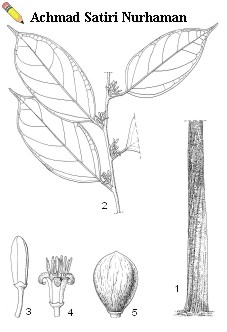 | Scorodocarpus borneensis (Baillon) Becc. – 1, bole; 2, flowering twig; 3, flower bud; 4, flower; 5, fruit. |
Ecology
S. borneensis occurs scattered but may be locally common or even gregarious in primary rain forest, up to 600(-900) m altitude.
Silviculture and Management
S. borneensis can be propagated by seed or by wildlings. Before storage seeds should be sun-dried for about 10 days. There are about 27 000 dry pyrenes/kg and they show about 70% germination in 11-32 months, fruits have about 40% germination in 9-16 months. Stumps may coppice easily. For optimal growth it requires well-drained soils. The mean timber volume of S. borneensis found in a survey of 20 000 ha of the Semangus forest, Sumatra is about 0.5 m3/ha.
Genetic Resources and Breeding
There are no records of S. borneensis in germplasm collections or seed banks. As it has a wide geographical distribution it is not at risk of genetic erosion.
Prospects
It is unlikely that the use of the timber of S. borneensis will increase in the near future. It has no potential for reforestation.
Literature
[3]Abdul Rashid b. Hj. A. Malik, 1983. Malaysian timbers - kulim. Malaysian Forest Service Trade Leaflet No 77. Malaysian Timber Industry Board, Kuala Lumpur. 5 pp.
[50]Anonymous, 1970. Daftar nama pohon-pohonan Kapuas Barito (Kalimantan Selatan) [List of tree species in Kapuas-Barito (South Kalimantan)]. Laporan 121. Bagian Eksplorasi dan Botani, Lembaga Penelitian Hutan, Bogor. 90 pp.
[112]Bianchi, A.T.J., 1941. Verslag omtrent de proefbaanopname van 1940 in het boschcomplex Semangoes (Res. Palembang) [Report on the strip survey of 1940 in the Semangus forest (Palembang regency)]. Tectona 34: 286-328.
[151]Browne, F.G., 1955. Forest trees of Sarawak and Brunei and their products. Government Printing Office, Kuching, Sarawak. xviii + 369 pp.
[162]Burgess, P.F., 1966. Timbers of Sabah. Sabah Forest Records No 6. Forest Department, Sabah, Sandakan. xviii + 501 pp.
[163]Burkill, I.H., 1966. A dictionary of the economic products of the Malay Peninsula. 2nd edition. Ministry of Agriculture and Co-operatives, Kuala Lumpur. Vol. 1 (A-H) pp. 1-1240. Vol. 2 (I-Z) pp. 1241-2444.
[193]Chudnoff, M., 1980. Tropical timbers of the world. Forest Products Laboratory, Forest Service, United States Department of Agriculture, Madison. 831 pp.
[198]Cockburn, P.F., 1976-1980. Trees of Sabah. 2 volumes. Sabah Forest Records No 10. Forest Department Sabah, Sandakan.
[218]Dahms, K.-G., 1982. Asiatische, ozeanische und australische Exporthölzer [Asiatic, Pacific and Australian export timbers]. DRW-Verlag, Stuttgart. 304 pp.
[259]den Berger, L.G., 1926. Mechanical properties of Dutch East Indian timbers. Korte Mededeelingen No 12. Proefstation voor het Boschwezen, Buitenzorg. viii + 63 pp.
[261]den Berger, L.G. & Endert, F.H., 1925. Belangrijke houtsoorten van Nederlandsch-Indië, deel I [Important timbers of the Dutch East Indies, part I]. Mededeelingen No 11. Proefstation voor het Boschwezen, Buitenzorg. 136 pp.
[267]Desch, H.E., 1941-1954. Manual of Malayan timbers. Malayan Forest Records No 15. 2 volumes. Malaya Publishing House Ltd., Singapore. 762 pp.
[341]Flora Malesiana (various editors), 1950-. Kluwer Academic Publishers, Dordrecht, Boston, London.
[354]Foxworthy, F.W., 1927. Commercial timber trees of the Malay Peninsula. Malayan Forest Records No 3. Forest Department, Kuala Lumpur. 185 pp.
[436]Heyne, K., 1927. De nuttige planten van Nederlands-Indië [The useful plants of the Dutch East Indies]. 2nd edition, 3 volumes. Departement van Landbouw, Nijverheid en Handel in Nederlandsch-Indië. 1953 pp. (3rd edition, 1950. van Hoeve, 's-Gravenhage/Bandung. 1660 pp.).
[464]Ilic, J., 1990. The CSIRO macro key for hardwood identification. CSIRO, Highett. 125 pp.
[536]Keating, W.G. & Bolza, E., 1982. Characteristics, properties and uses of timbers. Vol. 1. South-East Asia, northern Australia and the Pacific. Inkata Press Proprietary Ltd., Melbourne, Sydney & London. 362 pp.
[553]Kessler, P.J.A. & Sidiyasa, K., 1994. Trees of the Balikpapan-Samarinda area, East Kalimantan, Indonesia. Tropenbos Series 7. The Tropenbos Foundation, Wageningen. 446 pp.
[571]Kloot, N.H. & Bolza, E., 1961. Properties of timbers imported into Australia. Technological Paper No 12. Division of Forest Products, CSIRO, Melbourne. 79 pp.
[677]Lee, Y.H. & Chu, Y.P., 1965. The strength properties of Malayan timbers. Malayan Forester 28: 307-319.
[678]Lee, Y.H., Engku Abdul Rahman bin Chik & Chu, Y.P., 1979. The strength properties of some Malaysian timbers. Malaysian Forest Service Trade Leaflet No 34 (revised edition). Malaysian Timber Industry Board, Kuala Lumpur. 107 pp.
[740]Malaysian Timber Industry Board, 1984. Peraturan pemeringkatan kayu keras gergaji Malaysia [The Malaysian grading rules for sawn hardwood timber]. Ministry of Primary Industries, Kuala Lumpur. 109 pp.
[741]Malaysian Timber Industry Board, 1986. 100 Malaysian timbers. Kuala Lumpur. x + 226 pp.
[757]Martawijaya, A., Kartasujana, I., Kadir, K. & Prawira, S.A., 1992. Indonesian wood atlas. Vol. 2. Forest Products Research and Development Centre, Bogor. 168 pp.
[829]Ng, F.S.P., 1991-1992. Manual of forest fruits, seeds and seedlings. 2 volumes. Malayan Forest Record No 34. Forest Research Institute Malaysia, Kepong. 997 pp.
[831]Ng, F.S.P. & Mat Asri Ngah Sanah, 1991. Germination and seedling records. Research Pamphlet No 108. Forest Research Institute Malaysia, Kepong. 191 pp.
[832]Ng, F.S.P. & Tang, H.T., 1974. Comparative growth rates of Malaysian trees. Malaysian Forester 37: 2-23.
[861]Oey Djoen Seng, 1951. De soortelijke gewichten van Indonesische houtsoorten en hun betekenis voor de praktijk [Specific gravity of Indonesian woods and its significance for practical use]. Rapport No 46. Bosbouwproefstation, Bogor. 183 pp.
[933]Research Institute of Wood Industry, 1988. Identification, properties and uses of some Southeast Asian woods. Chinese Academy of Forestry, Wan Shou Shan, Beijing & International Tropical Timber Organization, Yokohama. 201 pp.
[1023]Sjape'ie, I., 1954. Gewicht en volume van verschillende vrucht- en zaadsoorten [Weight and volume of various fruits and seeds]. Korte mededeling 20A. Bosbouwproefstation, Bogor. 10 pp.
[1038]Smitinand, T., 1980. Thai plant names. Royal Forest Department, Bangkok. 379 pp.
[1040]Smythies, B.E., 1965. Common Sarawak trees. Borneo Literature Bureau, South China Morning Post, Hong Kong. 153 pp.
[1048]Soepadmo, E., Wong, K.M. & Saw, L.G. (Editors), 1995-. Tree flora of Sabah and Sarawak. Sabah Forestry Department, Forest Research Institute Malaysia and Sarawak Forestry Department, Kepong.
[1052]Stadelman, R.C., 1966. Forests of Southeast Asia. Princeton, Memphis, Tennessee. 245 pp.
[1221]Whitmore, T.C. & Ng, F.S.P. (Editors), 1972-1989. Tree flora of Malaya. A manual for foresters. 4 volumes. Malayan Forest Records No 26. Longman Malaysia Sdn. Berhad, Kuala Lumpur & Petaling Jaya.
[1242]Wong, T.M., 1982. A dictionary of Malaysian timbers. Malayan Forest Records No 30. Forest Research Institute Malaysia, Kepong. 259 pp.
Author(s)
L.S.L. Chua
Correct Citation of this Article
Chua, L.S.L., 1998. Scorodocarpus Becc.. In: Sosef, M.S.M., Hong, L.T. and Prawirohatmodjo, S. (Editors): Plant Resources of South-East Asia No 5(3): Timber trees; Lesser-known timbers. PROSEA Foundation, Bogor, Indonesia. Database record: prota4u.org/prosea

All texts are licensed under a Creative Commons Attribution-Noncommercial-Share Alike 3.0 Netherlands License
This license does not include the illustrations (Maps,drawings,pictures); these remain all under copyright.