Record Number
6279
PROSEA Handbook Number
5(3): Timber trees; Lesser-known timbers
Taxon
Senna Mill.
Protologue
Gard. dict. abr. ed. 4, vol. 3 (1754).
Family
LEGUMINOSAE
Chromosome Numbers
x = 11, 12, 13, 14; S. siamea: n = 14, 18, 2n = 28
Vernacular Names
Senna (En). Malaysia: bebusok. Cambodia: ângkanh'. Laos: 'khi2 'lek. Thailand: khilek (general). Vietnam: mu[oof]ng.
Origin and Geographic Distribution
Senna comprises about 270 species and has a pantropical distribution; a few species extend to temperate regions. Tropical Asia is not very rich in Senna species in comparison with tropical America, Africa and Australia. Only about 7 species occur naturally in tropical Asia, and only about 5 in the Malesian region. Only S. siamea has importance as a timber. Approximately 10 species have been introduced in Malesia and have become naturalized or even weedy; another 8 are planted as ornamentals and are only rarely found as escapes.
Uses
The heartwood of S. siamea, which is often nicely figured, is used for joinery, inlaying, handles, sticks and other decorative uses. The wood has also been used for posts, poles, bridges, pit props, beams, and yields a good-quality firewood and charcoal. In Indonesia the wood of S. timoriensis has been reported to be favoured for axe handles, whereas in Indo-China it is used for boxes and joinery.
Several Senna species, including S. siamea, are well-known ornamental or roadside trees. Some of the introduced ornamental species grow to medium-sized trees (e.g. S. multijuga (L.C. Richard) Irwin & Barneby), and may provide larger sizes of timber when cut. S. siamea is also much used for auxiliary purposes in agriculture and forestry, e.g. as a shade tree, for wind-breaks and for the production of firewood. Its bark has been used to tan leather, but the amount of tannin is comparatively low. The roots are used in local medicine; they act as a vermifuge and prevent convulsions in children. S. timoriensis is suitable for mixed afforestation for soil protection purposes; it is also planted as a roadside tree. Its fruits have anthelmintic properties and the bark is used against scabies. In Thailand and Indo-China the flowers, young fruits and young leaves of both S. siamea and S. timoriensis are eaten after soaking 2-3 times in hot water to remove toxins, but they taste bitter. S. siamea also yields fodder but the flowers and pods and to a lesser extent the leaves are highly toxic to non-ruminants such as pigs and poultry. Several species are valued as medicinal plants (e.g. S. alata (L.) Roxb. and S. occidentalis (L.) Link).
Several Senna species, including S. siamea, are well-known ornamental or roadside trees. Some of the introduced ornamental species grow to medium-sized trees (e.g. S. multijuga (L.C. Richard) Irwin & Barneby), and may provide larger sizes of timber when cut. S. siamea is also much used for auxiliary purposes in agriculture and forestry, e.g. as a shade tree, for wind-breaks and for the production of firewood. Its bark has been used to tan leather, but the amount of tannin is comparatively low. The roots are used in local medicine; they act as a vermifuge and prevent convulsions in children. S. timoriensis is suitable for mixed afforestation for soil protection purposes; it is also planted as a roadside tree. Its fruits have anthelmintic properties and the bark is used against scabies. In Thailand and Indo-China the flowers, young fruits and young leaves of both S. siamea and S. timoriensis are eaten after soaking 2-3 times in hot water to remove toxins, but they taste bitter. S. siamea also yields fodder but the flowers and pods and to a lesser extent the leaves are highly toxic to non-ruminants such as pigs and poultry. Several species are valued as medicinal plants (e.g. S. alata (L.) Roxb. and S. occidentalis (L.) Link).
Production and International Trade
Senna timber is not traded in large amounts on the international market, but the heartwood is particularly in demand locally as it is decorative and durable.
Properties
Senna yields a medium-weight to heavy hardwood with a density of 600-1010 kg/m3 at 15% moisture content. Heartwood black-brown with paler streaks, sharply demarcated from the up to 6 cm wide pale sapwood; grain interlocked, occasionally straight; texture slightly coarse but even. Growth rings indistinct or occasionally distinct, boundary indicated by relatively little parenchyma; vessels medium-sized to moderately large, solitary, occasionally in radial multiples of 2-3, blocked with extraneous dark brown deposits, with occasional white or pinkish chalky deposits; parenchyma abundant, paratracheal confluent and apotracheal in broad more or less continuous concentric layers, narrower near growth ring boundaries and often interrupted, conspicuous; rays very fine, barely visible with a hand lens; ripple marks absent.
Shrinkage of the wood during seasoning is moderate to high but it seasons with little degrade. It is hard to very hard and strong. The wood is difficult to work, with a tendency to pick up in planing, but it takes a high polish. The sawdust of S. siamea may cause some irritation to eyes, nose and throat. The wood is durable with a service life of 9.5 years in a graveyard test in Peninsular Malaysia and probably resistant to termite attacks. The sapwood is susceptible to Lyctus and is permeable to pressure impregnation. The energy value of the wood is 22 400 kJ/kg.
See also the tables on microscopic wood anatomy and wood properties.
Botany
Herbs, shrubs or small to medium-sized trees up to 20(-30) m tall; bole usually short, up to 50 cm in diameter; bark surface smooth, greyish; crown usually dense and rounded at first, later becoming irregular and spreading with drooping branches. Leaves alternate, paripinnate with up to 24(-40) pairs of leaflets; stipules small, usually caducous. Flowers in a 1-many-flowered, axillary raceme often becoming corymbose-paniculate toward the end of branchlets, 5-merous; sepals imbricate, obtuse at apex; petals subequal to heteromorphic, yellow; stamens 10, accrescent toward the abaxial side of the flower, filaments straight and not more than twice as long as anthers; ovary superior, linear and curved. Fruit a stipitate, often strap-shaped, terete to compressed, usually dehiscent pod, usually with septae between the numerous seeds. Seed with distinct areole. Seedling with epigeal germination; cotyledons emergent, semi-fleshy.
Trees of S. siamea develop according to Scarrone's architectural tree model, characterized by an indeterminate trunk bearing tiers of orthotropic branches which branch sympodially as a result of terminal flowering. S. siamea is known to form ecto-mycorrhizae, but it does not fix nitrogen through Rhizobium symbiosis. S. siamea and S. timoriensis are reported to flower throughout the year and S. siamea starts flowering and fruiting at the age of 2-3 years. Early development of both species is rapid and 2-year-old plants of S. timoriensis have an average height of 6-7 m. Mean annual increment of the latter 8 years after planting is 1.4 cm in diameter and 1.7-1.8 m in height. For a 10-year-old S. siamea plantation, these values are 1-2.5 cm and 1.2-3 m, respectively.
Until the beginning of the 1980s Cassia was considered to be a very large genus of over 500 species, but then the genus was split into 3 genera: Cassia sensu stricto, Senna and Chamaecrista. Cassia now has only about 30 species, whereas Senna and Chamaecrista comprise about equal numbers of species.
Image
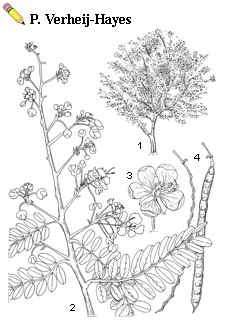 | Senna siamea (Lamk) Irwin & Barneby – 1, tree habit; 2, flowering twig; 3, flower; 4, fruits. |
Ecology
S. siamea is locally common along roadsides, in waste places and along river banks; it occurs in different types of lowland forest. S. timoriensis is often found on limestone hills, in open forest, up to 1100 m altitude. It is a common inhabitant of deciduous dipterocarp forest in areas with a monsoon climate, and is a pioneer species.
Silviculture and Management
Senna can be propagated by seed. Propagation by stem- and root cuttings has not been successful. The number of dry seeds per kg is 35 000-41 000 for S. siamea, and 52 500-71 000 for S. timoriensis. Seed can be stored for up to three years. Fresh seeds can be sown directly, but older seed needs a pretreatment to enhance a more rapid and uniform germination. For S. siamea, treatment with concentrated sulphuric acid for 10-30 minutes or with boiling water is recommended; using the first method about 90% of the seed germinates within 6 days, whereas germination of the untreated seeds is about 75% in 4-29 days. Germination of untreated seeds of S. timoriensis is about 25% in 6-103 days. Allowing the seed of both species to ripen for longer resulted in a slight increase in germination. Seed should be sown in full light, as the slightest shade reduces germination quite considerably. Direct seeding is often applied, for instance for the establishment of fuelwood plantations in Vietnam. Seedlings are often made into stumps before planting; for S. siamea a shoot of 10 cm long with a root of 30 cm long and a maximum diameter of 1 cm is recommended. Plantations should be weeded for the first two years, as S. siamea is susceptible to weed competition. In Indonesia planting trials of both Senna species have been conducted at a spacing of 3 m x 1 m. S. siamea developed low and heavy branches and forks, but under a closed canopy natural pruning was fairly good. Dense planting, however, leads to too slender stems after three years, which tend to bend over; timely thinning is of great importance. S. timoriensis is a very short-lived tree with a very fast early development, stagnating after 3.5 years and starting to die at the age of 8 years. S. siamea produced a clear bole volume of 77 m3/ha after 15.5 years, whereas a mean annual increment of wood of 20-35 m3/ha was determined in a 10-year-old plantation. S. siamea grows fast even on comparatively infertile soils in Indonesia. It tolerates inundation for a few weeks, and drought. It is, however, not suitable for shallow soils. For the production of fuelwood and charcoal, plantations are generally pollarded or regenerated by coppicing, leaving 2-3 shoots/stump after one year. It has been reported that the sapwood should be removed as soon as possible after felling, probably to prevent insect attack of the valuable heartwood. In Indonesia the fungus Ganoderma lucidum is locally a serious disease of S. siamea, causing wood rot on young plants. In Vietnam the butterfly Catopsilia crocale is a serious pest, its larvae feeding on the foliage of S. siamea. Plants of S. siamea are not susceptible to termite attack.
Genetic Resources and Breeding
There are no records of ex situ conservation of S. siamea and S. timoriensis but both are rather common in several areas and, moreover, planted extensively. Therefore, they are not endangered or liable to genetic erosion.
Prospects
S. siamea seems particularly worth trialling as a timber plantation tree. It grows comparatively fast and may provide timber of fair quality, although it may take a considerable time for larger sizes of heartwood to develop. Moreover, it is a rather attractive tree, with the potential of combining use as an ornamental with use as a timber tree.
Literature
[40]All Nippon Checkers Corporation, 1989. Illustrated commercial foreign woods in Japan. Tokyo. 262 pp.
[70]Backer, C.A. & Bakhuizen van den Brink Jr., R.C., 1963-1968. Flora of Java. 3 volumes. Wolters-Noordhoff, Groningen.
[130]Bosbouwproefstation, 1948. Tabellarisch overzicht van de beste kiem-, bewaar- en verzendingswijze van zaad van een aantal boomsoorten en groenbemesters [Tabular summary of the best ways to germinate, store and send seed of some tree and green manure species]. Voorlopig rapport No 38. Bosbouwproefstation, Buitenzorg. 15 pp.
[163]Burkill, I.H., 1966. A dictionary of the economic products of the Malay Peninsula. 2nd edition. Ministry of Agriculture and Co-operatives, Kuala Lumpur. Vol. 1 (A-H) pp. 1-1240. Vol. 2 (I-Z) pp. 1241-2444.
[209]Corner, E.J.H., 1988. Wayside trees of Malaya. 3rd edition. 2 volumes. The Malayan Nature Society, Kuala Lumpur. 774 pp.
[218]Dahms, K.-G., 1982. Asiatische, ozeanische und australische Exporthölzer [Asiatic, Pacific and Australian export timbers]. DRW-Verlag, Stuttgart. 304 pp.
[255]de Wit, H.C.D., 1956. A revision of the genus Cassia (Caesalp.) as occurring in Malaysia. Webbia 11: 197-292.
[260]den Berger, L.G., 1926. Houtsoorten der cultuurgebieden van Java en Sumatra's oostkust [Tree species of the cultivated areas of Java and the east coast of Sumatra]. Mededeelingen No 13. Proefstation voor het Boschwezen, Buitenzorg. 186 pp.
[261]den Berger, L.G. & Endert, F.H., 1925. Belangrijke houtsoorten van Nederlandsch-Indië, deel I [Important timbers of the Dutch East Indies, part I]. Mededeelingen No 11. Proefstation voor het Boschwezen, Buitenzorg. 136 pp.
[267]Desch, H.E., 1941-1954. Manual of Malayan timbers. Malayan Forest Records No 15. 2 volumes. Malaya Publishing House Ltd., Singapore. 762 pp.
[308]Eidmann, F.E., 1933. Kiemingsonderzoek bij een 55-tal wildhoutsoorten en groenbemesters [Research on the germination of seeds of some 55 tree species and green manures]. Mededeelingen No 26. Boschbouwproefstation, Buitenzorg. 156 pp.
[333]Faridah Hanum, I. & van der Maesen, L.J.G. (Editors), 1997. Plant resources of South-East Asia No 11. Auxiliary plants. Backhuys Publishers, Leiden. 389 pp.
[343]Flore du Cambodge, du Laos et du Viêtnam (various editors), 1960-. Muséum National d'Histoire Naturelle, Paris.
[402]Hallé, F., Oldeman, R.A.A. & Tomlinson, P.B., 1978. Tropical trees and forests - an architectural analysis. Springer Verlag, Berlin, Heidelberg, New York. 441 pp.
[405]Hardjowasono, M.S., 1942. Gewicht en volume van verschillende vrucht- en zaadsoorten [Weight and volume of various fruits and seeds]. Korte Mededelingen No 20. Bosbouwproefstation, Buitenzorg. 172 pp.
[436]Heyne, K., 1927. De nuttige planten van Nederlands-Indië [The useful plants of the Dutch East Indies]. 2nd edition, 3 volumes. Departement van Landbouw, Nijverheid en Handel in Nederlandsch-Indië. 1953 pp. (3rd edition, 1950. van Hoeve, 's-Gravenhage/Bandung. 1660 pp.).
[471]Irwin, H.S. & Barneby, R.C., 1982. The American Cassiinae. A synoptical revision of Leguminosae tribe Cassieae subtribe Cassiinae in the New World. Memoirs of the New York Botanical Garden 35 (2 parts). 918 pp.
[488]Japing, H.W. & Oey Djoen Seng, 1936. Cultuurproeven met wildhoutsoorten in Gadoengan - met overzicht van de literatuur betreffende deze soorten [Trial plantations of non teak wood species in Gadungan (East Java) - with survey of literature about these species]. Korte Mededeelingen No 55, part I to VI. Boschbouwproefstation, Buitenzorg. 270 pp.
[536]Keating, W.G. & Bolza, E., 1982. Characteristics, properties and uses of timbers. Vol. 1. South-East Asia, northern Australia and the Pacific. Inkata Press Proprietary Ltd., Melbourne, Sydney & London. 362 pp.
[633]Kramer, F., 1925. Kultuurproeven met industrie-, konstruktie- en luxe-houtsoorten [Investigations regarding the cultivation of different Javanese trees]. Mededeelingen No 12. Proefstation voor het Boschwezen, Buitenzorg. 99 pp.
[697]Letourneux, C., 1957. Tree planting practices in tropical Asia. FAO Forestry Development Paper No 11. FAO, Rome. 172 pp.
[736]Magini, E. & Tulstrup, N.P., 1955. Tree seed notes. I. Arid Areas II. Humid Tropics. FAO Forestry Development Paper 5. FAO, Rome. 354 pp.
[817]National Academy of Sciences, 1980. Firewood crops. Shrub and tree species for firewood production. National Academy Press, Washington, D.C. 237 pp.
[829]Ng, F.S.P., 1991-1992. Manual of forest fruits, seeds and seedlings. 2 volumes. Malayan Forest Record No 34. Forest Research Institute Malaysia, Kepong. 997 pp.
[831]Ng, F.S.P. & Mat Asri Ngah Sanah, 1991. Germination and seedling records. Research Pamphlet No 108. Forest Research Institute Malaysia, Kepong. 191 pp.
[861]Oey Djoen Seng, 1951. De soortelijke gewichten van Indonesische houtsoorten en hun betekenis voor de praktijk [Specific gravity of Indonesian woods and its significance for practical use]. Rapport No 46. Bosbouwproefstation, Bogor. 183 pp.
[889]Phengklai, C. & Khamsai, S., 1985. Some non-timber species of Thailand. Thai Forest Bulletin (Botany) 15: 108-148.
[933]Research Institute of Wood Industry, 1988. Identification, properties and uses of some Southeast Asian woods. Chinese Academy of Forestry, Wan Shou Shan, Beijing & International Tropical Timber Organization, Yokohama. 201 pp.
[934]Reyes, L.J., 1938. Philippine woods. Technical Bulletin No 7. Commonwealth of the Philippines, Department of Agriculture and Commerce. Bureau of Printing, Manila. 536 pp. + 88 plates.
[1163]Verdcourt, B., 1979. A manual of New Guinea legumes. Botany Bulletin No 11. Office of Forests, Division of Botany, Lae. 645 pp.
[1177]von Meyenfeldt, C.F.W.M. et al., 1978. Restoration of devastated inland forests in South Vietnam. Volume III: List of tree species. Agricultural University, Wageningen. 219 pp.
[1198]Weidelt, H.J. (Editor), 1976. Manual of reforestation and erosion control for the Philippines. Schriftenreihe No 22. Deutsche Gesellschaft für Technische Zusammenarbeit (GTZ) GmbH, Eschborn. 569 pp.
[1199]Werkgoep Tropische Houtteelt, 1973. Bebossing van geërodeerde gronden op Java - bijlage III: Houtsoorten [Afforestation of eroded lands in Java - Annex III: Tree species]. Landbouwhogeschool Wageningen. 128 pp.
[1221]Whitmore, T.C. & Ng, F.S.P. (Editors), 1972-1989. Tree flora of Malaya. A manual for foresters. 4 volumes. Malayan Forest Records No 26. Longman Malaysia Sdn. Berhad, Kuala Lumpur & Petaling Jaya.
[1242]Wong, T.M., 1982. A dictionary of Malaysian timbers. Malayan Forest Records No 30. Forest Research Institute Malaysia, Kepong. 259 pp.
Author(s)
E. Boer (general part), R.H.M.J. Lemmens (general part, selection of species)
Senna siamea
Senna timoriensis
Senna timoriensis
Correct Citation of this Article
Boer, E. & Lemmens, R.H.M.J., 1998. Senna Mill.. In: Sosef, M.S.M., Hong, L.T. and Prawirohatmodjo, S. (Editors): Plant Resources of South-East Asia No 5(3): Timber trees; Lesser-known timbers. PROSEA Foundation, Bogor, Indonesia. Database record: prota4u.org/prosea
Selection of Species
The following species in this genus are important in this commodity group and are treated separatedly in this database:
Senna siamea
Senna timoriensis
Senna siamea
Senna timoriensis

All texts are licensed under a Creative Commons Attribution-Noncommercial-Share Alike 3.0 Netherlands License
This license does not include the illustrations (Maps,drawings,pictures); these remain all under copyright.