Record Number
6328
PROSEA Handbook Number
5(3): Timber trees; Lesser-known timbers
Taxon
Strombosia Blume
Protologue
Bijdr. fl. Ned. Ind. 17: 1154 (1826).
Family
OLACACEAE
Chromosome Numbers
x = unknown; 2n = unknown
Vernacular Names
- Dedali (trade name): S. javanica.
- Kamap (trade name): S. ceylanica and S. philippinensis.
- Kamap (trade name): S. ceylanica and S. philippinensis.
Origin and Geographic Distribution
Strombosia comprises about 12 species, about 9 of which occur in tropical Africa and 3 others in Asia from Sri Lanka, south India and Burma (Myanmar) to Thailand, Peninsular Malaysia, Sumatra, Java, Borneo, the Philippines and the Moluccas. All 3 Asian species are present within the Malesian region.
Uses
The heavier timber of Strombosia, "kamap"", is used for temporary construction, flooring, pallets and posts. S. philippinensis is reported as being suitable for making shuttles and bobbins, and the young stem could be made into walking-sticks.
The lighter timber of Strombosia, "dedali"", is used for general utility purposes, local house building, medium-heavy construction under cover, interior finish, cabinet work, packing cases and in Indonesia for bent-work like badminton rackets. It is also used for the production of veneer and plywood.
The leaves of S. javanica are eaten raw or cooked and taste like groundnuts. The pulp of the fruits of S. philippinensis is eaten raw.
The lighter timber of Strombosia, "dedali"", is used for general utility purposes, local house building, medium-heavy construction under cover, interior finish, cabinet work, packing cases and in Indonesia for bent-work like badminton rackets. It is also used for the production of veneer and plywood.
The leaves of S. javanica are eaten raw or cooked and taste like groundnuts. The pulp of the fruits of S. philippinensis is eaten raw.
Production and International Trade
As supplies are generally small, Strombosia wood is used on a local scale only.
Properties
S. ceylanica and S. philippinensis ("kamap"") yield a heavy hardwood with a density of (635-)790-1220 kg/m3 at 15% moisture content, S. philippinensis being the harder and heavier of the two. Heartwood chocolate-brown or purple-brown, sharply demarcated from the about 4 cm wide, pale yellow-brown sapwood which may be much wider in small trees; grain straight (S. philippinensis) or interlocked (S. ceylanica); texture very fine to moderately fine and even; wood lustrous. Growth rings indistinct; vessels moderately small, solitary and in radial multiples of 2-5, tyloses common; parenchyma moderately abundant, apotracheal diffuse to diffuse-in-aggregates, indistinct even with a hand lens; rays very fine to moderately fine; ripple marks absent.
Kamap wood is subject to checking when seasoned in large pieces. It is hard to exceptionally hard. The wood is not difficult to work for such a hard wood and it takes a high polish. After pre-heating, 1.25 mm thick veneer can be produced without difficulty, but it is difficult to obtain thicker veneer. It is moderately durable to very durable; in a graveyard test in the Philippines the average service life of test stakes of S. philippinensis was 7 years and 8 months. The heartwood of S. philippinensis is very resistant to dry-wood termites, its sapwood is non-susceptible to Lyctus.
S. javanica ("dedali"") yields a medium-weight hardwood with a density of 540-770 kg/m3 at 15% moisture content. Heartwood pale yellow with an olive-brown tinge, darkening to pale orange-brown, moderately sharply differentiated from the paler sapwood, 2-15 cm wide; grain straight or interlocked; texture fine to moderately fine and even. Growth rings indistinct; vessels moderately small, in radial multiples of 2-8, occasionally solitary, usually open; parenchyma abundant, apotracheal diffuse and diffuse-in-aggregates; rays very fine; ripple marks absent.
Shrinkage upon air drying is moderate to high. The wood seasons very slowly: boards 13 mm and 38 mm thick take respectively about 7 and 12 months to air dry. Degrade upon air drying is a moderate amount of cupping, twisting, end-checking and surface-checking, and the wood is very susceptible to insect attack during seasoning. The wood is soft to moderately hard and of moderate strength. It is easy to saw and plane although the radial surface is slightly rough due to picking up of the grain. The wood is moderately durable when exposed to the weather or in contact with the ground, which is remarkable for a moderately soft wood. The wood is resistant to impregnation.
The gross energy value of the sapwood of S. ceylanica is about 21 205 kJ/kg.
See also the tables on microscopic wood anatomy and wood properties.
Kamap wood is subject to checking when seasoned in large pieces. It is hard to exceptionally hard. The wood is not difficult to work for such a hard wood and it takes a high polish. After pre-heating, 1.25 mm thick veneer can be produced without difficulty, but it is difficult to obtain thicker veneer. It is moderately durable to very durable; in a graveyard test in the Philippines the average service life of test stakes of S. philippinensis was 7 years and 8 months. The heartwood of S. philippinensis is very resistant to dry-wood termites, its sapwood is non-susceptible to Lyctus.
S. javanica ("dedali"") yields a medium-weight hardwood with a density of 540-770 kg/m3 at 15% moisture content. Heartwood pale yellow with an olive-brown tinge, darkening to pale orange-brown, moderately sharply differentiated from the paler sapwood, 2-15 cm wide; grain straight or interlocked; texture fine to moderately fine and even. Growth rings indistinct; vessels moderately small, in radial multiples of 2-8, occasionally solitary, usually open; parenchyma abundant, apotracheal diffuse and diffuse-in-aggregates; rays very fine; ripple marks absent.
Shrinkage upon air drying is moderate to high. The wood seasons very slowly: boards 13 mm and 38 mm thick take respectively about 7 and 12 months to air dry. Degrade upon air drying is a moderate amount of cupping, twisting, end-checking and surface-checking, and the wood is very susceptible to insect attack during seasoning. The wood is soft to moderately hard and of moderate strength. It is easy to saw and plane although the radial surface is slightly rough due to picking up of the grain. The wood is moderately durable when exposed to the weather or in contact with the ground, which is remarkable for a moderately soft wood. The wood is resistant to impregnation.
The gross energy value of the sapwood of S. ceylanica is about 21 205 kJ/kg.
See also the tables on microscopic wood anatomy and wood properties.
Botany
Evergreen, small to medium-sized trees up to 30(-40) m tall, rarely shrubs; bole columnar, sometimes knobbly, up to 70(-120) cm in diameter, sometimes twisted or fluted or rarely with steep buttresses; bark surface shallowly, irregularly fissured or cracked, peeling off with scroll-shaped flakes, yellowish-grey to reddish-brown or purple-brown, inner bark firm, cream with yellow to orange-brown flecks; crown dense, compact. Young twigs often zigzag. Leaves arranged spirally, sometimes almost distichous, simple, entire, exstipulate. Flowers in an axillary, short-peduncled cyme or sessile fascicle; calyx a shallow, 5-lobed cup, accrescent; petals (4-)5, free, greenish, hairy inside; stamens (4-)5, filaments largely adnate to the petals; disk (3-)5-lobed; ovary initially superior, finally partly inferior, 3-5(-6)-locular below, 1-locular above, with 3-5(-6) ovules, style short to elongate, stigma obscurely 3-5(-6)-lobed. Fruit a 1-seeded drupe crowned by the persistent calyx and style base, green ripening cream. Seed with abundant, oily endosperm. Seedling with hypogeal germination; cotyledons not emergent; hypocotyl elongated; first few leaves scale-like and decussate, subsequent leaves arranged spirally on the orthotropic leader, but alternate-distichous on the branches.
An individual 24-year-old S. javanica tree in the arboretum of the Forest Research Institute Malaysia, Kepong measured 16 m in height and 23 cm in diameter; generally, growth is considered to be slow. The crown is monopodial or ultimately sympodial. S. philippinensis flowers from April to May and bears fruits from June to August. S. javanica is reported to flower at irregular intervals. The fleshy pericarp and large seeds suggest dispersal by animals, mainly monkeys and birds.
An individual 24-year-old S. javanica tree in the arboretum of the Forest Research Institute Malaysia, Kepong measured 16 m in height and 23 cm in diameter; generally, growth is considered to be slow. The crown is monopodial or ultimately sympodial. S. philippinensis flowers from April to May and bears fruits from June to August. S. javanica is reported to flower at irregular intervals. The fleshy pericarp and large seeds suggest dispersal by animals, mainly monkeys and birds.
Image
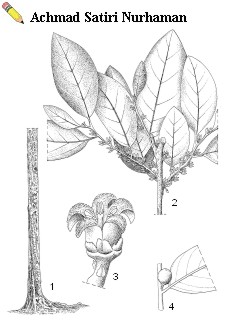 | Strombosia ceylanica Gardner – 1, bole; 2, flowering twig; 3, flower; 4, fruit. |
Ecology
Strombosia is found scattered but may occur locally common in primary, evergreen, lowland rain forest, from near the sea to 800(-1000) m altitude.
Silviculture and Management
Strombosia can be propagated by seed. S. ceylanica has about 405 dry seeds/kg, S. javanica 235 dry seeds/kg. Pyrenes of S. javanica show complete germination in 64-185 days. S. javanica is shade-tolerant.
Genetic Resources and Breeding
Strombosia is rather common and does not seem endangered.
Prospects
It is unlikely that Strombosia timber will be increasingly used. Its use for specialty purposes related to its strong and durable wood will remain locally important.
Literature
[151]Browne, F.G., 1955. Forest trees of Sarawak and Brunei and their products. Government Printing Office, Kuching, Sarawak. xviii + 369 pp.
[163]Burkill, I.H., 1966. A dictionary of the economic products of the Malay Peninsula. 2nd edition. Ministry of Agriculture and Co-operatives, Kuala Lumpur. Vol. 1 (A-H) pp. 1-1240. Vol. 2 (I-Z) pp. 1241-2444.
[235]de Guzman, E.D., Umali, R.M. & Sotalbo, E.D., 1986. Guide to the Philippine flora and fauna. Vol. 3: Dipterocarps, non-dipterocarps. Natural Resources Management Centre, Ministry of Natural Resources, Quezon City & University of the Philippines, Los Baños. xx + 414 pp.
[238]de Vogel, E.F., 1980. Seedlings of dicotyledons. Structure, development, types. Descriptions of 150 woody Malesian taxa. Pudoc, Wageningen. 465 pp.
[260]den Berger, L.G., 1926. Houtsoorten der cultuurgebieden van Java en Sumatra's oostkust [Tree species of the cultivated areas of Java and the east coast of Sumatra]. Mededeelingen No 13. Proefstation voor het Boschwezen, Buitenzorg. 186 pp.
[261]den Berger, L.G. & Endert, F.H., 1925. Belangrijke houtsoorten van Nederlandsch-Indië, deel I [Important timbers of the Dutch East Indies, part I]. Mededeelingen No 11. Proefstation voor het Boschwezen, Buitenzorg. 136 pp.
[267]Desch, H.E., 1941-1954. Manual of Malayan timbers. Malayan Forest Records No 15. 2 volumes. Malaya Publishing House Ltd., Singapore. 762 pp.
[319]Engku Abdul Rahman bin Chik & Wong, C.N., 1974. Preliminary studies on some Malaysian timbers for plywood manufacture. Part 9. Kamap (Strombosia rotundifolia). Malaysian Forester 37: 189-197.
[320]Engku Abdul Rahman bin Chik & Wong, C.N., 1975. Preliminary studies on some Malaysian timbers for plywood manufacture, part 11 - summary of results. Malaysian Forester 38: 101-107.
[341]Flora Malesiana (various editors), 1950-. Kluwer Academic Publishers, Dordrecht, Boston, London.
[354]Foxworthy, F.W., 1927. Commercial timber trees of the Malay Peninsula. Malayan Forest Records No 3. Forest Department, Kuala Lumpur. 185 pp.
[387]Grewal, G.S., 1979. Air-seasoning properties of some Malaysian timbers. Malaysian Forest Service Trade Leaflet No 41. Malaysian Timber Industry Board, Kuala Lumpur. 26 pp.
[406]Harker, A.P., Sandels, A. & Burley, J., 1982. Calorific values for wood and bark and a bibliography for fuelwood. Report G 162. Tropical Products Institute, London. 20 pp.
[436]Heyne, K., 1927. De nuttige planten van Nederlands-Indië [The useful plants of the Dutch East Indies]. 2nd edition, 3 volumes. Departement van Landbouw, Nijverheid en Handel in Nederlandsch-Indië. 1953 pp. (3rd edition, 1950. van Hoeve, 's-Gravenhage/Bandung. 1660 pp.).
[464]Ilic, J., 1990. The CSIRO macro key for hardwood identification. CSIRO, Highett. 125 pp.
[632]Kraemer, J.H., 1951. Trees of the western Pacific region. Tri-State Offset Company, Cincinnatti. 436 pp.
[677]Lee, Y.H. & Chu, Y.P., 1965. The strength properties of Malayan timbers. Malayan Forester 28: 307-319.
[678]Lee, Y.H., Engku Abdul Rahman bin Chik & Chu, Y.P., 1979. The strength properties of some Malaysian timbers. Malaysian Forest Service Trade Leaflet No 34 (revised edition). Malaysian Timber Industry Board, Kuala Lumpur. 107 pp.
[740]Malaysian Timber Industry Board, 1984. Peraturan pemeringkatan kayu keras gergaji Malaysia [The Malaysian grading rules for sawn hardwood timber]. Ministry of Primary Industries, Kuala Lumpur. 109 pp.
[741]Malaysian Timber Industry Board, 1986. 100 Malaysian timbers. Kuala Lumpur. x + 226 pp.
[780]Meniado, J.A. et al., 1975-1981. Wood identification handbook for Philippine timbers. 2 volumes. Government Printing Office, Manila. 370 pp. & 186 pp.
[804]Monsalud, M.R. & Tamolang, F.N., 1969. General information on Philippine hardwoods. Philippine Lumberman 15(7): 14-38.
[829]Ng, F.S.P., 1991-1992. Manual of forest fruits, seeds and seedlings. 2 volumes. Malayan Forest Record No 34. Forest Research Institute Malaysia, Kepong. 997 pp.
[831]Ng, F.S.P. & Mat Asri Ngah Sanah, 1991. Germination and seedling records. Research Pamphlet No 108. Forest Research Institute Malaysia, Kepong. 191 pp.
[832]Ng, F.S.P. & Tang, H.T., 1974. Comparative growth rates of Malaysian trees. Malaysian Forester 37: 2-23.
[861]Oey Djoen Seng, 1951. De soortelijke gewichten van Indonesische houtsoorten en hun betekenis voor de praktijk [Specific gravity of Indonesian woods and its significance for practical use]. Rapport No 46. Bosbouwproefstation, Bogor. 183 pp.
[933]Research Institute of Wood Industry, 1988. Identification, properties and uses of some Southeast Asian woods. Chinese Academy of Forestry, Wan Shou Shan, Beijing & International Tropical Timber Organization, Yokohama. 201 pp.
[934]Reyes, L.J., 1938. Philippine woods. Technical Bulletin No 7. Commonwealth of the Philippines, Department of Agriculture and Commerce. Bureau of Printing, Manila. 536 pp. + 88 plates.
[955]Rocafort, J.E., Floresca, A.R. & Siopongco, J.O., 1971. Fourth progress report on the specific gravity of Philippine woods. Philippine Architecture, Engineering & Construction Report 18(5): 17-27.
[1023]Sjape'ie, I., 1954. Gewicht en volume van verschillende vrucht- en zaadsoorten [Weight and volume of various fruits and seeds]. Korte mededeling 20A. Bosbouwproefstation, Bogor. 10 pp.
[1048]Soepadmo, E., Wong, K.M. & Saw, L.G. (Editors), 1995-. Tree flora of Sabah and Sarawak. Sabah Forestry Department, Forest Research Institute Malaysia and Sarawak Forestry Department, Kepong.
[1221]Whitmore, T.C. & Ng, F.S.P. (Editors), 1972-1989. Tree flora of Malaya. A manual for foresters. 4 volumes. Malayan Forest Records No 26. Longman Malaysia Sdn. Berhad, Kuala Lumpur & Petaling Jaya.
[1239]Wong, T.M., 1976. Wood structure of the lesser known timbers of Peninsular Malaysia. Malayan Forest Records No 28. Forest Research Institute Malaysia, Kepong. xi + 115 pp.
[1242]Wong, T.M., 1982. A dictionary of Malaysian timbers. Malayan Forest Records No 30. Forest Research Institute Malaysia, Kepong. 259 pp.
[1268]Zamuco, I.T., 1981. Some unexploited plants of the Philippines. Canopy International 7(3): 1, 10-11; 7(4): 10-14; 7(5): 13-14.
[163]Burkill, I.H., 1966. A dictionary of the economic products of the Malay Peninsula. 2nd edition. Ministry of Agriculture and Co-operatives, Kuala Lumpur. Vol. 1 (A-H) pp. 1-1240. Vol. 2 (I-Z) pp. 1241-2444.
[235]de Guzman, E.D., Umali, R.M. & Sotalbo, E.D., 1986. Guide to the Philippine flora and fauna. Vol. 3: Dipterocarps, non-dipterocarps. Natural Resources Management Centre, Ministry of Natural Resources, Quezon City & University of the Philippines, Los Baños. xx + 414 pp.
[238]de Vogel, E.F., 1980. Seedlings of dicotyledons. Structure, development, types. Descriptions of 150 woody Malesian taxa. Pudoc, Wageningen. 465 pp.
[260]den Berger, L.G., 1926. Houtsoorten der cultuurgebieden van Java en Sumatra's oostkust [Tree species of the cultivated areas of Java and the east coast of Sumatra]. Mededeelingen No 13. Proefstation voor het Boschwezen, Buitenzorg. 186 pp.
[261]den Berger, L.G. & Endert, F.H., 1925. Belangrijke houtsoorten van Nederlandsch-Indië, deel I [Important timbers of the Dutch East Indies, part I]. Mededeelingen No 11. Proefstation voor het Boschwezen, Buitenzorg. 136 pp.
[267]Desch, H.E., 1941-1954. Manual of Malayan timbers. Malayan Forest Records No 15. 2 volumes. Malaya Publishing House Ltd., Singapore. 762 pp.
[319]Engku Abdul Rahman bin Chik & Wong, C.N., 1974. Preliminary studies on some Malaysian timbers for plywood manufacture. Part 9. Kamap (Strombosia rotundifolia). Malaysian Forester 37: 189-197.
[320]Engku Abdul Rahman bin Chik & Wong, C.N., 1975. Preliminary studies on some Malaysian timbers for plywood manufacture, part 11 - summary of results. Malaysian Forester 38: 101-107.
[341]Flora Malesiana (various editors), 1950-. Kluwer Academic Publishers, Dordrecht, Boston, London.
[354]Foxworthy, F.W., 1927. Commercial timber trees of the Malay Peninsula. Malayan Forest Records No 3. Forest Department, Kuala Lumpur. 185 pp.
[387]Grewal, G.S., 1979. Air-seasoning properties of some Malaysian timbers. Malaysian Forest Service Trade Leaflet No 41. Malaysian Timber Industry Board, Kuala Lumpur. 26 pp.
[406]Harker, A.P., Sandels, A. & Burley, J., 1982. Calorific values for wood and bark and a bibliography for fuelwood. Report G 162. Tropical Products Institute, London. 20 pp.
[436]Heyne, K., 1927. De nuttige planten van Nederlands-Indië [The useful plants of the Dutch East Indies]. 2nd edition, 3 volumes. Departement van Landbouw, Nijverheid en Handel in Nederlandsch-Indië. 1953 pp. (3rd edition, 1950. van Hoeve, 's-Gravenhage/Bandung. 1660 pp.).
[464]Ilic, J., 1990. The CSIRO macro key for hardwood identification. CSIRO, Highett. 125 pp.
[632]Kraemer, J.H., 1951. Trees of the western Pacific region. Tri-State Offset Company, Cincinnatti. 436 pp.
[677]Lee, Y.H. & Chu, Y.P., 1965. The strength properties of Malayan timbers. Malayan Forester 28: 307-319.
[678]Lee, Y.H., Engku Abdul Rahman bin Chik & Chu, Y.P., 1979. The strength properties of some Malaysian timbers. Malaysian Forest Service Trade Leaflet No 34 (revised edition). Malaysian Timber Industry Board, Kuala Lumpur. 107 pp.
[740]Malaysian Timber Industry Board, 1984. Peraturan pemeringkatan kayu keras gergaji Malaysia [The Malaysian grading rules for sawn hardwood timber]. Ministry of Primary Industries, Kuala Lumpur. 109 pp.
[741]Malaysian Timber Industry Board, 1986. 100 Malaysian timbers. Kuala Lumpur. x + 226 pp.
[780]Meniado, J.A. et al., 1975-1981. Wood identification handbook for Philippine timbers. 2 volumes. Government Printing Office, Manila. 370 pp. & 186 pp.
[804]Monsalud, M.R. & Tamolang, F.N., 1969. General information on Philippine hardwoods. Philippine Lumberman 15(7): 14-38.
[829]Ng, F.S.P., 1991-1992. Manual of forest fruits, seeds and seedlings. 2 volumes. Malayan Forest Record No 34. Forest Research Institute Malaysia, Kepong. 997 pp.
[831]Ng, F.S.P. & Mat Asri Ngah Sanah, 1991. Germination and seedling records. Research Pamphlet No 108. Forest Research Institute Malaysia, Kepong. 191 pp.
[832]Ng, F.S.P. & Tang, H.T., 1974. Comparative growth rates of Malaysian trees. Malaysian Forester 37: 2-23.
[861]Oey Djoen Seng, 1951. De soortelijke gewichten van Indonesische houtsoorten en hun betekenis voor de praktijk [Specific gravity of Indonesian woods and its significance for practical use]. Rapport No 46. Bosbouwproefstation, Bogor. 183 pp.
[933]Research Institute of Wood Industry, 1988. Identification, properties and uses of some Southeast Asian woods. Chinese Academy of Forestry, Wan Shou Shan, Beijing & International Tropical Timber Organization, Yokohama. 201 pp.
[934]Reyes, L.J., 1938. Philippine woods. Technical Bulletin No 7. Commonwealth of the Philippines, Department of Agriculture and Commerce. Bureau of Printing, Manila. 536 pp. + 88 plates.
[955]Rocafort, J.E., Floresca, A.R. & Siopongco, J.O., 1971. Fourth progress report on the specific gravity of Philippine woods. Philippine Architecture, Engineering & Construction Report 18(5): 17-27.
[1023]Sjape'ie, I., 1954. Gewicht en volume van verschillende vrucht- en zaadsoorten [Weight and volume of various fruits and seeds]. Korte mededeling 20A. Bosbouwproefstation, Bogor. 10 pp.
[1048]Soepadmo, E., Wong, K.M. & Saw, L.G. (Editors), 1995-. Tree flora of Sabah and Sarawak. Sabah Forestry Department, Forest Research Institute Malaysia and Sarawak Forestry Department, Kepong.
[1221]Whitmore, T.C. & Ng, F.S.P. (Editors), 1972-1989. Tree flora of Malaya. A manual for foresters. 4 volumes. Malayan Forest Records No 26. Longman Malaysia Sdn. Berhad, Kuala Lumpur & Petaling Jaya.
[1239]Wong, T.M., 1976. Wood structure of the lesser known timbers of Peninsular Malaysia. Malayan Forest Records No 28. Forest Research Institute Malaysia, Kepong. xi + 115 pp.
[1242]Wong, T.M., 1982. A dictionary of Malaysian timbers. Malayan Forest Records No 30. Forest Research Institute Malaysia, Kepong. 259 pp.
[1268]Zamuco, I.T., 1981. Some unexploited plants of the Philippines. Canopy International 7(3): 1, 10-11; 7(4): 10-14; 7(5): 13-14.
Author(s)
D.S. Alonzo
Strombosia ceylanica
Strombosia javanica
Strombosia philippinensis
Strombosia javanica
Strombosia philippinensis
Correct Citation of this Article
Alonzo, D.S., 1998. Strombosia Blume. In: Sosef, M.S.M., Hong, L.T. and Prawirohatmodjo, S. (Editors): Plant Resources of South-East Asia No 5(3): Timber trees; Lesser-known timbers. PROSEA Foundation, Bogor, Indonesia. Database record: prota4u.org/prosea
Selection of Species
The following species in this genus are important in this commodity group and are treated separatedly in this database:
Strombosia ceylanica
Strombosia javanica
Strombosia philippinensis
Strombosia ceylanica
Strombosia javanica
Strombosia philippinensis

All texts are licensed under a Creative Commons Attribution-Noncommercial-Share Alike 3.0 Netherlands License
This license does not include the illustrations (Maps,drawings,pictures); these remain all under copyright.