Record Number
6391
PROSEA Handbook Number
5(3): Timber trees; Lesser-known timbers
Taxon
Timonius DC.
Protologue
Prodr. 4: 461 (1830).
Family
RUBIACEAE
Chromosome Numbers
x = unknown; 2n = unknown
Vernacular Names
Malaysia: berombong, merombong (Peninsular).
Origin and Geographic Distribution
Timonius is a large genus of about 150 species occurring from Mauritius, the Seychelles and Sri Lanka eastward through the Malesian region to tropical Australia, Micronesia and the Pacific. New Guinea is the richest with about 60 species. Specific endemism is high, and only few species are widely distributed (e.g. T. avenis, T. flavescens, T. timon).
Uses
The wood of Timonius is locally used for house building (poles, beams, rafters); it is also used as firewood.
T. timon has been recommended as a green manure for drier areas. Roots of T. timon are used as a febrifuge in traditional medicine in the Moluccas, both internally and externally. The leaves are applied against snakebites in New Guinea.
T. timon has been recommended as a green manure for drier areas. Roots of T. timon are used as a febrifuge in traditional medicine in the Moluccas, both internally and externally. The leaves are applied against snakebites in New Guinea.
Production and International Trade
The wood of Timonius is used rarely and only local.
Properties
Timonius yields a medium-weight to heavy hardwood with a density of (450-)530-880 kg/m3 at 15% moisture content. Heartwood straw to pale yellow-brown with an orange tinge, not differentiated from the sapwood; grain straight; texture moderately fine and even; some watered-silk figure on tangential faces. Growth rings sometimes visible to the naked eye, when visible boundaries indicated by layers of marginal parenchyma; vessels moderately small to medium-sized, solitary and in radial multiples of 2-3(-5), multiples predominating, often blocked by chalky white deposits; parenchyma abundant, paratracheal vasicentric tending to aliform and often confluent, apotracheal occasionally in marginal or seemingly marginal bands, and in wavy regular, both narrow as well as wide bands; rays very fine to medium-sized; ripple marks absent.
Wood moderately soft to hard, of relative low strength and non-durable.
See also the tables on microscopic wood anatomy and wood properties.
Wood moderately soft to hard, of relative low strength and non-durable.
See also the tables on microscopic wood anatomy and wood properties.
Botany
Dioecious, usually shrubs or small trees, or occasionally fairly large or rarely large trees up to 40(-45) m tall; bole sometimes crooked, usually short, up to 60(-80) cm in diameter, without or with small buttresses; bark surface smooth, pustular, scaly or fissured, often with prominent lenticels, grey to brown, inner bark brittle, pink. Leaves opposite or rarely whorled, simple, entire, pinnately veined but veins often not prominent, domatia often present in axils of veins; stipules large, caducous, falling individually or sheath-like and falling together. Flowers in a solitary, axillary, cymose, short inflorescence, unisexual; female flowers usually solitary or 3 together, male flowers many; calyx cupular to tubular, persistent, (1-)4-5(-6)-lobed or truncate; corolla funnel-shaped to trumpet-shaped, 4-10(-12)-lobed, lobes sometimes with appendages at apex (e.g. T. appendiculatus), white or yellowish to pale green, often flushed with pink outside, often pubescent outside; stamens 4-10, with short filaments attached below the throat of the corolla tube, staminodes present in female flowers; ovary inferior, 6-many-loculate with 1 ovule in each cell enclosed by a fibrous endocarp, style long, distally divided in 2-10(-12) exserted stigmatic arms. Fruit drupaceous, slightly angular, fleshy, red, purple to black when mature, with numerous single-seeded pyrenes. Seed with thin or no endosperm.
Trials with T. timon planted in West Java with a seasonal climate showed a mean annual increment of 1.0 cm in diameter and of 0.8-1.0 m in height 11 years after planting. Many species have been found flowering and fruiting throughout the year. Fruits are eaten by birds, bats and in New Guinea ground animals especially marsupials, which disperse the seeds. The fruits sometimes seem adapted to water dispersal (e.g. T. rivularis) by having a prominent central cavity.
Species of the subgenus Abbottia (F. v. Mueller) S. Darwin are characterized as hemi-epiphytes. They are initially woody epiphytes, but develop a root connection with the ground (then resembling lianas) and eventually become free-standing trees. This way of development resembles strangling figs, which also have prominent stipules and many-seeded fleshy fruits.
Timonius is placed in the tribe Guettardeae together with Guettarda. It is particularly characterized by the several to numerous locules which develop into separate 1-seeded pyrenes. Some groups which are considered monophyletic have been distinguished within the genus: subgenus Timonius with 8 species and subgenus Abbottia with about 30 species. However, most of the species have not yet been included in an infrageneric classification and are in need of a thorough taxonomic revision, as identification at species level is often difficult.
Trials with T. timon planted in West Java with a seasonal climate showed a mean annual increment of 1.0 cm in diameter and of 0.8-1.0 m in height 11 years after planting. Many species have been found flowering and fruiting throughout the year. Fruits are eaten by birds, bats and in New Guinea ground animals especially marsupials, which disperse the seeds. The fruits sometimes seem adapted to water dispersal (e.g. T. rivularis) by having a prominent central cavity.
Species of the subgenus Abbottia (F. v. Mueller) S. Darwin are characterized as hemi-epiphytes. They are initially woody epiphytes, but develop a root connection with the ground (then resembling lianas) and eventually become free-standing trees. This way of development resembles strangling figs, which also have prominent stipules and many-seeded fleshy fruits.
Timonius is placed in the tribe Guettardeae together with Guettarda. It is particularly characterized by the several to numerous locules which develop into separate 1-seeded pyrenes. Some groups which are considered monophyletic have been distinguished within the genus: subgenus Timonius with 8 species and subgenus Abbottia with about 30 species. However, most of the species have not yet been included in an infrageneric classification and are in need of a thorough taxonomic revision, as identification at species level is often difficult.
Image
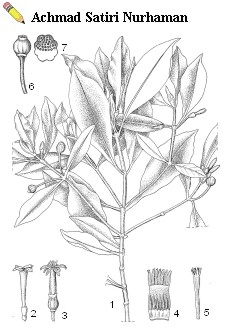 | Timonius avenis Valeton – 1, flowering and fruiting twig; 2, male flower; 3, female flower; 4, opened corolla of female flower; 5, style; 6, fruit; 7, cross section of fruit. |
Ecology
Timonius often occurs in coastal sandy or swampy sites, roadsides, river banks, secondary forest, monsoon forest, forest edges, savanna and open woodland. The species can be found in the lowlands up to the mountains, some even over 3500 m altitude (e.g. T. pubistipulus). In New Guinea several species occurring in montane forest are commonly associated with Castanopsis, Nothofagus and Podocarpus species. Some species, particularly T. timon, occupy a wide variety of habitats. T. rivularis is a pioneer dominating in riparian habitats. T. timon occurs on slopes of volcanoes in New Britain together with Gymnostoma papuanum (S. Moore) L.A.S. Johnson and Eucalyptus deglupta Blume in a succession stage preceding mixed rain forest, and is common in pockets of forest in coastal grassland on calcareous soils in northern Australia.
Silviculture and Management
Timonius may be raised from seed. There are about 574 000 dry seeds/kg for T. timon with approximately 200 seeds/fruit. In plantation trials in West Java with T. timon the canopy was fairly open with a large amount of light reaching the ground. This species is very fire resistant and hardly suffered from a large fire which struck the plantation. Several other species have also been reported as fire-resistant. In the Lesser Sunda Islands T. timon is recommended for reforestation in the low mountain areas. After cutting, T. timon regenerates easily by coppice shoots.
Genetic Resources and Breeding
Many Timonius species are narrow endemics and may be easily threatened when their habitat is destroyed on a large scale. The fact that several of them prefer secondary habitats diminishes this risk. Those species with a comparatively small area of distribution and apparently limited to lowland primary forest are most vulnerable (e.g. T. appendiculatus in the Philippines and T. modestus in New Guinea).
Prospects
It is unlikely that Timonius will enter commercial markets as sawn timber in the future; there is no reason to expect a change in local use.
Literature
[70]Backer, C.A. & Bakhuizen van den Brink Jr., R.C., 1963-1968. Flora of Java. 3 volumes. Wolters-Noordhoff, Groningen.
[124]Bolza, E. & Kloot, N.H., 1963. The mechanical properties of 174 Australian timbers. Technological Paper No 25. Division of Forest Products, CSIRO, Melbourne. 112 pp.
[163]Burkill, I.H., 1966. A dictionary of the economic products of the Malay Peninsula. 2nd edition. Ministry of Agriculture and Co-operatives, Kuala Lumpur. Vol. 1 (A-H) pp. 1-1240. Vol. 2 (I-Z) pp. 1241-2444.
[209]Corner, E.J.H., 1988. Wayside trees of Malaya. 3rd edition. 2 volumes. The Malayan Nature Society, Kuala Lumpur. 774 pp.
[225]Darwin, S.P., 1993. A revision of Timonius subgenus Timonius (Rubiaceae: Guettardeae). Allertonia 7: 1-39.
[226]Darwin, S.P., 1994. Systematics of Timonius subgenus Abbottia (Rubiaceae - Guettardeae). Systematic Botany Monographs Vol. 42, American Society of Plant Taxonomists, Ann Arbor, Michigan. 86 pp.
[267]Desch, H.E., 1941-1954. Manual of Malayan timbers. Malayan Forest Records No 15. 2 volumes. Malaya Publishing House Ltd., Singapore. 762 pp.
[405]Hardjowasono, M.S., 1942. Gewicht en volume van verschillende vrucht- en zaadsoorten [Weight and volume of various fruits and seeds]. Korte Mededelingen No 20. Bosbouwproefstation, Buitenzorg. 172 pp.
[423]Havel, J.J., 1975. Forest botany. Part 2: Botanical taxonomy. Training Manual for the Forestry College Vol. 3. Department of Forests, Port Moresby. 317 pp.
[427]Hellinga, G., 1950. Resultaten van de proeftuinen voor boomgewassen sedert 1937. Loofhoutsoorten II [Results from trial plots for trees since 1937. Deciduous trees II]. Rapport No 27. Bosbouwproefstation, Buitenzorg. 29 pp.
[436]Heyne, K., 1927. De nuttige planten van Nederlands-Indië [The useful plants of the Dutch East Indies]. 2nd edition, 3 volumes. Departement van Landbouw, Nijverheid en Handel in Nederlandsch-Indië. 1953 pp. (3rd edition, 1950. van Hoeve, 's-Gravenhage/Bandung. 1660 pp.).
[442]Hoff, R., 1992. Plants of New Guinea and the Solomon Islands: Dictionary of the genera and families of flowering plants and ferns. Wau Ecological Institute, Wau. 139 pp.
[463]Hyland, B.P.M. & Whiffin, T., 1993. Australian tropical rain forest trees: an interactive identification system. CSIRO Publishing, Melbourne. 2 Volumes + Atlas.
[464]Ilic, J., 1990. The CSIRO macro key for hardwood identification. CSIRO, Highett. 125 pp.
[772]Meijer Drees, E., 1951. Distribution, ecology and silvicultural possibilities of the trees and shrubs from the savanna-forest region in eastern Sumbawa and Timor (Lesser Sunda Islands). Communication No 33. Forest Research Institute, Bogor. 145 pp.
[861]Oey Djoen Seng, 1951. De soortelijke gewichten van Indonesische houtsoorten en hun betekenis voor de praktijk [Specific gravity of Indonesian woods and its significance for practical use]. Rapport No 46. Bosbouwproefstation, Bogor. 183 pp.
[1209]Whitmore, T.C., 1966. Guide to the forests of the British Solomon Islands. Oxford University Press, London. 208 pp.
[1221]Whitmore, T.C. & Ng, F.S.P. (Editors), 1972-1989. Tree flora of Malaya. A manual for foresters. 4 volumes. Malayan Forest Records No 26. Longman Malaysia Sdn. Berhad, Kuala Lumpur & Petaling Jaya.
[1232]Wisse, J.H., 1965. Volumegewichten van een aantal houtmonsters uit West Nieuw Guinea [Specific gravity of some wood samples from West New Guinea]. Afdeling Bosexploitatie en Boshuishoudkunde, Landbouwhogeschool, Wageningen. 23 pp.
[1238]Wong, K.M., 1988. The Antirheoideae (Rubiaceae) of the Malay Peninsula. Kew Bulletin 43(3): 491-518.
[124]Bolza, E. & Kloot, N.H., 1963. The mechanical properties of 174 Australian timbers. Technological Paper No 25. Division of Forest Products, CSIRO, Melbourne. 112 pp.
[163]Burkill, I.H., 1966. A dictionary of the economic products of the Malay Peninsula. 2nd edition. Ministry of Agriculture and Co-operatives, Kuala Lumpur. Vol. 1 (A-H) pp. 1-1240. Vol. 2 (I-Z) pp. 1241-2444.
[209]Corner, E.J.H., 1988. Wayside trees of Malaya. 3rd edition. 2 volumes. The Malayan Nature Society, Kuala Lumpur. 774 pp.
[225]Darwin, S.P., 1993. A revision of Timonius subgenus Timonius (Rubiaceae: Guettardeae). Allertonia 7: 1-39.
[226]Darwin, S.P., 1994. Systematics of Timonius subgenus Abbottia (Rubiaceae - Guettardeae). Systematic Botany Monographs Vol. 42, American Society of Plant Taxonomists, Ann Arbor, Michigan. 86 pp.
[267]Desch, H.E., 1941-1954. Manual of Malayan timbers. Malayan Forest Records No 15. 2 volumes. Malaya Publishing House Ltd., Singapore. 762 pp.
[405]Hardjowasono, M.S., 1942. Gewicht en volume van verschillende vrucht- en zaadsoorten [Weight and volume of various fruits and seeds]. Korte Mededelingen No 20. Bosbouwproefstation, Buitenzorg. 172 pp.
[423]Havel, J.J., 1975. Forest botany. Part 2: Botanical taxonomy. Training Manual for the Forestry College Vol. 3. Department of Forests, Port Moresby. 317 pp.
[427]Hellinga, G., 1950. Resultaten van de proeftuinen voor boomgewassen sedert 1937. Loofhoutsoorten II [Results from trial plots for trees since 1937. Deciduous trees II]. Rapport No 27. Bosbouwproefstation, Buitenzorg. 29 pp.
[436]Heyne, K., 1927. De nuttige planten van Nederlands-Indië [The useful plants of the Dutch East Indies]. 2nd edition, 3 volumes. Departement van Landbouw, Nijverheid en Handel in Nederlandsch-Indië. 1953 pp. (3rd edition, 1950. van Hoeve, 's-Gravenhage/Bandung. 1660 pp.).
[442]Hoff, R., 1992. Plants of New Guinea and the Solomon Islands: Dictionary of the genera and families of flowering plants and ferns. Wau Ecological Institute, Wau. 139 pp.
[463]Hyland, B.P.M. & Whiffin, T., 1993. Australian tropical rain forest trees: an interactive identification system. CSIRO Publishing, Melbourne. 2 Volumes + Atlas.
[464]Ilic, J., 1990. The CSIRO macro key for hardwood identification. CSIRO, Highett. 125 pp.
[772]Meijer Drees, E., 1951. Distribution, ecology and silvicultural possibilities of the trees and shrubs from the savanna-forest region in eastern Sumbawa and Timor (Lesser Sunda Islands). Communication No 33. Forest Research Institute, Bogor. 145 pp.
[861]Oey Djoen Seng, 1951. De soortelijke gewichten van Indonesische houtsoorten en hun betekenis voor de praktijk [Specific gravity of Indonesian woods and its significance for practical use]. Rapport No 46. Bosbouwproefstation, Bogor. 183 pp.
[1209]Whitmore, T.C., 1966. Guide to the forests of the British Solomon Islands. Oxford University Press, London. 208 pp.
[1221]Whitmore, T.C. & Ng, F.S.P. (Editors), 1972-1989. Tree flora of Malaya. A manual for foresters. 4 volumes. Malayan Forest Records No 26. Longman Malaysia Sdn. Berhad, Kuala Lumpur & Petaling Jaya.
[1232]Wisse, J.H., 1965. Volumegewichten van een aantal houtmonsters uit West Nieuw Guinea [Specific gravity of some wood samples from West New Guinea]. Afdeling Bosexploitatie en Boshuishoudkunde, Landbouwhogeschool, Wageningen. 23 pp.
[1238]Wong, K.M., 1988. The Antirheoideae (Rubiaceae) of the Malay Peninsula. Kew Bulletin 43(3): 491-518.
Author(s)
S. Aggarwal (general part), R.H.M.J. Lemmens (general part, selection of species)
Timonius appendiculatus
Timonius avenis
Timonius belensis
Timonius bismarckensis
Timonius corneri
Timonius flavescens
Timonius longitubus
Timonius meridionalis
Timonius modestus
Timonius pubistipulus
Timonius rivularis
Timonius rufescens
Timonius timon
Timonius wallichianus
Timonius wrayi
Timonius avenis
Timonius belensis
Timonius bismarckensis
Timonius corneri
Timonius flavescens
Timonius longitubus
Timonius meridionalis
Timonius modestus
Timonius pubistipulus
Timonius rivularis
Timonius rufescens
Timonius timon
Timonius wallichianus
Timonius wrayi
Correct Citation of this Article
Aggarwal, S. & Lemmens, R.H.M.J., 1998. Timonius DC.. In: Sosef, M.S.M., Hong, L.T. and Prawirohatmodjo, S. (Editors): Plant Resources of South-East Asia No 5(3): Timber trees; Lesser-known timbers. PROSEA Foundation, Bogor, Indonesia. Database record: prota4u.org/prosea
Selection of Species
The following species in this genus are important in this commodity group and are treated separatedly in this database:
Timonius appendiculatus
Timonius avenis
Timonius belensis
Timonius bismarckensis
Timonius corneri
Timonius flavescens
Timonius longitubus
Timonius meridionalis
Timonius modestus
Timonius pubistipulus
Timonius rivularis
Timonius rufescens
Timonius timon
Timonius wallichianus
Timonius wrayi
Timonius appendiculatus
Timonius avenis
Timonius belensis
Timonius bismarckensis
Timonius corneri
Timonius flavescens
Timonius longitubus
Timonius meridionalis
Timonius modestus
Timonius pubistipulus
Timonius rivularis
Timonius rufescens
Timonius timon
Timonius wallichianus
Timonius wrayi

All texts are licensed under a Creative Commons Attribution-Noncommercial-Share Alike 3.0 Netherlands License
This license does not include the illustrations (Maps,drawings,pictures); these remain all under copyright.