Record Number
6494
PROSEA Handbook Number
5(3): Timber trees; Lesser-known timbers
Taxon
Xylopia L.
Protologue
Syst. Nat., ed. 10, 2: 1250 (1759).
Family
ANNONACEAE
Chromosome Numbers
x = unknown; 2n = unknown
Vernacular Names
Mempisang (trade name). Brunei: bangkoh (Malay). Indonesia: jangkang (general). Malaysia: jangkang, pisang-pisang (Peninsular), kelili (Sarawak). Vietnam: d[eef]n.
Origin and Geographic Distribution
Xylopia comprises some 100 to 150 species and occurs throughout the tropics. In Asia it is found in Sri Lanka, southern India, Indo-China, Thailand, throughout the Malesian region except for Java, and in New Caledonia and Fiji. The largest number of species is found in Africa; some 30 species occur in Malesia.
Uses
The wood of Xylopia is used for light construction, interior joinery, light-duty parquet and strip flooring, packing boxes, crates, tool handles, low grade furniture, sliced veneer, matchboxes and match splints.
A decoction of the bark of X. ferruginea is reputed to stop vomiting. In Peninsular Malaysia the boiled roots of X. malayana have been given to women after childbirth.
A decoction of the bark of X. ferruginea is reputed to stop vomiting. In Peninsular Malaysia the boiled roots of X. malayana have been given to women after childbirth.
Production and International Trade
"Mempisang"" is a general trade name comprising most of the genera of Annonaceae, and Xylopia probably comprises a fair proportion of the wood traded under this name. In 1992 the export of mempisang wood from Sabah amounted to 25 000 m3 of sawn timber and 42 500 m3 of logs with a total value of about US$ 7.2 million. Small amounts of mempisang are imported by Japan, mainly from Sabah and Sarawak. In Mindanao, the Philippines, X. ferruginea is planted on a small scale for matchstick production.
Properties
Xylopia yields a lightweight to heavy hardwood with a density varying from 295 to 975 kg/m3; X. caudata and X. magna yield heavy wood, X. ferruginea and X. fusca yield lightweight wood, whereas X. malayana yields lightweight to heavy wood (density 410-870 kg/m3). Heartwood pale yellow-brown, dark yellow-brown in X. caudata, sometimes with a green tinge, not clearly differentiated from the sapwood; grain straight; texture rather coarse and even to uneven; wood sometimes with silver grain. Growth rings occasionally distinct; vessels medium-sized in species with heavy wood, medium-sized to moderately large in others, solitary and in radial multiples of 2-4(-6) and occasional clusters, sometimes white, yellow or reddish deposits present; parenchyma abundant, apotracheal in regular, narrow bands (scalariform); rays moderately fine to medium-sized, sometimes moderately broad in X. fusca; ripple marks absent.
Shrinkage upon air drying is moderate; board of X. fusca 13 mm and 38 mm thick take respectively 3 and 5 months to air dry. There is moderate risk of cupping, bowing and stain during drying. Sawing of green logs of X. fusca is very easy, yielding a smooth surface; turning of X. caudata wood produces a rather rough and fibrous surface. The lightweight wood of X. fusca is non-durable. Xylopia wood is easy to treat with preservatives.
See also the tables on microscopic wood anatomy and wood properties.
Shrinkage upon air drying is moderate; board of X. fusca 13 mm and 38 mm thick take respectively 3 and 5 months to air dry. There is moderate risk of cupping, bowing and stain during drying. Sawing of green logs of X. fusca is very easy, yielding a smooth surface; turning of X. caudata wood produces a rather rough and fibrous surface. The lightweight wood of X. fusca is non-durable. Xylopia wood is easy to treat with preservatives.
See also the tables on microscopic wood anatomy and wood properties.
Botany
Evergreen, small to fairly large trees up to 40 m tall; bole straight, up to 70 cm in diameter, often with small buttresses or stilt roots; bark surface smooth to cracking or scaly, sometimes lenticellate, greyish-white to brown or orange-brown or red, inner bark fibrous, mottled, pinkish-brown, dull yellow or with brown and white patches. Leaves alternate, simple, entire, exstipulate. Flowers axillary, solitary, cymose or fascicled, often fragrant, bisexual; sepals 3, valvate, connate; petals 6, in 2 rows, valvate, narrow, subequal or the outer ones longer, white to greenish, yellow or reddish; stamens few to many, with an enlarged, obtuse to pointed connective; carpels 2-many, free, each with 1-8 ovules in 1 or 2 rows, style usually long, stigma club-shaped to linear. Fruit apocarpous, with 1-30(-40) monocarps, each monocarp sessile or stipitate, not dehiscing or dehiscent along the dorsal suture, globose to narrowly oblong, 1-16-seeded, sometimes constricted between the seeds, with a woody wall. Seed ellipsoid to broadly ellipsoid; testa crustaceous; endosperm hard. Seedling with epigeal germination; cotyledons not emergent; hypocotyl elongated; leaves arranged spirally on the orthotropic leader, distichous on the branches.
Early growth of planted X. ferruginea is fairly rapid, with a mean annual increment of about 1 m in height and about 3 cm in diameter during the first 3-5 years. The tree form of Xylopia is according to Roux's architectural tree model, characterized by a continuously growing monopodial orthotropic trunk with plagiotropic branches and distichous leaf arrangement, flowering does not influence the architecture. Flowers of X. ferruginea open at dusk and last for several nights; in Mindanao, the Philippines, it flowers from August to September and fruits from November to December. X. papuana has been observed flowering and fruiting in May-July and October. In Peninsular Malaysia X. stenopetala flowers regularly after the early year dry season, whereas X. malayana fruits in October and November. Fruits are eaten and dispersed by birds, mainly pigeons, and by squirrels, macaques and orang-utans.
Many of the Malesian species of Xylopia are still poorly known and are in need of a taxonomic revision.
Early growth of planted X. ferruginea is fairly rapid, with a mean annual increment of about 1 m in height and about 3 cm in diameter during the first 3-5 years. The tree form of Xylopia is according to Roux's architectural tree model, characterized by a continuously growing monopodial orthotropic trunk with plagiotropic branches and distichous leaf arrangement, flowering does not influence the architecture. Flowers of X. ferruginea open at dusk and last for several nights; in Mindanao, the Philippines, it flowers from August to September and fruits from November to December. X. papuana has been observed flowering and fruiting in May-July and October. In Peninsular Malaysia X. stenopetala flowers regularly after the early year dry season, whereas X. malayana fruits in October and November. Fruits are eaten and dispersed by birds, mainly pigeons, and by squirrels, macaques and orang-utans.
Many of the Malesian species of Xylopia are still poorly known and are in need of a taxonomic revision.
Image
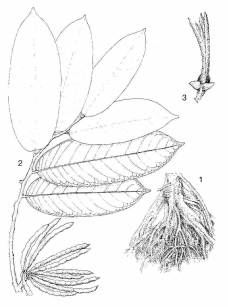 | Xylopia fusca Maingay ex Hook. f. & Thomson – 1, stilt roots. Xylopia ferruginea (Hook. f. & Thomson) Hook. f. & Thomson – 2, fruiting twig; 3, flower. |
Ecology
Xylopia is found scattered in primary and secondary, lowland and hill rain forest. X. fusca is characteristic of swamp forest where it may be common but seldom abundant. In a peat-swamp forest in Thailand X. fusca and X. malayana were observed as the dominant trees. X. ferruginea is found gregarious in forests in Mindanao, the Philippines. X. coriifolia is found in swamp forest and kerangas.
Silviculture and Management
Xylopia can be propagated by seed. Germination experiments have been executed in Peninsular Malaysia. One seedlot of X. caudata showed about 65% germination in 40-75 days, but another achieved only about 10% germination, possibly because the seeds were not fully mature when collected. Seeds of X. malayana had about 85% germination in 33-45 days. In nursery experiments with watering twice a day X. caudata was very vulnerable, as the cotyledons and epicotyl became trapped in the testa causing the seedling to rot. In the Philippines fresh seeds of X. ferruginea germinated in 20-40 days. When seedlings are 2 weeks old (3 cm tall and with 2 leaves) they are pricked out and transferred to shaded polybags; shade is gradually removed over a period of 1.5 months. Two weeks later they can be planted at a spacing of 4 m x 8 m. Survival is 75-80% provided weeding is adequate.
Genetic Resources and Breeding
Some Xylopia species have a narrow geographical distribution and are at risk of genetic erosion by destruction of their habitat.
Prospects
As the growth of Xylopia is rapid, it is worthwhile to determine experimentally its potential for forest plantations.
Literature
[151]Browne, F.G., 1955. Forest trees of Sarawak and Brunei and their products. Government Printing Office, Kuching, Sarawak. xviii + 369 pp.
[162]Burgess, P.F., 1966. Timbers of Sabah. Sabah Forest Records No 6. Forest Department, Sabah, Sandakan. xviii + 501 pp.
[163]Burkill, I.H., 1966. A dictionary of the economic products of the Malay Peninsula. 2nd edition. Ministry of Agriculture and Co-operatives, Kuala Lumpur. Vol. 1 (A-H) pp. 1-1240. Vol. 2 (I-Z) pp. 1241-2444.
[209]Corner, E.J.H., 1988. Wayside trees of Malaya. 3rd edition. 2 volumes. The Malayan Nature Society, Kuala Lumpur. 774 pp.
[267]Desch, H.E., 1941-1954. Manual of Malayan timbers. Malayan Forest Records No 15. 2 volumes. Malaya Publishing House Ltd., Singapore. 762 pp.
[302]Eddowes, P.J., 1980. Lesser known timber species of SEALPA countries. A review and summary. South East Asia Lumber Producers' Association, Jakarta. 132 pp.
[304]Eddowes, P.J., 1995-1997. The forests and timbers of Papua New Guinea. (unpublished data).
[387]Grewal, G.S., 1979. Air-seasoning properties of some Malaysian timbers. Malaysian Forest Service Trade Leaflet No 41. Malaysian Timber Industry Board, Kuala Lumpur. 26 pp.
[402]Hallé, F., Oldeman, R.A.A. & Tomlinson, P.B., 1978. Tropical trees and forests - an architectural analysis. Springer Verlag, Berlin, Heidelberg, New York. 441 pp.
[464]Ilic, J., 1990. The CSIRO macro key for hardwood identification. CSIRO, Highett. 125 pp.
[526]Kartasujana, I. & Martawijaya, A., 1979. Kayu perdagangan Indonesia - sifat dan kegunaannya [Commercial woods of Indonesia - their properties and uses]. Lembaga Penelitian Hasil Hutan, Bogor. 28 pp.
[544]Keng, H. & Heaslett, E.A., 1973. The Xylopia malayana fruit: significance of its dehiscence. Gardens' Bulletin, Singapore 26: 223-225.
[547]Kessler, P.J.A., 1987. Some interesting distribution patterns in Annonaceae. Annonaceae Newsletter 6: 14-23.
[550]Kessler, P.J.A., 1989. Some notes on different genera of Annonaceae in Malesia. Annonaceae Newsletter 7: 1-5.
[553]Kessler, P.J.A. & Sidiyasa, K., 1994. Trees of the Balikpapan-Samarinda area, East Kalimantan, Indonesia. Tropenbos Series 7. The Tropenbos Foundation, Wageningen. 446 pp.
[554]Kessler, P.J.A. & van Heusden, E.C.H., 1993. The Annonaceae of the Balikpapan-Samarinda area, East Kalimantan, Indonesia. Rheedea 3: 50-89.
[632]Kraemer, J.H., 1951. Trees of the western Pacific region. Tri-State Offset Company, Cincinnatti. 436 pp.
[678]Lee, Y.H., Engku Abdul Rahman bin Chik & Chu, Y.P., 1979. The strength properties of some Malaysian timbers. Malaysian Forest Service Trade Leaflet No 34 (revised edition). Malaysian Timber Industry Board, Kuala Lumpur. 107 pp.
[694]Leighton, M. & Leighton, D.R., 1983. Vertebrate responses to fruiting seasonality within a Bornean rain forest. In: Sutton, S.L., Whitmore, T.C. & Chadwick, A.C. (Editors): Tropical rain forest: ecology and management. Special Publication number 2 of the British Ecological Society. Blackwell Scientific Publications, Oxford, London, Edinburgh, Boston, Melbourne. pp. 359-375.ogical Society. Blackwell Scientific Publications, Oxford, London, Edinburgh, Boston, Melbourne. pp. 181-196.
[707]Lim, S.C., 1988. Malaysian timbers - mempisang. Timber Trade Leaflet No 106. The Malaysian Timber Industry Board, Kuala Lumpur & Forest Research Institute Malaysia, Kepong. 8 pp.
[740]Malaysian Timber Industry Board, 1984. Peraturan pemeringkatan kayu keras gergaji Malaysia [The Malaysian grading rules for sawn hardwood timber]. Ministry of Primary Industries, Kuala Lumpur. 109 pp.
[770]Medway, Lord, 1972. Phenology of a tropical rain forest in Malaya. Biological Journal of the Linnean Society 4(2): 117-146.
[785]Merrill, E.D., 1923-1926. An enumeration of Philippine flowering plants. 4 volumes. Bureau of Printing, Manila.
[827]Ng, F.S.P., 1983. Ecological principles of tropical lowland rain forest conservation. In: Sutton, S.L., Whitmore, T.C. & Chadwick, A.C. (Editors): Tropical rain forest: ecology and management. Special Publication number 2 of the British Ecological Society. Blackwell Scientific Publications, Oxford, London, Edinburgh, Boston, Melbourne. pp. 359-375.ogical Society. Blackwell Scientific Publications, Oxford, London, Edinburgh, Boston, Melbourne. pp. 181-196.mber 2 of the British Ecol
[829]Ng, F.S.P., 1991-1992. Manual of forest fruits, seeds and seedlings. 2 volumes. Malayan Forest Record No 34. Forest Research Institute Malaysia, Kepong. 997 pp.
[831]Ng, F.S.P. & Mat Asri Ngah Sanah, 1991. Germination and seedling records. Research Pamphlet No 108. Forest Research Institute Malaysia, Kepong. 191 pp.
[844]Niyomdham, C., 1988. Some important characters and a special note on the flora of peat swamp forest in Thailand. Thai Forest Bulletin (Botany) 17: 106-115.
[861]Oey Djoen Seng, 1951. De soortelijke gewichten van Indonesische houtsoorten en hun betekenis voor de praktijk [Specific gravity of Indonesian woods and its significance for practical use]. Rapport No 46. Bosbouwproefstation, Bogor. 183 pp.
[958]Rojo, J.P., 1975. Identity of banlag (Annonaceae). Forpride Digest 4: 26-35.
[1017]Sinclair, J., 1955. A revision of the Malayan Annonaceae. Gardens' Bulletin, Singapore 14: 149-516.
[1038]Smitinand, T., 1980. Thai plant names. Royal Forest Department, Bangkok. 379 pp.
[1040]Smythies, B.E., 1965. Common Sarawak trees. Borneo Literature Bureau, South China Morning Post, Hong Kong. 153 pp.
[1098]Timber Research and Development Association, 1979. Timbers of the world. Volume 1. Africa, S. America, Southern Asia, S.E. Asia. TRADA/The Construction Press, Lancaster. 463 pp.
[1126]van Heusden, E.C.H., 1992. Flowers of Annonaceae: morphology, classification, and evolution. Blumea Supplement 7. 218 pp.
[1134]van Setten, A.K. & Koek-Noorman, J., 1992. Fruits and seeds of Annonaceae, morphology and its significance for classification. Studies in Annonaceae XVII. Bibliotheca Botanica 142. 101 pp. & 50 plates.
[1218]Whitmore, T.C., 1984. Tropical rainforest of the Far East. 2nd edition. Clarendon Press, Oxford. xvi + 352 pp.
[1221]Whitmore, T.C. & Ng, F.S.P. (Editors), 1972-1989. Tree flora of Malaya. A manual for foresters. 4 volumes. Malayan Forest Records No 26. Longman Malaysia Sdn. Berhad, Kuala Lumpur & Petaling Jaya.
[1242]Wong, T.M., 1982. A dictionary of Malaysian timbers. Malayan Forest Records No 30. Forest Research Institute Malaysia, Kepong. 259 pp.
[162]Burgess, P.F., 1966. Timbers of Sabah. Sabah Forest Records No 6. Forest Department, Sabah, Sandakan. xviii + 501 pp.
[163]Burkill, I.H., 1966. A dictionary of the economic products of the Malay Peninsula. 2nd edition. Ministry of Agriculture and Co-operatives, Kuala Lumpur. Vol. 1 (A-H) pp. 1-1240. Vol. 2 (I-Z) pp. 1241-2444.
[209]Corner, E.J.H., 1988. Wayside trees of Malaya. 3rd edition. 2 volumes. The Malayan Nature Society, Kuala Lumpur. 774 pp.
[267]Desch, H.E., 1941-1954. Manual of Malayan timbers. Malayan Forest Records No 15. 2 volumes. Malaya Publishing House Ltd., Singapore. 762 pp.
[302]Eddowes, P.J., 1980. Lesser known timber species of SEALPA countries. A review and summary. South East Asia Lumber Producers' Association, Jakarta. 132 pp.
[304]Eddowes, P.J., 1995-1997. The forests and timbers of Papua New Guinea. (unpublished data).
[387]Grewal, G.S., 1979. Air-seasoning properties of some Malaysian timbers. Malaysian Forest Service Trade Leaflet No 41. Malaysian Timber Industry Board, Kuala Lumpur. 26 pp.
[402]Hallé, F., Oldeman, R.A.A. & Tomlinson, P.B., 1978. Tropical trees and forests - an architectural analysis. Springer Verlag, Berlin, Heidelberg, New York. 441 pp.
[464]Ilic, J., 1990. The CSIRO macro key for hardwood identification. CSIRO, Highett. 125 pp.
[526]Kartasujana, I. & Martawijaya, A., 1979. Kayu perdagangan Indonesia - sifat dan kegunaannya [Commercial woods of Indonesia - their properties and uses]. Lembaga Penelitian Hasil Hutan, Bogor. 28 pp.
[544]Keng, H. & Heaslett, E.A., 1973. The Xylopia malayana fruit: significance of its dehiscence. Gardens' Bulletin, Singapore 26: 223-225.
[547]Kessler, P.J.A., 1987. Some interesting distribution patterns in Annonaceae. Annonaceae Newsletter 6: 14-23.
[550]Kessler, P.J.A., 1989. Some notes on different genera of Annonaceae in Malesia. Annonaceae Newsletter 7: 1-5.
[553]Kessler, P.J.A. & Sidiyasa, K., 1994. Trees of the Balikpapan-Samarinda area, East Kalimantan, Indonesia. Tropenbos Series 7. The Tropenbos Foundation, Wageningen. 446 pp.
[554]Kessler, P.J.A. & van Heusden, E.C.H., 1993. The Annonaceae of the Balikpapan-Samarinda area, East Kalimantan, Indonesia. Rheedea 3: 50-89.
[632]Kraemer, J.H., 1951. Trees of the western Pacific region. Tri-State Offset Company, Cincinnatti. 436 pp.
[678]Lee, Y.H., Engku Abdul Rahman bin Chik & Chu, Y.P., 1979. The strength properties of some Malaysian timbers. Malaysian Forest Service Trade Leaflet No 34 (revised edition). Malaysian Timber Industry Board, Kuala Lumpur. 107 pp.
[694]Leighton, M. & Leighton, D.R., 1983. Vertebrate responses to fruiting seasonality within a Bornean rain forest. In: Sutton, S.L., Whitmore, T.C. & Chadwick, A.C. (Editors): Tropical rain forest: ecology and management. Special Publication number 2 of the British Ecological Society. Blackwell Scientific Publications, Oxford, London, Edinburgh, Boston, Melbourne. pp. 359-375.ogical Society. Blackwell Scientific Publications, Oxford, London, Edinburgh, Boston, Melbourne. pp. 181-196.
[707]Lim, S.C., 1988. Malaysian timbers - mempisang. Timber Trade Leaflet No 106. The Malaysian Timber Industry Board, Kuala Lumpur & Forest Research Institute Malaysia, Kepong. 8 pp.
[740]Malaysian Timber Industry Board, 1984. Peraturan pemeringkatan kayu keras gergaji Malaysia [The Malaysian grading rules for sawn hardwood timber]. Ministry of Primary Industries, Kuala Lumpur. 109 pp.
[770]Medway, Lord, 1972. Phenology of a tropical rain forest in Malaya. Biological Journal of the Linnean Society 4(2): 117-146.
[785]Merrill, E.D., 1923-1926. An enumeration of Philippine flowering plants. 4 volumes. Bureau of Printing, Manila.
[827]Ng, F.S.P., 1983. Ecological principles of tropical lowland rain forest conservation. In: Sutton, S.L., Whitmore, T.C. & Chadwick, A.C. (Editors): Tropical rain forest: ecology and management. Special Publication number 2 of the British Ecological Society. Blackwell Scientific Publications, Oxford, London, Edinburgh, Boston, Melbourne. pp. 359-375.ogical Society. Blackwell Scientific Publications, Oxford, London, Edinburgh, Boston, Melbourne. pp. 181-196.mber 2 of the British Ecol
[829]Ng, F.S.P., 1991-1992. Manual of forest fruits, seeds and seedlings. 2 volumes. Malayan Forest Record No 34. Forest Research Institute Malaysia, Kepong. 997 pp.
[831]Ng, F.S.P. & Mat Asri Ngah Sanah, 1991. Germination and seedling records. Research Pamphlet No 108. Forest Research Institute Malaysia, Kepong. 191 pp.
[844]Niyomdham, C., 1988. Some important characters and a special note on the flora of peat swamp forest in Thailand. Thai Forest Bulletin (Botany) 17: 106-115.
[861]Oey Djoen Seng, 1951. De soortelijke gewichten van Indonesische houtsoorten en hun betekenis voor de praktijk [Specific gravity of Indonesian woods and its significance for practical use]. Rapport No 46. Bosbouwproefstation, Bogor. 183 pp.
[958]Rojo, J.P., 1975. Identity of banlag (Annonaceae). Forpride Digest 4: 26-35.
[1017]Sinclair, J., 1955. A revision of the Malayan Annonaceae. Gardens' Bulletin, Singapore 14: 149-516.
[1038]Smitinand, T., 1980. Thai plant names. Royal Forest Department, Bangkok. 379 pp.
[1040]Smythies, B.E., 1965. Common Sarawak trees. Borneo Literature Bureau, South China Morning Post, Hong Kong. 153 pp.
[1098]Timber Research and Development Association, 1979. Timbers of the world. Volume 1. Africa, S. America, Southern Asia, S.E. Asia. TRADA/The Construction Press, Lancaster. 463 pp.
[1126]van Heusden, E.C.H., 1992. Flowers of Annonaceae: morphology, classification, and evolution. Blumea Supplement 7. 218 pp.
[1134]van Setten, A.K. & Koek-Noorman, J., 1992. Fruits and seeds of Annonaceae, morphology and its significance for classification. Studies in Annonaceae XVII. Bibliotheca Botanica 142. 101 pp. & 50 plates.
[1218]Whitmore, T.C., 1984. Tropical rainforest of the Far East. 2nd edition. Clarendon Press, Oxford. xvi + 352 pp.
[1221]Whitmore, T.C. & Ng, F.S.P. (Editors), 1972-1989. Tree flora of Malaya. A manual for foresters. 4 volumes. Malayan Forest Records No 26. Longman Malaysia Sdn. Berhad, Kuala Lumpur & Petaling Jaya.
[1242]Wong, T.M., 1982. A dictionary of Malaysian timbers. Malayan Forest Records No 30. Forest Research Institute Malaysia, Kepong. 259 pp.
Author(s)
E. Boer (general part), M.S.M. Sosef (general part, selection of species)
Xylopia caudata
Xylopia coriifolia
Xylopia dehiscens
Xylopia elliptica
Xylopia ferruginea
Xylopia fusca
Xylopia magna
Xylopia malayana
Xylopia papuana
Xylopia stenopetala
Xylopia coriifolia
Xylopia dehiscens
Xylopia elliptica
Xylopia ferruginea
Xylopia fusca
Xylopia magna
Xylopia malayana
Xylopia papuana
Xylopia stenopetala
Correct Citation of this Article
Boer, E. & Sosef, M.S.M., 1998. Xylopia L.. In: Sosef, M.S.M., Hong, L.T. and Prawirohatmodjo, S. (Editors): Plant Resources of South-East Asia No 5(3): Timber trees; Lesser-known timbers. PROSEA Foundation, Bogor, Indonesia. Database record: prota4u.org/prosea
Selection of Species
The following species in this genus are important in this commodity group and are treated separatedly in this database:
Xylopia caudata
Xylopia coriifolia
Xylopia dehiscens
Xylopia elliptica
Xylopia ferruginea
Xylopia fusca
Xylopia magna
Xylopia malayana
Xylopia papuana
Xylopia stenopetala
Xylopia caudata
Xylopia coriifolia
Xylopia dehiscens
Xylopia elliptica
Xylopia ferruginea
Xylopia fusca
Xylopia magna
Xylopia malayana
Xylopia papuana
Xylopia stenopetala

All texts are licensed under a Creative Commons Attribution-Noncommercial-Share Alike 3.0 Netherlands License
This license does not include the illustrations (Maps,drawings,pictures); these remain all under copyright.