Record Number
6505
PROSEA Handbook Number
5(3): Timber trees; Lesser-known timbers
Taxon
Zanthoxylum L.
Protologue
Sp. pl. 1: 270 (1753); Gen. pl., ed. 5: 130 (1754).
Family
RUTACEAE
Chromosome Numbers
x = 16, 17, 18; Z. acanthopodium DC.: n = 32, Z. nitidum (Roxb.) DC., Z. rhetsa, Z. scandens Blume: n = 34
Vernacular Names
Ivy-rue, thorny yellow-wood (En). Malaysia: chenkring, hantu duri (Peninsular). Vietnam: s[er]n.
Origin and Geographic Distribution
Zanthoxylum comprises about 200 species and has a pantropical distribution with a few representatives in temperate eastern Asia and North America. Most species occur in South America. The genus is found throughout South-East Asia and in northern Australia and the Pacific; there are 20 species within Malesia.
Uses
The wood of Zanthoxylum is used for house building (planking, rafters, scantlings), furniture and various small articles like jewelry boxes, kris handles and sheaths, axe handles, walking-sticks, inlay work, gun stocks, carving and novelties.
The fruits of Z. rhetsa are used as a spice and yield an essential oil that shows anthelmintic activity. In the Philippines its pounded bark mixed with oil has been used externally against stomach-ache, and a decoction of it is taken internally to cure pains in the chest. The chewed bark is applied to snake bites. The soft, fibrous material from the roots of Z. integrifoliolum has been used in the Philippines to caulk canoes.
The fruits of Z. rhetsa are used as a spice and yield an essential oil that shows anthelmintic activity. In the Philippines its pounded bark mixed with oil has been used externally against stomach-ache, and a decoction of it is taken internally to cure pains in the chest. The chewed bark is applied to snake bites. The soft, fibrous material from the roots of Z. integrifoliolum has been used in the Philippines to caulk canoes.
Production and International Trade
Zanthoxylum wood is sold in local markets, and may be exported in mixed consignments of yellow hardwood. The fruits were formerly sold in local markets in Java and are traded in parts of Thailand.
Properties
Zanthoxylum yields a lightweight to medium-weight hardwood with a density of (290-)335-790 kg/m3 at 15% moisture content with samples of Z. rhetsa covering the whole range. Heartwood bright yellow to pale brown, not clearly differentiated from the pale brown sapwood; grain straight; texture fine to moderately fine and even; wood of several species lustrous. Growth rings usually distinct to the naked eye, boundaries indicated by layers of narrow marginal parenchyma, latewood slightly denser than earlywood, occasionally with a ring of solitary vessels in the earlywood; vessels very small to medium-sized, solitary and in radial multiples of 2-4, open, occasionally filled with chalky white deposits; parenchyma sparse to moderately abundant, paratracheal scanty to vasicentric, apotracheal banded in marginal or seemingly marginal bands; rays moderately fine to medium-sized, of the larger ones visible to the naked eye; ripple marks mostly absent, sometimes with a tendency to irregularly storied arrangement.
Shrinkage is high but the wood seasons well without degrade. The wood of Z. rhetsa is hard and tough, that of Z. myriacanthum is soft. It is easy to work by hand and machine and finishes to a shiny surface. The heartwood of Z. rhetsa is resistant to dry-wood termites and moderately resistant to fungi. The sapwood is usually non-susceptible to Lyctus. In a graveyard test in the Philippines the average service life of Z. rhetsa was 40 months, which is classified as moderately durable.
The average fibre length of Z. rhetsa is 1.15 mm. The most important chemical constituents of Malesian Zanthoxylum species are alkaloids and coumarins. The bark of several species contains alkaloids. The fruits of Z. rhetsa yield a volatile oil, about 50% of which consists of sabinene.
See also the tables on microscopic wood anatomy and wood properties.
Shrinkage is high but the wood seasons well without degrade. The wood of Z. rhetsa is hard and tough, that of Z. myriacanthum is soft. It is easy to work by hand and machine and finishes to a shiny surface. The heartwood of Z. rhetsa is resistant to dry-wood termites and moderately resistant to fungi. The sapwood is usually non-susceptible to Lyctus. In a graveyard test in the Philippines the average service life of Z. rhetsa was 40 months, which is classified as moderately durable.
The average fibre length of Z. rhetsa is 1.15 mm. The most important chemical constituents of Malesian Zanthoxylum species are alkaloids and coumarins. The bark of several species contains alkaloids. The fruits of Z. rhetsa yield a volatile oil, about 50% of which consists of sabinene.
See also the tables on microscopic wood anatomy and wood properties.
Botany
Evergreen or deciduous, dioecious or rarely monoecious, scandent or erect shrubs or small to medium-sized trees up to 35 m tall; bole up to 60 cm in diameter, occasionally larger, without buttresses; bark surface often studded with spines or prickles, grey or brownish, inner bark fibrous, aromatic. Twigs armed. Leaves alternate, paripinnate or imparipinnate; leaflets 1-15, opposite to alternate, entire or glandular-dentate, with pellucid dots; stipules absent. Flowers in an axillary or terminal panicle, raceme or cyme or rarely solitary, unisexual or bisexual, small; perianth with 6-8 tepals or differentiated into 4-5 sepals and petals; stamens 4-6, rudimentary in female flower; disk flat to cushion-like; ovary superior, 1-5-carpellate, rudimentary in male flower, carpels free or fused at base, each with 2 ovules, styles fused to divergent, stigma capitate. Fruit composed of 1-5 free or basally fused follicles; exocarp glandular, red to black. Seed ovoid to globose, 1 per follicle, often hanging from a funiculus; testa black or reddish, glossy; endosperm present. Seedling with epigeal germination; cotyledons emergent; hypocotyl elongated.
Several species are myrmecophytes with hollow branches showing slit-like openings in which ants of the genera Camponotus and Crematogaster live. In Peninsular Malaysia Z. rhetsa is deciduous around March or April and flowers just after or just before the new leaves. In Java it flowers in December. The fragrant flowers are probably pollinated by insects. In Java ripe fruits of Z. rhetsa are available in February and March.
Zanthoxylum belongs to the subfamily Rutioideae and includes the genus Fagara. It is often misspelled as Xanthoxylum.
Several species are myrmecophytes with hollow branches showing slit-like openings in which ants of the genera Camponotus and Crematogaster live. In Peninsular Malaysia Z. rhetsa is deciduous around March or April and flowers just after or just before the new leaves. In Java it flowers in December. The fragrant flowers are probably pollinated by insects. In Java ripe fruits of Z. rhetsa are available in February and March.
Zanthoxylum belongs to the subfamily Rutioideae and includes the genus Fagara. It is often misspelled as Xanthoxylum.
Image
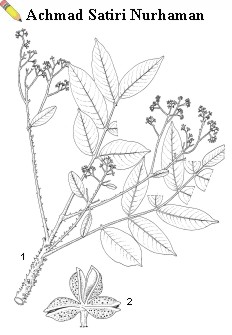 | Zanthoxylum myriacanthum Wallich ex Hook. f. – 1, flowering twig; 2, dehisced fruit. |
Ecology
The timber-yielding Zanthoxylum species are found in primary and secondary forest and thickets, up to 2100 m altitude. Z. myriacanthum is locally common in secondary forest and thickets on hills and mountains. Z. rhetsa is generally found in rather dry, often monsoonal forest and thickets, up to 500 m altitude.
Silviculture and Management
Z. rhetsa can be planted in the open provided it is above 400 m altitude. At lower altitudes it will benefit from some shade. It is not resistant to fire.
Genetic Resources and Breeding
The narrow geographical distribution of some Zanthoxylum species may make them vulnerable to genetic erosion. The availability of Z. rhetsa in Bali is seriously reduced due to exploitation for the handicraft industry.
Prospects
The pale-coloured wood of Zanthoxylum has potential for decorative articles. Since there is no experience with planting Zanthoxylum, silvicultural information should be obtained through experimentation.
Literature
[70]Backer, C.A. & Bakhuizen van den Brink Jr., R.C., 1963-1968. Flora of Java. 3 volumes. Wolters-Noordhoff, Groningen.
[150]Brown, W.H., 1951-1957. Useful plants of the Philippines. Reprint of the 1941-1943 edition. 3 volumes. Technical Bulletin 10. Department of Agriculture and Natural Resources. Bureau of Printing, Manila. Vol. 1(1951) 590 pp., Vol. 2 (1954) 513 pp., Vol. 3 (1957) 507 pp.
[163]Burkill, I.H., 1966. A dictionary of the economic products of the Malay Peninsula. 2nd edition. Ministry of Agriculture and Co-operatives, Kuala Lumpur. Vol. 1 (A-H) pp. 1-1240. Vol. 2 (I-Z) pp. 1241-2444.
[209]Corner, E.J.H., 1988. Wayside trees of Malaya. 3rd edition. 2 volumes. The Malayan Nature Society, Kuala Lumpur. 774 pp.
[238]de Vogel, E.F., 1980. Seedlings of dicotyledons. Structure, development, types. Descriptions of 150 woody Malesian taxa. Pudoc, Wageningen. 465 pp.
[260]den Berger, L.G., 1926. Houtsoorten der cultuurgebieden van Java en Sumatra's oostkust [Tree species of the cultivated areas of Java and the east coast of Sumatra]. Mededeelingen No 13. Proefstation voor het Boschwezen, Buitenzorg. 186 pp.
[267]Desch, H.E., 1941-1954. Manual of Malayan timbers. Malayan Forest Records No 15. 2 volumes. Malaya Publishing House Ltd., Singapore. 762 pp.
[304]Eddowes, P.J., 1995-1997. The forests and timbers of Papua New Guinea. (unpublished data).
[410]Hartley, T.G., 1966. A revision of the Malesian species of Zanthoxylum (Rutaceae). Journal of the Arnold Arboretum 47: 171-221.
[412]Hartley, T.G., 1970. Additional notes on the Malesian species of Zanthoxylum (Rutaceae). Journal of the Arnold Arboretum 51: 423-426.
[436]Heyne, K., 1927. De nuttige planten van Nederlands-Indië [The useful plants of the Dutch East Indies]. 2nd edition, 3 volumes. Departement van Landbouw, Nijverheid en Handel in Nederlandsch-Indië. 1953 pp. (3rd edition, 1950. van Hoeve, 's-Gravenhage/Bandung. 1660 pp.).
[464]Ilic, J., 1990. The CSIRO macro key for hardwood identification. CSIRO, Highett. 125 pp.
[508]Joy, M.T. et al., 1986. Essential oil of Zanthoxylum rhetsa. Flavour and Fragrance Journal 1(4/5): 165-168.
[772]Meijer Drees, E., 1951. Distribution, ecology and silvicultural possibilities of the trees and shrubs from the savanna-forest region in eastern Sumbawa and Timor (Lesser Sunda Islands). Communication No 33. Forest Research Institute, Bogor. 145 pp.
[861]Oey Djoen Seng, 1951. De soortelijke gewichten van Indonesische houtsoorten en hun betekenis voor de praktijk [Specific gravity of Indonesian woods and its significance for practical use]. Rapport No 46. Bosbouwproefstation, Bogor. 183 pp.
[933]Research Institute of Wood Industry, 1988. Identification, properties and uses of some Southeast Asian woods. Chinese Academy of Forestry, Wan Shou Shan, Beijing & International Tropical Timber Organization, Yokohama. 201 pp.
[934]Reyes, L.J., 1938. Philippine woods. Technical Bulletin No 7. Commonwealth of the Philippines, Department of Agriculture and Commerce. Bureau of Printing, Manila. 536 pp. + 88 plates.
[955]Rocafort, J.E., Floresca, A.R. & Siopongco, J.O., 1971. Fourth progress report on the specific gravity of Philippine woods. Philippine Architecture, Engineering & Construction Report 18(5): 17-27.
[968]Rulliaty, S., 1988. Kayu panggal buaya (Zanthoxylum rhetsa (Roxb.) DC.) sebagai kayu perpatungan [Panggal buaya wood (Zanthoxylum rhetsa (Roxb.) DC.) for wood carving]. Jurnal Penelitian dan Pengembangan Kehutanan 4: 26-29.
[974]Salvosa, F.M., 1963. Lexicon of Philippine trees. Bulletin No 1. Forest Products Research Institute, College, Laguna. 136 pp.
[1038]Smitinand, T., 1980. Thai plant names. Royal Forest Department, Bangkok. 379 pp.
[1048]Soepadmo, E., Wong, K.M. & Saw, L.G. (Editors), 1995-. Tree flora of Sabah and Sarawak. Sabah Forestry Department, Forest Research Institute Malaysia and Sarawak Forestry Department, Kepong.
[1089]Tantra, I.G.M., 1987. Kayu kurang dikenal yang mungkin dipasarkan di Bali untuk kerajinan [The possibilities for marketing lesser-known tree species in Bali for handicrafts]. In: Soemarna, K. et al. (Editors): Prosiding diskusi pemanfaatan kayu kurang dikenal, 13-14 Januari 1987, Cisarua, Bogor. Badan Penelitian dan Pengembangan Kehutanan, Bogor. pp. 335-336.
[1090]Tavita, Y.L. & Palisoc, J.G., 1979. Morphological characteristics of some Philippine hardwoods and other plant fibres. Forpride Digest 8(3-4): 31-47.
[1169]Vidal, J., 1962. Noms vernaculaires de plantes en usage au Laos [Vernacular names of plants used in Laos]. Ecole française d'Extrême-Orient, Paris. 197 pp.
[1183]Waterman, P.G., 1977. A review of the chemosystematics of the genus Zanthoxylum L. (Rutaceae). In: Stone, B.C. (Editor): The role and goals of tropical botanic gardens: proceedings of a symposium held at the Rimba Ilmu Botanic Garden of the University of Malaya, Kuala Lumpur, Malaysia. Penerbit Universiti Malaya, Kuala Lumpur. pp. 109–129.
[1221]Whitmore, T.C. & Ng, F.S.P. (Editors), 1972-1989. Tree flora of Malaya. A manual for foresters. 4 volumes. Malayan Forest Records No 26. Longman Malaysia Sdn. Berhad, Kuala Lumpur & Petaling Jaya.
[1242]Wong, T.M., 1982. A dictionary of Malaysian timbers. Malayan Forest Records No 30. Forest Research Institute Malaysia, Kepong. 259 pp.
[150]Brown, W.H., 1951-1957. Useful plants of the Philippines. Reprint of the 1941-1943 edition. 3 volumes. Technical Bulletin 10. Department of Agriculture and Natural Resources. Bureau of Printing, Manila. Vol. 1(1951) 590 pp., Vol. 2 (1954) 513 pp., Vol. 3 (1957) 507 pp.
[163]Burkill, I.H., 1966. A dictionary of the economic products of the Malay Peninsula. 2nd edition. Ministry of Agriculture and Co-operatives, Kuala Lumpur. Vol. 1 (A-H) pp. 1-1240. Vol. 2 (I-Z) pp. 1241-2444.
[209]Corner, E.J.H., 1988. Wayside trees of Malaya. 3rd edition. 2 volumes. The Malayan Nature Society, Kuala Lumpur. 774 pp.
[238]de Vogel, E.F., 1980. Seedlings of dicotyledons. Structure, development, types. Descriptions of 150 woody Malesian taxa. Pudoc, Wageningen. 465 pp.
[260]den Berger, L.G., 1926. Houtsoorten der cultuurgebieden van Java en Sumatra's oostkust [Tree species of the cultivated areas of Java and the east coast of Sumatra]. Mededeelingen No 13. Proefstation voor het Boschwezen, Buitenzorg. 186 pp.
[267]Desch, H.E., 1941-1954. Manual of Malayan timbers. Malayan Forest Records No 15. 2 volumes. Malaya Publishing House Ltd., Singapore. 762 pp.
[304]Eddowes, P.J., 1995-1997. The forests and timbers of Papua New Guinea. (unpublished data).
[410]Hartley, T.G., 1966. A revision of the Malesian species of Zanthoxylum (Rutaceae). Journal of the Arnold Arboretum 47: 171-221.
[412]Hartley, T.G., 1970. Additional notes on the Malesian species of Zanthoxylum (Rutaceae). Journal of the Arnold Arboretum 51: 423-426.
[436]Heyne, K., 1927. De nuttige planten van Nederlands-Indië [The useful plants of the Dutch East Indies]. 2nd edition, 3 volumes. Departement van Landbouw, Nijverheid en Handel in Nederlandsch-Indië. 1953 pp. (3rd edition, 1950. van Hoeve, 's-Gravenhage/Bandung. 1660 pp.).
[464]Ilic, J., 1990. The CSIRO macro key for hardwood identification. CSIRO, Highett. 125 pp.
[508]Joy, M.T. et al., 1986. Essential oil of Zanthoxylum rhetsa. Flavour and Fragrance Journal 1(4/5): 165-168.
[772]Meijer Drees, E., 1951. Distribution, ecology and silvicultural possibilities of the trees and shrubs from the savanna-forest region in eastern Sumbawa and Timor (Lesser Sunda Islands). Communication No 33. Forest Research Institute, Bogor. 145 pp.
[861]Oey Djoen Seng, 1951. De soortelijke gewichten van Indonesische houtsoorten en hun betekenis voor de praktijk [Specific gravity of Indonesian woods and its significance for practical use]. Rapport No 46. Bosbouwproefstation, Bogor. 183 pp.
[933]Research Institute of Wood Industry, 1988. Identification, properties and uses of some Southeast Asian woods. Chinese Academy of Forestry, Wan Shou Shan, Beijing & International Tropical Timber Organization, Yokohama. 201 pp.
[934]Reyes, L.J., 1938. Philippine woods. Technical Bulletin No 7. Commonwealth of the Philippines, Department of Agriculture and Commerce. Bureau of Printing, Manila. 536 pp. + 88 plates.
[955]Rocafort, J.E., Floresca, A.R. & Siopongco, J.O., 1971. Fourth progress report on the specific gravity of Philippine woods. Philippine Architecture, Engineering & Construction Report 18(5): 17-27.
[968]Rulliaty, S., 1988. Kayu panggal buaya (Zanthoxylum rhetsa (Roxb.) DC.) sebagai kayu perpatungan [Panggal buaya wood (Zanthoxylum rhetsa (Roxb.) DC.) for wood carving]. Jurnal Penelitian dan Pengembangan Kehutanan 4: 26-29.
[974]Salvosa, F.M., 1963. Lexicon of Philippine trees. Bulletin No 1. Forest Products Research Institute, College, Laguna. 136 pp.
[1038]Smitinand, T., 1980. Thai plant names. Royal Forest Department, Bangkok. 379 pp.
[1048]Soepadmo, E., Wong, K.M. & Saw, L.G. (Editors), 1995-. Tree flora of Sabah and Sarawak. Sabah Forestry Department, Forest Research Institute Malaysia and Sarawak Forestry Department, Kepong.
[1089]Tantra, I.G.M., 1987. Kayu kurang dikenal yang mungkin dipasarkan di Bali untuk kerajinan [The possibilities for marketing lesser-known tree species in Bali for handicrafts]. In: Soemarna, K. et al. (Editors): Prosiding diskusi pemanfaatan kayu kurang dikenal, 13-14 Januari 1987, Cisarua, Bogor. Badan Penelitian dan Pengembangan Kehutanan, Bogor. pp. 335-336.
[1090]Tavita, Y.L. & Palisoc, J.G., 1979. Morphological characteristics of some Philippine hardwoods and other plant fibres. Forpride Digest 8(3-4): 31-47.
[1169]Vidal, J., 1962. Noms vernaculaires de plantes en usage au Laos [Vernacular names of plants used in Laos]. Ecole française d'Extrême-Orient, Paris. 197 pp.
[1183]Waterman, P.G., 1977. A review of the chemosystematics of the genus Zanthoxylum L. (Rutaceae). In: Stone, B.C. (Editor): The role and goals of tropical botanic gardens: proceedings of a symposium held at the Rimba Ilmu Botanic Garden of the University of Malaya, Kuala Lumpur, Malaysia. Penerbit Universiti Malaya, Kuala Lumpur. pp. 109–129.
[1221]Whitmore, T.C. & Ng, F.S.P. (Editors), 1972-1989. Tree flora of Malaya. A manual for foresters. 4 volumes. Malayan Forest Records No 26. Longman Malaysia Sdn. Berhad, Kuala Lumpur & Petaling Jaya.
[1242]Wong, T.M., 1982. A dictionary of Malaysian timbers. Malayan Forest Records No 30. Forest Research Institute Malaysia, Kepong. 259 pp.
Author(s)
E. Boer (general part), M.S.M. Sosef (general part, selection of species), J. Ilic (wood anatomy)
Zanthoxylum celebicum
Zanthoxylum integrifoliolum
Zanthoxylum myriacanthum
Zanthoxylum pluviatile
Zanthoxylum rhetsa
Zanthoxylum integrifoliolum
Zanthoxylum myriacanthum
Zanthoxylum pluviatile
Zanthoxylum rhetsa
Correct Citation of this Article
Boer, E., Sosef, M.S.M. & Ilic, J., 1998. Zanthoxylum L.. In: Sosef, M.S.M., Hong, L.T. and Prawirohatmodjo, S. (Editors): Plant Resources of South-East Asia No 5(3): Timber trees; Lesser-known timbers. PROSEA Foundation, Bogor, Indonesia. Database record: prota4u.org/prosea
Selection of Species
The following species in this genus are important in this commodity group and are treated separatedly in this database:
Zanthoxylum celebicum
Zanthoxylum integrifoliolum
Zanthoxylum myriacanthum
Zanthoxylum pluviatile
Zanthoxylum rhetsa
Zanthoxylum celebicum
Zanthoxylum integrifoliolum
Zanthoxylum myriacanthum
Zanthoxylum pluviatile
Zanthoxylum rhetsa

All texts are licensed under a Creative Commons Attribution-Noncommercial-Share Alike 3.0 Netherlands License
This license does not include the illustrations (Maps,drawings,pictures); these remain all under copyright.