Record Number
6534
PROSEA Handbook Number
17: Fibre plants
Taxon
Cyperus L.
Protologue
Sp. pl.: 44 (1753); Gen. pl. ed. 5: 26 (1754).
Family
CYPERACEAE
Chromosome Numbers
x = 5, 8, 9, 11, 13, 19, 29; Cyperus papyrus: n = c. 50, 2n = c. 102; Cyperus procerus: n = 52, 2n = 18, 64
Major Taxa and Synonyms
Major species and synonyms
— Cyperus elatus L., Cent. pl. 2: 301 (1756), synonyms: Cyperus racemosus Retz. (1789), Cyperus scoparius Decne (1834), Cyperus bispicatus Steud. (1855).
— Cyperus malaccensis Lamk, Tabl. encycl. 1(1): 146 (1791), synonyms: Cyperus monophyllos Vahl (1806), Cyperus spaniophyllus Steud.(1855), Chlorocyperus malaccensis (Lamk) Palla (1912).
— Cyperus papyrus L., Sp. pl.: 47 (1753), synonyms: Papyrus antiquorum Willd. (1812), Papyrus domesticus Poir. ex Cuvier (1825), Chlorocyperus papyrus (L.) Rikli (1895).
— Cyperus procerus Rottb., Descr. icon. rar. pl.: 29, t. 5, f. 3 (1773), synonyms: Cyperus ornatus R. Br. (1810), Cyperus heynii Boeck. (1868).
— Cyperus elatus L., Cent. pl. 2: 301 (1756), synonyms: Cyperus racemosus Retz. (1789), Cyperus scoparius Decne (1834), Cyperus bispicatus Steud. (1855).
— Cyperus malaccensis Lamk, Tabl. encycl. 1(1): 146 (1791), synonyms: Cyperus monophyllos Vahl (1806), Cyperus spaniophyllus Steud.(1855), Chlorocyperus malaccensis (Lamk) Palla (1912).
— Cyperus papyrus L., Sp. pl.: 47 (1753), synonyms: Papyrus antiquorum Willd. (1812), Papyrus domesticus Poir. ex Cuvier (1825), Chlorocyperus papyrus (L.) Rikli (1895).
— Cyperus procerus Rottb., Descr. icon. rar. pl.: 29, t. 5, f. 3 (1773), synonyms: Cyperus ornatus R. Br. (1810), Cyperus heynii Boeck. (1868).
Vernacular Names
General: cyperus, nut grass, nut sedge (En).
— Cyperus elatus: Indonesia: wlingi (Javanese), lilisungan (Sundanese), tintilohuangga (northern Sulawesi). Philippines: kobong-kobong (Bisaya). Vietnam: c[os]i m[af]o.
— Cyperus malaccensis: Chinese mat grass (En). Indonesia: bundung (southern Kalimantan), darengdeng (Sundanese), pea-pea (Sulawesi). Malaysia: selimbu, menderong darat (Peninsular). Philippines: balangot (general), baga-as (Panay Bisaya), talaid (Bagobo). Thailand: yaa saam liam (Bangkok). Vietnam: c[os]i, c[aa]y c[os]i, l[as]c.
— Cyperus papyrus: papyrus, paper reed, Egyptian paper plant (En). Thailand: kok eeyip (Bangkok).
— Cyperus procerus: Indonesia: rumput adem (general). Malaysia: rumput mensiang. Thailand: kok ta krap (Bangkok), yaa ta krap (central).
— Cyperus elatus: Indonesia: wlingi (Javanese), lilisungan (Sundanese), tintilohuangga (northern Sulawesi). Philippines: kobong-kobong (Bisaya). Vietnam: c[os]i m[af]o.
— Cyperus malaccensis: Chinese mat grass (En). Indonesia: bundung (southern Kalimantan), darengdeng (Sundanese), pea-pea (Sulawesi). Malaysia: selimbu, menderong darat (Peninsular). Philippines: balangot (general), baga-as (Panay Bisaya), talaid (Bagobo). Thailand: yaa saam liam (Bangkok). Vietnam: c[os]i, c[aa]y c[os]i, l[as]c.
— Cyperus papyrus: papyrus, paper reed, Egyptian paper plant (En). Thailand: kok eeyip (Bangkok).
— Cyperus procerus: Indonesia: rumput adem (general). Malaysia: rumput mensiang. Thailand: kok ta krap (Bangkok), yaa ta krap (central).
Origin and Geographic Distribution
Cyperus comprises about 600 species, of which the majority occur in the tropics and subtropics. Most of the about 80 species found in South-East Asia have a pantropical or palaeotropical distribution. Cyperus elatus originated in Asia and is distributed from India to Indo-China, the Philippines and Indonesia. In South-East Asia it is common in Thailand, Cambodia, Vietnam, Peninsular Malaysia, Indonesia (Sumatra and Java), less common in the Lesser Sunda Islands, Borneo, Sulawesi and the Philippines, and absent in the Moluccas and New Guinea. Cyperus malaccensis, originating in Asia, is distributed from Iraq through India to southern China, northern Australia and Polynesia and is common throughout South-East Asia. It is cultivated as a matting sedge in northern Sulawesi, the Sangir Islands, and in Brazil. Cyperus papyrus originated in Central Africa and has spread over tropical Africa between 13°N and 26°S (including Madagascar). It has been cultivated in Egypt and neighbouring areas since ancient times and is sometimes naturalized in the Mediterranean area (Israel, Sicily). Nowadays it is rarely cultivated as a fibre plant, but it is widely grown as an ornamental, for instance in Java. The origin of Cyperus procerus is unknown. It is distributed from India, Sri Lanka and Nepal through South-East Asia to eastern China, Taiwan and Australia (Queensland). In Malesia it occurs in Peninsular Malaysia, Java, Borneo, the lesser Sunda Islands and the Philippines (Luzon), but it is not common.
Uses
The stems of Cyperus elatus serve in Indonesia for weaving hats (Java) and mats (Sulawesi). The stems of Cyperus malaccensis are often and widely used in South-East Asia for tying and for weaving mats, baskets and hats. In some towns on Luzon (the Philippines) slippers are made from them. In Central Java (Indonesia) the stems are plaited into ropes by fishermen to attract young fish, which are caught and placed in fishponds. In India Cyperus malaccensis is used for weaving mats, hats and baskets; it is also woven into mats in China and Taiwan. The tough stems of Cyperus procerus are split into three to serve as string or binder twine, e.g. in Java.
The pith of the stem of Cyperus papyrus was used by early civilizations (Egyptians, Greeks, Romans) to make a primitive form of paper, and the plant was cultivated for this purpose in the Egyptian Nile delta, Palestine and southern Europe. It was already in use by 3500 BC and fragments of papyrus sheets dated at 4600 years old have been found. The fibrous outer parts of the stem were used in ancient Egypt for making ropes, baskets, nets, sails, mats, sandals and furniture coverings. The stems were also made into boats and dried plant material served as fuel. Nowadays it is only cultivated on a small scale and used locally for mat-making and similar purposes. It is considered a potential raw material for the production of paper and board, though pulping experiments carried out in the 1920s and 1950s gave unsatisfactory results. Around 1920, a papyrus-based pulping mill operated for a short time in South Africa.
The rhizomes of Cyperus malaccensis are used medicinally in Vietnam for post-partum treatment and against oedemas; they are considered to be diuretic. The stems and rhizomes of Cyperus papyrus are edible. Cyperus elatus and Cyperus papyrus are eaten by cattle. Experiments indicate that the high biomass production of Cyperus papyrus makes it effective in removing N and P from wastewater and eutrophic pond water. Many Cyperus are considered weeds in rice fields, though they also provide green manure.
The pith of the stem of Cyperus papyrus was used by early civilizations (Egyptians, Greeks, Romans) to make a primitive form of paper, and the plant was cultivated for this purpose in the Egyptian Nile delta, Palestine and southern Europe. It was already in use by 3500 BC and fragments of papyrus sheets dated at 4600 years old have been found. The fibrous outer parts of the stem were used in ancient Egypt for making ropes, baskets, nets, sails, mats, sandals and furniture coverings. The stems were also made into boats and dried plant material served as fuel. Nowadays it is only cultivated on a small scale and used locally for mat-making and similar purposes. It is considered a potential raw material for the production of paper and board, though pulping experiments carried out in the 1920s and 1950s gave unsatisfactory results. Around 1920, a papyrus-based pulping mill operated for a short time in South Africa.
The rhizomes of Cyperus malaccensis are used medicinally in Vietnam for post-partum treatment and against oedemas; they are considered to be diuretic. The stems and rhizomes of Cyperus papyrus are edible. Cyperus elatus and Cyperus papyrus are eaten by cattle. Experiments indicate that the high biomass production of Cyperus papyrus makes it effective in removing N and P from wastewater and eutrophic pond water. Many Cyperus are considered weeds in rice fields, though they also provide green manure.
Production and International Trade
No production or trade statistics for Cyperus are available. In the past (1200 AD), mats made from Cyperus elatus were traded from Java to China. At the present time mats and other products from Cyperus malaccensis are made in Vietnam for export, but quantities are unknown.
Properties
Cyperus malaccensis has been said to provide very good matting material, but mats made from it have also been described as less durable than those made from Fimbristylis umbellaris (Lamk) Vahl and as much more brittle than those of Lepironia articulata (Retz.) Domin. The character of weaving material from Cyperus malaccensis largely depends on the preparation method. The 3-sided stems may be split and the sides pulled apart, or just one side may be removed. If only a little pulp is removed, the straw is thick and soft, but if much is removed and the straw is finely split, the straw is thin and fine.
Papyrus fibre cells are (1—)1.8(—4) mm long and (8—)12(—25) µm wide. They are narrow, thick-walled and have pointed ends. Investigations in the early 20th Century showed that papyrus stems from Egypt provided a moderate pulp yield of fair quality, but the pulp was difficult to bleach. Experiments with Cyperus papyrus in South Africa gave pulp yields of 45—48%. Because the stems have no nodes, the pulp does not contain hard particles, and even rayon-grade pulp has been produced from papyrus. However, the pith must be removed; it does not add strength to the paper but uses pulping chemicals and makes washing and forming of the paper difficult. The pith is not a problem for the production of hardboard. More recently it has been found that the major pulping chemicals successfully pulp papyrus and the pulp can be bleached under conditions similar to those required for rice straw. The resulting pulp can be used as the main constituent of writing and printing papers, but not for wrapping paper.
Vietnamese Cyperus malaccensis rhizomes were found to contain approximately 3.1% tannin, 0.7% flavonoids, 0.5% essential oil and 0.5% alkaloids. In a Kenyan study the crude protein content of papyrus umbels decreased from 11% (juvenile) to 4% (dead) and that of culms from 4% to 2%. The ruminal dry matter digestibility of the umbels decreased from 38% to 13% and that of the culms from 46% to 3%.
Papyrus fibre cells are (1—)1.8(—4) mm long and (8—)12(—25) µm wide. They are narrow, thick-walled and have pointed ends. Investigations in the early 20th Century showed that papyrus stems from Egypt provided a moderate pulp yield of fair quality, but the pulp was difficult to bleach. Experiments with Cyperus papyrus in South Africa gave pulp yields of 45—48%. Because the stems have no nodes, the pulp does not contain hard particles, and even rayon-grade pulp has been produced from papyrus. However, the pith must be removed; it does not add strength to the paper but uses pulping chemicals and makes washing and forming of the paper difficult. The pith is not a problem for the production of hardboard. More recently it has been found that the major pulping chemicals successfully pulp papyrus and the pulp can be bleached under conditions similar to those required for rice straw. The resulting pulp can be used as the main constituent of writing and printing papers, but not for wrapping paper.
Vietnamese Cyperus malaccensis rhizomes were found to contain approximately 3.1% tannin, 0.7% flavonoids, 0.5% essential oil and 0.5% alkaloids. In a Kenyan study the crude protein content of papyrus umbels decreased from 11% (juvenile) to 4% (dead) and that of culms from 4% to 2%. The ruminal dry matter digestibility of the umbels decreased from 38% to 13% and that of the culms from 46% to 3%.
Description
Perennial or annual herbs, tufted or with creeping rhizome or stolons, sometimes with tubers; stem (culm) usually erect, solid, triangular (sometimes terete) in cross-section, usually leafy at the base only. Leaves in 3 vertical ranks, narrowly linear, grass-like, rarely lanceolate or elliptic, the lower ones often scale-like, covering the base of the stem and the rhizome, rarely all reduced to sheaths only. Inflorescence terminal, often anthelate, simple to decompound, umbel-like or umbellate, not rarely capitate by suppression of the rays; rays subtended by a leaf-like bract similar to the leaves, the base enclosed in a tubular, two-keeled prophyll, the bracts usually approximate as though forming an involucre; spikelets subcompressed, quadrangular to subterete, 1—many-flowered; axis (rachilla) often winged by the decurrent base of the glumes, persistent or caducous (in the latter case spikelet falling as a whole); glumes distichous, usually 2 basal ones empty; flowers usually bisexual, the uppermost in a spikelet often male or sterile; stamens 1—3; style continuous with the ovary and ending in 2—3 stigmas. Fruit a sessile or short-stalked nut, trigonous or lenticular.
— Cyperus elatus. A perennial herb with very short rhizome; stems tufted, tall, 0.5—1(—2) m x 3—10 mm, smooth. Leaves flat or somewhat plicate with midrib prominent beneath and 2 lateral veins strongly marked above; lower sheaths black-purplish; blade 4—10(—15) mm wide, bright green above. Inflorescence up to 30 cm in diameter, compound; involucral bracts 4—8, up to 75 cm long, overtopping the inflorescence; primary rays up to 10, unequal, up to 20 cm long; secondary rays 2—5 cm long; spikes digitately arranged, 2—7 cm x 3—5 mm; spikelets 6—16-flowered, 3—6 mm x 1 mm; glumes ovate, 1.2—1.8 mm x 1 mm, 3—5-veined, mucronulate; stamens 3; stigmas 3. Nut trigonous-ellipsoid, up to 0.9 mm x 0.4 mm, yellow-grey-brown.
— Cyperus malaccensis. A perennial herb with stout stolons and woody rhizome; stems approximate, robust, 60—175 cm x 12—15 mm, spongious, triangular with concave sides, smooth. Lower leaves reduced to spongious sheaths up to 20 cm long, upper ones much shorter than the stem but with small blade 5—10(—18) mm wide and abruptly acuminate. Inflorescence broader than long, about 15 cm in diameter; involucral bracts 3—4, flat, erect to reflexed, up to 30 cm x 8—15 mm, overtopping the inflorescence; primary rays 3—6(—10), spreading, unequal, 3—10 cm long; secondary rays slender, about 2 cm long; spikes broadly ovoid in outline with 6—12, spicately arranged spikelets; spikelet subcylindrical, 1—3 cm x 1.2—1.7 cm, with 16—20(—40) flowers; glumes chartaceous, ovate to elliptic, up to 2.2 mm x 1.5 mm, indistinctly 5—7-veined; stamens 3; stigmas 3. Nut trigonous-cylindrical, about 2 mm x 0.5 mm, brown-black.
— Cyperus papyrus. A perennial herb with coarse, short rhizome; stems up to 5 m tall, trigonous, pithy, clothed at base with brown bladeless sheaths. Leaves only with small blade up to 1 cm wide in sterile shoots. Inflorescence umbelliform, 20—35 cm in diameter; involucral bracts up to 12, lanceolate, much shorter than the inflorescence; primary rays numerous, slender, suberect, subequal, 10—30 cm long; secondary rays up to 5 cm long; spikes 1—3 cm x 6—10 mm, bearing distichously many spikelets; spikelet cylindrical, 6—12 mm x 1 mm, 5—17-flowered; glumes ovate-elliptic, 2 mm long, 3-veined green keel, light brown; stamens 3; stigmas 3. Nut trigonous-cylindrical, about 1 mm long.
— Cyperus procerus. A perennial herb with stoloniferous rhizome; stems stout, 70—125(—175) cm x 0.5—1 cm, smooth, at base clothed with brown to purplish sheaths. Leaves firm, spongious or coriaceous, oblong-canaliculate, 9—15 mm wide, gradually acuminate at apex. Inflorescence subcompound, loose, 10—15 cm long; involucral bracts 3—4, erect to spreading, up to 70 cm long, the larger ones far overtopping the inflorescence; primary rays 3—7, unequal, 6—20 cm long, spreading; secondary rays absent to very short; spikes broadly ovoid, 2—4 cm long and wide, loose; spikelets up to 10—18 in the terminal spike, 3—4 in the lateral ones, spicately arranged, lower ones at right angles to the rachis, 10—35 mm x 2—3 mm, up to 40-flowered; glumes ovate to elliptic, 2.5—3 mm x 2 mm, hardly keeled, 7-veined, red-brown; stamens 3; stigmas 3. Nut obovoid to ellipsoid, triangular, 1.5 mm x 0.8 mm, black-brown.
— Cyperus elatus. A perennial herb with very short rhizome; stems tufted, tall, 0.5—1(—2) m x 3—10 mm, smooth. Leaves flat or somewhat plicate with midrib prominent beneath and 2 lateral veins strongly marked above; lower sheaths black-purplish; blade 4—10(—15) mm wide, bright green above. Inflorescence up to 30 cm in diameter, compound; involucral bracts 4—8, up to 75 cm long, overtopping the inflorescence; primary rays up to 10, unequal, up to 20 cm long; secondary rays 2—5 cm long; spikes digitately arranged, 2—7 cm x 3—5 mm; spikelets 6—16-flowered, 3—6 mm x 1 mm; glumes ovate, 1.2—1.8 mm x 1 mm, 3—5-veined, mucronulate; stamens 3; stigmas 3. Nut trigonous-ellipsoid, up to 0.9 mm x 0.4 mm, yellow-grey-brown.
— Cyperus malaccensis. A perennial herb with stout stolons and woody rhizome; stems approximate, robust, 60—175 cm x 12—15 mm, spongious, triangular with concave sides, smooth. Lower leaves reduced to spongious sheaths up to 20 cm long, upper ones much shorter than the stem but with small blade 5—10(—18) mm wide and abruptly acuminate. Inflorescence broader than long, about 15 cm in diameter; involucral bracts 3—4, flat, erect to reflexed, up to 30 cm x 8—15 mm, overtopping the inflorescence; primary rays 3—6(—10), spreading, unequal, 3—10 cm long; secondary rays slender, about 2 cm long; spikes broadly ovoid in outline with 6—12, spicately arranged spikelets; spikelet subcylindrical, 1—3 cm x 1.2—1.7 cm, with 16—20(—40) flowers; glumes chartaceous, ovate to elliptic, up to 2.2 mm x 1.5 mm, indistinctly 5—7-veined; stamens 3; stigmas 3. Nut trigonous-cylindrical, about 2 mm x 0.5 mm, brown-black.
— Cyperus papyrus. A perennial herb with coarse, short rhizome; stems up to 5 m tall, trigonous, pithy, clothed at base with brown bladeless sheaths. Leaves only with small blade up to 1 cm wide in sterile shoots. Inflorescence umbelliform, 20—35 cm in diameter; involucral bracts up to 12, lanceolate, much shorter than the inflorescence; primary rays numerous, slender, suberect, subequal, 10—30 cm long; secondary rays up to 5 cm long; spikes 1—3 cm x 6—10 mm, bearing distichously many spikelets; spikelet cylindrical, 6—12 mm x 1 mm, 5—17-flowered; glumes ovate-elliptic, 2 mm long, 3-veined green keel, light brown; stamens 3; stigmas 3. Nut trigonous-cylindrical, about 1 mm long.
— Cyperus procerus. A perennial herb with stoloniferous rhizome; stems stout, 70—125(—175) cm x 0.5—1 cm, smooth, at base clothed with brown to purplish sheaths. Leaves firm, spongious or coriaceous, oblong-canaliculate, 9—15 mm wide, gradually acuminate at apex. Inflorescence subcompound, loose, 10—15 cm long; involucral bracts 3—4, erect to spreading, up to 70 cm long, the larger ones far overtopping the inflorescence; primary rays 3—7, unequal, 6—20 cm long, spreading; secondary rays absent to very short; spikes broadly ovoid, 2—4 cm long and wide, loose; spikelets up to 10—18 in the terminal spike, 3—4 in the lateral ones, spicately arranged, lower ones at right angles to the rachis, 10—35 mm x 2—3 mm, up to 40-flowered; glumes ovate to elliptic, 2.5—3 mm x 2 mm, hardly keeled, 7-veined, red-brown; stamens 3; stigmas 3. Nut obovoid to ellipsoid, triangular, 1.5 mm x 0.8 mm, black-brown.
Image
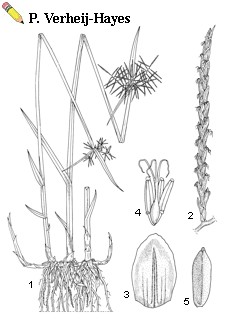 | Cyperus malaccensis Lamk — 1, habit; 2, spikelet; 3, dorsal view opened glume; 4, flower; 5, fruit |
Growth and Development
In Java Cyperus elatus, Cyperus malaccensis and Cyperus papyrus flower year-round. Natural propagation of Cyperus elatus is by the nuts, which are dispersed by water and birds. The nuts of Cyperus malaccensis and Cyperus procerus are dispersed. Some Cyperus species are known to have C4-photosynthesis, whereas others have C3-photosynthesis. Cyperus papyrus has C4-photosynthesis, which contributes to its exceptionally high productivity. The culms have numerous large intercellulair air cavities and 'Krantz' chlorenchyma, which are involved in CO2-recycling. Under natural conditions average annual growth rates up to about 40 g/m2 dry weight per day have been recorded, and in hydroponic culture short-term growth rates up to 125 g/m2 dry weight per day are possible. In Lake Naivasha, Kenya, the total standing biomass was found to be 7.8 kg/m2 dry weight. Of this total biomass 57% was located in the rhizome, 29% in the culms, 13% in the umbels, and 1% in the roots. The majority of Cyperus papyrus umbels do not produce flowers, but the umbels are the principal photosynthetic tissue in mature plants. In a closed canopy the leaves senesce during early extension of the culms, but the leaves can be important for photosynthesis in plants that develop from seed or during regrowth after cutting or burning.
Other Botanical Information
Within the Cyperaceae, Cyperus is placed in the subfamily Cyperoideae and the tribe Cypereae, but there is no general agreement on the circumscription and subclassification of the genus. Some subdivide it into 3 subgenera (Cyperus, Pycreus and Kyllingia), others into 2 subgenera (Cyperus and Anosporum) with Pycreus P. Beauv. and Kyllingia Rottb. as separate genera. The species treated here and most other Malesian Cyperus species are classified in the subgenus Cyperus, characterized by the Kranz syndrome and often spicately arranged spikelets.
In Cyperus procerus the rachis of the spikes is normally smooth, but in all Malesian specimens it is more or less scabrous hispid. The Malesian plants may therefore be referred to var. lasiorrhachis Clarke. In Cyperus malaccensis 2 subspecies have been distinguished:
— subsp. malaccensis: found from the Mediterranean to South-East Asia; lower leaf sheaths surpassing the inflorescence rays; uppermost leaf with an elongated blade; spikelets densely flowered with glumes not conspicuously incurved.
— subsp. monophyllus (Vahl) T. Koyama: occurring in China and the southern Ryukyu Islands; characteristics opposite to those mentioned above for subsp. malaccensis.
For several Cyperus species occurring in South-East Asia no reports exist on their use as a fibre plant in the Malesian region, whereas they are known to be used for weaving elsewhere. They include: Cyperus alopecuroides Rottb., used for mat-making in Egypt since ancient times; Cyperus cephalotes Vahl, made into mats in Japan; Cyperus compactus Retz. (synonyms: Cyperus dilutus Vahl, Mariscus microcephalus Presl), made into low-quality mats in Vietnam (Tonkin) and sometimes used for making roofs in Thailand; and Cyperus exaltatus Retz., used as a fibre plant and for making fine mats in Korea since ancient times. Cyperus corymbosus Rottb. (synonym Cyperus tegetiformis Roxb.), probably does not occur in Malesia, but it yields material for matting and strings in, for instance, Thailand, Indo-China, India and China.
In Cyperus procerus the rachis of the spikes is normally smooth, but in all Malesian specimens it is more or less scabrous hispid. The Malesian plants may therefore be referred to var. lasiorrhachis Clarke. In Cyperus malaccensis 2 subspecies have been distinguished:
— subsp. malaccensis: found from the Mediterranean to South-East Asia; lower leaf sheaths surpassing the inflorescence rays; uppermost leaf with an elongated blade; spikelets densely flowered with glumes not conspicuously incurved.
— subsp. monophyllus (Vahl) T. Koyama: occurring in China and the southern Ryukyu Islands; characteristics opposite to those mentioned above for subsp. malaccensis.
For several Cyperus species occurring in South-East Asia no reports exist on their use as a fibre plant in the Malesian region, whereas they are known to be used for weaving elsewhere. They include: Cyperus alopecuroides Rottb., used for mat-making in Egypt since ancient times; Cyperus cephalotes Vahl, made into mats in Japan; Cyperus compactus Retz. (synonyms: Cyperus dilutus Vahl, Mariscus microcephalus Presl), made into low-quality mats in Vietnam (Tonkin) and sometimes used for making roofs in Thailand; and Cyperus exaltatus Retz., used as a fibre plant and for making fine mats in Korea since ancient times. Cyperus corymbosus Rottb. (synonym Cyperus tegetiformis Roxb.), probably does not occur in Malesia, but it yields material for matting and strings in, for instance, Thailand, Indo-China, India and China.
Ecology
Most Cyperus species are hygrophilous, growing in moist localities at low to medium altitudes, with only a few at altitudes higher than 1600 m. Cyperus procerus, and especially Cyperus malaccensis, prefer muddy habitats within the influence of salt or brackish water. Cyperus elatus grows on riverbanks, in swamps, rice fields and meadows, and other open wet locations up to 700(—1000) m altitude. Cyperus malaccensis is found, often abundantly, in moist habitats, usually within the influence of salt or brackish water (muddy estuaries, mud flats and sandy foreshores covered by spring tides) and often forming a dense fringe vegetation. Cyperus procerus grows in open, wet locations, like swamps and pools, often near the sea in brackish localities, and in wet rice fields, usually up to 50 m altitude, but also near Bogor (West Java) at 250 m altitude. In Indonesia Cyperus elatus, Cyperus malaccensis and Cyperus procerus are considered weeds of minor importance in rice fields. They can be controlled by manual weeding.
Cyperus papyrus is the dominant species in most African permanent swamps. It is adversely affected by seasonal flooding regimes exceeding 3—4 m in amplitude, flash flooding or very low water levels during the dry season. Papyrus is sometimes considered a nuisance, forming floating islands that obstruct navigation and water flow.
Cyperus papyrus is the dominant species in most African permanent swamps. It is adversely affected by seasonal flooding regimes exceeding 3—4 m in amplitude, flash flooding or very low water levels during the dry season. Papyrus is sometimes considered a nuisance, forming floating islands that obstruct navigation and water flow.
Propagation and planting
Cyperus can generally be propagated by seed, division, and cuttings. The seed of Cyperus papyrus needs light to germinate. Tuber-forming Cyperus are easily propagated by tubers.
Diseases and Pests
In Peninsular Malaysia, Cyperus is susceptible to attack by smut fungi (Ustilago spp.). In southern China (Guangxi) Cyperus malaccensis blight, caused by Phytophthora cyperi, occurs widely.
The stem borer Schoenobius ochraceellus has been recorded on Cyperus elatus and Cyperus procerus in Indonesia, mostly in the subterranean stem parts.
The stem borer Schoenobius ochraceellus has been recorded on Cyperus elatus and Cyperus procerus in Indonesia, mostly in the subterranean stem parts.
Harvesting
The stems of Cyperus malaccensis are cut when flowering starts.
Yield
No information is available on Cyperus yields in South-East Asia. The annual aboveground production of Cyperus papyrus in Lake Naivasha swamp in Kenya has been estimated at about 50 t/ha dry matter per year.
Handling After Harvest
In processing Cyperus malaccensis stems in Indonesia, one of the ribs is removed and the remaining stem is dried in the sun for 3 days. Then the stems are spread out indoors for 24 hours to become supple, after which they are smoothed with a piece of bamboo. In the Philippines whole stems are plaited into coarse matting, whereas fine matting is made by splitting the stems before drying. Splitting preferably is done when the stems are fresh and in any case before they are dry. The strips may be placed in the sun for a first quick drying. After this, the straw finishes drying in the shade. The resulting unbleached, light green-coloured straw is ready for use, but it may also be whitened and toughened by keeping it damp in the sun for several days. If it dries completely in the sun, it becomes brittle. For mat-making in Gorontalo (Sulawesi) Cyperus elatus stems are split into three and the strips are smoothed with a piece of wood. In Vietnam the stems are split and dried in the sun.
In ancient Egypt Cyperus papyrus was probably made into writing material by stripping the fibrous outer parts from the stems and slitting the inner pith into strips. These strips were laid side by side, with a second layer of strips placed crosswise on top, dampened, pressed, dried in the sun, and polished.
In ancient Egypt Cyperus papyrus was probably made into writing material by stripping the fibrous outer parts from the stems and slitting the inner pith into strips. These strips were laid side by side, with a second layer of strips placed crosswise on top, dampened, pressed, dried in the sun, and polished.
Genetic Resources and Breeding
No germplasm collections or breeding programmes of Cyperus elatus, Cyperus malaccensis, Cyperus papyrus and Cyperus procerus are known to exist.
Prospects
Based on their traditional use by local people, Cyperus elatus, Cyperus malaccensis and Cyperus procerus will remain of local importance as sources of weaving and binding material in South-East Asia. Cyperus papyrus has a high productivity and may have some potential as a raw material for papermaking.
Literature
Abe, K., Ozaki, Y. & Mizuta, K., 1999. Evaluation of useful plants for the treatment of polluted pond water with low N and P concentrations. Soil Science and Plant Nutrition 45(2): 409—417.
Anonymous, 1976. Making aquatic weeds useful: some perspectives for developing countries. National Academy of Sciences, Washington, D.C., United States. pp. 102—104.
Jones, M.B. & Muthuri, E.M., 1997. Standing biomass and carbon distribution in a papyrus (Cyperus papyrus L.) swamp on Lake Naivasha, Kenya. Journal of Tropical Ecology 13(3): 347—356.
Kern, J.H., 1974. Cyperaceae. In: van Steenis, C.G.G.J. (Editor): Flora Malesiana. Series 1, Vol. 7(3). Noordhoff International Publishing, Leiden, the Netherlands. pp. 592—661.
Kostermans, A.J.G.H., Wirjahardja, S. & Dekker, R.J., 1987. The weeds: description, ecology and control. In: Soerjani, M., Kostermans, A.J.G.H. & Tjitrosoepomo, G. (Editors): Weeds of rice in Indonesia. Balai Pustaka, Jakarta, Indonesia. pp. 24—565.
Muthuri, F.M., Jones, M.B. & Imbamba, S.K., 1989. Primary productivity of papyrus (Cyperus papyrus) in tropical swamp; Lake Naivasha, Kenya. Biomass 18(1): 1—14.
Nguyen Khac Khoi, 1999. Cyperus L. In: de Padua, L.S., Bunyapraphatsara, N. & Lemmens, R.M.H.J. (Editors): Plant Resources of South-East Asia No 12(1). Medicinal and poisonous plants 1. Backhuys Publishers, Leiden, the Netherlands. pp. 222—229.
Thompson, K., Shewry, P.R. & Woolhouse, H.W., 1979. Papyrus swamp development in Upemba Basin, Zaire: studies of population structure in Cyperus papyrus stands. Botanical Journal of the Linnean Society 78(4): 299—316.
Anonymous, 1976. Making aquatic weeds useful: some perspectives for developing countries. National Academy of Sciences, Washington, D.C., United States. pp. 102—104.
Jones, M.B. & Muthuri, E.M., 1997. Standing biomass and carbon distribution in a papyrus (Cyperus papyrus L.) swamp on Lake Naivasha, Kenya. Journal of Tropical Ecology 13(3): 347—356.
Kern, J.H., 1974. Cyperaceae. In: van Steenis, C.G.G.J. (Editor): Flora Malesiana. Series 1, Vol. 7(3). Noordhoff International Publishing, Leiden, the Netherlands. pp. 592—661.
Kostermans, A.J.G.H., Wirjahardja, S. & Dekker, R.J., 1987. The weeds: description, ecology and control. In: Soerjani, M., Kostermans, A.J.G.H. & Tjitrosoepomo, G. (Editors): Weeds of rice in Indonesia. Balai Pustaka, Jakarta, Indonesia. pp. 24—565.
Muthuri, F.M., Jones, M.B. & Imbamba, S.K., 1989. Primary productivity of papyrus (Cyperus papyrus) in tropical swamp; Lake Naivasha, Kenya. Biomass 18(1): 1—14.
Nguyen Khac Khoi, 1999. Cyperus L. In: de Padua, L.S., Bunyapraphatsara, N. & Lemmens, R.M.H.J. (Editors): Plant Resources of South-East Asia No 12(1). Medicinal and poisonous plants 1. Backhuys Publishers, Leiden, the Netherlands. pp. 222—229.
Thompson, K., Shewry, P.R. & Woolhouse, H.W., 1979. Papyrus swamp development in Upemba Basin, Zaire: studies of population structure in Cyperus papyrus stands. Botanical Journal of the Linnean Society 78(4): 299—316.
Author(s)
U.A. Dasuki
Correct Citation of this Article
Dasuki, U.A., 2003. Cyperus L.. In: Brink, M and Escobin, R.P. (Editors): Plant Resources of South-East Asia No 17: Fibre plants. PROSEA Foundation, Bogor, Indonesia. Database record: prota4u.org/prosea

All texts are licensed under a Creative Commons Attribution-Noncommercial-Share Alike 3.0 Netherlands License
This license does not include the illustrations (Maps,drawings,pictures); these remain all under copyright.