Record Number
6535
PROSEA Handbook Number
17: Fibre plants
Taxon
Donax canniformis (G. Forster) K. Schumann
Protologue
Bot. Jahrb. Syst. 15: 440 (1893).
Family
MARANTACEAE
Chromosome Numbers
2n = unknown
Synonyms
Thalia canniformis G. Forster (1780), Donax arundastrum Loureiro (1790), Donax grandis (Miq.) Ridley (1899), Donax cannaeformis (G. Forster) Rolfe (1907), Donax parviflorum Ridley (1910).
Vernacular Names
Brunei: bamban, bamban batu. Indonesia: bamban (Malay, Javanese, Sundanese), bangban (Sundanese), moa (Moluccas). Malaysia: bemban, bemban ayer, buluh leck (Kelabit). Philippines: bamban, banban (Tagalog, Ilokano, Bisaya, Manobo, Sulu, Bukidnon). Cambodia: daem run. Thailand: klah, blah, klum (central, Surat Thani, Trat). Vietnam: dong s[aaj]y.
Origin and Geographic Distribution
Donax canniformis is distributed from India throughout South-East Asia to southern China, Taiwan and Polynesia. Occasionally it is also cultivated.
Uses
Stem material of Donax canniformis is widely used in South-East Asia for the production of baskets, bags, mats and trays. In the Philippines, for instance, it is made into a wide range of articles, including hats, waste baskets, laundry baskets, flowerpot holders, trays, tables, magazine racks and bookshelves. The importance of Donax canniformis as a source of weaving material in South-East Asia seems to increase as rattans become scarcer, but products from Donax canniformis are generally of lesser quality than those made of rattans. Because they are usually not durable, baskets from Donax canniformis are often coarse, with on average wider strips than in rattan baskets. In Sarawak, however, fine patterned baskets such as wedding pouches ('sintong bangin') may occasionally be encountered. Throughout South-East Asia the stems of Donax canniformis are used for making fish traps, for stitching thatch and for other tying work. In Borneo they have been made into strings for musical instruments. The Semai in West Malaysia make blowpipe darts from the stem. The pith of the stem is used for paper making. The leaves are employed as cigarette paper in New Guinea.
In Indonesia the juice from young, uncurled leaves is used medicinally against eye disease, and that from young stems against snake bites. In the Philippines a decoction of the roots is considered an antidote against snake bites and blood poisoning, the juice from crushed roots is used against fungal infections and an infusion of young shoots is taken to lower fever.
Donax canniformis is also made into mats and baskets in the Andaman Islands (India) and into thread in the Solomon Islands. In India and on Martinique it is locally cultivated to obtain starch from the rhizome. The rhizomes are edible and sometimes used for making confectionery.
In Indonesia the juice from young, uncurled leaves is used medicinally against eye disease, and that from young stems against snake bites. In the Philippines a decoction of the roots is considered an antidote against snake bites and blood poisoning, the juice from crushed roots is used against fungal infections and an infusion of young shoots is taken to lower fever.
Donax canniformis is also made into mats and baskets in the Andaman Islands (India) and into thread in the Solomon Islands. In India and on Martinique it is locally cultivated to obtain starch from the rhizome. The rhizomes are edible and sometimes used for making confectionery.
Production and International Trade
Baskets and mats made of Donax canniformis are sold as handicrafts for tourists, but statistics are not available.
Properties
The stems of Donax canniformis yield several grades of strips, the best one being the outer layer ('peel'), which is green if the epidermis is not removed and light to dark brown if the epidermis is scraped off. It is thinner than rattan peel and less robust, breaking more easily when bent and splitting longitudinally when used. Furthermore it does not acquire any aesthetic qualities as it ages. Like rattan, it can be dyed, though it fails to achieve the same depth of colour. The best material comes from the main stem with its longer internodes.
Adulterations and Substitutes
As a source of weaving material, Donax canniformis may be replaced by rattans and various Cyperaceae, Palmae and Pandanaceae.
Description
A perennial, stout, tufted-rhizomatous, erect, shrub-like herb, 2—5 m tall, with true, slender, sympodially branching stems. Leaves all cauline, sheathed, thin-coriaceous; sheath up to 20 cm long; ligule very short; petiole 1—2.5 cm long, thickened into a cylindrical, pilose pulvinus; blade broadly ovate to elliptical, 10—45 cm x 4—25 cm, base rounded, apex acuminate, underside appressed-pilose along the midrib, lateral veins numerous, running parallel. Inflorescence terminal on a leafy branch, slenderly paniculate, up to 20 cm long, branched at base, partial inflorescences condensed cymose (spiciform) in the axils of primary bracts; bracts 9—11, distichous, obovate to lanceolate, 2.5—3.5 cm long, caducous; pedicel up to 5 mm long, thickened in fruit; flowers in pairs; bracteoles 2 per flower pair, glandular; sepals 3, free, triangular-ovate, 3—5 mm long, white, glabrous; corolla tubular and 3-lobed, tube 8—10 mm long, lobes linear, 1—1.5 cm x 2—3 mm; staminodes and stamen forming a tube 3—4 mm long; outer staminodes 2, petaloid, subequal, obovate, 12—14 mm x 5—6 mm, white; inner staminodes 2, unequal, yellowish; one is the fleshy (callose) staminode, petaloid, about 1.5 cm long, inside at base with a hairy thickened part, apex emarginate; the other one is the hooded (cucullate) staminode, about 1 cm long, enclosing the style and stigma in the hood and bearing a broad lateral lobe; fertile stamen 1, about 8 mm long with a narrowly triangular appendage; pistil with sericeous, 3-celled ovary; style and stigma held erect first by the hooded staminode, when released the upper part springing downwards to form an inverted U, the stigma resting on the callus of the fleshy staminode. Fruit globose to ellipsoid, 1—1.5 cm in diameter, dry, indehiscent, subglabrescent, whitish-cream, crowned by the withered flower, 1—2-seeded. Seed globose to ellipsoid, 7—8 mm in diameter, grooved, warty, brown.
Image
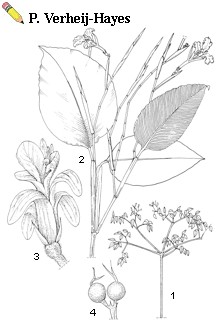 | Donax canniformis (G. Forster) K. Schumann - 1, habit; 2, flowering branch; 3, flower; 4, fruits |
Growth and Development
The stem of Donax canniformis rises in a single, cane-like internode from the ground to 2 m long or longer and then in a much shorter internode to the next leaf. Branching is sympodial throughout, with each axillary shoot bearing first a short 2-keeled sheath backing on to the main axis, then close to it an unkeeled bladeless sheath and a foliage leaf, then 1 or 2 more leaves separated by longer or shorter internodes and a terminal inflorescence. Donax canniformis flowers and fruits throughout the year in Java. In Indo-China it flowers from May to September and fruits in February.
Other Botanical Information
There is no general agreement on the number of species in Donax Lour., which, according to different opinions, ranges from 1 to 4. A revision of this genus, along with a group of closely related genera, is needed. There is general agreement that the Donax taxa are all closely related. Because information in the literature cannot be assigned with certainty to individual taxa (which are all similarly used), here a single wide species concept is followed. Taxa have been characterized as follows:
— Donax arundastrum Loureiro. Stem up to 3 m tall; leaf blade small, elliptical, 10—22 cm x 4—10 cm; fruit often trigonous and 3-seeded.
— Donax canniformis (G. Forster) K. Schumann (synonym: Donax cannaeformis (G. Forster) Rolfe). Stem up to 5 m tall; leaf blade ovate to elliptical, 10—45 cm x 10—25 cm; flowers large, rich in nectar; fruit globose, 1-seeded.
— Donax grandis (Miquel) Ridley. Stem up to 5 m tall; leaf blade up to 30 cm x 20 cm, widest near the base; flowers large and corolla tube much longer than the sepals; fruit globose, 1- but usually 2-seeded.
— Donax parviflorum Ridley. Stem short; leaf blade up to 20 cm x 9 cm, nearly elliptical; flowers small, poor in nectar, corolla tube shorter than the sepals; fruit 2-seeded and bilobed or globose and 1-seeded.
— Donax arundastrum Loureiro. Stem up to 3 m tall; leaf blade small, elliptical, 10—22 cm x 4—10 cm; fruit often trigonous and 3-seeded.
— Donax canniformis (G. Forster) K. Schumann (synonym: Donax cannaeformis (G. Forster) Rolfe). Stem up to 5 m tall; leaf blade ovate to elliptical, 10—45 cm x 10—25 cm; flowers large, rich in nectar; fruit globose, 1-seeded.
— Donax grandis (Miquel) Ridley. Stem up to 5 m tall; leaf blade up to 30 cm x 20 cm, widest near the base; flowers large and corolla tube much longer than the sepals; fruit globose, 1- but usually 2-seeded.
— Donax parviflorum Ridley. Stem short; leaf blade up to 20 cm x 9 cm, nearly elliptical; flowers small, poor in nectar, corolla tube shorter than the sepals; fruit 2-seeded and bilobed or globose and 1-seeded.
Ecology
In general Donax canniformis grows in wet locations, such as swamps and periodically flooded areas. In South-East Asia it occurs up to about 1000 m altitude in secondary forest, teak forest and bamboo forest, but also in coconut plantations and near paddy fields.
Propagation and planting
Though Donax canniformis is usually gathered from the wild, it is occasionally planted, for instance in Peninsular Malaysia, Sarawak and northern Sumatra. Information on planting and cultivation practices is, however, lacking.
Harvesting
The stems of Donax canniformis are usually gathered from the wild and sold. Quality is determined by dryness, colour and length. Harvested stems are usually several metres long, with a diameter of 1—3 cm.
Handling After Harvest
In Malaysia the outer layer of Donax canniformis is separated from the stem and split into long fibres, which are dried in the sun, after which they are ready for use. In Indonesia the green epidermis is scraped from the cut stems, which are dried and split, after which the soft inner layer is removed, leaving hard, shiny, thin strips. In the Philippines gathered stems are dried in the sun, after which they are split and the inner part of the stems is removed until the desired thickness is obtained.
Genetic Resources and Breeding
Donax canniformis does not seem threatened with extinction, though supply of stem material is decreasing and more uncertain locally in the Philippines. No germplasm collections or breeding activities of Donax canniformis are known to exist.
Prospects
Donax canniformis seems to be gradually replacing rattan in the handicraft or cottage industry, largely due to the destruction and decline of the primary jungle favoured by many of the rattan species. Because handicrafts made of Donax canniformis are less durable than those made from rattans, they are generally newer, which may also contribute to the impression that its use is increasing. An advantage of Donax canniformis is that it is easy to collect and prepare. Donax canniformis will probably not fully replace rattan, because some rattan species can be (and are) cultivated as well.
Literature
Blehaut, J.-F., 1994. Iban baskets. Sarawak Literary Society, Kuching, Sarawak, Malaysia. pp. 40—45.
Borboran, L.C., Pasig, S.D. & Dionglay, M.G., 1983. Bamban: another promising raw material for our cottage industry. Canopy International 9(3): 13—14.
Brown, W.H., 1951. Useful plants of the Philippines. Reprint. Vol. 1. Technical Bulletin 10. Department of Agriculture and Natural Resources. Bureau of Printing, Manila, the Philippines. p. 437.
Christensen, H., 1997. An ethnobotanical survey of the flora used by two longhouse communities in Sarawak and an evaluation of their agronomic potential for agroforestry based farming systems. PhD thesis, University of Århus, Risskov, Denmark. Appendix 1, p. 90.
Holttum, R.E., 1951. The Marantaceae of Malaya. Gardens Bulletin, Singapore 13: 254—296.
Koyama, T., 1978. Maranthaceae. In: Li, H.-L., Liu, T.-S., Huang, T.-C., Koyama, T. & DeVol, C.E. (Editors): Flora of Taiwan. Vol. 5. Epoch Publishing Co., Taipei, Taiwan. pp. 856—858.
Borboran, L.C., Pasig, S.D. & Dionglay, M.G., 1983. Bamban: another promising raw material for our cottage industry. Canopy International 9(3): 13—14.
Brown, W.H., 1951. Useful plants of the Philippines. Reprint. Vol. 1. Technical Bulletin 10. Department of Agriculture and Natural Resources. Bureau of Printing, Manila, the Philippines. p. 437.
Christensen, H., 1997. An ethnobotanical survey of the flora used by two longhouse communities in Sarawak and an evaluation of their agronomic potential for agroforestry based farming systems. PhD thesis, University of Århus, Risskov, Denmark. Appendix 1, p. 90.
Holttum, R.E., 1951. The Marantaceae of Malaya. Gardens Bulletin, Singapore 13: 254—296.
Koyama, T., 1978. Maranthaceae. In: Li, H.-L., Liu, T.-S., Huang, T.-C., Koyama, T. & DeVol, C.E. (Editors): Flora of Taiwan. Vol. 5. Epoch Publishing Co., Taipei, Taiwan. pp. 856—858.
Author(s)
S.P. Teo
Correct Citation of this Article
Teo, S.P., 2003. Donax canniformis (G. Forster) K. Schumann. In: Brink, M and Escobin, R.P. (Editors): Plant Resources of South-East Asia No 17: Fibre plants. PROSEA Foundation, Bogor, Indonesia. Database record: prota4u.org/prosea

All texts are licensed under a Creative Commons Attribution-Noncommercial-Share Alike 3.0 Netherlands License
This license does not include the illustrations (Maps,drawings,pictures); these remain all under copyright.